

Skincare After a Chemical Peel: Sunscreen, Simple Moisturizer and When Actives Can Return
Key Takeaways
- Light peels typically finish surface healing in 1–7 days, medium peels in 7–14 days and deep peels in about two weeks with redness lasting months, according to the Mayo Clinic.
- The worst-looking window after most light and medium peels falls around days 2 to 4, when skin darkens and tightens before flaking has finished.
- Sun exposure during recovery is the leading avoidable cause of lasting color changes, so shade and hats come first and broad-spectrum SPF 30 or higher follows once the surface has closed.
- A moisturizer for post-peel skin should be fragrance-free with no acids, retinoids or vitamin C; occlusive ointments early on keep the healing surface slightly moist, which supports smoother re-epithelialization.
- Retinoids and exfoliating acids are usually paused until flaking ends and plain moisturizer no longer stings, then reintroduced one at a time on the clinician's timeline.
- People with any history of cold sores should tell their clinician before a medium or deep peel, because the virus can reactivate across freshly peeled skin.
After a chemical peel, most care teams advise gentle cleansing with lukewarm water, a plain fragrance-free moisturizer or the ointment they provide, and daily broad-spectrum sunscreen once the skin can tolerate it, alongside strict sun avoidance. Exfoliants, retinoids and other actives are usually paused until peeling has finished and the skin feels normal, typically 1–2 weeks or longer for deeper peels, on your clinician's advice.
The bathroom shelf looks different the morning after. Yesterday it held a vitamin C serum, a glycolic toner, a retinol you were finally proud of using consistently. Today your face feels like it has been out in a cold wind, tight and faintly shiny, and every one of those bottles suddenly looks like a threat. You pick up the moisturizer, read the label twice, and put it down again.
This is the moment most people realize that skincare after chemical peel treatment is less about adding and more about taking away. The peel has done the active work. Your job for the next week or two is to stay out of its way: shield the new skin from ultraviolet light, keep it comfortable with something bland, and resist the urge to speed things along.
What follows is the honest version of that job, including the day that usually feels worst, the products that genuinely help, and the point at which your favorite actives can quietly come back.
What actually happens to your skin during a chemical peel
A chemical peel is a controlled chemical injury. That sounds alarming, but it is the whole point. A clinician applies an acid solution, most often a fruit-derived alpha hydroxy acid such as glycolic acid, salicylic acid, trichloroacetic acid (TCA) or, for the deepest peels, phenol. The acid loosens the bonds between skin cells so that the outermost layers separate and shed over the following days, according to the Mayo Clinic.
How deep that injury goes defines everything about recovery. Dermatologists sort peels into three tiers. A superficial or light peel removes only the epidermis, the thin outer layer you can see. A medium peel reaches into the upper part of the dermis, the living layer below that contains collagen. A deep peel penetrates further into the dermis and is used far less often today because of its longer recovery and higher risk profile, as the Cleveland Clinic explains.
Once the acid is neutralized or washed off, the biology of wound healing takes over. Blood flow to the area increases, which is why the skin looks pink or red. Cells at the edges of the injury migrate inward and multiply to rebuild the surface. Fibroblasts, the collagen-producing cells in the dermis, are stimulated to lay down new protein. Meanwhile the damaged outer layers dry, tighten and flake away.
Two facts follow from this. First, the skin you are caring for in the days after a peel is genuinely a healing wound, not merely dry skin, and it lacks its usual protective barrier. Second, the timeline is set by the depth of the peel, not by how much product you apply. Understanding that makes the rest of aftercare far less mysterious.
Who a chemical peel is usually for, and who is asked to wait
Chemical peels are commonly offered for fine lines, uneven pigmentation, sun damage, acne and acne scarring, and a generally dull or rough surface texture. The Mayo Clinic notes that light peels are often repeated in a series, while medium peels may be repeated after several months and deep peels are typically done only once.
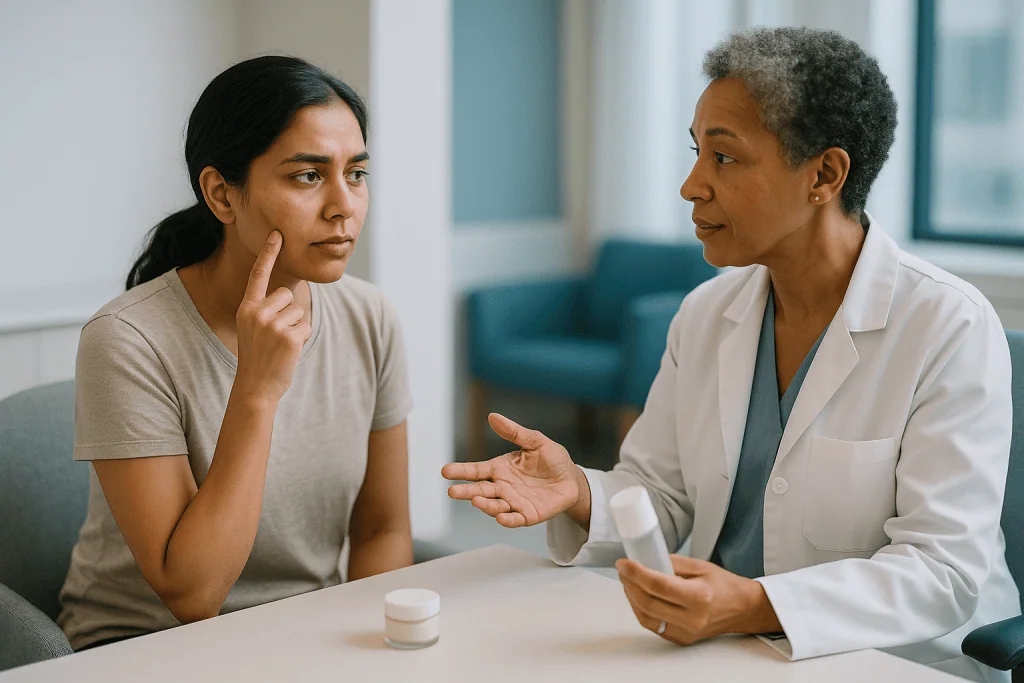
Not everyone is a good candidate at any given moment, and a careful consultation screens for this. According to the Mayo Clinic, clinicians usually ask people to postpone or reconsider a peel if they have taken oral isotretinoin, an acne medicine that thins the outer skin and slows healing, within roughly the past six months; if they have a history of keloids or other abnormal scarring; if they are pregnant; or if they have frequent or severe cold sore outbreaks, since the virus can reactivate across freshly peeled skin.
Skin tone matters too. Deeper skin tones carry a higher risk of post-inflammatory hyperpigmentation, meaning dark patches that appear where the skin was inflamed. That does not rule out peels, but it often steers the choice toward lighter, more frequent treatments and makes sun protection afterward even more critical, a point the Cleveland Clinic also raises.
Active skin infections, open wounds, sunburn or a very recent course of strong topical retinoids are also reasons a clinician may ask you to come back later. None of these are judgments. They are simply the conditions under which a controlled injury is more likely to heal well, and a good practitioner will explain which apply to you before any acid touches your face.
What should I put on my skin after a chemical peel?
Remarkably little. The instinct to reach for a repair serum or a soothing mask is strong, and it is usually the wrong one. The skin has lost part of its barrier, so ingredients that would normally sit harmlessly on the surface can now penetrate, sting and provoke inflammation that slows healing or triggers pigment changes.
Most aftercare protocols, including the general guidance published by the Mayo Clinic, come down to three items and a habit. The three items are a mild, non-foaming cleanser or plain water; a bland, fragrance-free moisturizer or the protective ointment your clinician supplies; and a broad-spectrum sunscreen once the skin surface has closed. The habit is hands off.
Cleansing should be brief and lukewarm. Hot water dilates blood vessels and increases redness, while cold water can feel shocking on raw skin. Pat rather than rub, and use a clean soft towel each time. For medium and deep peels, clinicians sometimes advise soaks or compresses followed by an ointment to keep the healing surface moist; follow their specific instructions over anything you read online, including this article.
Moisturizer serves a physiological purpose here, not a cosmetic one. Wounds that are kept slightly moist re-epithelialize, meaning grow a new surface layer, faster and with less crusting than wounds left to dry out. That is why occlusive ointments feel greasy but work. The same logic tells you what to skip: anything with acids, retinoids, vitamin C, fragrance, alcohol, essential oils or physical exfoliating grains. If a label promises to brighten, resurface, tighten or renew, it belongs in the drawer until your clinician says otherwise.
Why sunscreen is the non-negotiable part of skincare after chemical peel
If you remember one thing from this article, make it this: the single most common cause of a disappointing peel result is sun exposure in the weeks afterward. New skin has very little protective pigment and an immature barrier. Ultraviolet light hitting that surface can produce blotchy hyperpigmentation, prolonged redness and, in the worst cases, patchy hypopigmentation where color never fully returns. The Mayo Clinic lists these color changes among the main risks of peels and stresses daily sunscreen and sun avoidance during recovery.
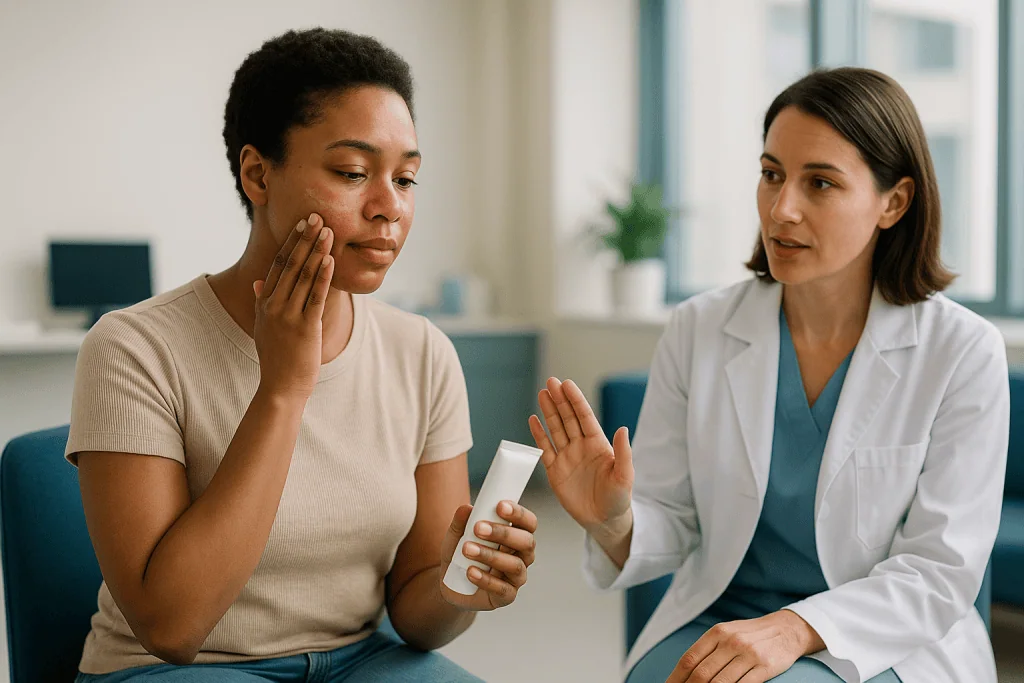
The first line of defense is not a product at all. During the days of active peeling, when the surface is open or flaking, most clinicians ask you to stay out of direct sun altogether: a wide-brimmed hat, shade, and errands scheduled for early morning or evening. Sunscreen on raw, weeping skin can sting and is generally introduced once the surface has closed, on your clinician’s timing.
When it does come in, the standards are the same ones the NHS gives for everyday sun protection: a sun protection factor of at least 30 with broad-spectrum UVA coverage, applied generously and reapplied at least every two hours outdoors and after sweating. Many dermatologists favor mineral formulas, which use zinc oxide or titanium dioxide to reflect light, because they tend to be better tolerated on compromised skin; that is a tolerability observation rather than proof of superior protection.
How long does this vigilance last? The pigment-producing cells stay reactive for weeks after a medium peel and months after a deep one, well past the point when the skin looks healed. Treat rigorous daily sunscreen as part of the treatment itself, not an afterthought, for at least as long as your care team specifies.
Choosing a simple moisturizer: what "bland" really means
Bland is a compliment in post-peel skincare. It describes a product with a short ingredient list, no fragrance, no botanical extracts, no acids and no active claims. The goal is a substance that sits on the skin, slows water loss and does nothing else.
Moisturizers work through three kinds of ingredients. Occlusives, such as petrolatum, dimethicone and mineral oil, form a film that reduces evaporation. Emollients, like ceramides, squalane and fatty alcohols, fill gaps between skin cells and smooth the surface. Humectants, most famously glycerin and hyaluronic acid, draw water into the outer layer. In the first days after a medium or deep peel, occlusive-heavy ointments are usually recommended because a slightly moist wound heals more smoothly, a principle the Mayo Clinic reflects in its post-peel guidance.
Once flaking begins and the surface is intact, a lighter cream with ceramides and glycerin often feels more comfortable. Humectant-only gels can paradoxically feel drying in low humidity, because they pull water toward the surface where it evaporates, so pair them with something that seals.
Ingredients to keep away from healing skin include:
- Fragrance and essential oils, common causes of contact irritation on a broken barrier.
- Alcohol denat, which stings and dries.
- Alpha and beta hydroxy acids, even in low “gentle” concentrations.
- Retinol and other vitamin A derivatives.
- Vitamin C in its acidic ascorbic acid form.
- Niacinamide at high strengths, which some people find flushing on raw skin.
Skip the scrubbing brushes and cleansing cloths as well. Your clinician may recommend a specific product or a plain over-the-counter option; if they do, use that and nothing else until you are told the barrier has recovered.
What should you not do after a chemical peel?
The don’ts matter more than the do’s, because most complications after a peel trace back to a few avoidable behaviors rather than to the peel itself.
Do not pick, peel or rub. Flaking skin that still clings to the surface is protecting the layer beneath it. Pulling it off early exposes tissue that is not ready, and that is a well-recognized route to scarring and dark marks. If a flap of skin is catching on your pillow, ask your clinician whether it can be trimmed with clean scissors rather than pulled.
Do not expose the skin to direct sun, tanning beds or reflective environments such as snow and open water during recovery. The Mayo Clinic is explicit that sun exposure during healing risks permanent color changes.
Do not sweat heavily for the first few days. Sweat is salty and can sting broken skin, and the heat of intense exercise or a sauna increases blood flow and swelling. Most clinicians ask for a pause of several days after a light peel and longer after a medium one; ask yours for a specific timeframe.
Do not restart exfoliants, retinoids or other actives until you are cleared to. Do not use waxing, threading, laser hair removal or dermaplaning on the treated area. Do not book another peel, facial or resurfacing treatment on top of skin that is still recovering.
Do not soak in hot baths or use very hot water on your face, and steer clear of chlorinated pools until the surface is fully closed. Finally, do not smoke if you can help it during recovery; nicotine constricts blood vessels and impairs wound healing, a finding well documented across the surgical literature.
What's the worst day after a chemical peel? A realistic timeline
People searching this question usually want permission to feel discouraged, and they deserve an honest answer. For most light and medium peels, the low point falls around day two to day four. The redness of day one has settled into a tight, darker, sometimes leathery look; the skin feels dry and a little uncomfortable; and flaking has begun around the mouth and nose but has not yet finished anywhere. It is the stretch when you look worse than you did before the peel and better skin is not yet visible.
Here is how the days usually unfold, using healing ranges published by the Mayo Clinic and the Cleveland Clinic. Individual experience varies, and these are typical ranges rather than promises.
Day 0 to 1. Pinkness or redness, a sensation like mild sunburn, sometimes slight swelling. After a light peel this can be almost unnoticeable.
Days 2 to 4. Skin darkens and tightens; flaking begins, often in the most mobile areas around the mouth. Medium peels may crust or develop small blisters at this stage. This is usually the worst-looking window.
Days 5 to 7. Flaking spreads across the face and then thins out. Light peels are usually finished healing by now; the Mayo Clinic gives one to seven days for light peels.
Days 7 to 14. Medium peels typically complete their surface healing in this range, with residual pinkness that fades over the following weeks.
Weeks 2 and beyond. Deep peels take about two weeks to re-epithelialize, and redness can persist for several months. Sun sensitivity outlasts visible healing for every depth.
Light, medium and deep peels: how aftercare differs
Aftercare instructions vary so widely online because people are often describing different procedures under one name. A lunchtime glycolic peel and a phenol peel performed under monitoring have almost nothing in common apart from the word “peel.” The table below summarizes typical differences drawn from the Mayo Clinic and Cleveland Clinic overviews. Your own protocol may differ, and your clinician’s written instructions take priority.
| Feature | Light (superficial) peel | Medium peel | Deep peel |
|---|---|---|---|
| Depth reached | Epidermis only | Upper dermis | Mid dermis |
| Typical agents | Glycolic, salicylic, lactic, low-strength TCA | TCA, sometimes combined with glycolic | Phenol |
| Surface healing time | About 1–7 days | About 7–14 days | About 2 weeks; redness may last months |
| Immediate skin care | Gentle cleanse, bland moisturizer, sunscreen | Soaks or compresses, ointment, strict sun avoidance | Dressings may be applied; close follow-up |
| Makeup usually allowed | Often the next day | Often after 5–7 days | Typically once fully re-epithelialized, per clinician |
| Return of actives | Once flaking ends and skin feels normal | Usually 2 weeks or more, per clinician | Weeks to months, per clinician |
| Repeat frequency | Can be repeated in a series | Every few months if needed | Usually a single treatment |
Two patterns stand out. Every tier shares the same core trio of gentle cleansing, bland moisture and sun protection. What changes is duration and supervision: the deeper the peel, the longer each phase lasts and the more closely a clinician should be checking your progress. If you are not sure which depth you had, ask. It changes how you should read every piece of aftercare advice.
When can retinol and other actives return after a peel?
The short answer is: when peeling has finished, the skin no longer stings with plain moisturizer, and your clinician agrees. For light peels that often means about a week; for medium peels, two weeks or longer; for deep peels, your care team will set the timeline. These ranges follow the healing times given by the Mayo Clinic rather than any fixed rule.
Why wait at all? Retinoids, a family of vitamin A derivatives that includes over-the-counter retinol and prescription tretinoin, speed up cell turnover and can cause dryness and irritation even on intact skin, as the Cleveland Clinic describes. Layered onto a surface that is still rebuilding, they can prolong redness and disrupt the new barrier. Exfoliating acids do something similar by design. Vitamin C in its ascorbic acid form is acidic enough to sting, and high-strength niacinamide can flush sensitive skin.
Reintroduction works best as a sequence rather than a single day of restoring your whole routine. A reasonable order many dermatologists suggest is to confirm plain moisturizer and sunscreen feel completely comfortable first, then bring back one active at a time, at your previous strength rather than a stronger one, using it every second or third night before returning to your usual frequency. Give each product several days before adding the next, so that if irritation appears you know what caused it.
Prescription retinoids deserve a specific conversation. Some clinicians ask patients to stop them for a period before a peel and then advise on exactly when to restart; the decision belongs to the prescribing clinician, and this article is not a signal to change anything about how you use a prescribed medicine. If a product stings, burns or produces new redness on reintroduction, stop it and go back to the basics for a few more days.
Makeup, shaving, washing and exercise: the everyday questions
Once the alarming day-three face has been dealt with, the practical questions arrive. Can I go to work? Can I cover this up? The answers depend on peel depth, and again the general timings come from the Mayo Clinic.
Makeup. After a light peel, makeup is usually permitted the following day. After a medium peel, most clinicians ask you to wait until the surface has closed, often around five to seven days. Mineral powders and fragrance-free formulas tend to be tolerated best, and every brush and sponge should be freshly cleaned. Makeup on skin that is still weeping or crusted traps bacteria and pulls at fragile new tissue when removed.
Cleansing. Twice daily with lukewarm water and, if your clinician allows, a mild non-foaming cleanser. Fingertips only, no cloths or devices, and pat dry.
Shaving. Razors remove a thin layer of skin along with hair, which is exactly what you do not want on a healing surface. Most people are asked to skip shaving the treated area until flaking has finished, and to use a fresh blade and gentle pressure when they resume. Depilatory creams and waxing wait considerably longer.
Exercise. Light walking is fine from the start. Heat, heavy sweating and swimming are usually paused for a few days after a light peel and longer after a medium one, both because sweat stings open skin and because heat worsens redness and swelling.
Sleeping. Clean pillowcases changed frequently, and if you can manage it, sleeping on your back for the first few nights reduces friction on flaking areas. Elevating the head slightly may ease morning swelling after medium peels.
Dark marks, infection and cold sores: complications and darker skin tones
Most peels heal without incident, but it helps to know what the recognized complications look like and who is at higher risk of each. The Mayo Clinic lists redness and swelling, scarring, color changes, infection, and heart, kidney or liver effects specific to phenol deep peels among the risks.
Post-inflammatory hyperpigmentation is the most common lasting problem. Any inflammation can prompt pigment cells to overproduce melanin, leaving flat brown or gray patches where the skin was irritated. It occurs more readily in people with medium to deep skin tones, and the two biggest modifiable triggers are sun exposure and picking. This is why clinicians often recommend lighter peels in series for darker skin and may prescribe a pigment-suppressing cream before or after treatment; the mechanism of such creams is to slow melanin production, and their use is a decision for the treating clinician. If hyperpigmentation does appear, it frequently fades over months with strict sun protection, though not always completely.
Hypopigmentation, or loss of color, is less common and is chiefly a risk of deep peels; it can be permanent.
Infection is uncommon but possible on any open skin. Bacterial infection shows as increasing pain, spreading redness, warmth, pus or a foul smell rather than the expected steady improvement.
Cold sores deserve special mention. The herpes simplex virus lies dormant in nerves and can reactivate across a freshly peeled face, sometimes spreading widely rather than staying at the lip. People with any history of cold sores are often prescribed a preventive antiviral medicine around the time of a medium or deep peel; antivirals work by blocking the virus from copying itself. Whether you need one, and when to take it, sits entirely with your prescribing clinician.
What people often get wrong about skincare after chemical peel
Several myths circulate persistently, and each of them can undo a good peel.
“More peeling means it worked better.” Visible flaking is a side effect of some peels, not a measure of success. Many light salicylic or lactic peels produce little visible shedding and still deliver their effect at a cellular level. Judging results by how much skin came off tempts people to pick, and picking is the fastest route to scarring and dark marks.
“I should exfoliate the flakes away so the new skin can breathe.” Skin does not breathe, and the flakes are a biological dressing. They will release on their own when the tissue beneath is ready. Scrubs, cloths and gentle “buffing” all count as exfoliation.
“My usual moisturizer is fine because I have used it for years.” Products that were harmless on an intact barrier can sting and inflame skin that has lost that barrier. Fragrance and botanical extracts are the usual culprits.
“Sunscreen only matters if I am going to the beach.” Ultraviolet A penetrates window glass and cloud cover, and incidental exposure on a commute or in a car adds up. The NHS advises broad-spectrum protection of at least SPF 30 whenever you are exposed, and post-peel skin has less tolerance than usual.
“Once the redness fades I can go back to everything.” The visible surface heals before the barrier fully recovers and long before pigment cells calm down. Reintroduce actives one at a time and keep sun protection strict for weeks.
“A stronger peel gives faster results.” Deeper peels give longer recovery and higher risk, not quicker improvement. A series of lighter peels, spaced as your clinician advises, is often the safer route to the same goal, particularly for deeper skin tones.
Questions to ask your care team before and after a peel
Good aftercare starts in the consultation, not the bathroom. Written instructions specific to your peel are worth more than any general article, and the questions below help make sure you leave with them.
Before the peel:
- What depth of peel are you planning, and which agent will you use?
- Given my skin tone and history, what is my particular risk of hyperpigmentation or scarring, and how will we reduce it?
- Should I stop any of my current products or prescribed medicines beforehand, and for how long? Who decides when I restart them?
- I have had cold sores in the past. Do you recommend any preventive treatment, and how does that work?
- What will I look like on the worst day, and how long until I can reasonably be seen at work?
After the peel:
- Which cleanser, moisturizer or ointment should I use, and exactly how often for the first week?
- When can I start applying sunscreen, and which type do you suggest for my skin right now?
- When can I wear makeup, shave, exercise, and swim?
- When may I reintroduce my retinoid, my exfoliating acid and my vitamin C, and in what order?
- What signs should make me call you today rather than wait for my follow-up?
- When is my review appointment, and how do I reach the team outside office hours?
Ask for the answers in writing or by secure message. On day three, with a tight face and a foggy memory of the consultation, a printed sheet is worth a great deal. If instructions from your team conflict with something you read here or elsewhere, follow your team. They know your skin, the exact solution used and how you responded on the day.
When to call your doctor after a chemical peel
Normal healing is boring in a good way: each day is a little less red, a little less tight, and any discomfort responds to bland moisturizer and time. Complications announce themselves by breaking that pattern. Contact the clinician who performed your peel, or seek urgent care if you cannot reach them, if you notice any of the following, which reflect the risks described by the Mayo Clinic and the Cleveland Clinic.
- Pain that increases after the first day or two instead of easing, or pain out of proportion to how the skin looks.
- Redness that spreads beyond the treated area, feels hot to the touch, or develops streaks.
- Pus, yellow or green discharge, thick crusts that reform after cleansing, or an unpleasant smell.
- Clusters of small fluid-filled blisters, tingling or burning in one area, or a spreading rash of sores, which may indicate a herpes simplex flare.
- Fever, chills or feeling generally unwell.
- Swelling that closes the eyes, or any swelling of the lips or tongue, difficulty breathing, or a widespread hives-type rash, which need emergency care.
- Areas that look white, waxy or unusually deep, or bleeding that does not stop with gentle pressure.
- After a phenol deep peel specifically: palpitations, an irregular heartbeat, dizziness or reduced urination, since phenol is absorbed systemically and these peels are done under monitoring for that reason.
- New dark patches, lighter patches or raised thickened areas developing in the weeks after healing.
None of these should be waited out or treated with home remedies. Early assessment gives your team the best chance to manage an infection, calm an inflammatory reaction or begin treatment for pigment changes. When in doubt, a phone call costs nothing but a few minutes, and a good practice would rather hear from you unnecessarily than late.
Frequently asked questions
What should I put on my skin after a chemical peel?
Keep it to gentle cleansing with lukewarm water, a bland fragrance-free moisturizer or the ointment your clinician supplied, and broad-spectrum sunscreen once the surface has closed. Avoid acids, retinoids, vitamin C, fragrance and scrubs until peeling ends. Your care team’s written instructions override any general advice, since they know the depth and agent used.
What should you not do after a chemical peel?
Do not pick or rub flaking skin, expose the area to direct sun or tanning beds, sweat heavily, use hot water, or restart exfoliants and retinoids before you are cleared. Skip waxing, shaving the treated area, swimming and other facial treatments until healing is complete. Smoking also slows wound healing and is best avoided during recovery.
What's the worst day after a chemical peel?
For most light and medium peels, days two to four tend to feel and look worst. The skin darkens, tightens and begins flaking unevenly, so it looks rougher than before treatment. This phase passes as shedding completes, typically within a week for light peels and about two weeks for medium peels, according to Mayo Clinic healing ranges.
What are the best products to use after a chemical peel?
The best products are the plainest ones: a mild non-foaming cleanser, a fragrance-free moisturizer built around petrolatum, ceramides or glycerin, and a broad-spectrum SPF 30 or higher sunscreen, often a mineral formula for tolerability. No specific brand has been shown superior; what matters is the absence of fragrance, acids, retinoids and other actives during healing.
How long after a chemical peel can I use retinol?
Usually once flaking has finished and plain moisturizer no longer stings, which is often about a week after a light peel and two weeks or more after a medium peel, based on Mayo Clinic healing times. Deep peels take longer. Reintroduce at your previous strength on alternate nights first, and ask your clinician if you use a prescription retinoid.
Can I wear makeup after a chemical peel?
After a light peel, makeup is often allowed the next day. After a medium peel, most clinicians ask you to wait until the surface has closed, commonly around five to seven days, per the Mayo Clinic. Use clean brushes and fragrance-free or mineral formulas, and never apply makeup over skin that is still weeping or crusted.
How do I stop hyperpigmentation after a chemical peel?
The two most effective steps are strict sun protection for weeks after healing and never picking at flaking skin, since inflammation and ultraviolet light both stimulate pigment cells. People with deeper skin tones carry higher risk and are often offered lighter peels in series. Clinicians may prescribe pigment-suppressing creams; that decision belongs to the treating team.
Can I do a facial after a chemical peel?
Not while the skin is healing. Facials commonly involve steam, extraction, massage and exfoliating products, all of which can irritate a compromised barrier or pull at new skin. Wait until flaking has fully ended and your clinician confirms the barrier has recovered, and mention the recent peel to any aesthetician so they avoid exfoliating steps.
Why does my skin still look red weeks after a chemical peel?
Redness reflects increased blood flow to healing tissue and often outlasts visible peeling, particularly after medium and deep peels; the Mayo Clinic notes deep-peel redness can persist for months. Persistent redness on its own is usually not dangerous, but redness that spreads, feels hot or comes with pain or discharge should prompt a call to your clinician.
Should I moisturize or let my skin dry out after a peel?
Moisturize. A slightly moist healing surface re-epithelializes more smoothly and with less cracking than one left to dry, which is why clinicians recommend bland moisturizers or occlusive ointments after peels. Drying the skin out does not speed shedding and can increase discomfort and the temptation to pick at tight, cracked flakes.
References
This article is for general information only and is not a substitute for professional medical advice. Please consult a qualified doctor about your individual situation.

More from the Blog
Timing Reconstruction After Skin Disease: Why Active Infection or Tumor Must Settle First
Reconstruction after skin cancer is usually timed to two conditions rather than a calendar date: the pathology report must confirm the tumor has been…
Scar Treatment Side Effects: Temporary Darkening, Redness and What to Report to Your Doctor
Most scar treatment side effects are temporary: redness, swelling, tenderness, itching and a period of darkening (post-inflammatory hyperpigmentation) that usually fades over weeks to…
Aftercare After Fibroblast Plasma Treatment: Crusts, Cleansing and the Week Without Makeup
Fibroblast treatment aftercare centers on leaving the small carbon crusts alone until they fall off on their own, cleansing gently with lukewarm water and…

When Pigmentation Returns After Treatment: Sun, Hormones and What the Next Step Looks Like
Pigmentation often comes back after treatment because creams, peels and lasers reduce or remove existing pigment without switching off the pigment-making cells underneath. Ultraviolet…
Plexr Plasma Exeresis vs Surgical Blepharoplasty: Which Eyelids Suit a Non-Surgical Lift?
Plasma exeresis and surgical blepharoplasty address different problems. Plasma exeresis vaporizes tiny points of eyelid skin so it contracts, which suits mild skin laxity…
Who Should Wait Before Mesotherapy: Health Factors Your Dermatologist Will Ask About
People usually asked to wait before mesotherapy include anyone who is pregnant or breastfeeding, taking blood thinners or living with a bleeding disorder, carrying…