

Sperm Banking Before Testicular Cancer Treatment: Why Your Team Raises It Early
Key Takeaways
- Some men with testicular cancer already have reduced sperm counts or quality before any treatment starts, which makes the pre-surgery sample potentially the best one available.
- A single sperm banking visit, including consent, blood tests and collection, usually takes one to two hours and fits within the normal gap between diagnosis and surgery.
- Laboratories generally ask for two to five days without ejaculation before a sample, the same preparation used for a standard semen analysis.
- Standard chemotherapy for testicular cancer is typically given in three or four cycles of roughly three weeks each, and sperm freezing should be completed before the first cycle.
- Sperm production, when it recovers after chemotherapy, often takes one to two years and sometimes longer, and recovery cannot be guaranteed for any individual.
- Very low sperm counts are still worth freezing because intracytoplasmic sperm injection can achieve fertilization with only a handful of sperm.
Sperm banking before testicular cancer treatment means freezing one or more semen samples, ideally before surgery, chemotherapy or radiotherapy begins, because these treatments can lower or temporarily stop sperm production. Care teams raise it early since collection usually fits within the normal days between diagnosis and treatment, and frozen sperm can be stored for many years. Whether and when to bank is a decision made with the treating team.
The scan is barely an hour old, the word “cancer” is still settling, and a urologist is asking a 27-year-old whether he has thought about having children. It can feel like the wrong question at the wrong moment. He came in about a lump. Nobody mentioned a family.
Yet that question, asked in the first appointment rather than the last, is one of the more thoughtful things a care team does. Sperm banking before testicular cancer treatment is a small, quick step with a long shadow: it protects a choice that surgery, chemotherapy or radiotherapy may later narrow. Testicular cancer tends to arrive young, often between the late teens and mid-forties, precisely the years when fatherhood is a plan, a maybe, or not yet a thought at all.
This explainer walks through what banking involves, why timing matters, who is usually offered it, what the following weeks look like, and which common assumptions get in the way.
Why sperm banking before testicular cancer treatment comes up in the very first conversation
There is a practical reason the subject arrives so quickly. Testicular cancer is usually treated fast. Removal of the affected testicle, an operation called an orchiectomy, is often scheduled within days of diagnosis because the tumor itself is what confirms the cancer type, and staging decisions follow from it. Chemotherapy or radiotherapy, when needed, tends to begin within a few weeks. Once those treatments start, the window for collecting a sample that reflects pre-treatment sperm quality closes.
The National Cancer Institute notes that some men with testicular cancer already have reduced sperm counts or quality at the time of diagnosis, before any treatment. That is a second reason to act early: the sample banked before surgery may be the best sample available, and waiting until after the operation means relying on the remaining testicle alone.
Care teams also raise it early because fertility is one of the few parts of this diagnosis where a patient can act now to keep a door open later. Treatment plans are built by oncologists and surgeons. Whether to preserve the option of biological children is a decision the patient owns, and it deserves more than a rushed afterthought on the morning of surgery.
An honest opinion from the editor’s chair: the awkwardness of the conversation is real, but regret is worse. Plenty of men who were certain they never wanted children at 22 feel differently at 35. Banking does not commit anyone to fatherhood. It simply keeps a choice on the table that treatment might otherwise take away, and it costs nothing in terms of delaying the cancer plan when arranged promptly.
How sperm banking actually works, step by step
Sperm banking, also called sperm cryopreservation, is the freezing and storage of semen at very low temperatures so the sperm inside can be thawed and used years later. The process is far less clinical than most people picture.
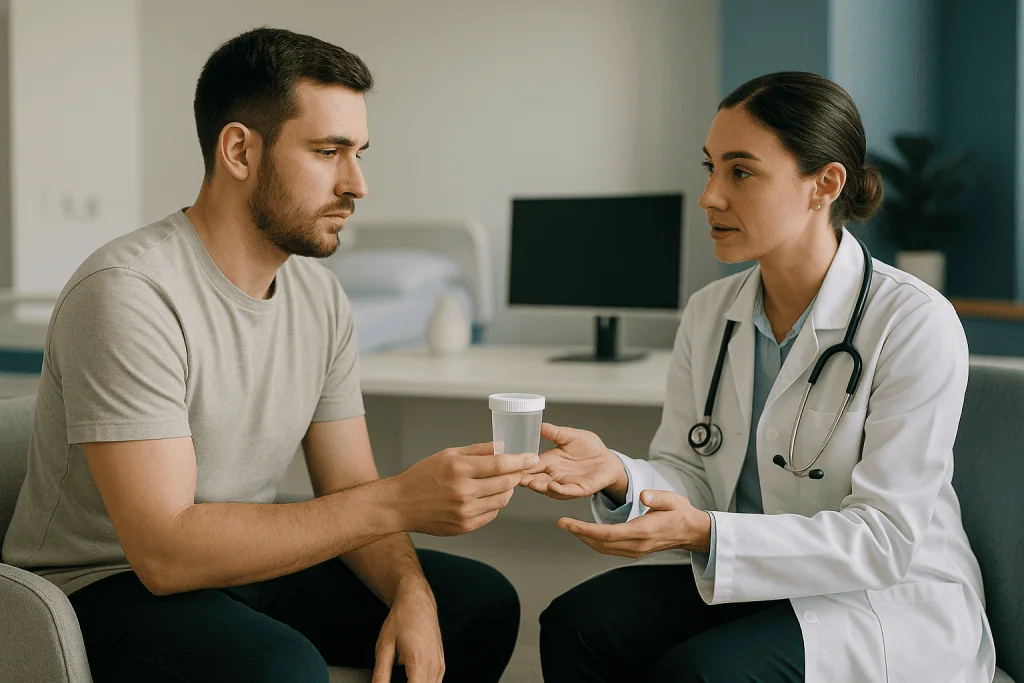
It begins with a short consultation at a fertility laboratory or andrology unit, the department that studies male reproductive health. Staff explain consent forms, storage terms and what happens to samples in the future. Blood tests for certain infections are standard before storage, a routine safety requirement in laboratories that handle and store human tissue.
The sample itself is produced by masturbation in a private room at the facility, into a sterile container. Some laboratories allow home collection if the sample can reach them quickly, though this varies. Laboratories typically ask for two to five days without ejaculation beforehand, the same preparation MedlinePlus describes for a standard semen analysis, because it tends to give a more representative sample.
In the laboratory, technicians assess the sample under a microscope for volume, concentration, movement and shape. They then mix it with a protective solution called a cryoprotectant, which limits ice damage to cells, divide it into several small vials or straws, and freeze it. Storage is in liquid nitrogen at around -196°C, a temperature at which biological activity effectively stops. Frozen sperm has been thawed and used successfully after decades in storage, according to NCI and NHS patient information.
Most facilities encourage more than one sample where time allows, because dividing sperm across several vials gives more chances for later use. Each visit takes an hour or two. The whole arrangement usually fits between the diagnosis appointment and the first treatment date.
Which testicular cancer treatments affect fertility, and how
Not every treatment carries the same fertility risk, and understanding the difference helps explain why banking is recommended broadly rather than only for men facing chemotherapy.
Orchiectomy removes one testicle. The remaining testicle usually continues producing sperm and testosterone, and Cleveland Clinic notes that most men remain fertile after removal of a single testicle. The catch is that the remaining testicle may already have lower output, and in the small group of men with cancer in both testicles, or a second cancer later, surgery alone can end natural fertility.
Chemotherapy targets rapidly dividing cells, and sperm-producing cells divide constantly, which makes them vulnerable. Some regimens cause a temporary drop in sperm production; others cause longer or permanent loss, depending on the drugs used and the total amount given. The NHS notes that fertility often recovers after treatment, but this cannot be guaranteed for any individual.
Radiotherapy, sometimes used for the seminoma type of testicular cancer, is aimed at lymph nodes in the abdomen, but scattered radiation can reach the remaining testicle and reduce sperm production, according to NCI.
Retroperitoneal lymph node dissection, an operation to remove lymph nodes at the back of the abdomen, can damage nerves that control ejaculation, leading to dry orgasm or semen entering the bladder rather than leaving the body. Sperm production continues, but delivery is affected.
| Treatment | Main fertility effect | Typical timing of effect |
|---|---|---|
| Orchiectomy (one testicle) | Usually preserved via remaining testicle | Immediate, generally stable |
| Chemotherapy | Reduced or absent sperm production | During treatment; recovery variable over months to years |
| Radiotherapy to abdomen | Reduced production from scatter | During and after; recovery variable |
| Lymph node surgery | Ejaculation may be disrupted | Immediate; sometimes permanent |
Sperm freezing before chemotherapy: what the timing usually looks like
Timing is where most of the anxiety sits, so it is worth being precise about the usual sequence rather than the worst case.
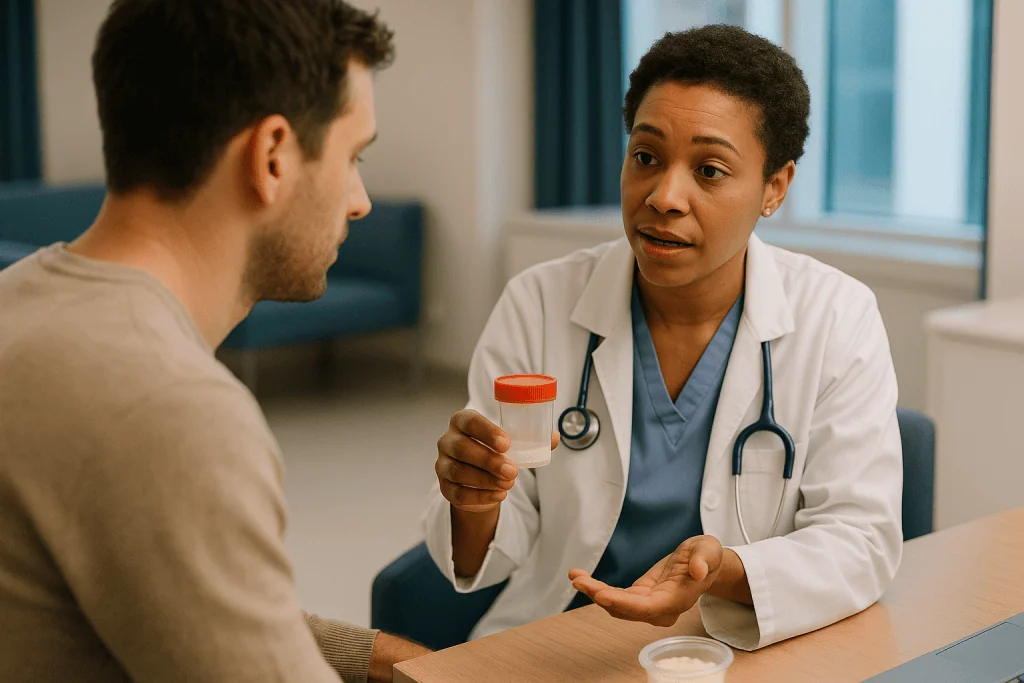
Most men learn they have testicular cancer after an ultrasound and blood tests, and orchiectomy is typically scheduled within a week or two. That gap, however short, is the ideal moment for a first sample. Fertility laboratories that work with cancer patients are used to same-week or even next-day appointments, because oncology referrals are routinely marked urgent.
If the plan after surgery is surveillance, meaning regular scans and blood tests with no further treatment, there may be time for additional samples in the weeks that follow. If chemotherapy is planned, it generally starts a few weeks after surgery once the wound has healed and staging is complete. NHS guidance describes standard chemotherapy for testicular cancer as given in cycles of roughly three weeks, usually three or four cycles in total. Samples should be completed before the first cycle.
A frequent misunderstanding is that banking must happen before surgery or not at all. In fact, sperm freezing before chemotherapy is the most important deadline for men who need drug treatment, and a sample from the remaining testicle after orchiectomy is still valuable. The reverse is also true: a man who banks before surgery and then learns he needs no chemotherapy has lost nothing.
What oncology teams do not want is for fertility preservation to push back chemotherapy for aggressive disease by more than a short, agreed pause. In practice this rarely conflicts, because collection takes hours, not weeks. When it genuinely does conflict, the oncologist and fertility team negotiate the sequence together, and the patient is part of that discussion.
Who is usually offered sperm banking, and who is usually asked to wait
Guidance from cancer bodies in the United States and United Kingdom is consistent: every person of reproductive age facing cancer treatment that could affect fertility should be told about preservation options before treatment begins, and offered a referral. For testicular cancer, that means essentially every adult patient, and adolescents who have gone through puberty, regardless of whether they have expressed interest in children.
It is offered even to men who already have children, because family plans change and because a later second cancer or relapse could require more intensive treatment. It is offered to men in their forties as readily as men in their twenties. It is offered to men whose relationships are uncertain or nonexistent, since stored sperm belongs to the person who provided it and can be used with a future partner, a gestational surrogate or not at all.
Who is asked to wait? A small group. Men who are acutely unwell, for instance with a very large tumor burden causing breathing or kidney problems, may need chemotherapy within days, and oncologists may judge that even a short delay carries risk. In that setting the team may still attempt a single rapid collection, or may explain that treatment cannot wait. Men who are unable to produce a sample due to illness, pain or distress may be offered alternative retrieval methods discussed later in this article.
Boys who have not reached puberty cannot bank sperm because their testicles are not yet producing it. For this group, options remain largely experimental and are handled by specialist pediatric teams. Adolescents post-puberty can usually bank, with age-appropriate consent processes and parental involvement handled sensitively by the fertility unit.
The decision about sequence always rests with the treating team, informed by the patient’s wishes.
Is it safe to bank sperm before chemotherapy?
This is among the most searched questions on the topic, and the answer is reassuring on the point people worry about most. Producing a semen sample does not affect the cancer, does not spread it, and does not weaken the body for treatment. The procedure is non-invasive and carries no medical risk in itself.
The safety question that does deserve attention runs the other way: is sperm collected after chemotherapy has started safe to use? Chemotherapy drugs can damage the DNA inside developing sperm, and NCI advises that men avoid trying to conceive during treatment and for a period afterward, with the exact interval set by the treating team. This is the scientific reason banking is timed before the first dose, and why laboratories generally decline to freeze samples once chemotherapy is underway. A sample frozen beforehand carries none of that concern.
Some men ask whether the testicular cancer itself makes the sperm unsafe. Testicular cancer is not inherited in a straightforward way, and children conceived using sperm banked by men with the disease are not known to face a specific increased risk beyond the modest familial tendency that exists whether sperm is fresh or frozen. This is a fair question to put to the fertility specialist, who can discuss family history in detail.
Another practical safety aspect is the infection screening performed before storage. This protects laboratory staff and other stored samples and is not a reflection of any suspicion about the patient. Results that need follow-up are handled confidentially by the fertility team.
The remaining concern is emotional rather than physical. Producing a sample under time pressure, in an unfamiliar room, days after a cancer diagnosis, is hard. Fertility units expect this and build in privacy, patience and, where needed, a second attempt.
How long does sperm banking take, and does it delay cancer treatment?
Two clocks matter here: the time spent at the facility and the time the sample keeps.
The first is short. A consultation, consent, blood tests and one collection typically fit into a single visit of one to two hours. A second or third sample means a return visit each time, usually spaced a couple of days apart to allow sperm numbers to rebuild. Where the treatment schedule is tight, one sample is better than none, and laboratories will say so plainly rather than insisting on the ideal.
Does it delay treatment? For the overwhelming majority, no. Orchiectomy dates are set by surgical scheduling, and a collection appointment slots into the days before it. Chemotherapy generally begins a few weeks after surgery, leaving ample room. The NHS describes surgery followed, where needed, by chemotherapy or radiotherapy planned after staging, a sequence that naturally contains gaps banking can occupy.
The second clock is long. Frozen sperm does not degrade in any meaningful way while held in liquid nitrogen, and NCI notes that stored sperm can remain viable for many years. Storage periods and renewal rules are set by national regulations and by the facility’s own policies, so the exact terms should be read carefully at the time of consent. Annual contact from the storage facility is normal and should not be ignored, because unanswered correspondence can eventually affect continued storage.
What patients should not do is assume they can bank later if treatment goes badly. Once chemotherapy begins, the option is generally gone until sperm production recovers, which may take years or may not happen. The few days before treatment are the moment.
What if the sample is poor, or there is no sperm at all?
This happens more often than people expect, and it is not a dead end.
As NCI describes, a meaningful proportion of men with testicular cancer have reduced sperm counts or motility at diagnosis, thought to reflect both the tumor’s effect on the testicle and an underlying shared tendency toward lower fertility and testicular cancer. Some samples contain very few moving sperm. Occasionally a sample contains none, a finding called azoospermia.
A low count does not make banking pointless. Modern fertility treatment can achieve fertilization with very small numbers of sperm using intracytoplasmic sperm injection, or ICSI, a laboratory technique in which a single sperm is injected directly into an egg. Laboratories routinely freeze samples that would be considered inadequate for natural conception precisely because ICSI later requires so few.
Where no sperm are found, or a man cannot produce a sample, surgical retrieval is an option. Sperm can sometimes be extracted directly from testicular tissue under anesthesia. In testicular cancer specifically, this is occasionally done at the same time as orchiectomy, taking tissue from the removed testicle or the remaining one, a technique sometimes called onco-TESE. Whether this is appropriate depends on the individual case and must be planned in advance between surgeon and fertility team, which is another reason the conversation needs to happen early.
Electroejaculation, a procedure performed under anesthesia for men with nerve-related difficulty ejaculating, is used rarely and in specialist settings.
None of these alternatives should be assumed available at every center or suitable for every patient. They are worth asking about if a first attempt fails, and the fertility specialist can explain realistically what each involves and what the sample quality was.
What the following days and weeks usually look like
Once a sample is frozen, the fertility part of the journey goes quiet for a long time, which is exactly the point. Attention turns to treatment.
In the days after banking, the laboratory sends written confirmation of what was stored, typically including how many vials and an assessment of quality. That document should be kept safely. It is the record a future fertility clinic will ask for.
Surgery follows, usually a day-case or overnight procedure through a small incision in the groin. Recovery takes a week or two for most men, and the NHS notes that a prosthetic testicle can be inserted at the same time or later if desired. Pathology results from the removed testicle then determine the type of cancer and, with scans and blood markers, the stage.
From here paths diverge. Many men with early-stage disease move to active surveillance, with regular blood tests and scans over several years and no further treatment unless something changes. Others begin chemotherapy, given in cycles of about three weeks according to NHS guidance, or a short course of radiotherapy. During chemotherapy, sperm production falls, often to zero, and teams advise reliable contraception because of the DNA-damage concern discussed above.
Around a year after treatment, some clinicians offer a repeat semen analysis to see whether natural production is returning. This is not urgent and not universal, but it gives useful information for men deciding whether stored sperm may be needed.
Throughout this period the storage facility does very little except send occasional correspondence. Replying to it, and updating contact details after any move, is the only maintenance required.
Fertility after testicular cancer: what usually returns, and when
The honest answer is that recovery is common but individual, and no clinician can promise a particular man that his sperm production will return.
After orchiectomy alone, the remaining testicle usually compensates. Cleveland Clinic notes that one healthy testicle is generally sufficient for both fertility and normal testosterone levels. Men on surveillance often notice no change at all.
After chemotherapy, sperm production typically drops sharply during treatment and then, in many men, rebuilds over the following one to two years, sometimes longer, according to NCI. The likelihood and speed of recovery depend on the specific drugs, the number of cycles and the man’s sperm production before treatment. Higher cumulative amounts of certain chemotherapy drugs carry a higher chance of long-term loss. Some men never regain production, which is why banking is recommended rather than assumed unnecessary.
After radiotherapy, recovery follows a similar pattern of decline and gradual return over months to years, again with no guarantee.
After lymph node surgery, sperm production may be unaffected while ejaculation is disrupted. Nerve-sparing surgical techniques have reduced this problem, and when it does occur, sperm can sometimes be retrieved from urine or directly from the testicle for use in fertility treatment.
Testosterone is a separate question. A single remaining testicle usually maintains normal levels, but some men experience low testosterone after treatment and may notice fatigue, low mood or reduced libido. This is worth reporting to the follow-up team, who can check levels with a blood test and discuss management. Testosterone therapy, where used, is prescribed and monitored by a clinician, and it does not restore sperm production.
The takeaway: fertility after testicular cancer is often preserved or recovered, and banked sperm is the safeguard for the cases where it is not.
What people often get wrong about banking sperm before cancer treatment
Several myths circulate, and some of them cost men the chance to bank at all.
“I only have one testicle affected, so I’ll be fine.” Often true, but not reliably. NCI notes that pre-treatment sperm quality is already reduced in a meaningful share of men with testicular cancer, and the remaining testicle may be the weaker one. Banking covers that uncertainty.
“Frozen sperm doesn’t work as well as fresh.” Some sperm do not survive thawing, which is why laboratories freeze multiple vials, but the sperm that survive are used routinely in fertility treatment. NHS and NCI both describe frozen sperm as a standard, established option.
“I can bank after surgery once I know whether I need chemo.” Sometimes possible, but the pre-surgery sample is often the best available, and if chemotherapy is needed the window closes fast. Banking before surgery and again after, if time allows, covers both scenarios.
“Talking about fertility means the doctors think I’ll be infertile.” The offer is universal. It reflects guidelines, not a prediction about any individual.
“Banking means I have to have children someday.” Stored sperm can be left unused, discarded at the patient’s request or, in some jurisdictions and with consent, donated. Banking preserves a choice; it does not make one.
“Fertility recovers, so banking is a waste.” It often does recover, but not always, and no test before treatment predicts reliably who will be affected. The one to two years it can take, according to NCI, is also a long time to wait for a couple hoping to start a family soon after treatment ends.
“It’s embarrassing, so the team would rather not discuss it.” Fertility units have this conversation every day. The awkwardness is real and brief.
How long does it take to treat testicular cancer, and what about it coming back?
Fertility decisions sit inside a treatment timeline, so it helps to understand that timeline realistically.
For early-stage disease, active treatment may be a single operation followed by years of surveillance. Where chemotherapy is needed, the NHS describes a typical course as three or four cycles, each around three weeks, meaning roughly nine to twelve weeks of drug treatment, with recovery from side effects extending beyond that. Radiotherapy courses for seminoma are generally shorter, given over a few weeks. Lymph node surgery, when required, adds an operation and a hospital stay.
Follow-up is long regardless of the initial approach. The NHS notes that most recurrences happen within the first two years after treatment, which is why appointments, blood tests for tumor markers and scans are most frequent during that period and then gradually spaced out over several more years.
What are the chances of it coming back? This depends heavily on the cancer type, stage and the treatment given, and any figure quoted without those details is misleading. The treating oncologist can give a personalized estimate based on the pathology and staging results. What can be said in general terms, with the NHS as the source, is that testicular cancer is among the more treatable cancers and that recurrences, when they happen, are frequently detected early through surveillance and treated further.
What happens if testicular cancer is not treated? Left alone, it typically grows and spreads through lymph channels to the abdomen and then further, most commonly to the lungs. This is why the diagnostic and treatment pathway moves quickly and why fertility preservation is arranged in parallel rather than as a reason to postpone.
The relevance for banking is simple: treatment is finite, follow-up is long, and stored sperm quietly waits through all of it.
Questions to ask your care team before you decide
Most men have less than a week between diagnosis and surgery, so a short, focused list helps. These are the questions fertility specialists and oncologists say they wish more patients asked.
- Given my scan and blood results, how quickly does my cancer treatment need to start, and does that leave time for one or more samples?
- Can a fertility referral be made today, and is there a laboratory that takes urgent oncology appointments?
- Should I bank before surgery, after it, or both, and why in my case?
- If my sample turns out to be poor or empty, what alternatives exist here, and would any need to be planned alongside my operation?
- How many vials would you consider a reasonable store for my situation?
- What are the storage terms, how long is storage agreed for, and what happens if I move, lose touch, or change my mind?
- Who owns the sample and who can use it if I become seriously unwell? What do the consent forms say about partners?
- Once treatment is finished, when would it make sense to check whether my natural sperm production has returned?
- How long after chemotherapy or radiotherapy should we avoid conceiving naturally?
- Is there a counselor or psychologist attached to the fertility unit or cancer service I can talk to?
Write the answers down or bring someone who will. The days after diagnosis are a poor time for remembering details, and the storage paperwork will matter years from now.
One final question worth asking yourself rather than the team: if I skip this and later want children, how would I feel? Most men who answer that honestly find the decision easier.
When to call your doctor
Fertility preservation itself rarely causes problems, but the wider treatment pathway carries situations that need prompt attention. Contact the care team the same day if any of the following occur.
After orchiectomy: increasing pain, spreading redness, swelling or discharge at the wound; fever; or sudden swelling and severe pain in the remaining testicle, which could indicate torsion or infection and needs urgent assessment.
During chemotherapy: any fever, since chemotherapy lowers white blood cell counts and infection can escalate quickly; shortness of breath or chest pain; persistent vomiting preventing fluids; unusual bleeding or bruising; or numbness and tingling in hands or feet that is new or worsening. Teams give patients a direct number for exactly these reasons, and it should be used without hesitation.
During surveillance or after treatment: a new lump or hardness in the remaining testicle, persistent back or abdominal pain, unexplained cough or breathlessness, or breast tenderness or enlargement, which can occur with certain hormone-producing tumors. These are reasons to bring forward a scheduled appointment rather than wait.
Fertility-specific concerns: distress that feels unmanageable around sample collection, a wish to change consent or storage arrangements, or any correspondence from the storage facility that is unclear. Fertility units would far rather hear from a patient early than discover a problem years later.
Mood matters too. Low mood, anxiety or loss of interest in daily life during or after treatment is common and treatable, and it is a legitimate reason to speak to the team.
Everything in this article is general information. The people who know the individual case, the surgeon, the oncologist, the fertility specialist and the specialist nurses, make the decisions together with the patient.
Frequently asked questions
Is it safe to bank sperm before chemotherapy?
Yes, producing a semen sample before chemotherapy is non-invasive and carries no medical risk to the patient or the cancer. The safety concern runs the other way: chemotherapy can damage the DNA in developing sperm, which is why laboratories freeze samples before the first dose and why teams advise against conceiving during treatment and for an interval afterward set by the oncologist.
How long does sperm banking take from referral to frozen sample?
For cancer patients, referral to first frozen sample often happens within days, because fertility laboratories prioritize oncology cases. The visit itself, covering consent, blood tests and collection, usually takes one to two hours. Additional samples require return visits spaced a couple of days apart. Storage, once arranged, continues for years with only occasional correspondence to answer.
Does sperm freezing before chemotherapy delay cancer treatment?
Rarely. Collection takes hours, and chemotherapy generally starts a few weeks after surgery once staging is complete, leaving room for banking. In the uncommon situation where disease is so advanced that treatment must begin within days, the oncologist and fertility team decide together whether a rapid single collection is possible or whether treatment must take priority.
Can I still have children after testicular cancer without banked sperm?
Many men can. After removal of one testicle, the remaining testicle usually maintains fertility, and sperm production often recovers after chemotherapy or radiotherapy within one to two years, according to the National Cancer Institute. Recovery is not guaranteed, though, and no pre-treatment test predicts it reliably, which is why banking is offered to everyone as a safeguard.
Which testicular cancer sperm bank arrangements should I ask about before consenting?
Ask how long storage is agreed for, how renewal works, what happens if you move or lose contact, who may use the sample and under what circumstances, and how to withdraw consent later. Storage terms are set by national rules and facility policy, so read the paperwork carefully and keep the written confirmation of what was stored.
What if my sample has very few sperm or none at all?
Low counts are common in men with testicular cancer at diagnosis and are still worth freezing, because intracytoplasmic sperm injection can fertilize an egg with a single sperm. If no sperm are found, surgical retrieval from testicular tissue, sometimes performed alongside orchiectomy, may be an option. The fertility specialist can explain what is realistic in your case.
How long does it take to treat testicular cancer?
It varies with stage and type. Early-stage disease may need only orchiectomy followed by surveillance. When chemotherapy is required, the NHS describes a typical course as three or four cycles of about three weeks each, so roughly nine to twelve weeks of drug treatment. Follow-up continues for several years, most intensively in the first two.
What are the chances of testicular cancer coming back after treatment?
The risk depends on cancer type, stage and treatment given, so only the treating oncologist can provide a meaningful personal estimate. In general terms, the NHS notes that most recurrences occur within the first two years, which is why surveillance is most frequent then, and that recurrences detected through follow-up can often be treated further.
Will fertility after testicular cancer be affected if I only have surgery?
Usually not in a noticeable way. Cleveland Clinic notes that one healthy remaining testicle is generally enough to maintain both sperm production and normal testosterone. The exceptions are men whose remaining testicle already had reduced function, or the small number who later develop cancer in that testicle too. Banking covers those possibilities.
What happens if you don't treat testicular cancer?
Untreated testicular cancer typically grows and spreads through lymph channels to nodes in the abdomen and then to other organs, most commonly the lungs. This is why diagnosis and surgery move quickly. Fertility preservation is designed to run alongside that fast pathway, not to delay it, and the treating team coordinates the sequence.
References
This article is for general information only and is not a substitute for professional medical advice. Please consult a qualified doctor about your individual situation.

More from the Blog

How Long Do International Patients Stay After Mohs Surgery Before Flying Home?
No published guideline sets a fixed waiting period for flying after Mohs surgery. In practice, surgeons often ask patients with a simple closure to…
When Immunotherapy Enters a Cancer Treatment Plan: First Line, After Surgery or Later
Immunotherapy is used at several points in a cancer treatment plan, not only late. Depending on the cancer type, its stage and biomarker test…
Why Head Cancer Follow-Up Keeps Examinations and Scans on a Schedule After Treatment
Head and neck cancer follow up scans and examinations stay on a schedule because most recurrences appear within the first few years after treatment,…
Ablation or Surgery for Liver Cancer? What Makes Each Option Suitable
Ablation and surgery are both used to treat liver cancer that has not spread beyond the liver. Ablation destroys a small tumor in place…

How Doctors Choose Between HDR and LDR Brachytherapy: Temporary Source or Permanent Seeds
Doctors choose between HDR and LDR brachytherapy based on the cancer type and size, how the tumor sits next to healthy organs, the patient's…

Immunotherapy Cycles Explained: Why Infusions Repeat Every Few Weeks and for How Long
Immunotherapy is usually given in cycles because the drugs are cleared from the body over days to weeks and the immune response they trigger…