

Spine Surgery Abroad: How Follow-Up, Imaging and Physiotherapy Continue After You Fly Home

Key Takeaways
- The NHS describes most lumbar decompression patients walking within a day and leaving hospital within one to four days, yet soft tissue healing continues for weeks and follow-up should be planned accordingly.
- Spinal fusion is stabilized by implants immediately but, according to the Mayo Clinic, takes several months for bone to become solid, which is why X-rays are repeated over the first year.
- CDC medical tourism guidance advises against flying until the surgeon clears it, because surgery and long flights each raise blood clot risk independently.
- Plain X-rays, not MRI, are the routine follow-up scan after fusion; MRI and CT are ordered only for specific concerns such as new nerve symptoms, infection or unclear fusion status.
- A complete record (operative note, implant details, pre- and post-operative images, medication list in generic names) is what allows a home clinician to take over follow-up safely.
- New weakness, loss of bladder or bowel control, calf swelling, chest pain or fever with wound redness are red-flag signs that require same-day local assessment, not an email to the overseas surgeon.
After spine surgery abroad, follow-up does not end at the airport. Patients usually need a named home clinician to review the wound, repeat imaging at agreed intervals, continue physiotherapy for weeks to months, and know whom to call with red-flag symptoms. Arranging that handover, with a written operative report and images, before travel is the safest approach.
The discharge letter is three pages long, printed in a language you half understand, and tucked into a backpack next to a neck pillow. In two days you will sit through a long flight with a fresh scar over your lumbar spine, and the question that keeps surfacing is not about the operation at all. It is about afterward. Who checks the wound on day ten? Who orders the scan at three months? Who notices if something is quietly going wrong?
Spine surgery abroad follow up is the part of the journey that gets the least planning and carries the most consequence. The operation itself is a few hours. Recovery runs for months, and most of it happens in a different country, in a different healthcare system, under a clinician who did not do the surgery.
This explainer walks through what that handover should look like, what imaging and physiotherapy actually involve, and which symptoms mean you stop waiting for the next appointment and pick up the phone.
What does spine surgery abroad follow up actually involve?
Follow-up after spine surgery is not a single visit. It is a chain of checks spread across months, each one answering a different question: Is the wound healing? Is the nerve recovering? Is the bone fusing? Is the patient moving the way the operation was meant to allow? When the surgery happens abroad, that chain has to cross a border, and every link needs a named person at the home end.
In practical terms, follow-up after spine surgery usually includes four strands. The first is wound and general surgical review, typically in the first two weeks. The second is clinical reassessment of pain, numbness, strength and function, which continues at intervals. The third is imaging, most often plain X-rays for fusion patients, with CT or MRI reserved for specific concerns. The fourth is rehabilitation, usually physiotherapy that starts in hospital and carries on for weeks or months at home.
The operating team abroad can realistically deliver only the first few days of this. Everything else lands on a home clinician who may never have met you. That is why the single most useful thing a patient can do is to leave the operating hospital with a complete record: the operative note, the implant details if any hardware was placed, pre- and post-operative images on a disc or secure link, the medication list, and written instructions on activity, driving and lifting.
The US Centers for Disease Control and Prevention, in its guidance on medical care in another country, advises arranging follow-up care at home before travel and carrying copies of all medical records, because complications may not appear until after the return flight. That advice is not bureaucratic caution. It reflects the fact that the most common problems after spine surgery, including infection, clots and persistent nerve symptoms, often declare themselves in the second or third week, well after most patients have flown.
How spine surgery heals: what actually happens in the first weeks
Two very different biological processes run after spine surgery, and they heal on different clocks. Understanding both explains why follow-up stretches so far.

The first is soft tissue healing. Skin, fascia and muscle were cut or moved to reach the spine. A lumbar decompression, which is surgery to remove bone or disc material pressing on a nerve, involves a skin incision that typically closes within about two weeks, with deeper layers taking longer. The NHS notes that most people can walk around the ward within a day of lumbar decompression and leave hospital within one to four days, but that the tissues are still knitting for weeks afterward.
The second process is bone healing, and it applies to spinal fusion. Spinal fusion is surgery that joins two or more vertebrae permanently using bone graft, usually held by screws and rods while the bone grows. The hardware provides immediate stability; the graft provides the real, lasting union. The Mayo Clinic describes fusion as taking several months to become solid, and that timeline cannot be rushed by feeling well. A patient who is pain-free at six weeks is not fused at six weeks. They are stabilized by metal while biology catches up.
Nerve recovery runs on a third timeline of its own. A nerve that was compressed before surgery may continue to tingle, burn or feel weak for weeks after the pressure is removed. Some of this settles quickly; some takes months; a portion of long-standing nerve injury may not fully recover. This is one reason surgeons avoid promising outcomes.
Follow-up visits are essentially checkpoints along these three timelines. Early visits ask about the wound and the nerve. Later visits, with imaging, ask about the bone.
Who is usually cleared to fly home sooner, and who is asked to wait?
There is no universal number of days between spine surgery and a safe flight. The decision rests with the operating team, and it depends on what was done, how the patient is recovering, and the length of the journey.
Patients who tend to be cleared earlier are those who had a smaller procedure, such as a single-level microdiscectomy (removal of a fragment of herniated disc through a small incision), who are walking comfortably, whose wound is dry, and whose pain is controlled on oral medication. Even then, the surgeon will usually want to see the wound at least once after the inpatient stay before signing off.
Patients who are usually asked to wait longer include those who had a multi-level fusion, anterior approaches through the abdomen or chest, any post-operative wound drainage, a fever, new leg weakness, or difficulty passing urine. Surgery on the thoracic or cervical spine with a chest or neck approach raises separate concerns about air pressure changes and swelling. Patients with a prior history of blood clots, obesity, smoking or hormone therapy carry higher clot risk and often face a longer wait before long-haul travel.
CDC guidance on medical tourism is direct: flying after surgery increases the risk of blood clots, and travelers should not fly until the treating surgeon says it is safe. The NHS lists recent surgery and long-distance travel as independent risk factors for deep vein thrombosis, which is a clot in a deep leg vein. Stack the two together and the risk compounds.
If a surgeon abroad is pressing for discharge to the airport before you feel ready, that is a reasonable moment to ask for the clinical reasoning in writing. The waiting period is a medical judgment, not a scheduling convenience.
Flying after spinal fusion: clots, cabin pressure and sitting still
The spine itself usually tolerates a flight reasonably well once cleared. The hazards of flying after spinal fusion or decompression are mostly about everything else in the body.
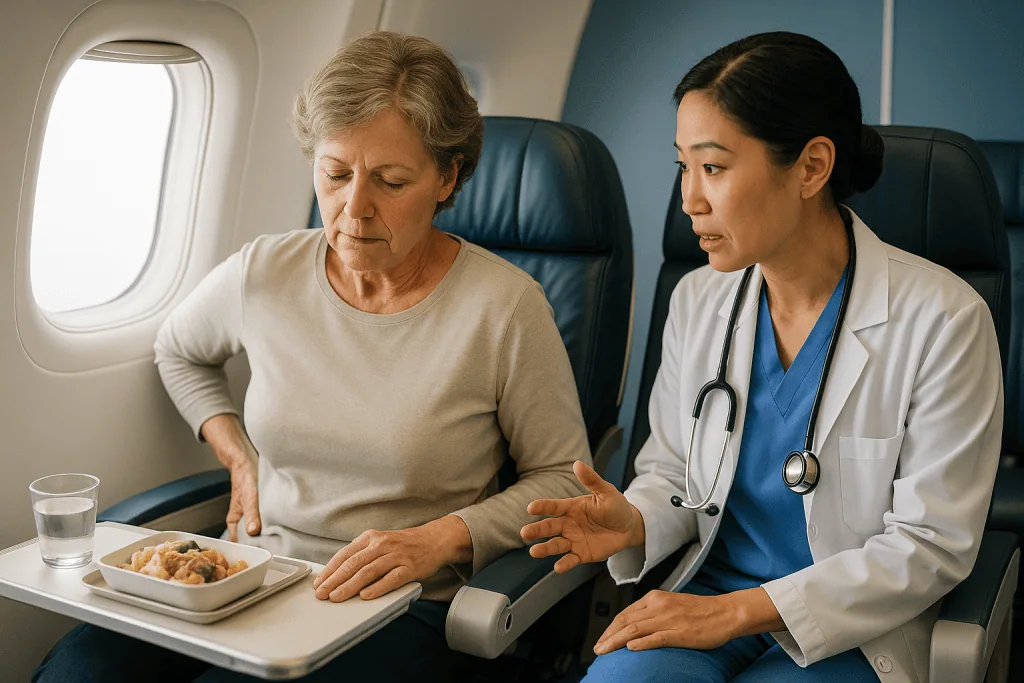
Blood clots come first. Surgery triggers clotting pathways, and immobility lets blood pool in the calf veins. A long flight adds hours of sitting with bent knees in a dry, slightly low-oxygen cabin. The NHS deep vein thrombosis guidance advises that on long journeys people should move their legs regularly, walk the aisle when permitted, keep hydrated and avoid alcohol. For surgical patients, the operating team may also prescribe compression stockings or a short course of an anticoagulant, which is a medicine that slows clot formation. Whether that is needed, and for how long, is their decision.
The second concern is the wound. Airline seats press directly on a lumbar incision for hours. A small lumbar pillow, frequent position changes and a dry dressing help. Any oozing, redness spreading beyond the incision, or a wound that feels hot before departure should delay the flight, not be managed at altitude.
The third is pain and medication. Oral pain relief must be timed around the flight, and controlled medicines need accompanying prescriptions for customs. Patients should carry medicines in hand luggage, in original packaging, with the prescribing letter.
A few practical points reduce risk without medical input. Book an aisle seat so standing is easy. Avoid lifting bags into overhead lockers; ask for help or check luggage through. Walk every hour the seatbelt sign allows. Do calf raises in the seat. Keep water within reach.
None of this substitutes for the surgeon’s go-ahead. It is simply what safe travel looks like once that go-ahead exists.
Spine surgery abroad follow up: who is responsible once you land?
This is the question nobody answers clearly before travel, and the honest reply is that responsibility fragments. The operating surgeon remains the person who knows exactly what was done. The home primary care clinician remains the person who can examine you. Neither one automatically owns the gap between them.
The way to close that gap is to assign it deliberately. Before surgery, identify a home clinician who agrees to take over follow-up and knows the surgery is happening. For many people this is a primary care doctor; for others it is a local spine surgeon or physiotherapist with a surgical background. Ask the operating team abroad for a written follow-up plan that this home clinician can follow: what to check, at what intervals, which imaging to order and what findings would prompt a call back to the operating surgeon.
Ask, too, how the operating surgeon can be contacted. A named email address or secure portal for sending wound photographs and imaging results is far more useful than a switchboard number. Clarify time zones and typical response times.
Spinal surgery follow up appointments at home work best when the home clinician has the complete operative record in advance. The CDC recommends carrying copies of medical records, including operative reports and imaging, when returning from care abroad, precisely so a domestic clinician can act on them.
Patients sometimes find that a home surgeon is reluctant to take on follow-up for an operation they did not perform. That reluctance is not hostility; it reflects medicolegal caution and unfamiliarity with the implants or technique used. A complete record, including implant manufacturer and model documentation, does a great deal to reduce that friction. Without it, the home team is being asked to manage an operation they can only partly see.
Spinal surgery follow up appointments: what a typical schedule looks like
Follow-up schedules vary by procedure, surgeon and patient, so the table below describes common patterns rather than rules. It draws on typical timelines described by the NHS for lumbar decompression and by the Mayo Clinic and MedlinePlus for spinal fusion. Your own plan may differ, and the treating team’s instructions override anything here.
| Typical window | Common purpose | Usually delivered by | Imaging often involved? |
|---|---|---|---|
| Before leaving hospital | Wound check, mobility assessment, discharge instructions, early physiotherapy | Operating team | Sometimes a post-operative X-ray to confirm implant position |
| About 10–14 days | Wound review, suture or staple removal, pain and nerve symptom check | Home clinician or nurse | Rarely, unless concern |
| About 6 weeks | Functional review, activity and driving advice, physiotherapy progression | Home clinician, with report to operating surgeon | X-ray for fusion patients in some protocols |
| About 3 months | Assessment of pain trajectory and return to work; early fusion assessment | Home or operating surgeon | Often X-ray for fusion; MRI only for specific concerns |
| About 6–12 months | Later fusion assessment, long-term function review | Operating or home surgeon | X-ray, sometimes CT if fusion status unclear |
Two features of this table matter most. First, the early visits are about soft tissue and nerves, and they are the ones most likely to catch infection or a clot. Missing them because the flight home was booked for day five is a genuine safety gap. Second, the later visits exist mainly for fusion patients, because the NHS notes a lumbar decompression without fusion typically allows return to work in about four to six weeks and needs less long-term surveillance, while fusion takes months to mature.
Write the dates into a calendar before flying, and give the home clinician the table so they can agree or amend it.
Imaging after spinal fusion and decompression: what scans show and when
Patients often assume follow-up means an MRI. For most spine operations it does not, and understanding why saves worry and unnecessary scans.
Plain X-rays are the workhorse after fusion. They show whether screws and rods remain where they were placed, whether the spacing between vertebrae is preserved, and, over months, whether bone is bridging the fused segment. The Mayo Clinic describes imaging over the months after surgery as the way surgeons judge whether fusion is progressing, since the patient’s symptoms alone cannot confirm it. Standing X-rays also reveal alignment under load, which a lying-down scan cannot.
CT scanning, which uses X-rays to build cross-sectional images, gives a much clearer picture of bone and metal. It is reserved for cases where X-rays are ambiguous, where fusion seems delayed, or where a screw position needs checking. It carries more radiation than plain films, so it is not routine.
MRI, which uses magnetic fields rather than radiation, excels at soft tissue: discs, nerves, fluid collections and infection. After surgery it is ordered when there is a specific question, most commonly new or worsening nerve symptoms, suspected infection, or a suspected fluid leak. Metal implants cause artifact on MRI, so for fusion patients it is sometimes less informative than hoped.
Imaging after spinal fusion therefore follows a pattern: X-rays at intervals set by the surgeon, often around six weeks, three months and six to twelve months; CT or MRI only on indication. A home clinician can order these locally and send the images to the operating surgeon for review, provided the operating team has specified what views are wanted.
Bring the pre-operative scans home too. A new MRI is only interpretable against the old one, and an unknown post-operative appearance is far more alarming without a baseline.
Physiotherapy after spine surgery: what continues at home
Rehabilitation is the part of recovery with the longest tail and the least glamour. It is also the part most likely to be dropped once a patient is back home, far from the hospital physiotherapist who started it.
Physiotherapy after spine surgery begins early. The NHS describes patients being helped to walk within about a day of lumbar decompression and given exercises to continue at home. In the first weeks the goals are modest: walking that gradually lengthens, gentle mobility of the hips and shoulders, breathing exercises, and learning to move in and out of bed and chairs without twisting the spine. Nothing heroic.
From roughly six weeks, when the surgeon confirms soft tissue has healed, the program usually progresses to core stabilization. These exercises train the deep abdominal and back muscles that support the spine, because months of pre-operative pain often leave them weak and inhibited. A physiotherapist adjusts load, tempo and range week by week. This is where home continuity matters: a written program from the operating hospital is useful, but a program without a clinician to progress it tends to stall at week three.
For fusion patients the physiotherapist works within tighter limits set by the surgeon, since the fused segment must not be loaded in bending or rotation until the bone has matured. The same exercise that is routine after a microdiscectomy may be inappropriate after a two-level fusion.
Arrange the home physiotherapist before surgery and send them the operative plan. Ask the operating hospital for its rehabilitation protocol in writing, including what is permitted at each stage and what is specifically forbidden. A physiotherapist cannot safely guess at those limits, and a patient who is told to “take it easy” with no detail will either do too little or too much.
What the first days and weeks back home usually look like
The first week home is usually the hardest, and not because of the spine. Jet lag, disrupted sleep, the end of hospital routine and the sudden absence of anyone checking on you combine into a low point that many patients describe as unexpected.
Pain in the first two weeks is typically incisional and muscular rather than the nerve pain that prompted surgery. It is sore, stiff and worst on rising. The NHS notes that pain and stiffness after lumbar decompression are expected for some weeks and gradually settle. What should not happen is pain that escalates day on day, new leg pain that was not there before, or pain with fever.
Walking is the main activity. Short walks several times a day, extending as tolerated, do more for recovery than any single exercise. Sitting is usually tolerated in short spells; long sitting, which is why the flight was hard, aggravates the lumbar wound and stiffens the hips.
Around week two the wound is reviewed and any sutures or staples removed. Around weeks four to six, the NHS suggests many people after lumbar decompression return to light work and begin driving, though the exact timing depends on the surgeon, the job and the patient’s ability to perform an emergency stop comfortably. Fusion patients generally run slower on all of these.
Fatigue persists longer than most people expect. Major surgery, anesthesia and a long flight each draw on reserves, and it is normal to need an afternoon rest for several weeks.
Emotionally, weeks two to four are when doubt tends to arrive: the pain is not gone, the scan is not until month three, and the operating surgeon is in another time zone. This is exactly the point where a scheduled home follow-up visit prevents small worries from becoming unmanaged ones.
What should you not do after lower back surgery?
Surgeons tend to summarize post-operative restrictions as “no bending, lifting or twisting,” and the phrase is worth unpacking because patients interpret it very differently.
Bending means forward flexion at the waist, the movement of touching the floor. In the early weeks it strains the incision and, after fusion, loads the healing segment. Reaching the floor is done by squatting with a straight back or using a grabber.
Lifting limits are set by the surgeon and are usually light at first. The weight matters less than the lever: holding a modest object at arm’s length loads the lumbar spine far more than the same object held close. Overhead lifting, such as luggage into a locker, is best avoided entirely in the early period.
Twisting means rotating the trunk while the pelvis stays still, the movement of reaching across a car seat for a bag. Patients learn to turn the whole body as one unit, feet included.
Beyond those three, a few other things commonly go wrong. Sitting for long stretches stiffens the back and raises clot risk; the NHS advises regular movement after surgery for both reasons. Soaking the wound in a bath or pool before it is fully closed invites infection; showering is usually permitted once the dressing plan allows. Smoking slows bone healing and is strongly discouraged after fusion. Driving before being able to brake hard without hesitation is unsafe and may not be covered by insurance.
Equally, doing nothing is not safe either. Prolonged bed rest after spine surgery increases clot risk, weakens muscle and slows recovery. The target is frequent gentle movement within the surgeon’s limits, not stillness. When the written limits are unclear, that is a question for the operating team or the home clinician, not a judgment call to make alone.
Can life be normal after spinal fusion?
For most people, the honest answer is “largely, and differently.” Fusion removes motion from one or more segments, and the body adapts, but the adaptation takes time and the segment never moves again.
What usually returns: walking without restriction, sitting through a working day, driving, most household tasks, swimming, cycling, and many recreational activities once the surgeon confirms fusion is solid. The Mayo Clinic notes that it can take several months for the fusion to mature and that activity is increased gradually over that period. Many fusion patients return to desk work within weeks and to more physical work over months, though the exact timing is individual and set by the treating team.
What often changes: extreme bending and twisting feel different because an adjacent segment now does the work. Over years, this can place extra load on the levels above and below the fusion, a phenomenon surgeons call adjacent segment change. It is a recognized long-term consideration, not an inevitability, and it is one reason surgeons prefer to fuse as few levels as possible.
What the evidence does not support is a promise. Fusion is usually performed for instability, deformity or pain that has not responded to other treatment, and its purpose is to stabilize, not to guarantee a pain-free spine. A proportion of patients continue to have some back pain after a technically successful fusion, and some develop a non-union, which is bone that fails to bridge the segment. Imaging over the first year is how surgeons watch for this.
The patients who report the smoothest return to ordinary life tend to share a pattern: they kept walking, stayed with rehabilitation past the point where it felt necessary, and attended the later follow-up visits even when they felt well. Fusion is a long game, and follow-up is how it is played.
Medicines across borders: continuity without changing anything yourself
Patients discharged abroad often fly with a bag of medicines prescribed under a different naming system, in a different language, at a different strength convention. The risk is not the medicines themselves; it is the gap between finishing the supply and seeing a home prescriber.
Three classes commonly appear after spine surgery. Analgesics, which are pain-relieving medicines, often include a simple non-opioid together with a short course of an opioid for the first days. Opioids work on receptors in the nervous system to blunt pain signals and are typically intended for brief use, with the prescriber planning a step-down as surgical pain settles. Anticoagulants, which slow blood clotting, may be prescribed for a defined period after surgery when clot risk is judged high; the duration is set by the surgeon and is not something to extend or shorten on the basis of how you feel. Some patients are also prescribed medicines for nerve pain, which act on nerve signaling rather than inflammation and can take weeks to show effect.
The home clinician needs the exact generic names, not the brand names printed abroad, because the same drug is sold under different brands in different countries. Ask the discharging pharmacist to write generic names on the list. Carry the list and the medicines in hand luggage with the prescription.
Do not stop a medicine early because it seems unnecessary, and do not continue one past its prescribed course because the pain has not gone. Both decisions belong to a prescriber who can examine you. If the supply will run out before the home appointment, contact the home clinician before travel rather than after landing, since some medicines prescribed abroad cannot simply be re-issued without a review.
Nothing here is a recommendation for or against any medicine; it is a description of how continuity is usually managed.
What people often get wrong
“The best rated hospital for spinal surgery is the one that matters.” Rankings are a popular search, but they rarely measure what a traveling patient needs most: documented follow-up arrangements, image and record transfer, and a clear plan for complications after the flight home. A well-regarded surgical team with no handover plan leaves a patient less safe than a less famous team with a written one. The question to ask is not “who is best?” but “who will manage week three?”
“If I feel fine, I don’t need the three-month X-ray.” Fusion status and implant position cannot be felt. The Mayo Clinic is explicit that fusion takes months and is assessed with imaging. Feeling well is encouraging, not diagnostic.
“Laser spine surgery is less invasive, so follow-up is minimal.” “Laser” is a marketing term more than a surgical category. Most spine operations are performed with conventional instruments, and the follow-up need is set by what was removed or fused, not by what tool was used. Mainstream guidance from the NHS and Mayo Clinic does not describe laser as a distinct, lower-follow-up pathway.
“My home doctor can’t treat me because the surgery was abroad.” A home clinician can and should examine, order imaging and manage complications. What they cannot do without records is understand the operation. Records solve most of the problem.
“Pain after surgery means the surgery failed.” Incisional and muscular pain for weeks is expected; nerve symptoms may take months to settle. What matters is the trajectory, which is why follow-up exists.
“Flying is the dangerous part; once I land I’m safe.” Clot risk persists for weeks after surgery, and the NHS lists recent surgery as a risk factor independent of travel. The flight is one exposure among several.
Questions to ask your care team before and after surgery
The questions below are designed to be asked in two places: of the operating team before you travel, and of the home clinician once you return. The answers belong in writing.
Before surgery, ask the operating team:
- Exactly which procedure is planned, at which levels, and whether implants will be used. If so, can the implant documentation be provided?
- What is the earliest you would consider a flight safe, and what would make you delay it?
- What clot prevention is planned, for how long, and who reviews it at home?
- What is the follow-up schedule, which imaging is wanted at each stage, and what views?
- How do I send you wound photographs or scan results, and what is your typical response time?
- What is the written rehabilitation protocol, including what is forbidden and until when?
- What symptoms should prompt me to seek emergency care locally rather than wait to contact you?
After returning, ask the home clinician:
- Are you willing to take over follow-up with the records I have brought, and is anything missing?
- Can you order the imaging on the operating surgeon’s schedule and forward it?
- Who do I contact out of hours, and will they have access to my surgical records?
- Can you review my medication list and plan any continuation or step-down?
- Can you refer me to a physiotherapist who will follow the surgeon’s protocol?
One further question is worth asking both teams: if something goes wrong and I need another operation, who would perform it and how would the two teams communicate? Patients rarely ask this, and it is the scenario in which fragmented care does the most harm. Having an answer before it is needed, even an uncomfortable one, is part of a safe plan.
When to call your doctor
Most recovery after spine surgery is uneventful, and most symptoms are the ordinary aches of healing. A short list of signs, however, means contacting a clinician promptly rather than waiting for the scheduled visit. If you are far from the operating team, that means the home clinician or, for the urgent items, local emergency services.
Seek urgent care the same day for any of the following:
- New or worsening weakness in a leg or arm, or difficulty walking that was not present at discharge.
- New numbness around the genitals or inner thighs, or new difficulty controlling the bladder or bowels. These can indicate pressure on the nerves at the base of the spine and are treated as an emergency.
- Sudden chest pain, breathlessness or coughing blood, which can signal a clot that has traveled to the lung.
- A calf that becomes swollen, painful, warm or red, particularly on one side, which the NHS lists among the signs of deep vein thrombosis.
- Fever with wound redness, spreading warmth, increasing pain or discharge, which can indicate surgical site infection.
- Clear, watery fluid leaking from the wound, which may be spinal fluid.
- A severe headache that is worse when upright and eases lying down.
Contact the home clinician or operating team within a day or two for:
- Pain that is clearly increasing rather than settling over several days.
- Return of the original nerve pain after an initial improvement.
- A wound that has opened or is not closing as expected.
- Running out of a prescribed medicine before the planned review.
When in doubt, call. A clinician would much rather assess a wound that turns out to be fine than hear about an infection a week late. If the operating surgeon cannot be reached quickly, do not wait for them; local assessment first, and the overseas team informed afterward, is the right order.
Frequently asked questions
Can life be normal after spinal fusion?
Largely, yes, for most people, though the fused segment no longer moves and the body adapts around it. Walking, sitting, driving, swimming and most daily tasks typically return once the surgeon confirms fusion is solid, which the Mayo Clinic notes takes several months. Some back pain can persist, and the levels above and below can carry extra load over years. Outcomes are individual and are assessed by the treating team.
Can you have surgery if you were out of the country when the first operation was done?
Yes. A home surgeon can perform further surgery after an operation abroad, but they will need the original operative report, implant documentation and imaging to plan safely. Without those records, revision surgery is harder and riskier. This is one reason to request complete documentation before leaving the operating hospital and to establish early which home team would manage any complication.
What should you not do after lower back surgery?
Avoid forward bending at the waist, lifting beyond the surgeon’s limit, twisting the trunk, prolonged sitting, soaking the wound before it is closed, smoking after fusion, and driving before you can brake hard comfortably. Equally, avoid prolonged bed rest, which raises clot risk. The specific limits and their duration are set by the operating team and should be written down.
How long after spine surgery is flying usually considered safe?
There is no fixed interval; it depends on the procedure, recovery and flight length. CDC guidance on medical care abroad advises not flying until the treating surgeon confirms it is safe, because surgery and flying both raise clot risk. Smaller procedures with a dry wound and good mobility are often cleared sooner than multi-level fusions, but the decision belongs to the operating team.
What imaging after spinal fusion is routine?
Plain X-rays are routine, usually at intervals such as six weeks, three months and six to twelve months, to check implant position and bone bridging. CT is used when X-rays are unclear about fusion, and MRI when there are new nerve symptoms or suspected infection. A home clinician can order these locally if the operating surgeon specifies the views wanted.
What does physiotherapy after spine surgery involve at home?
Early physiotherapy focuses on walking, safe movement in and out of bed, and gentle mobility. From around six weeks, once the surgeon confirms healing, it progresses to core stabilization and graded loading. Fusion patients work within stricter limits until bone matures. A written protocol from the operating hospital and a home physiotherapist to progress it are both needed for continuity.
What is the best rated hospital for spinal surgery?
Rankings rarely measure what a traveling patient needs most: documented follow-up arrangements, record and image transfer, and a plan for complications after the flight. A safer question is whether a team provides a written handover plan, implant documentation and a reliable contact route. Accreditation and surgeon qualifications matter too, but no ranking replaces a clear plan for week three.
Who manages spinal surgery follow up appointments once I am home?
A named home clinician, usually a primary care doctor or local spine specialist, who has agreed in advance to take over and has the full surgical record. The operating surgeon remains available for questions about the procedure, ideally through a secure email or portal. The CDC advises arranging this follow-up before travel rather than after.
Is pain weeks after spine surgery normal?
Incisional and muscular pain for several weeks is expected, and the NHS notes stiffness and discomfort after lumbar decompression gradually settle. Nerve symptoms that were present before surgery can take months to improve. What is not expected is pain that escalates day by day, new leg pain, or pain with fever, all of which should prompt a call to a clinician.
What if I run out of medicine prescribed abroad before my home appointment?
Contact the home clinician before travel, not after landing, since some medicines prescribed abroad cannot simply be re-issued without a review. Carry the medication list written in generic names, with the prescription, in hand luggage. Do not stop a course early or extend it yourself; both decisions belong to a prescriber who can examine you.
References
- NHS: Lumbar decompression surgery, Recovery
- NHS: Deep vein thrombosis (DVT)
- MedlinePlus: Spinal fusion
This article is for general information only and is not a substitute for professional medical advice. Please consult a qualified doctor about your individual situation.
Add us as a Preferred Source to see more of our trusted health content across Google Search, AI Overviews and Discover.

More from the Blog

Is Numbness After Spinal Stenosis Surgery Normal? What Fades, What Stays and When to Call
Yes, some numbness after spinal stenosis surgery is common and usually expected. Surgery removes pressure from the nerve, but the nerve itself heals slowly,…

How Spinal Fusion Works: Bone Graft, Screws and Rods and What Fusing Actually Means
Spinal fusion is surgery that permanently joins two or more vertebrae so they heal into a single, solid bone. A surgeon places bone graft…

After Herniated Disc Surgery: Wound Leaks, Fever and New Weakness That Need a Prompt Call
After herniated disc surgery, the signs that need a prompt call are fluid leaking from the wound, a temperature of 100.4°F (38°C) or higher,…

When Is Scoliosis Surgery Recommended? Curve Size, Progression and Symptoms That Matter
Scoliosis surgery is usually recommended when a curve measures about 45 to 50 degrees or more on the Cobb angle, is still progressing, and…
Why Repeat X-Rays Matter During Scoliosis Bracing: Checking Fit, Growth and Curve Control
Repeat X-rays during scoliosis bracing let the care team measure the Cobb angle, check how well the brace is holding the curve, and track…

Who Is a Candidate for Nucleoplasty? Contained Disc Herniations and Who Needs Another Option
A nucleoplasty candidate is typically an adult with leg-dominant pain from a small, contained lumbar disc herniation, confirmed on MRI, whose symptoms have not…