

Statin Alternatives: Red Yeast Rice, Plant Sterols, Ezetimibe and PCSK9: What Works

Key Takeaways
- Red yeast rice contains monacolin K, a compound chemically identical to the prescription statin lovastatin, so it carries statin-type effects at an unknown and variable dose.
- Plant sterols lower LDL by a reproducible 8 to 10 percent across more than 100 trials, but no study has ever tested whether they prevent heart attacks or strokes.
- Ezetimibe added to a statin reduced cardiovascular events by about 6.4 percent relative to statin alone over seven years in the 18,000-person IMPROVE-IT trial.
- PCSK9 antibodies lower LDL by 55 to 60 percent and cut major cardiovascular events by about 15 percent in trials enrolling more than 46,000 people.
- Bempedoic acid reduced heart attacks by about 23 percent in statin-intolerant people in the 2023 CLEAR Outcomes trial, with gout and gallstones as its main added risks.
- In the blinded SAMSON trial, about 90 percent of the symptom burden people attributed to statins also appeared while they were taking an identical placebo.
Statin alternatives range from well-tested medicines to modest supplements. Ezetimibe, PCSK9 inhibitors and bempedoic acid have randomized trials showing they lower LDL cholesterol and reduce heart attacks and strokes. Plant sterols lower LDL by roughly 8 to 10 percent but have no outcome data. Red yeast rice contains a natural statin with unpredictable strength. Diet changes help but rarely replace medication in high-risk people. Any switch belongs with your prescribing clinician.
Scroll through any health feed as of this writing in spring 2025 and the pitch arrives within minutes: a bottle of red yeast rice, a tub of sterol-fortified spread, a confident voice promising ‘statin results without the statin’. The timing is not random. Statin alternatives are trending because three things collided: a 2023 trial showing a non-statin pill cut heart attacks in people who could not tolerate statins, a 2024 label expansion for that same medicine, and a wave of 2024 safety reports in Japan linking some red yeast rice supplements to kidney injury.
Underneath the noise sits a real, unglamorous problem. Surveys suggest that roughly one in five people prescribed a statin stops within a year, often because of muscle aches, and many never tell their doctor what they tried instead.
This piece walks through each option, what the trials actually measured, and where the evidence is thin. The goal is not to talk anyone off a statin. It is to make the next conversation with your clinician a better one.
What changed recently with statin alternatives
Three dated developments explain the current search surge.
In March 2023, the CLEAR Outcomes trial, published in the New England Journal of Medicine, randomized about 14,000 people who reported they could not tolerate statins to bempedoic acid or placebo. Over a median of 40 months, the medicine reduced the combined risk of cardiovascular death, heart attack, stroke or revascularization by 13 percent relative to placebo. That was the first large outcome trial of a non-statin pill run specifically in a statin-intolerant population, and it moved the option from ‘promising’ to ‘evidence-based’.
In March 2024, the US Food and Drug Administration broadened the approved indication for bempedoic acid to include people who need LDL lowering to reduce cardiovascular risk, whether or not they can take a statin. Prescribers now have clearer regulatory footing for using it earlier.
Also in 2024, health authorities in Japan investigated more than 100 hospitalizations and several deaths associated with specific red yeast rice supplements. Investigators pointed to a contaminant produced during manufacturing rather than to red yeast rice itself, but the episode put a spotlight on a long-standing issue: supplements are not held to medicine-grade manufacturing standards, and their active content can vary widely between bottles.
Alongside these headlines, the 2018 American Heart Association and American College of Cardiology cholesterol guideline remains the US reference point. It positions statins as first-line treatment, then recommends adding ezetimibe for very high-risk people whose LDL stays above target, and a PCSK9 inhibitor after that. Nothing in the newer trials overturns that order. What has changed is that people who genuinely cannot take a statin now have a better-mapped path, and people tempted by supplements have fresh reason to ask what is actually in the capsule.
Why statins are still the benchmark every alternative is measured against
To judge an alternative you need to know what it is competing with. LDL cholesterol, often called ‘bad’ cholesterol, is the particle that carries cholesterol into artery walls, where it drives the build-up of plaque. Statins block an enzyme in the liver called HMG-CoA reductase, which slows the liver’s own cholesterol production and prompts liver cells to pull more LDL out of the blood.

Depending on intensity, statins lower LDL by about 30 to 50 percent. That number matters less than what follows it. Pooled data from more than 170,000 trial participants, analyzed by the Cholesterol Treatment Trialists’ Collaboration, show that every 1 mmol/L (about 39 mg/dL) drop in LDL translates to roughly a 22 percent reduction in major vascular events, year after year, with benefit accumulating the longer treatment continues.
Two details from that evidence base shape the whole alternatives debate. First, the benefit appears to come mainly from how far LDL falls and for how long, not from any statin-specific magic. That is the scientific reason non-statin medicines that lower LDL by other routes have, so far, also lowered event rates. Second, statins have decades of safety data in millions of people, with serious muscle damage (rhabdomyolysis) occurring in roughly 1 to 3 per 100,000 person-years and a small increase in new-onset diabetes, concentrated in people already close to the diabetic threshold.
Measured against that record, every alternative faces the same two questions. Does it lower LDL enough to matter, and has anyone shown that the lowering it produces actually prevents heart attacks? For some options the answer to both is yes. For others the honest answer to the second question is ‘nobody has checked’.
How common is statin intolerance, and which statin has the fewest side effects?
Ask a room of statin users and a third will report muscle aches. Ask a randomized, blinded trial and the picture shifts. Across placebo-controlled trials, muscle symptoms are only about 1 percentage point more common on statin than on placebo. That gap between everyday experience and trial data has a name: the nocebo effect, meaning real symptoms produced by the expectation of harm rather than by the drug’s chemistry.
The clearest demonstration came from the SAMSON trial, published in 2020. Sixty people who had previously quit statins because of side effects took, in rotating months, a statin, an identical placebo, or nothing at all, rating symptoms daily. Symptom scores were almost identical on statin and placebo, and about 90 percent of the symptom burden attributed to the statin appeared on placebo too. Half the participants later restarted statins successfully.
None of this means intolerance is imaginary. Mainstream estimates suggest genuine, reproducible intolerance affects somewhere between 5 and 10 percent of users, and a small number develop measurable muscle injury or a rare immune-mediated muscle disease. Those people need non-statin options.
So which is the safest statin? There is no single winner, which is why the question deserves a nuanced answer rather than a product name. Observational data suggest water-soluble statins may be slightly gentler on muscle for some people, and lower-intensity regimens produce fewer symptoms than high-intensity ones. Guidelines favor a structured approach: confirm the symptom pattern, pause, rechallenge, and try a different statin or intensity before concluding that statins are off the table. Which statin, and at what intensity, is a decision for the prescriber who knows your kidney function, other medicines and cardiovascular risk. If you suspect a side effect, say so before you stop; the SAMSON data are a reminder that the first instinct is often wrong.
Red yeast rice vs statins: is it really a natural alternative?
Red yeast rice is rice fermented with the mold Monascus purpureus, a staple in Chinese cooking for centuries. During fermentation the mold produces a family of compounds called monacolins. One of them, monacolin K, is chemically identical to lovastatin, a prescription statin. That single fact reframes the whole conversation: red yeast rice is not an alternative to statins. It is a statin, delivered without a label telling you how much.
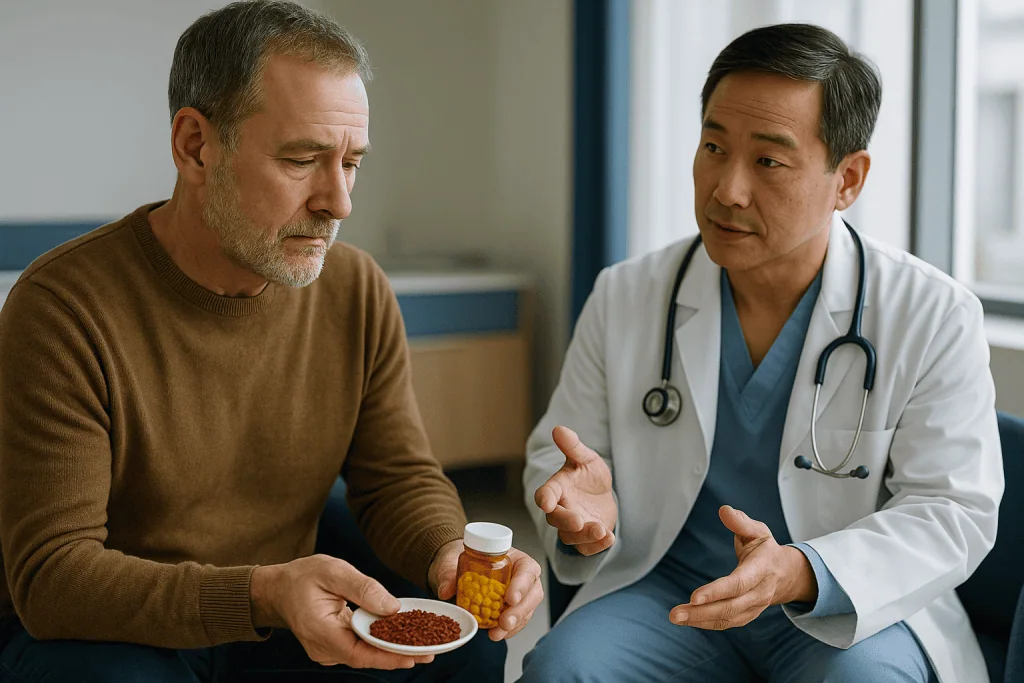
The evidence that it lowers LDL is reasonably good at the level of short randomized trials, with reductions of around 15 to 25 percent reported, consistent with what a modest statin dose achieves. One Chinese outcome trial from 2008, using a standardized extract, reported fewer coronary events in heart attack survivors, but the product tested is not what sits on most shelves.
The problems are practical. Independent analyses of commercial products have found monacolin K content varying by more than 60-fold between brands, and some capsules contain almost none. A proportion contain citrinin, a kidney-toxic byproduct of fermentation. The 2024 Japanese cases involved a different contaminant, but the lesson is the same. Because the active ingredient is a statin, side effects can be statin side effects, including muscle symptoms and liver enzyme changes, and interactions with the same medicines that interact with lovastatin apply.
Regulatory status matters here. In the United States, the FDA considers red yeast rice products containing more than trace monacolin K to be unapproved drugs, so legally sold supplements are supposed to contain very little of the compound that works. People who feel better on red yeast rice than on a prescribed statin are often, in effect, taking a lower and unknown statin dose. That can be discussed openly with a clinician, who can offer the same effect with a measured, quality-controlled product. Using red yeast rice while hiding it from the prescriber, or combining it with a statin, is where the real risk lies.
Plant sterols for cholesterol: modest, consistent, and unproven for outcomes
Plant sterols and stanols are compounds found naturally in vegetable oils, nuts, seeds and grains that resemble cholesterol closely enough to compete with it for absorption in the gut. Less cholesterol crosses into the bloodstream, and LDL falls. The mechanism is sound and the effect size is remarkably reproducible: at the amounts used in trials, typically delivered through fortified spreads, yogurts or drinks, LDL drops by about 8 to 10 percent within a few weeks. Pooled analyses of more than 100 randomized trials agree on that figure.
What makes plant sterols different from red yeast rice is predictability. Fortified foods carry a stated sterol content, the ingredient is not pharmacologically a drug, and side effects in trials are essentially those of the carrier food. The effect also stacks with statins, because the two work in different places; the statin cuts production in the liver while sterols reduce absorption in the gut.
Here is where the honesty has to kick in. No randomized trial has ever tested whether plant sterols reduce heart attacks or strokes. The evidence is entirely about the surrogate marker, LDL. Most clinicians consider an LDL fall of this size worth having, and both the 2018 US guideline and European guidance mention sterols as a reasonable lifestyle adjunct. But a 9 percent LDL reduction is roughly a quarter of what a moderate-intensity statin delivers, so for someone at high risk sterols are a supporting act, not a substitute.
Two caveats appear in the literature. Blood levels of plant sterols rise during supplementation, and whether that has any downstream effect is debated with no firm answer. People with a rare inherited condition called sitosterolemia, who absorb sterols excessively, should avoid them. For most people the practical takeaway is that fortified foods are a reasonable, low-drama addition to a cholesterol-lowering diet, provided expectations stay proportionate to the numbers.
Ezetimibe: the quiet workhorse among non-statin cholesterol medications
Ezetimibe has been available for more than two decades and remains the first non-statin medicine most guidelines reach for. It blocks a protein in the small intestine called NPC1L1 that ferries cholesterol from food and bile into the body. Less cholesterol is absorbed, the liver compensates by pulling more LDL from the blood, and LDL falls by roughly 18 to 20 percent. Used on its own it is modest; added to a statin it contributes a similar extra percentage, which is why it is most often prescribed as a partner rather than a replacement.
The outcome evidence comes from IMPROVE-IT, a randomized trial of about 18,000 people who had recently had an acute coronary event. Adding ezetimibe to a statin lowered LDL further and reduced the combined rate of cardiovascular death, heart attack, stroke and related events by about 6.4 percent relative to statin alone over seven years. That is a small absolute gain, but it fits precisely on the line predicted by the LDL-lowering hypothesis, and it was the first trial to prove that a non-statin route to lower LDL also lowers events.
Tolerability is ezetimibe’s strength. In trials, rates of muscle symptoms, liver enzyme changes and discontinuation were similar to placebo. It is taken as a tablet, has few interactions, and does not require injections or monitoring beyond routine lipid checks. For someone who can take a lower-intensity statin but not a high one, the combination of a gentler statin plus ezetimibe often reaches a target that neither could alone.
Its limits are equally clear. On its own it rarely delivers the 50 percent LDL reduction that very high-risk patients need, and it has not been tested as monotherapy in a large outcome trial. Whether ezetimibe is the right next step, and in what combination, is a prescriber’s call based on your risk category and the LDL level you start from.
PCSK9 inhibitors: injections that cut LDL by half or more
PCSK9 is a protein the liver releases into the blood that tags LDL receptors for destruction. Fewer receptors on the liver surface means less LDL cleared. Block PCSK9, and the liver keeps its receptors, mopping up far more LDL. Three medicines exploit this. Evolocumab and alirocumab are monoclonal antibodies, lab-made proteins that bind PCSK9 directly; they are injected under the skin every two to four weeks. Inclisiran is a small interfering RNA, a molecule that stops liver cells from manufacturing PCSK9 in the first place, and is injected twice a year after initial doses.
The LDL effect is dramatic. Antibodies lower LDL by about 55 to 60 percent on top of statin therapy; inclisiran lowers it by around 50 percent. For people with familial hypercholesterolemia, an inherited condition causing very high LDL from birth, these medicines often achieve targets that were unreachable before.
Outcome data exist for the antibodies. FOURIER randomized about 27,500 people with established cardiovascular disease and found evolocumab reduced major cardiovascular events by 15 percent relative to placebo over a median of 2.2 years. ODYSSEY Outcomes, with nearly 19,000 people after a recent acute coronary syndrome, reported a similar 15 percent relative reduction with alirocumab and a small reduction in overall deaths. Inclisiran’s large outcome trial, ORION-4, is still underway, so its benefit is inferred from LDL lowering rather than demonstrated directly.
Side effects have been reassuringly mild across trials: injection-site reactions in a few percent, and no excess of muscle symptoms, diabetes or cognitive problems in dedicated substudies. Guidelines reserve PCSK9 inhibitors for very high-risk people whose LDL stays above target despite a maximally tolerated statin plus ezetimibe, or for those with documented statin intolerance. Who qualifies, and which agent fits, depends on insurance pathways and clinical judgment that a cardiologist or lipid specialist is best placed to make.
Bempedoic acid: the newest option for people who cannot take statins
Bempedoic acid works one step upstream of statins in the same cholesterol-making pathway, blocking an enzyme called ATP citrate lyase. The clever part is where it is switched on. The medicine is a prodrug, an inactive form that needs an enzyme to activate it, and that enzyme lives almost entirely in the liver. Muscle cells barely have it. In theory, and so far in practice, this means the medicine lowers cholesterol without the muscle exposure that drives most statin complaints.
Alone, bempedoic acid lowers LDL by about 17 to 21 percent in people not taking a statin. Combined with ezetimibe it reaches roughly 35 to 40 percent, approaching moderate-intensity statin territory. In CLEAR Outcomes, the 2023 trial that triggered much of the current interest, participants had a median baseline LDL of about 139 mg/dL and could not or would not take statins. Over 40 months, bempedoic acid cut the combined endpoint of cardiovascular death, heart attack, stroke or coronary revascularization by 13 percent relative to placebo, and heart attacks specifically by about 23 percent. Muscle symptoms were no more common than on placebo.
It is not side-effect free. Trial participants on bempedoic acid had higher rates of gout (about 3 percent versus 2 percent), gallstones/">gallstones (about 2 percent versus 1 percent), modest rises in uric acid and creatinine, and a small excess of tendon rupture reported in earlier studies. Prescribers typically check kidney function and uric acid before and during treatment.
Where does it sit? US guidance now positions bempedoic acid as an option for people who cannot tolerate statins or who need extra lowering, usually after ezetimibe has been considered. It has not been compared head-to-head with statins for outcomes, and the relative benefit seen in CLEAR Outcomes is smaller than what a high-intensity statin achieves in similar populations. For the person who has genuinely exhausted statin options, however, it is the first oral medicine with its own outcome trial in exactly that situation.
What can I do instead of taking a statin? Diet and lifestyle, with real numbers
This is the question most people are really asking, so it deserves figures rather than encouragement. Diet changes do lower LDL, and the size of the effect depends on what you change and how consistently.
Replacing saturated fat (butter, fatty meat, full-fat dairy, coconut oil) with unsaturated fat from olive oil, nuts and fish lowers LDL by roughly 5 to 10 percent in controlled feeding studies. Soluble fiber, the gel-forming kind in oats, barley, beans, psyllium and some fruit, binds bile acids in the gut and lowers LDL by about 5 percent at the amounts tested. Nuts, soy protein and plant sterols each add a few percentage points. The ‘portfolio diet’, which combines all of these, lowered LDL by about 13 percent under real-world conditions in a Canadian trial and by nearly 30 percent when every meal was provided, a result that rivals a low-intensity statin.
Weight loss of 5 to 10 percent of body weight typically trims LDL modestly and improves triglycerides more. Regular aerobic exercise raises HDL and lowers triglycerides but shifts LDL only slightly. Stopping smoking does little for LDL and a great deal for overall cardiovascular risk, which is the number that matters.
Two honest caveats. First, LDL responds to diet in proportion to how high it was from diet in the first place; someone with an inherited tendency to very high LDL will see smaller percentage changes than someone whose numbers track their eating. Second, no randomized trial has shown that diet alone, in people at high risk, prevents events as effectively as a statin. The Mediterranean-diet trial PREDIMED cut cardiovascular events by about 30 percent, but most participants were also taking statins.
Guidelines therefore frame lifestyle as the foundation for everyone, as the primary strategy for people at low to intermediate risk, and as a partner rather than a replacement for medication when risk is high. Whether your risk falls into the ‘diet first’ category is a calculation, not a feeling, and a clinician can run it in minutes.
Supplements and older medicines that did not deliver
A fair review of statin alternatives has to include the options that looked promising and failed, because several still circulate as recommendations.
Niacin (vitamin B3) raises HDL and lowers LDL and triglycerides, and for decades that lipid profile seemed ideal. Two large randomized trials, AIM-HIGH in 2011 and HPS2-THRIVE in 2014, added niacin to statin therapy in more than 29,000 people combined and found no reduction in cardiovascular events, alongside more infections, bleeding, gout and new diabetes. Guidelines no longer recommend it for prevention.
Fibrates lower triglycerides substantially but have shown inconsistent effects on heart attacks and none on mortality in people already on statins. The 2022 PROMINENT trial of pemafibrate found no benefit despite a large triglyceride drop. They retain a role for very high triglycerides, which is a different problem from high LDL.
Over-the-counter fish oil supplements have been tested in several large trials, including VITAL and ASCEND, with no meaningful reduction in cardiovascular events. One prescription-strength purified omega-3 preparation did reduce events in the REDUCE-IT trial, but that is a regulated medicine, not the capsules sold next to the vitamins, and it does not lower LDL.
Garlic, policosanol, guggul, artichoke extract and coenzyme Q10 have each been studied. Meta-analyses find either no effect on LDL or effects too small and inconsistent to matter. Coenzyme Q10 is often promoted to relieve statin muscle symptoms; a 2015 meta-analysis of randomized trials found no benefit over placebo, though some clinicians still consider it harmless to try.
The pattern is instructive. Lowering LDL by almost any route has, so far, reduced events in proportion to the lowering. Changing other lipid numbers, or taking compounds that do not move LDL, has not. That single observation is the best filter for evaluating the next viral statin alternative before it reaches your cart.
Statin alternatives at a glance: a comparison table
Numbers below are approximate averages drawn from randomized trials and meta-analyses; individual responses vary, and the LDL figures describe effect on top of or instead of a statin as noted in each trial program. ‘Outcome evidence’ means whether a randomized trial has shown fewer heart attacks and strokes, not just lower cholesterol.
| Option | How it works | Typical LDL reduction | Outcome evidence | Main tolerability issues |
|---|---|---|---|---|
| Statins (reference) | Block cholesterol production in liver | 30 to 50 percent | Strong: dozens of RCTs, mortality benefit | Muscle symptoms, small diabetes risk |
| Ezetimibe | Blocks gut cholesterol absorption | 18 to 20 percent | Moderate: IMPROVE-IT, added to statin | Similar to placebo |
| PCSK9 antibodies | Preserve liver LDL receptors | 55 to 60 percent | Strong: FOURIER, ODYSSEY Outcomes | Injection-site reactions |
| Inclisiran | Stops liver making PCSK9 | About 50 percent | Pending: ORION-4 ongoing | Injection-site reactions |
| Bempedoic acid | Blocks production upstream of statins, liver-only activation | 17 to 21 percent alone | Moderate: CLEAR Outcomes in statin-intolerant people | Gout, gallstones, uric acid rise |
| Plant sterols | Compete with cholesterol for absorption | 8 to 10 percent | None: LDL only | Minimal; avoid in sitosterolemia |
| Red yeast rice | Contains lovastatin (monacolin K) | 15 to 25 percent, highly variable | Weak: one trial of a standardized extract | Statin-type effects, contaminants, unknown dose |
| Diet pattern (portfolio, Mediterranean) | Less saturated fat, more fiber, nuts, sterols | 10 to 30 percent depending on adherence | Moderate for Mediterranean diet, mostly alongside statins | Adherence |
Read the table from right to left as much as left to right. An option that lowers LDL impressively but has never been tested for outcomes is a reasonable bet, not a proven one. An option with modest LDL effect but hard outcome data, such as ezetimibe, earns its guideline place precisely because the test was run. Where a row says ‘none’ or ‘pending’, that is the current state of science, not a verdict that the option fails.
What the evidence actually says: grading the strength
Medical evidence comes in tiers, and stacking statin alternatives by tier clarifies more than any single number.
Strong evidence (multiple large randomized trials with hard outcomes). Statins occupy this tier alone among oral agents. PCSK9 antibodies join them on the strength of FOURIER and ODYSSEY Outcomes, which together enrolled more than 46,000 people and showed consistent 15 percent relative reductions in major events, though follow-up was shorter than in statin trials and mortality benefit was seen in only one.
Moderate evidence (one large outcome trial, or trials in a specific population). Ezetimibe sits here, proven as an add-on in IMPROVE-IT but never as a stand-alone treatment in an outcome trial. Bempedoic acid also sits here after CLEAR Outcomes, with the caveat that its one trial was in self-reported statin-intolerant people and its absolute benefit was smaller than statins produce. The Mediterranean diet earns a moderate grade from PREDIMED, though that trial was partly re-analyzed after randomization problems at some sites.
Surrogate-only evidence (randomized trials show LDL falls, no outcome data). Plant sterols and inclisiran are the clearest examples. Both reliably lower LDL in blinded trials; whether that translates into fewer events is extrapolated from the broader LDL hypothesis, which has held up well so far but is still an assumption for these specific agents.
Weak or inconsistent evidence. Red yeast rice has short LDL trials and one outcome trial of a product unlike commercial supplements, undermined by variable content. Niacin, fibrates and over-the-counter fish oil have outcome trials, but negative ones, which is useful information pointing the other way.
Expert opinion. Advice on managing statin intolerance by rechallenge, switching statins or adjusting intensity rests on observational data and consensus statements rather than large trials, although SAMSON provides randomized support for the nocebo component.
A practical reading: if your risk is high enough that outcomes matter more than lab numbers, options from the top two tiers are where the proof lives. Options from the lower tiers can still be reasonable, as long as both you and your clinician know they are bets.
Common myths about statin alternatives, corrected
Myth: red yeast rice is a natural, side-effect-free alternative to statins. Red yeast rice contains monacolin K, which is lovastatin. Its side effects are statin side effects, its content is unregulated and highly variable, and contamination has caused real harm. ‘Natural’ describes the source, not the pharmacology.
Myth: plant sterols work as well as a statin. Trials consistently show an LDL drop of about 8 to 10 percent, roughly a fifth to a quarter of a moderate statin’s effect, with no outcome trials. Useful, not equivalent.
Myth: most people who stop statins have a true drug reaction. Blinded trials show muscle symptoms only about 1 percentage point above placebo, and SAMSON found 90 percent of symptom burden appeared on placebo. Genuine intolerance exists but is less common than it feels.
Myth: statins cause dementia. Large observational studies and randomized trials, including a dedicated cognitive substudy within FOURIER, have found no increase in cognitive decline. Some observational data point the other way, toward slightly lower dementia rates, which may reflect fewer small strokes.
Myth: some doctors are against statins because the drugs do not work. The professional debate is narrower than social media suggests. Virtually no mainstream clinician disputes the benefit in people with established heart disease or very high LDL. The genuine discussion concerns primary prevention in lower-risk people, where absolute benefit is smaller, risk calculators are imperfect, and the trade-off between a daily medicine and a modest risk reduction becomes a personal values question. Guidelines resolve this with shared decision-making and risk thresholds, not with a blanket yes or no.
Myth: if a medicine lowers cholesterol it must prevent heart attacks. Niacin lowered LDL and raised HDL and prevented nothing in two large trials. The LDL hypothesis has held for statins, ezetimibe, PCSK9 antibodies and bempedoic acid, but each needed its own trial to earn that place. The next supplement needs one too.
When to see a doctor about statins or statin alternatives
Every option in this article, from a fortified yogurt to a twice-yearly injection, works best when the decision is made with the clinician who knows your full picture. Some situations should prompt a conversation sooner rather than later.
Book an appointment if you have stopped, skipped or swapped a prescribed cholesterol medicine for any reason, including side effects you attributed to it. Rechallenge, switching or adding a non-statin agent are all standard moves, but only if your prescriber knows what happened. Tell them about any supplement you take, especially red yeast rice, since combining it with a statin stacks two statins without anyone realizing.
Arrange a review if your LDL remains above the target your clinician set despite treatment, if you have a family history of early heart disease (before age 55 in men or 65 in women), or if your LDL is very high, which can signal familial hypercholesterolemia and may warrant testing of relatives.
Seek urgent medical attention for these red flags:
- Severe, unexplained muscle pain or weakness, especially with dark or cola-colored urine, which can indicate muscle breakdown affecting the kidneys.
- Yellowing of the skin or eyes, pale stools, dark urine or persistent upper-right abdominal pain, which can signal liver injury.
- Sudden, intense joint pain, redness and swelling, often in the big toe, consistent with gout, which has been reported more often on bempedoic acid.
- A sudden snap or sharp pain near a tendon, particularly the Achilles or shoulder, followed by weakness.
- Any allergic reaction after an injection: facial swelling, hives, difficulty breathing.
- Chest pain, pressure or tightness, breathlessness, or sudden weakness, numbness, facial drooping or speech difficulty. These are signs of a heart attack or stroke and need emergency services immediately, regardless of what cholesterol treatment you are on.
Do not stop or change a prescribed medicine on your own while waiting for an appointment unless a clinician has told you to. The right alternative, if one is needed, depends on your risk category, kidney and liver function, other medicines and preferences, and that decision belongs with the person prescribing for you.
Frequently asked questions
What can I do instead of taking a statin?
Options with outcome evidence include ezetimibe, PCSK9 inhibitors and bempedoic acid, each prescribed by a clinician based on your risk. Diet changes such as cutting saturated fat, adding soluble fiber, nuts and plant sterols can lower LDL by 10 to 30 percent depending on adherence. For people at low risk, lifestyle may be enough; at high risk, guidelines treat it as a foundation rather than a replacement.
What are the new alternatives to statins?
The newest are bempedoic acid, an oral medicine with a 2023 outcome trial in statin-intolerant people and an expanded US indication in 2024, and inclisiran, a twice-yearly injection that silences the gene for PCSK9 and lowers LDL by about half. PCSK9 antibodies, approved since 2015, have the strongest outcome data of the non-statin injectables. All require a prescription and specialist assessment.
Does red yeast rice really work like a statin?
Yes, because it literally contains one. Monacolin K in red yeast rice is lovastatin. Short trials show LDL drops of 15 to 25 percent, but commercial products vary more than 60-fold in active content, some contain kidney-toxic contaminants, and US regulators treat products with meaningful monacolin K as unapproved drugs. Discuss it with your prescriber rather than using it alongside or instead of a prescribed statin.
Are plant sterols a good alternative to statins?
They are a good adjunct, not an alternative. Plant sterols lower LDL by roughly 8 to 10 percent at trial amounts, about a quarter of a moderate statin’s effect, and they stack with statins because they act in the gut rather than the liver. No trial has shown they prevent heart attacks. People with the rare condition sitosterolemia should avoid them.
Which is the safest statin with the least side effects?
No single statin is safest for everyone. In blinded trials all statins cause muscle symptoms only about 1 percentage point more often than placebo. Some observational data suggest water-soluble statins and lower intensities are better tolerated by people with prior symptoms. Guidelines recommend pausing, rechallenging and switching under a prescriber’s direction before concluding statins cannot be used.
Why are some doctors against statins?
The mainstream disagreement is about primary prevention in lower-risk people, where absolute benefit is small and risk calculators are imperfect, not about whether statins work. Benefit in people with existing heart disease or very high LDL is accepted across guidelines. Current guidance handles the grey zone through shared decision-making and risk thresholds rather than a blanket recommendation for or against.
Is ezetimibe as effective as a statin?
Not on its own. Ezetimibe lowers LDL by about 18 to 20 percent compared with 30 to 50 percent for statins, and its outcome evidence comes from being added to a statin in IMPROVE-IT, not from use alone. Its advantage is tolerability, with side-effect rates similar to placebo, which makes it a frequent partner for people who can only manage a low-intensity statin.
How much can diet alone lower cholesterol?
Controlled studies show replacing saturated with unsaturated fat lowers LDL by 5 to 10 percent, soluble fiber adds about 5 percent, and plant sterols, nuts and soy a few points each. Combined in the portfolio diet, reductions reached 13 percent in free-living conditions and nearly 30 percent when meals were fully provided. Results are smaller when high LDL is mainly inherited.
Do PCSK9 inhibitors have side effects?
In trials of tens of thousands of people, the main side effect was injection-site reaction in a few percent. Dedicated studies found no excess of muscle symptoms, new diabetes or cognitive decline compared with placebo. They are reserved for very high-risk people whose LDL stays above target on maximally tolerated statin plus ezetimibe, or with documented statin intolerance, as judged by a specialist.
Can I take red yeast rice with a statin?
This is generally not advised without a prescriber’s knowledge, because red yeast rice contains lovastatin and combining it with another statin effectively doubles up on statin exposure with an unknown dose. That raises the risk of muscle and liver effects without predictable extra benefit. If your LDL is not at target, tell your clinician; measured, quality-controlled options exist for adding to a statin.
References
This article is for general information only and is not a substitute for professional medical advice. Please consult a qualified doctor about your individual situation.

More from the Blog

Why Follow-Up Imaging Is Scheduled After Endovascular Surgery to Confirm Blood Flow
Follow-up imaging after endovascular surgery is scheduled because a stent graft can develop problems that cause no symptoms: blood leaking back into the aneurysm…

Heart Disease in Women: The Different Symptoms, Risk Factors and Tests
Heart disease is the leading cause of death in women, yet it is often recognized later than in men. Chest pain remains the most…

Heart Bypass Recovery Week by Week: From Intensive Care to Your First Walks Outside
Recovery after heart bypass surgery typically unfolds over about 12 weeks. Most people spend a day or two in intensive care, around a week…

Living With a Cardiometabolic Disorder: What Regular Monitoring Visits Actually Track
Regular monitoring visits for a cardiometabolic disorder track a small set of linked measures: blood pressure, blood sugar (usually A1c), a cholesterol panel, weight…

Permanent Pacemaker Recovery: Why Your Arm Stays Below Shoulder Level for Several Weeks
After a permanent pacemaker is implanted, most people are asked to keep the arm on the device side below shoulder height for roughly four…

The First 48 Hours After Carotid Angiography: Rest, Fluids and the Lifting Limit
After a carotid angiogram, most people lie flat for a few hours while the puncture site seals, drink extra fluids to help the kidneys…