

Supporting a Deafblind Family Member: Communication Training, Mobility and Safety Routines
Key Takeaways
- The NHS estimates around 400,000 people in the UK live with deafblindness, and most acquire it in later life when age-related hearing loss meets an eye condition such as macular degeneration or glaucoma.
- Usher syndrome accounts for about half of all hereditary deafblindness and typically affects hearing first and sight later, which is why tactile methods are often introduced before they become essential.
- Speaking louder distorts the sounds a person with high-frequency hearing loss can still catch; clear, unhurried speech at normal volume, face lit and at eye level, works better.
- In proper sighted guiding the person holds the guide's arm just above the elbow from slightly behind, so the guide's body movement signals steps and turns without pushing or steering.
- A standard smoke alarm gives no warning to someone who cannot hear; strobe alarms linked to a vibrating pad under the pillow are the recognized alternative.
- In the UK a cane banded in red and white signals that the user has both sight and hearing loss, alerting the public that a shouted warning will not be heard.
Supporting a deafblind family member means three things together: learning the communication method that fits their remaining sight and hearing, whether clear speech, tactile signing or a manual alphabet; arranging orientation and mobility training so they can move safely; and building consistent home routines, from vibrating alarms to fixed furniture layouts. A specialist deafblind assessment guides which methods to start with, and the care team leads every decision.
Maria noticed it in the kitchen, of all places. Her father had coped with hearing aids for a decade, and lately he had been holding letters closer to the window. But that afternoon he stood in front of the open cupboard, two identical tins in his hands, and simply waited. He could not read the labels, and he had not heard her come in to help.
That small stillness is where many families begin. Supporting a deafblind family member is not one skill but a set of habits: how you announce yourself, how you shape a sentence, how you set out a room so it stays predictable, how you walk together across a car park. None of it is intuitive at first, and much of it runs against the instinct to speak louder or to do things for the person rather than with them.
The evidence base is thinner than for many conditions, but the professional consensus is clear on what helps. This guide walks through it, from assessment to alarms.
What does deafblindness actually mean?
The word sounds absolute, but it rarely is. Deafblindness, sometimes called dual sensory loss, is a combination of sight and hearing impairment severe enough that neither sense can fully make up for the other. Most people who live with it retain some hearing, some vision, or both. What they have lost is the safety net. A person with low vision who can still hear leans on sound to find a doorway or catch a name across a room; a Deaf person leans on sight to lip-read and to sign. Reduce both, even partially, and tasks that seemed to depend on neither sense start to wobble.
The NHS estimates that around 400,000 people in the UK are affected, and most acquire the condition later in life, typically when age-related hearing loss meets macular degeneration, glaucoma or diabetic eye disease. A smaller group is born with it or develops it in childhood, often through genetic conditions such as Usher syndrome, which the NIH’s National Institute on Deafness and Other Communication Disorders describes as the cause of roughly half of all hereditary deafblindness.
Scale matters to a family because it explains why services exist yet can feel thinly spread. The WHO counts more than 1.5 billion people worldwide with some degree of hearing loss, about 430 million of whom need rehabilitation for disabling loss, and at least 2.2 billion with a near or distance vision impairment. The group with both is small by comparison, and specialist skills follow the numbers. Knowing the right phrase to ask for, a specialist deafblind assessment rather than separate eye and ear reviews, is the first practical step, because the two losses interact in ways that neither clinic sees on its own.
How communication training actually works when two senses are reduced
Think of communication as a signal looking for a channel. Speech normally travels by sound and is checked by sight: we watch a face to confirm what we heard. When both channels narrow, training does two jobs at once. It squeezes more information through whatever hearing and vision remain, and it opens a third channel, touch, that most adults have never used for language.
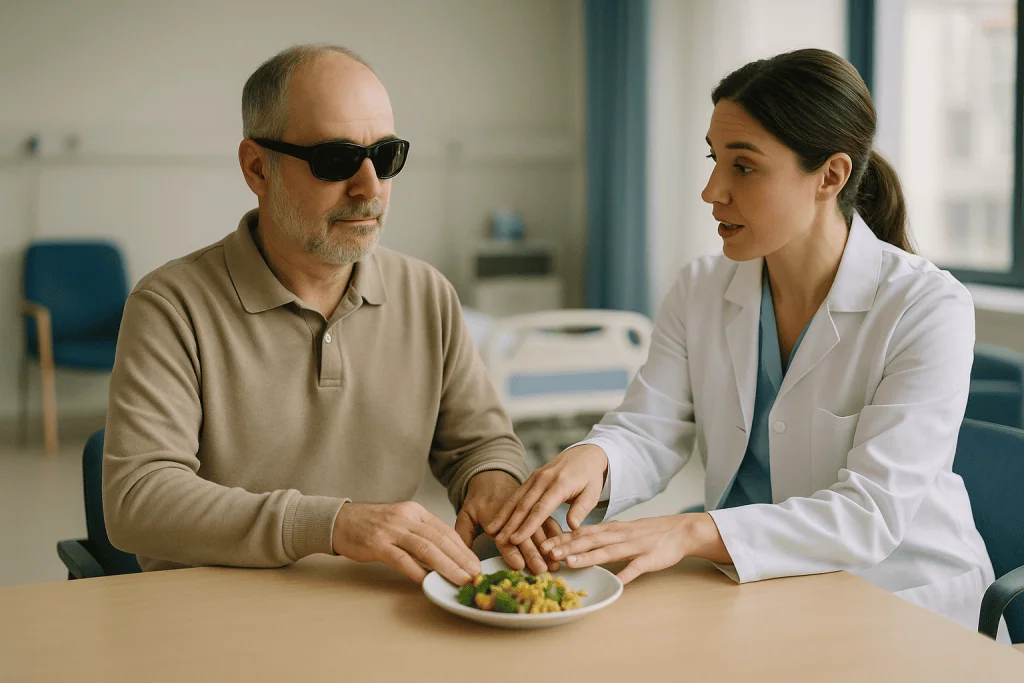
The first job is largely about environment and technique. A well-fitted hearing aid or a cochlear implant, an electronic device that sends sound signals directly to the hearing nerve, restores some access to speech, but only if the speaker sits in good light, at eye level, and finishes one thought before starting the next. Rehabilitation officers teach the family these habits as deliberately as they teach the person with the loss, because the listener cannot compensate for a speaker who mumbles into the fridge.
The second job depends on the brain’s capacity to remap. Research summarized by the NIH shows that touch and proprioception, the sense of where your own hands are, can carry language efficiently once the pattern is learned. The deafblind manual alphabet, in which each letter is a distinct touch on the listener’s hand, is learned much as a child learns to read: slowly, then in chunks, then almost without effort. Tactile sign language works the same way for people who already sign, with the receiver’s hands resting on the signer’s hands to follow shape and movement.
Training is usually delivered by a qualified deafblind specialist, sometimes called a rehabilitation officer for dual sensory loss, an intervenor or a communicator guide depending on the country. Sessions are short and repeated, because tactile attention tires quickly. Progress is measured in fewer misunderstandings per conversation, not in test scores.
Who is usually offered formal training, and who is asked to wait?
Anyone whose combined sight and hearing loss interferes with daily communication, mobility or safety can be referred, and the NHS specifically advises that a person with both losses should have a specialist assessment even when each loss alone seems mild. The interaction is the point. Mild hearing loss plus mild vision loss removes both the ability to lip-read and the ability to hear clearly, which is a greater loss than either alone.
Formal tactile training tends to be prioritized when speech-based communication has become unreliable despite well-fitted aids and good listening conditions, when the person is expected to lose further sight or hearing, as in Usher syndrome, or when isolation is already visible: fewer phone calls answered, meals skipped, a partner doing all the talking at appointments.
Some people are reasonably asked to wait, and it helps to understand why. A relative recovering from a stroke or a hospital admission may be too fatigued to learn a new alphabet, and the team will often start with environmental changes and family coaching first. Someone whose hearing aid or glasses prescription is out of date will usually be sent for updated fitting before tactile methods are introduced, because a device adjustment can change what training is needed. In children with a new diagnosis, the sequence is normally audiology and low-vision assessment, then early-intervention teaching that uses play and objects of reference, small items that stand for an activity, before formal alphabets.
Waiting is not the same as being declined. The clinical judgment is about sequencing, and a good team will explain what comes first and what would trigger the next step. If the explanation is missing, the family is entitled to ask for it.
Supporting a deafblind family member starts with a specialist assessment
Families often arrive at this point holding two separate clinic letters, one from ophthalmology and one from audiology, neither of which mentions the other. A specialist deafblind assessment pulls them together. In England, local authorities have a legal duty to assess anyone who is deafblind, and the NHS advises that the assessment be carried out by, or with input from, someone specifically trained in dual sensory loss. Other countries route this through rehabilitation agencies or community health services, but the elements are broadly the same.

What the assessor looks at is functional, not just measured. A visual field test tells the eye clinic how much peripheral vision remains; the deafblind assessor watches how the person actually finds a cup on a table, whether they notice someone entering the room, how quickly they tire during conversation. Hearing is judged in the person’s own kitchen with the tap running, not only in a soundproof booth.
The written outcome should cover four areas: communication, including which methods to trial first; mobility, both indoors and outside; daily living, from cooking safely to managing correspondence; and social contact, meaning how the person will stay connected with friends, work or worship. It should also name who will deliver each piece of support and when it will be reviewed, since needs change as sight or hearing changes.
Bring to the assessment a short, honest list of the moments that go wrong most often. The tins in the cupboard. The doorbell nobody hears. The bus stop that is now too dangerous. These concrete examples steer the assessor toward solutions faster than a general description of difficulty, and they give the family a shared language for what success will look like.
Deafblind communication methods compared
No single method suits everyone, and many people use two or three depending on the setting and how tired they are. The table below summarizes the approaches most commonly taught, with the situation each fits best. The specialist team decides what to trial; the family’s job is to practice whatever is chosen, consistently.
| Method | How it works | Usually suits | Main limitation |
|---|---|---|---|
| Clear speech with aids | Speaker faces the listener in good light, normal pace, one idea per sentence | People with useful residual hearing | Fails in noise or dim light |
| Deafblind manual alphabet | Each letter is a specific touch on the listener’s hand | People who could read and spell before the loss | Slower than speech; needs practice by every partner |
| Block alphabet | Capital letters traced on the palm with a finger | Brief exchanges with strangers or new carers | Very slow; tiring for long conversations |
| Tactile sign language | Receiver’s hands rest on the signer’s hands to feel shape and movement | People who signed before losing sight | Requires fluent signing partners |
| Braille and tactile print | Raised dots or large, high-contrast text | Reading, labels, written messages | Braille learning takes sustained teaching |
| Social haptics | Agreed touch signals on the back or arm convey environment and emotion | Adding context during any other method | Supplements rather than replaces language |
| Objects of reference | A physical item stands for a person, place or activity | Children and adults with additional learning needs | Limited vocabulary |
Two patterns are worth noticing. Methods that build on a skill the person already has, whether spelling, signing or hearing, are learned faster than methods that start from nothing. And every method has a partner requirement: the family member’s fluency matters as much as the deafblind person’s. Choosing a method the household will not practice is choosing silence.
How to communicate with a deafblind person using their remaining hearing
Most acquired deafblindness leaves useful hearing, and most families waste a good deal of it. The instinct is volume. What actually helps is signal quality.
Start with position. Sit or stand within arm’s reach, at the same height, with the light on your face and not behind you. A window at your back turns you into a silhouette. Get attention before speaking: a light touch on the shoulder or forearm, agreed in advance, tells the person a conversation is coming, so they can turn their better ear or focus their remaining vision. Say who you are each time, even if you are the spouse of forty years, because voices blur when high frequencies are lost.
Then slow down without stretching. Clear speech means finishing each word, pausing between ideas and keeping your hands away from your mouth, not exaggerating lip movements, which distorts the shapes a partial lip-reader relies on. Rephrase rather than repeat: if a sentence was missed twice, the problem is usually a particular sound, and different words will carry the same meaning past it.
Background noise is the great thief. A running dishwasher, a television in the next room or a fan can remove the consonants that make speech intelligible. Turning them off before an important conversation costs nothing. Hearing aids and cochlear implants work best when they are worn consistently, kept clean and checked at review appointments; a device that whistles or sits loosely is a device that will be abandoned in a drawer. Any change to settings belongs to the audiologist.
Finally, confirm rather than assume. A nod is not comprehension. Ask a question that requires a specific answer, and accept that conversations will be shorter and more purposeful than before. Depth of contact matters more than length.
Making remaining vision work harder: light, contrast and clutter
Vision that would count as poor on an eye chart can still do useful work at home, provided the home cooperates. Low-vision specialists focus on three levers: lighting, contrast and predictability.
Lighting comes first because it is cheap and immediate. Many people with macular degeneration or diabetic retinopathy see far better under bright, even, glare-free light than under a single ceiling bulb. Task lamps angled onto the work surface, not into the eyes, help with reading and cooking. Night-time routes from bed to bathroom benefit from low-level plug-in lights, since the eye adapts to darkness more slowly with age and with retinal disease.
Contrast is the second lever. A white cup on a white worktop disappears; the same cup on a dark mat is findable. Edges of steps marked with a contrasting strip, dark tape around a light switch, a coloured band on the rim of a favourite glass: none of this needs specialist equipment. Printed material works best as large, bold, black text on matte cream or white paper, with generous spacing. Glossy paper reflects light straight into the eyes and should be avoided.
Predictability is the lever families find hardest, because it asks everyone in the house to change habits. A chair left pulled out, a bag dropped in a hallway or a rearranged shelf can undo a week of confidence. Agree that furniture stays where it is and that anything moved is announced. Keep frequently used items in fixed, reachable spots, and return them there every time.
Magnifiers, electronic readers and screen software can extend what vision can do, but they should be trialled with a low-vision professional rather than bought on a guess. The right tool depends on which part of the visual field is lost, and that varies from one eye condition to the next.
Touch as a language: the deafblind manual alphabet, block letters and tactile signing
Learning to speak into someone’s hand feels strange for about a week and natural thereafter. Families who commit to it describe the same turning point: the first joke that lands by touch alone.
The deafblind manual alphabet, used mainly in the UK and Ireland, assigns each letter a distinct position or movement on the listener’s hand. The five vowels sit on the fingertips, from thumb to little finger, and consonants use recognizable shapes elsewhere on the hand. A speaker with normal vision can learn the whole alphabet in a few sessions; fluent, conversational speed takes daily practice over months, and the specialist team will set a realistic pace rather than a deadline. Other countries use hand-over-hand fingerspelling based on their national sign language alphabet, and the same learning curve applies.
The block alphabet is the fallback everyone should know. Capital letters are traced, one at a time, on the flat of the listener’s palm, usually with the index finger. It is slow and tiring, but it needs no training on the receiver’s side, which makes it valuable for hospital staff, taxi drivers and neighbours. A laminated card explaining it, kept in a coat pocket, can rescue an otherwise stranded afternoon.
Tactile sign language serves people who already sign and are losing sight, the typical pattern in Usher syndrome. The receiver places their hands lightly over the signer’s hands and follows the movement, space and hand shape. It is not a separate language but the same one delivered through touch, so hearing family members who learned to sign before the sight loss have a head start.
Social haptics, sometimes called pro-tactile communication, adds a layer that words cannot. An agreed tap pattern on the shoulder can mean someone has entered the room; a hand drawn across the back can sketch the layout of a space. These signals reduce the constant, exhausting question of what is happening around you.
Deafblind mobility training: sighted guiding and the long cane
Falls and near-misses are what push most families to seek help, and mobility is where professional training pays back fastest. Orientation and mobility training, taught by a specialist, covers how a person knows where they are, how they get where they are going, and how the people around them help without taking over.
Sighted guiding is the skill every family member should learn properly, because most of us do it wrong. The person being guided holds the guide’s arm just above the elbow, from behind and slightly to one side, so that the guide’s body movements telegraph what is coming. The guide does not push, pull or steer by the shoulders. Approaching a narrow gap, the guide moves the guiding arm behind their own back, and the person steps in behind. At stairs, the guide pauses, says or signals whether the steps go up or down, and moves so that the person can feel the first edge with a foot before committing. Seating is offered by placing the person’s hand on the back or arm of the chair, never by lowering them into it.
The long cane extends the reach of the feet by a stride and gives advance warning of kerbs, steps and obstacles. In the UK, a cane banded in red and white tells the public that the user has both sight and hearing loss, which matters because a shouted warning will not be heard. Cane technique is taught, not picked up; the sweep width, the timing with each step and the grip all affect whether it protects or trips.
Guide dogs suit some people and not others. They need consistent handling and a daily routine, and the assessment for suitability is thorough. Whatever the method, the training team will practice actual routes: the pharmacy, the bus stop, the daughter’s front gate. Confidence is route-specific at first and widens from there.
Safety routines at home that actually reduce risk
Safety for a deafblind relative is less about gadgets than about routines that hold when nobody is watching. Start with the alarms. Standard smoke alarms are useless to someone who cannot hear them; the alternatives are alarms wired to a strobe light and to a vibrating pad placed under the pillow, so that a fire at night still wakes the sleeper. Doorbells, phones and carbon monoxide detectors have vibrating or flashing equivalents, and a specialist assessor can advise which combination fits the home. Test them on a fixed day each month, together.
Next, the layout rules already described for vision: furniture stays put, doors are either fully open or fully closed (a half-open door is an edge at head height), floor coverings are flat and fixed, and trailing flexes are taped away. Stairs deserve a handrail on both sides and a contrasting strip on the top and bottom step.
In the kitchen, tactile markers on the cooker dial and microwave help the person find settings by feel. Bump-on dots, small raised stickers, can mark the off position, the most used temperature and the start button. Sharp knives live in one place, blade down. Boiling water is poured with the cup on the worktop, never held.
Medicines are a specific risk because labels are small and packaging looks alike. A pharmacist can arrange large-print or tactile labels and can discuss packaging that separates doses by day, so that the person or a carer can check what has been taken. Any question about what a medicine is for, or whether to change it, stays with the prescriber.
Finally, agree an emergency routine. Who checks in daily, by what method, and what happens if the check is missed. A card in the wallet stating the person is deafblind and how to communicate with them turns a confusing encounter with paramedics into a manageable one.
What the first weeks of supporting a deafblind family member usually look like
There is no fixed timetable, and any professional who offers one is guessing. What the NHS and rehabilitation services describe instead is a sequence, and it helps to know the shape of it.
The early period is dominated by assessment and adjustment rather than new skills. Hearing aids may be refitted, glasses updated, and the assessor will visit the home at least once to see how the person actually moves and communicates. Expect several appointments in different buildings, each of which needs a guide, and expect the person to be tired afterwards. Sensory effort is genuine effort; a two-hour clinic visit can wipe out an afternoon.
The middle stretch is when environmental changes land and family coaching begins. Lighting is improved, contrast added, alarms fitted. Everyone in the household learns to announce themselves, to sit in the light, to stop shouting. Small wins arrive here: a conversation that did not need repeating, a kettle filled without spills. So do frustrations, because old habits reassert themselves the moment someone is in a hurry.
Formal tactile methods, if chosen, usually start once devices are stable. Sessions are short and frequent. The deafblind person learns to receive; the family learns to send. Both sides make mistakes and both sides need permission to laugh about it. Progress is uneven, and a bad week, often driven by illness or a poor night’s sleep, does not mean the method has failed.
Throughout, one person in the family tends to become the coordinator, keeping track of appointments, equipment and who has learned what. That role is real work. Naming it, and sharing it where possible, prevents the quiet burnout that follows when it goes unrecognized. Review dates should be written down at the outset so that nobody has to chase them later.
Isolation, mood and carer strain: the part nobody schedules
Ask deafblind adults what is hardest and few say the stairs. They say the silence at family gatherings, the dinner where the conversation flows past them, the friend who stopped calling because the phone became too difficult. The NHS lists social isolation and low mood among the most common consequences of dual sensory loss, and they are preventable in a way that the sensory loss itself often is not.
Isolation is structural before it is emotional. Each barrier removed, a working doorbell, a route to the shops, a friend who learns the block alphabet, restores a thread of contact. Families can be deliberate about this. At a meal, one person takes the role of relay, summarizing the conversation into the person’s hand or ear in short bursts rather than leaving them to guess. Group settings are the most excluding environments; one-to-one time is where connection survives.
Depression and anxiety are more common in people with sensory loss than in the general population, and the symptoms can be missed because withdrawal is mistaken for the loss itself. Loss of interest in previously enjoyed activities, changed sleep or appetite, or comments about being a burden warrant a conversation with the GP or family doctor. Talking therapies can be adapted for deafblind people, and the referral should specify the communication method so that the therapist is prepared.
Carers carry their own load. Being the interpreter, guide and coordinator for someone you love is meaningful and exhausting in equal measure, and the two feelings do not cancel out. Respite, peer support groups for families living with deafblindness, and honest conversations with the assessment team about what is sustainable are not luxuries. A carer who collapses helps nobody. Most local authority and health systems offer a separate carer’s assessment; asking for it is a sign of planning, not failure.
What people often get wrong
Some misunderstandings recur so reliably that correcting them early saves months.
The first is that deafblind means total darkness and total silence. Most people with the condition see something and hear something, and the whole point of rehabilitation is to make that residual sense count. Treating a person as if they perceive nothing removes cues they could have used.
The second is that shouting helps. Loud speech distorts the vowels that a person with high-frequency hearing loss can still catch and makes lip-reading harder because the mouth moves abnormally. Clear, unhurried speech at normal volume, in good light, works better.
The third is that communication training is for the deafblind person alone. Every method in the table above has a sending side, and the family member is the one who sends. A relative who learns the manual alphabet and then never uses it has learned nothing useful.
The fourth is that the person should be steered by the shoulders or pulled by the hand. Both remove the information a guided person gets from the guide’s body movement and are a frequent cause of trips. Proper sighted guide technique takes twenty minutes to learn and is worth every one.
The fifth is that technology solves it. Devices help enormously when matched to the specific loss and used consistently, but a tablet with large text does not replace a door that stays closed or a neighbour who knows how to say hello. Behaviour and environment come first; equipment amplifies them.
The last is that decline means the effort was wasted. Progressive conditions such as Usher syndrome change what is needed over time. Skills learned early, especially tactile ones, are precisely what make later changes survivable. The team will adjust methods as sight or hearing shifts; the family’s job is to keep practicing what currently works.
Questions to ask your care team
Appointments are short and sensory effort is high, so go in with questions written down and hand the list to the clinician if speaking is slow. These are the ones that tend to change what happens next.
- Has my relative had a specialist deafblind assessment, as distinct from separate eye and hearing reviews, and who carried it out?
- Which communication methods do you recommend trialling first, and why those over the alternatives?
- Who will teach the family, not just my relative, and how many sessions are planned before review?
- Is the current hearing aid or implant programming and the glasses prescription up to date, and should either be adjusted before training begins?
- What is the likely course of the underlying eye and ear conditions, and what changes would prompt you to revisit the plan?
- Can you refer for orientation and mobility training, and will it include the specific routes my relative actually needs?
- What alarm and alerting equipment do you advise for this home, and who fits and maintains it?
- How do we get medicines labelled in a form my relative can read or feel, and who do we call if something is unclear?
- Are there signs of low mood or isolation we should watch for, and how would we access counselling adapted for deafblind people?
- Is a separate carer’s assessment available, and how do we request it?
- Who is our named point of contact, and by what method can they be reached given my relative’s communication needs?
Write down the answers, or ask permission to record them, and share them with everyone in the household. The plan only works when every family member is working from the same one. If an answer is uncertain, ask what would need to happen for it to become clear; good teams will tell you what they are waiting for.
When to call your doctor
Most of this guide concerns slow, patient adjustment. Some situations are different and need same-day medical attention or emergency services. Because a deafblind person may not notice or be able to report a change, families should know these signs.
Call emergency services for a sudden further loss of vision in one or both eyes, a sudden drop in hearing, a new severe headache, or any facial drooping, arm weakness or change in speech. Each can indicate a stroke, a retinal detachment or sudden sensorineural hearing loss, all of which are time-critical. Severe eye pain with a red eye, nausea and blurred vision can signal acute glaucoma and also needs urgent care.
Seek same-day advice after any fall that involves a blow to the head, loss of consciousness, inability to bear weight, or a person taking blood-thinning medicines, even if they seem fine. New confusion, unusual drowsiness or a sudden change in behaviour in an older adult can indicate infection, dehydration or medication problems and should not be attributed to the sensory loss.
Contact the GP promptly for signs of infection around a cochlear implant or hearing aid site, such as redness, swelling, discharge or fever; for a suspected medicine mix-up; for persistent dizziness or new balance problems, which are relevant in Usher syndrome type 1; and for signs of depression, including withdrawal, changed sleep or appetite, or any expression of not wanting to go on. Talk of self-harm is always an emergency.
When you call, say clearly that the person is deafblind and state how they communicate, so that responders arrive prepared. Keep a written summary of conditions, devices and current medicines where any family member can find it. The treating team makes the clinical decisions; the family’s role is to notice early and to describe what changed.
Frequently asked questions
How do I start supporting a deafblind family member if I have no training?
Begin by asking the GP or local authority for a specialist deafblind assessment, which the NHS recommends for anyone with combined sight and hearing loss. While waiting, change what you can control: announce yourself with an agreed touch, speak clearly in good light at normal volume, keep furniture in fixed positions and remove trailing cables. These habits cost nothing and are the same ones professionals teach first.
What are the main deafblind communication methods?
The main methods are clear speech supported by hearing aids or a cochlear implant, the deafblind manual alphabet spelled onto the hand, the block alphabet traced on the palm, tactile sign language for people who already sign, Braille or large-print text, and social haptics using agreed touch signals. Most people combine two or more, and the specialist team decides which to trial based on residual sight, residual hearing and prior skills.
How do you communicate with a deafblind person you have just met?
Approach from the front if they have any vision, then touch the back of the hand or forearm lightly to signal you are there. Introduce yourself by name. If speech is not understood, use the block alphabet, tracing capital letters slowly on their palm with your finger. Ask yes or no questions and wait for a clear response. Many deafblind people carry a card explaining their preferred method; look for it or ask.
What does deafblind mobility training involve?
Orientation and mobility training is delivered by a specialist and covers sighted guide technique for the family, long cane skills for the individual, and practice on the specific routes the person actually uses, such as a local shop or a relative’s house. It also addresses indoor movement, stairs and doorways. Guide dog suitability is assessed separately. Confidence tends to build route by route rather than all at once.
Is there Usher syndrome family support, and what does it focus on?
Support for families affected by Usher syndrome typically comes through the specialist deafblind service, genetics clinics and peer groups. The focus is on planning ahead: because hearing loss usually comes first and sight loss later, teams often introduce tactile communication and mobility skills while vision is still useful, so that later change is less disruptive. The NIH describes three types with different timelines, and the care team will explain which applies.
Can hearing aids or cochlear implants help someone who is deafblind?
They can, when hearing loss is a suitable type and the device is well fitted and worn consistently. A cochlear implant sends sound signals directly to the hearing nerve and is considered when hearing aids no longer give useful benefit. Neither device restores normal hearing, and both work best alongside good listening conditions and clear speech. Suitability, programming and any changes are decided by the audiology and ear, nose and throat team.
What home changes make the biggest difference for a deafblind relative?
Bright, even, glare-free lighting; strong colour contrast on steps, switches and worktops; furniture and belongings kept in fixed places; doors either fully open or fully closed; and alarms that flash or vibrate rather than sound. Tactile markers on cooker dials and medicine packaging help with daily tasks. A specialist assessor can advise on which equipment fits the home, but the behavioural rules matter as much as the hardware.
How long does it take to learn the deafblind manual alphabet?
The letters themselves can be learned in a few sessions by a sighted family member, but conversational speed depends on daily practice and there is no fixed timetable in the clinical guidance. Rehabilitation officers set a pace suited to the person’s fatigue and other commitments. Progress is judged by fewer misunderstandings in real conversations, and a slow week during illness does not mean the method has failed.
Why is my deafblind parent withdrawing from family gatherings?
Group conversations are the hardest setting for someone with dual sensory loss, because voices overlap, lighting is uneven and nobody addresses them directly. Withdrawal often reflects exhaustion and exclusion rather than lack of interest. Appoint one relay person to summarize into their hand or ear in short bursts, offer one-to-one time, and watch for persistent low mood, changed sleep or comments about being a burden, which warrant a conversation with the GP.
When should a deafblind person be seen urgently by a doctor?
Seek emergency care for sudden further loss of vision or hearing, a new severe headache, facial drooping, arm weakness or changed speech, or severe eye pain with a red eye and nausea. A fall involving a head injury, loss of consciousness or inability to bear weight also needs same-day attention, as does new confusion or drowsiness. Tell responders the person is deafblind and how they communicate.
References
- NHS: Deafblindness
- NIH National Institute on Deafness and Other Communication Disorders: Usher Syndrome
- MedlinePlus Genetics: Usher syndrome
- WHO Fact Sheet: Deafness and hearing loss
This article is for general information only and is not a substitute for professional medical advice. Please consult a qualified doctor about your individual situation.

More from the Blog

Medication-Overuse Headache: Why Headache Medicine Plans Watch Pain Reliever Use Closely
Medication-overuse headache is a near-daily headache that develops when acute pain relievers are taken on many days each month for several months, so the…

What Does an MRI Show in Spinal Cord Disorders, and Which Other Tests Follow?
An MRI shows the spinal cord itself in fine detail: swelling, inflammation, compression from a disc or bone, tumors, bleeding, fluid-filled cavities and scarring.…

Living With Peripheral Neuropathy: Foot Care, Balance Training and Daily Safety
Living with peripheral neuropathy is usually a matter of protecting what you cannot fully feel and strengthening what you can still control. Daily foot…

MRI, Lumbar Puncture or Evoked Potentials: Which Tests Confirm a Demyelinating Disease?
No single test confirms a demyelinating disease. Doctors combine a neurological examination with MRI of the brain and spinal cord, which shows areas of…
How Deep Brain Stimulation Surgery Is Performed: Electrodes, Testing and the Pulse Generator
Deep brain stimulation surgery is usually performed in stages. Surgeons use MRI and CT images to plan a target deep in the brain, open…

Inside Microvascular Decompression: How Trigeminal Neuralgia Surgery Cushions the Nerve
Microvascular decompression is an operation for trigeminal neuralgia in which a surgeon opens a small window in the skull behind the ear, finds the…