

Tendon Surgery for Athletes and Manual Workers: How Return to Load Is Planned
Key Takeaways
- Pooled trial data in a BMJ meta-analysis found Achilles surgery lowers re-rupture risk (about 2.3% versus 3.9%) but roughly triples other complications such as infection compared with structured non-surgical care.
- Mayo Clinic reports that most people, treated with or without surgery, return to their former level of activity within about four to six months of an Achilles rupture.
- Cleveland Clinic notes that full return to sport after Achilles repair can take up to around a year, and some people keep a measurable strength difference on the repaired side.
- Tendon collagen keeps remodeling for many months after the skin heals, which is why the period when the limb first feels normal is the most common time for re-injury.
- Modern return-to-load plans pair minimum healing times with measured criteria, such as strength symmetry and single-leg heel-raise tests, before allowing running, jumping or heavy work.
- Untreated complete ruptures allow the tendon ends to retract and the muscle to waste, so a delayed repair more often needs a graft or tendon transfer rather than direct stitching.
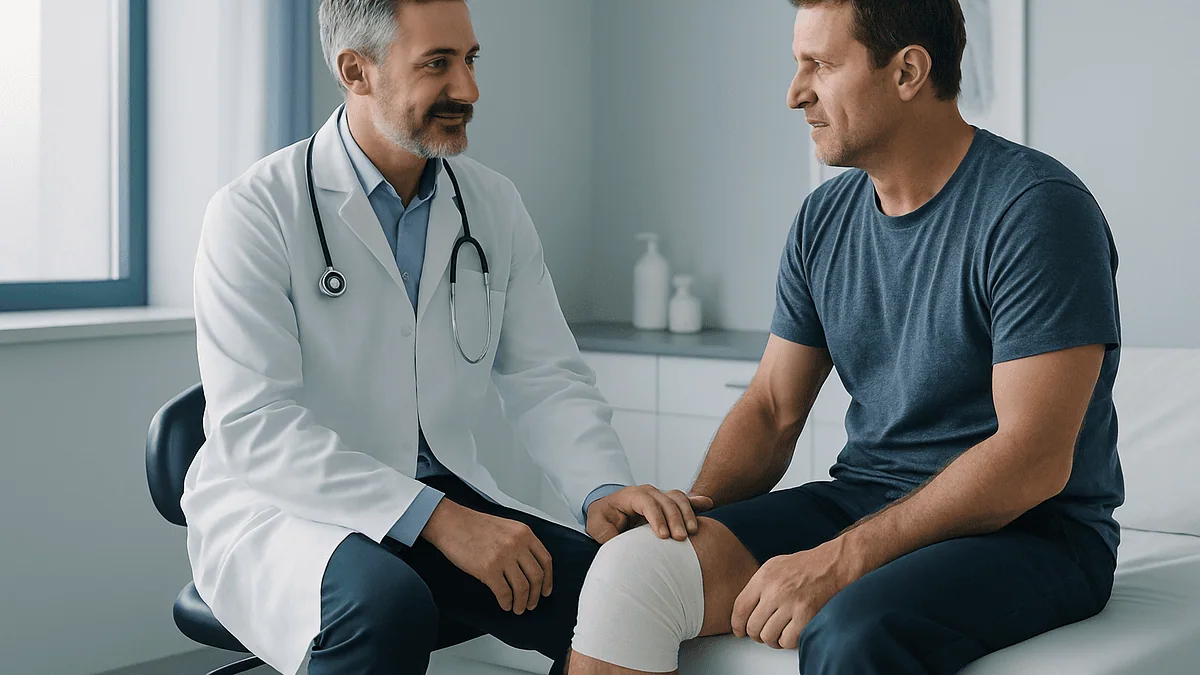
Tendon surgery for athletes and manual workers stitches or reconstructs a torn tendon, then relies on a staged rehabilitation plan that adds load gradually. Teams typically protect the repair first, restore motion and strength next, and clear sport or heavy work only when measured criteria are met. Evidence suggests surgery and structured non-surgical care can give comparable function for many tears, so the decision rests with the treating team.
The roofer felt it before he heard it: a sharp snap behind the heel while stepping off a ladder, then the strange sensation of a calf that would not push. Across town, a masters sprinter felt the same thing coming out of the blocks. Both men asked the same two questions in the emergency department. Will I need an operation? And when can I get back to what I do?
Those are the right questions, and they are harder to answer than most headlines admit. Tendon surgery for athletes and manual workers is not one decision but a chain of them, stretching from the operating table to the day someone is cleared to lift, jump or climb again. The stitching takes an hour or two. The return to load takes months, and it is planned with a discipline that surprises many patients.
This article walks through what actually happens, what the evidence supports, and how a careful team decides when a repaired tendon is ready for real work.
What tendon surgery for athletes and manual workers actually involves
A tendon is the cord of dense collagen that connects a muscle to bone; when the muscle contracts, the tendon transmits that pull. A rupture is a complete tear across that cord, and a partial tear or long-standing degeneration is often called tendinopathy. Surgery becomes a conversation when the tendon has torn through, when the ends have pulled apart, or when a chronic problem has failed structured rehabilitation.
For a fresh, complete rupture, the operation is conceptually simple. The surgeon exposes the two frayed ends, trims damaged tissue and stitches them together with strong suture so the repair can hold while biology does the slow work of knitting collagen back across the gap. This can be done through an open incision or through smaller cuts with instruments passed under the skin, an approach usually described as minimally invasive. Mayo Clinic notes that both approaches are in common use for the Achilles tendon and that the choice depends on the tear, the patient and the surgeon.
Where a tendon has pulled off the bone, as with many rotator cuff and distal biceps tears, the repair anchors the tendon back into a prepared bed on the bone rather than tendon to tendon. MedlinePlus describes rotator cuff repair as reattaching the tendon to the upper arm bone, often using small anchors, and notes it may be done arthroscopically, through open surgery, or a combination.
Older or neglected tears sometimes need more than stitches. If the ends have retracted and cannot meet, the surgeon may bridge the gap with tissue borrowed from nearby (a graft) or reroute another tendon to take over part of the job (a tendon transfer). Each of these definitions matters later, because the type of repair shapes how quickly load can be added.
Why load is the whole point: how tendons heal
Tendon healing is slow because tendon is metabolically quiet tissue. Blood supply is modest, cells are sparse, and the collagen that eventually forms is laid down as disorganized scar before it slowly remodels into the parallel fibers that give a healthy tendon its strength. Johns Hopkins describes this as a process that continues for many months after the injury, long after the skin has closed and the swelling has settled.
Here is the tension at the heart of every rehabilitation plan. Load is both the enemy and the medicine. Too much force too early can stretch or pull apart a repair that is still held together mostly by stitches. Too little load leaves the new collagen weak, disorganized and prone to the elongation that quietly costs athletes their push-off power. Tendon cells respond to mechanical stress by reorganizing fibers along the line of pull, which is why rehabilitation is now built around progressive loading rather than long periods of complete rest.
Mayo Clinic reflects this shift, noting that early controlled movement and weight bearing, rather than prolonged immobilization, are now common after both surgical and non-surgical management of Achilles ruptures. The word that matters is controlled. A walking boot with a raised heel, a sling with a fixed elbow angle, or a knee brace locked in extension all serve the same purpose: they let some safe force reach the tendon while blocking the specific movements that would threaten the repair.
Once you see rehabilitation as a dose of mechanical stimulus that must be increased carefully, the rest of return-to-load planning makes sense. The team is not waiting for a calendar date. It is titrating a stimulus to a tissue that cannot be rushed.
Surgery or not for an Achilles rupture: what the evidence shows
The Achilles has become the test case for a broader question in tendon care: does an operation actually beat a good non-surgical program? For decades the answer seemed obvious. Surgery restored the anatomy directly, so surgery had to be better. Research has complicated that picture.
A systematic review and meta-analysis published in the BMJ and indexed in PubMed pooled randomized trials and observational studies comparing operative with non-operative treatment. Operative repair reduced the risk of the tendon tearing again, about 2.3% versus 3.9%, but carried a higher rate of other complications such as wound infection and nerve irritation, about 4.9% versus 1.6%. Functional outcomes and return to sport did not differ meaningfully between groups when the non-surgical arm used early, structured rehabilitation.
Mayo Clinic summarizes the same body of work plainly, stating that recent studies have shown fairly equal effectiveness of operative and non-operative management for Achilles rupture. Cleveland Clinic likewise lists both routes as standard options and frames the choice around age, activity level and personal circumstances rather than one path being correct.
What this means for the roofer and the sprinter is not that surgery is unnecessary. It means the trade-off is real and specific. Surgery buys a lower chance of re-rupture and, some surgeons argue, better preservation of tendon length in people who load hard. In exchange it introduces wound and nerve risks that a boot does not. Someone whose livelihood depends on explosive calf strength may weigh those differently from someone whose priorities are avoiding an incision and getting back to walking. That weighing is the treating team’s job, done with the person in front of them.
Who is usually offered tendon surgery, and who is asked to wait
Selection is rarely about how athletic someone looks. It is about the anatomy of the tear, the timing, the demands the tendon will face and the risks of an operation for that particular body.
People who are commonly offered surgery include those with a complete rupture where imaging or examination shows the ends sitting apart when the joint is placed in a relaxed position, because a gap is harder for the body to bridge on its own. Tendons that have torn off bone, such as many full-thickness rotator cuff tears in younger active people or distal biceps ruptures in strength athletes, are also frequently repaired, since a tendon that has lost its anchor cannot reattach without help. MedlinePlus notes that rotator cuff repair is generally considered when symptoms persist despite non-surgical care, or when a tear results from an acute injury in an active person.
Others are usually asked to wait, or offered a non-surgical route first. Partial tears and chronic tendinopathy respond in many cases to a structured loading program; the NHS advises that Achilles tendinopathy is typically managed with activity modification and exercises for weeks to months before any procedure is considered. Fresh Achilles ruptures whose ends appose in a boot may be managed non-operatively with the functional rehabilitation described above.
The team also looks hard at healing risk. Diabetes, smoking, poor circulation, skin problems near the incision and certain medicines all raise the chance of wound trouble, and Mayo Clinic lists infection and nerve damage among the recognized risks of Achilles surgery. In those situations, the safer path may be to avoid an incision altogether. Waiting is not neglect. It is often a deliberate clinical choice.
When is it too late for tendon surgery?
This question comes up more often than surgeons would like, usually from someone who assumed the pain would settle, kept working and only sought care once the leg or arm stopped doing its job. The honest answer is that it is rarely absolutely too late, but delay changes what surgery can offer and how hard recovery becomes.
Two things happen when a complete rupture goes untreated. The muscle, no longer tethered, shortens and the tendon ends retract, so a gap opens that stitches alone cannot close. And the muscle itself, deprived of normal tension, begins to waste and fill with fat, a process that Johns Hopkins and Cleveland Clinic both describe as a reason prompt evaluation matters. A muscle that has been slack for months will never regain quite the same power even if the tendon is restored.
Surgeons therefore divide tears into acute and chronic, and the precise boundary varies between guidelines and between tendons. What is consistent is the principle: the earlier a complete rupture is assessed, the more likely a direct end-to-end repair is possible. Chronic ruptures more often require the graft or tendon transfer techniques described earlier, which carry longer protected periods and typically less predictable strength.
For rotator cuff tears the same logic applies. MedlinePlus explains that large, long-standing tears with muscle wasting may not be fully repairable, and alternative procedures may be discussed instead. So the practical message is not a deadline but a direction. If a tendon may have torn, get it examined sooner rather than later, and let the team explain which options remain open.
Is tendon repair surgery successful? An honest read of the evidence
Patients ask this hoping for a single percentage. The responsible answer is that success has several meanings, and the evidence supports some more firmly than others.
If success means the repaired tendon staying intact, the data are reassuring for acute Achilles repair: the BMJ meta-analysis cited above found a re-rupture rate of around 2.3% after surgery. If success means returning to the prior level of activity, Mayo Clinic notes that most people, whether treated surgically or not, do so within roughly four to six months. Cleveland Clinic adds that a full return to sport can take up to around a year, and that some people notice lasting differences in calf strength or push-off compared with the uninjured side.
That last point is where honesty matters most. Return to activity is not the same as return to prior performance. Athletes in explosive sports may find their repaired side slightly weaker or the tendon slightly longer, and manual workers may notice fatigue on ladders or when kneeling for long periods. These are common, not catastrophic, and good rehabilitation reduces them, but no surgeon can promise their absence.
For rotator cuff repair, MedlinePlus is similarly measured: most people regain useful strength and pain relief, recovery commonly takes four to six months, and outcomes depend heavily on tear size, tissue quality and adherence to rehabilitation. Notice the pattern across tendons. The operation sets the stage. Biology, time and the loading program determine how the story ends. That is why this article spends more words on planning than on suturing.
Achilles tendon repair recovery time: what the first days and weeks look like
The first fortnight is about protecting two things: the wound and the repair. Most people leave the hospital the same day or the next, with the ankle held in a splint or boot pointing the foot slightly downward so the stitched ends sit close together without tension. Elevation above heart level, wound care and short bouts of walking on crutches fill the days. Pain is usually most noticeable in the first several days and then eases, according to Cleveland Clinic.
The first follow-up visit typically checks the incision and confirms the repair feels secure. From here, Mayo Clinic describes a shift toward functional rehabilitation: a removable boot with heel wedges, gradual weight bearing as tolerated, and gentle movement exercises under physical therapy guidance. Wedges are removed one at a time over subsequent weeks to bring the ankle toward neutral, which slowly increases the stretch and load on the healing tendon.
Somewhere in the middle weeks the boot comes off for walking indoors, and this is when many people feel a jolt of vulnerability. The calf is visibly smaller. The ankle feels stiff and the heel rises awkwardly. This is normal and expected; the muscle has been unloaded for weeks and will rebuild.
The precise sequence differs between surgeons and between tendons. Rotator cuff repairs, MedlinePlus notes, often involve a sling and passive motion only in the early weeks, with active lifting deferred. Distal biceps and quadriceps repairs follow their own protocols. What every protocol shares is a first phase in which the patient does less than they feel capable of, because the tissue’s strength lags well behind how the limb feels.
How return to load is planned: the phase model
Rehabilitation teams tend to think in phases, each with a purpose, entry criteria and exit criteria. The exact durations shift with the tendon, the type of repair and the individual, so the table below shows structure rather than a schedule. Overall timelines from Mayo Clinic and Cleveland Clinic suggest that return to former activity commonly takes four to six months and full sport up to about a year for Achilles repair.
| Phase | Main goal | What load looks like | Typical gate to next phase |
|---|---|---|---|
| Protection | Wound healing, repair security | Boot or brace, partial weight bearing, gentle range of motion | Healed incision, pain settled, repair intact on exam |
| Restoration | Regain joint motion and basic muscle activation | Progressive weight bearing, isometric and light resisted work | Near-full range of motion, normal walking pattern |
| Strengthening | Rebuild tendon and muscle capacity | Heavy slow resistance, single-leg or single-arm work | Strength approaching the uninjured side on measured tests |
| Power and reactivity | Prepare tendon to store and release energy | Hopping, jumping, plyometrics, work-task simulation | Symmetric hop or lift tests, confident performance |
| Return to sport or work | Full unrestricted activity | Graded exposure to training or shifts, then competition or full duties | Criteria met plus team consensus |
Plyometrics, for anyone unfamiliar with the term, are explosive movements such as hops and bounds that train a tendon to absorb and return energy quickly. They sit late in the plan for a reason: a hop can load the Achilles with several times body weight, a force that a young repair cannot tolerate.
The elegance of the phase model is that it makes the invisible visible. Instead of a vague instruction to take it easy, the patient knows exactly which gate they are approaching and what they need to demonstrate to pass through it.
Time-based versus criteria-based: what 'cleared' really means
Older protocols were time-based: at week six, remove the boot; at month four, start running. They were easy to follow and easy to print. They were also blind to the person in the boot. Two people with identical operations can heal at different speeds because of age, tissue quality, nutrition, sleep, other health conditions and how faithfully they did their exercises.
Modern plans blend time with criteria. Time still matters, because collagen remodeling cannot be hurried and there are biological minimums before certain forces are safe. Criteria then act as a second lock. Before running, for example, a therapist might want to see full pain-free ankle motion, a normal walking pattern without a limp, and a set number of single-leg heel raises approaching the count and height achieved on the other side. Before jumping, they might want symmetric strength on a dynamometer, a device that measures the force a muscle produces, and calm tissue the next morning after a test session.
Clearance, in this framework, is not a single signature. It is a series of small demonstrations, each of which reduces the odds of overloading tissue that is not ready. Mayo Clinic frames rehabilitation as continuing until strength and function are restored, rather than for a fixed period, and MedlinePlus makes the same point about rotator cuff recovery depending on tear size and individual progress.
Patients sometimes feel these gates as obstacles. It helps to see them as the reason the plan can be trusted. When a therapist says a tendon is ready for the next load, it is because it has already proved it can handle the one before.
Return to work for manual workers: planning a graded return
Athletes have coaches, off-seasons and the option of sitting out a match. A plumber, electrician or warehouse picker often has none of those, and this reality reshapes return-to-load planning in ways that are easy to underestimate.
The first step is a job demands analysis, a structured description of what the work actually requires: how much is lifted and how often, whether it involves ladders, kneeling, crawling in roof spaces, overhead reaching or sustained gripping, and how far and on what surfaces the worker moves. A repaired Achilles faces a very different test on a scaffold than in an office chair. A repaired rotator cuff is challenged more by installing ceiling fixtures than by driving a forklift.
With that map, the team and, where available, an occupational health service build a graded return. Early phases might allow light duties on level ground with no ladders, no heavy carrying and frequent breaks. Later phases reintroduce specific tasks one at a time, mirroring the strengthening and power stages in the rehabilitation table. Work simulation in the clinic, such as loaded step-ups, carrying tasks or kneeling tolerance, offers a controlled rehearsal before the real thing.
Two hazards deserve plain naming. The first is uneven or unpredictable ground, which demands the rapid ankle corrections a healing Achilles handles poorly. The second is fatigue. A tendon that copes well for an hour may fail its owner near the end of a long shift, so restricted hours can be as important as restricted tasks in the middle phase.
None of this is a checklist to apply alone. It is a conversation between worker, employer, surgeon and therapist, with the treating team setting the medical limits.
Return to sport after tendon surgery: the extra steps athletes face
Sport adds three demands that ordinary life does not: high speed, high force and unpredictability. A sprinter’s Achilles, a volleyball player’s patellar tendon or a climber’s finger flexors face peak loads far beyond walking or lifting, often with a split second to react. The final phases of return-to-load planning exist to rehearse exactly those conditions before competition does.
After strength symmetry is achieved, the program layers in energy storage and release. Bilateral hopping precedes single-leg hopping. Straight-line running precedes cutting and changes of direction. Practice drills without contact precede full training. Each step is monitored not only for pain during the session but for how the tendon feels the next morning, since delayed stiffness is a classic early warning that load has outpaced capacity.
Cleveland Clinic notes that full return to sport after Achilles repair can take up to about a year, and that some athletes notice enduring differences in strength or endurance on the repaired side. This is one reason the psychological side of return is taken seriously. Fear of movement, sometimes called kinesiophobia, can lead an athlete to unconsciously protect the repaired limb, which shifts load to other joints and can raise the risk of a new injury elsewhere. Confidence is therefore treated as a criterion in its own right, not a nice extra.
Finally, return to training and return to competition are separated deliberately. Weeks of unrestricted practice give the tendon a chance to prove itself under realistic loads before the adrenaline and unpredictability of a match are added. Teams that respect this gap are not being cautious for its own sake. They are protecting the months of work already invested.
Pain relief, clot prevention and medicines: mechanisms, not doses
Medicines play a supporting role after tendon surgery, and understanding why they are used makes it easier to follow the plan without anxiety. What follows describes mechanisms and typical timelines only; every decision about which medicine, whether to take it and for how long sits with the prescribing clinician.
Pain control in the first days usually combines simple analgesics with local measures such as elevation and cold. Some clinicians are cautious with non-steroidal anti-inflammatory drugs in the early healing window because these medicines work by dampening prostaglandins, chemical messengers involved in both pain and the inflammatory phase that kicks off tissue repair. Evidence on whether this affects tendon healing in humans is mixed, and practice varies, so it is a question to ask rather than a rule to assume.
Blood clots deserve specific attention after lower-limb tendon surgery. Immobilization in a boot, reduced walking and the surgery itself all slow venous return from the calf, which raises the risk of deep vein thrombosis, a clot in a deep leg vein. Mayo Clinic lists blood clots among recognized risks of Achilles surgery. Prevention typically relies on early mobilization, moving the toes and unaffected joints frequently, staying hydrated and, in some people the team judges higher risk, a short course of an anticoagulant, a medicine that reduces the blood’s tendency to clot. Whether that applies to a given patient is an individual clinical judgement.
Antibiotics are commonly given around the time of surgery to reduce wound infection risk, and then stopped. Beyond these, there is no medicine that speeds tendon healing itself, despite plenty of marketing that suggests otherwise. The active ingredient in recovery is still graded load.
Which famous athletes have ruptured their Achilles, and what their stories do and don't teach
People search this question for a reason: a familiar face makes an unfamiliar injury feel survivable. Public reporting confirms that the footballer David Beckham did rupture his left Achilles tendon while playing club football in Italy late in his career, and that he underwent surgery and eventually returned to professional play. Several basketball players have also had widely reported Achilles ruptures, as have sprinters and American football players, and many returned to their sport.
Those stories offer two genuine lessons. First, an Achilles rupture is not automatically career-ending, even in sports built on explosive power. Second, the timelines these athletes followed, often the better part of a year before competitive return, sit comfortably alongside the up-to-a-year figure Cleveland Clinic gives for full return to sport. Elite status did not bypass biology.
What the stories do not teach is anything about an individual patient’s outcome. Professional athletes rehabilitate with daily supervision, controlled training loads and no need to climb a ladder at seven in the morning to earn a living. Some returned near their previous level; others, by their own accounts, never quite regained their old burst. Neither result predicts what a particular roofer or amateur sprinter will experience.
There is also a quieter point. The reason these injuries make headlines is that tendons carry enormous forces in people who load them hardest. The Achilles is the largest and strongest tendon in the body, Johns Hopkins notes, and it still gives way under the right combination of force and fatigue. That should reassure anyone who feels their injury was a personal failure. It was mechanics.
What people often get wrong about tendon surgery
Myths cluster around tendon repair because the injury is dramatic and the recovery is long. A few deserve direct correction.
The first is that surgery is always the stronger choice for active people. As the BMJ meta-analysis and Mayo Clinic both indicate, functional outcomes after Achilles rupture are broadly similar between surgery and early functional rehabilitation, with surgery trading a lower re-rupture rate for a higher rate of wound and nerve complications. Some active people will still choose surgery for good reasons; the point is that it is a choice, not a default.
The second is that once the wound has healed, the tendon has healed. The skin closes in a couple of weeks. The tendon remodels for many months, as Johns Hopkins describes, and it is weakest precisely when the limb starts to feel normal again. That mismatch is the single most common way people re-injure themselves.
The third is that pain is the only guide. Healing tendon can be overloaded without much pain in the moment, with stiffness and soreness arriving the next morning. Good programs monitor that delayed response, not just how the session felt.
The fourth is that rest heals tendons. Complete rest lets pain settle but leaves tissue weak and disorganized; the NHS advice for tendinopathy centers on gradual loading rather than stopping altogether, and the same principle governs post-surgical care.
The last is that everyone gets back to exactly where they were. Most people return to their former activities, according to Mayo Clinic, but Cleveland Clinic is candid that some notice lasting differences in strength. Setting expectations honestly is part of good care, not pessimism.
Questions to ask your care team
A consultation goes better when you arrive with questions that open up the reasoning rather than seek a yes or no. These are the ones that tend to change the conversation.
- Based on my tear and my imaging, what would you expect from surgery compared with a structured non-surgical program, and what specifically tips the balance in my case?
- If you recommend surgery, which technique do you plan, and how does that affect the early protection period?
- Which factors in my health, such as smoking, diabetes or medicines I take, raise my risk of wound problems or blood clots, and what can I change before the operation?
- What will my first two weeks look like day to day, and who do I contact if something feels wrong?
- How will you decide when I move from one rehabilitation phase to the next, and which tests or measurements will you use?
- Given the actual demands of my job or sport, what tasks will be restricted first, and how will they be reintroduced?
- What does the evidence say about typical timelines for my tendon, and what would make my recovery slower or faster than average?
- What should I expect in terms of lasting differences in strength, and how does the rehabilitation plan try to minimize them?
- How will pain relief be managed, and are there medicines you would prefer I avoid in the early weeks?
- If the repair were to fail or heal with a gap, how would we know, and what options would remain?
Write the answers down. Recovery spans months, and the reasoning that felt clear in the consulting room fades quickly under the daily grind of a boot and a stack of exercises. A written plan you understand is one of the most useful things you can carry out of that first appointment.
When to call your doctor
Most of the return-to-load journey is unremarkable, which is exactly how it should be. A few situations, though, need prompt contact with the treating team rather than a wait until the next scheduled visit.
Call the same day, or seek urgent care, if you notice any of the following after tendon surgery:
- A sudden snap, pop or giving-way sensation in the repaired area, or a new inability to perform a movement you could do the day before, which may signal a failed or stretched repair.
- Redness spreading from the incision, warmth, increasing pain, pus or an unpleasant smell, or a wound that opens, all of which can indicate infection.
- Fever or chills in the days and weeks after the operation.
- New calf pain, swelling or tenderness in the operated leg, or warmth and color change, which can point to a deep vein thrombosis.
- Sudden shortness of breath, chest pain or coughing up blood, which are emergency signs of a clot travelling to the lungs and need immediate emergency services.
- Numbness, tingling or weakness in the foot or hand that is new or worsening, since nerves near the repair can be irritated.
- Pain that escalates rather than settles despite following the plan, or swelling that a raised limb and rest do not improve.
Mayo Clinic lists infection, nerve damage and blood clots among recognized complications of Achilles surgery, and the same categories apply to other tendon repairs. None of these signs means something has certainly gone wrong, but each one is a reason to be checked quickly rather than to push through. Your team would far rather see you for a false alarm than treat a problem that was allowed to grow.
Every decision about restarting, pausing or changing your rehabilitation, your medicines or your return to work belongs with the clinicians who know your case. This article is a map. They hold the compass.
Frequently asked questions
Is tendon repair surgery successful?
For acute Achilles rupture, evidence suggests surgery reliably restores function for most people, with a re-rupture rate of about 2.3% in a BMJ meta-analysis. Success is less certain if it means returning to identical performance: Cleveland Clinic notes some people retain a strength difference on the repaired side. Outcomes depend heavily on rehabilitation, tissue quality and health factors, so your team can give a more individual picture.
Did David Beckham have an Achilles tendon tear?
Yes, according to widely reported public accounts, David Beckham ruptured his left Achilles tendon while playing club football in Italy late in his career, had surgery and later returned to professional play. His recovery followed a timeline broadly consistent with the up-to-a-year figure Cleveland Clinic gives for full return to sport. His case illustrates that the injury can be recovered from, but it does not predict any individual patient’s outcome.
Which famous athletes have ruptured their Achilles tendons?
Public reporting lists a number of high-profile Achilles ruptures across football, basketball, athletics and American football, David Beckham among them. Many of these athletes returned to competition after months of supervised rehabilitation, while some described never fully regaining their previous explosiveness. Their experiences show that the injury is recoverable even in power sports, but elite resources and daily supervision make their timelines an imperfect guide for everyone else.
When is it too late for tendon surgery?
It is rarely absolutely too late, but delay changes the operation. Once a complete rupture goes untreated, the tendon ends retract and the muscle wastes, so a simple end-to-end repair may no longer be possible and a graft or tendon transfer may be needed instead. MedlinePlus notes that large long-standing rotator cuff tears may not be fully repairable. Prompt assessment keeps the most options open.
What is the typical Achilles tendon repair recovery time?
Mayo Clinic reports that most people return to their former level of activity within about four to six months after an Achilles rupture, whether treated surgically or not. Cleveland Clinic adds that a full return to sport can take up to around a year. These are typical ranges, not promises, and individual recovery depends on the repair type, health factors and how the rehabilitation program progresses.
How is return to sport after tendon surgery decided?
Clearance is usually criteria-based rather than tied to a date. Teams look for full pain-free range of motion, a normal movement pattern, strength on the repaired side approaching the uninjured side on measured tests, and calm tissue the morning after hopping or work-simulation sessions. Return to unrestricted training typically comes before return to competition, so the tendon proves itself under realistic loads first.
Is it better to have surgery or a boot for a torn Achilles?
Neither is universally better. A BMJ meta-analysis found surgery reduced re-rupture risk (about 2.3% versus 3.9%) but increased other complications (about 4.9% versus 1.6%), with similar function overall when non-surgical care used early functional rehabilitation. Mayo Clinic describes the two approaches as fairly equal in effectiveness. The choice depends on the tear, your health and your priorities, and rests with your treating team.
Can I go back to a physical job after tendon surgery?
Most people do return to manual work, but the route is graded. Teams usually start with a job demands analysis covering lifting, ladders, kneeling and overhead work, then reintroduce tasks one at a time as strength and tolerance are demonstrated. Restricted hours can matter as much as restricted tasks, because a healing tendon may cope early in a shift and struggle when fatigued.
Why does my repaired tendon feel fine but my therapist still says no running?
Because how a limb feels lags well behind how strong the tendon actually is. Johns Hopkins describes tendon collagen remodeling for many months after injury, long after pain settles, and the repair is often weakest precisely when the limb starts to feel normal. Running loads the Achilles with several times body weight, so therapists wait for measured strength criteria rather than comfort alone.
Do anti-inflammatory painkillers slow tendon healing after surgery?
The evidence in humans is mixed. Non-steroidal anti-inflammatory drugs work by dampening prostaglandins, chemical messengers involved in both pain and the early inflammatory phase of repair, which is why some clinicians are cautious in the first weeks. Practice varies between teams and between tendons. Ask your prescribing clinician which pain relief they recommend and whether any medicines should be avoided in your case.
References
- PubMed: Operative treatment versus nonoperative treatment of Achilles tendon ruptures, systematic review and meta-analysis (BMJ)
- MedlinePlus: Rotator cuff repair
This article is for general information only and is not a substitute for professional medical advice. Please consult a qualified doctor about your individual situation.

More from the Blog
Meniscus Surgery After Fifty: Why Degenerative Tears Are Treated Differently From Sports Tears
After 50, most meniscus tears are degenerative: slow wear in cartilage that is already thinning, often alongside early arthritis. Randomized trials show that for…
Why Does a Shoulder Keep Dislocating? Recurrent Instability and When Surgery Is Advised
A shoulder keeps dislocating because the first dislocation usually tears or stretches the structures that hold the ball in its shallow socket, such as…
How a Dislocated Shoulder Is Put Back in Place: Closed Reduction, Sedation and the X-Ray After
A dislocated shoulder is usually put back in place with closed reduction: after a nerve-and-pulse exam and often an X-ray, a clinician uses slow,…

Living With Hip Bursitis: Sleeping, Sitting and Exercise Choices That Calm the Flare
Living with hip bursitis mostly means managing load on the outer hip: avoid lying directly on the sore side, stop crossing your legs or…
The Brostrom Procedure: Fixing Chronic Ankle Instability, Step by Step
The Brostrom procedure is an outpatient operation that tightens and reattaches the stretched outer ankle ligaments, usually the anterior talofibular and calcaneofibular ligaments, to…
When an ACL Graft Fails: Re-Rupture Causes and How Revision ACL Reconstruction Differs
ACL graft failure means a reconstructed ligament has torn, stretched or loosened enough that the knee is unstable again. Causes fall into three groups:…