

The Coronary Calcium Score: The 10-Minute Scan That Grades Artery Health

Key Takeaways
- A calcium score of zero was associated with roughly a 1 percent 10-year coronary event rate in the landmark MESA study, while scores above 300 carried nearly ten times the risk of zero.
- The scan delivers about 1 millisievert of radiation, comparable to a mammogram and a few months of natural background exposure, with no needles or contrast dye.
- Guidelines treat a score of 100 or higher, or one at or above the 75th percentile for your age and sex, as the threshold that generally favors starting preventive cholesterol treatment.
- The test sees only calcified plaque, so a zero can miss soft early-stage plaque, which is why guidelines say it shouldn't override treatment decisions in smokers, people with diabetes, or those with strong family histories.
- A calcium score never goes down, and effective treatment can actually raise it as plaque stabilizes and calcifies, so repeat scans are not used to track therapy.
- In the US the scan often isn't covered by insurance for screening and typically costs $100 to $400 self-pay, though coverage rules vary by state and plan.
A calcium score test, also called a coronary artery calcium scan, is a brief low-dose CT that measures hardened plaque in the heart's arteries and reports a single number. Zero means no detectable calcium; higher scores signal greater long-term heart attack risk. The scan takes about 10 minutes, uses no needles or dye, and is most useful for adults 40 to 75 whose heart risk is uncertain.
The whole thing is over before the parking meter runs out. You lie on a padded table, a technologist sticks three electrode patches on your chest, a machine hums, you hold your breath for a few seconds, twice, and you’re done. No needle. No dye. No hospital gown drama. Yet the number that comes back may say more about your heart’s future than decades of cholesterol panels.
That number is the coronary calcium score, and it answers a question blood tests can’t: has plaque actually started building in the arteries that feed your heart? Cholesterol tells you about risk in theory. Calcium tells you what has already happened.
Heart disease remains the leading cause of death in the United States, roughly one in every five deaths, according to the CDC, and much of it develops silently for decades. This scan is one of the few ways to catch that silence on camera.
What exactly is a calcium score test?
A calcium score test is a specialized CT scan of the chest that looks for one thing: calcium deposits inside the walls of the coronary arteries, the vessels that supply the heart muscle itself. Healthy artery walls contain no calcium. When it shows up there, it’s a footprint of atherosclerosis: the slow buildup of cholesterol-laden plaque that, over years, hardens and mineralizes.
The scanner’s software adds up every fleck of calcium it finds, weighting each by size and density, and produces a single number called the Agatston score, named for the cardiologist who developed the method in 1990. A score of zero means no detectable calcified plaque. A score of 400 means a substantial amount. There is no upper limit; scores above 1,000 occur.
Here’s the key idea worth holding onto: the test doesn’t measure blockage. A person with a score of 200 might have plaque spread thinly along the artery walls with excellent blood flow. What the score measures is plaque burdenand decades of research, most notably the Multi-Ethnic Study of Atherosclerosis (MESA), which followed more than 6,800 adults, show that burden predicts future heart attacks remarkably well. In that study, people with scores above 300 had nearly ten times the rate of coronary events compared with people who scored zero.
What happens during the 10-minute scan?
Preparation is minimal. You may be asked to skip caffeine for a few hours beforehand, since a slower, steadier heartbeat produces sharper images. You keep your clothes on unless there’s metal near your chest: an underwire, a zipper, a necklace.
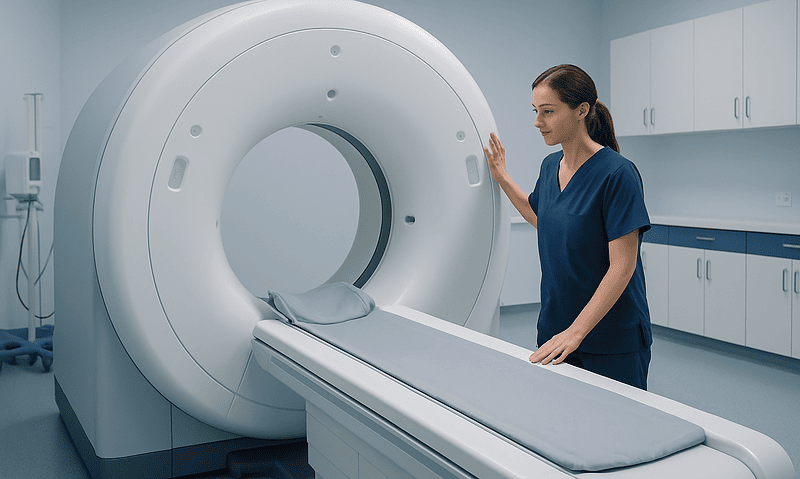
In the scanning room, a technologist places electrode patches on your chest. These let the scanner time its pictures to your heartbeat, snapping images in the brief moment between beats when the heart is nearly still. You lie on your back, the table slides into a wide, doughnut-shaped ring, not a tunnel, and a voice asks you to hold your breath for roughly 10 to 20 seconds. Usually twice. That’s it.
The actual imaging takes seconds; the appointment, start to finish, runs about 10 to 15 minutes. There’s no contrast dye, so no IV line, no metallic taste, no risk of dye-related kidney stress or allergic reaction. You can drive yourself home, eat lunch, go back to work.
A radiologist or cardiologist then reviews the images, and the software tallies your Agatston score. Most people receive results within a few days, often alongside a percentile comparing your score with others of your age, sex, and background: a detail that turns out to matter more than most people expect.
What do the calcium score numbers actually mean?
The Agatston score sorts neatly into ranges that clinicians use worldwide. Mayo Clinic and Cleveland Clinic describe the interpretation in broadly similar terms:
| Score | Plaque burden | What it generally suggests |
|---|---|---|
| 0 | No detectable calcified plaque | Very low 10-year risk of a coronary event |
| 1–99 | Mild | Plaque is present; risk rises as the number climbs |
| 100–299 | Moderate | Meaningful disease; preventive treatment is usually discussed |
| 300 and above | Extensive | High plaque burden; aggressive prevention is typically warranted |
Two cautions keep these ranges honest. First, the score describes probability, not destiny. Plenty of people with moderate scores never have a heart attack, and a rare few with low scores do, because soft, uncalcified plaque doesn’t show up on this scan at all.
Second, the raw number means different things at different ages, which is why reports usually include a percentile. A score of 80 in a 78-year-old is unremarkable; the same 80 in a 46-year-old signals disease arriving decades ahead of schedule. The number is the headline. The percentile is the story.
What is a good calcium score by age?
The only universally “good” score at any age is zero. Beyond that, context does the heavy lifting.
Calcified plaque accumulates with time, so population averages climb steadily by decade. Data from the MESA cohort: the large NIH-funded study that tracked adults of White, Black, Hispanic, and Chinese backgrounds, show that a median 50-year-old man has little or no coronary calcium, while by the mid-70s a majority of men have at least some. Women, protected somewhat until after menopause, tend to lag men by roughly a decade before their scores begin rising.
That’s why clinicians lean on percentiles rather than fixed cutoffs:
- Below the 25th percentile for your age and sex: less plaque than most of your peers.
- Around the 50th percentile: typical for your demographic, which is not the same as ideal, given how common heart disease is.
- At or above the 75th percentile: more plaque than three-quarters of your peers, a threshold major guidelines treat as a signal to intensify prevention regardless of the absolute number.
So a 55-year-old woman with a score of 40 may sit above the 75th percentile and warrant a serious conversation, while a 72-year-old man with the same 40 sits comfortably below average. Ask for your percentile if it isn’t on the report: it reframes the number entirely.
Is a calcium score of zero a free pass?
Cardiologists talk about “the power of zero,” and the phrase is earned. In MESA and similar studies, people with a score of zero had 10-year coronary event rates in the neighborhood of 1 percent, low enough that current American Heart Association and American College of Cardiology guidance says a zero can justify holding off on preventive medication for many middle-aged adults at borderline risk.
But zero is a strong signal, not a guarantee, and the exceptions matter. The scan sees only calcified plaque. Early-stage, soft, cholesterol-rich plaque, the kind more common in people under 50, in smokers, and in people with diabetes, is invisible to it. For exactly this reason, guidelines say a zero should not be used to skip treatment in people who smoke, have diabetes, or have a strong family history of early heart disease.
A zero also has a shelf life. Arteries change, and a clean scan at 52 says little about the same arteries at 62. If risk factors persist, many clinicians consider repeating the scan after roughly three to five years.
And one boundary is absolute: a zero means nothing if you’re having symptoms. Chest pressure or unusual breathlessness with exertion calls for a different evaluation entirely, no matter what a past scan showed.
Is a calcium score test worth having?
For the right person, yes, arguably more decisively than almost any other elective heart test. The right person is fairly specific: an adult between about 40 and 75 whose estimated 10-year heart risk lands in the intermediate zone, and who is genuinely unsure whether to start preventive medication.
Standard risk calculators work from statistics, age, blood pressure, cholesterol, smoking, diabetes, and they’re blunt instruments. Two 58-year-olds with identical numbers on paper can have wildly different arteries. The calcium score settles the question with direct evidence. Research from the MESA cohort found that adding the score to traditional risk factors correctly reclassified a substantial share of intermediate-risk adults, moving some up to high risk and, just as usefully, moving others down.
That second direction is underappreciated. A zero can spare someone years of daily medication they may not need. A high score can end years of ambivalence in a single afternoon. Either way, the test converts a vague probability into something concrete, and behavior research suggests people who see their own plaque burden are more likely to follow through on prevention.
Where the test is not worth it: when the answer wouldn’t change anything. If you’re already committed to treatment, or your risk is clearly very low or very high, the scan mostly confirms what’s known, at your own expense.
Who probably shouldn't get one?
The scan earns its keep by changing decisions, so the people who benefit least are those whose decisions are already made, or shouldn’t be made by this test.
- People with diagnosed heart disease. If you’ve had a heart attack, a stent, or bypass surgery, your plaque burden is already established fact. The score adds nothing to your management.
- People already on preventive cholesterol treatment. The score won’t change with therapy (more on that later), so scanning mid-treatment mostly generates confusion.
- Most adults under 40. Calcification takes decades. A young adult can harbor early soft plaque and still score zero, producing false reassurance. Exceptions exist for those with strong family histories of premature heart disease, decided case by case.
- People at clearly low risksay, a healthy nonsmoking 45-year-old with excellent numbers, for whom the expected score is zero and the result changes nothing.
- Anyone with symptoms. Chest pain, exertional breathlessness, and fainting call for diagnostic testing that evaluates blood flow, not a screening scan designed for people who feel fine.
There’s also a soft cost worth naming: incidental findings. Because the scan images the chest, it occasionally spots lung nodules or other unexpected shadows, most of which turn out benign but some of which trigger follow-up imaging and anxiety. Reasonable to accept when the scan is indicated; harder to justify when it wasn’t.
Which is worse, high cholesterol or a high calcium score?
This question comes up constantly, and the honest answer is that the two measure entirely different things, so “worse” depends on what you’re asking.
Think of it this way: cholesterol is the ingredient; calcium is the evidence. A high LDL cholesterol level means your blood carries a lot of the raw material that builds plaque: a cause, and a modifiable one. A high calcium score means plaque has already been built: an effect, and a permanent one. One is the weather forecast; the other is water damage in the walls.
If you’re asking which better predicts a heart attack in the next decade, the calcium score generally wins, and it isn’t close. Studies have repeatedly shown that plaque burden outperforms any single cholesterol number at forecasting near-term events. Some people with modest cholesterol develop extensive plaque; others with alarming cholesterol panels stay remarkably clean, thanks to genetics, blood pressure, and factors medicine doesn’t fully map yet.
But if you’re asking which one you can act on, cholesterol takes the prize: it responds to diet, activity, and medication, while a calcium score, once earned, never goes down.
The most concerning combination is obvious once you see it: high cholesterol and a high score. That’s abundant building material plus proof the construction crew has been busy for years. That pairing deserves the most aggressive prevention a clinician can offer.
At what calcium score do doctors recommend medication?
Current American Heart Association and American College of Cardiology cholesterol guidance draws its clearest line at two markers: a calcium score of 100 or higher, or a score at or above the 75th percentile for your age and sex. At either threshold, starting cholesterol-lowering medication is generally recommended for adults 40 to 75, because the odds that treatment prevents a future event now clearly outweigh the burdens of taking it.
The middle ground gets more nuanced:
- Score of 1 to 99, below the 75th percentile: treatment is reasonable and increasingly favored, particularly for adults 55 and older, since any calcium confirms the disease process is underway.
- Score of 0: for many intermediate-risk adults, guidelines support deferring medication and rechecking risk, and possibly the scan, in a few years. The notable exceptions are people who smoke, have diabetes, or have a family history of early heart disease, where a zero doesn’t override the risk factor.
Two honest caveats. First, these thresholds guide a conversation; they don’t replace one. Kidney disease, inflammatory conditions, pregnancy plans, and personal preference all belong in the decision, which is why the choice sits with you and your clinician, not a chart. Second, medication is only part of the response, blood pressure control, quitting smoking, and physical activity carry weight at every score, including zero.
Can you lower a calcium score once you have one?
No, and understanding why saves a lot of misplaced guilt. Calcified plaque is essentially mineralized scar tissue in the artery wall. No diet, workout regimen, or medication dissolves it. Once the scanner sees it, it stays seen.
Here’s the twist that surprises almost everyone: effective treatment can actually make the score go up. As cholesterol-lowering therapy stabilizes a soft, inflamed plaque, the plaque tends to shrink its dangerous lipid core and calcify more densely, trading a fragile structure for a hardened, more stable one. Researchers sometimes call this the calcium density paradox: denser calcification is associated with lower risk of rupture, even as it inflates the Agatston number. A rising score on treatment can be a sign the therapy is doing exactly what it should.
This is why clinicians almost never repeat the scan to “check progress” once treatment starts. The score served its purpose the moment it informed the decision; rescanning to grade your effort would only mislead.
What you can change is everything the score was warning you about: the soft, uncalcified plaque still forming, the cholesterol supplying it, the blood pressure straining artery walls. The goal after a positive scan isn’t to shrink the number. It’s to make sure the number stops mattering, by preventing the next plaque rather than mourning the last one.
How much radiation, and what does it cost?
The radiation dose is modest by imaging standards: roughly 1 millisievert, in the same general range as a mammogram and equivalent to a few months of the natural background radiation everyone absorbs from soil, air, and sky. For comparison, a standard chest CT delivers several times more. Because the dose isn’t zero, guidelines discourage casual repeat scanning, one well-timed scan, thoughtfully interpreted, is the model.
Cost is where this test breaks from the usual pattern. In the United States, calcium scoring is often not covered by insurance when ordered as screening for someone without symptoms, though coverage varies widely by plan and by state: a handful of states require insurers to cover it for qualifying patients. Where it isn’t covered, imaging centers typically charge a flat self-pay price, commonly in the range of $100 to $400. Many facilities publish the price openly, a rarity in American healthcare.
A few practical notes before you book:
- You’ll generally need a clinician’s order, even for a self-pay scan.
- Ask whether the reported result will include your age-and-sex percentile, not just the raw score.
- Confirm the scan is a dedicated cardiac CT with ECG gating, the heartbeat-timed technique, rather than an ungated chest scan, which estimates calcium less precisely.
Measured against a decade of guessing about your risk, it’s among the cheaper pieces of genuinely useful information in medicine.
Calcium scan vs. stress test vs. CT angiogram: what's the difference?
These three tests get tangled together in conversation, but they answer three different questions.
A calcium scan asks: is plaque present, and how much? No dye, minimal radiation, ten minutes, designed for people without symptoms who want to sharpen a fuzzy risk estimate. It cannot tell you whether any artery is narrowed.
A stress test asks: does the heart get enough blood when it works hard? You walk a treadmill (or receive medication that simulates exertion) while ECG, imaging, or both watch for signs of strain. It’s a test of function, not anatomy, used mainly when symptoms suggest a blood-flow problem. A stress test can be normal even when plaque is abundant, as long as no blockage is severe enough to choke flow.
A coronary CT angiogram asks: what do the arteries actually look like inside? It requires an IV, contrast dye, and a higher radiation dose, but it maps the vessel channels in detail, revealing both calcified and soft plaque and estimating how much any narrowing restricts the lumen. It’s a diagnostic tool, typically reserved for evaluating symptoms or ambiguous findings.
The sequencing usually runs one direction: screening questions get the calcium scan; symptom questions get the stress test or angiogram. Skipping ahead, ordering an angiogram “just to see”, buys extra radiation, dye exposure, and cost for information a symptom-free person rarely needs.
When should you see a doctor instead of booking a scan?
A calcium scan is a tool for people who feel fine. The moment symptoms enter the picture, the calculus changes completely, and speed matters more than scheduling.
Call emergency services immediately if you or someone near you has possible heart attack symptoms: pressure, squeezing, or fullness in the center of the chest lasting more than a few minutes or coming and going; pain radiating to the arm, jaw, neck, or back; sudden shortness of breath; a cold sweat, nausea, or lightheadedness alongside chest discomfort. Women somewhat more often experience the non-chest versions, breathlessness, nausea, jaw or back pain, and delay seeking help as a result. Don’t drive yourself.
See a doctor promptlydays, not months, for symptoms that come and go: chest tightness during exertion that eases with rest, breathlessness climbing stairs that used to be easy, unexplained fatigue with activity, palpitations paired with dizziness, or fainting. These call for diagnostic evaluation, and a screening calcium score is the wrong instrument for the job.
Book a routine visit to discuss whether the scan makes sense for you if you’re 40 to 75, symptom-free, and carrying risk factors, high cholesterol, high blood pressure, a parent or sibling with early heart disease, past smoking, but haven’t settled the prevention question. That conversation, more than the scan itself, is where the value begins.
You have your number, now what?
The scan’s real product isn’t the score. It’s the plan the score makes possible.
If the number is zero, the plan is protection: keep the habits that got you here, revisit your risk with your clinician periodically, and, if risk factors persist, consider a repeat scan in three to five years. Zero is a status to defend, not a diploma.
If the number is above zero, resist the instinct to treat it as a verdict. Millions of adults live long lives with coronary calcium; what separates outcomes is what happens next. The evidence-backed agenda is unglamorous and effective:
- Settle the medication question with your clinician, using the thresholds guidelines provide, score, percentile, and your full risk picture together.
- Know your blood pressure and treat it to target; pressure is the force that injures artery walls in the first place.
- Move most days. The American Heart Association’s benchmark is 150 minutes of moderate activity weekly, brisk walking counts.
- If you smoke, quitting is the single largest risk reduction available to you, larger than any scan or pill.
- Eat in a pattern, not a panicmore plants, fish, nuts, and olive oil; less processed meat and refined carbohydrate.
One scan, ten minutes, a number, and then years of ordinary decisions. The score doesn’t change your fate. It just tells you, earlier and more plainly than anything else can, which decisions are worth making.
Frequently asked questions
What is a good calcium score by age?
Zero is the only score considered good at every age, because it means no detectable calcified plaque. Beyond zero, interpretation depends on percentiles: a score below the 25th percentile for your age and sex means less plaque than most peers, while a score at or above the 75th percentile signals accelerated disease even if the raw number seems small. A score of 40 can be reassuring at 75 and worrying at 48.
Is a calcium score test worth having?
It’s most worthwhile for adults 40 to 75 at intermediate heart risk who are undecided about preventive medication, because the result frequently changes the decision in either direction. A high score can justify starting treatment; a zero can support safely deferring it. It’s least worthwhile if you already have diagnosed heart disease, are already on treatment, are under 40, or have symptoms: those situations call for different tests entirely.
Which is worse, high cholesterol or a high calcium score?
A high calcium score is generally the more serious finding, because it proves plaque has already formed, while high cholesterol only signals the potential for plaque. Studies show plaque burden predicts near-term heart attacks better than any single cholesterol number. That said, cholesterol is the modifiable cause and calcium is the permanent effect, and the riskiest scenario is having both, which warrants the most aggressive prevention.
At what calcium score do doctors recommend starting medication?
Major US guidelines generally recommend preventive cholesterol-lowering medication for adults 40 to 75 when the calcium score reaches 100 or lands at or above the 75th percentile for age and sex. Scores of 1 to 99 make treatment reasonable, especially after age 55. A score of zero can support deferring medication for a few years, unless you smoke, have diabetes, or have a family history of early heart disease.
Does a calcium score of zero mean my arteries are completely clear?
Not completely. A zero means no calcified plaque was detected, which places 10-year risk very low, around 1 percent in major studies. But the scan cannot see soft, uncalcified plaque, the early-stage form more common in people under 50, smokers, and people with diabetes. A zero also expires: arteries change over time, so clinicians often suggest reassessing, and possibly rescanning, after roughly three to five years if risk factors persist.
How often should you repeat a calcium scan?
For most people, once is enough, because the result informs a decision that then stands for years. If your score was zero and you still have risk factors, a repeat scan in three to five years is reasonable, since calcium can appear over that window. If your score was positive and you’ve started treatment, repeat scanning isn’t recommended, scores don’t fall with therapy and can even rise as plaque stabilizes, which would only mislead.
Is the radiation from a calcium scan dangerous?
The dose is small, roughly 1 millisievert, similar to a mammogram and equivalent to a few months of the natural background radiation everyone receives. Modern ECG-gated scanners keep exposure well below that of a standard chest CT. Because no radiation dose is truly zero, guidelines discourage repeat scanning without a clear reason, but for an appropriately selected adult the informational benefit is widely considered to outweigh the minimal exposure.
Can you lower your calcium score with diet or exercise?
No. Calcified plaque is mineralized tissue in the artery wall and doesn’t dissolve with any lifestyle change or medication. In fact, effective treatment can raise the score slightly as soft plaque stabilizes by calcifying more densely, generally a favorable change despite the higher number. Diet, exercise, blood pressure control, and quitting smoking still matter enormously: they slow or prevent the formation of new soft plaque, which is where future risk lives.
Do I need a referral, and does insurance cover the calcium score test?
You’ll typically need a clinician’s order, even at centers offering self-pay scans. Insurance coverage is inconsistent: many US plans don’t cover calcium scoring as screening for symptom-free people, though some states require coverage for qualifying patients and some plans have added it. Where it isn’t covered, imaging centers usually charge a flat fee, commonly $100 to $400. Call your insurer and the imaging center before booking to confirm both cost and coverage.
Is a calcium scan the same as a CT angiogram?
No. A calcium scan is a quick, dye-free CT that counts calcified plaque and produces a risk score; it cannot show whether arteries are narrowed. A coronary CT angiogram uses IV contrast dye and a higher radiation dose to map the inside of the arteries, revealing both soft and hard plaque and estimating blockages. The calcium scan screens symptom-free people; the angiogram investigates symptoms or ambiguous findings.
This article is for general information only and is not a substitute for professional medical advice. Please consult a qualified doctor about your individual situation.

More from the Blog

Recovery After a Stereotactic Biopsy: Headache, Pin-Site Soreness, Driving and Results
Stereotactic biopsy recovery is usually short. After a breast biopsy, most people go home the same day and have bruising or soreness for a…

After a PET-CT Scan: Clearing the Tracer, Contact Precautions and When Results Arrive
After a PET-CT scan, most people go home the same day, drink extra fluids and empty their bladder often to help clear the radioactive…

Preparing for an MRI: Eating, Metal, What to Wear
For most MRI scans you can eat and drink normally beforehand, because the magnet images tissue, not stomach contents. The exceptions are scans of…

What Does a Comprehensive Check-Up Include? Blood Work, Imaging and the Follow-Up Plan
A comprehensive check-up usually includes a medical and family history, a physical examination with blood pressure and body measurements, and blood and urine tests…

What a CT Scan Shows, and Why Doctors Order One
A CT scan shows detailed cross-sectional images of bones, organs, blood vessels and soft tissue by combining many X-ray views into slices. Doctors most…
Can an Ultrasound Detect Cancer? What It Can Show, Its Limits and the Next Steps
An ultrasound can detect abnormal lumps, masses and changes in organs that may be cancer, and it is especially good at telling a fluid-filled…