

EMG Test Preparation: Lotions, Pacemakers, Blood Thinners and What to Wear on the Day

Key Takeaways
- Lotion, oil, sunscreen and powder act as electrical insulators on the skin, which is why clean, product-free limbs give a cleaner nerve conduction recording.
- The needle EMG involves no electrical stimulation at all, so the pacemaker question applies only to the nerve conduction half, and disclosure rather than cancellation is the standard advice.
- Blood thinners are almost always continued; guidance from Mayo Clinic and MedlinePlus is to inform the team, and any pause is a decision for the prescribing clinician alone.
- Cold limbs conduct nerve signals more slowly and can make a normal nerve look borderline, which is one reason centers ask you to skip caffeine and nicotine and arrive warm.
- An EMG typically takes 30 to 60 minutes, longer with nerve conduction studies, and most people resume normal activity immediately afterward, according to Mayo Clinic and Johns Hopkins Medicine.
- Certain muscle changes take roughly two to three weeks to appear on a tracing, so a test scheduled within days of new symptoms may be deliberately delayed by the referring team.
To prepare for an EMG test, arrive with clean, lotion-free skin, wear loose clothing that lets the examiner reach the arms and legs, and tell the team in advance about any pacemaker or implanted device, blood thinners, bleeding disorders, or myasthenia gravis. Take your usual medicines unless the prescribing clinician says otherwise, and many centers ask you to skip caffeine and nicotine for a couple of hours beforehand.
The appointment letter is two pages long, and the line that stops most people is not the one about needles. It is the one that says: do not use lotion. Somewhere between the shower and the car keys, a small panic sets in. Does hand cream count? What about the deodorant already on? And, further down the page, a heavier question for anyone carrying a pacemaker or a prescription for a blood thinner: is this even safe for me?
Those are exactly the right things to wonder about, and the honest answer to how to prepare for EMG test day is reassuringly short. A few skin and clothing choices make the recording cleaner. A short list of medical facts, shared ahead of time, lets the team adjust the plan for you. Almost nothing else needs to change.
What follows is the long version: what the test measures, why each instruction exists, what people get wrong, and what the days afterward usually look like.
How to prepare for an EMG test: the short version first
An EMG, or electromyography, records the tiny electrical signals your muscles produce at rest and when you tighten them. Most appointments pair it with a nerve conduction study, which measures how quickly and strongly a nerve carries a signal. Both depend on clean electrical contact with your skin and on the examiner being able to reach the muscles in question, which explains nearly every preparation rule you have been given.
The essentials, drawn from the patient guidance published by Mayo Clinic, Cleveland Clinic and Johns Hopkins Medicine, come down to a handful of choices:
- Bathe or shower shortly before the visit and put nothing on the skin afterward: no lotion, oil, cream or powder.
- Wear loose, easily rolled clothing, or expect to change into a gown.
- Tell the team ahead of time about a pacemaker, implanted defibrillator or stimulator, any blood-thinning medicine, a bleeding disorder such as hemophilia, or myasthenia gravis.
- Continue your usual medicines unless the clinician who prescribed them tells you otherwise. Do not stop anything on your own.
- Ask whether your center wants you to avoid caffeine and nicotine for a few hours beforehand.
Notice what is not on the list. There is no fasting, no sedation, no arrangement for someone to drive you home in most cases, and no need to stop exercising the week before. The test is a measurement, not a treatment, and it works best when your body is behaving as it normally does.
One more thing worth planning: the timing of your medicines and the exact names of everything you take. Bring a written list or the containers. The examiner will want to know what is in your system, not to change it, but to interpret what the recording shows.
What actually happens during an EMG and nerve conduction study
Picture the two halves of the appointment as listening and knocking. The nerve conduction study is the knocking. Small flat electrodes are taped to the skin over a nerve, and a brief electrical pulse is delivered through them. The pulse travels along the nerve, and a second electrode further along records when it arrives and how large the response is. From that, the neurologist calculates conduction speed and signal size, which is how compression at the wrist or a slowed nerve in the leg shows up on paper.
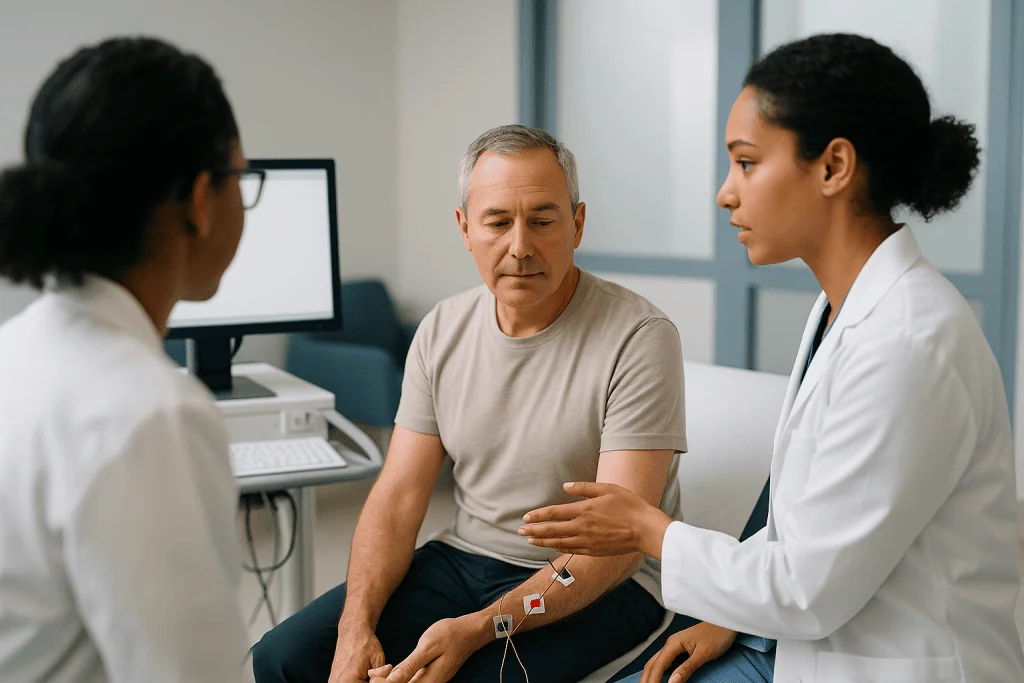
The needle EMG is the listening. A very fine needle electrode, thinner than the ones used to draw blood, is placed into a muscle. It is connected to a machine that displays the muscle’s electrical activity on a screen and often plays it through a speaker, so you may hear crackles and pops that sound like a poorly tuned radio. The examiner watches the resting muscle first, then asks you to tighten it gently, then harder. Healthy muscle at rest is electrically quiet; the patterns that appear during contraction tell the specialist whether the problem sits in the nerve, the muscle, or the junction between them, as MedlinePlus describes.
A common question is how many needles are involved. In practice there is usually one sterile, single-use needle electrode per person, moved from muscle to muscle. The number of muscles sampled varies with the question being asked: a suspected pinched nerve at the wrist may need only a few, while a search for a widespread nerve or muscle disease samples more. Your neurologist decides that as the picture develops during the test itself.
Nothing is injected through the needle. It records; it does not deliver.
Why lotions, oils and creams matter on the day
The lotion rule sounds fussy until you understand what the electrodes are asking of your skin. Surface electrodes for the nerve conduction study need low electrical resistance between skin and metal. A film of moisturizer, body oil, sunscreen or powder acts as an insulator. The pulse still gets through, but it may take a stronger stimulus to reach the nerve, and the recorded response can look smaller or noisier than it really is. Mayo Clinic’s preparation guidance is blunt about it: bathe shortly before the test to remove oils, and do not apply lotions or creams afterward.
Greasy skin also stops the adhesive electrodes from staying put. A pad that slides mid-recording means repeating the stimulus, which means more of the sensation people were hoping to avoid.
What counts as lotion? A practical rule is anything you rub in or spray onto the arms, legs, hands, feet, neck or back. That includes:
- Moisturizers and hand cream
- Body oil, massage oil and baby oil
- Sunscreen and self-tanning products
- Talc and body powder
- Medicated creams on the limbs, unless your prescriber has told you a dose must not be missed, in which case tell the team where it was applied
Facial moisturizer and underarm deodorant rarely interfere, because those areas are seldom tested, though the arm near the armpit sometimes is. If in doubt, skip it for a morning. Hair products are irrelevant unless the test involves the scalp or face.
The corollary is worth saying out loud: freshly washed skin without product is the goal, not scrubbed-raw skin. Vigorous exfoliation or shaving the limbs right before the visit can leave the surface irritated and slightly more tender to the tape and the needle. Ordinary soap and water, then nothing, is exactly right.
What not to do before an EMG: caffeine, nicotine and timing
The list of things to avoid is shorter than most people expect, and the reasoning behind each item is physiological rather than ceremonial.

Caffeine and nicotine are the two most commonly named. Both are stimulants that can make muscles slightly twitchy at rest and can constrict small blood vessels in the skin, which lowers surface temperature. Johns Hopkins Medicine and Cleveland Clinic both ask patients to avoid caffeinated drinks and smoking for roughly two to three hours before the test. Not every center applies the rule identically, so check your own instructions rather than assuming.
Temperature is the quiet variable behind several instructions. Nerves conduct more slowly when a limb is cold, enough to make a normal nerve look borderline on the tracing. Mayo Clinic notes that the examiner may warm your hand or foot before recording if it feels cool. You can help by arriving with warm limbs: avoid a long walk in freezing weather without gloves, and give yourself a few minutes in the waiting room rather than rushing in from the cold.
Things you generally do not need to avoid:
- Food and drink. There is no fasting requirement for a standard EMG.
- Your prescribed medicines, unless the prescribing clinician has said otherwise.
- Normal daily activity and light exercise.
Two cautions deserve emphasis. Never stop a blood thinner, a heart medicine or a myasthenia gravis medicine because a leaflet mentioned it. Those decisions belong to the clinician who prescribed the medicine, working with the neurophysiology team, and in many cases the answer is simply to carry on. And do not apply a numbing cream to the skin in the hope of an easier test. It leaves a residue, it rarely reaches the depth where the needle records, and it can interfere with the surface electrodes in exactly the way lotion does.
Pacemakers, defibrillators and other implanted devices
A pacemaker is a small implanted device that sends electrical pulses to keep the heart rhythm steady; an implantable cardioverter-defibrillator, or ICD, is a similar device that can also deliver a corrective shock. Because a nerve conduction study introduces small electrical pulses of its own, it is entirely reasonable to ask whether the two could confuse each other.
The mainstream patient guidance from Mayo Clinic, Cleveland Clinic and MedlinePlus takes the same position: tell the team before the appointment, so the examiner can plan. In most cases the test still goes ahead. The pulses used in nerve conduction studies are brief, low-energy and delivered to a limb, well away from the heart and its wiring. Neurophysiology laboratories routinely test people with cardiac devices and have protocols for doing so, which may include adjusting how and where stimulation is applied, avoiding stimulation near the device pocket, or coordinating with the cardiology team when a device has particular settings.
The needle EMG itself involves no electrical stimulation at all. It records signals; it does not send any. That half of the test raises no device concern.
Other implanted electronics deserve the same disclosure: spinal cord stimulators, deep brain stimulators, vagus nerve stimulators, cochlear implants, insulin pumps and implanted cardiac monitors. The examiner may ask you to bring your device identification card, which lists the manufacturer and model, so the settings can be checked if needed.
What you should not do is cancel the appointment on your own because of a device, or switch the device off. Neither is your job. Make the phone call, give the details, and let the team decide whether anything needs adjusting. In the large majority of cases the answer is that the appointment proceeds as planned, with a note in the file and a slightly more deliberate approach to electrode placement.
Blood thinners, bleeding disorders and the needle part
Anticoagulants are medicines that slow blood clotting to prevent dangerous clots; antiplatelet medicines do something similar by making platelets less sticky. Both groups are relevant to an EMG for one reason only: the needle electrode enters muscle, and muscle can bleed.
The realistic risk is modest. Mayo Clinic describes EMG as a low-risk procedure whose complications, when they occur, are typically minor bleeding, bruising, infection at the needle site or, rarely, nerve injury. A person taking a blood thinner is more likely to bruise and may bleed for longer from a puncture, which is why the instruction across MedlinePlus, Mayo Clinic and Johns Hopkins Medicine is to tell the team in advance, not to stop the medicine.
That distinction matters. Stopping an anticoagulant to make a diagnostic needle test marginally tidier trades a small bruise for a real risk of stroke or clot, and no neurophysiology team wants that trade made on their behalf without discussion. In practice, examiners adapt: they may sample fewer or more superficial muscles, avoid deep muscles near large vessels, apply pressure for longer after each needle placement, or choose to rely more on the nerve conduction half of the study. Any decision to pause a blood thinner, if one were ever considered, sits with the prescribing clinician who knows why you take it.
The same conversation applies to inherited bleeding disorders such as hemophilia or von Willebrand disease, to a low platelet count, and to liver disease that affects clotting. Bring the name of your hematology or anticoagulation clinic if you have one.
Common over-the-counter pain relievers in the nonsteroidal anti-inflammatory class, and certain supplements such as fish oil, garlic or ginkgo, can also affect bleeding slightly. Mention them. You will almost certainly be told to carry on, but the examiner benefits from knowing.
Other medicines and conditions to mention before the day
Beyond blood thinners and devices, a short list of conditions changes how the test is run or read, and each is worth a sentence in advance.
Myasthenia gravis is an autoimmune condition in which the signal between nerve and muscle fails intermittently, causing fatigable weakness. A class of medicines called cholinesterase inhibitors improves that signal transmission, and because part of an EMG may specifically test the nerve-muscle junction with repeated stimulation, the medicine can alter the findings. Cleveland Clinic advises people with myasthenia gravis to ask their doctor beforehand whether anything about their usual routine should be noted or adjusted. The point is coordination, not self-directed change.
Muscle relaxants and some sedatives can quiet the very activity the examiner is trying to record. Anticholinergic medicines, used for bladder or bowel symptoms among other things, can also alter certain responses. Mention them; the neurologist can interpret around them.
Conditions to flag include:
- Lymphedema, a chronic swelling caused by lymph fluid build-up, in an arm or leg, because needle placement in that limb is often avoided
- Active skin infection, rash or open wounds over the area to be tested
- A recent stroke or new severe weakness, which may change the urgency or focus of the study
- Pregnancy, which does not prevent the test but is worth documenting
- Prior surgery, injury or fracture in the limb, which can leave old changes on the tracing
None of these routinely cancels the appointment. They shape it. A skilled examiner would rather learn about a swollen leg or a tremor medicine at the booking stage than discover it with the electrodes half attached. Bring your medicine list, your condition list, and a willingness to be slightly over-thorough. Nobody in a neurophysiology lab has ever complained that a patient told them too much.
What to wear on the day of an EMG, and what to bring
The clothing question is practical rather than medical. The examiner needs to reach the muscles and nerves under investigation, and those are often in places that ordinary clothes cover: the forearm and hand for suspected carpal tunnel syndrome, the calf and foot for a possible pinched nerve in the lower back, sometimes the shoulder, thigh or the muscles alongside the spine.
Mayo Clinic suggests loose clothing that can be rolled or pulled away, and warns that you may be asked to change into a gown. Cleveland Clinic gives the same advice. Translating that into an outfit:
- A short-sleeved or loose-sleeved top for arm testing; a sleeveless top under a cardigan works well
- Shorts, or loose trousers that roll above the knee, for leg testing
- Slip-on shoes and socks that come off easily, since foot muscles and ankle nerves are frequently tested
- Nothing tight at the wrist, ankle or thigh, which can restrict blood flow and cool the limb
Jewelry is not dangerous, but bracelets, watches and rings near the test area get in the way and may be removed. Leave valuables at home if that is simpler.
The things to bring are mostly paper. A written list of every medicine and supplement, with the names spelled as they appear on the label. Your device identification card if you have a pacemaker, defibrillator or stimulator. Any relevant previous test results, scans or clinic letters, especially if this EMG is a repeat. Reading glasses, if you will be asked to sign anything.
A friend or family member is optional. The test involves no sedation, and Mayo Clinic notes that most people resume normal activities immediately afterward, so you can usually drive yourself. If needles make you faint, or if the limb being tested is one you drive with and you expect it to feel sore, company is a reasonable comfort rather than a requirement.
Who an EMG is usually for, and who may be asked to wait
Clinicians reach for an EMG when a symptom could come from a nerve, a muscle, or the meeting point between them, and the physical examination alone cannot settle which. MedlinePlus lists the typical triggers: tingling, numbness, weakness, muscle pain or cramping, and certain kinds of limb pain that follow a nerve’s territory. The conditions being sorted through include carpal tunnel syndrome, a pinched nerve root in the neck or lower back, peripheral neuropathy, muscle diseases such as the muscular dystrophies, disorders of the nerve-muscle junction such as myasthenia gravis, and motor neuron diseases including amyotrophic lateral sclerosis.
The test does not make a diagnosis by itself. It maps where the electrical system is behaving abnormally and in what pattern, and the referring clinician combines that with the history, examination, blood tests and imaging. An EMG report that says a nerve is compressed at the wrist is a strong piece of evidence; the decision about what to do with it belongs to the treating team.
Who tends to be asked to wait or to plan differently? Not many people, and rarely for long:
- Someone with an active skin infection over the area, until it settles
- Someone with severe lymphedema in the limb, where needle testing is often avoided in favor of surface studies or the opposite side
- Someone whose symptoms began only a day or two earlier, because certain changes in muscle take roughly two to three weeks to appear on the recording, and testing too early can miss them
- Someone whose anticoagulation or platelet count is unstable, where the hematology and neurophysiology teams may want to coordinate first
Age alone is not a barrier. Children are tested with extra preparation and comfort measures, and older adults are among the most frequent patients in any neurophysiology laboratory.
How long does an EMG take, and how much does it hurt?
Mayo Clinic and Johns Hopkins Medicine both give the same working figure: an EMG typically takes around 30 to 60 minutes, and longer when a nerve conduction study is included or when several limbs are examined. Plan for up to 90 minutes in the building, including check-in and a brief examination.
Pain is the part people research most, so here is a candid comparison rather than a reassurance.
| Part of the test | What is done | What most people report feeling | Typical duration |
|---|---|---|---|
| Nerve conduction study | Brief electrical pulses through skin electrodes | A quick tingling or thump, like a static shock or an elastic band snap; the muscle may twitch | About 15 to 60 minutes depending on how many nerves |
| Needle EMG at rest | Fine needle electrode placed into muscle | A sharp pinch on entry, then a dull ache or pressure; some muscles are more tender than others | Seconds to a few minutes per muscle |
| Needle EMG with contraction | You tighten the muscle while the needle records | Increased ache while squeezing, easing when you relax | Seconds per effort |
Mayo Clinic describes the discomfort as usually mild and brief. That matches what most people say afterward: unpleasant in the moment, over quickly, and less than they feared.
On making it easier, evidence and experience point the same way. Breathe out slowly as each needle goes in; a relaxed muscle hurts less than a braced one, and it also records more cleanly, so the examiner may need fewer attempts. Tell the examiner if a particular site is very painful; they can often pause, reposition or choose an alternative muscle. Ask them to talk you through each step, because predictability lowers the sting. Keep the limb warm, since cold skin is more sensitive. And avoid numbing creams for the reasons already covered. If needle anxiety is severe, say so when booking; some centers can schedule extra time or discuss options with your referring clinician.
The days after: soreness, bruising and when EMG results arrive
Most people leave the neurophysiology laboratory and go about their day. Mayo Clinic’s guidance is that ordinary activities can usually resume immediately, and that the tested muscles may feel tender or bruised for a few days. Small dots where the needle entered are normal and fade quickly. An over-the-counter cold pack held over a sore muscle for short periods is a reasonable comfort measure; if you would normally take a pain reliever for a bruise, ask your pharmacist or clinician whether it fits with your other medicines rather than guessing.
The tracings themselves need interpretation. The neurologist who performed or supervised the study reviews the waveforms, compares them with normal ranges for your age and height, and writes a report. Some examiners share an initial impression at the end of the session; others prefer to send everything to the referring clinician first. Cleveland Clinic notes that results are often available within a few days, and Mayo Clinic describes the report going to the referring doctor for discussion at a follow-up appointment. If you were not told how results will reach you, ask before you leave.
A rough sense of the typical timeline:
- First hours: mild ache, possible small bruises, normal activity
- Two to three days: tenderness settles; any bruise begins to fade
- Days to a week or two: report reaches the referring clinician; follow-up arranged
The report rarely stands alone. A finding of nerve compression may lead to a conversation about splinting, activity changes, injections or surgical referral; a pattern suggesting neuropathy may prompt blood tests for causes such as diabetes or vitamin deficiency; an unexpectedly normal study is itself useful, steering the search elsewhere. Each of those next steps is a decision for you and your treating team together, informed by the tracing but never dictated by it.
What people often get wrong about how to prepare for an EMG test
Some myths make the test harder; a few make it riskier. The most common, corrected against mainstream guidance:
Stop the blood thinner to be safe. Backwards. Mayo Clinic and MedlinePlus ask you to tell the team about anticoagulants, not to stop them. The bleeding risk from a fine needle in muscle is small and manageable; the clot risk from an unplanned pause is not. Only the prescribing clinician should ever make that call.
A pacemaker rules it out. It does not. Disclosure lets the examiner adjust technique, and the needle portion involves no electrical stimulation at all.
Numbing cream will make it painless. The needle records from inside the muscle, below the depth a topical anesthetic reaches, and the cream leaves the kind of residue that spoils electrode contact.
You must fast. There is no fasting requirement for a standard EMG. Eat normally; a light meal beforehand is fine and may reduce lightheadedness.
Rest the limb for days beforehand. Unnecessary. Normal activity does not change the findings in any way the examiner cannot account for.
It is dozens of needles. Typically a single fine needle electrode is moved between a handful of muscles, with the number depending on the clinical question.
The machine gives a diagnosis on the spot. The tracings need expert interpretation and are read alongside your history and examination. An initial impression is sometimes offered; the formal report follows.
Any electrical test must be dangerous. The pulses in a nerve conduction study are brief and low-energy, delivered to a limb, and Mayo Clinic classes the whole procedure as low risk.
Face and scalp products break the rules. Only if the face or scalp is being tested. The instruction targets the limbs and back.
Getting these right removes most of the anxiety and, not coincidentally, most of the avoidable discomfort.
Questions to ask your care team before your EMG
A five-minute conversation at booking, or a short call the week before, resolves nearly everything this article covers for your particular situation. The questions below are deliberately specific, because vague reassurance is less useful than a clear instruction written on your appointment letter.
- Which limbs or muscles are you planning to test, so I know which sleeves and trouser legs need to roll up?
- I take a blood thinner. Have you noted it, and is there anything you want me to do differently on the day? Should my prescribing clinician be involved in that decision?
- I have a pacemaker or another implanted device. Do you need the make and model, and should I bring the card?
- I have myasthenia gravis. Has my neurologist been asked whether anything about my usual routine should be noted before the test?
- Does your center ask patients to avoid caffeine or nicotine beforehand, and for how long?
- Roughly how long should I set aside, including check-in?
- Will I be given an initial impression on the day, or will results go to my referring clinician first? How long does that usually take?
- Is there anything about my skin, swelling or a recent injury in the limb that would change the plan?
- I am anxious about needles. Can we allow extra time, and is there anything you recommend?
- Will the examiner talk me through each step as we go?
- If the study is normal, what happens next? If it is abnormal, who will discuss it with me?
Write the answers down. Instructions delivered over the phone have a way of evaporating by the morning of the appointment, and the person who booked you may not be the person holding the electrodes. A short note in your own hand, checked against the appointment letter the night before, is the most reliable preparation of all.
When to call your doctor after an EMG
Serious problems after an EMG are rare. Mayo Clinic lists the recognized complications as bleeding, infection and nerve injury at the needle site, each uncommon, and notes a very small risk of air leaking into the space around the lung when muscles of the chest wall are sampled. Knowing what those would look like turns a vague worry into a checklist you can act on.
Contact your doctor or the laboratory that performed the test promptly if you notice any of the following in the days afterward:
- Swelling that keeps growing, or bleeding that does not stop with firm pressure after several minutes
- Increasing redness, warmth, pus or spreading tenderness at a needle site, or a fever
- New numbness, tingling or weakness that was not present before the test and does not settle within a day
- Pain that worsens rather than eases after the first two to three days
Seek emergency care immediately if, after chest wall or upper back testing, you develop sudden sharp chest pain, shortness of breath, or a racing heartbeat. Those are the warning signs of a collapsed lung and need same-day assessment.
Use the same low threshold for anything that worries you about a blood thinner or heart device after the test: an unusually large bruise, a device alarm, or a feeling that your heart rhythm has changed. Your prescribing clinician or cardiology team is the right first call, and no question about safety is too small.
Everything else, from a tender calf to a purple dot on the forearm, is ordinary and passes. The purpose of the test was to answer a question about your nerves and muscles. When the report arrives, sit down with the clinician who ordered it and let the findings, your symptoms and your priorities shape what happens next, together.
Frequently asked questions
What not to do before an EMG?
Do not apply lotion, oil, cream or powder to your skin after your shower, do not stop any prescribed medicine on your own, and do not use a numbing cream on the test area. Many centers also ask you to avoid caffeine and nicotine for two to three hours beforehand. Fasting is not required, and normal activity is fine.
How many needles are inserted for an EMG test?
Usually a single fine, sterile, single-use needle electrode is used for the whole test and moved from muscle to muscle. The number of muscles sampled depends on the question being asked, from a few for a suspected wrist nerve compression to more for a widespread condition. Nothing is injected through the needle; it only records.
Do you get EMG results immediately?
Sometimes partially. The neurologist may share an initial impression at the end of the session, but the formal report requires careful interpretation of the tracings against normal ranges. Cleveland Clinic notes results are often available within a few days, and the report typically goes to the clinician who referred you for discussion at follow-up.
Does an EMG hurt, and how can I make it less painful?
Most people describe brief, mild discomfort: a quick static-shock feeling during nerve conduction pulses and a pinch then dull ache from the needle. Breathing out slowly as the needle enters, keeping the muscle relaxed, staying warm, and asking the examiner to narrate each step all help. Tell them if a site is especially painful; they can often adjust.
Can I have an EMG with a pacemaker?
In most cases, yes. Tell the team in advance so the examiner can plan electrode placement and stimulation appropriately. The needle EMG involves no electrical stimulation, and the pulses used in nerve conduction studies are brief, low-energy and delivered to a limb. Bring your device identification card, and let the team decide on any adjustments.
Should I stop taking blood thinners before an EMG?
Not on your own, and usually not at all. Mayo Clinic and MedlinePlus advise telling the team you take an anticoagulant so they can adapt the technique and apply longer pressure after each needle placement. The bleeding risk is small; the clot risk from an unplanned pause is real. Any change belongs to your prescribing clinician.
Can I eat and drink before an EMG?
Yes. There is no fasting requirement for a standard EMG or nerve conduction study, and a light meal beforehand may help prevent lightheadedness. The only common restriction is caffeine, which some centers ask you to avoid for a couple of hours because it can make muscles twitchy and cool the skin.
What should I wear for an EMG test?
Loose, comfortable clothing that can be rolled or removed easily: short or loose sleeves for arm testing, shorts or loose trousers for leg testing, and slip-on shoes with socks that come off quickly. Avoid anything tight at the wrist, ankle or thigh. Many centers provide a gown if needed, according to Mayo Clinic.
Can I drive home after an EMG?
Usually, yes. The test involves no sedation, and Mayo Clinic notes most people return to normal activities right away. The tested muscles may feel tender or bruised for a few days. If you tend to feel faint with needles, or the tested limb is one you rely on to drive, bringing someone along is a sensible comfort.
How long does an EMG take from start to finish?
An EMG typically takes about 30 to 60 minutes, according to Mayo Clinic and Johns Hopkins Medicine, and longer when combined with a nerve conduction study or when several limbs are examined. Allow up to about 90 minutes in the building to cover check-in, a brief examination and any explanation at the end.
References
- Electromyography (EMG) and Nerve Conduction Studies: MedlinePlus
- EMG (Electromyography): Cleveland Clinic
This article is for general information only and is not a substitute for professional medical advice. Please consult a qualified doctor about your individual situation.

More from the Blog

Recovery After a Stereotactic Biopsy: Headache, Pin-Site Soreness, Driving and Results
Stereotactic biopsy recovery is usually short. After a breast biopsy, most people go home the same day and have bruising or soreness for a…

After a PET-CT Scan: Clearing the Tracer, Contact Precautions and When Results Arrive
After a PET-CT scan, most people go home the same day, drink extra fluids and empty their bladder often to help clear the radioactive…
Preparing for an MRI: Eating, Metal, What to Wear
For most MRI scans you can eat and drink normally beforehand, because the magnet images tissue, not stomach contents. The exceptions are scans of…

What Does a Comprehensive Check-Up Include? Blood Work, Imaging and the Follow-Up Plan
A comprehensive check-up usually includes a medical and family history, a physical examination with blood pressure and body measurements, and blood and urine tests…
What a CT Scan Shows, and Why Doctors Order One
A CT scan shows detailed cross-sectional images of bones, organs, blood vessels and soft tissue by combining many X-ray views into slices. Doctors most…
Can an Ultrasound Detect Cancer? What It Can Show, Its Limits and the Next Steps
An ultrasound can detect abnormal lumps, masses and changes in organs that may be cancer, and it is especially good at telling a fluid-filled…