

The Days Before Radiation Therapy Starts: Simulation, Skin Marks and a Checklist to Follow
Key Takeaways
- Simulation is a planning CT scan in your treatment position, not a treatment, and no therapeutic radiation is delivered during it.
- Skin marks, whether permanent freckle-sized tattoos or ink under clear film, are the alignment system for every session, so they should be protected rather than scrubbed, redrawn or peeled.
- The gap between simulation and the first session, typically days to a few weeks according to NHS guidance, is used for contouring, beam design and physics checks on the actual machine.
- External beam radiation is usually given once a day on weekdays over several weeks, with the beam on for only a few minutes within an appointment of roughly 10 to 30 minutes, per the National Cancer Institute.
- Side effects accumulate, so the hardest days are commonly the final week of treatment and the one to two weeks after it ends, when skin reactions and fatigue often peak.
- Stable weight, a consistent bladder or bowel routine where instructed, and a complete medicine and supplement list are the three preparation details most likely to keep a plan on schedule.
Preparing for radiation therapy usually means attending a planning appointment called a simulation, where you lie in your treatment position for a CT scan, a mask or mold may be made, and small skin marks or tiny tattoos are placed. In the days that follow, protect those marks, follow any bladder or bowel instructions, avoid sunburn and new skin products in the area, and bring your questions and medication list to your first visit.
She sat in the car for a while afterward, engine off, a square of clear film stuck to her collarbone with two ink crosses underneath it. The planning appointment had taken about an hour, nobody had hurt her, and still she felt as if something had started. Her phone held a photo of the mask they had molded over her face, a note that said “no lotion, no deodorant on that side,” and a start date eleven days away.
That gap is what this article is about. Preparing for radiation therapy is mostly quiet work: a scan, some measurements, a few habits to pause, and a lot of waiting while physicists and dosimetrists build the plan you will never see. The treatment itself is delivered in minutes a day. The preparation decides how smoothly those minutes go.
Here is what actually happens at simulation, why the skin marks matter so much, what to stop doing, and a checklist you can follow between now and day one.
What does preparing for radiation therapy actually involve?
Most people picture radiation therapy as the machine. In practice, the machine is the last step in a chain that begins weeks earlier, and the preparation phase has three distinct parts.
The first is the consultation with a radiation oncologist, the physician who specializes in treating cancer with radiation. This is where the decision to treat is made, the goal is explained (shrinking a tumor before surgery, lowering the chance of return afterward, or easing pain), and your medical history is combed for anything that changes the plan: prior radiation, a pacemaker, a possible pregnancy, recent surgery that still needs to heal.
The second part is the simulation, sometimes called planning or mapping. You lie on a CT scanner in the exact position you will hold for every treatment, immobilization devices are made if needed, and your skin is marked so that position can be reproduced to within millimeters. According to the National Cancer Institute, external beam radiation is typically given once a day on weekdays over several weeks, so reproducibility is the whole point of this visit.
The third part is invisible to you. A team of medical physicists and dosimetrists uses your scan to design where the beams enter, how they are shaped, and how the surrounding organs are spared. The plan is then checked on the machine before you ever return. The NHS notes this planning stage can take anywhere from a few days to a few weeks before treatment begins.
Your job during all three parts is simpler than it feels: show up in the same body you were scanned in. That means protecting the marks, keeping your weight and bladder habits steady where asked, and reporting anything new, from a rash to a dental appointment, before it quietly changes the geometry.
What happens at the radiation simulation appointment?
Simulation is a planning session, not a treatment. The NHS describes it as a visit that often takes up to an hour, and the Mayo Clinic notes some sessions run longer when devices need to be made or contrast is used. No therapeutic radiation is delivered; the only radiation involved is from the CT scan itself, which is similar to a diagnostic scan.
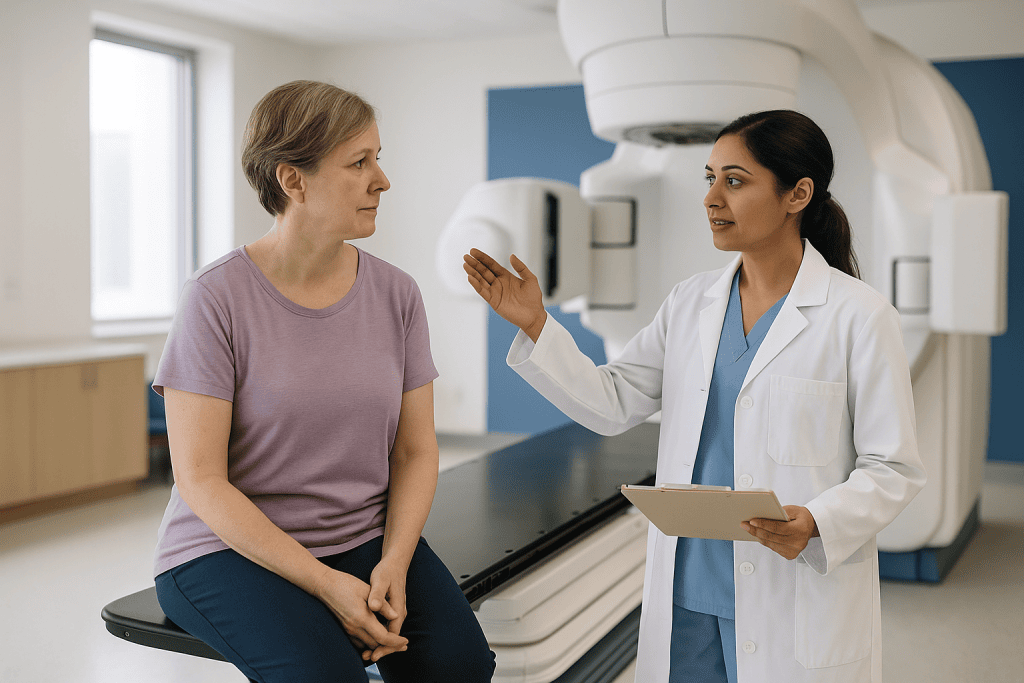
You will be asked to change into a gown and lie on a flat, hard table that mimics the treatment couch. Radiation therapists, the technologists who run the machines daily, will position you using lasers mounted on the walls and ceiling. The thin red or green lines you see on your skin are alignment lights, not beams. They will adjust your shoulders, hips and chin repeatedly, sometimes by only a finger’s width, until the position is one you can hold still in and they can rebuild tomorrow.
Depending on the site, a mask, cushion or vacuum bag may be formed around you. A contrast dye may be given by vein or by mouth to help organs show up clearly; you will be asked about allergies and kidney function first. For some pelvic cancers, a thin tube or small marker may be used so the planning scan captures how your bladder, rectum or vagina sits during treatment.
Then comes the scan, a few minutes of lying motionless while the table slides through the ring. Afterward, the therapists place marks (more on those below), photograph your position and the devices, and give you written instructions for the days ahead.
Bring a list of your medicines, wear comfortable clothing that is easy to remove around the treatment area, and tell the team if you have claustrophobia, back pain, or difficulty raising your arms. These are design problems, and the team would far rather solve them now than on day one.
Masks, molds and breath-holds: why holding still is half the work
Modern radiation is shaped to the tumor with margins measured in millimeters. A beam aimed that tightly only works if the target is where the plan says it is, which is why immobilization gets so much attention at simulation.
For head and neck or brain treatment, a thermoplastic mask is common. The therapists warm a sheet of perforated plastic in a water bath until it is pliable, drape it over your face and shoulders, and mold it as it cools and hardens over several minutes. It feels warm and snug, like a damp towel pressed firmly down, and it clips to the table so your head cannot drift. You can breathe and swallow through the holes. The mask is yours alone and is used at every session.
For chest, abdomen and limb treatment, a vacuum-formed cushion or a custom foam mold may be made to hold your arms, legs or torso in a repeatable shape. Breast and chest-wall treatment often uses an inclined board with arm rests above the head, so the arm position is noted precisely.
Some left-sided breast and chest treatments use a breath-hold technique. Taking a deep breath lifts the chest wall and pushes the heart down and away from the beam; you hold for a count of 20 to 30 seconds while the beam is on, then breathe normally. At simulation, therapists coach you through this so the planning scan is taken in the same held breath you will use later. If that sounds daunting, say so; the team can practice with you.
Why does this matter to your preparation? Because anything that changes your shape changes the fit. The Cleveland Clinic advises keeping your weight stable during treatment, and significant weight change, new swelling, or a new hairstyle under a mask can all mean a repeat simulation. Mention changes early rather than discovering them on the couch.
Radiation therapy skin marks: tattoos, ink and tattoo-free options
At the end of simulation, therapists transfer the plan’s coordinates onto your skin. These radiation therapy skin marks are the bridge between the scan and every future session, and understanding them removes a surprising amount of anxiety.
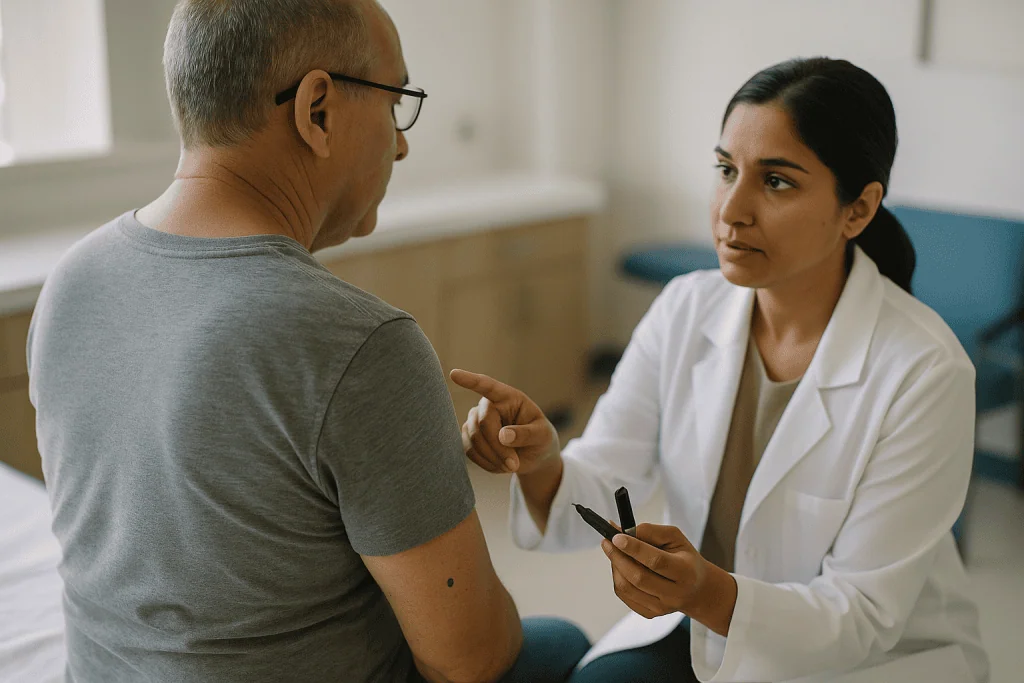
Three systems are in common use. Permanent tattoos are the traditional method: a drop of ink and a fine needle create a dot the size of a freckle, usually three to five of them. Each takes a second and feels like a brief pinprick. The dots never need maintenance, which is why they have endured; they also stay with you after treatment, and some people find that a permanent reminder they did not choose.
Semi-permanent ink marks are the second option. Therapists draw crosses or lines with a skin marker and cover them with clear waterproof film. You can shower with the film on, but you should not scrub it, soak in a bath, swim, or peel it. If a line fades or a dressing lifts, do not redraw it yourself; the team will realign you from photographs and the mask, then remark.
The third approach uses no marks at all. Surface-guided systems project a light pattern onto the skin and track its three-dimensional shape in real time, so the therapists match your contour rather than a dot. Not every center offers it, and it suits some body sites better than others.
Whatever system you have, the rules are the same. Avoid lotions, oils and deodorant directly over the marks unless told otherwise, pat the area dry rather than rubbing, wear soft clothing that does not chafe, and do not let the area sunburn, since a changed skin surface is harder to align and harder to care for later. The NHS and the National Cancer Institute both advise checking with your team before applying anything to the treatment area.
How does radiation therapy work, and what are the 5 R's of radiotherapy?
Radiation treats cancer by damaging DNA. High-energy X-rays or particles pass through tissue and break the DNA strands inside cells. Healthy cells have robust repair machinery and can often fix that damage overnight; many cancer cells have faulty repair systems and die when they next try to divide, which is why the effect unfolds over days and weeks rather than instantly. MedlinePlus and the National Cancer Institute describe this same mechanism in patient terms.
Splitting the course into daily sessions is called fractionation, and it exploits that difference. Radiation biologists summarize the reasoning in what textbooks call the 5 R’s:
- Repair: the overnight gap lets normal tissue mend DNA damage faster than tumor tissue can.
- Redistribution (also called reassortment): cells are more vulnerable at certain stages of the division cycle, and repeated sessions catch more of them in a sensitive phase.
- Repopulation: healthy cells regrow between sessions, which helps skin and lining tissue recover; some tumors also repopulate, which is why unplanned breaks are kept short.
- Reoxygenation: oxygen-starved tumor cells resist radiation; as outer layers die, oxygen reaches deeper cells and makes them easier to treat at later sessions.
- Radiosensitivity: different tissues and tumors have inherent differences in how much radiation they can tolerate.
None of this requires action from you, but it explains two things people often ask. First, why you are asked to come every weekday and not to skip sessions: each one is a step in a sequence designed around repair and repopulation. Second, why side effects lag behind treatment and can continue for a week or two after the last session; the biology is still playing out.
Preparation fits in here, too. Good nutrition and sleep do not change the physics, but they support the repopulation of normal tissue that the schedule depends on.
Why is there a wait between simulation and the first treatment?
The gap after simulation can feel like limbo, especially when you have just been told time matters. It helps to know the gap is full.
Your CT images go to a dosimetrist, who outlines the tumor target and every nearby organ slice by slice, then designs beam angles and intensities. A medical physicist independently checks the plan and runs quality assurance on the actual machine, sometimes delivering the plan to a phantom (a water or plastic stand-in for your body) to confirm the dose distribution matches the computer. The radiation oncologist reviews and approves. Only then is your first appointment confirmed. The NHS notes this can take from a few days to a couple of weeks, longer for complex plans.
| Stage | What happens | Typical timing (per NHS and NCI patient guidance) |
|---|---|---|
| Consultation | Decision to treat, goals, history review, consent | Weeks before treatment |
| Pre-tests | Dental check, pregnancy test, device check, bloodwork where needed | Before or soon after consultation |
| Simulation | Positioning, immobilization devices, CT scan, skin marks | Often around an hour; sometimes longer |
| Planning and QA | Contouring, beam design, physics checks, physician approval | A few days to a few weeks |
| Verification | Imaging on the treatment machine to confirm setup | First session, then regularly |
| Treatment course | Daily weekday sessions of roughly 10–30 minutes each | Several weeks, as planned by your team |
Use the waiting time deliberately. Arrange transport for the first week, ask about parking or drop-off, tell your employer the likely schedule, and stock the soft clothing and unscented skin care your team has approved. If the wait stretches beyond what you were told, call and ask. Delays usually have a mundane reason, and a quick call beats a week of imagining otherwise.
Who is ready to start, and who is usually asked to wait?
Radiation therapy is used across most cancer types and across ages, from people who need a short course for pain to those having weeks of treatment combined with chemotherapy. Readiness is less about diagnosis than about a short list of practical conditions that the team checks before scheduling.
You are usually ready to start when the planning scan reflects your current anatomy, any surgery in the area has healed enough that swelling is settled, your skin in the treatment field is intact, and prerequisite checks are complete. For head and neck treatment that often means a dental assessment and any extractions done ahead of time, because the jaw heals poorly after radiation; the National Cancer Institute advises this dental visit before treatment begins. For pelvic treatment it may mean completing a bowel preparation routine or confirming you can hold a comfortable bladder volume.
You may be asked to wait, or your plan adjusted, in several circumstances:
- Possible pregnancy, since fetal exposure must be avoided; a test is routine for anyone who could be pregnant.
- A cardiac pacemaker or defibrillator, which needs assessment and sometimes monitoring because radiation can affect the device’s electronics.
- Recent surgery with wounds still open or draining in the field.
- A skin infection, rash or active shingles in the area.
- Rapid weight change or new swelling that makes the simulation scan inaccurate.
- Incomplete prior radiation records when the same region has been treated before, because cumulative tolerance of normal tissue has to be calculated.
Certain medicines also prompt a conversation, not because you should stop them yourself, but because some drug classes can heighten skin or tissue sensitivity to radiation. Bring a complete list, including supplements, and let the prescribing clinician and radiation oncologist decide together. Waiting a week to start a well-designed plan is routine; the team schedules with that margin in mind.
What not to do before radiation: habits worth pausing
Searches for what not to do before radiation return a long and contradictory list. The evidence-backed version is shorter.
Do not change the canvas. Avoid sunbathing, tanning beds and sunburn on the treatment area; the NHS advises covering the area and using the skin care your team recommends. Skip waxing, hair-removal creams and blade shaving in the field, since tiny nicks and irritation become harder to manage once treatment starts. If hair needs to be removed, ask whether an electric trimmer is acceptable.
Do not add new products. Perfumed lotions, alcohol-based toners, adhesive bandages and powders over the marks can lift ink, irritate skin or leave residue that changes surface readings. On deodorant, the picture has shifted: older advice banned it entirely, while more recent reviews have not found that modern aluminum-free or even standard antiperspirants worsen skin reactions in most people. Because practice varies, the National Cancer Institute’s advice stands: ask your own team what is permitted in your field.
Do not start supplements quietly. High-dose antioxidant supplements are a genuine gray area; the concern, raised in research summarized by the NIH Office of Dietary Supplements, is that some might protect tumor cells from the oxidative damage radiation relies on. The evidence is incomplete, which is exactly why your team needs to know before you take anything new.
Do not alter prescribed medicines on your own, including stopping blood thinners or diabetes drugs because you assume treatment requires it. That decision belongs to your prescribers.
Do not crash diet. Losing weight to “get healthy” before treatment can loosen a mask or shift a mold enough to require re-planning, and the Cleveland Clinic recommends maintaining weight through the course.
Finally, do not scrub, pick or peel the marks, and do not swim or soak while ink marks are in place. Showers are fine; baths and pools usually wait.
Full bladder, empty bowel, no breakfast? Site-specific preparation explained
Instructions differ by body site because the organs around the target move, and the team wants them in the same place every day. If your sheet says something that seems odd, there is almost always a geometric reason.
For prostate, bladder, cervical and rectal treatment, you may be asked to arrive with a comfortably full bladder. A full bladder pushes loops of small bowel up and out of the beam and lifts the bladder dome into a predictable shape. Teams typically ask you to empty, then drink a set amount of water about 30 to 60 minutes before each session, matching what you did at simulation; the exact routine is printed for you, and the daily cone-beam image confirms it worked. You may also be asked to keep the rectum empty, since gas or stool shifts the prostate by several millimeters. Low-gas eating and a regular bowel habit are discussed at planning.
For stomach, pancreas and some liver treatments, you may be asked not to eat for a few hours beforehand so the stomach is reliably empty and small. Breath-hold or respiratory-gated techniques, which switch the beam on only during part of the breathing cycle, may be practiced at simulation.
For breast and chest wall treatment, preparation centers on the skin and arm position rather than digestion: soft, front-opening tops, no products over the marks, and practicing the arms-up position if shoulder stiffness is a problem.
For head and neck treatment, the dental check matters most, along with a nutrition plan; the National Cancer Institute’s patient guidance highlights that mouth soreness and taste changes can affect eating during treatment, so a dietitian visit beforehand is common.
Whatever your site, consistency beats perfection. Doing the same thing you did at simulation, at the same time of day, is what the plan was built on.
Preparing for radiation therapy: a checklist for the final week
Lists help here, because the days before treatment tend to fill with appointments and worry in equal measure. This is the practical version of preparing for radiation therapy, organized around what the care team actually needs from you.
- Protect the marks. Keep the clear film dry where possible, pat rather than rub, and photograph the marks so you can tell if one fades.
- Finish prerequisite checks. Confirm dental, cardiac device, pregnancy or lab tests are done and results have reached the radiation department.
- Compile a medicine and supplement list with names and reasons, and bring it to the first session. Add any over-the-counter creams you use.
- Rehearse the site routine. Practice the bladder-filling timing or the breath-hold at home once or twice so the first day is not the first attempt.
- Plan logistics. Daily weekday visits over several weeks, per NCI guidance, add up; map parking, transport backup, and who can come on the first day.
- Tell work and family the pattern rather than vague dates; a standing time slot is easier for everyone to plan around.
- Stock approved skin care and soft, loose, natural-fiber clothing for the treatment area. Avoid anything new on skin without clearance.
- Arrange nutrition support if your site affects eating; ask whether a dietitian is part of the team.
- Write down your questions (the section below offers a starting list) and bring a notebook for answers.
- Choose a contact routine. Know the department’s daytime number and the after-hours number, and put both in your phone before you need them.
One thing you do not need to do is “get strong” through punishing exercise or a radical diet. Gentle daily walking is reasonable for most people and is associated in NCI patient guidance with less treatment-related fatigue, but the week before treatment is for stability, not transformation. Rest, hydrate, and keep your body the shape it was scanned in.
What happens on the first day of radiation therapy?
The first day of radiation therapy is usually the longest, and knowing why makes it easier. Beyond the treatment itself, the team is verifying that the plan built from your simulation scan fits the real you.
You will check in, change, and be walked to the treatment room, which holds a linear accelerator, the machine that generates and shapes high-energy X-ray beams. It looks like a large arm that rotates around the couch. The therapists will position you exactly as at simulation, using the mask or mold, the wall lasers and your skin marks. Expect several small adjustments and a few quiet minutes while they confirm numbers on screens.
Before the first beam, they take verification images, either X-rays or a low-dose cone-beam CT, and compare them with the planning scan. Small shifts are corrected by moving the couch. This image check is repeated regularly during the course and is why your daily routine matters so much.
Then the therapists leave the room. They watch you on cameras and can hear you through an intercom at all times; if you need to stop, you raise a hand or speak and they pause the machine. The beam itself is silent and painless. You may hear buzzing and clicking as the machine moves, and you may see the arm pass over you from different angles. According to the National Cancer Institute, the radiation is on for only a few minutes, and the whole appointment usually runs roughly 10 to 30 minutes.
You can leave straight afterward. External beam radiation does not make you radioactive; you can hug children and share a bed as normal. Most people drive themselves to later sessions, though having company on day one is worth arranging. A weekly review with the oncologist or nurse is standard, and that is where side effects and questions are handled as they arise.
What do the following weeks usually look like, and which days are hardest?
People searching for the hardest days after radiation treatment often expect the answer to be the first week. For most external beam courses it is the opposite: side effects accumulate, and the toughest stretch is usually the final week of treatment and the first one or two weeks after it ends.
The pattern follows the biology described earlier. Skin in the field often shows redness, dryness or itching after two to three weeks of treatment, according to the National Cancer Institute, and may progress to peeling or a sunburn-like soreness toward the end. Fatigue tends to build gradually and can continue for weeks after the last session. Site-specific effects follow the organ in the beam: mouth soreness and taste changes in head and neck treatment, bladder or bowel irritation in pelvic treatment, a tickly cough or swallowing discomfort in chest treatment.
Many of these effects peak after the machine stops. That lag catches people off guard, so it is worth saying plainly: feeling worst a week after finishing is common, not a sign something has gone wrong. The NCI notes skin changes usually settle within a few weeks after treatment ends, while fatigue can take longer.
Through the course, expect a weekly clinic review, regular verification imaging, and occasional small changes to skin care or medicines as effects evolve. Teams try hard to avoid unplanned breaks, because the repopulation principle means gaps can let tumor cells recover; if you are ill, call rather than quietly skipping.
Beyond the acute phase, your team will describe any late effects relevant to your site and the follow-up schedule for them. These are discussed individually, since they depend on the region treated and your overall plan, and no article can substitute for that conversation. What you can prepare for now is the shape of the curve: a slow climb, a difficult plateau, and a recovery that begins a week or two after the last session.
What people often get wrong about radiation therapy
Myths around radiation are durable, partly because the treatment is invisible. These are the ones radiation therapists hear most, with what the evidence actually says.
“I’ll be radioactive and dangerous to my grandchildren.” External beam radiation passes through you and is gone the moment the machine switches off, as MedlinePlus and the National Cancer Institute both explain. Only certain internal treatments (sealed implants or swallowed radioactive medicines) carry precautions, and those are spelled out separately if they apply to you.
“The simulation is my first treatment.” It is a planning scan. Nothing therapeutic is delivered, and the small amount of radiation involved is from the CT itself.
“Radiation burns like a stove.” Skin reactions resemble sunburn, not thermal burns, and they develop over weeks. The beam is painless at the moment of delivery.
“Missing a day is no big deal, I’ll just add it at the end.” Teams do add missed sessions, but unplanned gaps matter because tumor cells can repopulate between treatments. Call before skipping.
“I should scrub off the marks after each session so my skin can breathe.” The marks are the alignment system. Removing them means re-marking and sometimes re-imaging.
“Natural oils are safer than hospital creams.” Unapproved products, including essential oils and some herbal salves, can irritate radiation-sensitized skin or alter its surface. Approved, fragrance-free products are chosen for a reason.
“Radiation is the treatment of last resort.” It is one of the three main pillars of cancer treatment alongside surgery and drug therapy, and the American Cancer Society and NCI note that a large proportion of people with cancer receive it at some point, often with the goal of long-term control.
“I’ll know by the end of the course whether it worked.” Because cells die as they attempt to divide, response is assessed weeks to months later by imaging or examination, on a schedule your team sets.
What I wish I knew before radiation: the quieter lessons
Ask people who have finished a course what they wish they had known, and the answers rarely concern physics. They concern pace, logistics and the texture of daily life. These themes recur in patient education from the NCI and NHS, and they are worth hearing before you start rather than after.
The appointment is short; the routine is long. Twenty minutes in the department can swallow two hours of the day once travel and waiting are counted, every weekday, for weeks. People who thrived treated it like a part-time job: a fixed slot, a packed bag by the door, a book for the waiting room.
Fatigue is real and cumulative, and it is not laziness. It often arrives in week two or three and lingers after the course. Short walks tend to help more than long naps, and planning lighter weeks toward the end is wise.
The mask gets easier. Many people dread it on day one and barely notice it by day ten. Telling the team about claustrophobia early opens options: music, a coached breathing pattern, cutouts for the eyes, or in some cases a relaxation medicine discussed with a clinician.
Skin needs boring care. Fragrance-free, approved moisturizers used as directed from the first week, loose cotton, no heat packs or ice directly on the area, and shade outdoors. Starting before the skin complains is easier than catching up.
Your team wants to hear the small things. A new cough, a tender spot, trouble sleeping, a question about intimacy: these are what the weekly review exists for, and nurses often have practical solutions that never appear in leaflets.
Finally, the end of treatment is not the end of feeling it. Expect a wobble in the fortnight after your last session, physically and emotionally, and line up support for those days, not only for the first ones.
Questions to ask your care team before day one
Bring these to your consultation, simulation or first treatment review. The answers are specific to your plan, and writing them down turns an abstract course into something you can manage.
- What is the goal of my radiation: to control the cancer long-term, to lower the chance it returns, or to relieve symptoms?
- How many sessions are planned, over how many weeks, and what happens if I have to miss one?
- Which type of marks will I have, and exactly how should I care for them?
- Is there a bladder, bowel, eating or breath-hold routine I should rehearse at home, and when should I start?
- Which skin products are approved in my treatment area, and may I use my usual deodorant, soap or moisturizer?
- Which side effects are likely for my site, when do they usually begin, and how long after treatment do they typically last?
- Are any of my current medicines or supplements a concern during treatment, and who should I speak to before making any change?
- Do I need a dental, cardiac device, fertility or dietitian appointment before I begin?
- Can I keep working, exercising, driving and traveling for short trips during the course?
- Who do I call during the day, and who do I call at night or on weekends, if something worries me?
- Will I have imaging on the machine, and how often will I see the oncologist or nurse during treatment?
- What late effects are relevant to my treatment area, and what follow-up is planned once the course ends?
Two further suggestions from experienced patients: ask whether a family member can see the treatment room once, which demystifies it for everyone at home, and ask what the department would like you to report immediately versus at the weekly review. Knowing the threshold removes a lot of second-guessing in the weeks ahead.
When to call your doctor
Most of what happens before and during radiation therapy is predictable, and your team will have told you what to expect at each stage. Some things are not routine and should prompt a same-day call to the radiation department or your oncologist, using the daytime or after-hours number you saved during preparation.
Before treatment starts, call if you notice a new rash, blister, infection or wound in the treatment area; if a skin mark fades or a dressing lifts and you cannot see the line; if you develop a fever or feel unwell; if there is any possibility you could be pregnant; if you have gained or lost noticeable weight or developed swelling since simulation; or if you have started, stopped or been prescribed any new medicine or supplement.
During treatment, call promptly for any of the following red-flag signs, which the National Cancer Institute and NHS flag as reasons to seek care rather than wait for the weekly review:
- Fever, shaking chills, or feeling suddenly very unwell, especially if you are also having chemotherapy.
- Skin that is broken, weeping, bleeding or showing pus, or pain in the treated area that your usual measures do not ease.
- Difficulty swallowing fluids, persistent vomiting, or signs of dehydration such as very dark urine or dizziness on standing.
- New or worsening shortness of breath, chest pain, or coughing up blood.
- A swollen, warm or painful calf, or sudden breathlessness, which can signal a blood clot.
- Blood in urine or stool, or inability to pass urine.
- New confusion, severe headache, seizure, weakness or numbness.
- Any symptom that frightens you or feels wrong, even if it is not on this list.
If you cannot reach the department and symptoms are severe, use emergency services and tell them you are receiving radiation therapy. Decisions about pausing, adjusting or continuing treatment, and about any medicine, rest with your treating team. Calling early is never an overreaction; it is part of the plan.
Frequently asked questions
What are the 5 R's of radiotherapy?
The 5 R’s are repair, redistribution, repopulation, reoxygenation and radiosensitivity, the radiobiology principles behind splitting treatment into daily sessions. Healthy cells repair DNA damage between sessions, dividing cells are caught at vulnerable stages, normal tissue regrows, oxygen reaches deeper tumor cells as outer layers die, and different tissues tolerate radiation differently. Together they explain why courses run on weekdays over weeks and why side effects lag behind treatment.
What are the hardest days after radiation treatment?
For most external beam courses the hardest stretch is the last week of treatment and the first one to two weeks after it ends, not the beginning. Skin reactions, fatigue and site-specific effects such as mouth soreness or bladder irritation build gradually and often peak after the machine stops. The National Cancer Institute notes skin changes usually settle within a few weeks of finishing, while fatigue can last longer.
What should I not do before radiation starts?
Avoid sunburn, tanning, waxing or blade shaving in the treatment area, do not apply new lotions, perfumes or adhesive products over the skin marks, and do not swim or soak while ink marks are in place. Do not start supplements, crash diet or change prescribed medicines without telling your team, since each can affect skin, mask fit or treatment safety. Ask your own department about deodorant, as practice varies.
Can I shower after my radiation simulation appointment?
Yes, in most cases you can shower with ink marks covered by clear waterproof film, as long as you avoid scrubbing, soaking, or aiming a strong jet at the area. Pat the skin dry rather than rubbing. Permanent tattoo marks need no special protection. If a dressing lifts or a line fades, do not redraw it yourself; call the department, which can realign you from photographs and the mask and remark the skin.
Does radiation simulation hurt, and does it involve radiation?
Simulation is generally painless, though lying still on a hard table for up to an hour can be uncomfortable, and tattoo marks feel like brief pinpricks. The only radiation is from the CT scan used for planning, similar to a diagnostic scan; no treatment is given. A warm thermoplastic mask may feel snug as it sets. Tell the team about claustrophobia or back pain so they can adjust positioning or offer support.
Why do I need a full bladder for pelvic radiation therapy?
A comfortably full bladder lifts loops of small bowel up and out of the beam path and gives the bladder a predictable shape, so the target sits in the same place as on your planning scan. Teams usually ask you to empty, then drink a set amount of water a set time before each session, matching what you did at simulation. Daily imaging on the machine confirms the position before the beam is switched on.
How long after simulation does radiation treatment usually start?
According to NHS patient guidance, treatment typically begins a few days to a few weeks after the planning scan, depending on the complexity of the plan. During that time dosimetrists outline the target and organs, design the beams, and medical physicists check the plan on the actual machine before the oncologist approves it. If your wait runs longer than you were told, call the department and ask; delays are usually administrative.
Can I wear deodorant during breast or chest wall radiation?
Possibly, but check with your own team. Older advice banned all deodorant because of concerns about metal content and skin irritation; more recent clinical reviews have not shown that most modern products worsen skin reactions, and many departments now permit a gentle, fragrance-free deodorant away from broken skin. Because practice differs and your skin will be assessed weekly, the National Cancer Institute advises asking before applying anything to the treatment area.
Will I be radioactive after external beam radiation therapy?
No. External beam radiation passes through the body and stops the moment the machine is switched off, so you can hug children, hold a baby, and sleep beside a partner as usual, according to MedlinePlus and the National Cancer Institute. Only certain internal treatments, such as sealed implants or swallowed radioactive medicines, carry temporary precautions, and your team will explain those separately if they apply to you.
What do people wish they knew before radiation, especially about work and driving?
Most people say the daily routine, not the treatment, was the real adjustment: a short appointment that absorbs a couple of hours each weekday for weeks. Many continue working with adjusted hours and drive themselves after the first session, since external beam treatment does not impair you. Fatigue tends to build in later weeks and lingers afterward, so lighter plans for the end of the course and the fortnight that follows are a common piece of advice.
References
This article is for general information only and is not a substitute for professional medical advice. Please consult a qualified doctor about your individual situation.

More from the Blog
IMRT Planning Day Explained: Simulation CT, Immobilization Mask and Skin Marks
An IMRT simulation planning CT is the mapping appointment before radiation treatment begins. You lie in the exact position you will use for every…

Why Chronic Lymphocytic Leukemia Is Often Watched First, and What Triggers Treatment
Chronic lymphocytic leukemia is often watched rather than treated at first because trials have not shown that starting treatment early helps people live longer,…
Bleeding, Fever or Pain After Endometrial Cancer Surgery: Which Signs Need a Call
After a hysterectomy for endometrial cancer, call your surgical team the same day for bleeding heavier than a light period or that suddenly restarts,…

When Does Leukemia Treatment Include a Stem Cell Transplant, and Who Is Assessed for It?
A stem cell transplant becomes part of leukemia treatment when the disease is judged likely to return after chemotherapy alone, or when it has…
Staging Before Cancer Treatment Starts: How Imaging and Pathology Set the Plan
Cancer staging before treatment describes how large a tumor is and whether it has reached nearby lymph nodes or distant organs, most often using…
Surgery or Radiation for Prostate Cancer? How Specialists Compare the Two Paths
For localized prostate cancer, surgery and radiation therapy are both standard treatments, and the largest long-term randomized trial found deaths from prostate cancer were…