

The First Two Weeks After ACL Surgery: Crutches, Bracing, Ice and Bending the Knee
Key Takeaways
- Full knee extension, not deep bending, is the motion milestone most rehabilitation protocols want achieved within the first two weeks after ACL surgery.
- The NHS gives around two weeks as the typical crutch period, but a concurrent meniscus repair often extends weight-bearing restrictions by several weeks.
- Routine post-operative bracing has not been shown to improve final outcomes, which is why some surgeons prescribe a locked hinged brace and others use none.
- MedlinePlus discharge guidance describes icing in roughly 20-minute sessions several times daily, with the whole leg elevated above the heart and no pillow behind the knee.
- An ACL graft is strongest on the day of surgery and temporarily weakens as the body remodels it, so feeling strong early is not evidence of readiness.
- Calf pain or swelling greater than the knee, fever with a hotter incision, or sudden breathlessness are same-day red flags, not symptoms to watch over the weekend.
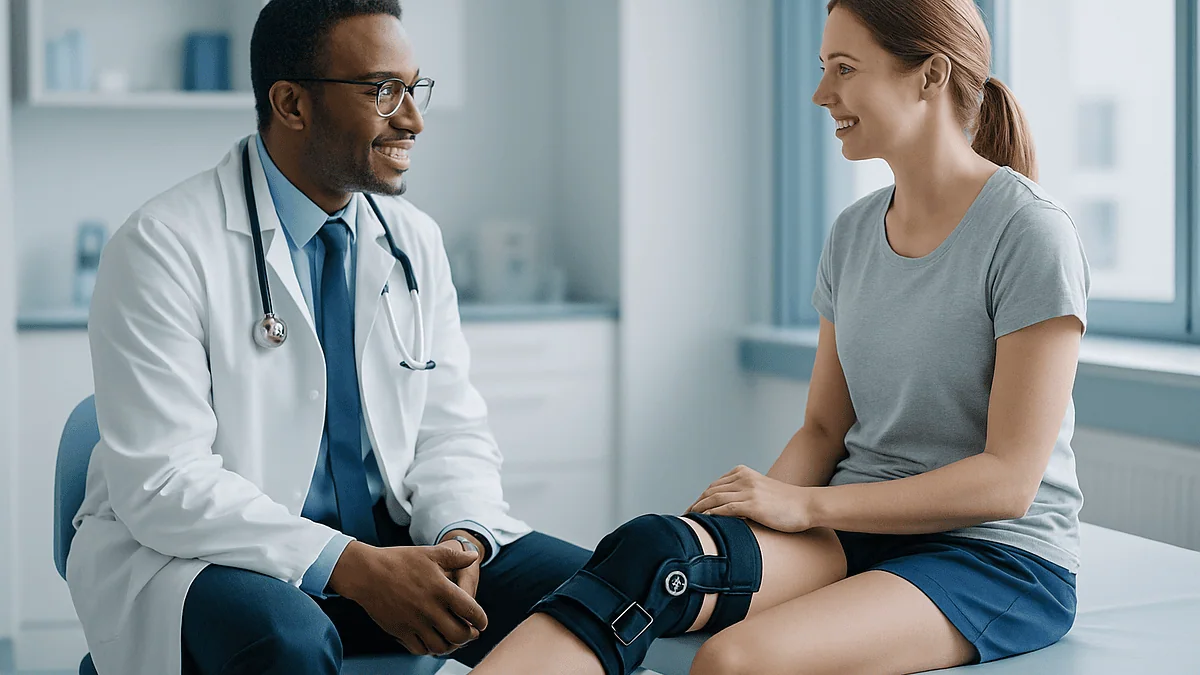
The first two weeks after ACL surgery usually focus on four jobs: walking safely with crutches, wearing any brace the surgeon has prescribed, controlling swelling with ice and elevation, and gently restoring knee motion, especially full straightening. Most people use crutches for roughly two weeks and begin supervised physical therapy within days. Pace, brace rules and bending targets differ by graft and surgeon, so the care team's plan takes priority.
The ride home is where it sinks in. The anesthesia has worn off enough to notice the bulky dressing, the leg that feels like it belongs to someone else, and the crutches rattling in the back seat. Somebody has handed over a folder of instructions, and the question that matters is suddenly very practical: what exactly am I supposed to do with this knee for the next fourteen days?
The first two weeks after ACL surgery are not glamorous. Nobody gets stronger in this window. What happens instead is quieter and arguably more important: swelling is tamed, the wound heals, the knee learns to straighten fully again, and the new graft is protected while it begins to anchor itself inside the bone tunnels.
This guide walks through what the evidence says about crutches, bracing, ice and bending in that early stretch, what people commonly get wrong, and which signs should prompt a phone call rather than patience.
What actually happens during ACL reconstruction, and what is an ACL graft?
The anterior cruciate ligament (ACL) is a short, rope-like band in the center of the knee that stops the shin bone from sliding forward and twisting under the thigh bone. Once it tears, it does not knit back together on its own, because its blood supply is poor and the torn ends retract inside the joint fluid.
Reconstruction does not stitch the old ligament. It replaces it with a graft, a piece of tendon used to build a new ligament. Surgeons most often take that tendon from the patient’s own body (an autograft), usually the hamstring tendons, the middle third of the patellar tendon, or the quadriceps tendon. Donor tissue from a tissue bank (an allograft) is another option in some situations. Each has trade-offs in harvest-site soreness, early stiffness and healing speed, and the choice is a shared decision between patient and surgeon, as Mayo Clinic describes.
The operation is nearly always arthroscopic, meaning a thin camera and small instruments go in through keyhole incisions rather than one large cut. The surgeon drills narrow tunnels in the thigh bone and shin bone, threads the graft through them, and fixes it in place with screws, buttons or staples. Cleveland Clinic puts the typical operating time at roughly one to two hours, and most people go home the same day.
One detail shapes everything in the first two weeks: the graft is strongest on the day it is implanted and then temporarily weakens as the body remodels it into living ligament over months. The early rules about crutches, bracing and avoiding twisting exist to protect a structure that is, for a while, more vulnerable than it feels.
Who usually has ACL surgery, and who is usually asked to wait?
Not every torn ACL needs an operation. The NHS notes that surgery is generally considered for people whose knee gives way during daily activity, for athletes who pivot and cut in sport, and for those with other damaged structures, such as a meniscus tear that needs repair alongside the ligament. Younger, more active people are more likely to be offered reconstruction because an unstable knee that repeatedly buckles can injure cartilage over time.
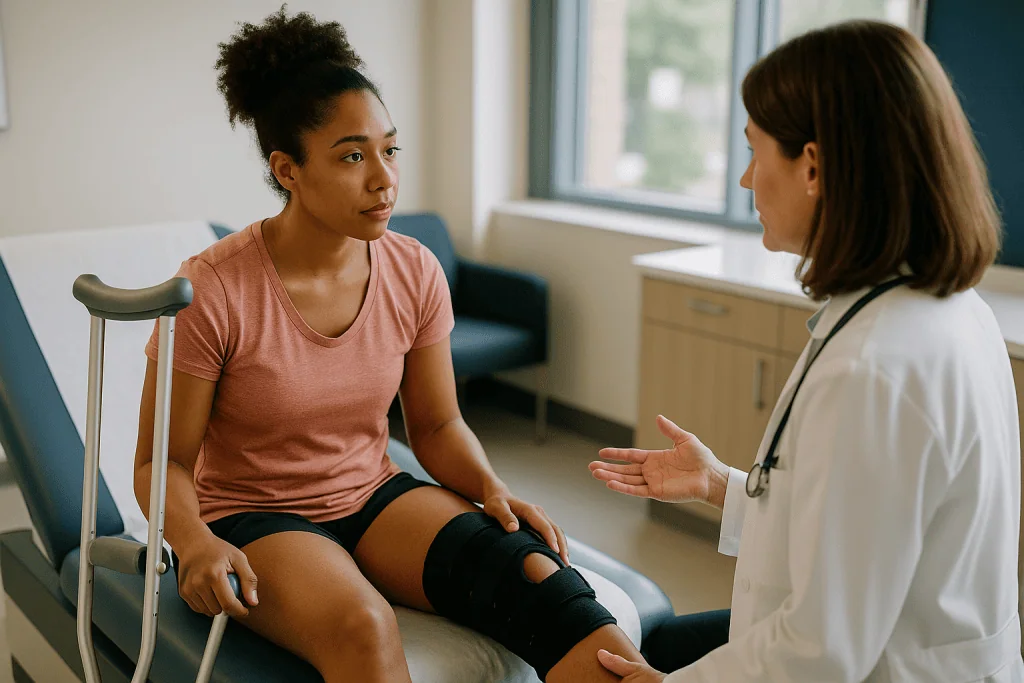
Non-surgical management is a legitimate path, not a consolation prize. Structured physical therapy to strengthen the quadriceps and hamstrings, a hinged brace for certain activities, and a shift away from pivoting sports can leave many people with a stable, functional knee. Some who start down this road later choose surgery if instability persists; the reverse rarely happens, which is why many surgeons will discuss a trial of rehabilitation first for people whose sports do not demand sharp changes of direction.
Timing matters even once surgery is chosen. Most surgeons prefer to wait until the acute swelling has settled and the knee bends and straightens reasonably well. Operating on a hot, stiff knee raises the risk of arthrofibrosis, a problematic build-up of scar tissue that locks the joint. That pre-surgery waiting period, often described as “prehab,” is also when people practice crutch walking and the exercises they will be asked to do afterward.
People may be asked to wait or reconsider if they smoke heavily, have poorly controlled diabetes, an active infection, or significant arthritis in the same knee, since each can compromise graft healing or the overall result. None of these is an automatic no. They are reasons for a longer conversation with the treating team about risk, benefit and alternatives.
The first two weeks after ACL surgery: what the days usually look like
Day one is mostly about rest, ice and getting the leg elevated above heart level. The nerve block used during surgery often numbs the leg for several hours, so pain may arrive later that evening rather than in the recovery room. Walking to the bathroom with crutches, ankle pumps to keep blood moving, and a few gentle quadriceps squeezes are usually the entire exercise program.
Days two through four tend to be the sorest. Swelling peaks, the thigh muscle feels switched off, and the knee resists straightening. MedlinePlus discharge guidance describes keeping the leg raised, icing in roughly 20-minute stretches several times a day, and beginning the simple motion exercises the surgeon has approved. Many people start formal physical therapy within the first few days, as Mayo Clinic notes, because early supervised movement reduces stiffness.
By the end of week one, the dressing has often been changed, the knee is usually bending somewhere between a right angle and a bit beyond, and crutch walking looks less like a lurch. Fatigue is common; the body is running a repair project and sleep is fragmented.
Week two brings the first clinic visit for most people, where sutures or staples come out, the incisions are checked, and the surgeon reviews motion. This is also when many are allowed to put more weight through the leg and begin weaning off one crutch, then both, provided the knee straightens fully and the quadriceps can hold the leg steady. The NHS gives around two weeks as the typical crutch period.
What these fourteen days are not: a strength phase. Anyone pushing squats or resisted work this early is working against the biology of the graft, not with it.
How long on crutches after ACL surgery?
Around two weeks is the figure the NHS gives for most people, though the real answer depends on three things: what else was repaired, how much weight the surgeon allows, and whether the knee can be controlled without a wobble.
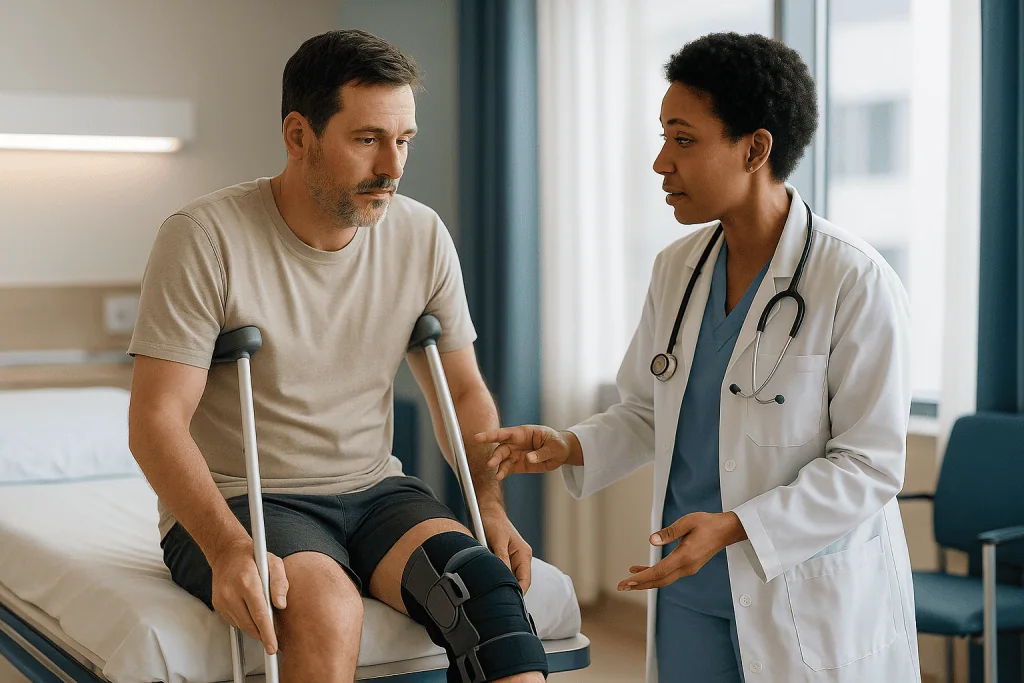
Many surgeons permit weight-bearing as tolerated from day one after an isolated ACL reconstruction, meaning the leg can take as much load as feels comfortable while the crutches share it. If the meniscus was repaired at the same time, weight may be restricted for several weeks to protect the stitches, and the brace may be locked straight for walking. The surgeon’s instruction sheet overrides any general rule, including this one.
Crutches do two jobs in this window. They protect the graft and any repair from sudden twisting loads, and they let the person walk with a normal heel-to-toe pattern rather than a stiff-legged limp. That second job is underrated. A limp learned in week one can take months to unlearn, so therapists usually keep people on two crutches until they can walk smoothly, then one crutch on the opposite side of the surgical leg, then none.
Common milestones therapists look for before dropping the crutches:
- The knee straightens all the way, matching the other side.
- The thigh muscle contracts well enough to lift the leg straight without the knee sagging.
- Walking is pain-controlled, with no buckling or catching.
Stairs follow a simple rule that most physical therapy programs teach: lead with the uninjured leg going up, the operated leg going down, crutches moving with the operated leg. Rushing this transition rarely speeds recovery; it more often produces a swollen knee and a step backward.
Do you need a knee brace after ACL surgery?
Here the honest answer is that practice varies, and the evidence does not strongly favor one approach. A hinged post-operative brace, a brace with adjustable metal hinges at the sides that can be locked straight or set to a bending limit, is prescribed by many surgeons for the first few weeks. Others, particularly after an isolated reconstruction with a secure fixation, do not use one at all.
What a brace can do in the first two weeks is protect against accidental hyperextension or a twist if the leg gives way, and remind a sleepy, medicated person not to bend the knee in bed. What it cannot do is substitute for a working quadriceps. The brace does not hold the knee up; the muscle does, and a locked brace that stays on too long can make that muscle lazier.
Typical patterns people encounter, each dictated by the surgeon rather than by preference:
- Brace locked in full extension for walking and sleeping, unlocked for exercises.
- Brace set to a bending range that opens up week by week.
- No brace, with crutches alone providing early protection.
Where a meniscus repair or a ligament on the side of the knee was also addressed, a locked brace during walking is more common, because those repairs tolerate less movement under load.
Compression sleeves and soft supports are a different category. They reduce swelling and provide a feeling of security but offer no structural protection for the graft. Mayo Clinic and the NHS both frame bracing as something surgeons may use rather than something every patient needs, which is exactly how to read it: a tool, applied case by case, and worth asking about directly.
Ice, elevation and swelling: why the early knee needs cooling
Swelling is not a side issue after ACL surgery. A joint full of fluid reflexively switches off the quadriceps, resists straightening, and hurts. Controlling it is therefore a motion strategy and a pain strategy rolled into one, which is why the discharge sheet talks about ice so much.
MedlinePlus discharge guidance describes icing for about 20 minutes at a time, several times a day, with a cloth between ice and skin to avoid cold injury. Cold narrows small blood vessels, slowing the leak of fluid into the joint and dulling pain signals from the surface. It does not reach the deep graft, and it does not need to; the aim is comfort and reduced effusion, not healing.
Elevation works on gravity. The knee should sit above the heart, which in practice means lying down with the whole leg propped on pillows under the calf and ankle, not a single pillow under the knee. That last detail is the one most often missed. A pillow wedged behind the knee keeps it slightly bent for hours, and a knee that lives bent in week one fights full extension in week two.
Cold compression devices that circulate chilled water through a wrap are offered in some settings. They are convenient and feel good, but they have not been shown to change long-term outcomes compared with ordinary ice, so treat them as a comfort measure rather than a necessity.
Practical rhythm for the first several days: ice and elevate after every exercise session, keep sitting with the foot down to short stretches, and judge progress by how the knee looks each morning. Overnight reduction in puffiness is a good sign; a knee that is tighter each morning suggests the daily load is too high.
When can I bend my knee after ACL surgery?
Usually right away, within limits set by the surgeon, and the more pressing priority is actually the opposite movement. Full extension, the ability to straighten the knee completely so it matches the other side, is the single milestone most rehabilitation protocols want achieved in the first two weeks. A knee that cannot straighten walks with a limp, loads the kneecap awkwardly, and is harder to fix later than one that is slow to bend.
Bending, called flexion, typically progresses from around a right angle in the first week toward a deeper bend over the following weeks, with the exact targets written into the surgeon’s protocol. Heel slides, where the heel is drawn toward the body on a smooth surface, are the standard way to coax flexion without loading the graft. Gravity-assisted bending while sitting on the edge of a bed or chair is another.
For extension, two simple positions do most of the work: lying with the heel propped on a rolled towel so the knee hangs straight, and lying face down with the foot off the end of the bed. Both use time and gravity rather than force. Short, frequent sessions are safer than one long push.
Where a meniscus repair accompanied the reconstruction, flexion is often capped for several weeks, because deep bending under load stresses the stitches. This is a clear example of why one person’s protocol cannot be borrowed from another’s.
A mechanical device that moves the knee automatically, called a continuous passive motion machine, is sometimes offered. Reviews have not shown it improves final range of motion over active exercises, so its absence is not a gap in care.
Pain in the first two weeks after ACL surgery: what is typical and how it is managed
Expect real pain for the first several days, easing noticeably by the end of the first week. The graft harvest site often hurts more than the reconstruction itself: the front of the knee after a patellar tendon graft, the back of the thigh after a hamstring graft. Deep aching, bruising that tracks down the calf, and a tight, heavy feeling in the joint are all common.
Pain management after knee surgery usually layers several approaches, each chosen and adjusted by the prescribing clinician. A nerve block placed during surgery numbs the leg for hours and sometimes into the next day. Non-steroidal anti-inflammatory medicines reduce prostaglandins, the chemical messengers behind swelling and pain, while acetaminophen works centrally on pain perception. Short courses of opioid medicines are sometimes used for the first few days; they act on receptors in the brain and spinal cord and carry risks of drowsiness, constipation and dependence, which is why most care teams aim to stop them early. Some surgeons avoid anti-inflammatory medicines for a period because of a theoretical concern about bone and tendon healing, another point where the surgeon’s instruction wins.
Ice, elevation and keeping to the exercise plan reduce the amount of medicine needed. Pain that spikes during an exercise and settles within a short period is generally acceptable; pain that leaves the knee more swollen and stiffer the next day is a signal to ease off.
Nausea, dizziness and sleep disruption are frequent companions to pain medicines in the first week. Any question about adjusting, combining or stopping them belongs with the prescribing team, not a forum. And nothing here should be read as advice to start or stop any medicine; the aim is to explain what each type does so the conversation with the clinician makes sense.
Wound care, showering and sleep in the early days
The incisions are small, usually two or three keyhole ports plus a slightly longer cut where the graft was harvested. They are closed with stitches, staples or adhesive strips and covered with a dressing that most surgeons want left intact for the first few days, then changed as instructed. MedlinePlus discharge guidance describes keeping the area clean and dry and watching for increasing redness, warmth or discharge.
Showering is usually permitted once the surgeon confirms the dressing can get wet or be swapped for a waterproof cover, often within the first week. Soaking the knee in a bath, pool or hot tub waits until the incisions are fully sealed, commonly a few weeks. Sitting on a shower stool and keeping the crutches within reach prevents the slip that nobody wants in week one.
Sleep is the part people least expect to struggle with. The brace, the ache, and the instruction to keep the leg straight add up to restless nights. Practical measures that help:
- Pillows under the calf and ankle, never behind the knee.
- Icing shortly before bed to blunt the evening swelling peak.
- Sleeping on the back or on the non-operated side with a pillow between the legs.
Numbness in a patch of skin on the outer shin is common after a hamstring or patellar tendon harvest, because a small sensory nerve runs through that area. It often improves over months and is a nuisance rather than a danger, but it is worth mentioning at follow-up so it is documented.
Driving depends on which leg was operated on, whether the brace is locked, and whether sedating medicines are still in use. Most surgeons set the timeline individually, and insurers sometimes have their own rules.
Blood clots and infection: the two risks worth understanding early
Serious complications after ACL reconstruction are uncommon, and the NHS lists infection, a blood clot in the leg, knee stiffness and graft failure among the recognized risks. Two of these matter most in the first fortnight because they are time-sensitive.
A deep vein thrombosis is a clot forming in the deep veins of the calf or thigh, encouraged by immobility, the surgical injury itself and sluggish blood flow in a swollen limb. Prevention basics are simple: ankle pumps several times an hour while awake, walking short distances with the crutches rather than lying still all day, and staying hydrated. Some people are prescribed an anticoagulant, a medicine that reduces the blood’s clotting tendency, for a period after surgery if their personal risk is higher; that decision and its duration sit with the surgical team. Calf pain, swelling that is clearly worse than the knee itself, warmth and redness along the calf are the signs to report the same day.
Surgical infection usually declares itself in the first one to three weeks rather than the first two days. Early signs are an incision that becomes redder, hotter or weepy after initially settling, a knee that becomes more swollen and painful again, and fever or chills. Because the graft and fixation hardware sit inside the joint, infection there is treated urgently, which is why the instruction sheet asks people to call rather than wait.
Less dramatic but far more frequent is stiffness. The knee that refuses to straighten at the two-week visit is the complication therapists work hardest to prevent, and the daily extension exercises are the main defense. Keeping those appointments and doing the home program matters more in these two weeks than at any later point.
ACL surgery recovery timeline: how the first two weeks fit into the whole year
The early fortnight makes more sense when set against the full arc. Mayo Clinic describes recovery as generally taking about nine months, with athletes often needing eight to twelve months or more before returning to their sport. The NHS notes that desk-based work may be possible after two to three weeks, while physical jobs and pivoting sports wait much longer.
| Phase | Typical timing (ranges vary by surgeon) | Main goals |
|---|---|---|
| Protection and motion | Weeks 0–2 | Control swelling, achieve full extension, early bending, wound healing, crutch walking |
| Early strength | Weeks 2–6 | Wean off crutches and brace as allowed, normalize walking, rebuild quadriceps control, bending toward full |
| Progressive loading | Months 2–4 | Closed-chain strengthening, stationary cycling, balance work, light jogging when cleared |
| Sport-specific training | Months 4–9 | Running progression, agility, hopping and landing mechanics, strength symmetry testing |
| Return to sport | Around 9–12 months or longer | Objective testing, graft maturity, psychological readiness, gradual return |
Two patterns in the table deserve emphasis. First, the fortnight at the top is the only phase where the goal is protection rather than progress; everything that follows builds on a knee that straightens fully and has a working quadriceps, which is why those boring early exercises carry so much weight. Second, the graft is weakest around the middle of this timeline, not the start, as the body replaces donor tissue with its own cells. Feeling strong at month three is common and is not the same as being ready to cut and pivot.
These ranges describe what typically happens, not what any individual is promised. Concurrent meniscus or cartilage work, graft type, age, and how consistently the rehabilitation program is followed all shift the numbers.
What people often get wrong about the first two weeks after ACL surgery
“More exercise means faster recovery.” In this phase, no. The goals are motion and swelling control. Adding resistance or walking long distances on crutches usually produces a hotter, stiffer knee the next day and delays the very milestones that unlock the next phase.
“Bending is the big goal.” Full straightening comes first. Most protocols accept slower flexion but are strict about extension, because a knee that cannot straighten alters gait and kneecap mechanics for months.
“The brace is what protects the graft.” The brace reduces accidental loads, but the graft’s real protection in week one is avoiding twisting and keeping the quadriceps engaged. Evidence does not show that routine bracing improves the final result, which is why some surgeons skip it.
“If it does not hurt, it is fine.” The graft has no pain fibers to warn of overload. A twist that feels harmless can still stress fixation while it is still settling. Rules exist precisely because sensation is an unreliable guide early on.
“A pillow under the knee is comfortable, so it must be okay.” It keeps the joint bent for hours and is one of the most common reasons for an extension deficit at the first follow-up.
“Ice heals the ligament.” Ice controls swelling and pain at the surface. Healing happens inside the bone tunnels over months and is unaffected by how cold the skin gets.
“Everyone on the same protocol should look the same at two weeks.” Graft type, meniscus work, pain tolerance and pre-surgery fitness create wide, normal variation. Comparing progress with an acquaintance who had a different operation is a reliable source of unnecessary worry.
The thread connecting these myths is a mismatch between what the knee feels like and what is biologically happening inside it. Trusting the written plan over instinct is the practical fix.
Questions to ask your care team before and after ACL surgery
Written answers to a few specific questions remove most of the guesswork in the first two weeks. Many surgeons hand out a protocol sheet; where something is unclear, these prompts tend to fill the gaps.
- Which graft was used, and does that change my pain pattern, brace rules or early exercises?
- Was anything else repaired, such as the meniscus, and does that limit how much weight I can put on the leg or how far I may bend?
- Am I weight-bearing as tolerated, partial, or non-weight-bearing, and for how long?
- Do I have a brace, and should it be locked for walking, for sleeping, or both? When is it unlocked?
- What range of motion do you expect at the two-week visit, and what should I do if I am behind?
- How often and for how long should I ice, and is there any reason I should avoid anti-inflammatory medicines?
- Which pain medicines have been prescribed, what does each do, and when do you expect me to stop them?
- Have I been given anything to reduce clot risk, and what calf symptoms should prompt a call?
- When may I shower, and when do stitches or staples come out?
- When do I start physical therapy, and who do I contact between visits if something feels wrong?
- What are your rules on driving, work and stairs in the first month?
- What signs would make you want to see me sooner than the scheduled follow-up?
Bringing a companion to the pre-surgery and first post-surgery appointments helps, because the volume of instructions is large and the medicines used around surgery cloud memory. Keeping the protocol sheet and the clinic’s contact number in one place, ideally photographed on a phone, saves searching at the moment it matters.
When to call your doctor
Most of the first two weeks involves ordinary discomfort that improves day by day. The signs below are different because they can indicate infection, a blood clot, bleeding, or a problem with the graft or fixation, and they are reasons to contact the surgical team the same day or, where noted, to seek emergency care.
- Fever or chills, especially combined with a knee that is becoming more red, hot, swollen or painful after initially settling.
- Cloudy, bloody or foul-smelling fluid leaking from an incision, or edges of the wound opening up.
- Calf pain, calf swelling noticeably greater than the knee, or warmth and redness running along the lower leg: possible deep vein thrombosis.
- Sudden shortness of breath, chest pain, coughing up blood, or fainting: possible clot in the lung. Call emergency services immediately.
- Pain that is escalating despite medicine, rest and ice, rather than improving.
- Numbness, tingling or coldness in the foot, or toes that look pale or blue, which can indicate pressure on nerves or blood vessels, sometimes from a dressing or brace that is too tight.
- A pop, a sense of the knee giving way, or a sudden loss of motion after a fall or twist.
- Inability to straighten or bend the knee at all, or a rapidly ballooning joint.
- Persistent vomiting, severe drowsiness, confusion, or any unexpected reaction to a prescribed medicine.
If something feels wrong and it is not on this list, calling is still the right move. Surgical teams would rather field an unnecessary phone call than meet a preventable complication at the two-week visit. Nothing in this article replaces that team’s judgment; they know the graft, the fixation and the person, and every decision about weight, bracing, motion and medicines rests with them.
Frequently asked questions
What is an ACL graft and where does it come from?
An ACL graft is a strip of tendon used to build a replacement ligament, because a torn ACL cannot be stitched back together. It is usually taken from the patient’s own hamstring, patellar or quadriceps tendon, or occasionally from donor tissue. The graft is threaded through tunnels drilled in the thigh and shin bones and fixed with screws or buttons, then slowly converts into living ligament over months.
What is the typical ACL surgery recovery timeline?
Recovery generally takes about nine months, according to Mayo Clinic, with athletes often needing eight to twelve months or more before returning to pivoting sports. Crutches are typically used for around two weeks, desk work may resume after two to three weeks per the NHS, and strength and running progress through the middle months. Timelines vary with graft type, additional repairs and rehabilitation consistency.
What are the alternatives to ACL surgery?
Structured physical therapy to strengthen the quadriceps and hamstrings, a functional brace for certain activities, and modifying or avoiding pivoting sports are the main non-surgical options. The NHS notes surgery is usually offered when the knee gives way in daily life or when sport demands cutting and twisting. Some people manage well without an operation, and the decision belongs with the treating team.
How painful is tearing your ACL on a scale of 1 to 10?
There is no reliable number, because pain at the moment of injury ranges widely between people. Many describe a pop followed by sharp pain and rapid swelling, which often eases within hours, so that some people walk off the field and only realize the extent later. A low pain score does not rule out a complete tear; instability and swelling are better indicators than intensity.
How long are you on crutches after ACL surgery?
Around two weeks is typical for an isolated ACL reconstruction, per the NHS, with weight-bearing often allowed as tolerated from the start. Therapists usually wait for full extension, a working quadriceps and a smooth, pain-controlled walking pattern before removing crutches. If the meniscus or another ligament was repaired at the same time, crutches and restricted weight-bearing can continue for several weeks longer.
When can I bend my knee after ACL surgery?
Gentle bending usually begins within days, guided by the surgeon’s protocol, with a right angle commonly reached in the first week or two. Full straightening is the higher priority early, because an extension deficit affects walking and is harder to correct later. A simultaneous meniscus repair may cap bending for several weeks, so the written protocol should always take precedence over general targets.
What should the first week after ACL surgery feel like?
Expect the sorest days around days two to four as the nerve block fades and swelling peaks, then steady improvement. A heavy, tight knee, bruising tracking toward the calf, a thigh muscle that feels switched off, and poor sleep are all common. Pain should trend downward by the end of the week; pain that climbs, or a knee that gets hotter and redder, warrants a call.
Do I have to sleep with the brace on after ACL surgery?
It depends entirely on the surgeon’s instructions. Some ask for the brace locked straight at night for the first weeks to prevent sleepy bending and protect the graft; others do not prescribe a brace at all. The evidence does not show routine bracing improves final results, so neither approach is wrong. Ask the surgical team to write down their brace rules for walking, sleeping and exercise.
How much should I ice my knee after ACL surgery?
MedlinePlus discharge guidance describes icing for about 20 minutes at a time, several times a day, with a cloth between ice and skin to prevent cold injury. Icing after each exercise session and before bed tends to be most useful, combined with elevating the whole leg above the heart. Ice controls swelling and surface pain; it does not speed graft healing inside the bone.
When can I shower and when do the stitches come out after ACL surgery?
Showering is usually allowed once the surgeon confirms the dressing can get wet or be covered, often within the first week, while soaking in a bath or pool waits until the incisions are fully sealed. Stitches or staples are typically removed at the first follow-up visit around two weeks. Watch for redness, warmth or discharge at the incisions and report any change promptly.
References
- NHS: Knee ligament surgery
- MedlinePlus: ACL reconstruction – discharge
- MedlinePlus: Anterior cruciate ligament (ACL) reconstruction
This article is for general information only and is not a substitute for professional medical advice. Please consult a qualified doctor about your individual situation.

More from the Blog

When Is Arthroscopy Enough and When Is Open Surgery Needed? How Surgeons Decide
Arthroscopy is usually enough when the problem is inside the joint, limited in size, and reachable with a thin camera and small instruments, such…

Rotator Cuff Surgery Cost: Pricing the Repair, Honestly
In our August 2026 guide, rotator cuff repair for international patients typically runs EUR 4,700–11,050, compared with roughly GBP 4,400–8,500 for private surgery in…
Arthroscopic Surgery for Shoulder Impingement: What Subacromial Decompression Involves
Shoulder impingement surgery, usually arthroscopic subacromial decompression, is a keyhole operation that removes inflamed bursa and shaves a few millimeters of bone from the…
How Tenosynovitis Starts: Why a Tendon Sheath Swells and How Care Is Planned
Tenosynovitis usually starts when the thin, fluid-lined sheath around a tendon becomes irritated, most often from repeated gripping, twisting or lifting, and less often…
Running and Squatting After Meniscus Surgery: How Return to Sport Is Cleared Stage by Stage
Running after meniscus surgery is cleared in stages rather than on a fixed date. Surgeons and physical therapists typically look for a knee that…
Arthroscopy Complications Explained: Portal Infections, Swelling, Clots and When to Call
Arthroscopy complications are uncommon but real. Most people have some bruising, swelling and soreness for one to two weeks, which is expected. Warning signs…