

The McGill Big 3: The Back-Pain Exercises Spine Researchers Recommend
Key Takeaways
- The McGill Big 3 consists of the modified curl up, the side plank and the bird dog, each chosen because EMG studies show strong trunk-muscle activation at low disc compression.
- A conventional sit-up loads the lower discs at roughly 3,300 newtons in McGill's models, close to the 3,400-newton occupational action limit, which is why the curl up lifts the head only a few centimeters.
- The program uses a descending pyramid of 6, 4 and 2 repetitions held about ten seconds each; the 3-3-3 gym rule is an unrelated internet habit.
- Randomized trials show stabilization exercise improves chronic low back pain about as much as other exercise types, not more, and trials of the exact Big 3 package remain small.
- No published evidence supports the viral claim that the Big 3 prevents a herniated disc from healing; the moves avoid the loaded flexion that produced herniation in lab studies.
- WHO's December 2023 guideline on chronic low back pain recommends structured exercise over passive treatments such as braces and traction, which helps explain the current surge of interest.
The McGill Big 3 is a set of three low-load core endurance exercises for people with low back pain: the modified curl up, the side plank (side bridge) and the bird dog. They train the trunk to hold a steady, neutral spine while limbs move. Laboratory and small clinical studies support the approach; large randomized trials of the exact program are limited. Anyone with pain plus red-flag symptoms should see a clinician first.
A physical therapist kneels on a gym mat, one hand tucked under the small of her back, and lifts her head about the height of a paperback. The clip has been viewed tens of millions of times. The comments split in two: people who swear the McGill Big 3 ended years of morning stiffness, and people repeating a newer viral claim that these same moves stop a herniated disc from healing.
As of March 2026, that argument is why a program first published in a spine biomechanics lab in the late 1990s is suddenly one of the most searched back-pain routines online. The timing is not random. The World Health Organization’s first guideline on chronic low back pain, released in December 2023, put structured exercise ahead of most passive treatments, and the Big 3 is the most teachable exercise set to fit that advice.
So here is what the three moves actually do, what the evidence can and cannot promise, and the one question people keep typing into search bars: why the first exercise feels so strange.
What is the McGill Big 3, and why three?
The McGill Big 3 is a trio of floor exercises designed to build endurance in the muscles that hold the lumbar spine still: the modified curl up, the side plank and the bird dog. The program takes its name from Stuart McGill, the Canadian spine biomechanics researcher who spent three decades at the University of Waterloo measuring what different movements do to spinal tissue. He is a scientist, not a physician, and the Big 3 grew out of lab data rather than a clinic.
Why three rather than one or ten? Each exercise targets a different wall of what McGill called the core cylinder. The curl up challenges the front, chiefly the rectus abdominis and the deep obliques. The side plank loads the lateral wall, the quadratus lumborum and obliques that keep you from folding sideways under a grocery bag. The bird dog works the back wall, the erector spinae and multifidus, those thumb-thick muscles that run alongside the vertebrae. Together they cover the trunk in 360 degrees without asking the spine to bend repeatedly.
That last phrase is the whole idea. McGill’s lab repeatedly loaded pig spines, which share key properties with human lumbar discs, through thousands of bend-and-straighten cycles. The discs failed by herniation: the gel center pushed through the fibrous outer ring. A spine held in a neutral position tolerated far more load. The Big 3 therefore trains the muscles to resist motion rather than to produce it.
Two more design choices matter. The exercises are low load, so people in pain can start them. And they are endurance exercises, measured in seconds held rather than weight lifted, because McGill’s studies of workers and athletes found that poor trunk endurance, not poor strength, predicted future back trouble more reliably.
What changed recently to make the Big 3 trend?
Nothing about the exercises themselves has changed. The context around them has.

On 7 December 2023, the WHO published its first evidence-based guideline for the non-surgical management of chronic primary low back pain in adults. Among its recommendations: structured exercise programs and education for most adults, and a move away from routine use of passive treatments such as lumbar braces and traction. Low back pain affected an estimated 619 million people worldwide in 2020, according to WHO’s own fact sheet, with 843 million projected by 2050 as populations age. A guideline that favors exercise sends a lot of people looking for a program they can learn at home.
The second shift is simpler: short-form video. Between 2024 and early 2026, clinicians and trainers posted thousands of under-sixty-second demonstrations of the curl up, side plank and bird dog. The format suits three moves that need no equipment. It also suits counter-claims, and in late 2025 a widely shared post argued that the Big 3 “keeps your herniated disc from healing.” Search interest for the phrase roughly tracked the spread of that debate.
Guideline language in other countries points the same way. The NHS back pain pages advise staying active and continuing normal activities as far as possible, noting that bed rest tends to make recovery slower. The US National Institute of Neurological Disorders and Stroke states that most acute low back pain improves within a few days to weeks with self-care, and that exercise helps reduce recurrences.
Put those pieces together and the trend makes sense. People have been told, by multiple health authorities, to move. The Big 3 is a specific, memorable answer to the question of how.
What is a McGill curl up, and why does the first exercise confuse everyone?
The modified curl up is the move that generates the most “I don’t understand this” comments, usually because it looks like a sit-up that forgot to finish. That is the point.
Lie on your back. Bend one knee so that foot is flat; keep the other leg straight. Slide both hands, palms down, under the natural arch of your lower back. The hands are a sensor: they preserve the lumbar curve and tell you if you start flattening it. Elbows can rest on the floor or hover slightly, which raises the challenge.
Now stiffen the abdomen as if preparing for a light tap to the stomach. Raise your head and shoulders as a single unit, only a few centimeters, without tucking the chin or bending the neck. Picture the head sitting on a bathroom scale and lifting just enough to change the number. Hold for about ten seconds, breathing normally, then lower with control. Switch which knee is bent halfway through your sets.
Why so small? A conventional sit-up or crunch bends the lumbar spine repeatedly, and McGill’s biomechanical models estimated compression on the lower discs near 3,300 newtons per repetition, close to the 3,400-newton action limit that US occupational-safety researchers set for lifting tasks. The modified curl up keeps the spine neutral and produces a fraction of that load while still activating the abdominal wall strongly, as measured by electromyography (EMG), which records the electrical activity of contracting muscle.
Common errors: pulling with the neck, lifting the whole torso, holding the breath, and pressing the lower back into the hands. If your hands feel squashed, you have flattened the arch. Lift less, brace more.
How do you do the side plank (side bridge) correctly?
The side plank, which McGill’s papers call the side bridge, trains the muscles that stop the spine from buckling sideways. Lab EMG work found it activates the quadratus lumborum and obliques strongly while producing lower disc compression than most front-loaded abdominal exercises, which is why it earned a place in a routine for sore backs.
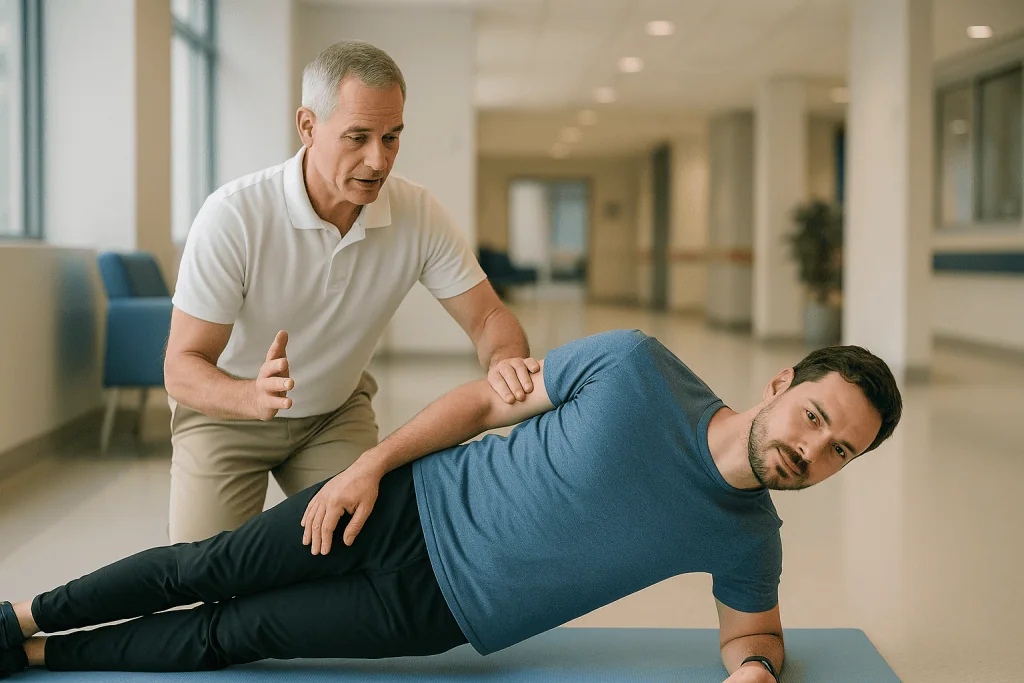
Start at the easiest level. Lie on your side with your elbow under your shoulder and both knees bent to about ninety degrees. Place the top hand on the opposite shoulder or on the floor in front for balance. Lift your hips so the trunk forms a straight line from knee to shoulder. Hold for roughly ten seconds, breathing, then lower. Do both sides.
Once that is comfortable, extend the legs and support on the feet, top foot in front of the bottom foot for stability. The hardest common version rolls from a side plank through a front plank to the other side, keeping the hips level the whole way, which asks the trunk to stay stiff while the body rotates under it.
Form points worth repeating:
- Keep the hips stacked. If the top hip drifts backward, the load leaves the target muscles.
- Do not let the hips sag toward the floor; a sag reintroduces side bending, the very motion the exercise is meant to resist.
- Keep the neck long and the shoulder pressed away from the ear.
A useful self-check from McGill’s testing in healthy adults: the two sides should hold for similar times. A difference greater than roughly 5 percent between left and right was associated with higher rates of back complaints in some of his cohorts. That is an observation, not a diagnosis, but it gives you a reason to compare sides honestly instead of favoring the easier one.
How do you do the bird dog without arching your back?
The bird dog covers the back wall of the core cylinder. It asks the spine to stay perfectly still while an arm and the opposite leg move, which is exactly what happens when you reach into a car trunk or step off a curb.
Begin on hands and knees, hands under shoulders, knees under hips, spine in its natural neutral curve. Brace lightly. Extend the right arm forward and the left leg backward at the same time until both are roughly parallel to the floor. Stop there. The leg should not rise above hip height, because going higher almost always tips the pelvis and arches the lower back. Hold about ten seconds, return the hand and knee to the floor without touching down heavily, then repeat on the other diagonal.
McGill added two refinements that make the move harder without adding load. First, make a fist and clench it as you extend the arm, which increases activation through the shoulder and upper back. Second, instead of bringing the limbs straight back to the start, sweep the knee and hand toward each other under the body, then extend again. The spine must stay level throughout; a book balanced on your lower back should not slide.
Why not simply lift both arms and legs at once from a prone position, the so-called superman? Because that exercise hyperextends the lumbar spine and, in McGill’s measurements, produces compression well above the levels seen in the bird dog while offering little extra benefit for the back extensors. The bird dog is quieter and kinder to the joints.
If balance is a problem, extend only the leg for the first week or two, then add the arm. Many people with acute pain begin that way.
How many reps? The descending pyramid, and the 3-3-3 rule confusion
Searches for the “3-3-3 rule gym” often land on Big 3 articles, but the two have nothing to do with each other. The 3-3-3 rule is a general fitness habit that circulates online, typically three workouts a week, three sets per exercise, three key lifts, or some variation. It is not a medical protocol and it was not part of McGill’s research.
The Big 3 uses a different scheme called a descending pyramid, chosen to build endurance without fatiguing the muscles into sloppy form. The pattern is sets of 6, 4 and 2 repetitions, each repetition held for about ten seconds, with a short rest between sets. So for the curl up you would do six ten-second holds, rest, four holds, rest, two holds. Repeat the pyramid for the side plank on each side, then for the bird dog on each diagonal.
Why ten-second holds instead of one long hold? McGill’s lab found that repeated short contractions preserved muscle oxygenation and allowed more total quality work than a single sixty-second effort, which tends to end with trembling and a lost neutral spine. Endurance accumulates across the pyramid rather than in one heroic hold.
Progression happens by adding repetitions to each tier, not by holding longer: 8-6-4 is the next step, then 10-8-6. People with significant pain often start at 4-2-1 or even a single set of three holds. Frequency in McGill’s writing is daily, ideally a little later in the morning rather than immediately on waking, because discs are at their most hydrated and stiff in the first hour after sleep.
Total time for a beginner pyramid across all three moves is usually eight to twelve minutes. Consistency over weeks is what the endurance data rewarded, not intensity on any single day.
What the evidence actually says about the McGill Big 3
This deserves plain grading, because the online debate treats the Big 3 either as proven or as debunked. Neither is accurate.
Strong laboratory evidence (mechanistic studies). The claim that repeated lumbar flexion under load damages discs rests on controlled biomechanical experiments on animal spine segments and cadaveric tissue, replicated across several labs. The EMG studies showing which muscles each exercise activates, and the modeling studies estimating spinal compression, are also robust for what they measure. These tell us the exercises are low load and target the intended muscles. They do not, by themselves, show that doing them relieves pain.
Moderate evidence for the category (randomized trials). The Big 3 belongs to a family usually labeled motor control or lumbar stabilization exercise, meaning exercises that train the deep trunk muscles to steady the spine. Systematic reviews of randomized trials, including a Cochrane review updated in 2016, found that stabilization exercise improves pain and function in chronic low back pain compared with minimal care, and that it performs about as well as other forms of exercise such as general strengthening or walking programs. In other words, exercise helps; this specific flavor is not clearly superior to others.
Limited evidence for the exact program. Trials that tested the three McGill exercises as a stand-alone package are small, often single-site, and frequently combined the moves with education and movement coaching. Encouraging results, but not enough to claim the Big 3 outperforms a well-designed alternative.
Expert opinion. The ordering of the moves, the descending pyramid and the morning timing come from McGill’s clinical reasoning and lab observations rather than head-to-head trials.
The honest summary: the Big 3 is a sensible, well-reasoned, low-risk way to meet guideline recommendations for exercise in back pain. It is not a uniquely proven one.
McGill Big 3 vs other lower back pain exercises: a comparison
People rarely choose between the Big 3 and nothing. They choose between the Big 3 and yoga, Pilates, walking, a general gym program or the sheet of lumbar stabilization exercises a physical therapist handed them. The table below summarizes what each approach emphasizes and how strong the trial evidence is for chronic low back pain. Grades follow the pattern used by major reviews: moderate means consistent benefit in randomized trials; low means fewer or smaller trials.
| Approach | Main emphasis | Spinal motion involved | Trial evidence (chronic LBP) |
|---|---|---|---|
| McGill Big 3 | Trunk endurance in neutral spine | Minimal | Moderate for the stabilization category; low for the exact program |
| General stabilization sheet | Deep trunk muscle control | Low to moderate | Moderate |
| Walking program | Aerobic conditioning, gentle loading | Rhythmic, low amplitude | Moderate |
| Yoga | Flexibility, strength, breathing | Moderate to high | Moderate |
| Pilates | Core control, mobility | Moderate | Moderate |
| General strength training | Whole-body strength | Varies with exercise choice | Moderate |
Two things stand out. First, every active option earns at least a moderate grade, which is exactly why guidelines recommend exercise broadly rather than a single brand of it. Second, the Big 3 is distinctive in how little it bends the spine, which makes it the easiest entry point for someone whose pain flares with flexion, the forward-bending motion of tying shoes or slumping in a chair.
That is also its limitation. A spine that never bends is not a healthy goal; it is a temporary strategy while sensitive tissue settles. Most people do best pairing the Big 3 with daily walking in the early weeks and gradually adding more varied movement as tolerance returns, a sequence the Mayo Clinic’s patient guidance on back exercises broadly echoes.
Can the McGill Big 3 keep a herniated disc from healing?
This is the viral claim, so it earns its own answer. The short version: there is no published evidence that the three exercises delay disc healing, and the biomechanical rationale runs the other way.
A disc herniation occurs when the soft nucleus of an intervertebral disc pushes through the tougher outer ring, sometimes pressing on a nerve root and causing leg pain, the pattern called sciatica. Imaging studies that followed people over months show that a large proportion of herniations shrink on their own, and the body appears to resorb the extruded material most readily when it is not being repeatedly re-injured. Repeated loaded flexion is the mechanism that produced herniation in McGill’s laboratory. Exercises that avoid loaded flexion therefore remove a plausible aggravator rather than add one.
Where does the claim come from? Usually from a reasonable concern dressed up as a certainty: that holding the spine rigid all day could leave someone fearful of normal movement, and that fear of movement is itself linked to slower recovery in observational studies. That is a fair point about how the program is coached, not about the exercises. Nobody serious proposes bracing permanently; the goal is to build capacity so that ordinary bending becomes comfortable again.
Who should modify or wait? The curl up can be uncomfortable in the first days after an acute flare, and some people with sciatica find the bird dog’s leg extension provokes symptoms until nerve irritation calms. People with diagnosed osteoporosis, those recovering from spinal surgery, anyone in later pregnancy and anyone whose pain began after a fall or accident should have a clinician look first and adapt the moves. In those groups, start positions and hold times are routinely changed, and a professional can judge what is appropriate.
Common myths about the McGill Big 3, corrected
Short-video culture compresses nuance. These are the claims that circulate most, and what the evidence supports instead.
Myth: the Big 3 fixes back pain in two weeks. Endurance adaptations in trunk muscles take several weeks to build, and trials of stabilization exercise typically report benefits measured over eight to twelve weeks. Symptom changes earlier than that are usually the natural course of acute back pain, which, as the NINDS notes, improves within days to weeks for most people regardless of treatment.
Myth: you must never bend your spine again. McGill’s advice was to spare the spine from repeated loaded flexion during recovery, not to abolish bending. Discs need movement to exchange nutrients, and a spine that only ever stays neutral becomes stiff and deconditioned in different ways.
Myth: planks and crunches are the same thing as the Big 3. A standard front plank is a reasonable exercise, but it loads the hip flexors heavily and many people arch through it. Crunches bend the lumbar spine repeatedly, the specific pattern the program was built to avoid.
Myth: if it does not burn, it is not working. The holds are deliberately submaximal. Shaking and burning usually mean form has broken down and the spine is no longer neutral, which defeats the purpose.
Myth: the Big 3 is only for people with back pain. The original cohorts included firefighters, police officers and athletes without current pain; endurance deficits in these groups predicted later injury. Healthy adults can use the moves as a brief daily trunk routine.
Myth: the exercises are dangerous for herniated discs. Covered above: no evidence supports it, and the mechanics argue against it. Individual tolerance still varies, which is why a clinician should guide anyone with a confirmed herniation.
Why do the McGill Big 3 exercises feel too easy, or too hard?
The two most common complaints after a first week are opposites, and both usually trace to form rather than fitness.
If the routine feels too easy, check the brace. The curl up should be preceded by stiffening the abdominal wall as if bracing for a light tap. Without that, lifting the head a few centimeters is trivial and the abdominals barely register on EMG. Check the bird dog leg height too: a leg lifted lazily to knee height asks little of the back extensors, while a leg held exactly at hip height with a clenched fist on the opposite side is surprisingly demanding at the eighth hold. And remember progression is by repetitions, so an 8-6-4 pyramid is the appropriate next step.
If it feels too hard, drop a level. The side plank from the knees halves the lever arm compared with the full version from the feet. The bird dog can be done with leg only, then arm only, before combining. The curl up can begin with the head barely leaving the floor. McGill’s own clinical descriptions start many patients with pyramids as small as 3-2-1, and that is still useful work.
Pain during the holds deserves a separate rule. Mild muscular effort is expected; sharp, shooting or spreading pain is not. Stop the set, reduce the range or level, and if the same movement reproduces the sharp pain on a second attempt, leave it out until a clinician has assessed you. A good routine should leave the back feeling the same or slightly better in the hour afterward, not worse.
Finally, breathing. Holding the breath spikes blood pressure and tends to collapse form the moment you exhale. Breathe steadily through every ten-second hold.
How do you fit the Big 3 into daily life, and what pairs well with it?
Ten minutes on a mat matters less than what the spine does for the other 23 hours and 50 minutes. McGill paired the exercises with what he called spine hygiene, a set of movement habits that reduce the cumulative load that his lab linked to disc injury. None of them require equipment.
Walk. Brisk walking with arms swinging is the one activity McGill recommended as often as the Big 3 itself, and it has independent randomized-trial support for reducing recurrence of low back pain. Aim for several short walks across the day rather than one long one if sitting tolerance is low.
Hinge at the hips. Bending forward by pushing the hips back and keeping the lumbar curve, the way a good lifter picks up a barbell, moves the bend from the discs to the hip joints. Practice it on light objects until it becomes automatic.
Break up sitting. Discs lose fluid and stiffen under sustained compression. Standing for a minute every half hour, or alternating sitting and standing tasks, keeps the tissue moving.
Delay flexion after waking. The first hour of the day is when discs are most swollen with fluid and bending stress on the outer ring is highest. Do the Big 3 later in the morning rather than straight out of bed, and save the toe-touching stretches for the afternoon.
Sleep positions count too. Side-lying with a pillow between the knees, or on the back with a pillow under the knees, keeps the lumbar spine closer to neutral overnight.
None of these habits replace the exercises, and the exercises do not replace them. The lab data describe cumulative loading, and cumulative loading is built from ordinary moments: the slouch at a desk, the twist to grab a bag from the back seat.
What are the 3 most effective core exercises, really?
The search phrase assumes a single answer exists. It does not, because “effective” depends on the goal. For a sprinter, for a person recovering from a disc flare and for a 70-year-old who wants to garden without back spasms, the most effective three will differ.
What the Big 3 offers is the best-documented answer to a narrower question: which three exercises build trunk endurance and control while keeping disc compression low? On that question the EMG and modeling literature is consistent. The curl up, side plank and bird dog produce strong activation of their target muscles at compression levels well below those of sit-ups, straight-leg raises, back extensions on a Roman chair or the superman.
If the goal is athletic performance, heavier loaded carries, anti-rotation presses with a cable and front-loaded squats enter the conversation, and McGill’s later work on athletes included exactly those progressions once the basic endurance was in place. If the goal is general health in an older adult, the Big 3 plus walking and a chair-based sit-to-stand routine covers most needs.
A practical way to think about it: the Big 3 is the foundation layer, not the whole building. It answers the question of effectiveness for people who need to protect a sensitive spine while rebuilding capacity. Once hold times stabilize and pain settles, the next most effective exercises are the ones that gradually reintroduce load and movement, under guidance if there is a history of injury.
One number helps keep expectations honest. In McGill’s normative testing of healthy young adults, the side bridge was held for about 80 to 95 seconds on each side before fatigue. Most people with chronic back pain start far below that. Closing the gap takes weeks, and the gap closing is the outcome that his observational data tied to fewer future episodes.
When to see a doctor about low back pain
Most episodes of low back pain are not dangerous and improve with time, movement and simple self-care, which is why health authorities steer people toward exercise programs like the Big 3. A minority of cases need prompt medical attention, and no exercise routine should delay it.
Seek urgent care, the same day, if back pain comes with any of the following, which the NHS, Mayo Clinic and MedlinePlus list as red flags:
- Loss of bladder or bowel control, or difficulty passing urine
- Numbness around the genitals, buttocks or inner thighs
- Weakness, numbness or tingling spreading down one or both legs, especially if it is getting worse
- Pain that began after a fall, car accident or other significant trauma
- Unexplained fever, chills or recent infection alongside the pain
- Unintended weight loss, a history of cancer, or pain that is severe at night and does not ease with rest
Make a routine appointment if pain has not improved after about four weeks of self-care, if it keeps returning, if it stops you from sleeping or working, or if you are unsure whether the Big 3 is appropriate for a known condition such as osteoporosis, spinal stenosis, a recent surgery or pregnancy. A clinician can confirm that exercise is safe, adjust the moves, and refer you to a physical therapist who can watch your form, which solves most of the “I don’t understand the first exercise” problems in a single session.
If you take prescribed pain medicine or any medicine for a spine condition, keep taking it as directed while you start exercising, and discuss any changes with the prescriber rather than adjusting on your own. Starting a core routine is not a reason to alter a treatment plan without that conversation.
Exercise is first-line care for ordinary low back pain. It is not a substitute for assessment when the pattern is unusual.
Frequently asked questions
What is a McGill curl up?
A McGill curl up is a modified crunch in which you lie on your back with one knee bent, hands tucked under the lumbar arch, and lift the head and shoulders only a few centimeters while keeping the spine neutral. Holds last about ten seconds. The small range keeps disc compression far below that of a standard sit-up while still working the abdominal wall.
What are the 3 most effective core exercises for lower back pain?
For protecting a sensitive spine while rebuilding endurance, the modified curl up, side plank and bird dog are the best-documented trio, because they activate the front, side and back trunk muscles at low spinal load. For other goals, such as athletic performance, loaded carries and anti-rotation exercises become more relevant once basic endurance is established.
Can you give me a PDF of lumbar stabilization exercises?
We do not host a printable sheet, but the exercise descriptions in this article contain everything a PDF would. Mayo Clinic and the NHS publish free illustrated back-exercise pages that include similar lumbar stabilization moves. A physical therapist can also tailor a printed program to your condition, which is safer than a generic handout if you have a diagnosed spine problem.
What is the 3-3-3 rule in the gym, and is it the same as the Big 3?
No. The 3-3-3 rule is an informal fitness guideline, usually three sessions a week with three sets of three main lifts, and has no research basis in spine care. The McGill Big 3 refers to three specific endurance exercises performed in a descending pyramid of 6, 4 and 2 ten-second holds.
How often should I do the McGill Big 3?
McGill’s protocol suggests daily practice, ideally a little later in the morning rather than straight after waking, when discs are most hydrated and stiff. A beginner pyramid across all three moves takes about eight to twelve minutes. Progress by adding repetitions to each tier rather than by holding longer, and keep every hold pain-free.
How long before the McGill Big 3 helps back pain?
Endurance changes in trunk muscles take several weeks, and trials of stabilization exercise report benefits over eight to twelve weeks. Earlier improvement often reflects the natural course of acute back pain, which eases within days to weeks for most people. Consistency over a couple of months matters more than any single session.
Is the McGill Big 3 safe with a herniated disc or sciatica?
Usually yes, with modifications, because the moves avoid the repeated loaded bending linked to disc injury. There is no evidence they slow healing. Some people with sciatica find the bird dog leg extension provokes symptoms early on and need a smaller range. Anyone with a confirmed herniation should have a clinician or physical therapist adapt the program.
Can I do the Big 3 if I have osteoporosis or am pregnant?
Often, but not without guidance. Osteoporosis changes which positions are advisable, and later pregnancy makes lying flat on the back uncomfortable or inadvisable for some people. Clinicians routinely adapt start positions and hold times for both groups. Check with your doctor or physical therapist before starting rather than modifying on your own.
Why do my hands get squashed during the curl up?
Pressure on the hands means you have flattened the natural lumbar arch, usually by lifting the torso too high or pulling with the neck. The hands are there precisely to detect this. Lift less, brace the abdomen before moving, and raise the head and shoulders as one unit only a few centimeters.
Should I stop the Big 3 if it hurts?
Stop any hold that produces sharp, shooting or spreading pain, drop to an easier level, and retry once. If the same move reproduces that pain, leave it out and see a clinician. Mild muscular effort is normal. Urgent assessment is needed for pain with leg weakness, numbness in the saddle area, or bladder or bowel changes.
References
- World Health Organization: Low back pain fact sheet
- NHS: Back pain
- NIH National Institute of Neurological Disorders and Stroke: Back pain
- MedlinePlus: Back pain
This article is for general information only and is not a substitute for professional medical advice. Please consult a qualified doctor about your individual situation.

More from the Blog

How Is Pain Managed After Hand Surgery? Elevation, Splints and Safe Relief
Pain after hand surgery is usually managed with a combination of measures: keeping the hand raised above heart level to limit swelling, wearing the…

Glucosamine, Collagen and the Arthritis Diet: What Trials Show for Joint Pain
Glucosamine is a natural building block of cartilage sold as a supplement for osteoarthritis. Large randomized trials show it works no better than placebo…

Pavlik Harness Warning Signs: Skin Redness, Swollen Feet and When to Call the Clinic
Mild pinkness under Pavlik harness straps that fades within about 30 minutes is common, but skin that stays red, weeps, cracks or smells needs…

Kinesiology Tape: What the Studies Show Behind the Colorful Strips
Kinesiology tape is a stretchy cotton strip applied over muscles and joints. Randomized trials and systematic reviews show it produces, at best, small and…

The Hip Replacement Scar: Size, Placement and How It Fades
A hip replacement scar is typically a single straight or gently curved line, roughly 3 to 6 inches long with minimally invasive techniques and…

Toe Shortening Surgery Recovery: Surgical Shoes, Swelling and When Shoes Fit Again
Toe shortening surgery recovery typically means a stiff-soled surgical shoe for several weeks, careful heel-weighted walking from the first days if the surgeon allows…