

TMJ Exercises: The Jaw Routine Physiotherapists Use
Key Takeaways
- The two best-supported TMJ exercises are also the simplest: a resting jaw position with teeth apart and tongue on the palate, and slow, pain-free controlled opening.
- Pooled trial data show exercise and manual therapy modestly improve pain and mouth opening in temporomandibular disorders, with low-to-moderate certainty because most studies are small.
- The three-finger test measures opening range of roughly 40 millimeters and nothing else; it neither confirms nor rules out a jaw disorder.
- No mainstream body defines four stages of TMJ; the Wilkes classification has five stages and applies only to disc displacement, which is a minority of cases.
- Chewing gum, forcing the jaw through a click and clenching to test the pain are the three habits physiotherapists most often ask people to stop.
- A jaw that locks, swells, or hurts with chewing in someone over 50 with new headache or vision change needs clinical assessment, not a home routine.
TMJ exercises are gentle jaw movements physiotherapists teach to relax the chewing muscles, restore smooth opening and retrain jaw posture. Small randomized trials and systematic reviews suggest they modestly reduce pain and improve mouth opening in temporomandibular disorders, usually within a few weeks, with low-to-moderate certainty. Most jaw pain settles with self-care, but a locked jaw, swelling or persistent pain warrants a clinical assessment.
The clip is barely eight seconds long. Someone stacks three fingers, pushes them between their teeth, winces, and a caption declares the result a diagnosis. Millions of views later, as of early 2025, search interest in tmj exercises has surged alongside a wave of short videos promising to fix clicking, aching jaws with a handful of stretches. Some of those videos borrow from real physiotherapy practice. Others are guesswork dressed up as expertise.
The timing is not accidental. Clinical guidance from major sources has steadily pushed conservative, movement-based care to the front of the queue for jaw disorders, and a widely cited 2020 national report called for exactly that shift. So the public appetite and the evidence are, for once, roughly pointing the same way.
What follows is the routine physiotherapists actually use, what the trials show it can and cannot do, and the handful of warning signs that mean a video is no substitute for an examination.
What are TMJ exercises and what do they do to the joint?
The temporomandibular joint (TMJ) is the hinge-and-slide joint just in front of each ear that connects the lower jaw to the skull. Between the two bones sits a small articular disc, a cushion of cartilage that glides forward every time the mouth opens. Pain, clicking or restricted movement in this system is grouped under the umbrella term temporomandibular disorder (TMD). According to the NIH’s dental research institute, TMD affects an estimated 5 to 12 percent of the population, with the highest rates in people aged 20 to 40 and roughly twice as many women as men.
TMJ exercises are not about building a stronger bite. The masseter, the thick muscle you can feel at the angle of the jaw when you clench, is already one of the most powerful muscles in the body for its size. Most jaw pain comes from muscles that are overworked and guarding, not weak ones. The goal of the routine is therefore closer to what a physiotherapist does for a stiff, irritable shoulder: calm the protective tension, restore a smooth movement pattern, and retrain the nervous system so the jaw stops bracing at rest.
Three mechanisms matter. First, slow, pain-free movement improves proprioception, the body’s sense of where a joint is in space, which helps the jaw open straight instead of zig-zagging around a clicking disc. Second, repeated gentle opening and closing increases blood flow through tired muscles and can reduce the tenderness clinicians find when they press on them. Third, rest-position training reduces the hours a day the teeth sit clenched together, which is the single habit most strongly linked to muscle-type TMD.
None of this reshapes bone or reseats a displaced disc permanently. What it can do, and what the evidence supports, is reduce pain and restore function well enough that the condition stops running daily life.
What changed recently in how jaw pain is treated
Three dated developments explain why conservative care, and tmj exercises in particular, now sit at the center of mainstream advice rather than at its margins.

In 2014, researchers published the Diagnostic Criteria for Temporomandibular Disorders (DC/TMD), a standardized examination protocol that separates muscle-driven pain from true joint problems. That sounds academic, but it mattered: once clinicians could reliably sort the two, trials could finally test exercises on the group most likely to benefit, which is the muscle-pain majority.
In 2016, a systematic review and meta-analysis in the journal Physical Therapy pooled 48 studies of manual therapy and therapeutic exercise for TMD. The authors found that these approaches improved pain and mouth opening compared with no treatment or minimal care, while also noting that most included trials were small and at high risk of bias. That review remains one of the most frequently cited pieces of evidence behind physiotherapy-led jaw care, and it is listed in the references below.
Then, in March 2020, a consensus report from the National Academies of Sciences, Engineering, and Medicine, commissioned with support from the NIH, concluded that TMD care had drifted toward irreversible procedures with weak supporting evidence and recommended a decisive move toward conservative, reversible, multidisciplinary management. The NIH’s dental research institute summarizes that position on its public TMD page.
Patient-facing guidance has followed. The NHS, Mayo Clinic and Cleveland Clinic all now describe self-care, jaw rest, gentle exercise and stress management as the first line, with splints, medicines and injections reserved for persistent cases and surgery for a small minority. The viral videos of 2025 are, in effect, a noisy echo of a quiet professional consensus that has been building for a decade.
What the evidence actually says about tmj exercises
The honest grade is this: low-to-moderate certainty evidence that exercise reduces pain and improves opening in muscle-related and mixed TMD, and little evidence either way for exercise alone in purely joint-structural problems.
Here is how that breaks down by evidence type.
- Randomized controlled trials. Dozens exist, but most enroll fewer than 60 people and follow them for weeks rather than years. Pooled together, as in the 2016 Physical Therapy meta-analysis, they show a consistent direction of benefit for pain intensity and maximal mouth opening when exercise, often combined with hands-on manual therapy, is compared with no treatment or education alone. Effect sizes are modest, not dramatic.
- Observational data. Clinic cohorts repeatedly show that most people with new-onset jaw pain improve over weeks to a few months regardless of the specific intervention. Mayo Clinic’s patient guidance reflects this: in most cases, symptoms are temporary and ease with self-managed care. That natural recovery makes small uncontrolled studies hard to interpret.
- Expert opinion. Physiotherapy and dental bodies broadly agree that gentle, pain-free movement is safe and sensible, and that the risk of harm is low when exercises stay below the pain threshold.
So, can TMJ be fixed by exercises? For the common muscle-pain pattern, exercises and habit change are often enough to bring symptoms down to a level where they no longer interfere with eating, talking or sleeping, and that is the realistic definition of success. For a disc that is displaced and does not reduce, or for degenerative joint change, exercises can improve function and comfort but do not restore the original anatomy. No head-to-head trial has shown that one specific exercise beats another, which is why the routine below prioritizes principles over tricks.
Step one: the resting jaw position physiotherapists teach first
Before any stretch, physiotherapists teach where the jaw should live when it is doing nothing. Most people with jaw pain are surprised to learn their teeth should not be touching. The standard resting position has four parts, and it is the foundation every other exercise builds on.
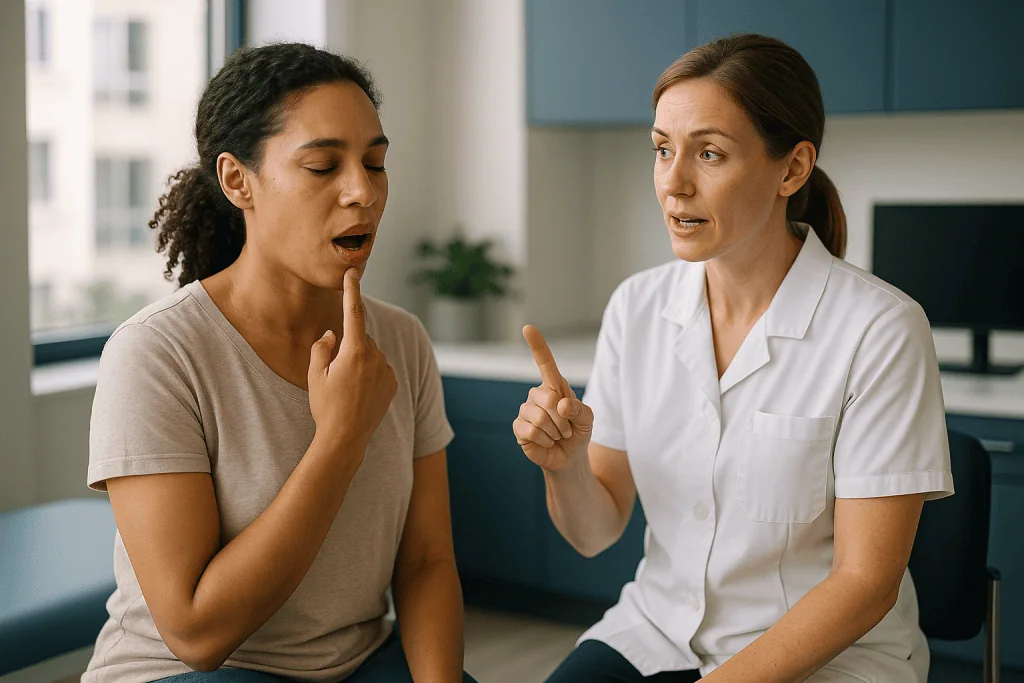
- Lips gently together.
- Teeth slightly apart, with a few millimeters of space between the upper and lower molars.
- The front third of the tongue resting lightly on the roof of the mouth, just behind the upper front teeth, without pressing.
- Breathing quietly through the nose.
Try it now and notice what happens in the muscles at the angle of the jaw and in the temples. For many people they soften within seconds. That softening is the point. Clenching is often unconscious and can persist for hours during focused work, driving, or scrolling a phone, and it is the habit most strongly linked with muscle-type TMD in clinical descriptions from the NHS and Cleveland Clinic.
The retraining method is simple repetition. Physiotherapists commonly suggest checking the resting position several times an hour during the day, often prompted by a sticky note on a screen, a phone reminder or a habit cue such as every red traffic light. The sequence is: breathe out, let the teeth part, let the tongue float up, let the shoulders drop.
One variation adds a gentle opening from this position. With the tongue kept on the palate, open the mouth slowly only as far as the tongue can stay in contact, usually about half of full opening, then close just as slowly. Keeping the tongue up limits range and tends to produce a straighter, quieter hinge movement. Six slow repetitions, repeated a few times a day, is a typical starting prescription, and it should never hurt.
Jaw exercises for TMJ pain: controlled opening and the mirror check
Once the resting position feels familiar, the next layer is controlled opening. The aim is a straight, unhurried path rather than a wide one. Many people with a clicking joint open with a visible sideways swerve as the jaw works around the disc; teaching a straighter track often reduces both the click and the discomfort that follows it.
The mirror check is the physiotherapist’s favorite tool for this. Stand facing a mirror, set the resting position, and open slowly while watching the midline of the chin. If it drifts to one side, close, reset and try again a little less wide, stopping just before the point where the deviation begins. Over days, the pain-free straight range tends to grow. Expect progress measured in millimeters, not centimeters.
Two guided versions are widely used:
- Partial opening with light fingertip feedback. Place one fingertip on the chin and one on the TMJ in front of the ear. Open halfway, feel for the joint moving smoothly under the finger, then close. The fingers are sensors, not levers; they should not push.
- Full opening with the same feedback. Identical setup, opening fully but only within comfort. People often notice the click happens at one specific point; the exercise is about moving through that point slowly rather than snapping past it.
Pain is the governor. Physiotherapists typically allow mild stretching discomfort that fades within a minute or two after the set, and treat sharper pain, pain that lingers for hours, or a jaw that feels worse the next morning as a signal to shrink the range. This graded, below-threshold approach is the same principle used for irritable joints elsewhere in the body, and it is the reason the routine is considered low-risk when done as taught.
Resisted movements and side-to-side glides
Resistance exercises for the jaw are frequently misunderstood as strengthening work. In practice they are used for two different reasons: to give the nervous system a clear, controlled signal that helps relax overactive muscles afterward, and to improve coordination between the opening and closing muscle groups. The force involved is light, roughly the pressure you would use to hold a sheet of paper against a table.
The standard set has four directions.
- Resisted opening. Place a thumb under the chin and open slowly against gentle upward pressure, hold for a few seconds, then release.
- Resisted closing. Hold the chin lightly between thumb and index finger and close against a soft downward pull.
- Side glides. Place a fingertip on one side of the chin and move the jaw sideways against light pressure, then repeat the other way. Some physiotherapists have people slide the jaw across a thin object such as a flat wooden stick held between the front teeth to make the movement easier to feel.
- Forward glide (protrusion). Slide the lower jaw forward so the bottom front teeth move ahead of the top ones, then return.
Each is usually done for a small number of slow repetitions, and all should feel like controlled effort rather than strain. People with an actively locking joint or a disc that catches are generally told to skip resisted work until a clinician has examined them, because pushing against a mechanical block can irritate the joint.
The evidence for resisted exercises specifically is thinner than for the overall package; they appear as components in many trials but have rarely been tested in isolation. Their inclusion rests mostly on clinical reasoning and expert consensus rather than on trials proving they add benefit on their own, which is worth knowing if a video insists they are the secret ingredient.
Why neck posture and chin tucks belong in a TMJ routine
The jaw does not hang in isolation. Its position is influenced by the head on the neck, and the head’s position is influenced by what the eyes are doing. When the head drifts forward over a laptop or phone, the lower jaw tends to be pulled slightly back and down, the muscles under the chin lengthen and tense, and the resting gap between the teeth closes. Physiotherapists see this pattern so often that neck assessment is routine in jaw clinics.
The chin tuck is the standard counter-move. Sitting tall, draw the chin straight back as if making a double chin, without tipping the head up or down, hold briefly, then relax. Done a handful of times, several times a day, it repositions the head over the shoulders and often produces an immediate, if temporary, easing of the tension at the angle of the jaw.
Shoulder rolls and gentle upper-back extension over the top of a chair complete the set. Neither targets the jaw directly; both reduce the slumped posture that keeps the jaw muscles in a shortened, braced state for hours.
How strong is the evidence here? Moderate at best. Several small trials and the 2016 meta-analysis found that combining jaw exercises with cervical (neck) treatment produced better pain outcomes than jaw work alone, but the studies are heterogeneous and the added benefit is modest. Observational work consistently finds that people with TMD report more neck pain than the general population, which supports treating the two regions together without proving that one causes the other.
The practical takeaway is that a tmj exercises routine which ignores the neck is incomplete, and the ten seconds a chin tuck takes is a low-cost addition that most physiotherapists consider essential rather than optional.
The physiotherapist's TMJ exercise routine at a glance
Below is the routine as a whole, with the goal of each component and an honest grade of how strong the supporting evidence is. The grades follow the usual hierarchy: randomized trials rank highest, then observational data, then expert opinion.
| Exercise | Main goal | Typical pattern | Evidence strength | Key caution |
|---|---|---|---|---|
| Resting jaw position (tongue up, teeth apart) | Reduce clenching and muscle guarding | Brief checks many times a day | Trials as part of self-care packages; expert consensus | Do not press the tongue hard |
| Tongue-up controlled opening | Straight, quiet hinge movement | Six slow repetitions, a few times daily | Component of multiple small RCTs | Stop before pain or click |
| Mirror-guided opening | Correct sideways deviation | Several slow repetitions daily | Expert consensus; small trials | Fingers sense, never push |
| Light resisted opening and closing | Coordination and post-effort relaxation | Few repetitions, gentle hold | Mostly expert opinion | Avoid if jaw locks or catches |
| Side and forward glides | Restore lateral mobility | Few repetitions each side | Expert consensus | Keep range small and smooth |
| Chin tucks and shoulder rolls | Reduce forward-head posture | Several times a day at a desk | Moderate; combined-treatment RCTs | No forcing or neck strain |
Two patterns stand out from the table. The components with the best evidence are the simplest ones: rest-position training and slow, pain-free opening. The more elaborate resisted and glide exercises that dominate online videos rest more on clinical reasoning than on trials. That does not make them useless, but it does mean a beginner who only manages the first two rows is doing the part of the routine that matters most.
Frequency matters more than intensity. The routine is designed to be done little and often, woven into an ordinary day, rather than performed as a single intense session that leaves the jaw sore.
What is the 3 finger test for TMJ, and what does it miss?
The three-finger test is a quick screen for mouth opening. You stack the index, middle and ring fingers of one hand vertically and see whether they fit between the upper and lower front teeth. For most adults, three fingers corresponds to roughly 40 millimeters, which sits at the lower end of normal maximal opening. Clinicians usually regard an opening below about 35 millimeters as restricted, and many use a ruler rather than fingers because finger width varies considerably from person to person.
Physiotherapists and dentists do use this screen. It is a reasonable way to track whether opening is improving week to week, and it is one of the measurements built into the standardized DC/TMD examination. Where the viral version goes wrong is in treating it as a diagnosis.
Consider what the test does not tell you.
- It says nothing about pain. Plenty of people with significant muscle-type TMD open a full three fingers and hurt every time they chew.
- It does not reveal why opening is limited. Muscle guarding, a disc that is blocking the joint, arthritis and swelling can all restrict opening and call for different management.
- It ignores the path of movement. A jaw that reaches three fingers by swerving sharply to one side is telling a story the test cannot read.
- It can falsely reassure people with hypermobile joints who open very wide, click loudly, and occasionally dislocate.
A fourth problem is more subtle. Forcing three fingers in to pass the test is itself a provocation, and a sore joint pushed to its limit on camera tends to be sorer afterward.
Used as intended, as one of several measurements over time, the screen is useful. Used as a stand-alone verdict, it misclassifies a large share of people in both directions, which is why no mainstream source treats it as sufficient on its own.
Are there really four stages of TMJ?
Search for the four stages of TMJ and you will find confident lists, but no mainstream clinical body publishes a four-stage model for the condition as a whole. The idea appears to be a simplified blend of two real frameworks.
The first is the Wilkes classification, a staging system for internal derangement of the joint, meaning displacement of the articular disc. It describes five stages, not four, running from early painless clicking, through intermittent locking, to persistent locking and finally to degenerative change in the joint surfaces. It was designed for imaging and surgical planning and applies only to disc-related problems, which are a minority of TMD cases.
The second is the broader DC/TMD system, which does not stage disease at all. It sorts people into diagnostic categories: muscle pain (myalgia), joint pain (arthralgia), headache attributed to TMD, disc displacement with or without reduction, and degenerative joint disease. Many people fit more than one category at once.
The important clinical point is that TMD does not march predictably from stage to stage. Population studies show that most jaw clicking never progresses to locking, and most pain episodes resolve or fluctuate rather than steadily worsen. The NIH’s dental research institute describes TMD as commonly temporary and cyclical, and the 2020 national report explicitly warned against the assumption that early symptoms inevitably lead to joint damage, because that assumption had been used to justify irreversible treatment.
So when a video promises that exercises will stop you reaching stage four, treat the framing with suspicion. A more useful question to ask yourself, and to bring to a clinician, is simpler: is this mostly muscle, mostly joint, or both? That distinction, not an invented stage number, is what shapes which tmj exercises are likely to help and which should wait for an examination.
What not to do with TMJ disorder while you exercise
Physiotherapists spend as much time removing aggravating habits as adding exercises, and several widely shared tips are precisely backwards. The NHS and Mayo Clinic self-care advice converges on a short list of things to avoid during a flare.
- Forcing the jaw open or through a click. Pushing past a mechanical catch to prove the joint can do it tends to inflame the tissues behind the disc. Range should grow by invitation, not force.
- Chewing gum as exercise. Hours of repetitive chewing load exactly the muscles that are already overworked. Gum is the opposite of a therapeutic exercise for most people with muscle-type pain.
- Wide yawns, big bites and hard or chewy foods. During a flare, cutting food smaller, favoring softer textures and supporting the chin with a fist during a yawn reduce peak loads on the joint.
- Resting the chin on a hand or cradling a phone between ear and shoulder. Both push the jaw sideways for long periods.
- Clenching to test the pain. The urge to check whether it still hurts is understandable and counterproductive.
- Self-manipulating or cracking the joint. Relief, when it comes, is brief, and repeated forceful cracking can increase joint laxity.
- Sleeping face-down. Side or back sleeping places less sustained sideways pressure on the jaw.
Equally important is what not to do with exercise itself. Doing the routine aggressively, many sets at a time, or only on days the jaw already hurts is a common pattern that leaves people convinced exercise made them worse. The routine works through frequent, light, pain-free repetition over weeks.
One more thing not to do: stop or change any prescribed medicine, splint or treatment plan on the strength of a video. Those decisions belong with the clinician who assessed you, and exercises are meant to sit alongside that plan, not replace it.
Common myths about TMJ exercises, corrected
The viral surge has carried some claims a long way from the evidence. Here are the ones clinicians hear most, each corrected with what the data actually shows.
Myth: Mewing or tongue-posture training reshapes the jaw and resolves TMJ. Resting the tongue on the palate is a genuine physiotherapy technique for reducing clenching, as described above. The further claim that it remodels adult facial bone or realigns the joint has no supporting trial evidence. Benefit, where it exists, comes from relaxed muscles, not a changed skeleton.
Myth: Clicking means the joint is being damaged and must be treated. Painless clicking is extremely common in the general population and most of it never progresses. Mainstream guidance is clear that clicking without pain or locking does not need treatment.
Myth: If exercises hurt, they are working. The trials that showed benefit used pain-limited, gentle movement. Pain that lingers after a set is a sign to reduce range, not a badge of progress.
Myth: Total rest is safer than exercise. Prolonged immobilization tends to stiffen joints and sensitize muscles. Rest from aggravating activities, combined with gentle movement, is the pattern supported by evidence.
Myth: The three-finger test diagnoses TMJ. It measures opening range and nothing else, as the earlier section explains.
Myth: Most people with TMJ end up needing surgery or splints for life. Both the 2020 national report and current patient guidance from the NHS and Mayo Clinic describe surgery as appropriate for a small minority, after conservative care has been tried, and emphasize that most cases improve with self-management.
Myth: A specific exercise sequence from one video is the one that works. No trial has shown one exercise or sequence to be superior. The evidence supports a set of principles, and any routine that follows them is likely to be as good as another.
TMJ physical therapy exercises: what a referral adds to home practice
If the home routine is sound, why see a physiotherapist at all? For many people with mild, recent-onset pain, the honest answer is that a well-taught home program plus habit change is enough. Referral earns its place when symptoms persist beyond a few weeks, when the pattern is confusing, or when self-directed effort has stalled.
A physiotherapy assessment adds several things that a video cannot.
- Classification. Pressing on specific muscles, measuring opening with a ruler, listening to the joint and watching the path of movement lets the clinician sort muscle pain from joint pain and from disc displacement, which changes what is prescribed.
- Manual therapy. Hands-on techniques to the jaw muscles, the joint itself and the neck were the other half of the 2016 meta-analysis, and in several trials the combination of manual therapy and exercise outperformed exercise alone, albeit with modest effect sizes and low-to-moderate certainty.
- Dosing of movement. A clinician can set a pain-free range precisely and progress it, which is where many people doing tmj exercises alone either underdo or overdo it.
- Screening. Physiotherapists are trained to spot features that point away from a routine TMD, such as ear disease, dental infection, nerve-related facial pain or, rarely, a jaw-claudication pattern seen with inflammatory blood-vessel conditions in older adults, and to refer onward.
Where a dentist or physician is involved, physiotherapy typically runs alongside other conservative options such as an occlusal splint, a custom mouthguard-like device worn mainly at night to reduce the effects of grinding, or short-term medicines. Decisions about those, including whether to start, continue or stop them, rest with the prescribing clinician, and exercises are intended to complement rather than compete with that plan.
How long before it helps? Trials and clinical experience point to the same window: some easing within two to three weeks, with more reliable change over six to twelve. A program that has produced nothing after that long is a reason to go back and be reassessed, not to push harder.
When to see a doctor about jaw pain
Most jaw pain is benign and self-limiting, and tmj exercises are a reasonable first step for the familiar pattern of achy chewing muscles, a tired jaw on waking and a click that comes and goes. Certain features, however, mean a video routine should wait until a dentist, physician or physiotherapist has examined you.
Arrange an appointment promptly if you notice any of the following:
- The jaw locks open or closed, or you cannot open wide enough to eat normally.
- Pain is severe, worsening over days, or consistently wakes you at night.
- Swelling, redness or warmth over the joint, or fever alongside jaw pain, which may point to infection or inflammatory arthritis rather than muscle strain.
- Pain or numbness that follows a recent blow to the face or a fall.
- Difficulty swallowing, a new change in how the teeth meet, or a visibly shifted bite.
- Jaw pain that comes on with chewing and eases with rest in someone over 50, especially with new headache, scalp tenderness or vision changes. This pattern needs urgent assessment because it can be a sign of inflammation in the arteries of the head.
- Numbness, weakness or persistent tingling in the face.
- Ear pain with discharge or hearing change, which belongs with an ear assessment before it is attributed to the jaw.
Seek emergency care without delay for jaw pain accompanied by chest pressure, shortness of breath, sweating or pain spreading to the arm, since jaw pain can be a presenting feature of a heart attack, particularly in women.
Short of red flags, the practical threshold is time: pain that has not eased after two to three weeks of sensible self-care, or that repeatedly returns, deserves a proper classification so that treatment can be matched to the cause. Every decision about medicines, splints, injections or imaging belongs to the clinician who examines you; the role of this article is to help you arrive at that conversation well informed.
Frequently asked questions
Can TMJ be fixed by exercises?
For the common muscle-pain form of temporomandibular disorder, exercises combined with habit changes often reduce symptoms to a level that no longer interferes with eating or sleeping, which is the realistic goal. Trials show modest, consistent improvement in pain and opening. Exercises do not restore a displaced disc or reverse arthritic change, but they can still improve comfort and function in those cases.
What is the 3 finger test for TMJ?
It checks whether three stacked fingers fit vertically between the front teeth, roughly 40 millimeters, which is at the lower end of normal opening. Clinicians use it to track range over time, usually alongside a ruler measurement. It does not assess pain, the cause of any restriction or the path of movement, so it cannot diagnose or exclude a jaw disorder.
What not to do with TMJ?
Avoid chewing gum, hard or chewy foods during a flare, wide unsupported yawns, forcing the jaw through a click, cracking or self-manipulating the joint, resting the chin on a hand and clenching to check whether it still hurts. Also avoid doing exercises aggressively or only on painful days. Never stop or change a prescribed splint or medicine without discussing it with the clinician who prescribed it.
What are the four stages of TMJ?
There is no official four-stage model. The Wilkes classification describes five stages of disc displacement, from painless clicking to degenerative change, and applies only to disc-related problems. The standard DC/TMD system classifies by type, such as muscle pain, joint pain and disc displacement, rather than by stage. Most jaw clicking never progresses to locking, so symptoms do not march predictably through stages.
How often should I do jaw exercises for TMJ pain?
Little and often works best. Physiotherapists typically suggest brief rest-position checks many times through the day and a short set of slow opening exercises, around six repetitions, a few times daily. Each set should be pain-free or produce only mild stretch that fades within minutes. Frequent gentle repetition over several weeks matters more than intensity in any single session.
Can TMJ exercises make pain worse?
They can if done too forcefully, too wide or too many times at once, which is the most common reason people report that exercise aggravated their jaw. Pain that lingers for hours or a jaw that is worse the next morning means the range or volume should shrink. Done gently and below the pain threshold, as in the trials, the routine is considered low-risk.
Do jaw exercises help with jaw clicking?
Often they reduce the click or the discomfort around it by teaching a straighter opening path, but they rarely abolish clicking entirely because the sound usually reflects the position of the articular disc. Painless clicking is common and does not need treatment. Clicking that comes with pain, catching or locking should be assessed so the right exercises can be chosen.
Does physical therapy for TMJ actually work?
Pooled evidence from dozens of small randomized trials, summarized in a 2016 meta-analysis, found that manual therapy combined with exercise improved pain and mouth opening compared with no treatment or education alone. The certainty is low to moderate because of small samples and risk of bias, and effects are modest rather than dramatic. Benefit is clearest for muscle-related pain.
Should I do TMJ exercises if my jaw locks?
Not until a clinician has examined the joint. Locking, whether open or closed, suggests the disc or joint is mechanically blocking movement, and pushing through it or doing resisted exercises can irritate the tissues. The resting jaw position is still safe to practice. A dentist, physician or physiotherapist can determine the cause and advise which movements are appropriate.
Is chewing gum good exercise for TMJ?
No. Prolonged chewing loads the masseter and temporalis muscles, which in most people with jaw pain are already overworked and tender rather than weak. Mainstream self-care guidance lists gum among the things to avoid during a flare. Therapeutic exercises aim to relax and coordinate these muscles through slow, light movement, which is the opposite of repetitive chewing.
References
- NHS: Temporomandibular disorder (TMD)
- NIH National Institute of Dental and Craniofacial Research: TMD (Temporomandibular Disorders)
- Cleveland Clinic: Temporomandibular Disorders (TMD)
- MedlinePlus: Temporomandibular Joint Dysfunction
This article is for general information only and is not a substitute for professional medical advice. Please consult a qualified doctor about your individual situation.

More from the Blog

Bad Breath: The Causes Beyond Brushing, From Tonsil Stones to Reflux
Most bad breath, roughly nine in ten cases by dental estimates, begins in the mouth: sulfur-producing bacteria on the back of the tongue, gum…

How Often Should You Have an Eye Exam? The Schedule by Age and Risk
Healthy adults without symptoms or risk factors are generally advised to have a baseline comprehensive eye exam at age 40, then one every two…

OTC Hearing Aids and AirPods as Hearing Aids: What Changed and Who Benefits
OTC hearing aids are FDA-regulated devices that adults 18 and older can buy and fit themselves for perceived mild to moderate hearing loss, a…

Cavities in Adults: Why They Still Happen and Whether Early Decay Can Reverse
Cavities still happen in adults because bacteria in plaque turn sugars into acid, and when acid attacks outnumber saliva's repair cycles, enamel loses mineral…

Mouth Ulcers: Why They Recur and When They Need a Doctor
Mouth ulcers, often called canker sores, are shallow breaks in the lining of the mouth that usually heal on their own within one to…

Mouthwash: Does It Help or Harm the Oral Microbiome?
Mouthwash can help or disturb the oral microbiome depending on its active ingredient. Fluoride rinses strengthen enamel without killing bacteria and have the strongest…