

Traveling on Peritoneal Dialysis: Supplies, Storage and Planning Exchanges Away From Home
Key Takeaways
- Peritoneal dialysis fluid bags hold roughly 2 to 3 quarts each, which is why heavy supplies are shipped to the destination and only a travel-day minimum is carried.
- Exchanges follow dwell time rather than the clock, so time-zone changes are handled by shifting dwells gradually, never by skipping an exchange.
- A CAPD exchange takes about 30 to 40 minutes with 4 to 6 hour dwells, while an APD cycler session runs roughly 8 to 10 hours overnight, and each pattern creates different travel trade-offs.
- Dialysis fluid belongs at room temperature in the closet, not in a car trunk, a hotel minibar or on a winter balcony, and every bag should be checked for clarity, leaks and expiry before use.
- The cycler travels in the aircraft cabin as a medical device, and declared medical liquids are generally exempt from standard cabin liquid limits when you carry a unit letter.
- Cloudy drained fluid, abdominal pain, fever or an inflamed exit site are same-day phone calls wherever you are, because peritonitis is the most common serious PD complication.
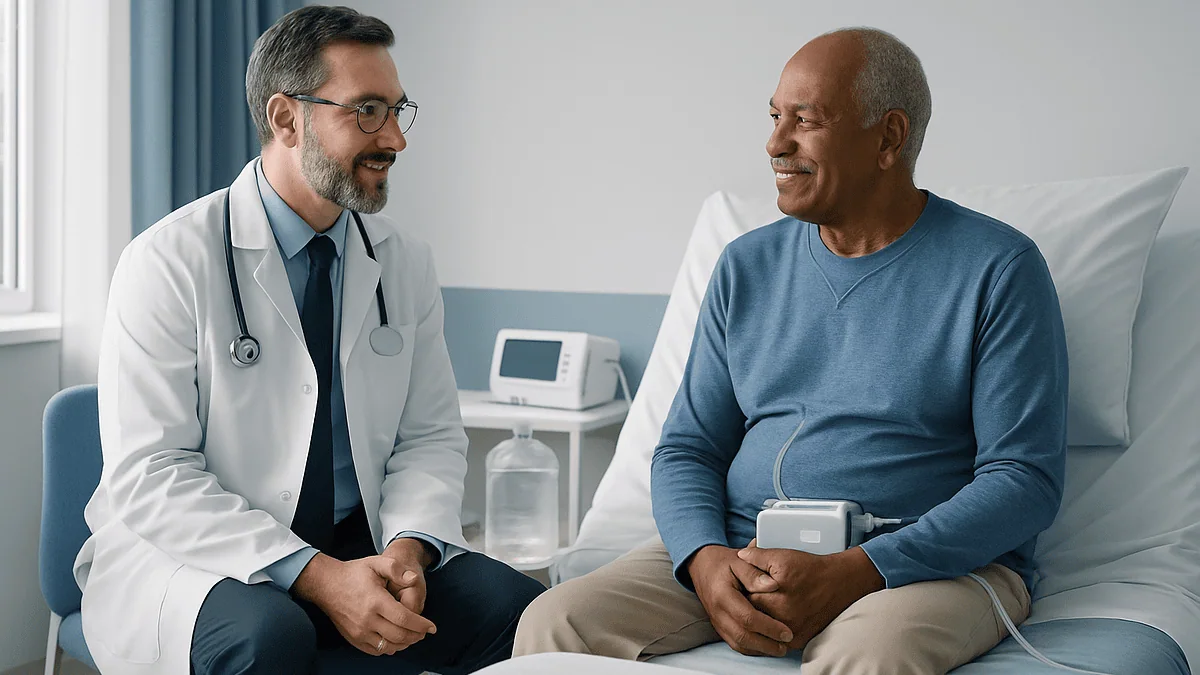
People on peritoneal dialysis can usually travel, but it takes planning. Most patients ask their renal unit and supplier to ship fluid and sets to the destination weeks ahead, carry a minimum of supplies and the cycler as hand luggage, store bags at room temperature away from heat and freezing, keep exchanges clean and on schedule across time zones, and confirm a local renal contact before leaving.
The suitcase is open on the bed, but the thing holding up the trip is not what to pack. It is a stack of dialysis fluid boxes in the hallway closet and a simple question: how do you move all of this to a beach house four states away without missing a single exchange?
If you do peritoneal dialysis at home, that question is familiar. The treatment that gave you back your evenings and your kitchen table also tethers you to a supply chain. Sorting out peritoneal dialysis travel supplies, where the fluid will sleep, and how the exchanges fit around a flight or a long drive is the real work of planning a trip.
The encouraging part is that renal units handle this every week. People on peritoneal dialysis visit family, attend weddings and take working trips all the time. What follows is what the evidence and standard practice say about doing it safely, and where the decisions belong to you and your care team.
Can you keep traveling with peritoneal dialysis?
Yes, in most cases, and the reason is built into the treatment itself. Peritoneal dialysis (PD) is a home therapy: it uses the lining of your own abdomen as the filter, so the “machine” travels with you. What has to be organized is the fluid, the sterile sets and a clean place to connect. Those are logistics problems, not medical ones, and logistics problems have solutions.
The National Institute of Diabetes and Digestive and Kidney Diseases (NIDDK) describes PD as a treatment that fits around work, school and travel, provided supplies can be delivered or carried to where you are going. That is the whole model: the therapy is designed to be done in a bedroom or a living room, and a hotel room is just another room.
Two things make PD travel different from a normal trip. First, there are no treatment-free days to bank. Waste and extra fluid build up continuously, so the daily routine has to continue in whatever time zone you land in. Second, the sterile technique that protects you from infection at home protects you on the road too, and it does not get a holiday. Peritonitis, an infection of the abdominal lining, is the complication renal teams worry about most, and the Mayo Clinic lists it as the most serious common risk of PD.
The practical starting point is a conversation with your renal unit well before you book. Units usually want to know the destination, the dates, the delivery address and how you will travel, because they coordinate the supply order and may ask a renal team near your destination to be on standby. The earlier that conversation happens, the more options you keep.
How peritoneal dialysis actually works, and why that makes it portable
A soft tube called a catheter sits in your abdomen, placed by a small operation. Through it, dialysis fluid (a sterile solution containing a sugar, usually a form of glucose, and salts) is run into the peritoneal cavity, the space around your intestines. The membrane lining that space, the peritoneum, is full of tiny blood vessels. Waste products and extra water cross from the blood into the fluid while it sits there. That waiting period is called a dwell. Draining the used fluid and running in fresh fluid is an exchange.
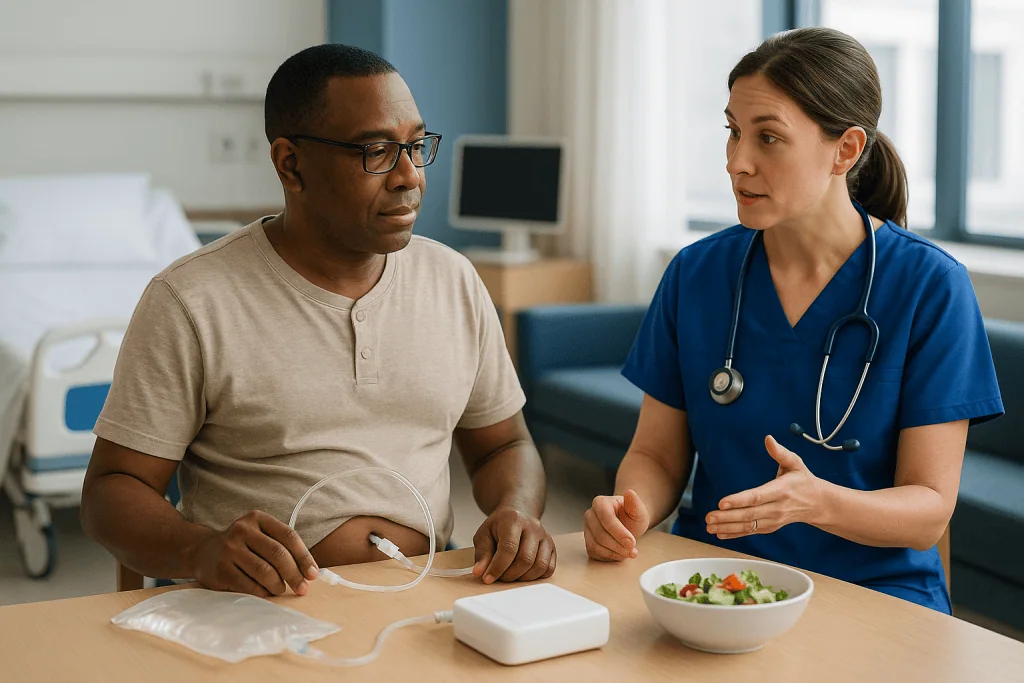
There are two ways to do it. In continuous ambulatory peritoneal dialysis (CAPD), you do exchanges by hand through the day. The Mayo Clinic describes each exchange as taking about 30 to 40 minutes, with the fluid dwelling for roughly 4 to 6 hours, and most people doing three to five exchanges in 24 hours. In automated peritoneal dialysis (APD), a bedside machine called a cycler does the exchanges while you sleep, over a session the NHS describes as typically 8 to 10 hours.
Each bag of fluid holds roughly 2 to 3 quarts, according to NIDDK. That number matters for travel because fluid is heavy: a week of CAPD can mean several dozen bags, and a single bag weighs more than a bag of sugar. It is the main reason supplies are shipped ahead rather than carried.
What makes PD portable is what it does not need. There is no blood circuit, no dialysis machine pumping blood, no water treatment plant. CAPD needs gravity and clean hands. APD needs a power outlet and a flat surface. Everything else fits in a box.
Who is usually cleared to travel, and who is usually asked to wait
Renal teams tend to clear travel readily for people whose PD is established and steady: a healed exit site (the spot where the catheter leaves the skin), a stable prescription, consistent fluid removal, weights and blood pressure that behave, and confidence with the connection technique. If you have been doing your exchanges at home without drama for a while, you are the kind of traveler units say yes to.
Some situations usually lead to a request to wait, or to a shorter trip closer to home. The weeks right after catheter placement are one, because the catheter needs time to heal before full use and your unit will want you nearby during training; NIDDK notes that PD training itself takes place over days to weeks. A recent episode of peritonitis is another, since the team will want to see the infection fully treated and the fluid clear. A recent prescription change, a hernia awaiting repair, unstable heart failure, or a transplant work-up that could call you in at short notice are all reasons a nephrologist may ask you to hold off.
Destination matters too. Within your own country, your supplier can often deliver to a home address or a hotel. Crossing borders is possible but more complex: fluid formulations differ, customs rules vary, and a backup renal unit may be harder to arrange. None of this is a prohibition. It is a risk assessment, and the decision belongs to you and your treating team together.
One honest point: travel is also an opportunity. Units sometimes use a planned trip to tidy up a prescription or retrain a technique, so raising it early can improve your dialysis at home as well.
Peritoneal dialysis travel supplies: what ships ahead and what you carry
Think of peritoneal dialysis travel supplies in two piles: the heavy pile that ships to your destination, and the light pile that never leaves your side.
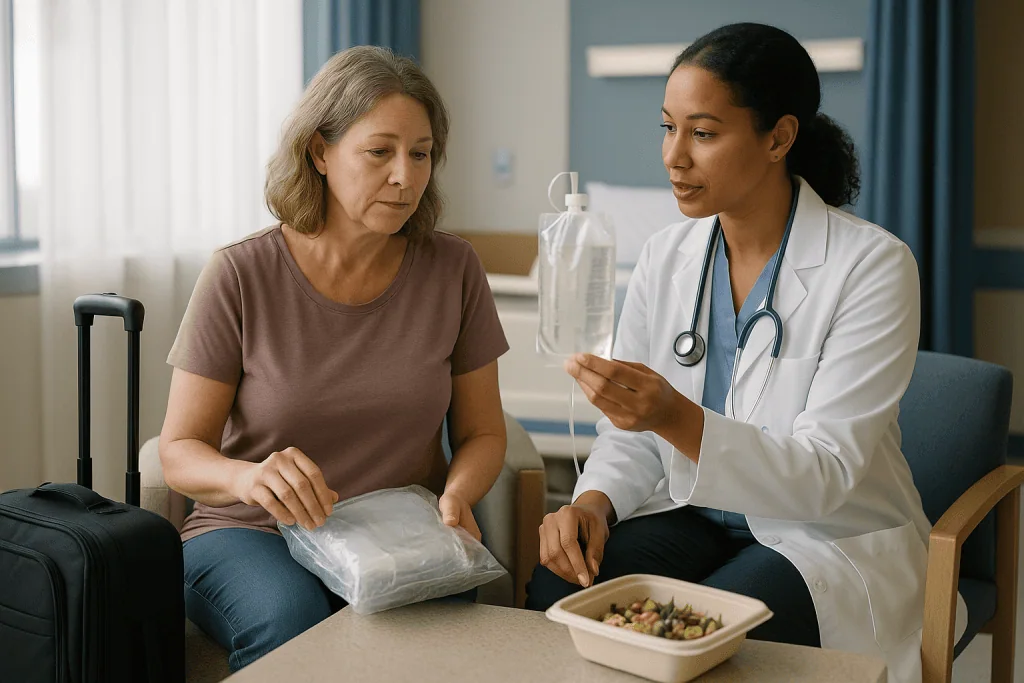
The shipped pile is mostly fluid. Your unit or supplier calculates the number of bags from your prescription, the length of the trip and a buffer for delays. For CAPD that is every bag for every exchange, usually in your mix of lower and higher strength solutions. For APD it is the overnight fluid plus cycler cassettes and lines, and often a manual exchange kit in case of a power cut. Drain bags, transfer-set caps, masks, dressings and tape usually travel in the same boxes. Ask your unit what it counts as a sensible buffer; policies differ.
The carried pile is what gets you through a travel day and a delivery that is late. Most teams advise hand luggage containing:
- enough fluid and sets for the exchanges you will do while traveling, plus a cushion
- spare caps, masks, hand sanitizer and a dressing kit
- the cycler, if you use one, as a medical device rather than checked baggage
- your current prescription, a letter from your unit describing PD and the catheter, and contact numbers for home and destination renal teams
- a blood pressure cuff, thermometer, scale if you have a travel one, and your record book
- your regular medicines in original packaging, carried, not checked
MedlinePlus advises keeping a written list of medicines and medical devices when traveling with a chronic condition. Keep copies on paper and on your phone. If your bag is delayed, that paperwork is what lets a pharmacist or a local renal unit help quickly.
Resist the temptation to pack fluid in checked luggage to save a delivery. Checked bags get lost, crushed and left on hot tarmac. Fluid that has been frozen in a hold or cooked in a trailer is fluid you cannot use.
A peritoneal dialysis travel checklist for the weeks before you go
Good PD trips are planned backward from the delivery date. Here is how a typical sequence runs, counted in weeks rather than days because supply chains move slowly.
As early as possible, tell your renal unit where, when and how you are traveling. They will confirm you are stable enough, check whether your supplier delivers to that address, and start the order. Many suppliers want notice measured in weeks; ask your unit for its own lead time rather than assuming.
Once the order is placed, call the destination. A hotel needs to know that boxes will arrive before you do, that someone must sign for them, and that they need a dry room-temperature space, not a loading dock or a walk-in fridge. A relative’s house needs the same conversation, minus the formality.
In the weeks before departure, gather paperwork: your prescription, a unit letter, insurance details, and the name and number of a renal unit near your destination that your team has contacted. The CDC’s advice for travelers with chronic illnesses adds a pre-travel check of vaccinations and a plan for care abroad; your nephrologist can advise what applies to you.
Check practicalities a week out. Confirm the delivery has been dispatched and, ideally, received. Test the cycler and pack its plug adaptor if the destination uses a different outlet. Pack your hand-luggage kit and weigh it; airlines have limits, and medical equipment allowances vary.
The day before, do a final count, print the delivery confirmation, and write down the exchange times you plan for the travel day in the local time of each place you will be. That last sheet of paper saves more confusion than anything else on this list.
Flying with dialysis supplies: airports, cabin bags and the cycler
Flying with dialysis supplies is routine for security staff, even if it feels anything but routine to you. Security authorities in most countries exempt medically necessary liquids and devices from the usual limits on cabin liquids, provided you declare them and allow screening. Keep fluid bags in their outer packaging, carry the unit letter, and tell the officer what you have before the bag goes through. Expect a few extra minutes, not a problem.
The cycler should go in the cabin. Treat it as you would a laptop: it is a medical device, airlines generally allow it in addition to the normal cabin allowance, and it should never be checked. Confirm the airline’s policy in advance and bring the letter describing it.
If your flight is long, think about where exchanges fall. A short hop usually needs nothing. A transatlantic flight may cross one of your CAPD exchange times, and some units advise travelling with fluid in for a longer dwell, or doing an exchange in a lounge before boarding. Your team will tell you what suits your prescription. Doing a sterile exchange in an aircraft toilet is not something most units recommend.
Movement matters too. The NHS lists long journeys, by plane, car or train, among the things that raise the risk of deep vein thrombosis (DVT), a clot in a leg vein. Kidney failure already shifts clot risk, so follow the basics: get up and walk every hour or so, flex your calves while seated, avoid crossing your legs for long stretches, and stay within the fluid allowance your team has set rather than over-drinking. Compression stockings are a question for your nephrologist, not a default.
Give yourself time at both ends. Rushing through an airport with a cycler and a kit bag is where things get dropped or left behind.
Storing dialysis fluid when traveling: heat, cold and hotel rooms
Dialysis fluid is a sterile medical product, and storing dialysis fluid when traveling comes down to one rule: keep it at ordinary room temperature, out of sunlight, and never let it freeze or overheat. The exact range is printed on every box; read it, because it is the manufacturer’s instruction and your unit’s reference point.
The common mistakes are predictable. A car trunk in summer can be far hotter than the cabin, and a rental trailer parked in the sun is worse. A balcony in winter can freeze a bag overnight. A hotel minibar is a fridge, and refrigerated fluid is uncomfortable to use and may be outside the labelled range. Stack boxes in the room, off the floor, away from radiators and air-conditioning vents.
Before each exchange, inspect the bag exactly as you were trained: check the expiry date, look for leaks at the seams and ports, and hold the bag to the light for clarity. The NHS and NIDDK both emphasize that cloudy or discolored fluid, in the bag or in the drain, is a signal to stop and call, not to carry on.
Warming fluid for a CAPD exchange is where travel gets improvised, and improvisation is risky. Most units teach dry warming, with a heating pad or a warming plate, to a comfortable body-neutral temperature. Microwaves heat unevenly and can create hot spots, and immersing bags in water introduces contamination at the ports. Pack whatever warming method you were trained on, and if you cannot bring it, ask your unit for an alternative before you leave rather than inventing one in a hotel.
Finally, plan for the empties. Drained fluid goes down the toilet; the bags go in household waste unless your unit says otherwise. Flattened boxes keep a small room livable.
How do you plan exchanges across time zones and long travel days?
Exchanges follow dwell time, not the clock on the wall. That is the principle that unknots most time-zone worries. Your body does not care whether the fluid went in at 8 a.m. at home or 2 p.m. in the new place; it cares that the dwell lasted roughly as long as prescribed and that the number of exchanges in 24 hours stayed the same.
For CAPD, the common approach is to shift exchange times gradually toward the destination schedule, lengthening or shortening one or two dwells slightly rather than dropping an exchange. A dwell that runs a little long is usually tolerated; a dwell that is skipped is not. Your unit will tell you how much flexibility your prescription has, because it depends on how your peritoneum transports fluid and solutes.
For APD, the cycler runs on local night. Going east shortens the first day, so the first night’s session may start earlier than feels natural; going west lengthens it, and your team may suggest a daytime manual exchange or a longer daytime dwell to bridge the gap. This is why many APD travelers carry a manual kit even if they never use it at home.
On the travel day itself, write a plan in local times for each location and stick it in your passport. Include where you will do each exchange: home before departure, a lounge, the hotel on arrival. Weigh yourself and check blood pressure as you normally would, because long days with airline food and less movement shift fluid balance quickly.
Eating and drinking need a little thought as well. Salt on a plane and in restaurants is higher than at home, and the dietary limits your dietitian set do not change because you are on holiday. Carrying your own snacks is unglamorous and effective.
Where do you do an exchange in a hotel room or someone else's house?
Any room can become an exchange space if you set it up the same way every time. The goal is the same as at home: nothing touches the open ends of the catheter and the set except sterile equipment and clean hands.
Pick a surface you can clean, such as a desk or a cleared tabletop, not the bathroom counter. Wipe it down, lay out your supplies in the order you use them, and close the door. Turn off fans and air conditioning vents that blow across the surface, and keep pets and children out until the connection is done. Open windows in a seaside hotel feel lovely and move a surprising amount of dust.
Hand hygiene is the single most effective step. The CDC’s dialysis safety guidance stresses hand washing or an alcohol-based rub before every connection, and masks for you and anyone helping. Hotel soap works fine; the technique is what matters. If the water supply at your destination is questionable, use the sanitizer you packed.
Exit-site care continues daily or on whatever schedule you follow at home. Shower rather than bath, keep the dressing dry, and look at the site in good light each day. Mayo Clinic lists exit-site infection and peritonitis as the infections PD teams watch for, and both are easier to treat when caught in the first day or two.
Swimming is a frequent question. Policies differ between units: some permit pools or the sea with a waterproof dressing and immediate exit-site care afterward, and nearly all advise against hot tubs and still water such as lakes. Ask before you go rather than deciding at the pool edge.
If you use a cycler, set it on a stable surface near an outlet, with the drain line secured in a bathroom or bucket as trained, and check the machine’s alarm volume so it does not wake the corridor.
CAPD or APD: which is easier to travel with?
Neither is “better” for travel; they trade different burdens. People who use CAPD carry less equipment but more fluid and more daytime interruptions. People on APD carry a machine and need a power supply, but their days are free. The table below summarizes what usually differs on the road, drawing on the way NIDDK and the NHS describe each method.
| Travel question | CAPD (manual, daytime) | APD (cycler, overnight) |
|---|---|---|
| Exchanges | Three to five by hand through the day | Several done by the machine over about 8 to 10 hours at night |
| Equipment to carry | Warming method, sets, caps | Cycler, cassettes, lines, plug adaptor, backup manual kit |
| Fluid volume | Highest per day; all bags ship ahead | Comparable total, delivered in larger containers |
| Power needs | None for the exchange itself | Reliable outlet; check voltage and plug type |
| Daytime flexibility | Exchanges interrupt sightseeing and meetings | Days are free; nights are fixed |
| Time-zone shifts | Adjust dwells gradually | Run on local night; bridge with a daytime exchange if advised |
| Common worry | Finding a clean space mid-day | Cycler in airline cabin, power failures |
Some people on APD are trained in manual exchanges specifically so that a power cut, a lost cycler bag or a long overnight journey does not leave them without treatment. If you have not practiced a manual exchange recently, ask your unit for a refresher before a trip. Equally, CAPD travelers sometimes ask whether a short switch to a different schedule is possible for a particular itinerary. That is a prescription decision for the nephrologist, never a change to make on your own.
What the first few days of a trip usually look like
Day one is the travel day, and it rarely goes exactly to plan. Flights are delayed, deliveries are signed for by the wrong person, and the room is not ready. The pattern that works is to treat the first exchange at the destination as the priority task: find the boxes, check the fluid, set up the space and connect. Everything else can wait.
Over the next two or three days, your numbers may wander. Heat makes you sweat and lose fluid; airline and restaurant salt makes you retain it; walking more than usual changes appetite and blood pressure. Keep the same records you keep at home: weight, blood pressure, fluid removed, and how you feel. The Mayo Clinic notes that fluid overload and dehydration both show up on PD, and the daily log is how you and your team tell them apart.
Check the exit site each morning. Look for new redness, tenderness, swelling or discharge. Look at every drained bag against the light. These two habits catch most trouble early.
By the end of the first week, most travelers have found their rhythm. Supplies are counted, the exchange space is set up, and the destination unit’s number is pinned to the fridge. If your weights or blood pressure have drifted in one direction for several days, that is the point to call your home unit, which can advise on strength selection within your existing prescription rather than leaving you to guess.
The last days of a trip bring their own task: counting what is left. A surplus goes home with you or is left with the destination unit if that was agreed; a shortfall is why the buffer exists. On the way home, repeat the travel-day plan in reverse, and book your usual clinic review for soon after you return so blood results can be checked.
What people often get wrong about peritoneal dialysis travel supplies
Myths around peritoneal dialysis travel supplies tend to come from trying to make the trip simpler than it is. Some of the common ones, corrected:
“I can skip an exchange on the travel day.” PD removes waste and water continuously, and there is no reserve to draw on. A longer dwell, agreed with your unit, is sometimes acceptable; a dropped exchange is a missed treatment, and repeated misses show up as fluid overload and rising potassium. Plan the exchange, not the skip.
“Fluid is fine in checked luggage.” Holds freeze, tarmac bakes, and baggage handlers crush. Fluid outside its labelled temperature range or with a damaged seam is unusable. Ship the heavy supplies and carry the travel-day minimum.
“The hotel fridge keeps it fresh.” Dialysis fluid is stored at room temperature. Chilled bags are uncomfortable to infuse and fall outside the label. The closet is the right place, not the minibar.
“Any hospital can do my exchanges if something goes wrong.” Not every hospital has PD expertise. That is why your unit identifies a renal center near your destination in advance, and why the contact number belongs in your wallet.
“A doctor’s letter lets me adjust my own prescription on holiday.” The letter explains your treatment to officials and clinicians. It does not change fluid strengths or exchange numbers; those remain decisions for your nephrologist, usually made by phone if you call with your records.
“A few days of sloppy technique will not matter.” Peritonitis does not require weeks of carelessness; a single contaminated connection can be enough. The Mayo Clinic links most PD infections to breaks in technique at the connection or the exit site. Your routine is the thing that keeps you well, at home and away.
Questions to ask your care team before you book
A short, specific conversation with your renal unit does more for a trip than any amount of online research. These are the questions that experienced PD travelers tend to ask, phrased so you can take them to clinic.
- Am I stable enough for this trip, and is there anything about my recent results or exit site that makes you want me to wait?
- How many weeks’ notice does our supplier need, and does it deliver to this destination and type of address?
- How many bags of each strength will you order, and how big a buffer are you building in for delays?
- What should I carry in hand luggage for the travel day, and how many extra exchanges should that cover?
- Can you give me a letter describing my treatment, the catheter and the cycler for airport security and the airline?
- Which renal unit near my destination have you contacted, and how do I reach them out of hours?
- How should I shift my exchange times or cycler schedule across the time-zone change on this specific itinerary?
- If I am on APD, should I be retrained in manual exchanges before I go, and should a manual kit travel with me?
- Is swimming at this destination acceptable, and with what precautions?
- What changes in weight, blood pressure or drained volume should prompt a phone call rather than waiting for my next review?
- Are any vaccinations, food or water precautions relevant to this destination given my kidney failure and medicines?
- When should I be seen after I get back?
Write the answers down. The value of this list is not the asking but the having, two weeks later, in a hotel room, when a bag looks slightly off and you want to remember exactly what the nurse said.
When to call your doctor
Being away from home changes nothing about the signs that need prompt attention; it only changes who you call first. Keep both your home unit’s number and the destination renal contact to hand, and do not wait for the trip to end.
Call the same day, or seek urgent care, if you notice any of the following, which NIDDK and the Mayo Clinic list as warning signs of peritonitis or other serious PD complications:
- cloudy or unusually discolored drained fluid, with or without abdominal pain
- new or worsening abdominal pain, tenderness, nausea or vomiting
- fever or chills
- redness, swelling, warmth, pain or discharge at the exit site, or a visible leak of fluid around the catheter
- fluid that will not drain or will not run in, or drained volumes far below what you usually get
- rapid weight gain, swelling of the legs or face, or breathlessness, especially lying flat, which can signal fluid overload
- dizziness, cramps or a drop in blood pressure, which can signal too much fluid removed
- blood in the drained fluid beyond the faint tinge some people see occasionally
Go to an emergency department, or call emergency services, for chest pain, severe breathlessness, confusion, fainting, a painful swollen calf after a long journey (a possible DVT, as the NHS describes), or abdominal pain severe enough that you cannot stand upright.
Bring your record book, your prescription and a sample of the cloudy fluid if you have been asked to keep one. The clinicians you meet may not know PD well; your paperwork and the number of your home unit help them help you. Whatever happens, do not change fluid strengths, exchange numbers or any prescribed medicine on your own. Describe what you see, and let your treating team decide the next step.
Frequently asked questions
How far ahead should I arrange peritoneal dialysis travel supplies?
Start the conversation with your renal unit as soon as you know your plans, because supplier lead times are usually measured in weeks. The unit calculates bags from your prescription and trip length, adds a buffer, and arranges delivery to the destination address. Confirm with the hotel or host that boxes will be accepted and stored at room temperature, and check the delivery has arrived before you travel if you can.
Is flying with dialysis supplies allowed in the cabin?
Generally yes. Security authorities in most countries exempt medically necessary liquids and devices from standard cabin limits when they are declared and screened. Carry fluid in its outer packaging, keep the cycler as a cabin item rather than checked baggage, and bring a letter from your unit describing the treatment and equipment. Check the airline’s medical equipment policy in advance, since allowances vary.
What is the safest way of storing dialysis fluid when traveling?
Keep it at room temperature, away from direct sun, heaters, air-conditioning vents and freezing conditions, with the labelled range on the box as your guide. Avoid car trunks in summer, balconies in winter and hotel fridges. Store boxes off the floor, and inspect every bag for expiry, leaks and clarity before use. Cloudy or discolored fluid should not be used; call your unit instead.
Can I skip an exchange while traveling with peritoneal dialysis?
Units advise against it. Peritoneal dialysis clears waste and water continuously and has no reserve to draw on, so a dropped exchange is a missed treatment. What is often possible is a slightly longer dwell or a shifted exchange time agreed with your team in advance. Write the travel day’s exchanges in local time for each location and plan where each will happen.
How do I adjust exchange times across time zones?
Shift gradually and keep the number of exchanges in 24 hours the same. For CAPD, lengthen or shorten one or two dwells slightly as you move toward the new schedule. For APD, run the cycler on local night and, if your nephrologist advises, bridge a long day with a manual exchange. How much flexibility you have depends on your prescription, so ask before you go.
What goes in my hand luggage on a peritoneal dialysis travel checklist?
Enough fluid and sets for the travel day plus a cushion, spare caps, masks, sanitizer and a dressing kit, the cycler if you use one, your prescription, a unit letter, home and destination renal contact numbers, your regular medicines in original packaging, and a blood pressure cuff and record book. Think of this bag as what gets you through a late delivery or a lost suitcase.
Where do I do an exchange in a hotel room?
Choose a cleanable surface such as a desk, not the bathroom. Wipe it down, lay out supplies in order, close the door, switch off fans and vents, and keep pets and others out until you are connected. Wash hands or use alcohol rub and wear a mask exactly as at home. Drained fluid goes down the toilet; empty bags go in household waste unless your unit says otherwise.
Can I swim with a peritoneal dialysis catheter on holiday?
It depends on your unit’s policy, so ask before you travel. Some units allow swimming in a chlorinated pool or the sea with a waterproof dressing and immediate exit-site care afterward. Most advise against hot tubs, lakes, rivers and other still or shared water because of infection risk. Never improvise a dressing; use what your team provides and inspect the exit site afterward.
What should I do about blood clot risk on a long journey?
The NHS lists long journeys by plane, car or train among the things that raise the risk of deep vein thrombosis. Walk the aisle or stop the car every hour or so, flex your calves while seated, avoid long periods with crossed legs, and keep to the fluid allowance your team set rather than over-drinking. Ask your nephrologist whether compression stockings are appropriate for you.
What if I run out of supplies or the delivery never arrives?
Call your home unit first; they can chase the supplier or arrange an emergency delivery. Your hand-luggage buffer is designed to cover a short delay. If the gap is longer, the renal unit near your destination that your team identified in advance may be able to provide fluid or temporary treatment. Do not switch to unfamiliar fluid or change your prescription without your nephrologist’s instruction.
References
- NIDDK (NIH): Peritoneal Dialysis
- MedlinePlus: Peritoneal dialysis
- NHS: Dialysis
- NHS: Deep vein thrombosis (DVT)
This article is for general information only and is not a substitute for professional medical advice. Please consult a qualified doctor about your individual situation.
Add us as a Preferred Source to see more of our trusted health content across Google Search, AI Overviews and Discover.

More from the Blog

Can Bladder Stones Come Back After Removal? Treating the Cause, Not Just the Stone
Yes, bladder stones can come back after removal if the condition that caused them is still present. Most bladder stones in adults form because…

Why Does My Bladder Hurt? Infection, Bladder Pain Syndrome and Other Causes
Bladder pain most often comes from a bladder infection (cystitis), which usually brings burning, urgency and cloudy or strong-smelling urine. When urine tests stay…

Supporting Someone Through Testicular Torsion Surgery: The First Night and the Week After
Supporting someone after testicular torsion surgery mostly means keeping the first night calm and the week after predictable: help them rest with the scrotum…

Preventing Another Kidney Stone: Fluids, Diet Changes and the Follow-Up Tests That Guide Them
To lower the chance of another kidney stone, most guidelines start with drinking enough fluid to keep urine pale and plentiful through the day,…

How Erectile Dysfunction Is Evaluated: Blood Tests, Hormone Checks and Heart Risk Assessment
Erectile dysfunction is evaluated with a detailed medical and sexual history, often a short questionnaire, a physical examination, and blood tests that commonly include…

How a Urinary Tract Infection Can Reach the Kidneys and How Prompt Care Prevents It
A urinary tract infection usually starts in the bladder, and the bacteria can climb the ureters, the tubes that link bladder and kidneys, to…