

Trim vs Wedge Labiaplasty: How Each Technique Handles Edge, Color and Scar Position

Key Takeaways
- A trim removes the free edge of the labia minora along with its naturally darker band; a wedge removes a V-shaped segment from the middle and keeps the original edge and its color.
- The trim scar runs the full length of the new border but hides in the natural fold, while the wedge scar is shorter but crosses the labium and can notch where it meets the rim.
- Wound separation at the join is the most frequently reported complication of wedge techniques in published series, and it is most likely in the first two weeks of healing.
- Over-resection is the defining risk of trim techniques, because removed labial tissue cannot be rebuilt by any reliable method.
- No randomized trial has compared trim and wedge directly, so any claim that one is best rests on single-surgeon series rather than comparative evidence.
- The NHS quotes one to two hours for the operation, one to two weeks off work and around six weeks without sex or tampons, with the final appearance settling over months.
Trim labiaplasty removes the outer free edge of the labia minora along a line, so the scar runs along the new border and the naturally darker rim is removed. Wedge labiaplasty removes a V-shaped segment from the middle and rejoins the tissue, keeping the original edge and its color with a shorter scar across the labium. Neither is proven superior; the choice depends on anatomy and goals, decided with the surgical team.
The consultation letter arrives with two words underlined in blue inktrim and wedgeand a note asking her to decide before the next appointment. She has studied the diagrams. She has read forum posts that swear by one and warn against the other. What she has not found is a plain account of what each does to the three things she cares about: the edge she will see, the color it will be, and where the scar will sit.
That is what the trim vs wedge labiaplasty question really comes down to. Not which is fashionable, and not which a particular surgeon happens to offer, but which set of trade-offs fits a particular body and a particular reason for surgery.
This explainer walks through both techniques the way a surgeon might on a whiteboard, then stays for the questions the whiteboard leaves out: recovery, risks, the myths that circulate online, and what to ask before anyone picks up a marker.
What happens in a trim vs wedge labiaplasty?
Both operations work on the labia minora, the two inner folds of skin that frame the vaginal opening, and both aim to reduce how far those folds project beyond the labia majora, the outer, hair-bearing folds. The similarity ends there.
In a trim labiaplasty (sometimes called an edge or linear resection), the surgeon marks a line along the outer free border of each labium and removes the tissue beyond it, then closes the fresh edge with fine dissolvable stitches. Picture the hem of a curtain being taken up: the fabric that hung longest is gone, and a new hem is sewn where the cut was made.
A wedge labiaplasty takes a different route. The surgeon removes a V-shaped segment from the widest, most protruding part of the labium, usually the middle third, and brings the upper and lower edges together so the labium shortens without its natural border ever being cut. Imagine removing a slice from a pie and pressing the remaining pieces together: the crust stays intact, but the pie is smaller.
The procedure is usually done under general anaesthetic, or local anaesthetic with sedation, and typically takes one to two hours according to the NHS. Most people go home the same day. Surgeons may combine either method with a reduction of the clitoral hood, the fold of skin covering the clitoris, when leftover tissue there would look unbalanced once the labia are shorter.
What matters for the rest of this article is that the two approaches do not merely differ in shape. They make opposite decisions about the three things people notice most afterward: where the edge ends up, what color it is, and where the scar lies.
What are the different types of labiaplasty?
Search for types of labiaplasty and you will find a long menu of names. Most are variations on the two families above.

The trim family includes the straight linear cut and curved versions that follow the natural arc of the labium rather than a ruler-straight line. Some surgeons stagger the closure or add a small zigzag so the healed edge does not contract into a tight cord.
The wedge family is larger. The classic central wedge removes a V from the middle. An inferior wedge takes tissue from the lower portion, useful when the fullness sits low. An extended wedge carries the excision upward into the clitoral hood so that hood and labium are reduced in one continuous plan. Z-plasty variants rearrange the closure lines to lower the chance of a notch forming where the two edges meet.
A third, less common approach is de-epithelialization: the surgeon removes only the surface layer of skin from a central strip on both faces of the labium and stitches the raw areas together, so the labium narrows while the edge and deeper tissue are fully preserved. It suits modest excess only.
Composite techniques combine a wedge with a light trim of any remaining rim, or pair labial reduction with clitoral hood work. Laser or radiofrequency devices are sometimes used as the cutting tool instead of a scalpel; they change how the incision is made, not the underlying technique.
None of these names is a standard classification, and different surgeons use the same word for slightly different operations. When a technique name appears in your consultation letter, ask which family it belongs to and, above all, what happens to the edge.
How each technique handles the labial edge
The edge is the first thing a trim changes and the last thing a wedge touches.
After a trim, the labium ends in a brand-new border created by the surgeon. That border can be set at a chosen length and shaped to run parallel to the outer labia. It heals as a fine line, and because dissolvable stitches sit right along it, the early edge can feel firm or slightly irregular until the sutures dissolve: a process the NHS describes as taking a few weeks. The natural free border, often thin, frilled or gently wavy, is gone. For someone whose main concern was an elongated or irregular rim, that is precisely the appeal. For someone who liked the look of their natural edge and wanted only less projection, it can feel like an unwanted trade.
A wedge preserves the edge entirely. The original border, with its texture and contour, is shortened by removing tissue from behind it. The two cut surfaces meet at one point on the rim, and the surgeon’s craft lies in making that junction lie flat rather than dip into a notch. When the join heals well, the border looks continuous, as if it had always been that length.
Anatomy pushes the decision one way or the other. A labium that is uniformly long from front to back suits a trim, because there is no single peak to remove. A labium with a distinct central bulge and thinner tissue above and below suits a wedge, because the V can be centered on the fullest part. A very thin, delicate labium may not hold a wedge closure securely; a very thick one may leave a bulky seam after a trim. This is why the answer to which is better begins with an examination, not a preference.
Color: why trim and wedge leave a different border
Labia minora are rarely one color. Tissue near the base is usually pink and moist, while the free edge is frequently darker, brown, purplish or gray-toned, because the skin there carries more melanin and sees more friction. That gradient is normal and varies with ethnicity, hormonal history and age.
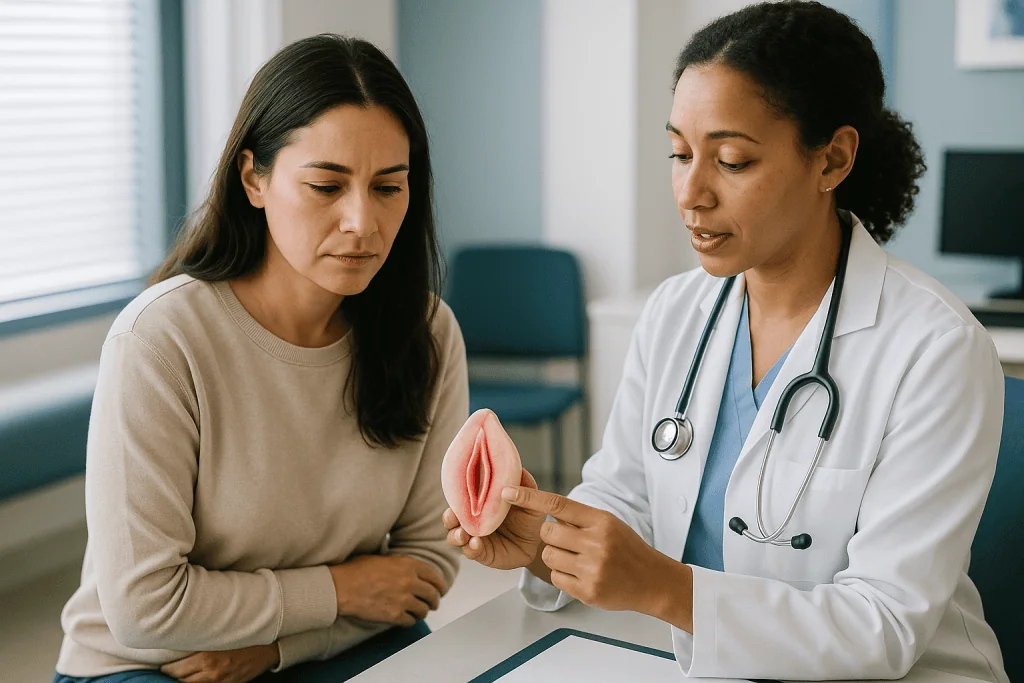
A trim removes the free edge, and with it the darker band. The new border is formed from paler tissue that used to sit further in, so the labium generally looks lighter and more uniform. This is the outcome some people specifically want, and it is the reason trim techniques are often requested when color is part of the concern. It bears saying plainly: darker labial skin is not a medical problem, and a wish to change it is a personal aesthetic preference rather than a health indication.
A wedge keeps the free edge, so it keeps its color. If the border was dark before surgery, it will be dark afterward, only shorter. For people who regard the pigmented rim as part of how their body looks and simply want less protrusion, that is a reason to lean toward a wedge.
Two nuances complicate the picture. When a wedge join heals, the scar line can sit a little paler than the surrounding tissue, producing a small break in the color of the rim; careful closure minimizes but does not always eliminate this. And a trimmed edge is not guaranteed to stay pale: pigment can return along a healed border over months, and no technique controls that reliably. Surgeons can describe the likely direction of change. They cannot promise a shade, and anyone who does is selling rather than advising.
Where the scar sits, and why position matters more than length
Every incision leaves a scar. The question is where it lives and how visible it is in ordinary positions.
A trim scar runs the full length of the new edge, so it is the longer of the two. It is also, paradoxically, often the less noticeable, because the labial rim is a place where a fine line blends into the natural fold. The risk is less about visibility than texture: if the closure contracts, the edge can feel firm or develop a scalloped outline where individual stitch points pulled tighter than the tissue between them.
A wedge scar is shorter, a single line running from the rim inward across the labium, but it crosses the labium rather than following it. On the inner, moist surface it usually fades well. At the point where it meets the rim, it is the site most likely to show a notch or step. Because a wedge join is under more tension than a trimmed edge, it is also the technique more often associated with wound separation in published series indexed on PubMed, particularly during the first two weeks.
Neither technique is prone to raised, thickened scars in the way skin on the chest or shoulders can be. MedlinePlus notes that keloids, scars that grow beyond the original wound, are far more common in certain body areas and in people with a personal or family history of them. The moist, mobile tissue of the labia is generally forgiving, though anyone with a keloid history should raise it before surgery.
Position matters most when sitting or lying with the legs together. A trim scar lies exactly where the two labia meet, hidden in the fold. A wedge scar lies partly on the outer surface, where it may show when the labia are parted.
Trim vs wedge labiaplasty at a glance
Placing the two techniques side by side makes the trade-offs clearer than any paragraph. The table describes typical tendencies reported in surgical literature, not guarantees; individual results depend on anatomy, healing and the surgeon’s approach.
| Feature | Trim (edge resection) | Wedge (V-excision) |
|---|---|---|
| What is removed | A strip along the free border | A V-shaped segment from the fullest part |
| Natural edge | Removed; a new edge is created | Preserved and shortened |
| Color of border | Darker rim removed; usually lighter | Original color kept |
| Scar length | Full length of the new edge | Short line across the labium |
| Scar position | Along the rim, in the fold | Across inner and outer surfaces to the rim |
| Signature concern | Over-resection; firm or scalloped edge | Wound separation; notch at the join |
| Anatomy it often suits | Uniformly long labium | Central bulge with thinner tissue above and below |
| Revision approach | Difficult if too much removed | Notch can sometimes be re-excised |
Reading down the columns, a pattern emerges. Trim gives control over final shape and color at the cost of the original border. Wedge gives fidelity to the original border at the cost of a tension-bearing join across the labium. Surgeons who offer both generally describe choosing case by case rather than by habit, and some combine them: a wedge for the bulk, a light trim for the rim. Ask your team which column your anatomy fits and why. If the answer is a reason your body suits one method, that is a good sign. If it is a reason the other method is bad, ask again.
Which labiaplasty technique is best? What the evidence actually shows
Type which labiaplasty technique is best into a search engine and you will get confident answers in both directions, many of them from practices that favor one method. The honest position from the published literature indexed on PubMed is untidier: no randomized trial has directly compared trim and wedge in the same group of patients, and most reports are single-surgeon series with different follow-up periods, different outcome measures and different definitions of a complication.
What those series do agree on is that both techniques are commonly performed, both reduce projection when performed for that purpose, and each carries a signature problem. For wedge, it is wound separation at the join. For trim, it is over-resection, removing more than intended, which cannot be undone, and an edge that heals stiff or irregular. Reported rates vary so widely between series that quoting a single figure would mislead; the direction of the risks is more reliable than their size.
Sensation deserves a plain word. Both approaches cut through tissue that contains nerve endings. Some surgeons argue that a wedge preserves the nerve-rich edge; others note that a trim removes a strip in which nerves run parallel to the cut and may spare deeper branches. Studies measuring sensation before and after surgery are small, and neither side has decisive evidence. The NHS lists reduced sensitivity among the recognized risks of labiaplasty regardless of technique.
So what is best? The technique that matches your anatomy, addresses the specific thing bothering you, and is one your surgeon performs routinely. A surgeon who offers only one method is not necessarily wrong, but you should hear a clear reason it suits you, not a reason the alternative is inferior.
What is a Barbie labiaplasty, and why clinicians are wary of the term
Barbie labiaplasty is a marketing phrase, not a surgical one. It describes an aggressive trim in which the labia minora are reduced so far that they sit entirely hidden within the labia majora, producing a smooth, doll-like outer contour with no visible inner fold. Some practices also use it for a combined reduction of the clitoral hood to complete the effect.
Several things about the phrase trouble many gynecologists and plastic surgeons. First, it presents one specific look, one most adult bodies do not have, as a goal, which can shape expectations in people who did not begin with that wish. The NHS is explicit that labia minora showing below the outer folds are entirely normal, and that most people considering surgery have anatomy within the ordinary range.
Second, the operation it describes is the one most exposed to the signature risk of trim techniques: over-resection. Removed labial tissue does not grow back, and there is no reliable reconstruction for labia minora that have been reduced too far. Some surgeons report tightness, dryness at the vaginal opening or discomfort during sex when very little tissue remains, though this comes from case reports and expert opinion rather than large controlled studies.
Third, it borrows a toy’s name to sell a body shape. That is not a clinical argument, but it is a reason to read any material that leads with the term more carefully than usual.
If you have encountered the phrase and it appeals to you, that is a legitimate thing to raise with a surgeon, paired with the follow-up questions of how much tissue they would leave, why that amount, and what they would do if healing did not go as planned.
Who usually considers labiaplasty, and who is asked to wait
Labiaplasty is usually sought for one of two reasons, and sometimes both. Physical reasons include chafing or irritation from clothing or exercise, discomfort during sex, difficulty keeping the area clean, or catching and pulling during activities such as cycling. Appearance-related reasons center on how the labia look in swimwear, underwear or to a partner. NHS guidance treats both as valid starting points for a conversation, while stressing that appearance concerns deserve exploration before a decision.
Several groups are usually asked to wait, or to think further. Anyone under 18 is generally not offered cosmetic labiaplasty, because the labia continue to develop through puberty and often change in proportion as the labia majora fill out. Someone who has recently given birth is usually advised to allow tissue to settle, since labial shape shifts during pregnancy and in the months after delivery. People with active genital skin conditions such as lichen sclerosus, or with recurrent infection, are typically asked to treat those first, because operating on inflamed tissue heals poorly. Smokers are often asked to stop well before surgery to lower wound-healing risk.
A separate group deserves gentler handling. If the wish for surgery is driven mainly by a belief that one’s anatomy is abnormal, or by distress out of proportion to what a clinician sees, surgeons are advised to discuss this openly and may suggest speaking with a psychologist first. That is not a refusal; it is a check that surgery is the right tool for the problem.
Some people are candidates for neither trim nor wedge because their concern is asymmetry, fullness of the outer labia, or the clitoral hood alone. The right first step is a consultation that names the concern precisely before any technique enters the conversation.
What the first days and weeks after surgery usually look like
The NHS describes labiaplasty recovery in broad strokes, and most surgeons’ instructions fall within them. The timeframes below are typical ranges, not promises.
The first two to three days are the sorest. Expect swelling that can look alarming, the labia often appear larger than before surgery, along with bruising, slight bleeding and a burning sensation when passing urine. Cool packs wrapped in cloth, loose cotton underwear and lying with the hips slightly raised help many people; your team will advise on pain relief. Some surgeons suggest pouring warm water over the area while urinating to ease stinging.
By the end of the first week, swelling usually starts to ease. Many people return to desk-based work within one to two weeks, which is the range the NHS quotes for time off. Walking is encouraged from day one to reduce clot risk, but anything that puts pressure or friction on the area, cycling, horse riding, vigorous exercise, waits several weeks.
Stitches are typically dissolvable and disappear over a few weeks. Wedge patients are usually told to be especially careful in the first two weeks, when the join is weakest. Trim patients may notice the edge feels firm or lumpy where sutures sit; this softens as they dissolve.
The NHS advises avoiding sex, tampons and swimming for around six weeks, or until the team confirms healing. Tight clothing is discouraged in that window too.
Final appearance takes longer. Subtle swelling can persist for months, and scars keep maturing and softening over the first year. Judging the result at four weeks is like judging a paint job while it is still wet: the color and finish are not yet what they will be. Surgical teams commonly ask people to wait several months before weighing whether any touch-up is warranted.
Risks with each technique, and the alternatives worth weighing
The NHS lists the general risks of labiaplasty as bleeding, infection, scarring, reduced sensitivity, the wound opening, and dissatisfaction with the result. Each technique tilts that list slightly.
With a wedge, the standout risk is dehiscence: the surgical word for a closed wound pulling apart. Because the join carries tension and sits in a moist, mobile area, it is the complication most frequently reported in wedge series. Small separations often heal on their own with careful hygiene; larger ones may leave a notch that needs later revision. Wedge also carries a small risk to the blood supply of the edge if the flaps are cut too thin.
With a trim, the standout risk is taking too much. Once the edge is gone, a surgeon cannot add tissue back, and an over-reduced labium can leave the vaginal opening feeling exposed or dry. Trim edges can also heal with a scalloped outline or a firm ridge along the stitch line, and there is a theoretical concern that cutting across the edge divides more superficial nerve endings, though the evidence on sensation is inconclusive.
Both techniques share the risks of asymmetry, hematoma, a collection of blood under the skin that may need draining, and delayed healing in smokers or people with diabetes.
Alternatives exist, and a fair consultation covers them. Doing nothing is a legitimate choice: labial length does not affect health, and the NHS emphasizes that variation is normal. For chafing, changes to clothing, padded cycling shorts and barrier creams help some people. For appearance-related distress, talking therapy has evidence for improving body image and is sometimes suggested before or instead of surgery. For dryness or irritation after menopause, addressing the underlying hormonal change may settle the symptom without any operation. Every one of these belongs on the table before a technique is chosen.
What people often get wrong about trim and wedge
Wedge is modern and trim is outdated. Both are current, both are taught, and neither has been shown superior in comparative research. The wedge was popularized later, but newer has never meant better in surgery.
Trim always gives a straight, unnatural edge. A trim can be curved to follow the labium’s natural arc, and a well-planned trim leaves a soft border. Stiff, ruler-straight edges signal technique or healing problems, not an inevitable feature.
Wedge never changes the edge. It shortens it and creates a join on it. If the join heals with a small notch, the edge is changed in a way that can be more visible than a trim scar.
Darker labial skin means something is wrong. Pigmentation of the labial edge is normal and varies widely. A trim happens to remove it; that is a side effect some people welcome, not a medical benefit.
Labiaplasty tightens the vagina or improves sexual function. It changes the external folds only. The vaginal canal is untouched, and the NHS makes no claim that labiaplasty improves sensation, reduced sensitivity is listed as a risk.
Swelling at two weeks shows the final result. Swelling in this area is dramatic and slow to resolve. Surgeons ask people to wait months before judging.
Labia can be restored if too much is removed. There is no reliable way to rebuild labia minora. That is why conservative planning matters more than any technique choice.
Revision is quick and easy. Correcting a wedge that notched or a trim that scalloped is possible but typically more complex than the first operation, because less tissue remains and scar is already present. The best revision is the one that careful planning made unnecessary.
Questions to ask your care team
A good consultation should leave you able to answer these yourself. Bring the list and write down the replies.
- Which technique do you recommend for me, and what about my anatomy points you toward it rather than the other?
- Do you perform both trim and wedge routinely? If not, how do you decide who should be referred elsewhere?
- Where exactly will the scar sit, and can you show me on a diagram or with a marker?
- Will the natural edge and its color be kept or removed under the plan you propose?
- How much tissue will you leave, and how do you guard against removing too much?
- What are your own rates of wound separation, revision and infection, and how do you define each?
- If the wound opens in the first two weeks, who do I contact and what is the plan?
- Will the clitoral hood be reduced as well? Why or why not?
- What are the alternatives, including doing nothing, and who could I speak with about body image before deciding?
- When can I return to work, exercise, cycling, tampons and sex, and who confirms I have healed?
- How many follow-up visits are planned, and at what points?
- If I am unhappy after six months, what are the options and what would a revision involve?
Two further checks belong outside the consultation room. The NHS advises confirming that any surgeon performing cosmetic surgery is registered with the relevant regulator and has specific training in the operation you are considering. And if any part of the conversation leaves you feeling pressured or hurried, that is information too. A permanent change to genital tissue can afford a second appointment, a period of reflection, or a second opinionand a surgeon worth choosing will say so first.
When to call your doctor
Most recoveries are uneventful, but a few signs need same-day advice from your surgical team or, out of hours, an urgent care service.
Call promptly if you notice:
- Bleeding that soaks through a pad within an hour or does not slow with firm, gentle pressure.
- A rapidly enlarging, tense, very painful swelling on one side: a possible hematoma.
- Fever, chills or feeling generally unwell in the first two weeks.
- Spreading redness, heat, pain that increases rather than eases, or foul-smelling discharge: MedlinePlus lists these as signs a surgical wound may be infected.
- Wound edges visibly pulling apart, especially at a wedge join.
- Inability to pass urine, or urination that becomes cloudy or increasingly painful.
- Numbness or loss of sensation that is new or worsening rather than improving.
Seek emergency care immediately for heavy bleeding that will not stop, fainting, chest pain, sudden shortness of breath, or a hot, swollen, painful calf: the last can signal a blood clot, a risk after any operation.
Two quieter situations also deserve a call rather than a wait. If you feel low, anxious or regretful in a way that interferes with daily life, tell your team; this is common enough after cosmetic surgery that many services have someone to talk to. And if the shape at several months is not what you discussed, book a review rather than searching online for what went wrong.
Your treating team knows what your tissue looked like on the day and what they expect at each stage. They, not a general article, are the right judges of whether what you are seeing is normal healing. Every decision about further treatment, revision or reassurance rests with them.
Frequently asked questions
Which labiaplasty technique is best?
Neither trim nor wedge has been shown to be better in comparative research; the best technique is the one that suits your anatomy and the specific concern you have. Published series indexed on PubMed are single-surgeon reports with different outcome measures, so no head-to-head verdict exists. A uniformly long labium tends to suit a trim, a central bulge tends to suit a wedge, and the decision belongs with your surgical team after examination.
What is a Barbie labiaplasty?
It is a marketing term for an aggressive trim that reduces the labia minora until they are hidden entirely within the outer labia, sometimes with clitoral hood reduction added. Clinicians are cautious about the phrase because it promotes one look as a goal, and because the extensive tissue removal it describes carries the highest risk of over-resection, which cannot be reversed. The NHS notes that visible inner labia are normal anatomy.
What are the results of a wedge labiaplasty?
Wedge labiaplasty results typically include a shorter labium with its original edge, texture and color preserved, and a short scar crossing the labium rather than running along the rim. When the join heals flat, the border looks continuous. The main things that can affect the outcome are wound separation in the early weeks and a small notch or paler line where the scar meets the edge. Final appearance settles over months, not weeks.
What are the different types of labiaplasty?
Most techniques fall into two families: trim methods, which remove a strip along the free edge, and wedge methods, which remove a V-shaped segment from the middle and rejoin the tissue. Wedge variants include central, inferior, extended and Z-plasty designs. De-epithelialization removes only surface skin from a central strip to narrow the labium. Composite procedures combine approaches or add clitoral hood reduction. The names are not standardized, so ask what happens to the edge.
Does a trim labiaplasty remove the dark edge?
Yes, a trim removes the free border of the labia minora, which is usually the most pigmented part, so the new edge is generally lighter and more uniform. That said, pigment can return along a healed border over months, and surgeons cannot guarantee a particular shade. A wedge, by contrast, keeps the original edge and its color. Darker labial skin is normal and not a medical concern; changing it is a personal preference.
Does labiaplasty reduce sensation?
It can, and the NHS lists reduced sensitivity among the recognized risks of labiaplasty regardless of technique. Both trim and wedge cut through tissue that contains nerve endings. Some surgeons argue wedge preserves more sensation by keeping the edge; others believe trim spares deeper nerves. Studies measuring sensation before and after surgery are small and inconclusive, so no technique can be promised as sensation-sparing. Discuss the uncertainty openly with your surgical team.
Can a wedge labiaplasty open up after surgery?
Yes, wound separation, dehiscence, is the most frequently reported complication of wedge techniques in published series, because the join sits under tension in a moist, mobile area. It is most likely in the first two weeks. Small separations often heal with careful hygiene and no further surgery; larger ones may leave a notch needing later revision. If you see the edges pulling apart, contact your team the same day rather than waiting.
How long does it take to heal after trim or wedge labiaplasty?
The NHS describes recovery as taking one to two weeks off work, with sex, tampons and swimming avoided for around six weeks or until the team confirms healing. Dissolvable stitches disappear over a few weeks. Swelling is marked in the first days and eases gradually, but subtle swelling and scar maturation continue for months. Treat these as typical ranges tied to guidance, not guarantees; your surgical team will confirm your own timeline.
Is there a minimum age for labiaplasty?
Cosmetic labiaplasty is generally not offered to anyone under 18, according to NHS guidance, because the labia continue to develop through puberty and proportions often change as the outer labia fill out. Concerns that feel pressing in adolescence frequently resolve as development completes. If a younger person is distressed about their anatomy, a conversation with a doctor about normal variation, and support for body image, is the recommended first step.
Can a labiaplasty be revised if the result is uneven?
Revision is sometimes possible, but it is usually more complex than the first operation because less tissue remains and scar is already present. A notch after a wedge can often be re-excised; a scalloped trim edge can sometimes be smoothed. Tissue that was removed cannot be rebuilt, which is why conservative planning matters most. Surgical teams generally ask people to wait several months for swelling to settle before assessing whether revision is warranted.
References
- NHS: Labiaplasty (vulval surgery)
- NHS: Cosmetic procedures: what to consider
- MedlinePlus: Plastic and Cosmetic Surgery
- MedlinePlus: Surgical wound infection: treatment
This article is for general information only and is not a substitute for professional medical advice. Please consult a qualified doctor about your individual situation.

More from the Blog

How Long Do Fat Grafting Results Last? Graft Take, Volume Settling and Realistic Expectations
Fat grafting results are generally considered long-lasting once the transferred fat has survived, but not all of it does. Published reviews report that roughly…

When a Thigh Lift Needs Revision: Scar Migration, Residual Laxity and Timing of a Redo
A thigh lift revision is a second operation to correct problems left after an earlier thigh lift, most often a scar that has drifted…

CoolSculpting After Pregnancy: When It Helps, When It Does Not and Why Timing Matters
Cryolipolysis, the fat-freezing treatment sold under the CoolSculpting name, can reduce small, pinchable fat pockets that persist after pregnancy, but it does not tighten…

When Compression Is No Longer Enough: How Doctors Decide Lymphedema Surgery Is the Next Step
Lymphedema surgery is usually considered only after months of consistent conservative care, including compression, decongestive therapy and skin care, has failed to control swelling,…

Cycling, Running and Tight Clothing After Labiaplasty: A Realistic Return-to-Activity Guide
Exercise after labiaplasty is usually rebuilt in stages: short walks within days, light low-impact activity often from about two weeks, and strenuous exercise, running…

Arm Liposuction Risks: Contour Unevenness, Numbness and Which Signs to Report Early
Arm liposuction risks include contour unevenness (lumps, dents or asymmetry), temporary or occasionally lasting numbness, bruising, fluid collections called seromas, infection and, rarely, blood…