

Ultherapy vs Morpheus8: Ultrasound and Radiofrequency Tightening Compared

Key Takeaways
- Ultherapy targets the SMAS layer about 4.5 millimeters down using microfocused ultrasound, the same layer surgeons tighten in a facelift, while leaving the skin surface intact.
- Morpheus8 delivers radiofrequency through fine insulated needles to roughly 4 millimeters, improving texture and scars as well as mild laxity, usually over three sessions spaced 4–6 weeks apart.
- The best independent Ultherapy study, published in 2010, found a measurable brow lift in 86 percent of 35 participants at 90 days, averaging about 1.7 millimeters, roughly the thickness of a dime.
- Published follow-up for both devices rarely extends past six months, so claims that results last one to three years rest on expert opinion and collagen biology rather than measured data.
- Fat loss and temporary facial nerve weakness are documented but uncommon complications of both procedures, most often linked to deep settings over thin areas, which makes operator skill the main modifiable risk.
- Ultrasound is independent of skin pigment and radiofrequency microneedling is widely used across skin tones, whereas pigment-targeting lasers carry the real risk for darker complexions.
Ultherapy uses microfocused ultrasound to heat deep tissue layers from the outside, prompting new collagen and a modest lift, usually in one session. Morpheus8 uses radiofrequency delivered through fine needles to tighten and resurface the skin itself, usually over three sessions. Both are supported mainly by small observational studies rather than large randomized trials, both give subtle results, and neither replaces a surgical lift.
A friend texted me two screenshots last week. One was a short video captioned “Ultherapy made my face look hollow.” The other, posted the same day, claimed Morpheus8 “melted my cheek fat.” She wanted to know which one was lying. The honest answer is that both clips were describing the same underlying worry, and that the evidence for either claim is thinner than the comments sections suggest.
Search interest in ultherapy and radiofrequency microneedling has climbed sharply over the past year, driven less by new science than by a wave of before-and-after videos, celebrity interviews, and the arrival of updated versions of both devices. As of mid-2025, the two procedures are among the most-searched non-surgical lifting options in the United States, and the questions people type are strikingly consistent: does it work, does it hurt, is it better than a laser, and why does it carry such a high price tag.
This piece walks through what each technology actually does to the skin, what the published studies show and how strong they are, and which warning signs mean a phone call rather than a wait-and-see.
What is Ultherapy skin lifting, and how does ultrasound tighten skin?
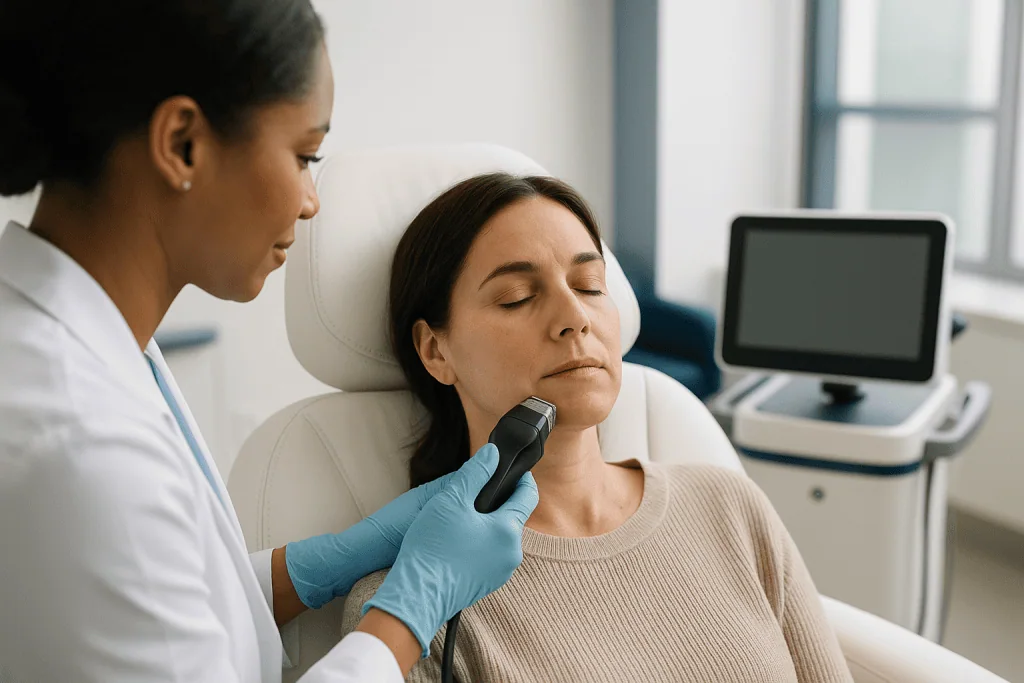
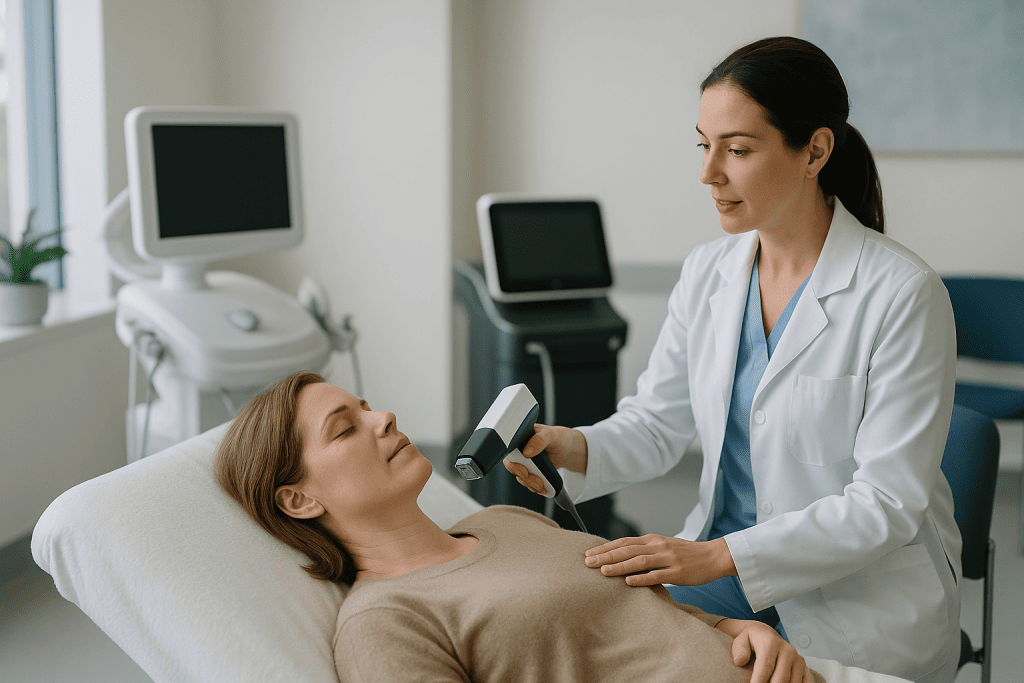
Ultherapy is the brand name for a procedure that uses microfocused ultrasound, meaning sound waves concentrated into tiny points deep under the skin so that heat builds only at those points while the surface stays cool. Think of a magnifying glass focusing sunlight onto a single spot of paper: the glass itself does not get hot, but the spot does.
The device places thousands of these heat points, each roughly the size of a grain of rice, at preset depths. The standard handpieces reach about 1.5 millimeters (the upper dermis, the skin’s living middle layer), 3.0 millimeters (the deep dermis), and 4.5 millimeters, which in the face corresponds to the superficial musculoaponeurotic system, or SMAS. The SMAS is the sheet of connective tissue and muscle that surgeons tighten during a facelift. Ultherapy is the only widely used non-surgical device that routinely targets this layer, which is why it is marketed as a lift rather than a resurfacing treatment.
Each focal point reaches roughly 60 to 70 degrees Celsius for a fraction of a second. That brief heat causes existing collagen fibers to contract slightly and, more importantly, triggers a wound-healing response. Over the following weeks fibroblasts, the cells that manufacture collagen, lay down fresh fibers. This gradual rebuilding, called neocollagenesis, is why results appear over two to six months rather than on the day of treatment.
The device also includes ultrasound imaging, so the practitioner can see the tissue layers on a screen before firing. In theory this lets them avoid wasting energy on fat or bone. In practice, operator skill in reading that image is one of the biggest variables in outcome, a point that matters when comparing providers.
Ultherapy received its first US clearance for lifting the brow in 2009, followed by the neck and under-chin area in 2012 and lines on the chest in 2014. Those clearances mean the device demonstrated safety and a measurable effect in modest studies, not that it rivals surgery.
What is Morpheus8, and how does radiofrequency microneedling work?
Morpheus8 belongs to a different family altogether. It is a radiofrequency microneedling device, which means it combines two older ideas: fine needles that puncture the skin to stimulate repair, and radiofrequency energy, an electrical current that heats tissue as it passes through.
A cartridge of insulated gold-coated needles, typically 24 in a small grid, is pressed into the skin to a chosen depth. Once the tips are in place, radiofrequency energy flows between them, heating the surrounding dermis and, at deeper settings, the layer of fat just beneath it. Because the needles are coated along their shafts, most of the energy is released near the tips. That design is intended to protect the surface, which is why the procedure is often described as being gentler on darker skin tones than older heat-based treatments.
Standard tips reach up to about 4 millimeters; newer configurations go deeper and can fire at several depths in one pass. Where Ultherapy skips the surface entirely, Morpheus8 deliberately injures it with thousands of microscopic channels. That mechanical injury is the point. Micro-wounds recruit growth factors, and the added heat denatures old collagen so it can be remodeled. The combination is why practitioners reach for it when the problem is not only laxity but also texture: acne scars, enlarged pores, crepey skin on the neck, fine wrinkles, and stretch marks.
The regulatory language is worth stating plainly. In the United States, Morpheus8 is cleared as a device for electrocoagulation and hemostasis of soft tissue in dermatologic and surgical procedures. The aesthetic claims you see in advertisements, including “fat remodeling” and “non-surgical facelift,” are how clinics describe their use of it, not what the clearance document says. That gap does not make the treatment unsafe, but it does mean the burden of proof sits with the published research rather than the brochure.
What changed recently: why Ultherapy and Morpheus8 are trending now
Nothing in the peer-reviewed literature has upended our understanding of either device in the past year. What has changed is the volume and the tone of the public conversation.
Three things happened at roughly the same time. First, both manufacturers released updated platforms over the past two years, with marketing that emphasized faster treatment, more comfort, and real-time imaging. New hardware tends to generate a fresh round of clinic promotions, which in turn generates search traffic. Second, several widely shared videos and interviews described facial “hollowing” or fat loss after one procedure or the other. Those posts travel far because they tap a plausible fear: both devices heat tissue near fat, and fat does not like heat. Third, the broader shift toward “prejuvenation,” the idea of starting maintenance treatments in your thirties, has pulled a younger audience into comparing options that were once marketed mainly to people over fifty.
Against that noise, the scientific anchors remain dated but useful. The most-cited independent Ultherapy study, published in the Journal of the American Academy of Dermatology in 2010, followed 35 adults and found that blinded raters judged 86 percent as showing a measurable brow lift at 90 days, averaging about 1.7 millimeters. That is a real number, and it is a small one. It is roughly the thickness of a dime. Mayo Clinic’s current patient guidance on wrinkle treatments lists both ultrasound and radiofrequency among the non-surgical options, describing the results as modest and noting that studies on durability remain limited.
Put those pieces together and the “what changed” is honest and slightly deflating: the devices improved incrementally, the marketing improved considerably, and the evidence base stayed roughly where it was. Anyone considering treatment in 2025 is weighing the same fundamental trade-offs patients weighed a decade ago, with somewhat more comfortable hardware.
Ultherapy vs Morpheus8: how the two technologies actually differ
The simplest way to hold the comparison in your head is this: Ultherapy works from the inside out without breaking the skin, and Morpheus8 works from the outside in by breaking it on purpose. Nearly every practical difference flows from that.
| Feature | Ultherapy | Morpheus8 |
|---|---|---|
| Energy type | Microfocused ultrasound | Radiofrequency through microneedles |
| Deepest target | About 4.5 mm (SMAS layer) | About 4 mm standard; deeper tips available |
| Skin surface | Left intact | Punctured; micro-channels and heat |
| Primary goal | Lift and tightening of sagging tissue | Tightening plus texture and scar improvement |
| Typical sessions | Usually one | Usually three, spaced 4–6 weeks |
| Downtime | Minimal; redness for hours | Redness and pinpoint crusting for 3–7 days |
| Discomfort | Deep aching heat during treatment | Sharp pricking and heat; topical numbing standard |
| Results visible | Gradually over 2–6 months | Texture within weeks; tightening over months |
| Imaging guidance | Built-in ultrasound view | None; depth set mechanically |
| Evidence quality | Small prospective cohorts, blinded raters | Small case series, mostly manufacturer-linked |
A few rows deserve a second look. The imaging row is often underappreciated: seeing the tissue layers is what lets an Ultherapy operator aim at the SMAS rather than fat or bone, and it is also why the procedure is only as good as the person reading the screen. The downtime row explains why Morpheus8 patients plan around a weekend while Ultherapy patients go back to work. And the evidence row should temper enthusiasm for both: neither has been tested in the kind of large, randomized, independently funded trial that would settle the question of which is better.
Who is a good candidate for Ultherapy, and who suits Morpheus8?
Dermatologists tend to sort people by two questions: is the main problem sagging, or is it surface quality, and how much of either is there?
Ultherapy is generally considered for mild to moderate laxity in people who still have reasonable skin elasticity, often in their forties to early sixties. The classic targets are a brow that has drifted a few millimeters, early softening along the jawline, and loose skin under the chin. Because the energy bypasses the surface, it does not help much with pigment, pores, or fine crepe-paper texture. Someone with significant jowling, heavy neck bands, or a great deal of excess skin is usually told, correctly, that no energy device will deliver what they are picturing; that is surgical territory.
Morpheus8 suits people whose complaints cluster at the surface or just beneath it: acne scarring, textural roughness, enlarged pores, fine lines, and mild laxity on the lower face, neck, or body. It is also used on areas Ultherapy is not cleared for, such as the abdomen and knees. Because it relies on needle injury rather than light, it is considered usable across skin tones, though people with deeper complexions carry a higher risk of post-inflammatory hyperpigmentation, meaning dark marks that appear after any skin inflammation, and settings are adjusted accordingly.
Both procedures are typically avoided during pregnancy, over active infections or open wounds, in people with implanted electronic devices such as pacemakers (relevant to radiofrequency), and in people with a history of keloid scarring (relevant to microneedling). Recent use of isotretinoin, a prescription acne medicine, is a common reason to delay microneedling because of concerns about healing.
The candidacy decision belongs to a qualified clinician who has examined your skin in person. A good consultation will spend as much time explaining what the device will not do as what it might.
What the evidence actually says about Ultherapy and Morpheus8
It helps to grade the research the way clinicians do, from strongest to weakest: large randomized controlled trials, then smaller controlled trials, then observational cohort studies, then case series, then expert opinion.
For Ultherapy, the best available data sit in the observational tier. The 2010 study in the Journal of the American Academy of Dermatology was prospective and used blinded raters, which guards against wishful thinking, but it enrolled only 35 people and had no untreated control group. Subsequent studies on the neck and lower face report similar patterns: roughly two-thirds to four-fifths of participants judged improved, with average changes measured in a few millimeters. Several were funded or co-authored by people connected to the manufacturer. There is no large independent randomized trial comparing Ultherapy with sham treatment or with surgery. The honest summary is moderate-quality observational evidence of a small, real effect in selected patients.
For Morpheus8 specifically, the published base is thinner still. Most reports are case series, often from a handful of practices, describing improvements in scars, texture, and laxity using before-and-after photographs and patient satisfaction scores. The wider literature on radiofrequency microneedling in general is somewhat stronger, with a few small randomized split-face trials for acne scarring showing benefit, but those used various devices and settings and cannot be assumed to transfer directly to one brand. For the headline claim of “fat remodeling” and lifting, the evidence is case-series and expert-opinion level.
Neither device has robust long-term data. Follow-up in most studies ends at 90 to 180 days. Statements about results lasting one year or more are extrapolations from how collagen ages, not measured outcomes.
So the fair verdict is not that these treatments do nothing. It is that they do something modest, that Ultherapy’s lifting evidence is a notch stronger and more independent than Morpheus8’s, and that both are being sold with more confidence than the literature supports.
What does an Ultherapy treatment feel like? Pain, time, and downtime
Patients describe Ultherapy in surprisingly consistent terms: a deep, hot ache that pulses with each pass, sharpest over bone and along the jaw, dull on the cheeks. The sensation comes from heating tissue well below the nerve endings that register surface pain, so topical numbing creams do relatively little. Many practices offer oral pain relief or anti-anxiety medication beforehand; what is offered, and whether it is appropriate for you, is a decision between you and the treating clinician, not something to arrange on your own.
A full face and neck session runs 60 to 90 minutes. The practitioner marks the treatment zones, applies gel, images each area on screen, then delivers lines of energy in a grid. Newer platforms fire faster, which shortens the session but does not change the number of focal points placed.
Afterward, the skin is usually pink and may feel tender or slightly swollen for a few hours to a couple of days. Some people notice tingling or patches of reduced sensation that fade over days to weeks. Faint linear welts along the energy lines are not uncommon and typically settle within a day. Most people drive themselves home and return to normal activity immediately. There is no peeling, no crusting, and no need to hide.
Morpheus8 is a different experience. A thick layer of numbing cream sits for 30 to 45 minutes first. The treatment itself is a rapid stamping sensation with heat, more startling than agonizing for most people, over 30 to 60 minutes. The face is red and feels sunburned for a day or two, then shows a fine grid of tiny scabs that flake off over about a week. Makeup is usually avoided for 24 to 48 hours and sun protection is non-negotiable.
The practical takeaway: Ultherapy trades a harder hour for an easier week; Morpheus8 trades an easier hour for a week of visible healing, repeated three times.
Ultherapy side effects and Morpheus8 risks: what the data and case reports show
Most side effects from both procedures are temporary and mild, and that statement is backed by the safety data submitted for regulatory clearance as well as the published cohorts. The rarer complications are where the viral stories come from, so they deserve clear language.
Common Ultherapy effects include redness, swelling, tenderness, tingling, and transient numbness, typically resolving within days to a few weeks. Bruising occurs in a minority. Welts along treatment lines are usually gone within 24 hours. Less common but documented complications include small areas of fat loss in the cheeks or temples, temporary weakness of a facial nerve branch (most often the marginal mandibular nerve, which controls the lower lip, producing an uneven smile for several weeks), and hair loss where energy was delivered near the hairline or beard. Nerve effects reported in the literature have been temporary. Permanent fat loss has been described in case reports; its true frequency is unknown because there is no registry.
Common Morpheus8 effects include redness, swelling, pinpoint bleeding, crusting, and itching during healing. The complications that matter more are post-inflammatory hyperpigmentation, especially in deeper skin tones or after sun exposure during healing; persistent grid-pattern marks if settings were too aggressive; small burns or blisters; and, as with ultrasound, fat loss when deep settings are used on thin areas such as the temples or under the eyes. Infection is uncommon but possible because the skin barrier is breached, and reactivation of cold sores in people prone to them is well recognized with any microneedling.
A note on proportion. Case reports exist for both devices because thousands of treatments are performed, and rare events eventually get written up. That does not mean fat loss is likely; it means it is possible, that depth and energy settings matter, and that the skill of the person holding the handpiece is the single largest modifiable risk factor you control.
Is Ultherapy better than laser for skin tightening?
This question comes up constantly, and it rests on a misunderstanding about what lasers do. Lasers deliver light energy that is absorbed by a specific target, called a chromophore, such as water in skin cells or pigment in melanin. Ablative lasers vaporize the top layers of skin; non-ablative lasers heat the dermis while sparing the surface. Both are primarily resurfacing tools: they improve sun damage, fine lines, pigment, and texture. Some tightening occurs as a byproduct of dermal heating, but lasers do not reach the SMAS and are not lifting devices.
Ultherapy, by contrast, barely touches the surface. It will not fade brown spots, smooth pores, or erase fine lines. It is aimed at structure, not finish. So “better” depends entirely on the problem. For a brow that has dropped or a jawline that has softened, ultrasound targets the relevant layer and lasers do not. For sun-damaged, blotchy, finely lined skin, a laser addresses what you see in the mirror and Ultherapy does not.
Mayo Clinic’s guidance on laser resurfacing describes results as improvement rather than elimination of wrinkles, with ablative treatments carrying one to two weeks of healing and non-ablative treatments requiring several sessions. That profile places lasers closer to Morpheus8 than to Ultherapy on the downtime and purpose spectrum.
On skin tone, lasers that target pigment carry real risk in darker complexions because melanin absorbs the energy. Ultrasound ignores pigment entirely. Radiofrequency microneedling largely ignores it too, though the needle injury itself can trigger dark marks.
Many clinicians combine approaches over time: an energy-based lifting treatment for structure, a resurfacing treatment for surface quality, and sun protection to defend the result. Whether that is wise for you, and in what order, is a judgment call for a clinician who has examined your skin.
Why is Ultherapy so expensive compared with other treatments?
People are often startled by the quote, and the explanation is structural rather than mysterious. We will not list figures here; what matters is understanding where the money goes so you can judge whether a quote is reasonable.
Start with the hardware. Ultherapy systems are capital equipment in the category of diagnostic ultrasound machines, with built-in imaging, multiple precision transducers, and software that logs every line of energy delivered. The imaging alone sets it apart from most aesthetic devices. Clinics recover that investment over years.
Next are the consumables. Each handpiece has a limited number of lines it can fire before it must be replaced, and a full face and neck treatment uses hundreds of lines across three depths. In effect, a large part of the fee is the disposable component consumed during your session. Treating more area means more lines, which is why a brow-only session costs far less than a full face and neck.
Then there is time. A thorough treatment occupies an operator and a room for 60 to 90 minutes, and reputable practices have a physician or trained clinician perform or directly supervise it. Imaging and planning add minutes that cheaper treatments skip.
Morpheus8 spreads its fee differently: lower per-session consumable costs but typically three sessions, so the total over a course can approach or exceed a single ultrasound treatment depending on the area.
Finally, both are elective cosmetic procedures, so health insurance does not contribute, and the price you see is the full price. When a quote is far below the typical range for your region, it is worth asking whether fewer lines will be delivered, whether the transducers are genuine and in-date, and who exactly will perform the treatment. Cost-cutting in this field tends to show up in results rather than in the receipt.
How long does Ultherapy last, and when do you see results?
Timing is where expectations most often go wrong, because the mechanism is slow by design.
With Ultherapy, there may be a slight tightening visible immediately from collagen contraction, but it is subtle and partly swelling. The real change builds as new collagen matures: most studies assess outcomes at 90 days, and clinicians generally say the full effect is visible at four to six months. Photographs taken the week after treatment tell you almost nothing; photographs at six months, under identical lighting, tell you what you paid for.
With Morpheus8, textural improvements such as smoother scars and smaller pores often appear within a few weeks of each session as the surface heals, while tightening follows the same months-long collagen timeline. Because treatment is spread over three sessions, the full course and its final result typically span four to six months as well.
Durability is the honest gap in the evidence. Published follow-up rarely extends beyond six months. The widely repeated figure of “about a year” for Ultherapy, and “one to three years” for radiofrequency microneedling, comes from expert opinion and the known biology of collagen rather than from measured studies. What is certain is that neither treatment stops aging. Collagen continues to decline at roughly one percent per year after the mid-twenties, sun exposure accelerates the loss, and gravity does not take a break. A treatment that returns tissue to where it was a year or two ago will, in time, be overtaken by the same processes.
Realistic framing: you are buying a modest reset, not a pause button. People who are pleased with their results usually went in understanding that, protected their skin from the sun afterward, and judged the outcome at six months rather than six days.
Common myths about Ultherapy and Morpheus8, checked against evidence
“Ultherapy melts your face fat.” Fat loss has been described in case reports after both ultrasound and radiofrequency microneedling, almost always when deep settings were used over thin areas. It is a recognized complication, not a routine effect. There is no evidence that correctly performed treatment causes generalized hollowing, and the dramatic videos cannot separate the procedure from weight change, aging, lighting, or filler wearing off.
“Morpheus8 is a non-surgical facelift.” No energy device repositions tissue the way surgery does. Published results for radiofrequency microneedling show improvements in texture and mild laxity measured in small increments. Describing that as a facelift is marketing, not evidence.
“One treatment lasts forever.” Collagen produced by any treatment ages like the collagen you were born with. Follow-up data stop at about six months; everything beyond that is inference.
“If it hurts more, it works better.” Discomfort reflects where and how energy is delivered, not outcome. Over-aggressive settings increase complication risk without proven added benefit.
“It is just as good as a facelift, so surgery is obsolete.” The reverse is closer to the truth: these devices are best suited to people who are not yet candidates for surgery, or who have modest laxity and want modest change.
“Darker skin cannot have energy treatments.” Ultrasound is independent of pigment and is used across all skin tones. Radiofrequency microneedling is also used widely in deeper complexions, with adjusted settings and attention to hyperpigmentation risk. The devices that genuinely pose problems for darker skin are pigment-targeting lasers and some light therapies.
“At-home ultrasound or radiofrequency gadgets do the same thing.” Consumer devices operate at a fraction of the energy and depth for safety reasons. Whatever they do, it is not what is described in the clinical studies.
When to see a doctor after Ultherapy or Morpheus8
Most people need nothing more than sunscreen and patience afterward. A small number develop problems that benefit from prompt assessment, and knowing the difference saves worry in both directions.
Contact the clinic that treated you, or seek medical care, if you notice any of the following:
- Weakness or asymmetry of the face: a drooping lower lip, an uneven smile, difficulty closing an eye, or a brow that will not raise. This can signal a nerve branch affected by heat. Reported cases have been temporary, but early evaluation documents the problem and rules out other causes.
- Numbness or tingling that is spreading, worsening, or persists beyond a few weeks.
- Blisters, open sores, or skin that turns white, grey, or dark in patches, which may indicate a burn.
- Signs of infection after microneedling: increasing redness that spreads outward, warmth, swelling, pus, fever, or pain that worsens after the second day instead of easing.
- A cluster of painful blisters around the lips or on the treated area, suggesting a cold sore flare, which may need antiviral treatment prescribed by a clinician.
- A visible dent, hollow, or indentation that appears in the weeks after treatment and does not settle as swelling resolves.
- New dark patches or a grid pattern that persists beyond the normal healing window of two to three weeks.
- Hair loss along the hairline, eyebrows, or beard in the treated zone.
Any decision about treating a complication, including prescription creams, antiviral or antibiotic medicines, or corrective procedures, belongs to the clinician who examines you. Do not attempt to manage a burn, infection, or pigment change with over-the-counter products on your own, and do not stop or alter any prescribed medicine without talking to the prescriber.
Before treatment, see a doctor rather than a device if you have unexplained skin changes, a lump, a sore that will not heal, or a mole that has changed. Energy treatments are for cosmetic laxity in healthy skin, not for anything that has not been diagnosed.
How to choose between Ultherapy and Morpheus8, and the questions to ask
If you take one idea from this article, let it be that the device matters less than the diagnosis and the hands. Two people with the same machine can produce very different results, and the right machine aimed at the wrong problem helps no one.
Begin with an honest inventory in a mirror under daylight. If your concern is a brow that has settled, a jawline that has softened, or loose skin under the chin, you are describing laxity, and ultrasound-based lifting is at least the right category. If your concern is scars, pores, fine lines, and crepe texture, you are describing surface quality, and radiofrequency microneedling addresses that more directly. If you have both, a clinician may suggest sequencing rather than choosing.
Questions worth asking at any consultation:
- Who will perform the treatment, what are their qualifications, and how many of these procedures have they done?
- Will a physician be on site during the session?
- Can I see before-and-after photographs of your own patients at six months, with the same lighting and angle?
- What result do you realistically expect for me, and what will this not fix?
- How will you adjust settings for my skin tone and for thinner areas such as the temples?
- What is your plan if I develop a complication, and who do I call after hours?
Be cautious of any practice that promises a specific outcome, describes either device as equivalent to surgery, or discourages you from asking about complications. Independent regulators in both the United States and the United Kingdom advise that cosmetic procedures be carried out by appropriately trained, registered practitioners in clinical settings, and that patients be given time to reflect before committing.
Finally, remember that doing nothing is a legitimate choice. Modest laxity is not a medical problem. If you decide to proceed, do it with clear eyes about what the evidence supports, and judge the outcome on the calendar the biology runs on, not the one the comments section does.
Frequently asked questions
What is Ultherapy skin lifting?
Ultherapy is a non-surgical procedure that uses microfocused ultrasound to heat tiny points deep beneath the skin, including the SMAS layer that surgeons tighten during a facelift. The heat prompts the body to produce new collagen over two to six months, producing a modest lift of the brow, lower face, neck, or chest. The skin surface is not broken, so downtime is minimal.
Is Morpheus8 better than Ultherapy for the neck?
Neither is clearly better; they address different aspects of neck aging. Ultherapy is cleared for lifting lax skin under the chin and is aimed at structure. Morpheus8 improves crepey texture and horizontal lines as well as mild laxity, but requires about three sessions with a week of visible healing each time. A clinician should examine whether your concern is sagging, surface quality, or both.
Is Ultherapy better than laser?
They do different jobs. Ultherapy lifts by heating deep tissue and does little for pigment, pores, or fine lines. Lasers resurface the skin and improve sun damage and texture but do not reach the deeper lifting layer. For a drooping brow or soft jawline, ultrasound targets the relevant structure; for blotchy, finely lined skin, a laser treats what you see.
Why is Ultherapy so expensive?
The fee reflects capital equipment with built-in imaging, disposable transducers that fire a limited number of energy lines before replacement, and 60 to 90 minutes of trained operator time. Treating larger areas uses more lines, raising the cost. As an elective cosmetic procedure it is not covered by insurance. Unusually low quotes may mean fewer lines delivered or less qualified operators.
How long does Ultherapy last?
Published studies follow patients for only about three to six months, so there is no measured answer. Clinicians commonly estimate around a year based on how collagen ages, with some people choosing a maintenance session afterward. The treatment does not stop aging; collagen continues to decline about one percent per year and sun exposure speeds that loss.
Does Ultherapy melt facial fat?
Correctly performed Ultherapy is not intended to remove fat, and routine treatment does not cause general hollowing. Small areas of fat loss have been described in case reports, usually where deep settings were used over thin regions such as the temples. It is a recognized but uncommon complication, and viral videos cannot separate the procedure from weight change, aging, or filler wearing off.
What are the side effects of Morpheus8?
Common effects are redness, swelling, pinpoint bleeding, and tiny crusts that flake off over about a week. Less common problems include dark marks after inflammation, especially in deeper skin tones, persistent grid patterns from aggressive settings, small burns, infection, cold sore flares, and localized fat loss at deep settings. Spreading redness, pus, fever, or blisters warrant prompt medical review.
Can you combine Ultherapy and Morpheus8?
Some clinicians sequence them, using ultrasound for deeper lifting and radiofrequency microneedling for surface texture, typically separated by several weeks. There are no controlled studies showing combined treatment outperforms either alone, so this is expert opinion rather than evidence. Whether combining makes sense, and in what order, is a decision for a clinician who has examined your skin.
Is Ultherapy safe for darker skin tones?
Ultrasound energy is not absorbed by pigment, so Ultherapy is used across all skin tones without the hyperpigmentation risk that pigment-targeting lasers carry. Radiofrequency microneedling is also widely used in deeper complexions, though the needle injury can trigger dark marks, so settings are adjusted and strict sun protection during healing matters. Discuss your skin type with the treating clinician beforehand.
How strong is the evidence that Ultherapy works?
Moderate at best. The most-cited independent study enrolled 35 people, used blinded raters, and found a measurable brow lift in 86 percent at 90 days averaging about 1.7 millimeters. There is no large randomized trial against sham treatment or surgery, and follow-up ends at about six months. The effect appears real but small, and results vary with operator skill.
References
This article is for general information only and is not a substitute for professional medical advice. Please consult a qualified doctor about your individual situation.

More from the Blog
How to Start a Skincare Routine: The Dermatologist Version, in Four Steps
To start a skincare routine, dermatologists generally suggest four steps: a gentle cleanser, one targeted treatment chosen for your main concern, a moisturizer suited…

Why New Molluscum Bumps Can Appear After Treatment: What to Expect and When to Return
New molluscum bumps after treatment are common and usually do not mean the treatment failed. The molluscum virus has an incubation period of about…

Snail Mucin: The K-Beauty Staple Examined
Snail mucin is the filtered secretion of garden snails, used in Korean skincare as a moisturizer. Small clinical studies and laboratory work suggest it…

What to Expect From Psoriasis Treatment: How Improvement Is Measured and Why Care Continues
Psoriasis treatment aims to control, not eliminate, an overactive immune response in the skin. Creams and ointments usually take several weeks to show benefit,…

Sebaceous Filaments vs Blackheads: The Difference and Why Squeezing Backfires
Sebaceous filaments are the normal, thread-like columns of oil and skin cells that line every pore, most visibly on the nose; blackheads are blocked…
Skincare Alongside Rosacea Treatment: Gentle Cleansers, Daily Sunscreen and Tracking Triggers
A rosacea skincare routine works alongside prescribed treatment, not instead of it. Guidance from the NHS and Mayo Clinic centers on three habits: washing…