

What a Brain Injury Rehabilitation Program Covers: Movement, Thinking, Speech and Daily Skills
Key Takeaways
- A brain injury rehabilitation program is a coordinated team plan covering movement, thinking, communication, swallowing and daily skills, not a single treatment.
- Clinicians grade severity using the Glasgow Coma Scale, where 13 to 15 is mild, 9 to 12 moderate and 8 or below severe, and severity strongly shapes the rehabilitation pathway.
- Recovery is usually fastest in the first weeks and months, but the NHS and NIH describe gains in cognition and mood continuing for years after moderate and severe injury.
- Cognitive-communication problems, such as losing the thread of a conversation, are more common after TBI than classic aphasia and are treated by speech-language pathologists.
- Reduced initiative, irritability and lack of insight are neurological symptoms of frontal lobe injury, and they respond to structure and cueing rather than blame.
- A second brain injury before the first has healed can be more dangerous than the first, so return to sport, driving and fall-risk activities is a medical decision.
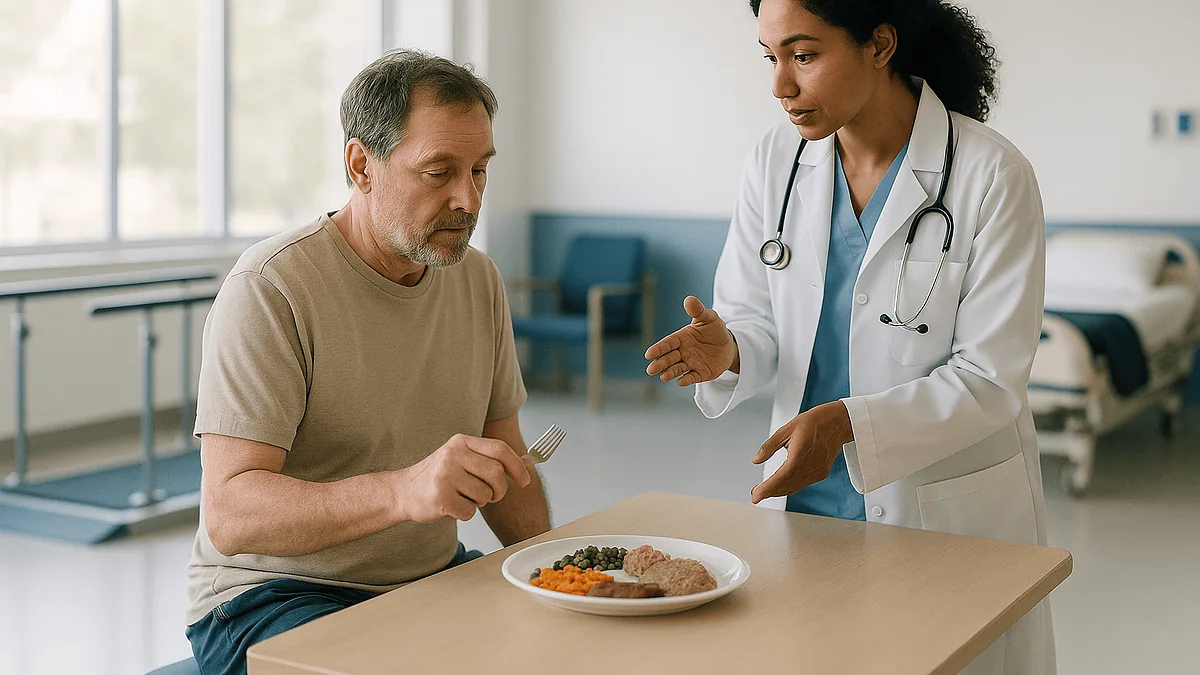
A brain injury rehabilitation program is a coordinated course of therapy that helps a person relearn movement, thinking, communication and everyday skills after a traumatic or non-traumatic brain injury. It usually combines physical therapy, occupational therapy, speech-language therapy, neuropsychology and rehabilitation medicine, delivered as an inpatient, outpatient or home-based plan. Goals, intensity and length are set by the treating team and adjusted as recovery unfolds.
The whiteboard in the hospital room has a new column. Next to the vital signs someone has written “PT 10:00, OT 11:30, SLP 2:00,” and the family is quietly looking it up on their phones. Three days ago the only question was whether he would wake up. Now the questions are smaller and, in a way, harder: Will he walk without the belt around his waist? Why does he lose the thread of a sentence halfway through? Who teaches you to make a cup of coffee again?
Those questions are exactly what a brain injury rehabilitation program is built to answer, one skill at a time. The program is not a single treatment. It is a team, a schedule and a set of measurable goals that shift as the brain recovers.
This explainer walks through what the program actually covers, who is referred and when, what the first weeks tend to look like, and which beliefs about recovery the evidence supports and which it does not.
How a brain injury rehabilitation program actually works
Rehabilitation rests on one biological fact: the brain can reorganize. Neuroplasticity, the brain’s ability to form new connections and re-route tasks around damaged tissue, is the mechanism every therapist in the program is trying to drive. Repetition, challenge and feedback are the levers. According to the National Institute of Neurological Disorders and Stroke, rehabilitation after traumatic brain injury (TBI) is individualized and typically involves several disciplines working from a shared plan.
The core team usually includes a physiatrist (a physician specializing in rehabilitation medicine), a physical therapist for movement and balance, an occupational therapist for daily tasks, a speech-language pathologist for communication and swallowing, a neuropsychologist for thinking and mood, rehabilitation nurses and a social worker or case manager. Larger programs add recreation therapists, dietitians and vocational counselors.
The work starts with assessment. Each therapist measures a baseline: how far the person walks in six minutes, whether they can recall three words after a delay, how safely they swallow thin liquids. From those numbers come goals written in plain terms, such as “transfer from bed to wheelchair with one person helping” or “follow a two-step instruction in a quiet room.” Goals are reviewed in a weekly team meeting, and the family is usually invited.
A typical day in an inpatient setting is built around therapy blocks, rest periods and practice woven into ordinary routines: brushing teeth becomes an occupational therapy session, walking to the dining room becomes gait training. Mayo Clinic describes rehabilitation as starting in hospital and continuing through inpatient units, outpatient clinics or home programs depending on the person’s needs. The setting changes; the principle of guided, repeated practice does not.
Who is usually referred to brain injury rehab, and who is asked to wait
Referral depends on severity, medical stability and what the person can tolerate. Clinicians often describe injury severity using the Glasgow Coma Scale, a 3-to-15 score of eye, verbal and motor responses; Johns Hopkins Medicine notes that scores of 13 to 15 are classed as mild, 9 to 12 as moderate and 8 or below as severe. People with moderate or severe injuries are the most common candidates for structured inpatient rehabilitation once they no longer need intensive care.
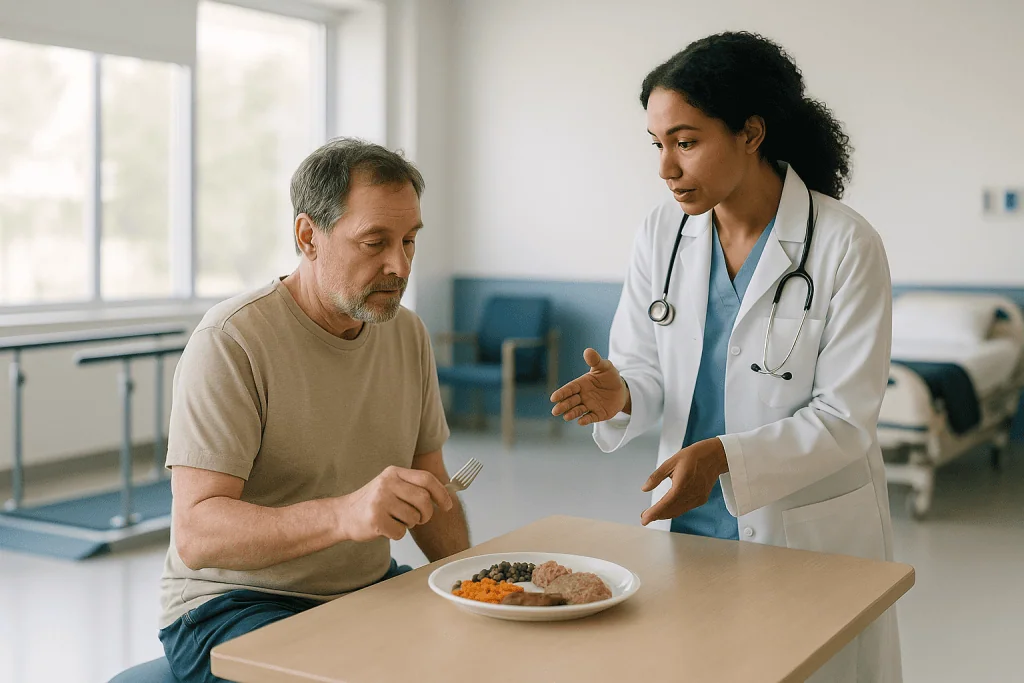
Formal programs are also offered after non-traumatic brain injuries, including stroke, lack of oxygen after cardiac arrest, infections such as encephalitis and some brain tumors. The injury’s cause matters less to the therapists than the pattern of problems it leaves behind.
Some people are asked to wait. A person who is still in a coma or minimally conscious may receive positioning, stretching and stimulation on the acute ward but is generally not enrolled in an intensive program until they can participate. Someone with unstable blood pressure, uncontrolled seizures, an open surgical wound or a pending neurosurgical procedure is usually stabilized first. Others are simply not ready to tolerate three hours of therapy a day and begin with a lower-intensity setting.
People with mild TBI or concussion sit at the other end. Mayo Clinic notes that most recover with rest and a gradual return to activity, so they may be referred only for specific problems such as persistent dizziness, headaches or concentration difficulties, often in an outpatient concussion clinic rather than a full program.
None of these thresholds is fixed. The rehabilitation physician weighs medical safety, expected benefit and the person’s own goals, and the decision rests with that treating team.
Inpatient brain injury rehab vs outpatient vs home-based programs
The same disciplines appear in every setting; what changes is intensity, supervision and the degree to which practice happens in real life. Many people move through more than one level.
| Setting | Who it usually suits | Typical intensity | Main advantage | Main limitation |
|---|---|---|---|---|
| Acute inpatient rehabilitation | Moderate to severe injury; needs daily physician and nursing care | Multiple therapy sessions most days | Medical safety plus intensive, coordinated therapy | Hospital environment differs from home |
| Post-acute or residential program | Medically stable but needs supervision for safety or behavior | Daily structured therapy in a community-style setting | Practices real routines, such as cooking and shopping | Fewer programs available; longer stay away from family |
| Outpatient day program | Lives at home safely; can travel to clinic | Several sessions per week | Skills tested immediately in daily life | Depends on transport and family support |
| Home and community-based | Later recovery; mild injury; mobility limits travel | Weekly or less, with home exercise between visits | Therapy in the actual environment where problems occur | Lower intensity; relies on self-direction |
The NHS describes this stepped pattern for severe head injury, with hospital-based therapy followed by community rehabilitation and support after discharge. Moving down a level is not a sign of failure; it usually means the person has become safe enough to practice in a less protected place.
A practical point families raise often: inpatient brain injury rehab is not the same as a nursing facility. Rehabilitation units admit people specifically because they are expected to make measurable gains and can engage in therapy, and they discharge when that expectation changes or goals are met.
Movement: what physical therapy covers after a brain injury
Brain injury affects movement in ways that look different from an orthopedic injury. A person may have normal muscle strength yet be unable to sit upright because the brain no longer coordinates the trunk. Others develop spasticity, an involuntary tightening of muscles caused by damaged signaling between brain and spinal cord, or ataxia, a loss of smooth coordination. Balance, walking pattern and endurance are often affected together.
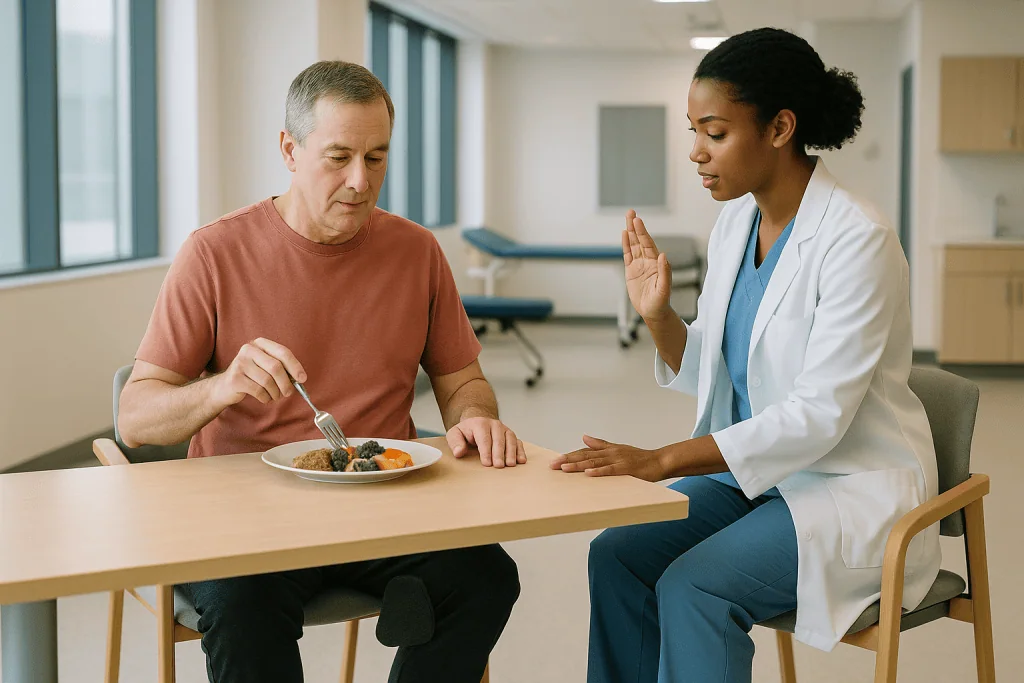
Physical therapists begin with the basics of posture and transfers: rolling in bed, sitting at the edge, standing with support. Gait training follows, often in parallel bars, then with a walker or cane, then on uneven ground and stairs. Treadmill training with body-weight support and task-specific practice, repeating the actual movement the person needs rather than isolated strengthening, are standard approaches.
Spasticity management is shared work. Therapists use stretching, positioning and splinting. When tightness limits function or causes pain, the physician may discuss medicine classes that relax muscle or targeted injections that temporarily weaken an overactive muscle. Whether any of these is appropriate, and how they are used, is a decision for the prescribing clinician, and therapy continues regardless.
Dizziness and visual disturbance are common after even mild TBI. Vestibular rehabilitation, exercises that retrain the balance system in the inner ear and brain, is used when clinicians identify a vestibular cause.
Falls are the risk that shapes everything. A person with impaired judgment may not remember they cannot walk unaided, which is why gait belts, bed alarms and supervised practice are common early on. As balance and insight improve, restrictions loosen in step. Progress is measured in concrete units: seconds standing on one leg, meters walked, steps managed. Those numbers, not impressions, guide the next goal.
Thinking: cognitive rehabilitation after brain injury
Cognition is often the slowest part of recovery and the hardest for outsiders to see. A person can walk out of the unit looking well while still unable to hold a grocery list in mind or track a conversation with two people. Cognitive rehabilitation after brain injury targets these invisible deficits directly.
Neuropsychological assessment maps the pattern first. Attention, processing speed, memory, language, visual-spatial skills and executive function (the planning, organizing and self-monitoring abilities that sit mostly in the frontal lobes) are each tested. Frontal lobe injury is common in TBI because of how the brain moves inside the skull, so planning and impulse control are frequently affected.
Therapy then works along two tracks. Restorative exercises try to rebuild the skill itself through graded, repeated drills, for example attention tasks that grow steadily more complex. Compensatory strategies accept the deficit and work around it: memory notebooks, phone alarms, checklists on the refrigerator, a fixed place for keys, breaking tasks into written steps. Most programs combine both.
Metacognitive training teaches people to notice their own errors. Someone who consistently misjudges how long a task will take is guided to predict, time and compare. Over weeks, the gap narrows.
Awareness itself can be impaired. Lack of insight after brain injury is a neurological symptom, not stubbornness, and therapists build feedback carefully rather than confronting. Family members are often coached to prompt with cues instead of correcting.
Fatigue limits everything here. Cognitive work is metabolically demanding for an injured brain, and sessions are typically short with rests between them. The NHS notes that tiredness and problems with memory and concentration are common after head injury and often improve over time, which is why programs pace cognitive load rather than pushing through it.
Speech, language and swallowing therapy
Speech-language pathologists cover three separate problems that are easy to confuse. Aphasia is difficulty understanding or producing language, caused by injury to language networks, usually in the left hemisphere. Dysarthria is slurred or weak speech caused by impaired control of the muscles of the mouth and throat; the language is intact but the delivery is not. Cognitive-communication disorder is the most common pattern after TBI: words and articulation may be fine, but the person interrupts, wanders off topic, misses sarcasm or cannot follow a fast conversation because attention and executive skills are impaired.
Treatment matches the diagnosis. Aphasia therapy uses word-retrieval drills, picture naming, script practice and increasingly, training of conversation partners so that communication succeeds even when words fail. Dysarthria work targets breath support, articulation precision and speaking rate. Cognitive-communication therapy rehearses real situations, such as ordering in a café or joining a group discussion, with structured feedback.
When speech is severely limited, augmentative and alternative communication, ranging from a laminated alphabet board to a speech-generating tablet, is introduced early. Evidence from stroke and TBI rehabilitation does not show that using a device delays natural speech recovery; it reduces frustration and keeps the person engaged.
Swallowing is the safety-critical piece. Dysphagia, difficulty swallowing, can send food or liquid into the airway and lead to pneumonia. The speech-language pathologist assesses swallowing at the bedside and may request an instrumental study such as a video X-ray swallow test. Based on results, food textures and liquid thickness are adjusted and swallowing exercises are prescribed. Diet levels are upgraded as safety improves, and the person, family and nursing staff are all taught the current rules so that a well-meant sip of water does not become a setback.
Daily skills, mood and fatigue: occupational therapy and psychology
Occupational therapy has an unfortunate name; it is not primarily about jobs. Occupational therapists work on the activities that occupy a day: dressing, bathing, cooking, managing medicines, handling money, using a phone, driving. They break each task into steps, identify where it breaks down, and either retrain the step or redesign the task.
Early sessions often look like ordinary life at a slower pace. Buttoning a shirt with one weak hand. Sequencing the steps to make toast without leaving the stove on. Practicing a shower transfer with a bench. Adaptive equipment, from long-handled sponges to weighted utensils, fills gaps that will not close quickly.
Later, the same therapists address higher-level tasks: planning a week’s meals, navigating public transport, sitting through a simulated workday. Return to driving is assessed formally, often with an on-road evaluation, because reaction time, visual attention and judgment are all involved, and clinicians rather than family decide when it is safe.
Emotional and behavioral change runs alongside. Irritability, impulsivity, low mood, anxiety and flattened motivation are common after TBI and, according to the National Institute of Neurological Disorders and Stroke, can be direct consequences of the injury as well as reactions to loss. Rehabilitation psychologists and neuropsychologists provide counseling, behavior plans and family education. When mood symptoms are severe or persistent, the treating physician may consider medicine classes used for depression or anxiety; that decision and its timing belong to the prescriber.
Fatigue deserves its own plan. Programs teach energy budgeting: scheduling demanding tasks for the best part of the day, building in rests before exhaustion rather than after, and protecting sleep, because poor sleep worsens every other symptom.
What the first weeks of TBI rehabilitation therapy usually look like
The transfer from an acute ward to a rehabilitation unit is often the moment recovery starts to feel real to families. The pace changes immediately. Instead of waiting for tests, the person is dressed in day clothes, up in a chair for meals and scheduled into therapy.
Week one is assessment-heavy. Each discipline completes baseline measures, the physician reviews medicines that might cloud thinking or lower seizure threshold, and swallowing and bladder function are checked. A team conference sets initial goals and an estimated length of stay, always framed as an estimate.
Weeks two and three are where visible gains often cluster. Post-traumatic amnesia, the period after injury when a person cannot lay down continuous new memories, frequently resolves in this window for moderate injuries, and its duration is itself used by clinicians as a marker of severity. Standing tolerance lengthens. Words come more reliably. Families are taught how to help with transfers and how to cue rather than correct.
Fatigue and frustration tend to peak around the same time, as insight returns and the person realizes what has changed. Therapists expect this and adjust.
The final week before discharge shifts toward practice in real conditions: a home visit by the occupational therapist to check doorways and bathrooms, a supervised outing, a trial of cooking a meal. Community therapy referrals, follow-up appointments and a written plan for medicines, precautions and exercises are arranged. The NHS describes this handover from hospital to community services as a standard part of recovery after severe head injury.
None of this runs on a fixed calendar. The sequence is typical; the speed belongs to the individual brain.
How long is brain injury rehab? What the evidence actually shows
Honest answer: it depends on severity, age, other health conditions and how the person responds, and any single number would be a guess dressed up as a fact. What the evidence does support is a general shape.
Mayo Clinic notes that most people with mild TBI recover within days to weeks, though some have symptoms that persist for months. For moderate and severe injury, the NHS describes recovery as taking place over months or years, with the fastest improvement generally in the early period and slower gains later. The National Institute of Neurological Disorders and Stroke similarly describes rehabilitation as an ongoing process that may continue for a long time after discharge.
Inpatient stays tend to be measured in weeks; outpatient and community programs in months. Formal therapy often winds down not because the brain has stopped changing but because gains have become too small to justify weekly sessions, at which point a home program takes over. Many people return for booster blocks of therapy when a new goal appears, such as returning to work or driving.
Several factors are consistently linked to longer rehabilitation in the medical literature: longer coma or post-traumatic amnesia, older age, injuries affecting multiple brain regions, and additional problems such as seizures, hydrocephalus (a build-up of fluid inside the brain) or serious injuries elsewhere in the body.
Families sometimes ask for a percentage, a curve or a date. A careful team will decline and offer instead a set of near-term goals with a review date. That is not evasion. Prognosis after brain injury is genuinely uncertain in the early months, and the measured, revisable goal is the most honest tool clinicians have.
Can you recover from a traumatic brain injury?
Recovery is real, common and rarely all-or-nothing. Most people with mild TBI return to their previous level of function, according to Mayo Clinic. After moderate and severe injury, the picture is broader: many regain independence in walking and self-care, some return to their previous work, and others live with lasting changes in memory, energy or personality while still rebuilding a satisfying life. The word clinicians use is recovery, not restoration, because the brain reorganizes rather than rewinds.
Three ideas from the evidence are worth holding onto. First, early improvement is usually fastest, but the NHS and the National Institute of Neurological Disorders and Stroke both describe gains continuing well beyond the first months, particularly in cognition and emotional adjustment. Second, the brain that recovers is the brain that is used: skills practiced in rehabilitation consolidate, while skills left idle fade. Third, secondary problems such as depression, sleep disorders, untreated pain and social isolation can mask true recovery, and treating them can produce improvement that looks like a late neurological gain.
Long-term follow-up matters. Some people develop post-traumatic epilepsy months after injury, and others experience changes in hormones controlled by the pituitary gland, which sits directly beneath the brain and is vulnerable to injury. Persistent fatigue, low mood or weight change after TBI should prompt a conversation with the treating physician rather than be accepted as inevitable.
Repeated injury changes the calculus. The CDC notes that a second brain injury before the first has healed can be more dangerous, which is why return to sport, ladders and other fall risks is a medical decision.
What no clinician can honestly offer is a guaranteed outcome. What they can offer is a plan that adapts, measures and keeps the door open.
Does stress make TBI worse?
Stress does not re-injure brain tissue, but it does make the symptoms of brain injury harder to live with and, in some cases, slower to settle. The distinction matters because it separates a real, manageable problem from a source of guilt.
Mechanically, an injured brain has less reserve. Attention, working memory and emotional regulation all draw on the same frontal networks that TBI commonly damages, and psychological stress further taxes those systems. A person who could follow a recipe in a calm kitchen may be unable to when the phone is ringing and a child is asking a question. Stress also disrupts sleep, and sleep is when the brain does much of the consolidation that therapy relies on. Poor sleep worsens headache, irritability and concentration, which in turn raise stress, a loop clinicians see often.
Emotional health after TBI is a recognized clinical concern rather than a soft add-on. The National Institute of Neurological Disorders and Stroke lists depression, anxiety and mood swings among the consequences of brain injury, and rehabilitation programs screen for them routinely. Post-traumatic stress symptoms are also more common when the injury occurred in a violent or frightening event, and these are treatable.
What helps, in practical terms, is what the program already teaches: predictable routines, one task at a time, environments with less noise and clutter, rest breaks planned before exhaustion, and honest conversation about frustration. Psychological therapies such as cognitive behavioral therapy have evidence for depression and anxiety after brain injury, and neuropsychologists adapt them for memory and attention limits.
Families carry stress too. Caregiver strain is well documented after TBI, and programs that include family education and respite planning are addressing a medical need, not offering a courtesy.
Good activities to do with someone who has a brain injury
The best activities are the ones that recruit the skills therapy is working on, at a level the person can succeed at most of the time. Success rate matters more than difficulty; a task that fails repeatedly teaches frustration, not skill. Asking the therapists which abilities are the current focus turns visiting time into useful practice.
Conversation itself is therapy for cognitive-communication problems. Sitting face to face, one speaker at a time, television off, gives the person a fair chance to follow and respond. Looking through family photos and naming people and places exercises memory and word retrieval at the same time, and it is pleasant, which keeps attention engaged.
Simple games do real work. Card matching and dominoes train attention and visual scanning. Board games with turn-taking practice impulse control and sequencing. Puzzles with large pieces suit hands that are still regaining coordination. Reading a short newspaper article together and summarizing it in two sentences rehearses comprehension and working memory.
Movement can be shared under the guidance the therapists have given: a supervised walk in a corridor, standing to water a plant, tossing a soft ball while seated. Follow the therapy team’s rules on supervision and equipment exactly, because judgment about safety is often one of the impaired skills.
Ordinary tasks with a helper are ideal in later recovery: folding laundry, sorting cutlery, making a shopping list, preparing a simple meal with someone watching the stove. These are the activities occupational therapists are rebuilding, and home practice reinforces them.
Pacing is the rule that governs all of the above. Short sessions, then rest. Stop before fatigue, not after. Quiet music is fine; a crowded party is often too much. Keeping visits predictable and leaving when energy dips is itself a form of care.
What people often get wrong about brain injury rehabilitation
“Recovery stops after a year.” Improvement is fastest early, but the NHS and NIH both describe gains continuing over years, especially in thinking, mood and social skills. The slope flattens; it does not usually hit zero.
“If she can walk, she is fine.” Walking is visible; attention, memory and judgment are not. Cognitive and behavioral changes are the most common reasons people struggle at work and in relationships after TBI, even when physical recovery looks complete.
“Pushing harder means recovering faster.” An injured brain fatigues quickly, and therapy works best in paced, repeated doses with rest. Exhaustion degrades learning and raises the risk of falls and frustration.
“He is being lazy or difficult.” Reduced initiative, irritability and lack of insight are neurological symptoms of frontal lobe injury, described by the National Institute of Neurological Disorders and Stroke as consequences of TBI. They respond to structure and cueing, not to blame.
“A concussion is not a real brain injury.” The CDC classifies concussion as a mild traumatic brain injury. Most people recover fully, but a second injury before healing can be more serious, and persistent symptoms deserve assessment.
“Communication devices will stop him from talking.” Evidence from aphasia rehabilitation does not support this. Devices reduce isolation and frustration, and speech therapy continues alongside them.
“Supplements or brain-training apps can replace therapy.” No dietary supplement has been shown in high-quality trials to speed recovery from brain injury, and commercial cognitive games have not been demonstrated to transfer to daily functioning the way task-specific therapy does. Anything taken alongside prescribed medicines should be discussed with the treating physician.
“Rehab is only for severe injuries.” Persistent dizziness, headache or concentration problems after a mild injury are legitimate reasons for a targeted outpatient program.
Questions to ask your care team about a brain injury rehabilitation program
Team conferences move quickly and use unfamiliar vocabulary. Arriving with written questions, and asking for a plain-language answer when a term is new, is standard practice and welcomed by most teams. These are the questions that tend to matter most.
- What specific problems has the assessment found in movement, thinking, communication and daily skills, and which ones are the current priority?
- What are the goals for the next two weeks, and how will we know if they have been met?
- What setting is being recommended, inpatient, day program or home-based, and what would change that recommendation?
- Roughly how long is the current stay expected to last, understanding that this is an estimate and will be reviewed?
- Which medicines are being used, what is each one for, and are any of them likely to affect alertness or thinking?
- Is there a risk of seizures, and what precautions apply at home?
- What can family do during visits that supports therapy, and what should we avoid?
- What is safe right now in terms of walking alone, showering, cooking, using stairs, and what are the current swallowing rules?
- When will driving, work or school be assessed, and who makes that decision?
- What symptoms after discharge should prompt a call, and who exactly do we call?
- What community therapy, support groups or caregiver resources are available after discharge?
- Who is the single point of contact if we have a question between appointments?
Write the answers down or ask permission to record them; family members are often absorbing information under stress. If the person with the injury can take part, they should be asked their own goals first. Rehabilitation works best when the plan belongs to the patient rather than being applied to them.
When to call your doctor
Rehabilitation is a period of expected change, which makes it harder to know which changes are warning signs. Two kinds of problem need attention: sudden neurological deterioration, which can signal bleeding, swelling or a seizure, and slower changes that suggest a complication or a treatable secondary problem.
Call emergency services immediately if the person has a seizure for the first time or a seizure lasting longer than a few minutes, becomes suddenly drowsy or difficult to wake, develops a severe or rapidly worsening headache, vomits repeatedly, shows new weakness or numbness on one side, has new slurred speech or confusion out of keeping with their recent baseline, has one pupil larger than the other, or has clear fluid or blood leaking from the nose or ears. Mayo Clinic and the CDC list these among the danger signs after head injury.
Contact the treating team the same day for fever, a cough or breathlessness after eating or drinking (possible aspiration), a new inability to pass urine or sudden incontinence, increasing headache or leg swelling in a person who is not yet mobile (a possible blood clot), a marked rise in agitation or a fall.
Book a review for gradual worsening of balance, memory or bladder control weeks or months after injury, which can indicate hydrocephalus; for persistent low mood, hopelessness or any thoughts of self-harm, which need urgent psychological support; for unrelenting fatigue, weight change or loss of libido, which may reflect pituitary hormone disturbance; and for any new symptom that does not fit the recovery pattern the team described.
When unsure, call. Rehabilitation teams would rather answer a question that turns out to be nothing than miss a change that mattered, and the judgment about what to do next is theirs to make.
Frequently asked questions
What kind of rehab is used for a brain injury?
Brain injury rehabilitation combines physical therapy for movement and balance, occupational therapy for daily tasks, speech-language therapy for communication and swallowing, and neuropsychology for thinking and mood, coordinated by a rehabilitation physician. It is delivered as inpatient, outpatient or home-based care depending on severity and safety. The mix and intensity are set by the treating team and adjusted as the person improves.
Can you recover from a traumatic brain injury?
Many people do recover substantially, and most with mild TBI return to their previous level of function. After moderate or severe injury, recovery varies widely: some regain full independence while others live with lasting changes in memory, energy or personality. Improvement is fastest early but can continue for years. No clinician can promise a specific outcome, which is why rehabilitation works with revisable goals.
What is inpatient brain injury rehab like day to day?
Days are structured around several therapy sessions, often physical, occupational and speech therapy, with rest periods and nursing care in between. Everyday routines such as dressing and eating are used as practice. Progress is measured against written goals reviewed weekly by the team, and families are usually invited to meetings and taught how to help safely.
How long is brain injury rehab?
There is no fixed length. Mild injuries often need only days to weeks of targeted therapy, while the NHS describes recovery from severe head injury as taking months or years. Inpatient stays are typically measured in weeks and community programs in months, with home exercise continuing afterward. The team gives an estimate and revises it as recovery unfolds.
What does cognitive rehabilitation after brain injury involve?
It starts with neuropsychological testing of attention, memory, processing speed and executive function, then combines restorative drills that rebuild skills with compensatory strategies such as memory notebooks, alarms and checklists. Sessions are kept short because cognitive effort fatigues an injured brain quickly. Family members are often taught to cue rather than correct.
Does stress make TBI worse?
Stress does not damage brain tissue further, but it worsens symptoms such as poor concentration, irritability and headache, and it disrupts the sleep that recovery relies on. Depression and anxiety are recognized consequences of TBI and are screened for in rehabilitation. Predictable routines, quiet environments, planned rests and psychological support all help, and persistent low mood should be raised with the treating team.
What are good activities to do with someone who has a brain injury?
Choose activities that use the skills therapy is currently targeting and that the person can succeed at most of the time: one-to-one conversation with the television off, looking through photos and naming people, card matching, simple board games, short reading and summarizing, or supervised household tasks. Keep sessions brief, stop before fatigue, and follow the therapists’ safety rules on movement exactly.
What is TBI rehabilitation therapy for speech?
Speech-language pathologists treat three distinct problems: aphasia (difficulty with language), dysarthria (slurred speech from weak muscle control) and cognitive-communication disorder (trouble staying on topic or following conversation). They also assess and manage swallowing safety, adjusting food textures and prescribing exercises. Communication boards or devices may be introduced early without delaying natural speech recovery.
Who is not ready for a brain injury rehabilitation program?
People who are still in a coma or minimally conscious, medically unstable, having uncontrolled seizures or awaiting neurosurgery are usually stabilized first and receive positioning and stretching on the acute ward. Others begin in a lower-intensity setting until they can tolerate more therapy. Readiness is judged by the rehabilitation physician and revisited regularly.
Are medicines part of brain injury rehabilitation?
Sometimes. Physicians may consider medicine classes for spasticity, seizures, sleep, mood or attention, and they also review existing medicines that could cloud thinking. Whether any medicine is used, and when, is a decision for the prescribing clinician based on the individual’s situation. Therapy continues regardless, and no supplement has been shown to speed brain recovery in high-quality trials.
References
- Traumatic Brain Injury (TBI): National Institute of Neurological Disorders and Stroke
- Severe head injury: Recovery: NHS
- About Traumatic Brain Injury and Concussion: CDC
- Traumatic Brain Injury: MedlinePlus
This article is for general information only and is not a substitute for professional medical advice. Please consult a qualified doctor about your individual situation.

More from the Blog
Physical Therapy Myths: No Pain No Gain, Machines Do the Work and Other Misconceptions
Physical therapy myths often come from a kernel of truth stretched too far. Some effort and mild, short-lived soreness can be part of rehabilitation,…

Magnifiers, Lighting and Electronic Aids: How Vision Rehabilitation Training Works
Low vision aids training is a rehabilitation program that teaches people with permanent, uncorrectable vision loss to use magnifiers, task lighting, contrast changes and…

Daily Residual Limb Care During Amputee Rehabilitation: Skin Checks, Compression and Liners
Residual limb care during amputee rehabilitation means checking the skin of the remaining limb at least twice a day (a mirror helps for the…

Sore After Therapeutic Exercise? Normal Muscle Ache vs Pain That Means the Plan Needs Changing
Mild, symmetrical muscle ache that starts 12 to 24 hours after a rehab session, peaks within about three days and eases with gentle movement…
Amputee Rehabilitation Stages: Wound Healing, Limb Shaping, Prosthetic Fitting and Walking
Amputee rehabilitation usually moves through overlapping stages: wound healing in the first weeks, shaping the residual limb with compression, a prosthetic fitting once the…

Manual Therapy and Prehab: The Hands-On Side of Physiotherapy
Manual therapy is a set of hands-on techniques, joint mobilization, manipulation, and soft-tissue work, that physical therapists use to ease pain and improve movement,…