

What an Ovarian Cancer Tumor Board Considers Before Recommending Surgery Timing

Key Takeaways
- A tumor board advises the treating team; the patient and her clinicians make the final decision on when surgery happens, and that decision is reviewed at each stage.
- The strongest predictor of outcome after debulking is whether all visible disease is removed, whichever sequence of surgery and chemotherapy is used.
- In a randomized trial of 670 women with stage IIIC or IV disease, chemotherapy before surgery was non-inferior for survival and carried lower rates of serious bleeding, infection and postoperative death.
- Where the cancer sits, such as the root of the small-bowel mesentery or inside the liver or lungs, matters more to resectability than how large the tumor is.
- A diagnostic laparoscopy before major surgery can spare a patient an extensive operation that would leave disease behind, at the cost of a short delay.
- Low-grade serous, mucinous and borderline tumors respond less reliably to chemotherapy, so boards usually favor surgery first for these subtypes regardless of extent.
An ovarian cancer tumor board weighs where the cancer sits on imaging, whether all visible disease can realistically be removed, the patient's fitness for a long operation, the stage and subtype confirmed by biopsy, and trial evidence showing that chemotherapy before surgery is a reasonable alternative in advanced disease. The board recommends; the final timing decision rests with the patient and treating team.
The folder on the kitchen table has grown thick in three weeks: a CT report, a blood test showing a raised CA-125, a biopsy result with a long name on it. Then the phone call. “Your case is going to the ovarian cancer tumor board later this week.” For many women and the people who love them, that sentence lands as both reassurance and bewilderment. Who are these people, and why does a room full of strangers get a say in when the operation happens?
The honest answer is that the timing of surgery is the single most debated decision in advanced ovarian cancer, and it is debated precisely because the evidence does not hand anyone an easy rule. Operate first and you may remove every visible deposit in one go, or you may put a frail body through a six-hour operation that leaves disease behind. Give chemotherapy first and the operation may become smaller and safer, at the cost of waiting.
This explainer walks through what the board actually looks at, what the trials really showed, and what the following weeks tend to look like on either path.
What is an ovarian cancer tumor board, and who sits around the table?
A tumor board, also called a multidisciplinary team meeting, is a scheduled conference in which specialists from different fields review one patient’s case together before treatment is recommended. The word “board” makes it sound like a tribunal. In practice it is closer to a working group, usually meeting weekly, often with a large screen showing scans at one end of the room and a nurse specialist taking notes at the other.
For ovarian cancer the core members are fairly consistent across guideline-based systems. A gynecologic oncologist (a surgeon trained specifically in cancers of the female reproductive organs) presents the surgical view. A medical oncologist speaks to chemotherapy and targeted treatment. A radiologist walks the room through the imaging, pointing at the exact deposits that will matter later. A pathologist describes what the biopsy cells looked like under the microscope and what subtype they fit. A clinical nurse specialist, who has often met the patient already, brings the human context: symptoms, home situation, what the patient has said she wants. Depending on the center, a geneticist or genetic counselor, a palliative care physician, and a radiation oncologist may also attend.
The patient is not in the room. That surprises many people and can feel exclusionary, but it is deliberate: the meeting is meant to be a frank technical discussion, after which the recommendation is brought back to the patient as a proposal, not an order. The NHS describes this team structure as standard for ovarian cancer care, and the same model is used across Europe and North America.
One point is worth stating plainly: a tumor board recommendation is advice to the treating clinician and patient. It can be accepted, questioned, or revisited when new information arrives, such as a laparoscopy finding or a change in the patient’s health.
Why surgery timing is the central question in advanced ovarian cancer
Most cancers are staged, then treated in a fairly fixed order. Ovarian cancer is different because of two biological facts that pull in opposite directions.

First, high-grade serous ovarian cancer, the most common type, tends to spread across the lining of the abdomen in sheets and nodules rather than as a single mass. By the time it causes bloating, fullness or a change in bowel habit, it has often reached the omentum (a fatty apron that hangs over the intestines), the surfaces of the bowel, the diaphragm, or produced fluid in the abdomen called ascites. Removing it surgically means a long operation that may involve the uterus, ovaries, omentum, lymph nodes, and sometimes sections of bowel or the lining of the diaphragm. Surgeons call this debulking or cytoreduction: an operation whose goal is to remove every deposit of cancer that can be seen.
Second, this same cancer is usually sensitive to platinum-based chemotherapy, at least initially. The National Cancer Institute’s treatment summary describes platinum combination chemotherapy as the standard systemic treatment, and tumors frequently shrink markedly within the first few cycles.
Put those facts together and the dilemma appears. The strongest predictor of how a patient does after debulking is how much cancer is left behind; the ideal is none visible. If the surgeon believes that can be achieved safely now, operating first keeps the whole process shorter and gives the pathologist untreated tissue to examine. If the deposits are in places that cannot be cleared, or the patient is too unwell for a major operation, giving chemotherapy first may shrink the disease so that a later, smaller operation can achieve the same goal with fewer complications. Timing is not a scheduling detail; it is the treatment strategy.
What the board has in front of it before anyone speaks
A tumor board discussion is only as good as the information on the screen, so the days before the meeting are busy ones for the patient. Three pieces of evidence are almost always required, and a fourth is increasingly routine.
The imaging is usually a CT scan of the chest, abdomen and pelvis with contrast. It shows the size of the ovarian masses, fluid in the abdomen or around the lungs, deposits on the omentum and bowel surfaces, enlarged lymph nodes, and whether the liver, spleen or lungs contain disease inside the organ rather than on its surface. MRI or PET-CT is added in some cases when the picture is unclear.
The blood test most people have heard of is CA-125, a protein that is often raised in ovarian cancer but also in endometriosis, pelvic infection, fibroids, pregnancy and even menstruation, which is why the Mayo Clinic cautions that it cannot diagnose cancer on its own. The board uses it as one data point, alongside kidney and liver function, blood counts, and albumin, a blood protein that falls with poor nutrition and inflammation and serves as a rough gauge of how well a body will tolerate surgery.
The biopsy is the third essential. Tissue may come from a needle sample of an omental deposit, from ascitic fluid, or from a diagnostic laparoscopy. Without it the board cannot be sure the disease is ovarian in origin, since cancers of the bowel, stomach or pancreas can look similar on CT and are treated quite differently.
The fourth element is the patient herself: her performance status (a simple scale describing how much daily activity she can manage), other illnesses, medicines, weight trend, and what she has said about her own priorities. The nurse specialist usually carries this part into the room.
How the board reads the scan: where the cancer is matters more than how much
Watching a radiologist present to a tumor board is instructive. They rarely start by saying how large the tumor is. They start with locations, because resectability, the surgeon’s judgment about whether all visible disease can be removed, depends on geography more than volume.
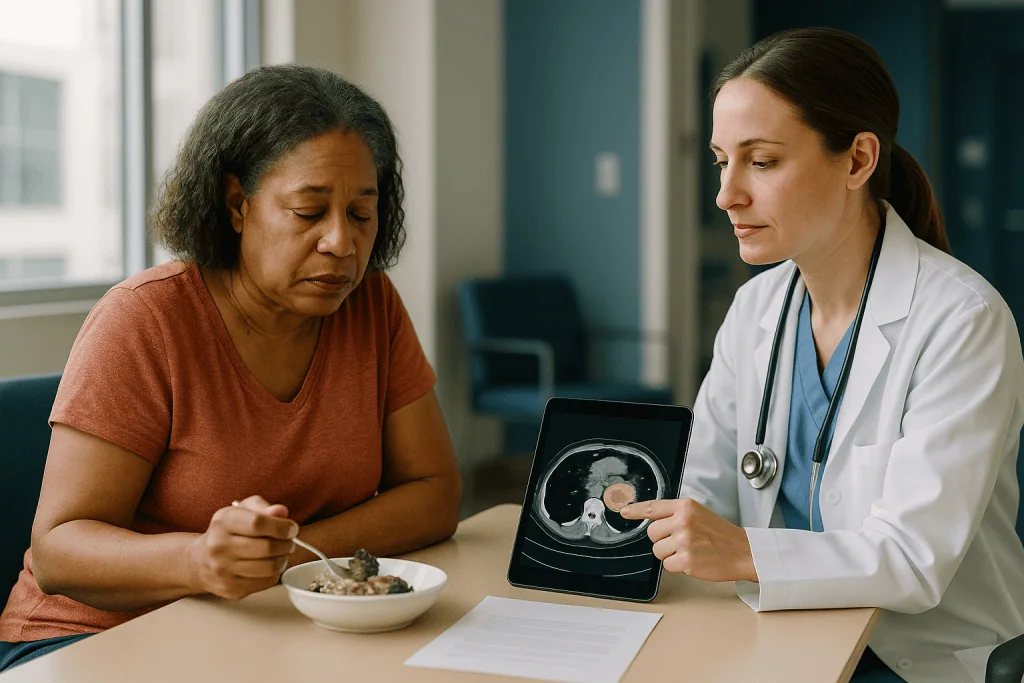
Some sites are hard to clear completely. Cancer coating the root of the small-bowel mesentery, the fan of tissue that carries blood vessels to the intestine, cannot be stripped away without threatening the bowel’s blood supply. Deposits at the porta hepatis, where the bile duct and major vessels enter the liver, sit among structures that cannot be sacrificed. Widespread tiny nodules dusted across many loops of bowel may each be small, yet collectively impossible to remove without taking out more intestine than a person can live comfortably without. Disease inside the lung or liver tissue, as opposed to on the surface, shifts the stage to IV and often shifts the recommendation toward chemotherapy first.
Other findings look alarming but are routinely handled: a large omental cake, fluid in the abdomen, deposits on the diaphragm surface, or a bulky pelvic mass fixed to the rectum. Experienced gynecologic oncologists remove these regularly, which is one reason the same scan can produce different recommendations at different centers.
Radiologists also look for things that change the operation itself: enlarged lymph nodes above the renal vessels, which lengthen surgery; blockage of the bowel or ureter, which may need urgent attention regardless of the overall plan; and blood clots in pelvic veins, which are common in ovarian cancer and must be managed before anesthesia. The scan is read, in other words, as a map of what surgery would involve, not simply as a measure of how advanced the disease is.
The role of diagnostic laparoscopy: a look before the big operation
Even the best CT scan underestimates small deposits on the bowel and mesentery. For that reason, many ovarian cancer tumor boards recommend a diagnostic laparoscopy before committing to primary debulking. A laparoscopy is a short operation under general anesthesia in which a thin camera is passed through one or two small cuts near the navel so the surgeon can inspect the abdominal cavity directly.
What the surgeon is looking for is specific. Is the mesentery retracted and studded with tumor? Are there deposits on the stomach or the small bowel that the scan missed? Is the liver surface or diaphragm involved more deeply than expected? Some centers use a formal scoring system that tallies these findings into a prediction of whether complete cytoreduction is likely. Tissue for diagnosis and for genetic testing is usually taken at the same time, so the laparoscopy serves two purposes in one anesthetic.
The appeal of this step is that it protects patients from an unproductive major operation. If the laparoscopy shows disease that cannot be cleared, the plan can pivot to chemotherapy first without the patient having endured a long laparotomy, a large open incision, and weeks of recovery for little gain. If the laparoscopy shows disease that can be cleared, surgery may proceed in the same session at some centers, or be scheduled shortly afterwards.
The trade-offs are real too. Laparoscopy adds an anesthetic and a small risk of injury to bowel or blood vessels, and it may delay the start of treatment by a week or two. Not every patient needs it; when the CT is clearly favorable or clearly unfavorable, the board may skip it. Whether to include this step is one of the choices a board weighs explicitly.
Who is usually offered surgery first, and who is usually asked to wait
Guideline-level practice, as summarized by the NCI and the NHS, tends to group patients into three broad situations.
Surgery first is usually favored when imaging and laparoscopy suggest all visible disease can be removed, when the patient is fit enough for a long operation, and when the cancer is confined to the pelvis and abdomen without deposits inside the liver, lungs or distant lymph nodes. Early-stage disease, where the cancer appears limited to one or both ovaries, almost always falls into this group because surgery is both treatment and the only reliable way to stage the cancer.
Chemotherapy first, with interval debulking surgery planned after the tumor has shrunk, is usually favored when deposits sit in locations that cannot be cleared, when there is extensive stage IV disease, or when the patient’s fitness makes an immediate major operation hazardous. Fitness here means more than age. Low albumin, significant heart or lung disease, poor mobility, recent weight loss, or a large volume of ascites causing breathlessness all weigh toward delaying surgery. A fit woman in her late seventies may be a better surgical candidate than a frail woman in her fifties.
A third group has no obvious answer, and this is where tumor boards earn their keep. Here the discussion turns on surgical judgment, the patient’s own tolerance for risk and time, and the center’s experience with complex resections. It is also where a diagnostic laparoscopy most often tips the balance.
Two further points matter. Being asked to wait for surgery is not a sign the team has given up; chemotherapy first is an active treatment with equivalent intent. And the groups are not fixed: a patient initially judged unfit may become a surgical candidate after fluid is drained, nutrition improves and the first cycles of chemotherapy take effect.
Surgery first or chemo first? What the trials actually showed
For decades, operating first was simply what was done. That changed because of two randomized trials that asked whether giving chemotherapy first was any worse.
The larger of the two, run by European cooperative groups and published in the New England Journal of Medicine, enrolled 670 women with stage IIIC or IV ovarian, fallopian tube or primary peritoneal cancer and randomly assigned them to primary debulking followed by chemotherapy, or to three cycles of platinum-based chemotherapy, then interval debulking, then further chemotherapy. The trial’s main finding was that survival in the two groups was not statistically different: chemotherapy first was non-inferior. Serious surgical complications told a clearer story. In the trial report, postoperative death within 28 days occurred in 2.5 percent of women after primary surgery versus 0.7 percent after interval surgery; severe bleeding was reported in 7.4 percent versus 4.1 percent; and infection in 8.1 percent versus 1.7 percent. The authors also found that whether all visible disease was removed, whichever path a woman took, was the strongest predictor of outcome.
A second British trial reached a similar conclusion, with fewer serious complications and shorter hospital stays in the chemotherapy-first group and no survival disadvantage.
The trials have been criticized, and the criticism is part of what a tumor board weighs. Rates of complete removal in the primary-surgery arms were lower than those reported by specialist centers that attempt very extensive operations, so some surgeons argue the trials understated what aggressive upfront surgery can achieve in expert hands. Others reply that trial conditions reflect what most patients actually receive. The current evidence-based position, reflected in the NCI summary, is that both strategies are acceptable in advanced disease and that selection should be individualized. That is exactly the judgment a board is convened to make.
Primary debulking vs neoadjuvant chemotherapy with interval debulking surgery: a side-by-side
The two strategies are easiest to understand placed next to each other. Neoadjuvant chemotherapy simply means chemotherapy given before surgery; interval debulking surgery is the operation performed partway through that chemotherapy course, once the tumor has shrunk. The table summarizes what a tumor board typically weighs for each path, drawing on the NCI and NHS treatment summaries and the trial evidence described above.
| Consideration | Primary debulking surgery | Neoadjuvant chemotherapy, then interval debulking |
|---|---|---|
| Usual candidate | Disease judged completely removable; fit for a long operation | Disease in sites that cannot be cleared, extensive stage IV, or limited fitness |
| Order of treatment | Surgery, then chemotherapy cycles | Several chemotherapy cycles, surgery, then remaining cycles |
| Size of operation | Often longer and more extensive | Usually shorter, with less bowel surgery |
| Serious complications in trial data | Higher rates of severe bleeding, infection and postoperative death | Lower rates of each |
| Survival in randomized trials | No statistically significant difference between arms | No statistically significant difference between arms |
| Tissue for diagnosis | Full, untreated specimen | Biopsy before chemotherapy; treated specimen later |
| Main risk | Major operation that may still leave disease behind | Tumor fails to respond, or surgery is never reached |
| Point at which the plan is reviewed | After surgery, with final pathology | After the first chemotherapy cycles, with repeat imaging |
One line in that table deserves emphasis. Both paths carry a risk that does not show up on a scan: the risk of the plan not working as intended. A primary operation may end with residual disease; a chemotherapy-first plan may stall if the tumor proves resistant, and a small proportion of patients never reach surgery. The board’s job is to estimate which of those risks is smaller for the person in front of them, and to say so honestly.
Does the stage or type of ovarian cancer change the timing?
Almost everything above concerns high-grade serous cancer at stage III or IV, because that is where the timing debate lives. For other situations the board’s discussion is usually shorter, though no less careful.
Apparent early-stage disease, where imaging suggests the cancer is confined to the ovaries or pelvis, is treated with surgery first in nearly every guideline. The reason is that staging depends on what the surgeon finds and the pathologist examines: washings of the abdominal cavity, biopsies of the peritoneum, removal of the omentum and sometimes lymph nodes. The NCI summary notes that a meaningful proportion of women thought to have early disease are found to have more extensive spread at operation, which changes whether chemotherapy is recommended afterwards. Delaying surgery here would mean treating with incomplete information.
Low-grade serous and mucinous cancers behave differently. They grow more slowly and respond less reliably to platinum chemotherapy, so the argument for shrinking them first is weaker. For these subtypes, boards generally favor surgery first even when disease is extensive, and may discuss hormonal therapy as part of later management.
Borderline ovarian tumors are not invasive cancers in the usual sense; surgery alone is standard and chemotherapy is rarely used. Germ cell and sex cord-stromal tumors, which are more common in younger women, have their own chemotherapy regimens and a stronger emphasis on preserving fertility where that is possible.
Subtype, then, is one of the first things a pathologist confirms, and it is why the board insists on a biopsy before recommending a sequence. A plan designed for the most common cancer can be the wrong plan for a less common one that looks similar on a scan.
How genetic testing and the wider multidisciplinary team fit into the timing decision
Genetic information rarely decides whether surgery happens first or second, but it is set in motion at the same time and increasingly shapes what follows surgery, which is why it appears on the board’s checklist.
The NCI and major guidelines recommend that every woman with high-grade epithelial ovarian cancer be offered testing for inherited mutations in BRCA1 and BRCA2, genes involved in repairing damaged DNA. Tumor tissue is also tested for homologous recombination deficiency, a broader measure of the same repair weakness. These results identify patients who may later benefit from maintenance treatment with a class of medicines called PARP inhibitors, which block a backup DNA-repair route that such tumors rely on. Whether and when such a medicine is used is a decision for the medical oncologist with the patient, well after the surgical question is settled; the board’s contribution is to make sure the tissue is collected and the test ordered early, so the result is ready when needed.
Inherited results also ripple outward. A positive BRCA finding means relatives can be offered testing, and it informs discussions about the fallopian tubes and ovaries of family members. The genetic counselor on the team handles that conversation.
Other members shape timing indirectly. A palliative care physician may be involved from the outset to manage ascites, pain or breathlessness so the patient is fitter for whichever treatment comes first; involvement does not mean treatment is being abandoned. A dietitian may work on nutrition before a planned operation. An anesthesiologist’s preoperative assessment can shift a borderline patient from one path to the other. The board exists to bring these threads together so that the surgical date, the chemotherapy schedule and the supportive care are planned as one sequence rather than as separate appointments.
What the weeks after a tumor board decision usually look like
The recommendation is usually relayed within a few days of the meeting, in person or by phone, by the surgeon or the nurse specialist. What follows depends on the path.
If surgery is first, the next weeks involve a preoperative assessment, blood tests, sometimes a bowel preparation, and a discussion of what may be removed, including the possibility of a temporary stoma if a section of bowel is taken. The operation itself is performed through a vertical abdominal incision and can last several hours. Hospital recovery involves early walking, pain management, and gradual return to eating; the NHS notes that recovery from a major abdominal operation takes weeks, and heavy lifting and driving are usually restricted until the wound has healed. Chemotherapy typically begins once recovery allows, commonly within a few weeks, with the exact start date set by the oncologist based on healing and blood counts.
If chemotherapy is first, treatment usually starts within days to a couple of weeks of the decision. The NHS describes chemotherapy for ovarian cancer as given in cycles roughly three weeks apart, each followed by a recovery period. In the trial design discussed earlier, repeat imaging and a CA-125 check after the third cycle guided the decision to proceed to interval debulking surgery, followed by further cycles afterwards. Side effects during this phase, such as fatigue, nausea, hair loss and lowered immunity, are managed by the oncology team and vary considerably between people.
In both paths the plan is formally revisited. After primary surgery, final pathology may upgrade or downgrade the stage. After the first chemotherapy cycles, imaging may show enough shrinkage to make surgery possible, or may not. Neither of these reviews is a sign something has gone wrong; they are built into the design.
What people often get wrong about ovarian cancer tumor boards
Several beliefs about tumor boards and surgery timing circulate widely, and each deserves a plain correction.
The first is that chemotherapy first means the cancer is too advanced to treat. The trial evidence says otherwise: women assigned to chemotherapy first had survival outcomes that were not statistically different from women who had surgery first, with fewer serious surgical complications. The sequence is a strategy, not a verdict.
The second is that faster is always better. Waiting a week for a laparoscopy, a nutrition assessment or a repeat scan can feel intolerable, yet it may prevent an operation that would have left disease behind or caused a complication that then delays chemotherapy by months. Speed matters, but informed speed matters more.
The third is that the board overrules the patient. It does not. The board advises the treating team; the patient decides, and a reasonable alternative plan can be requested and discussed. A patient who prefers to avoid extensive bowel surgery, or who prioritizes starting treatment immediately, is entitled to have that preference weighed.
The fourth is that a normal CA-125 rules out cancer, or that a high one proves it. The Mayo Clinic is explicit that the marker rises in many non-cancer conditions and can be normal in some ovarian cancers; it is a monitoring tool, not a diagnosis.
The fifth is that a tumor board at one center will reach the same answer as a board at another. Surgical experience and philosophy differ, which is why asking how the recommendation was reached, and what the alternative would involve, is a legitimate question rather than a challenge.
A final misconception is that the decision is made once. It is reviewed at every stage, and new information can change it.
Questions to ask your care team after the board meets
Most people leave the conversation about a tumor board recommendation realizing afterwards what they wished they had asked. Writing questions down beforehand, and bringing someone to take notes, helps. The following are the ones that tend to matter most for the timing decision.
- What type and stage of ovarian cancer does the biopsy and imaging suggest, and how confident is the team in that?
- Did the board consider both surgery first and chemotherapy first, and what tipped the recommendation one way?
- If surgery is recommended first, how likely does the surgeon think it is that all visible disease can be removed, and what would the operation involve?
- Is a diagnostic laparoscopy being proposed, and what would change depending on what it shows?
- If chemotherapy is recommended first, when and how will the response be assessed, and what are the possible outcomes of that assessment?
- Might a section of bowel need to be removed, and is a temporary or permanent stoma a possibility?
- What is the plan for managing ascites, breathlessness or pain while treatment is being arranged?
- Has genetic testing been requested, and when will the results be discussed?
- Who is my main point of contact between now and the first treatment, and how do I reach them?
- If I wanted a second opinion on the timing, how would that fit into the schedule without delaying care?
None of these questions is adversarial. Clinicians working within a multidisciplinary structure generally welcome them, because a patient who understands why a sequence was chosen is better placed to notice when something in her own condition changes and to report it early. The decision belongs to the patient and her treating team together, and good questions are how that partnership is built.
When to call your doctor
Waiting for a tumor board decision, or for a surgery or chemotherapy date, is not a passive period. Ovarian cancer can produce complications that need attention before the main treatment starts, and the team would far rather hear from you early than find out at the preoperative visit.
Contact your care team the same day if you notice vomiting that will not settle, a swollen and painful abdomen with no bowel movements or wind, or severe cramping pain, since these can signal a bowel blockage. Call urgently if you develop sudden breathlessness, chest pain, or a swollen, warm, painful calf, because blood clots in the legs and lungs are more common in ovarian cancer and need prompt treatment. A fever, shaking chills, or feeling suddenly very unwell also warrant a same-day call, particularly once chemotherapy has started, when a lowered immune system can turn a minor infection serious within hours.
Less dramatic changes still deserve a call rather than a wait: rapidly increasing abdominal swelling that makes eating or breathing uncomfortable, being unable to keep fluids down for more than a day, new confusion or drowsiness, bleeding from the vagina or rectum, or pain that your usual medicines no longer control. After any operation, redness, discharge or opening of the wound, or a temperature, should be reported promptly.
Your team will have given you a direct number for the nurse specialist or an acute oncology line; keep it where you can find it. If you cannot reach them and symptoms are severe, use emergency services. Nothing in a tumor board schedule is more important than treating a complication that has already arrived, and the plan can be adjusted around it.
Frequently asked questions
What does an ovarian cancer tumor board actually decide?
It recommends a treatment sequence, most often whether surgery or chemotherapy should come first, after reviewing imaging, biopsy results, blood tests and the patient’s fitness together. The board does not make a binding decision; it issues advice that the treating surgeon and oncologist bring back to the patient for discussion. The patient’s own priorities, and any new findings such as a laparoscopy result, can change the plan.
Is a multidisciplinary team meeting the same as a tumor board?
Yes, the terms describe the same thing. Multidisciplinary team meeting is the usual phrase in the United Kingdom and much of Europe; tumor board is more common in the United States. Both describe a scheduled conference where surgeons, oncologists, radiologists, pathologists and nurse specialists review a patient’s case before treatment is recommended, with the aim of applying guideline-based care consistently.
Why would the board recommend neoadjuvant chemotherapy for ovarian cancer instead of operating straight away?
Usually because imaging or laparoscopy shows deposits in places that cannot be safely removed, because disease has spread inside the liver, lungs or distant lymph nodes, or because the patient is not currently fit for a long operation. Chemotherapy first aims to shrink the cancer so that a later operation is smaller and more likely to remove everything visible. Trial evidence shows this approach is not inferior for survival in advanced disease.
What is interval debulking surgery?
It is the operation performed partway through a course of chemotherapy, after the tumor has shrunk, to remove as much remaining visible cancer as possible. In the main randomized trial it followed three chemotherapy cycles, with further cycles given afterwards. The surgery itself is similar in aim to primary debulking but is often shorter and involves less bowel surgery because there is less disease to remove.
Surgery first or chemo first for ovarian cancer: which is better?
Neither is better for everyone. Two randomized trials in advanced disease found no statistically significant survival difference between the two sequences, with fewer serious surgical complications when chemotherapy was given first. Surgery first is generally favored when all visible disease can be removed in a fit patient; chemotherapy first when it cannot, or when fitness is limited. The right answer depends on the individual case.
How long does it take to get a tumor board decision?
Most boards meet weekly, so a case is usually discussed within about a week of the necessary scans and biopsy being available, and the recommendation is relayed within a few days afterwards. Delays more often come from waiting for a biopsy result or an additional scan than from the meeting itself. Your nurse specialist can tell you which meeting your case is scheduled for.
Can I attend the ovarian cancer tumor board meeting?
In most systems patients do not attend, because the meeting is a technical discussion among clinicians about many patients in one session. You should, however, be told that your case is being discussed, be given the recommendation in a dedicated conversation afterwards, and be able to ask how it was reached. Some centers hold a separate clinic appointment specifically to explain the board’s reasoning.
Does a high CA-125 mean surgery should happen urgently?
No. CA-125 is a blood protein that rises in many conditions besides cancer, including endometriosis and pelvic infection, and its level does not by itself determine surgical timing. Boards use it alongside imaging as a baseline for monitoring response to treatment. What drives urgency is the pattern of disease on scans, symptoms such as bowel obstruction, and the patient’s overall fitness, not the marker alone.
What if I disagree with the tumor board's recommendation?
You are entitled to ask for the alternative plan to be explained, including its risks and what the board considered, and to seek a second opinion. A reasonable preference, such as wanting to avoid extensive bowel surgery or to start treatment immediately, should be weighed by the team. The recommendation is advice; the treatment decision is made jointly by you and your treating clinicians.
Will genetic test results change when my surgery happens?
Usually not. Testing for BRCA1 and BRCA2 mutations and for homologous recombination deficiency is requested early so results are ready for later decisions about maintenance treatment, which the medical oncologist discusses with you after surgery and chemotherapy. The results matter for relatives as well. They rarely alter whether the operation is first or second, but the board checks that tissue has been collected for testing.
References
This article is for general information only and is not a substitute for professional medical advice. Please consult a qualified doctor about your individual situation.

More from the Blog

How Hormone Therapy Is Given: Injections, Implants and Daily Tablets Compared
Hormone therapy for cancer is given in three main ways: tablets or capsules taken by mouth each day, injections given under the skin or…

Does Melanoma Need Treatment After Surgery? How Adjuvant Therapy Decisions Are Made
Not always. Whether melanoma needs treatment after surgery depends mainly on its stage. Thin, early melanomas are usually managed with surgery and follow-up alone.…

SBRT vs Conventional Radiation Therapy: Fewer Visits, Tighter Margins, Different Planning
SBRT (stereotactic body radiation therapy) and conventional radiation therapy use the same type of X-ray energy, but SBRT delivers a larger share of the…

Robotic Partial Nephrectomy Step by Step: Small Incisions, the Robot and Saving the Kidney
A robotic partial nephrectomy is keyhole surgery in which a surgeon, seated at a console, controls slender instruments through several small abdominal incisions to…

Immunosuppressive Medicines for Graft Disease (GVHD): What Blood Tests Monitor and Why
After a donor stem cell transplant, medicines that calm the donor immune system are monitored with regular blood tests: drug levels for calcineurin inhibitors…

When Does Myelogenous Leukemia Call for a Stem Cell Transplant Rather Than Drug Therapy?
A stem cell transplant is usually considered for acute myeloid leukemia when the leukemia's genetic features, or leukemia cells that persist after chemotherapy, make…