

What Causes Brain Tumors: Risk Factors, Triggers and What You Can Change
Key Takeaways
- Secondary brain tumors that spread from cancers elsewhere, most often lung, breast, kidney, bowel and skin, are more common than tumors that start in the brain.
- Ionizing radiation to the head, at the doses used in radiation therapy, is the only environmental exposure firmly established as a cause of brain tumors.
- Inherited syndromes such as neurofibromatosis, Li-Fraumeni and tuberous sclerosis account for only a small portion of brain tumors; most driving mutations are acquired by chance.
- Cell phones emit non-ionizing radiofrequency energy that cannot break DNA, and studies have not shown a link to brain tumors.
- Headaches worse in the morning, new seizures, one-sided weakness, vision changes, unexplained vomiting and personality shifts are the six warning signs that most warrant a medical visit.
- Brain tumors are graded 1 to 4; many grade 1 meningiomas can be removed completely by surgery, while high-grade gliomas are managed for control rather than cure.
Most brain tumors have no identifiable cause. They begin when cells in or around the brain acquire DNA changes that let them multiply unchecked, and in most people those changes appear to arise by chance. The only well-established risk factors are prior ionizing radiation to the head, older age, and a small number of inherited genetic syndromes. Cell phones, stress, and diet have not been shown to cause them.
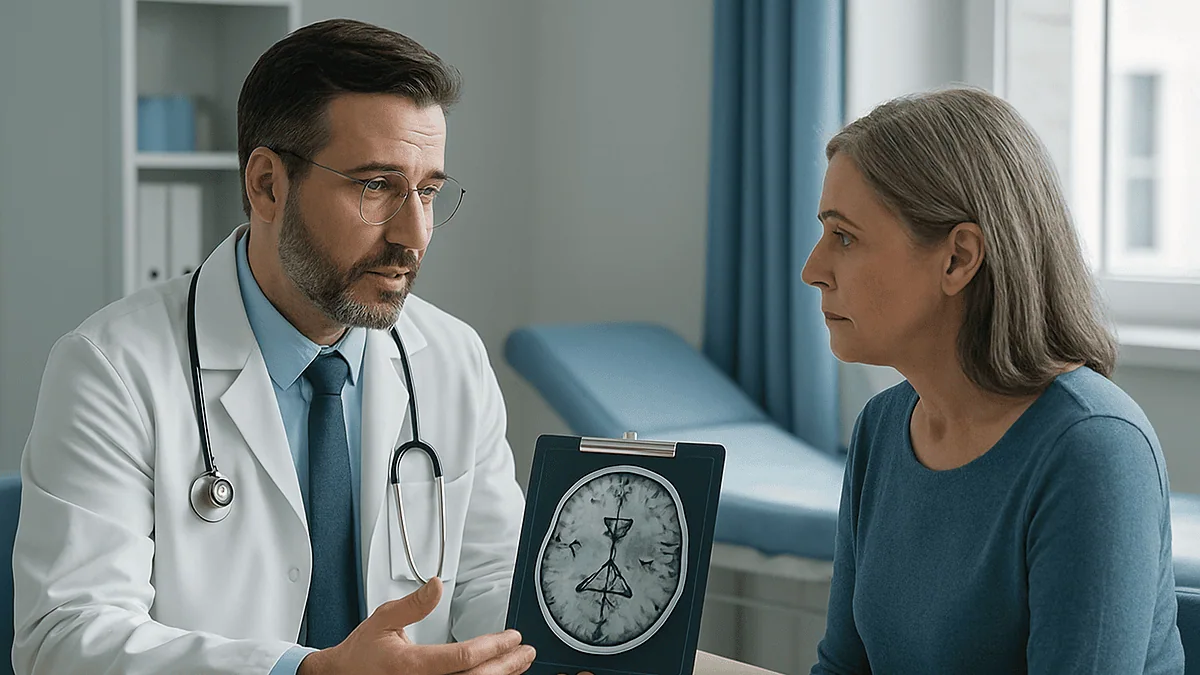
The question almost always arrives in the same shape. A scan has shown something. The neurosurgeon has finished explaining what it is and roughly where it sits. Then the person in the chair, or more often the spouse sitting beside them, leans forward and asks: was it the phone? Was it the stress at work? Was it something we ate, something we did, something we should have caught?
Those questions deserve a straight answer, and the honest one is uncomfortable in a specific way. Not because the news is bad, but because it is unsatisfying. For the large majority of brain tumors, medicine cannot point to a cause, and the everyday suspects people reach for have been studied and largely cleared.
What follows is a tour of what the evidence actually supports, what it has ruled out, and the handful of things that genuinely sit within a person’s control.
Is a brain tumor the same as brain cancer?
Not quite, and the distinction shapes everything that comes after a diagnosis. A brain tumor is any abnormal mass of cells growing in or next to the brain. Some are cancerous, meaning they grow quickly and invade surrounding tissue. Many are not. The NHS notes that even a non-cancerous tumor can be serious because the skull is a closed box: a slow-growing mass still presses on tissue that has nowhere to go.
Doctors also separate tumors by where they started. A primary brain tumor arises from cells of the brain itself or its coverings. A secondary, or metastatic, tumor has spread to the brain from a cancer elsewhere, most often the lung, breast, kidney, bowel or skin. Mayo Clinic points out that secondary tumors are more common than primary ones, which matters for the cause question, because in those cases the true origin lies outside the head entirely.
Grading adds a third layer. The NHS describes a scale from grade 1, the slowest growing, to grade 4, the fastest and most invasive. Grade 1 and 2 tumors are often called low grade or benign; grades 3 and 4 are high grade or malignant. Meningiomas, which grow from the membranes wrapping the brain, are the most common primary tumor in adults and are usually low grade. Gliomas, which come from the brain’s supporting cells, span the whole range.
So when someone asks what causes brain tumors, they are really asking about dozens of different diseases that happen to share an address.
What actually causes brain tumors? The honest answer
Every tumor starts the same way at the cellular level. A cell picks up a change in its DNA, the instruction manual that tells it when to divide and when to die. Most such changes are harmless or get repaired. Occasionally one lands in a gene that controls growth, and the cell begins dividing when it should have stopped. Mayo Clinic describes this cascade plainly: the altered cells multiply, outlive healthy cells, and accumulate into a mass.
The harder question is why the DNA changes in the first place. Here the evidence is thin, and it is worth being candid about that. Cleveland Clinic and MedlinePlus both state that for most primary brain tumors the cause is unknown. That is not a gap in effort; brain tumors have been studied for decades. It reflects the fact that most of the driving mutations appear to be acquired during a person’s lifetime, seemingly at random, rather than inherited or triggered by something identifiable.
Think of it like a typo appearing in a document that has been copied billions of times. Cells in the body divide constantly, and each division is an opportunity for a copying error. The brain’s own neurons rarely divide, which is one reason tumors arising from neurons are uncommon, while the supporting glial cells and the meningeal coverings, which do renew, account for most primary tumors.
Two things can nudge those odds: exposures that damage DNA directly, and inherited weaknesses in the repair machinery. Both are real, both are covered below, and together they still explain only a minority of cases.
Does radiation cause brain tumors?
Ionizing radiation to the head is the one environmental cause that every major source agrees on. Mayo Clinic, the NHS and Cleveland Clinic all list it, and the wording is consistent: people who received radiation therapy to the head or neck, particularly in childhood, carry a higher risk of developing a brain tumor years or decades later. Meningiomas and gliomas are the types most often linked to prior radiation.
The mechanism is straightforward. Ionizing radiation carries enough energy to break chemical bonds, including those in DNA. Most breaks are repaired. Some are repaired badly, and a mis-repaired break in a growth-control gene is precisely the kind of typo described above.
Context matters enormously here. The exposures in question are therapeutic doses given to treat a previous cancer or, historically, benign conditions such as scalp ringworm. Those are many orders of magnitude higher than a dental X-ray or a single head CT. Mayo Clinic is careful to note that the everyday radiation people encounter, from power lines, microwaves, or background sources, is not the type linked to brain tumors.
What about diagnostic imaging? CT scans do use ionizing radiation, and clinicians weigh that when ordering them, especially for children. Reasonable stewardship means not requesting a scan that will not change a decision, and asking whether an MRI or ultrasound, which use no ionizing radiation, would answer the same question. That is a conversation worth having, not a reason to refuse imaging that is medically indicated.
Are brain tumors hereditary?
Usually not. Mayo Clinic describes family history as a factor in a small portion of brain tumors, and the NHS echoes that most people who develop one have no relatives with the condition. Having a parent or sibling with a brain tumor does not, on its own, mean you are likely to develop one.
The exception is a short list of inherited syndromes in which a faulty gene is passed down and raises the risk of several tumor types, brain tumors among them. Mayo Clinic and Johns Hopkins name the main ones:
- Neurofibromatosis types 1 and 2, linked to gliomas, meningiomas and tumors of the hearing nerve
- Tuberous sclerosis, associated with low-grade tumors near the brain’s fluid spaces
- Li-Fraumeni syndrome, in which a damaged tumor-suppressor gene raises the risk of many cancers
- Von Hippel-Lindau disease, tied to blood-vessel tumors of the brain and spine
- Lynch syndrome and related conditions affecting DNA repair
These syndromes typically announce themselves. People often have other signs, such as skin findings, eye changes, or a striking family pattern of cancers at young ages. Genetic counseling exists precisely for families who fit that picture, and the value is not prevention of the tumor itself but earlier, planned surveillance.
For everyone else, the reassuring and slightly frustrating truth holds: the DNA changes that drive most brain tumors are acquired, not inherited, and there is no test that predicts them.
Who is most at risk? Age, sex and other patterns
Beyond radiation and inherited syndromes, epidemiologists have mapped a handful of patterns. None of them is a cause in the way a virus causes a cold; they are tendencies observed across large populations.
Age is the clearest. Mayo Clinic notes that brain tumors can occur at any age but become more common as people get older, with most diagnoses in adults. Childhood brain tumors are a distinct group with their own biology, and they are among the more common cancers of childhood even though their absolute numbers are small.
Sex and ancestry show subtler patterns. Meningiomas are diagnosed more often in women, while gliomas are somewhat more common in men. Cleveland Clinic and other sources report that gliomas are seen more frequently in white populations and meningiomas somewhat more in Black populations. Researchers do not fully understand why, and the differences are modest.
| Factor | Strength of evidence | What it means in practice |
|---|---|---|
| Prior radiation therapy to the head | Established | Long-term follow-up after childhood treatment is standard |
| Inherited tumor syndromes | Established, but rare | Genetic counseling for families with a clear pattern |
| Older age | Consistent | Not modifiable; explains why symptoms in later life are taken seriously |
| Sex and ancestry | Modest associations | Statistical, not personal predictors |
| Weakened immune system | Linked to one rare tumor type | Relevant mainly to primary brain lymphoma |
| Cell phones, stress, diet | No established link | See the sections below |
One further pattern: MedlinePlus notes that people with weakened immune systems, from illness or from medications given after organ transplants, face a higher risk of primary brain lymphoma, a rare tumor of immune cells that arises in the brain.
Do cell phones cause brain tumors?
This is the question asked most often and answered least clearly in everyday conversation, so it deserves precision. Cell phones emit radiofrequency energy, which is non-ionizing. Unlike X-rays or gamma rays, it does not carry enough energy to break chemical bonds or damage DNA directly. Its main biological effect is a very small amount of heating.
That mechanism argument is why most scientists were skeptical from the start. The empirical record has largely borne that skepticism out. Mayo Clinic states that studies have not proven a link between cell phone use and brain tumors. The NHS reaches the same conclusion, adding that research is ongoing because the technology is comparatively new and the longest-term data on heavy use over many decades are still accumulating.
Why, then, does the worry persist? Partly because a few case-control studies, which ask people with tumors to recall their past phone habits, reported associations. Recall studies are vulnerable to bias: someone searching for an explanation may remember using their phone more than they did. Large prospective studies that tracked phone use before anyone became ill have generally not found the same signal. And despite phone use rising dramatically over 25 years, brain tumor incidence has not tracked that surge in the way a true cause would predict.
The scientifically honest position is that no link has been shown, a residual uncertainty remains for very heavy use over very long periods, and anyone who wants to reduce exposure anyway can use a speaker or wired earpiece. That is a personal preference, not a medical recommendation.
Can stress cause a brain tumor?
There is no evidence that stress causes brain tumors. None of the major medical references lists it as a risk factor, and this is not a case of a question being ignored. Stress has been studied extensively in relation to cancer generally because so many patients ask about it, and the findings do not support a causal role in tumor formation.
The intuition behind the fear is understandable. Chronic stress does raise levels of hormones such as cortisol, and it can disturb sleep, appetite and immune function. It feels plausible that a body under strain would be less able to police rogue cells. Yet the brain tumor data simply do not show it. People with high-stress jobs, people who have lived through bereavement or trauma, and people with anxiety disorders do not develop brain tumors at higher rates.
Something else does happen, and it is worth naming because it fuels the myth. Stress and brain tumors can produce overlapping symptoms: headaches, poor concentration, irritability, fatigue, changes in sleep. Someone whose tumor was eventually found after months of what looked like burnout will naturally connect the two. The tumor was causing the symptoms that looked like stress, not the other way around.
That reversal is the useful lesson. Stress does not need to be feared as a cause, but a stubborn change in headaches, personality or thinking should not be filed under stress indefinitely without a conversation with a doctor.
Do diet, alcohol, smoking or chemicals cause brain tumors?
The lifestyle factors that drive so many other cancers turn out to have surprisingly little grip on the brain. Neither Mayo Clinic, the NHS nor Cleveland Clinic lists diet, alcohol or smoking as established causes of primary brain tumors. Decades of research into specific foods, processed meats, artificial sweeteners and alcohol have produced scattered and inconsistent findings, nothing approaching the consistency seen for, say, smoking and lung cancer.
Smoking does enter the picture through a side door. Lung cancer is one of the cancers most likely to spread to the brain, and Mayo Clinic notes that metastatic brain tumors are more common than primary ones. A smoker who develops a brain metastasis from a lung tumor has a brain tumor with a very clear cause, just not one that started in the head. The same logic applies to skin protection and melanoma, another cancer with a tendency to travel to the brain.
Occupational chemicals have been examined too. Some studies have looked at workers in the rubber, petroleum and agricultural industries and at solvents such as vinyl chloride. The results have been mixed, and no chemical exposure has reached the level of an established cause of primary brain tumors in the way ionizing radiation has. Sensible workplace protections remain worthwhile for many other health reasons.
The takeaway is not that lifestyle is irrelevant to health. It is that a person who develops a primary brain tumor almost certainly did not bring it on through what they ate or drank.
What about head injuries, allergies and other rumored triggers?
Head injury sits high on the list of things people blame, often because a knock to the head led to a scan that found a tumor. That sequence creates a powerful but misleading impression. Tumors take years to grow; a mass visible on a scan taken days after an accident was there long before the fall. Studies that have tracked people after head trauma have not found a meaningful increase in brain tumor risk, and no major reference lists injury as a cause.
Allergies produce one of the stranger findings in this field, and it runs the opposite direction. Several large studies have observed that people with asthma, eczema or hay fever have a somewhat lower risk of glioma. The leading explanation is that a more reactive immune system may be better at clearing abnormal cells early. This is an association, not a protective strategy; nobody should wish for hay fever. It is mentioned because it illustrates how the immune system’s vigilance may matter more than any external trigger.
Seizures are sometimes cited as a cause, but the relationship is backward: tumors can cause seizures, particularly in the brain’s outer layers, and a first seizure in adulthood is one of the reasons doctors order imaging.
Infections have been explored as well, with cytomegalovirus receiving particular attention in glioma research. Findings remain contested and no infectious cause has been established for the common primary tumors. The one clear immune-related link, as noted earlier, is between a suppressed immune system and primary brain lymphoma.
What are the warning signs of a brain tumor?
Symptoms depend far more on where a tumor sits and how fast it grows than on what type it is. A slow meningioma over the speech area can produce word-finding trouble for months before anything else; a fast-growing glioma deep in the brain can announce itself with a seizure out of nowhere. Mayo Clinic and the NHS describe a consistent core of warning signs, and six deserve particular attention.
Headaches that are new or have changed character come first, especially ones that are worse in the morning or on lying down, that wake a person from sleep, or that intensify with coughing or straining. Second, seizures in someone with no history of them. Third, nausea or vomiting without an obvious cause, particularly when paired with headache. Fourth, vision changes: blurring, double vision, or loss of part of the visual field. Fifth, weakness, numbness or clumsiness affecting one side of the body or one limb. Sixth, changes in personality, memory, judgment or speech that others notice before the person does.
Some signs are more specific to location. Hearing loss in one ear can point to a tumor on the hearing nerve. Balance problems suggest the cerebellum. Difficulty understanding language implicates the left temporal lobe in most people.
Two cautions keep this list in proportion. Every one of these symptoms is far more often caused by something else: migraines, inner-ear problems, stress, sleep deprivation. And a tumor rarely produces just one symptom in isolation for long. It is the pattern, the persistence and the progression that matter.
When should you see a doctor about possible brain tumor symptoms?
Seek emergency care immediately for a first-ever seizure, a sudden severe headache unlike any before, sudden weakness or numbness on one side of the body, sudden difficulty speaking or understanding speech, sudden loss of vision, or a headache accompanied by fever, stiff neck, confusion or repeated vomiting. Those red flags can signal a stroke, a bleed, an infection or a tumor causing dangerous pressure, and the distinction cannot be made at home.
Make a routine appointment, sooner rather than later, if headaches have changed in pattern or frequency over weeks, if headaches are consistently worse in the morning or wake you at night, if nausea keeps appearing without a stomach explanation, if vision has become blurred or doubled, if family members have commented on changes in your personality, memory or speech, or if you notice progressive clumsiness, hearing loss on one side or persistent balance trouble.
The NHS and Mayo Clinic both emphasize that these symptoms usually turn out to have other causes. That is exactly why they are worth checking. A doctor can take a careful history, examine the nervous system in a few minutes, and decide whether imaging is warranted. Most people leave reassured. The small number who do have a tumor benefit enormously from being found before pressure builds or a seizure occurs.
Bring a simple diary if you can: when the headaches happen, what makes them worse, any episodes of confusion or odd sensations. Patterns that feel vague in conversation become clear on paper, and they help a clinician decide quickly.
How do doctors find out what is causing your symptoms?
The workup starts with a neurological examination, which is more revealing than its simplicity suggests. Checking eye movements, facial symmetry, reflexes, strength, coordination and the back of the eye with an ophthalmoscope lets a clinician map which parts of the nervous system are and are not working. Swelling of the optic nerve, visible at the back of the eye, is a direct window onto raised pressure inside the skull.
Imaging follows if the examination or history raises concern. MRI is the workhorse, as Mayo Clinic and Johns Hopkins describe, because it shows soft tissue in fine detail without ionizing radiation. A contrast agent injected into a vein highlights areas where the blood-brain barrier has broken down, a common feature of tumors. Specialized MRI sequences can estimate how densely packed the cells are, map blood flow, and even identify which parts of the brain control language or movement so a surgeon can plan around them. CT is faster and often used in emergencies, particularly to look for bleeding.
Imaging suggests; tissue confirms. A biopsy or surgical removal provides cells for a pathologist, who determines the tumor type and grade under a microscope. Increasingly, the pathologist also runs molecular tests looking for specific genetic changes within the tumor. These markers have reshaped classification in recent years, because two tumors that look identical under the microscope can behave very differently depending on their mutations.
If a secondary tumor is suspected, the search widens to the chest, abdomen and skin to find the primary source. In that situation, the brain scan is the clue and the cause lies elsewhere.
Can a brain tumor be cured?
Sometimes, and it depends heavily on the type, grade and location. The NHS explains that many low-grade tumors, meningiomas in particular, can be removed completely by surgery, and for those people the tumor may never return. Other tumors sit in places where complete removal would damage speech, movement or vision, or they have infiltrated surrounding brain so that no visible margin exists. High-grade gliomas fall into this second group, and for them the realistic language is control and quality of life rather than cure.
Treatment, as Mayo Clinic and Cleveland Clinic outline, draws on a few main tools. Surgery removes as much tumor as can be taken safely, sometimes with the patient awake for part of the operation so that language and movement can be tested in real time. Radiation therapy uses precisely targeted beams to damage the DNA of remaining tumor cells, exploiting the same vulnerability that makes radiation a cause in the first place; modern planning shapes those beams to spare healthy tissue. Drug therapy works by interfering with the tumor cells’ ability to copy their DNA or by targeting specific molecular changes, and the choice of agent, schedule and duration is a decision for the treating team based on the tumor’s markers.
Medications are also used to manage consequences of the tumor: reducing swelling around it, which can relieve headache and weakness within days, and preventing seizures. Those are supportive measures, prescribed and adjusted by the clinician looking after the individual.
Recovery timelines vary from weeks after a straightforward meningioma removal to long-term follow-up with periodic scans for tumors that cannot be fully removed. Honest conversations about goals, at every stage, matter as much as any single treatment.
How to avoid brain tumors: what you can actually change
Here the honesty cuts both ways. Because most primary brain tumors have no known cause, there is no proven way to prevent them, and the NHS and Mayo Clinic say so directly. Anyone selling a diet, supplement or device to prevent brain tumors is selling something the evidence does not support.
That leaves a short but real list of things within reach. The first concerns radiation stewardship: asking whether a CT scan is necessary, particularly for a child, and whether an alternative would answer the question. Clinicians already weigh this, and an informed question from a parent supports good practice rather than obstructing it.
The second is indirect but arguably the most powerful. Since secondary tumors outnumber primary ones, the cancers most likely to spread to the brain are the ones worth preventing. Not smoking, protecting skin from sun, attending screening for breast and bowel cancer, and acting on persistent coughs or changing moles all reduce the odds that a cancer elsewhere ever reaches the brain.
The third applies to a small group: families with a clear pattern of early cancers or a known syndrome such as neurofibromatosis or Li-Fraumeni. Genetic counseling does not prevent a tumor, but it can set up surveillance so that anything that develops is found when it is small and options are widest.
The fourth is simply attention. Knowing the warning signs, noticing when a headache pattern changes, and not letting a persistent change in thinking or personality be explained away for months. Early detection is not prevention, but for brain tumors it is the closest thing most people have.
Frequently asked questions
What are 6 warning signs of a brain tumor?
The six most recognized signs are new or changing headaches, especially ones worse in the morning or on lying down; a first-ever seizure; nausea or vomiting without a stomach cause; vision changes such as blurring or double vision; weakness, numbness or clumsiness on one side of the body; and changes in personality, memory or speech noticed by others. Each is far more often due to something else, but a persistent or worsening pattern should be checked by a doctor.
How can you avoid brain tumors?
There is no proven way to prevent most primary brain tumors because their cause is usually unknown. What you can do is avoid unnecessary radiation exposure to the head, particularly in childhood; reduce the risk of cancers that commonly spread to the brain by not smoking, protecting skin from sun and attending recommended screenings; seek genetic counseling if your family has a clear pattern of early cancers; and know the warning signs so that anything that develops is found early.
Can a brain tumor be cured?
Some can. Many low-grade tumors, especially meningiomas, can be removed completely by surgery and may never return. Others sit in areas where full removal would damage vital functions, or have spread into surrounding brain tissue, and for these the goal shifts to controlling growth and preserving quality of life for as long as possible. Tumor type, grade, location and molecular markers all shape the outlook, which is why a treating team gives individual, not general, answers.
Can stress cause a brain tumor?
No evidence links stress to brain tumor development, and no major medical reference lists it as a risk factor. The confusion arises because tumors can cause symptoms that resemble stress, such as headaches, poor concentration, irritability and fatigue, so people often connect the two after the fact. If symptoms attributed to stress persist for months or steadily worsen, that is a reason to see a doctor rather than a reason to blame stress.
Do cell phones cause brain tumors?
Studies have not shown a link. Cell phones emit non-ionizing radiofrequency energy, which lacks the power to break DNA, unlike X-rays. Large studies that tracked people’s phone use before illness have not found increased tumor rates, and brain tumor incidence has not risen alongside the huge growth in phone use. Research continues because decades-long heavy use is still being studied, but current evidence does not support cell phones as a cause.
Are brain tumors hereditary?
Rarely. A small portion of brain tumors occur in people with inherited syndromes such as neurofibromatosis, tuberous sclerosis, Li-Fraumeni syndrome, von Hippel-Lindau disease or Lynch syndrome. These usually come with other signs and a strong family history of early cancers. For most people, having a relative with a brain tumor does not meaningfully raise personal risk, because the DNA changes that drive most tumors are acquired during life rather than inherited.
Can a head injury cause a brain tumor?
No established link exists between head injury and brain tumors. The belief often arises when a scan after an accident reveals a tumor, but tumors grow over months or years and would have been present before the injury. Studies following people after head trauma have not shown a meaningful rise in tumor risk. Injury does, however, sometimes lead to imaging that finds a tumor incidentally, which is a coincidence of timing rather than a cause.
What is the difference between a benign and malignant brain tumor?
Benign, or low-grade, tumors grow slowly, have clearer edges and rarely spread; malignant, or high-grade, tumors grow quickly and invade surrounding tissue. Doctors grade tumors from 1 to 4 along that spectrum. A benign tumor can still be serious because the skull leaves no room for expansion, so even slow growth can press on critical brain areas. Grade, location and the tumor’s molecular features together determine how it is managed.
Does radiation from CT scans or X-rays cause brain tumors?
The established link is with therapeutic radiation, the high doses used to treat cancer or, historically, benign scalp conditions, particularly in children. Diagnostic imaging uses vastly lower doses. CT scans do involve ionizing radiation and clinicians weigh their use carefully, especially in children, choosing MRI or ultrasound when those would answer the same question. A medically necessary scan should not be refused out of tumor fear; asking whether it is needed is reasonable.
Who is most likely to get a brain tumor?
Risk rises with age, and most diagnoses are in adults, although brain tumors are also among the more common childhood cancers. People who received radiation therapy to the head, especially as children, and those with certain inherited syndromes carry higher risk. Meningiomas are more common in women and gliomas somewhat more in men. People with weakened immune systems face a higher risk of primary brain lymphoma, a rare tumor of immune cells.
References
- NHS: Brain tumours
- MedlinePlus: Brain tumor – primary – adults
- Cleveland Clinic: Brain Cancer (Brain Tumor)
This article is for general information only and is not a substitute for professional medical advice. Please consult a qualified doctor about your individual situation.

More from the Blog
AI in Healthcare: What It Already Does in Hospitals, and Where It Falls Short
AI in healthcare currently helps hospitals read medical images, flag patients at risk of deterioration such as sepsis, draft clinical notes from recorded visits,…

Home Blood Pressure Monitors: Wrist vs Arm and How to Take a Reading That Counts
For most adults, the best home blood pressure monitor is an automatic upper-arm cuff that has passed independent validation testing and fits your arm…

Telehealth: What Can Be Diagnosed on a Video Call and What Cannot
Telehealth can reliably assess conditions a clinician diagnoses mostly by history and by looking: many rashes, mental health concerns, medication follow-ups, chronic disease check-ins…

Recovering from Radiotherapy: How Long Until You Feel Better
Most people start to feel noticeably better within a few weeks of their last radiotherapy session, although side effects such as fatigue and skin…

Patient Portals: How to Read Your Own Lab Results Without Panicking
A patient portal is the secure website or app your health system uses to show you appointments, messages, and test results, and since 2021…

Over-the-Counter CGMs: What Glucose Data Means for People Without Diabetes
Over-the-counter continuous glucose monitors such as Stelo and Lingo show adults without diabetes how blood sugar rises and falls through the day. For most…