

What Causes Hair Loss? The 10 Medical Reasons and How Doctors Tell Them Apart

Key Takeaways
- Shedding 50 to 100 hairs a day is normal because roughly 10 percent of scalp follicles are resting at any moment.
- Telogen effluvium arrives two to three months after its trigger, which is why the cause of sudden shedding is usually found in the previous season's events.
- Variation in hair thickness under dermoscopy marks pattern hair loss, while exclamation mark hairs mark alopecia areata; the two are rarely confused by a trained eye.
- Thyroid-stimulating hormone, ferritin and a full blood count are the standard first blood tests for diffuse hair loss, and normal results narrow the search quickly.
- Frontal fibrosing alopecia, a scarring cause of a receding hairline in postmenopausal women, often takes the eyebrows first and needs a biopsy to confirm.
- Topical minoxidil and oral finasteride for men have randomised trial support for pattern hair loss; biotin and collagen supplements for people with normal levels do not.
Hair loss has about ten common medical causes: pattern (androgenetic) hair loss, telogen effluvium after stress or illness, autoimmune alopecia areata, thyroid disease, iron or nutritional deficiency, medicines such as chemotherapy, scalp infections and skin conditions, tight hairstyles, scarring alopecias, and hormonal shifts such as childbirth or menopause. Doctors separate them by the pattern on the scalp, the timing, a gentle pull test, dermoscopy and targeted blood tests, sometimes with a small biopsy.
The shower drain has become a diagnostic instrument. People photograph it, count what they find and type “what causes hair loss” into a search bar before their hair has dried. As of mid-2025, those searches are climbing again, pushed by three things at once: a new class of prescription tablets approved for severe autoimmune hair loss, a wave of videos about taking a decades-old scalp medicine by mouth instead, and reports of shedding among people losing weight quickly on newer weight-loss medicines.
The noise hides a useful truth. Hair loss is not one condition; it is a symptom with roughly ten medical explanations, and most of them behave differently enough that a dermatologist can often sort them in a single visit. The pattern on the scalp, the calendar and a handful of blood tests do most of the work.
This guide walks through the ten reasons doctors look for, how they tell them apart, and what the evidence actually supports.
What does alopecia mean, and how much hair loss is normal?
Alopecia is simply the medical word for hair loss from any cause; it does not name a disease by itself. A doctor’s note saying “alopecia” means no more than “this person is losing hair,” and the real work is the word that comes before it.
Each scalp follicle runs its own cycle. The growing phase, called anagen, lasts roughly two to six years. A brief transition follows, then a resting phase, telogen, of about three months, after which the hair is released and a new one starts behind it. At any moment close to 90 percent of your roughly 100,000 scalp hairs are growing and the rest are resting, which is why losing 50 to 100 hairs a day is normal and barely noticeable. Hairs that shed with a small white bulb at the root have simply finished their cycle.
Hair loss becomes medical when that balance tips. Either too many follicles enter the resting phase together (shedding), or follicles shrink and produce finer, shorter hairs (thinning), or the follicle is destroyed and replaced by scar tissue (scarring). Those three mechanisms explain almost every case, and the ten causes below each lean on one or two of them.
Timing matters as much as volume. A sudden handful of hair in the brush points one way; a part line that has widened over five years points another; a smooth coin-sized bald spot points somewhere else again. Writing down when you first noticed a change, and what happened in your life two to three months before it, is the single most useful thing you can bring to an appointment.
What changed recently in hair loss treatment and research
Three developments explain the current attention. The first is regulatory. In June 2022 the US Food and Drug Administration approved the first oral tablet, a Janus kinase (JAK) inhibitor, for adults with severe alopecia areata; a second JAK inhibitor followed in June 2023 for people aged 12 and older, and a third for adults in July 2024. JAK inhibitors calm the immune signalling that attacks follicles in this autoimmune form of hair loss. The National Institute of Arthritis and Musculoskeletal and Skin Diseases and Mayo Clinic both now list this class among options a specialist may discuss. These medicines are prescription only, carry safety monitoring requirements, and are approved for alopecia areata, not for common pattern hair loss.

The second shift is a social-media trend rather than a scientific one: oral minoxidil. Minoxidil has been an approved topical treatment for pattern hair loss for decades. Taking it by mouth for hair is an off-label use, meaning it is prescribed outside the condition the drug was approved for. Evidence is growing but is mostly observational, with few randomised trials; a prescribing clinician weighs blood pressure effects and other risks before considering it.
The third is weight-loss medicine. Hair shedding has appeared as a reported side effect in trials of newer injectable weight-loss drugs. Dermatologists generally attribute this to telogen effluvium triggered by rapid weight loss itself rather than a direct effect on follicles, and expect recovery as weight stabilises. That remains expert interpretation, not settled trial data.
Guidance from MedlinePlus, the NHS and Cleveland Clinic has not changed on the fundamentals: identify the cause first, because treatment that fits one cause can be useless for another.
Reason 1: Pattern hair loss (androgenetic alopecia), the most common answer to what causes hair loss
Ask a dermatologist what causes hair loss in the people who walk through the door, and the honest answer is this one, most of the time. Androgenetic alopecia, also called male- or female-pattern hair loss, is hereditary thinning driven by the way follicles respond to androgens, the group of hormones that includes testosterone and its more potent relative dihydrotestosterone (DHT).
The mechanism is miniaturisation. Follicles that are genetically sensitive to DHT spend less time growing with each cycle, so every replacement hair comes back a little shorter and finer, until it is a barely visible fuzz. Nothing dramatic falls out; hair quietly stops being replaced at full strength. Around half of men show noticeable pattern loss by age 50, and prevalence in women climbs steadily after menopause, when protective estrogen falls.
Men and women wear it differently. Men typically see the hairline retreat at the temples and a thinning crown, which eventually meet. Women usually keep their frontal hairline and instead notice a widening part, often more pronounced toward the front, sometimes described as a “Christmas tree” pattern when viewed from above. Women can also inherit the genes from either parent; the old claim that baldness comes only from the mother’s side is not supported.
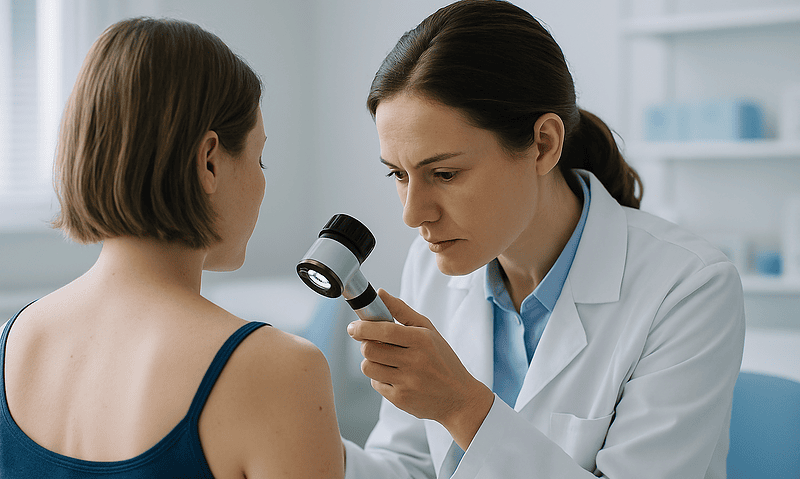
Pattern hair loss does not itch, flake or hurt, and it progresses over years rather than weeks. Under dermoscopy, a handheld magnifier dermatologists use on the scalp, the signature is variation in hair shaft thickness: thick and thin hairs side by side. That single clue separates it from the uniform shedding of telogen effluvium.
It is also the cause with the strongest treatment evidence, which is covered below.
Reason 2: Telogen effluvium, the shedding that arrives three months late
The surprise of telogen effluvium is its delay. A high fever in January, surgery in February, a bereavement, a crash diet, childbirth, a new medicine or a severe bout of illness pushes a large share of follicles into the resting phase at once. Nothing happens for roughly two to three months. Then the resting hairs release together, and the drain fills.

Telogen effluvium is diffuse: it thins the whole scalp rather than one zone, although people often notice it most at the temples because hair is finer there. A gentle pull test is usually positive, meaning several hairs come away with light traction, and the shed hairs carry the small white club-shaped root of a completed cycle.
Common triggers documented by Mayo Clinic and Cleveland Clinic include major physical stress (surgery, infection, blood loss), rapid weight loss, hormonal change after pregnancy or stopping contraception, starting or stopping certain medicines, and sustained emotional stress. The widespread shedding reported after COVID-19 infection fitted this pattern closely.
Reassurance here is evidence-based rather than polite. Because the follicles are paused rather than damaged, hair generally regrows once the trigger has passed, with visible recovery over six to twelve months. Shedding that continues beyond six months is called chronic telogen effluvium and deserves a closer look for an ongoing cause such as thyroid disease or iron deficiency.
A practical distinction: telogen effluvium makes your ponytail thinner everywhere; pattern hair loss widens your part while the ponytail length stays. The two can coexist, and a stressful year often unmasks pattern thinning that was already quietly underway.
Reason 3: Alopecia areata, when the immune system targets hair follicles
Alopecia areata looks nothing like the gradual thinning of pattern loss. A smooth, round, completely bald patch appears, often on the scalp but sometimes in the beard, eyebrows or eyelashes, with normal-looking skin underneath. It can arrive in days.
The cause is autoimmune: white blood cells that normally defend the body mistakenly surround the base of growing follicles and switch them off. The follicles are not destroyed, which is why hair can and often does regrow, sometimes white at first. The condition affects roughly two in every hundred people at some point in life, frequently begins in childhood or early adulthood, and runs in families alongside other autoimmune conditions such as thyroid disease, vitiligo and type 1 diabetes.
Dermatologists recognise it quickly. Under dermoscopy they look for “exclamation mark” hairs, short broken hairs that are narrower near the scalp than at the tip, plus yellow dots marking empty follicle openings. Fingernails may show fine pitting. Blood tests are not needed to confirm the diagnosis, although thyroid function is often checked because the two conditions travel together.
Severity varies enormously. Many people have one or two patches that regrow within a year without treatment. Others progress to loss of all scalp hair (alopecia totalis) or all body hair (alopecia universalis), and this severe end of the spectrum is where the recently approved JAK inhibitors apply. Those decisions, including who qualifies and what monitoring is required, belong to the treating dermatologist.
Alopecia areata is unpredictable, and the unpredictability is its own burden; relapse after regrowth is common, and mental-health support is a recognised part of care, not an afterthought.
Reason 4: Can thyroid issues cause hair loss?
Yes, and in both directions. The thyroid gland sets the metabolic pace for every cell, hair follicles included. An underactive thyroid (hypothyroidism) slows the cycle so follicles linger in rest and hair becomes dry, coarse and sparse; an overactive thyroid (hyperthyroidism) speeds everything up and can produce fine, soft hair that sheds diffusely. Either way the loss is spread across the scalp rather than patterned, and it tends to be gradual.
Two clues raise suspicion. Thinning of the outer third of the eyebrows is a classic sign of hypothyroidism, and hair changes rarely arrive alone; fatigue, weight change, feeling unusually cold or hot, altered bowel habit, palpitations or menstrual changes often sit alongside. People with alopecia areata are also more likely to have autoimmune thyroid disease, so a thyroid check is routine when patches appear.
Diagnosis is straightforward. A blood test measuring thyroid-stimulating hormone (TSH), sometimes with free thyroxine, is part of the standard workup for diffuse hair loss listed by MedlinePlus and the NHS. If thyroid disease is confirmed, treating it is the treatment for the hair loss too, although regrowth lags by several months because follicles need to complete a full cycle.
One complication: some medicines used to control an overactive thyroid can themselves cause temporary shedding, and starting thyroid hormone replacement occasionally produces a brief increase in shedding before improvement. Neither is a reason to stop a prescribed medicine; both are reasons to tell the prescriber what you are seeing.
If your thyroid results are normal and shedding continues, the thyroid is cleared and the search moves to the next items on this list, most often iron stores and recent stressors.
Reason 5: Iron deficiency, crash diets and other nutritional gaps
Hair is a luxury the body cuts first. When protein, iron or calories run short, follicles are among the earliest tissues to be rationed, because hair is not essential for survival.
Iron deficiency is the most common nutritional cause doctors check, particularly in women with heavy periods, people following restrictive diets and frequent blood donors. The test is usually ferritin, a protein that reflects stored iron, alongside a full blood count. The association between low ferritin and hair shedding is supported by observational studies, though the exact threshold at which hair suffers is debated and trials of iron supplementation for hair in people who are not deficient have been unconvincing. Taking iron without a confirmed deficiency can cause harm, so testing comes before supplements.
Rapid weight loss is a trigger in its own right. Losing a large amount of weight quickly, whether through a very low-calorie diet, bariatric surgery or medication, commonly produces telogen effluvium two to three months later. Inadequate protein intake, severe zinc deficiency and, less often, biotin deficiency can contribute, but true biotin deficiency is rare in people eating a varied diet.
Excess can hurt as much as shortage. Too much vitamin A, usually from high-strength supplements, is a recognised cause of hair loss listed by Mayo Clinic, and some “hair, skin and nails” products contain far more than the recommended daily amount. Selenium toxicity does the same.
The practical message from the NIH Office of Dietary Supplements is unglamorous: correct a proven deficiency, eat enough protein, and treat supplements as medicines with doses and side effects rather than harmless insurance.
Reason 6: Medicines and medical treatments that thin hair
A new prescription is one of the first things a dermatologist asks about, because many common medicines can trigger shedding and the link is easy to miss when the loss appears months later.
Two mechanisms are at work. Most medicine-related loss is telogen effluvium: the drug nudges follicles into rest, and diffuse shedding follows after the usual two- to three-month delay. Blood thinners, some blood pressure medicines including beta blockers, retinoid acne treatments, certain antidepressants and mood stabilisers, anticonvulsants, high-dose vitamin A derivatives and some hormonal contraceptives are all on lists from Mayo Clinic and the NHS. Stopping or changing contraception can do it too.
The second mechanism is anagen effluvium, in which a medicine stops hair in the middle of its growing phase so it breaks off within one to three weeks. Chemotherapy is the main cause, because it targets rapidly dividing cells and hair matrix cells divide fast. Radiotherapy to the head produces loss only in the treated area. Hair usually regrows after chemotherapy ends, sometimes with a temporary change in colour or curl, although a minority of people experience lasting thinning. Scalp cooling during infusions can reduce loss for some regimens; an oncology team can advise whether it suits a given treatment.
Never stop a medicine because of hair changes without speaking to the prescriber. Many of these drugs treat conditions far more serious than hair loss, and alternatives or dose adjustments are often possible once the clinician knows. Hair that sheds because of a medicine generally recovers after the cause is addressed, but the follicle needs months to show it.
Reasons 7 and 8: Scalp infections, skin conditions and tight hairstyles
Two causes announce themselves on the skin rather than in the hair, and both are easy to confirm in clinic.
Tinea capitis, a fungal infection of the scalp sometimes called scalp ringworm, is the leading cause of patchy hair loss in children. It produces scaly or crusted patches with hairs broken off at or near the surface, sometimes with swollen lymph nodes at the back of the neck. Because the fungus lives inside the hair shaft, shampoos alone do not clear it; a doctor confirms the diagnosis with a scraping or hair sample and prescribes an oral antifungal. Untreated, inflammation can scar the follicles.
Inflammatory skin conditions do their damage indirectly. Severe seborrheic dermatitis and scalp psoriasis cause itching, scaling and scratching, and the resulting inflammation and trauma increase shedding; hair generally recovers once the skin is controlled. Discoid lupus, by contrast, scars follicles and belongs in the next section.
Traction alopecia is mechanical. Years of tight braids, ponytails, buns, weaves, extensions or heavy locs pull constantly on the same follicles, and the hairline, temples and the area above the ears thin first. Early on there may be small bumps or soreness; later, a band of short, fine “fringe” hairs along the hairline marks where tension has done its work. In the first months or years the follicles recover when the tension stops. Left long enough, the follicle scars and the loss becomes permanent, which is why dermatologists treat ongoing traction as a reason to change styling now rather than later.
Chemical relaxers and frequent high heat weaken the shaft so hair breaks mid-length. That is breakage rather than true loss, but it looks the same in the mirror.
Reason 9: Scarring alopecias and hair thinning at the front of a woman's head
Scarring, or cicatricial, alopecias are the group doctors least want to miss, because they destroy the follicle and replace it with scar tissue. Hair that is gone from a scarred area does not come back; the aim is to stop the process spreading.
Frontal fibrosing alopecia is the one that answers a question many women type: why is my hair thinning at the front of my head? It mostly affects women after menopause and produces a slowly receding band along the frontal hairline and temples, typically with loss of the eyebrows, and sometimes a pale, slightly shiny appearance of the skin where follicles used to be. Fine “lonely” hairs may remain in front of the new hairline. It is considered a variant of lichen planopilaris, an inflammatory condition in which immune cells attack the upper follicle, and its rising incidence over the past two decades is documented but not yet explained.
Central centrifugal cicatricial alopecia starts at the crown and spreads outward, and occurs mainly in women of African descent. Discoid lupus causes scaly, discoloured scarred plaques. Folliculitis decalvans produces pustules and tufts of several hairs emerging from one opening.
Frontal thinning in women has non-scarring explanations too, and sorting them matters. Female pattern hair loss accentuates thinning just behind the front hairline while leaving the hairline itself intact; traction alopecia pulls the hairline back from the temples with a fringe of short hairs; telogen effluvium thins the temples diffusely. Loss of eyebrows, scalp redness, scaling, burning or a hairline that has moved back smoothly without short hairs in front of it all point toward a scarring process.
When any of those signs are present, a dermatologist usually takes a small skin biopsy, because the diagnosis changes everything about management.
Reason 10: Hormonal shifts: childbirth, menopause and PCOS
Hormones do not cause one kind of hair loss; they tilt the scalp toward whichever kind a person is already prone to.
Pregnancy is the clearest example. High estrogen holds follicles in the growing phase, so many women notice thicker hair in the third trimester. After delivery estrogen falls, those held-over follicles enter rest together, and shedding peaks around three to four months postpartum. This is textbook telogen effluvium, it is common, and hair density generally returns within a year. Breastfeeding does not cause it and does not need to stop.
Menopause works more slowly. As estrogen declines, androgens exert relatively more influence on sensitive follicles, and women with an inherited tendency to pattern loss see their part widen and their ponytail thin over the following years. Hormone therapy decisions are made for other reasons, with hair as one consideration among many, and belong with the treating clinician.
Polycystic ovary syndrome (PCOS) raises androgen levels in women of reproductive age and is a recognised driver of female pattern thinning, often alongside irregular periods, acne and increased facial or body hair. When those features cluster, doctors may check androgen levels and other markers, because managing PCOS has implications well beyond the scalp.
Starting, switching or stopping hormonal contraception can trigger a few months of shedding while the body adjusts; methods with more androgenic progestins may aggravate pattern loss in susceptible women. Testosterone therapy, in any context, can accelerate pattern hair loss in people who carry the genes for it.
The through-line is that hormone-related loss is usually diffuse or patterned, never a smooth bald patch, and it coincides with an identifiable life change two to four months earlier.
How doctors tell the causes apart: history, pull test, dermoscopy and bloodwork
Diagnosis is mostly pattern recognition backed by a few cheap tests, and a good consultation follows a predictable path.
History first: when it started, how fast, where, whether it itches or hurts, what happened two to three months beforehand, what medicines and supplements you take, your menstrual and family history, and how you style your hair. Then a close look at the scalp for redness, scale, pustules or scarring. A gentle pull test tugs about 60 hairs; more than a few coming away suggests active shedding. Dermoscopy magnifies the follicles and often settles the question on the spot. Blood tests follow when loss is diffuse: thyroid function, full blood count and ferritin as a minimum, with vitamin D, zinc, androgens or autoimmune markers added when the story warrants. A biopsy is reserved for suspected scarring or unclear cases.
| Cause | Typical pattern | Speed | Scalp skin | Key confirming test |
|---|---|---|---|---|
| Pattern hair loss | Widening part or receding temples and crown | Years | Normal | Dermoscopy: mixed thick and thin hairs |
| Telogen effluvium | Diffuse, whole scalp | Weeks, 2–3 months after trigger | Normal | Positive pull test; club-root hairs |
| Alopecia areata | Smooth round patches | Days | Normal | Exclamation mark hairs on dermoscopy |
| Thyroid or iron related | Diffuse | Months | Normal, hair texture may change | TSH, ferritin, blood count |
| Tinea capitis | Patchy with broken hairs | Weeks | Scaly, crusted | Fungal scraping or culture |
| Traction alopecia | Hairline and temples | Months to years | Bumps early, smooth later | Styling history; fringe sign |
| Scarring alopecia | Receding frontal band or central patch | Months to years | Shiny, red or scaled, no follicle openings | Scalp biopsy |
Two or more causes frequently overlap, and the table is a map rather than a verdict; a clinician reading the whole picture is what turns it into a diagnosis.
How can I stop my hair falling? What the evidence actually says
The honest answer begins with the cause, because the strength of the evidence varies enormously from one to the next.
For pattern hair loss, the evidence is strongest. Topical minoxidil has multiple randomised controlled trials showing it slows loss and increases hair count in both men and women, and it is approved for over-the-counter use in many countries. Oral finasteride, which blocks the conversion of testosterone to DHT, is supported by large randomised trials in men and is approved for that use; its use in women is off-label and limited to specialist settings. Oral minoxidil for hair is off-label with mostly observational support and a small number of trials; low-level laser devices have modest randomised evidence; platelet-rich plasma injections have small, mixed trials and no standard protocol. Every one of these is a prescribing or specialist decision, and none promises a particular result.
For telogen effluvium, treatment is removing or waiting out the trigger. Recovery is well documented in clinical experience and observational series rather than trials, because the condition is self-limiting.
For alopecia areata, randomised trials underpin corticosteroid injections for limited patches and the newer JAK inhibitors for severe disease, with regulators requiring safety monitoring.
For nutritional causes, correcting a confirmed deficiency is supported; supplementing without deficiency is not, and biotin or collagen supplements lack randomised evidence for hair in people with normal levels.
For scarring alopecias, anti-inflammatory treatment aims to halt progression; evidence is largely observational and expert consensus.
Nothing on this list works for a cause it was not designed for, which is why diagnosis precedes any plan.
Common myths about what causes hair loss
The viral claims circulating now share a pattern: a grain of mechanism stretched into a certainty.
“Baldness comes from your mother’s father.” Pattern hair loss is polygenic, meaning many genes from both parents contribute. One well-studied androgen receptor gene sits on the X chromosome, which is where the myth came from, but a father’s hairline predicts a son’s roughly as well as a maternal grandfather’s.
“Washing or brushing makes hair fall out.” Shampooing releases hairs that had already finished their cycle. Washing less simply stores them up for a more alarming shower.
“Wearing hats causes hair loss.” There is no evidence that ordinary hats affect follicles. Constant tension from tight styling does; a loose cap does not.
“Stress turns hair grey or bald overnight.” Severe stress can trigger telogen effluvium, but the shedding arrives two to three months later and recovers. Sudden, dramatic loss within days is more likely alopecia areata.
“Biotin fixes hair loss.” Biotin treats biotin deficiency, which is rare. In people with normal levels, randomised evidence for hair benefit is absent, and high doses can interfere with laboratory tests, including thyroid and cardiac markers.
“Minoxidil taken by mouth is just a stronger version of the foam.” It is a blood pressure medicine with systemic effects used off-label for hair; the decision and monitoring belong to a prescriber.
“Weight-loss injections make you bald.” Reported shedding fits telogen effluvium from rapid weight loss and is expected to recover; the trials did not show permanent loss.
“Sun, scalp massage or onion juice regrow hair.” Small or anecdotal studies only; none reach the standard of randomised evidence.
Myths persist because the real answers are slower and require a diagnosis. That is less shareable, and far more useful.
When to see a doctor about hair loss
Most hair loss is not dangerous, but several patterns deserve a prompt appointment with a primary care clinician or dermatologist, and a few signal a condition that needs treatment beyond the scalp.
Seek advice soon if you notice any of the following:
- Sudden shedding, or loss of a large amount of hair over a few weeks, especially in handfuls.
- Smooth round or oval bald patches, or loss of eyebrows or eyelashes.
- Scalp redness, scaling, crusting, pustules, pain, burning or itching alongside the loss.
- A hairline that is moving back, particularly in a woman after menopause.
- Patchy loss with broken hairs in a child, which often needs an oral antifungal.
- Hair loss together with fatigue, unexplained weight change, feeling cold or hot, palpitations, irregular periods, increased facial hair, or a rash on the face or body.
- Shedding that began after starting a new medicine; do not stop the medicine yourself, but tell the prescriber.
- Hair loss that is affecting your mood, sleep or willingness to see people. Distress is a valid reason to be seen.
Bring a short timeline, photographs from a year or two ago, a list of medicines and supplements, and details of any diet or styling changes. Expect a scalp examination, possibly a pull test and dermoscopy, and blood tests if the loss is diffuse. A biopsy is uncommon and usually quick.
Early assessment matters most for traction alopecia and the scarring alopecias, where the window for preserving follicles can close. For everything else, a diagnosis replaces guesswork, and any treatment plan, whether watchful waiting, a topical product, a prescription or a referral, should come from the clinician who has examined you.
Frequently asked questions
What causes hair thinning at the front of a woman's head?
The most common causes are female pattern hair loss, which thins the area just behind an intact hairline, and traction alopecia from tight styling, which pulls the hairline back from the temples. In women after menopause, frontal fibrosing alopecia, a scarring condition that also thins the eyebrows, must be considered. A dermatologist can usually distinguish them with dermoscopy and, if scarring is suspected, a small biopsy.
How can I stop my hair falling?
Start by finding the cause, because treatment differs for each. Shedding after illness, childbirth or rapid weight loss usually recovers on its own within months. Pattern hair loss has approved treatments with randomised trial evidence that a clinician can prescribe or recommend. Deficiencies are corrected once confirmed by blood tests, and tight hairstyles are loosened early. Supplements without a proven deficiency have little evidence.
Can thyroid issues cause hair loss?
Yes. Both an underactive and an overactive thyroid can cause diffuse thinning across the scalp, often with eyebrow thinning and changes in hair texture. A simple blood test for thyroid-stimulating hormone identifies it. Once thyroid levels are controlled, hair usually recovers over several months, although some thyroid medicines can cause brief shedding at first. Tell the prescriber rather than stopping treatment.
What does alopecia mean?
Alopecia is the general medical term for hair loss from any cause. It is not a single disease. Doctors add a second word to specify the type: androgenetic alopecia for hereditary pattern loss, alopecia areata for autoimmune patches, traction alopecia for styling-related loss, and cicatricial alopecia for scarring forms. The descriptor, not the word alopecia, determines treatment.
Is hair loss after stress permanent?
Usually not. Stress-related shedding is telogen effluvium, in which follicles pause rather than die. Shedding typically begins two to three months after the stressful period and settles within six months, with density returning over a year. If shedding continues beyond six months, doctors look for an ongoing cause such as thyroid disease, iron deficiency or an unmasked tendency to pattern hair loss.
Why am I losing hair in round patches?
Smooth, round, completely bald patches with normal skin are the hallmark of alopecia areata, an autoimmune condition in which the immune system switches off hair follicles. Patches can appear within days and often regrow within a year, though relapse is common. Scaly or crusted patches with broken hairs suggest a fungal scalp infection instead, which needs a prescribed oral antifungal.
Does low iron cause hair loss?
Iron deficiency is a recognised contributor to diffuse hair shedding, particularly in women with heavy periods or restrictive diets. The link is supported by observational studies, and doctors check ferritin and a blood count as part of the standard workup. Correcting a confirmed deficiency can help; taking iron without a deficiency has not been shown to improve hair and can cause harm.
Can medicines make your hair fall out?
Many can. Blood thinners, some blood pressure medicines, retinoids, certain antidepressants and anticonvulsants, hormonal contraceptives and chemotherapy are all documented causes. Most produce diffuse shedding two to three months after starting; chemotherapy causes faster loss that usually regrows after treatment. Never stop a prescribed medicine on your own; discuss the shedding with the prescriber, who may be able to adjust the plan.
What blood tests are done for hair loss?
For diffuse shedding, the usual first tests are thyroid-stimulating hormone, a full blood count and ferritin, which reflects iron stores. Depending on the history, a clinician may add vitamin D, zinc, androgen levels when PCOS is suspected, or autoimmune markers. Patchy or pattern hair loss often needs no blood tests at all, because the diagnosis is made by examining the scalp.
How do doctors diagnose the cause of hair loss?
They combine the story with a scalp examination. The timing, pattern, symptoms, medicines and styling history narrow the options; a gentle pull test shows whether shedding is active; dermoscopy reveals follicle-level clues such as mixed hair thickness or exclamation mark hairs. Blood tests follow for diffuse loss, and a small scalp biopsy is used when scarring is suspected or the picture is unclear.
References
This article is for general information only and is not a substitute for professional medical advice. Please consult a qualified doctor about your individual situation.

More from the Blog
Oral Minoxidil: Why Dermatologists Now Prescribe the Blood-Pressure Pill for Hair
Oral minoxidil is a prescription tablet approved to treat severe high blood pressure that dermatologists increasingly prescribe off-label, in amounts far below the blood-pressure…

Scalp Psoriasis vs Dandruff: How to Tell Them Apart and Treat Each
Scalp psoriasis is an immune-driven condition that produces thick, sharply bordered, silvery plaques that often extend past the hairline, while dandruff is a mild,…

Dutasteride for Hair Loss: How It Differs From Finasteride and What Trials Show
Dutasteride is a prescription medicine approved in the United States for enlarged prostate, not for hair loss, though it is approved for male pattern…

Exosomes for Hair Loss: Promising, Unproven, and What That Means for You
Exosome therapy for hair loss is experimental. Early laboratory and animal studies suggest exosomes, microscopic particles that carry signals between cells, might stimulate hair…

Does Microneedling Help Hair Growth? A Careful Reading of the Trials
Small randomized trials suggest microneedling can improve regrowth in androgenetic (pattern) hair loss, mostly when combined with a proven topical hair-growth medication; evidence for…

Derma Rolling for Hair: What Needling Can Add, and Its Limits
Derma rolling can modestly support hair regrowth in pattern hair loss, mainly when paired with a clinician-recommended topical treatment; small randomized trials show greater…