

What Genetic Counseling Adds in Thalassemia: Carrier Testing and Family Planning Questions

Key Takeaways
- When both partners carry a beta thalassemia gene change, each pregnancy carries a 1 in 4 chance of a child with the disease, a 2 in 4 chance of a carrier and a 1 in 4 chance of neither, and the odds reset every time.
- Thalassemia carriers are healthy; their small red cells reflect reduced globin production, not low iron, so a ferritin test should come before anyone recommends iron supplements.
- Everyone has four alpha globin genes and two beta globin genes, which is why alpha thalassemia is counted by missing genes and why DNA testing is needed to tell the cis from the trans arrangement.
- Standard hemoglobin electrophoresis often misses alpha thalassemia trait, so a normal result does not rule it out when red cells are small.
- Chorionic villus sampling is usually performed between 11 and 14 weeks of pregnancy and amniocentesis from 15 weeks, and both require the parents' specific gene changes to be known first.
- Approved gene therapies treat some people who already have transfusion-dependent beta thalassemia; they do not apply to carriers and do not change the genes a person passes on.
Thalassemia genetic counseling helps people understand how this inherited blood disorder passes through families, interpret carrier test results, and weigh reproductive options without pressure. A counselor explains the gene changes involved, calculates the chance of an affected child for each pregnancy, describes prenatal and preimplantation testing, and connects families with hematology care. All decisions remain with the person or couple and their treating team.
The result arrives in a routine prenatal blood panel, tucked between glucose and vitamin D: small red cells, a hemoglobin pattern flagged for review. Nobody in the family has ever been ill. Yet suddenly a word appears that most people have only seen in a biology textbook, and a couple expecting their first child is asked to book a thalassemia genetic counseling appointment within the week.
That scene plays out quietly in clinics every day, because carrying one altered hemoglobin gene almost never causes symptoms. People discover it when a partner is tested, a sibling has a child who needs transfusions, or a lifelong “borderline anemia” finally gets a second look.
Counseling exists for exactly that moment. It translates percentages into decisions a family can live with, and it does so by laying out the evidence rather than by steering toward any particular path.
What is thalassemia genetic counseling, in plain language?
Thalassemia is a group of inherited conditions in which the body makes less of one of the protein chains that build hemoglobin, the oxygen-carrying molecule inside red blood cells. Genetic counseling is a structured conversation with a trained professional, usually a certified genetic counselor or a physician with genetics training, about what an inherited condition means for you and your relatives.
For thalassemia, that conversation has four jobs. It explains what your blood tests show and whether you carry a gene change. It works out the chance that a pregnancy could be affected, which depends on both partners. It describes the testing and reproductive options that exist, with their timing and limits. And it links you to hematology, the medical specialty for blood disorders, if anyone in the family needs ongoing care.
What counseling does not do matters just as much. A counselor will not tell you whether to have children, end a pregnancy, or pursue IVF. Professional standards in genetics describe the role as non-directive: the counselor supplies accurate information and helps you clarify your own values, then steps back. MedlinePlus Genetics describes genetic counseling as a service that helps people understand inherited risk and “make informed decisions,” which is a deliberately neutral phrase.
Sessions are often shorter than people expect. A first appointment commonly runs 30 to 60 minutes, and it may happen in person, by video or by phone. You can bring a partner, a parent or a friend. Many clinics send a summary letter afterward so the numbers and names of tests are written down, because few people remember every detail of a conversation about probability on the day they first hear it.
The best way to think about the appointment is as a translation service. The laboratory speaks in gene names and hemoglobin fractions. Your family speaks in questions about a future child. Counseling stands between the two.
How does the thalassemia inheritance pattern actually work?
Thalassemia follows an autosomal recessive pattern. “Autosomal” means the genes sit on the numbered chromosomes rather than the sex chromosomes, so males and females are affected equally. “Recessive” means a person needs altered copies from both parents to have the disease; one altered copy makes a carrier, who is generally healthy.

Each parent passes on one copy of each gene, chosen at random. When both parents are carriers of a beta thalassemia gene change, MedlinePlus Genetics lays out the odds for every pregnancy: a 1 in 4 (25 percent) chance the child inherits two altered copies and has thalassemia, a 2 in 4 (50 percent) chance the child is a carrier like the parents, and a 1 in 4 (25 percent) chance the child inherits two unaltered copies.
Two points about those numbers trip people up. First, the odds reset with each pregnancy. Having one affected child does not “use up” the risk, and having three healthy children does not mean the fourth is safe. Each conception is an independent roll. Second, a 1 in 4 chance also means a 3 in 4 chance of a child who does not have the disease, and families hear that half of the sentence very differently depending on their circumstances.
When only one partner is a carrier, no child from that couple can have beta thalassemia major, because a second altered copy has nowhere to come from. Each child does have a 50 percent chance of being a carrier, which is why counseling often extends to the next generation: a carrier child will one day face the same partner-testing question.
The arithmetic is simple. The difficulty lies in the fact that the partner’s status is usually unknown until someone asks, and asking is where counseling begins.
Is thalassemia inherited from the mother or the father?
Both. This is one of the most common questions typed into a search bar, and the honest answer is that thalassemia is never traced to one parent alone when a child has the full condition. A child with beta thalassemia major, the form that typically needs regular transfusions, inherited one altered gene from the mother and one from the father. Both parents are carriers, even if neither has ever had a symptom or an abnormal result they noticed.
The question often carries an emotional weight that the biology does not support. Parents sometimes arrive at counseling convinced that one side of the family “brought this in.” The genetics make that impossible for the recessive disease. A carrier parent did nothing wrong, knew nothing, and in most cases inherited the change from one of their own parents in a line that may stretch back many generations. CDC notes that thalassemia gene changes are common in populations whose ancestors lived in regions where malaria was historically widespread, including the Mediterranean, the Middle East, South and Southeast Asia, and parts of Africa, because carrying one copy appears to have offered some protection against severe malaria.
Where the “which parent” question does matter is in carrier status alone. If only one partner carries a gene change, a child can inherit that single copy from that parent and become a carrier. That child cannot have the disease.
Alpha thalassemia adds a twist. Because each person has four alpha globin genes rather than two, which parent carries which combination determines whether a child could face the severe forms. That is covered in the next section, and it is one reason counselors ask for test results from both partners rather than relying on one.
In practice, the most useful reframing a counselor offers is this: the relevant unit is the couple, not the individual, and the relevant question is “what do we carry together?”
Alpha versus beta thalassemia: why the gene count changes the conversation
Hemoglobin in adults is built from two alpha chains and two beta chains. The instructions for alpha chains sit in two genes, HBA1 and HBA2, and because everyone has two copies of each, every person carries four alpha globin genes. Beta chains come from a single gene, HBB, so each person has two copies. That difference shapes everything about how the two types of thalassemia are counseled.
In beta thalassemia, MedlinePlus Genetics describes a spectrum. One altered HBB copy gives beta thalassemia minor, also called trait, usually with no symptoms or mild anemia. Two altered copies can give thalassemia intermedia, with moderate anemia, or thalassemia major, in which signs typically appear within the first two years of life and lifelong transfusions are usually required.
Alpha thalassemia is counted by how many of the four genes are missing or altered. One missing gene is a silent carrier state. Two missing genes is alpha thalassemia trait, with small red cells and mild or no anemia. Three missing genes causes hemoglobin H disease, with moderate to severe anemia. Four missing genes causes hemoglobin Bart’s hydrops fetalis, a condition in which the fetus cannot make functional adult hemoglobin at all and which is usually fatal before or shortly after birth without intensive intervention.
The arrangement matters, not just the count. Two missing alpha genes can sit on the same chromosome (called cis) or one on each (called trans). Only a parent with the cis arrangement can pass two missing genes at once, so the four-gene fetal condition is possible only when both partners carry the cis form. Standard blood tests cannot distinguish cis from trans; DNA testing can.
| Form | Genes involved | Typical picture | Counseling relevance |
|---|---|---|---|
| Beta thalassemia minor (trait) | 1 of 2 HBB copies altered | No symptoms or mild anemia | Partner testing decides risk |
| Beta thalassemia major | 2 of 2 HBB copies altered | Severe anemia from infancy | 25 percent per pregnancy if both parents are carriers |
| Alpha thalassemia trait | 2 of 4 alpha genes missing | Small red cells, mild or no anemia | Cis or trans arrangement must be clarified by DNA testing |
| Hemoglobin H disease | 3 of 4 alpha genes missing | Moderate to severe anemia | Needs hematology follow-up |
| Hemoglobin Bart’s hydrops fetalis | 4 of 4 alpha genes missing | Usually fatal before or around birth | Possible only if both parents carry the cis form |
What does thalassemia carrier testing involve?
Carrier testing starts with ordinary blood tests and escalates to DNA analysis only when the first results leave a question open. Nothing about the first step is specialized, which is why so many carriers are found by accident.
The first test is a complete blood count (CBC), which measures how many red cells you have and how large they are. Thalassemia carriers typically have red cells that are smaller than average, a finding called microcytosis, often with a near-normal hemoglobin level. That combination is the clue. Iron deficiency also shrinks red cells, so the NHS points out that carriers are sometimes wrongly assumed to be iron deficient and given iron supplements that cannot help and may be unnecessary. A ferritin test, which measures iron stores, helps separate the two.
The second test is hemoglobin electrophoresis or a related method such as high-performance liquid chromatography. Both separate the different types of hemoglobin in a sample. In beta thalassemia trait, the proportion of a minor adult hemoglobin called HbA2 is usually raised, which is a fairly reliable marker. In alpha thalassemia trait, this test is often normal, because alpha chains are part of every hemoglobin type and no single fraction stands out.
That gap is why the third step exists. DNA testing of the alpha and beta globin genes identifies the specific deletion or mutation. It is the only way to confirm alpha thalassemia trait, to determine whether two missing alpha genes are cis or trans, and to pin down the exact beta variant, which matters later if prenatal or embryo testing is being considered.
Results from a CBC and electrophoresis are often available within days. DNA testing takes longer, commonly two to several weeks depending on the laboratory and how many genes are examined. Counselors generally recommend that both partners be tested in parallel rather than one after the other, so a couple is not waiting on two sequential timelines during a pregnancy.
Who is thalassemia genetic counseling usually for, and who is asked to wait?
Referral patterns are fairly consistent across health systems, even where the formal screening programs differ.
Counseling is routinely offered to anyone whose blood tests suggest carrier status, to the partner of a known carrier, and to parents of a child diagnosed with any form of thalassemia. It is also offered to adults with thalassemia who are considering children, because their partner’s status determines the risk for the next generation, and to adult siblings of a person with the disease, each of whom has a 2 in 3 chance of being a carrier if they are themselves unaffected.
Population screening is a separate route. In England, the NHS offers sickle cell and thalassemia screening to every pregnant woman, ideally within the first 10 weeks of pregnancy, with a family origin questionnaire and a blood test; where the result suggests carrier status, the partner is invited for testing and the couple is referred for counseling. In the United States, there is no single national program, but prenatal carrier screening and newborn screening pick up many cases, and the CDC encourages people with a family history or ancestry from higher-prevalence regions to ask about testing.
Who is asked to wait? Children who are carriers but not ill are generally not referred for their own counseling until adolescence or adulthood, when the information becomes relevant to their own decisions; parents receive the results and guidance on when and how to share them. People who want testing “just in case” with no family history, no ancestry link and normal blood counts are sometimes advised that the yield is low, although many clinics will still test on request.
One group is often referred urgently rather than asked to wait: pregnant couples where both partners may carry alpha thalassemia in the cis arrangement, because the four-gene fetal condition can cause complications for the pregnant parent as well and early diagnosis changes monitoring. In practice, clinicians prioritize appointments by gestational age.
What actually happens in a counseling session?
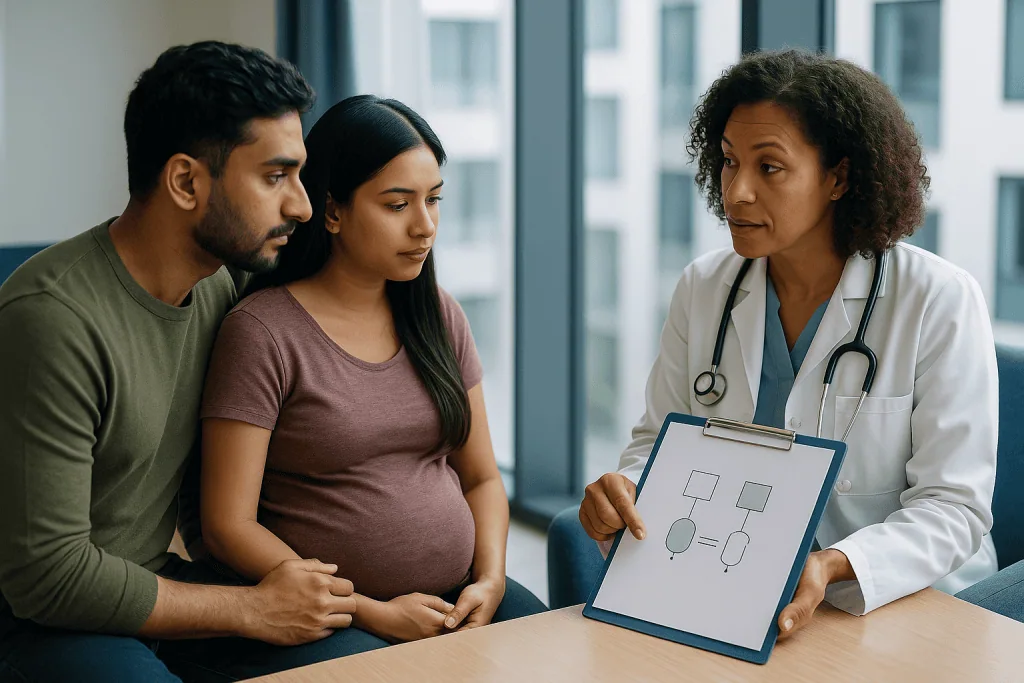
A first session usually opens not with your results but with your family. The counselor draws a pedigree, a diagram of at least three generations showing who had anemia, who needed transfusions, who died young and where the family’s ancestors lived. Patterns that look like coincidence to a family often look like inheritance on paper.
Next comes the explanation of your own results, in the order the laboratory produced them: red cell size, hemoglobin fractions, DNA findings if available. Expect the counselor to draw the two-copy or four-copy gene picture and to walk through the inheritance odds with a simple grid. Most people find the grid clearer than the percentages.
The middle of the session covers options, and this is where the non-directive principle is most visible. If both partners are carriers of beta thalassemia, the counselor will typically describe conceiving naturally with prenatal diagnosis, conceiving through IVF with embryo testing, using donor eggs or sperm, adoption, and having children without testing and planning care from birth. Each option is described with its timing, its practical demands and its limits. The counselor will not rank them.
Toward the end, the conversation turns to the wider family. Because each sibling of a carrier has a 50 percent chance of also being a carrier, counselors often raise what is called cascade testing, meaning the offer of testing to relatives who may be at risk. You decide whether and how to share; the counselor can provide a letter you can pass on.
Sessions end with written material and a plan for follow-up, which might be a second appointment once the partner’s results return, a referral to hematology, or a maternal-fetal medicine referral if a pregnancy is already underway. Many people describe leaving with fewer questions than they arrived with but with a clearer sense of which questions are theirs to answer.
Thalassemia trait and pregnancy: what changes when you are already expecting?
Most people learn about carrier status during pregnancy, which compresses a leisurely decision into a few weeks. The counseling content does not change, but the sequencing does, and the gestational clock shapes every step.
For the pregnant carrier, the first clinical question is iron. Pregnancy raises iron needs, and a carrier’s small red cells can mask or mimic iron deficiency on a routine count. Clinicians generally check ferritin rather than assuming, because unnecessary iron does not help thalassemia trait and real deficiency should be treated on its own evidence. Mayo Clinic notes that thalassemia trait itself typically causes mild or no anemia, and most carriers have uncomplicated pregnancies.
The partner’s test becomes urgent. If the partner is not a carrier of the same type, counseling can usually close with reassurance about the disease and a note that the child has a 50 percent chance of being a carrier. If the partner is also a carrier, prenatal diagnostic testing is offered.
Two tests exist. Chorionic villus sampling (CVS) takes a small piece of placental tissue and is usually performed between 11 and 14 weeks of pregnancy. Amniocentesis takes a sample of the fluid around the fetus and is usually offered from 15 weeks onward. Both are DNA tests for the specific gene changes already identified in the parents, which is why parental DNA results need to be in hand first. Both carry a small additional risk of miscarriage, which the NHS estimates at up to about 1 in 100 procedures.
Non-invasive prenatal testing from a maternal blood sample, which screens for chromosome conditions such as Down syndrome, does not currently diagnose thalassemia in routine practice, and counselors are careful to explain that distinction.
Where a four-gene alpha condition is possible, maternal-fetal medicine specialists usually add ultrasound monitoring, because fetal anemia produces visible changes and because the pregnant parent can develop complications. That pathway is specialized and is coordinated by the treating obstetric team.
What options do couples usually discuss when both partners are carriers?
When two carriers of the same type of thalassemia plan a family, counseling lays out a menu rather than a recommendation. Here is what each item typically involves, in neutral terms.
Natural conception with prenatal diagnosis means conceiving as usual, then having CVS or amniocentesis to test the fetus. Results guide a decision to continue the pregnancy with planning for care at birth, or not to continue, depending on the family’s values and the law where they live. Some couples use prenatal testing purely to prepare, with no intention of ending a pregnancy, and counselors support that use.
Preimplantation genetic testing, often shortened to PGT-M for single-gene conditions, pairs IVF with testing of embryos before transfer. A few cells are removed from each embryo and analyzed for the known parental gene changes; unaffected embryos can then be selected. The process requires a fertility clinic, a laboratory able to design a test for the family’s specific variants, and several months of preparation. It does not guarantee a pregnancy, and confirmatory prenatal testing is often still advised.
Donor eggs or donor sperm removes one altered gene from the equation entirely, because the donor is screened as a non-carrier. Adoption or choosing not to have children are also described plainly, without being treated as lesser choices.
Having children without testing is a legitimate option that some couples choose, particularly where their faith or outlook does not permit the alternatives. Counseling then shifts to preparation: identifying a hematology team, understanding that newborn screening or early testing will confirm the child’s status, and learning what transfusion and iron chelation programs involve. Chelation is treatment to remove the excess iron that builds up from repeated transfusions, and it is lifelong for people on regular transfusions.
The counselor’s role in all of this is to make sure nobody chooses a path because they did not know another existed.
What do the following weeks look like after carrier testing?
The timeline depends entirely on whether a pregnancy is underway, so it helps to describe both versions.
Outside pregnancy, the pace is gentle. A CBC and hemoglobin analysis usually return within a few days. If they suggest carrier status, a counseling appointment follows, often within a few weeks, and DNA testing is ordered for one or both partners. DNA results commonly take two to six weeks. A second session reviews the combined results. If both partners are carriers and the couple is considering IVF with embryo testing, the laboratory work to design a family-specific test can add further months before any treatment cycle begins. Many couples describe this phase as unexpectedly calm: the questions are serious, but there is time.
During pregnancy, the same steps run on a compressed clock. The NHS model, which offers screening ideally by 10 weeks, is built so that a carrier result, a partner test and a counseling session can all happen before the CVS window opens at 11 weeks. In systems without a formal program, the first result may arrive later, and the available diagnostic test may be amniocentesis from 15 weeks rather than CVS. Prenatal DNA results typically take one to two weeks, sometimes longer for alpha deletions.
Physically, carrier testing involves nothing more than blood draws. CVS and amniocentesis are outpatient procedures; most people are advised to rest for the remainder of the day and to report cramping, bleeding or fluid leakage, which the obstetric team will have described.
Emotionally, the weeks between tests are the hardest part, and counselors say so openly. Written summaries, a named contact for questions and, where available, peer support through patient organizations help. Results are usually given in a scheduled call or appointment rather than by letter, so that the next step can be discussed in the same conversation.
Is gene therapy for thalassemia available, and what does counseling say about it?
Yes, gene therapy exists for some people with transfusion-dependent beta thalassemia, and counselors are asked about it at nearly every session. The honest answer has three parts: what it is, whom it is for, and what remains unknown.
Two approaches have regulatory approval in the United States and elsewhere. Gene addition uses a modified virus called a lentiviral vector to insert a working copy of the beta globin gene into a patient’s own blood-forming stem cells. Gene editing uses a CRISPR-based tool to switch on production of fetal hemoglobin, the form all of us made before birth, which can stand in for the missing adult chains. In both cases, stem cells are collected from the patient, modified in a laboratory, and returned after chemotherapy has cleared space in the bone marrow. That chemotherapy step carries real risks, including infertility and infection, and is one reason the treatment is given only in specialized centers.
Eligibility is narrow. These therapies are for people who already have severe disease and depend on transfusions. They do not apply to carriers, who are healthy, and they are not used to alter the genes a person passes to children. A treated person’s eggs or sperm are unchanged, so their children face the same inheritance odds as before.
On outcomes, the evidence base consists of clinical trials in relatively small numbers of people followed for a limited number of years. Long-term durability and late effects are still being collected. A responsible counselor will say that gene therapy is a meaningful development, not a reason to treat the carrier conversation as obsolete.
Cost is another frequent question. This magazine does not publish treatment prices because they vary by country, payer and program and because a figure out of context misleads more than it informs. Questions about coverage and access belong with the treating hematology team and the relevant payer.
Stem cell transplantation from a matched donor, which Mayo Clinic lists among established treatments for severe thalassemia, remains the comparator against which gene therapy is judged.
What people often get wrong about thalassemia carrier status
Myths around thalassemia are persistent, and some cause real harm. These are the ones counselors correct most often.
“Carriers have a mild form of the disease.” They do not. Beta thalassemia trait and alpha thalassemia trait are not illnesses. The NHS is explicit that carriers are healthy, may have slightly small red cells and mild anemia, and need no treatment. The term “thalassemia minor” contributes to the confusion because it sounds like a diagnosis rather than a description of carrier status.
“If I’m a carrier, I should take iron.” Only if iron deficiency is confirmed. Small red cells in a carrier are caused by reduced globin production, not by low iron, and extra iron does not change them. Unneeded iron supplements can cause gastrointestinal side effects and, over years, can contribute to iron buildup. Any supplement decision belongs with your clinician after a ferritin check.
“Thalassemia only affects people from the Mediterranean.” The name comes from the Greek word for sea, but CDC and MedlinePlus describe carriers across the Middle East, South and Southeast Asia, China and parts of Africa, and in every community descended from those regions. Ancestry questionnaires miss people whose family history is incomplete, which is one reason blood-based screening matters.
“We already have a healthy child, so we’re fine.” Each pregnancy carries the same independent chance. A healthy first child provides no information about the second.
“A carrier test is a genetic test, so it will tell me about everything.” Carrier testing for thalassemia examines the globin genes only. It does not screen for other inherited conditions unless an expanded panel is ordered, and it does not predict the carrier’s own future health.
“Gene therapy means we don’t need to think about this anymore.” Gene therapy treats some people who already have severe disease. It does not change what carriers pass on, and it is not available or appropriate for everyone with thalassemia.
Why relatives beyond the couple are part of the picture
A carrier result is rarely a fact about one person. It is a fact about a bloodline, and counselors spend part of every session on what that means for parents, siblings and children.
The arithmetic is straightforward. If you are a carrier, at least one of your parents is a carrier. Each of your full siblings has a 50 percent chance of carrying the same change. Each of your children, if your partner is not a carrier, has a 50 percent chance. Your nieces and nephews may be carriers through your siblings. None of these people is ill, and none of them knows unless someone tells them or a test happens to catch it.
This is the logic behind cascade testing: offering carrier testing to relatives who have a known chance of carrying the same gene change, so that they can make their own reproductive decisions with information rather than by chance. The CDC and NHS both frame family testing as an opportunity rather than an obligation.
Sharing results raises practical and emotional questions. Who tells the sibling who is already pregnant? How does a parent explain to a teenage carrier what the result means without alarming them? Counselors routinely provide a plain-language family letter that names the gene change found, explains what a carrier is and tells the relative what test to ask for. Many people find a letter easier than a phone call.
Privacy runs the other way too. Your results are yours. No clinician will contact your relatives without your consent, and you are entitled to decide the pace at which information travels.
For children identified as carriers through newborn screening, the standard advice is to tell them in stages, with a fuller conversation in adolescence when the information becomes relevant to their own lives. Counselors can help plan that conversation, and some clinics offer a dedicated appointment for young adults who learned their status as children.
Questions to ask your care team
Counseling works best when you arrive with questions already written down. The list below is a starting point; cross out what does not apply and add what keeps you awake.
- Which type of thalassemia do I carry, alpha or beta, and has the exact gene change been identified by DNA testing?
- If alpha: are my two missing genes on the same chromosome (cis) or on different chromosomes (trans), and does that change the risk for a pregnancy?
- Has my partner been tested for both alpha and beta thalassemia, and for other hemoglobin variants such as sickle cell or hemoglobin E that can interact with mine?
- What is the chance, for each pregnancy, of a child with the disease, a carrier child, and a child with neither?
- Which prenatal tests are available to us, at what weeks, and how long do results take?
- If we were to consider IVF with embryo testing, how long would the preparation take, and who would coordinate it?
- Do I need a ferritin test before anyone recommends iron, and should my iron be rechecked during pregnancy?
- Which of my relatives might benefit from testing, and can you give me a letter to share with them?
- If a child were born with thalassemia, which hematology team would care for them, and what would the first year look like?
- Is anyone in our family a candidate for stem cell transplantation or gene therapy, and who makes that assessment?
- Who do I contact if I have questions between appointments, and will I receive a written summary?
One more question deserves its own line: “What would you want to know in my position that I have not asked?” Experienced counselors appreciate it, and the answer often surfaces the detail a family would otherwise discover too late.
When to call your doctor
Carriers are healthy, so most of this section concerns people with the disease, children being evaluated, and pregnancies where a severe form is possible. Knowing the red flags helps families act on time rather than wonder.
For an infant or child whose parents are both carriers, contact your pediatrician or hematology team promptly if you notice persistent pallor, yellowing of the skin or whites of the eyes, a swollen belly that could indicate an enlarged spleen or liver, unusual tiredness or irritability, poor feeding or slow growth, or dark urine. Mayo Clinic lists these among the early signs of significant thalassemia, which typically appear in the first two years of life for beta thalassemia major. Seek urgent care for breathlessness, a very fast heartbeat, or a child who is floppy or difficult to rouse.
For adults with thalassemia on transfusions, call your team about new shortness of breath, chest pain, palpitations, swelling of the legs, severe abdominal pain, fever, or symptoms of high blood sugar such as unusual thirst and frequent urination, since iron overload can affect the heart, liver and pancreas.
In pregnancy where both partners carry alpha thalassemia, or where a fetus has been diagnosed with a hemoglobin disorder, report sudden swelling, severe headache, visual disturbance, rapid weight gain, or reduced fetal movement to your obstetric team the same day. After CVS or amniocentesis, report bleeding, fluid leakage, persistent cramping or fever.
For any carrier, a reason to call is simpler: if you have been prescribed or advised iron without a ferritin test, or if your anemia is being treated without anyone having considered thalassemia, ask for a review.
None of this replaces individual advice. Every threshold for action, every test and every treatment decision sits with your treating team, who know your results and your history.
Frequently asked questions
What does genetic counseling for thalassemia typically include?
A typical session includes a three-generation family history, an explanation of your blood and DNA results, a calculation of the chance of an affected child for each pregnancy, a neutral description of prenatal and preimplantation testing options, and referral to hematology if anyone in the family needs care. Counselors do not recommend a path; they provide evidence and a written summary and leave decisions with you and your treating team.
Is thalassemia inherited from a mother or father?
From both. A child with beta thalassemia major inherited one altered gene from each parent, so both parents are carriers even if neither has symptoms. A child who inherits a single altered copy from one parent becomes a healthy carrier, not someone with the disease. The inheritance is autosomal recessive, which means sons and daughters are affected equally.
How is thalassemia carrier testing done?
It begins with a complete blood count, which shows small red cells in most carriers, and a hemoglobin analysis such as electrophoresis, which usually detects beta thalassemia trait through raised hemoglobin A2. Alpha thalassemia trait often looks normal on that test and needs DNA analysis of the alpha globin genes to confirm. Both partners are usually tested at the same time.
What is the thalassemia inheritance pattern for alpha thalassemia?
Alpha thalassemia also follows autosomal recessive inheritance, but because each person has four alpha globin genes, the outcome depends on how many are missing and how they are arranged. A parent can pass on two missing genes at once only if both sit on the same chromosome, the cis arrangement. The most severe form, with all four genes missing, is possible only when both parents carry the cis form.
Does thalassemia trait affect pregnancy?
For the pregnant carrier, thalassemia trait itself usually causes mild or no anemia and most pregnancies are uncomplicated, though iron status should be checked with a ferritin test rather than assumed. The main issue is the partner’s carrier status, which determines whether the pregnancy could be affected and whether prenatal diagnostic testing is offered. Your obstetric team coordinates any extra monitoring.
Is there gene therapy for thalassemia?
Yes. Two approaches have regulatory approval for some people with transfusion-dependent beta thalassemia: gene addition using a lentiviral vector and CRISPR-based editing that switches on fetal hemoglobin. Both involve collecting a patient’s own stem cells, modifying them and returning them after chemotherapy. They are not used for carriers and do not alter the genes passed to children. Long-term results are still being gathered.
How much does thalassemia gene therapy cost?
This article does not publish treatment prices, because figures vary widely by country, payer and program and a number without context tends to mislead. Gene therapy is offered only in specialized centers to people with severe, transfusion-dependent disease who meet eligibility criteria. Questions about access, coverage and the full assessment process should go to the treating hematology team and the relevant payer.
Can two thalassemia carriers have a healthy child?
Yes. When both partners carry a beta thalassemia gene change, each pregnancy has a 3 in 4 chance of a child without the disease: a 2 in 4 chance of a healthy carrier and a 1 in 4 chance of a child who inherits no altered copy. The 1 in 4 chance of an affected child applies independently to every pregnancy, which is why prenatal or embryo testing is offered.
Should a thalassemia carrier take iron supplements?
Only if iron deficiency is confirmed by a ferritin test. Small red cells in a carrier come from reduced globin production, and extra iron does not change them. Taking iron that is not needed can cause side effects and, over time, contribute to iron buildup. Any supplement decision, especially in pregnancy when iron needs rise, belongs with your clinician.
When can prenatal testing for thalassemia be done?
Chorionic villus sampling is usually performed between 11 and 14 weeks of pregnancy and amniocentesis from 15 weeks onward, according to NHS guidance. Both test fetal DNA for the specific gene changes already identified in the parents, so parental DNA results are needed first. Each carries a small additional miscarriage risk, estimated at up to about 1 in 100, which your obstetric team will discuss.
References
- Beta thalassemia: MedlinePlus Genetics
- Alpha thalassemia: MedlinePlus Genetics
- Thalassaemia carriers: NHS
- About Thalassemia: CDC
This article is for general information only and is not a substitute for professional medical advice. Please consult a qualified doctor about your individual situation.

More from the Blog

Neutropenia During Chemotherapy: How Oncology Teams Time Cycles and Protect Patients
Neutropenia during chemotherapy means the blood has too few neutrophils, the white cells that fight bacteria. Oncology teams manage it by checking the absolute…

When Does Myelodysplastic Syndrome Move From Monitoring to Active Treatment?
MDS usually moves from monitoring to active treatment when the disease starts to cause problems that outweigh the burden of therapy: falling blood counts…

How Long Anemia Treatment Takes to Show in Blood Tests and Energy Levels
How long anemia treatment takes depends on the cause. In iron deficiency, many people notice more energy within one to two weeks, hemoglobin usually…

How Marrow Failure Treatment Is Planned: Transfusions, Medicines or Transplant
Marrow failure treatment is planned in steps. Doctors first confirm the cause and grade severity from blood counts and a marrow biopsy. Transfusions and…

Aplastic Anemia in Older Adults: How Age and Fitness Shape the Treatment Recommendation
For older adults with aplastic anemia, treatment is usually chosen by overall fitness, disease severity and donor availability rather than by birth date alone.…

Phlebotomy for Polycythemia Vera: What a Session Involves and How Targets Are Set
Phlebotomy for polycythemia vera is the scheduled removal of roughly a pint of blood through an arm vein to lower the hematocrit, the share…