

What Happens During an IPL Photorejuvenation Session: Cooling Gel, Flashes and Timing
Key Takeaways
- IPL is filtered broad-band light spanning roughly 500 to 1,200 nanometers, not a laser, which is why one device can be tuned toward brown pigment or red vessels by swapping filters.
- The cooling gel does three jobs at once: it couples light into the skin, chills the melanin-rich surface to reduce burns, and lets the handpiece glide.
- Published protocols describe courses of about three to five sessions spaced three to four weeks apart, because pigment needs time to shed and vessels time to resorb between rounds.
- Evidence is consistent for evening out color and considerably weaker for wrinkles and laxity, so deep lines are usually directed toward resurfacing approaches instead.
- Treated sun spots typically darken within hours and flake away over one to two weeks, so early darkening is the expected route out rather than a complication.
- IPL removes existing pigment and vessels but does not stop new ones forming, and Mayo Clinic notes repeat treatment is often needed to maintain improvement, making daily SPF 30 sunscreen the variable you control.
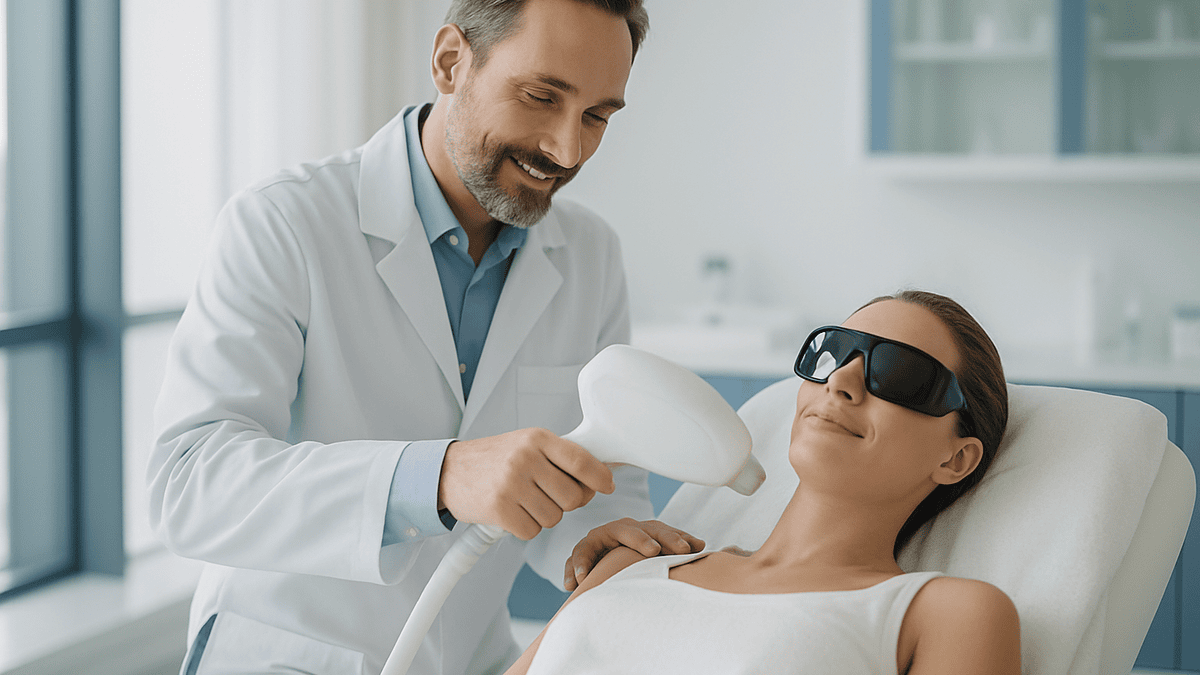
During an IPL photorejuvenation session, a clinician cleanses the skin, applies a cool clear gel, gives you protective eyewear, and passes a handpiece across the treatment area in a series of bright flashes that feel like a warm snap from a rubber band. Most face treatments take roughly 20 to 30 minutes, and the gel is wiped away afterward. Redness usually settles within hours to a day or two.
The waiting room smells faintly of aloe. Someone in a paper gown is asked, for the third time, whether they have been in the sun this week. They have not, and they are a little proud of it. In a few minutes a nurse will smooth a cold, clear gel across their cheeks and hand them a pair of dark goggles that make the ceiling disappear. Then the flashes will start.
If you are booked for your first IPL photorejuvenation session, that scene is probably the part you are most curious about. The brochures show glowing skin; they rarely explain the gel, the goggles, the snapping sensation, or why one person is finished in fifteen minutes while another is asked to come back four times.
This explainer walks through the room, the device, and the timing the way a clinician would if there were no schedule to keep, and it stays honest about what the published evidence does and does not show.
What actually happens in an IPL photorejuvenation session, step by step
IPL stands for intense pulsed light: a device that releases short bursts of filtered, non-laser light across a range of wavelengths. Photorejuvenation simply means using that light to fade brown spots and visible small vessels so the skin looks more even. Put together, an IPL photorejuvenation session is a short outpatient visit that follows a fairly predictable rhythm.
The appointment opens with questions. The clinician confirms recent sun exposure, self-tanner, tanning beds, retinoid use, current medicines, and any history of cold sores or keloid scars. Photographs are often taken so both of you can compare later, because memory flatters and flatters unevenly.
Next comes cleansing. Makeup, sunscreen and skin oils are removed, since anything sitting on the surface can absorb light meant for deeper pigment. A test pulse on a small patch is common, particularly for a first visit, to check how your skin reacts before the whole area is treated.
Then the gel. A cool, water-based gel is spread over the treatment area, goggles or adhesive eye shields go on, and the handpiece is pressed gently to the skin. Each press delivers one flash. The clinician works in overlapping rows, cheek to cheek, lifting and repositioning between pulses.
When the area is covered, the gel is wiped away, the skin is cooled again if needed, and sunscreen is applied. You will be given written aftercare instructions and, in most protocols, a return date several weeks out. That entire sequence, from questions to sunscreen, is what people mean when they talk about a session. The next sections take each piece apart.
How does IPL work, and is IPL a laser?
IPL is not a laser, and the difference matters for what it can treat. A laser emits a single wavelength, meaning one precise color of light. IPL emits a broad band, roughly 500 to 1,200 nanometers according to a review in Lasers in Surgery and Medicine, and glass filters trim that band to suit the target (a nanometer is one billionth of a meter, the unit used to describe light color).
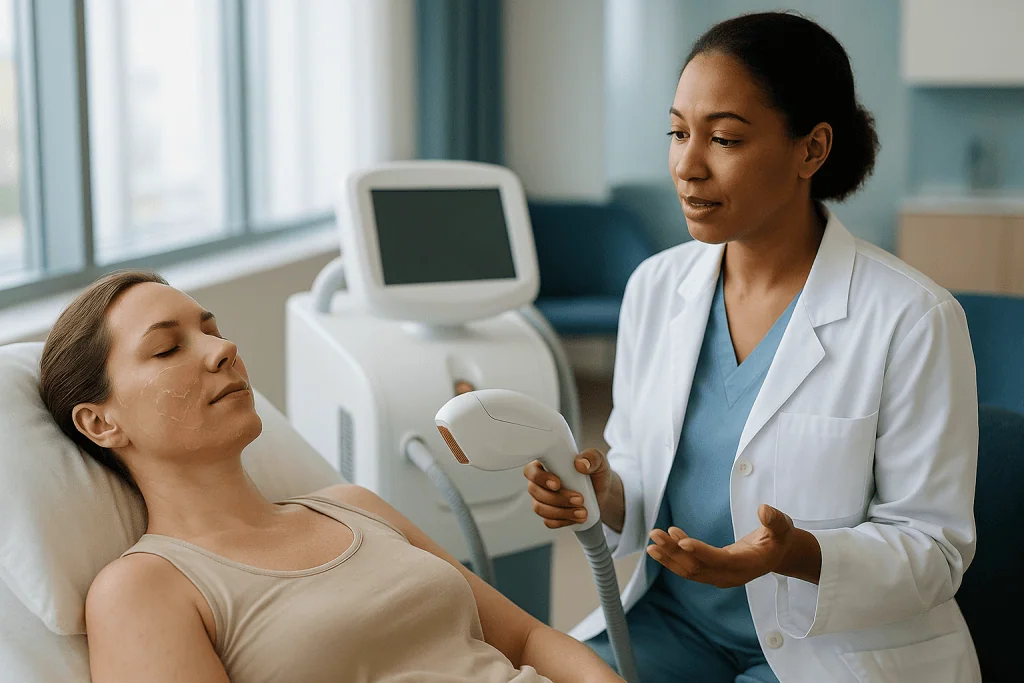
The underlying principle is called selective photothermolysis: light is absorbed by a specific colored molecule, called a chromophore, which converts it to heat, and that heat damages the structure holding the chromophore while sparing surrounding tissue. Skin has two chromophores that matter here. Melanin, the brown pigment in sun spots and freckles, absorbs strongly across the visible range. Hemoglobin, the red pigment in blood, absorbs at particular peaks and is the target in flushed cheeks and fine visible vessels.
Because the light is broad, one device can be tuned toward brown or toward red by swapping filters. That flexibility is the appeal. The cost of flexibility is precision: a laser aimed at a single vessel is more focused, while IPL treats a wider field at once.
Heat also reaches the upper dermis, the second layer of skin, and there is laboratory and clinical evidence of modest collagen remodeling afterward. The same review characterizes this textural effect as smaller and less consistent than the effect on pigment and vessels, which is why realistic expectations start with color, not wrinkles.
Melanin in the surrounding skin absorbs light too. That is the central reason skin tone shapes eligibility, filter choice, and energy settings, discussed below.
Why the cooling gel matters more than it looks
The gel looks like an afterthought. It is doing three jobs at once.
First, optical coupling. Air between the handpiece crystal and the skin scatters light and wastes energy. A film of clear gel fills that gap so the flash passes into the skin more uniformly, the same reason ultrasound technicians use gel before scanning.
Second, cooling. IPL works by heating pigment and vessels below the surface, but the outermost layer, the epidermis, contains melanin too and absorbs some of every pulse. A chilled gel pulls heat out of that top layer before and during the flash, reducing the chance of a burn or a blister. Many modern handpieces add a cooled sapphire or glass tip for the same reason; the gel and the tip work together.
Third, glide. The clinician needs to lift, reposition and press hundreds of times without dragging the skin. Gel lets the crystal slide.
You may notice the gel is noticeably cold, sometimes kept in a refrigerator, and that the clinician reapplies it as it warms. That is deliberate rather than fussy. The skin’s surface temperature during a pulse is the single variable most linked to unwanted effects such as blistering and pigment change, and cooling is the simplest lever to control it.
A practical note: the gel is usually water-based and washes off easily. If you have a known allergy to common gel ingredients or preservatives, mention it at the consultation. Reactions are uncommon, but a quick swap is easier than an itchy afternoon.
By the time the goggles are on, the gel has cooled the skin, and the first test flash is about to happen.
What do the flashes feel like?
Ask ten people and you will hear the same comparison ten times: a rubber band snapped against the skin, wrapped in a moment of warmth. The flash itself is so bright that even through goggles you perceive it as a burst of white or orange behind your eyelids. There is often an audible click from the device as the capacitor discharges.
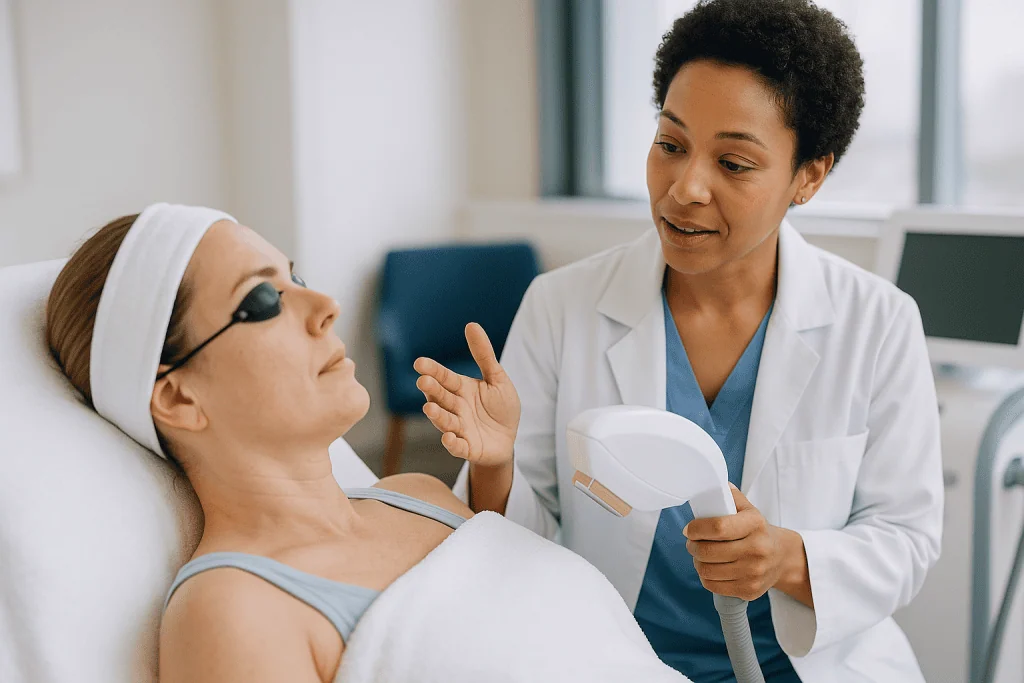
Each pulse lasts a few thousandths of a second. The sensation is sharp but short, and it varies by location. Skin over bone, such as the forehead, temples and jawline, tends to sting more than the fleshy cheeks. Areas with denser pigment or more visible vessels absorb more energy and can feel hotter, because absorption is the mechanism.
Discomfort also changes across the session. The first few pulses feel loud; most people report they settle into a rhythm and the later rows feel routine. Clinicians commonly pause after the test pulse to ask you to rate the sensation, then adjust the energy setting, called fluence, downward if the response is stronger than expected.
Numbing cream is not routinely needed for facial photorejuvenation in most published protocols, though some practices offer it for sensitive areas or anxious patients. If it is used, that is a decision for the treating clinician, and you should mention any past reactions to topical anesthetics.
Immediately after a pulse the skin often flushes pink and may look faintly darker over freckles and sun spots. That darkening is expected: the pigment has absorbed heat and is beginning the process that ends with it flaking away over the following days. Cold air or a cooled roller between rows takes the edge off the warmth.
How long does an IPL photorejuvenation session take, and what sets the timing?
The flashes themselves are the shortest part. Reviews describe typical face treatments in the range of about 20 to 30 minutes, with smaller areas such as the hands finishing faster and larger areas such as the chest or back taking longer. Add consultation, photographs, cleansing, gel and aftercare, and an hour in the building is a reasonable plan.
Four variables set the timing inside the room.
- Surface area. A full face needs several hundred overlapping pulses; a pair of hands needs far fewer.
- Number of passes. Some protocols treat pigment and redness in one pass with a single filter; others use two passes with different filters, roughly doubling the flash time.
- Cooling breaks. Reapplying cold gel and letting the skin recover between rows adds minutes but protects the surface.
- Test pulse and adjustment. A first visit almost always runs longer than a follow-up because the clinician is establishing your settings.
Timing also has a slower clock. Sessions are spaced weeks apart, commonly three to four in the published literature, so that treated pigment can shed and vessels can resorb before the next round. Treating sooner does not compress the biology, and it can raise the chance of irritation on skin that has not fully recovered.
Seasonal timing is the third clock. Because tanned skin carries more melanin in the epidermis, many clinicians prefer to treat during months when patients can realistically avoid strong sun for several weeks before and after. That is guidance, not a rule; the practical question is whether you can protect the skin, not what the calendar says.
Who is IPL usually for, and who is usually asked to wait
IPL photorejuvenation suits a fairly specific set of concerns. In published reviews and in guidance from Mayo Clinic on age spots and on rosacea, the strongest indications are sun-related brown spots, scattered freckling, diffuse facial redness, and fine visible vessels called telangiectasias (small dilated blood vessels near the surface). Mild textural roughness may improve as a secondary effect.
The best candidates share three features: a clear pigment or vessel target, relatively lighter skin tones in which that target contrasts with the background, and the ability to avoid sun exposure before and after treatment.
Skin tone is the most consequential factor. Dermatologists describe tone using the Fitzpatrick scale, a six-step classification of how skin responds to sun. In deeper tones the epidermis contains more melanin, so it absorbs more of every pulse and the margin between an effective setting and one that causes burns or dark patches narrows. Many clinicians do not offer IPL for the deepest tones and will suggest other approaches; for medium tones, conservative settings, specific filters and careful test pulses are standard.
People who are often asked to wait or to consider alternatives include those with a recent tan or self-tanner, active skin infection or cold sores in the area, a history of keloid scarring, recent use of photosensitizing medicines (drugs that make skin react more strongly to light, a question for the prescribing clinician), or unstable melasma, a hormonally influenced pigmentation that can worsen with heat.
Pregnancy is generally treated as a reason to postpone, mostly because safety data are lacking rather than because harm is documented. Whoever falls into any of these groups, the decision rests with the assessing clinician after a proper skin examination.
How many IPL sessions do you need?
Most published protocols describe a series rather than a single visit. The Lasers in Surgery and Medicine review of IPL reports typical courses of roughly three to five treatments spaced about three to four weeks apart, and Mayo Clinic’s patient information on age spots notes that light-based treatments may need two or three sessions. Those figures are ranges observed in studies, not promises for any one person.
Why more than one? Each session clears only a portion of the target. Pigment sits at different depths and densities, and vessels vary in caliber, so a setting safe for the whole face will fully treat some spots and partially treat others. Repeating the cycle catches what remained. Spacing matters because treated pigment takes days to flake away and treated vessels take weeks to resorb; the next session should begin from a settled baseline.
Several factors push the count up or down.
- Density of the target: a few discrete sun spots often respond faster than diffuse freckling across the whole face.
- Redness versus pigment: vessel-based concerns frequently need more sessions than pigment-based ones.
- Skin tone: conservative settings in medium tones may mean more, gentler visits.
- Ongoing sun exposure: new pigment can form while old pigment is being treated.
A course also has a stopping point. Once the target has faded to the point where further sessions produce little visible change, most clinicians recommend pausing rather than continuing indefinitely. Maintenance visits, discussed later, are a separate question from the initial course. Your treating team will suggest a number based on your test pulse and your response to the first visit, and will revise it as they see how your skin behaves.
Does photorejuvenation really work? What the evidence shows
The honest answer has two halves, and the split runs between color and texture.
For pigment and vessels, the evidence is reasonably consistent. Reviews summarize multiple studies showing meaningful lightening of sun-related brown spots and reduction of facial redness and small vessels after a course of IPL, with most participants in those studies reporting visible improvement. Mayo Clinic lists IPL among the standard options for age spots and describes light-based treatments as an established approach for the visible vessels of rosacea. The NHS rosacea guidance likewise mentions laser and IPL for persistent redness when other measures have not helped.
For wrinkles, pore size and skin laxity, the evidence is thinner and the effects smaller. Histology studies show some new collagen in the upper dermis after IPL, and patients in trials often rate texture as slightly smoother. Those changes are subtle compared with the pigment effects and are inconsistent across studies. Anyone whose main concern is deep lines or sagging is likely to be steered toward resurfacing lasers or other approaches, and Cleveland Clinic’s overview of laser skin resurfacing outlines what those involve.
Quality of the literature deserves a caveat. Many IPL studies are small, single-center and open-label, and device settings vary widely, so results are difficult to pool into a single effect estimate. Systematic reviews call for larger controlled trials. That does not mean the treatment is unproven for its core indications; it means the size of the benefit for any individual is not predictable in advance.
The most defensible summary is this: IPL is well supported for evening out color, modestly supported for texture, and not a treatment for volume loss or deep wrinkles.
IPL photofacial results: can you see a change after one treatment, and how long do they last?
After a single session, many people see a change, though not the one they expected first. Treated sun spots often turn darker within hours, like coffee grounds scattered under the skin, then lift and flake away over roughly one to two weeks in the timelines described in reviews. When the flaking finishes, the underlying skin is usually lighter. Redness and small vessels may look blotchier for a day or two before gradually fading over the following weeks.
So yes, one treatment can produce a visible difference in discrete brown spots. Diffuse redness, dense freckling and any textural change typically take the full course before the difference is obvious, which is why photographs at each visit are more reliable than the mirror.
Durability is where expectations most often drift. IPL removes existing pigment and closes existing vessels. It does not change the skin’s tendency to produce new ones. Sun exposure, genetics, and the underlying condition driving redness continue. Mayo Clinic’s rosacea guidance notes that light-based treatments often need to be repeated periodically to maintain the improvement, and the same logic applies to sun spots in someone who keeps spending weekends outdoors without protection.
In practice, clinicians commonly describe results as lasting many months to a few years for pigment in well-protected skin, with redness tending to return sooner, and they frame maintenance as optional and driven by what you see rather than by a fixed schedule. Those durations come from clinical experience and small studies rather than long-term trials, and your treating team can only give you a range, not a date.
Daily broad-spectrum sunscreen is the single behavior most linked to how long the improvement holds.
IPL aftercare: what the following days and weeks usually look like
The first evening is mostly warmth. Skin often feels like a mild sunburn for a few hours, and pinkness may last through the next day. Cool compresses and a bland moisturizer are the usual advice. Washing with lukewarm water and avoiding scrubs, acids and retinoids for a few days lets the surface recover.
Days two through seven belong to the pigment. Treated spots darken, feel slightly rough, and begin to lift. The temptation to pick is real and worth resisting: pulling off a spot before it is ready can leave a lighter or darker mark. Gentle cleansing does the job on its own.
By the second week most flaking has finished and the lighter skin underneath is visible. Redness treated at the same session is usually still fading at this point; vessels resorb more slowly than pigment sheds.
Sun protection runs through the whole period. Freshly treated skin is more prone to new pigmentation, and public health guidance from the NHS recommends broad-spectrum sunscreen of at least SPF 30, reapplied through the day, alongside shade and hats. Many clinicians ask for strict protection for several weeks both before and after each session.
Makeup can usually go on the day after treatment if the skin is intact, but any open or blistered area should be left bare until your clinician has looked at it.
A short timeline, drawn from published descriptions rather than a guarantee for you:
- Hours: warmth, pinkness, spots darkening.
- Days 2 to 7: flaking of pigment; mild dryness.
- Weeks 2 to 4: settled skin; redness still fading; next session typically scheduled.
IPL vs laser and other options: a plain comparison
People often arrive asking for IPL when a different tool fits better, or vice versa. The table sets out the main categories side by side in neutral terms; which one suits you depends on your skin, your target and your tolerance for downtime, and that judgment belongs to the assessing clinician.
| Approach | Main targets | Typical downtime | Skin tone considerations | Notes |
|---|---|---|---|---|
| IPL photorejuvenation | Sun spots, freckles, diffuse redness, small vessels | Hours to a few days of pinkness; pigment flakes over about 1 to 2 weeks | Best studied in lighter tones; caution or alternatives in deeper tones | Broad-band filtered light; series of sessions |
| Vascular laser | Individual vessels, persistent redness | Bruising possible for up to about 2 weeks | Some settings usable across a wider range of tones | Single wavelength; more precise for vessels |
| Pigment laser (Q-switched or picosecond) | Discrete spots, some tattoos | Days of crusting | Certain wavelengths chosen specifically for deeper tones | Very short pulses; less heat spread |
| Ablative or fractional resurfacing | Wrinkles, texture, scarring | Days to weeks of healing | Higher risk of pigment change in deeper tones | Removes or heats columns of skin; more downtime |
| Topical treatments | Mild pigment, prevention | None | Suitable across tones | Slower; maintenance rather than removal |
Two patterns emerge. IPL is a generalist: a good fit when the problem is mixed color, brown and red together, spread across the face. Lasers are specialists: better when one precise target dominates or when skin tone calls for a wavelength IPL cannot isolate. Resurfacing sits in a different category altogether, trading real downtime for textural change that IPL rarely delivers.
No option in the table permanently changes how skin responds to sun. Prevention runs alongside all of them.
What are the risks and side effects of IPL?
Most effects are mild and short-lived. Expected reactions include redness, warmth, mild swelling, temporary darkening of pigment and light flaking. These are part of the mechanism rather than complications.
Less common effects, described in reviews and in general cosmetic-procedure guidance from the NHS, include the following.
- Blistering or superficial burns, usually from too much energy for the skin’s melanin content or inadequate cooling. These generally heal but can leave marks.
- Post-inflammatory hyperpigmentation, meaning dark patches that appear after inflammation. Risk rises with deeper skin tones, recent tanning and sun exposure after treatment, and patches can take months to fade.
- Hypopigmentation, or lighter patches, which is rarer and can be longer lasting.
- Bruising or purpura (small purple spots from leaked blood), more often when vessels are the target.
- Reactivation of cold sores around the mouth in people who carry the virus.
- Hair loss in the treated area, because IPL is also used for hair removal and follicles absorb light; relevant for men treated over the beard line.
- Eye injury if the eyes are not fully shielded. Never remove eyewear during pulses, and treatment directly over the eyelid is avoided.
Scarring is uncommon with appropriate settings but not impossible. Operator training and a proper consultation are the strongest protective factors; the NHS advises checking that anyone performing light-based cosmetic procedures is appropriately qualified and works in a setting that can manage complications.
Every medical procedure involves a trade between benefit and risk. IPL’s profile is favorable for its core indications in well-selected skin, and considerably less so when it is applied to skin it was not designed for. Disclosing your full history and following aftercare shifts the balance in your favor.
What people often get wrong about IPL photorejuvenation
Myths gather around any treatment that produces a visible change. These are the ones clinicians correct most often.
It is a laser. It is not. IPL uses filtered broad-band light. The distinction affects precision, which skin tones can be treated safely, and which concerns respond.
It treats wrinkles. Only marginally. The evidence supports color correction far more strongly than textural change. Deep lines and laxity belong to other approaches.
One session is enough. A single session can visibly lighten discrete spots, but published protocols describe courses of several sessions weeks apart for the full effect, especially for redness.
Results are permanent. IPL removes what is there. It does not stop new pigment or new vessels forming, and Mayo Clinic notes repeat treatment is often needed to maintain improvement. Sun protection is the variable you control.
Darker skin cannot be treated at all. Too blunt. Deeper tones carry more risk with IPL and some clinicians decline the deepest tones, but medium tones are treated routinely with adjusted filters and conservative settings. The right answer is an in-person assessment, not a rule of thumb.
Darkening spots mean something went wrong. Usually the opposite. Pigment darkening and flaking is the expected route by which the spot leaves.
Melasma is just another brown spot. Melasma is hormonally influenced and heat-sensitive; IPL can worsen it. A clinician should distinguish melasma from sun spots before any light treatment.
More energy means better results. Higher settings raise burn and pigment-change risk sharply. The skill lies in the lowest effective setting for your skin, not the highest tolerated.
None of these corrections make IPL less useful. They make it useful for the right person, for the right problem, with the right expectations.
Questions to ask your care team before an IPL photorejuvenation session
A good consultation answers most of these unprompted. Bringing the list anyway keeps the conversation concrete.
- Which of my concerns are you targeting with IPL, and which would respond better to something else?
- How does my skin tone affect the filter and energy you plan to use, and will you do a test pulse first?
- Do any of the medicines, supplements or skincare products I use increase light sensitivity, and how long before treatment should I discuss stopping them with whoever prescribed them?
- Could any of my brown patches be melasma rather than sun damage, and how did you rule that out?
- How many sessions do you anticipate, how far apart, and what would make you stop early or change course?
- What should I expect in the first 48 hours, and what would be outside the normal range?
- Who do I contact if I develop blistering, spreading redness or pain after hours, and how quickly can I be seen?
- What are your qualifications and training for light-based procedures, and how are complications managed here?
- Will you photograph me before each session so we can judge progress objectively?
- How long do you ask patients to avoid sun before and after treatment, and what sunscreen advice do you give?
- If I have a history of cold sores, what is your approach to reducing the chance of a flare?
- What happens if I am pregnant, planning pregnancy or breastfeeding during the course?
Write the answers down. The value of a course of treatment lies in consistency across visits, and a written plan from the first consultation makes it easier to notice when something has changed, in your skin or in the approach. Any decision about proceeding, pausing or switching approach sits with you and the treating clinician together, informed by how your skin actually responds.
When to call your doctor after IPL
Mild pinkness, warmth, and darkening then flaking of treated spots are expected and settle on their own. A small number of reactions need prompt attention, and the treating team would rather hear from you early than late.
Contact your clinician the same day, or seek urgent care if you cannot reach them, for any of the following.
- Blisters, open or weeping skin, or areas that look white, gray or leathery rather than pink.
- Pain that increases after the first day instead of easing, or pain that keeps you awake.
- Redness that spreads beyond the treated area, feels hot and tight, or comes with yellow discharge, fever or chills, which can signal infection.
- A cluster of small painful blisters around the mouth or nose, suggesting a cold sore flare.
- Any change in vision, eye pain, or unusual light sensitivity after treatment, even if goggles were worn.
- Swelling of the lips, tongue or throat, wheeze or difficulty breathing, which are emergency symptoms regardless of cause.
- New dark or light patches that appear in the weeks after treatment and are not fading, so they can be assessed and managed early.
Bring your aftercare sheet and, if possible, photographs of the area over time. Do not apply home remedies, exfoliants or acids to an irritated area before it has been examined. Do not start, stop or change any prescribed medicine on your own in response to a skin reaction; the prescribing clinician needs to be part of that conversation.
For most people none of this list will apply. Knowing it exists is what lets you relax through the ordinary warmth and flaking and act quickly on the rare exception.
Frequently asked questions
How many IPL sessions do you need for a photofacial?
Most published protocols describe a course of roughly three to five sessions spaced about three to four weeks apart, and Mayo Clinic notes that light-based treatment of age spots may need two or three sessions. The exact number depends on how dense the pigment or redness is, your skin tone, and how your skin responds to the first visit, so your treating clinician will set and revise the plan.
Does photorejuvenation really work?
For sun spots, freckles, diffuse redness and small visible vessels, reviews of multiple studies show consistent visible improvement after a course of IPL, and Mayo Clinic lists it among standard options for age spots and rosacea-related vessels. For wrinkles and skin laxity the evidence is weaker and the effects are small and inconsistent. Many studies are small and uncontrolled, so the size of benefit for any one person cannot be predicted in advance.
How long does photorejuvenation last?
IPL removes existing pigment and vessels but does not change the skin’s tendency to form new ones. Clinicians commonly describe pigment improvement lasting many months to a few years in well-protected skin, with redness tending to return sooner, and Mayo Clinic notes that repeat treatments are often needed to maintain results. These durations come from clinical experience and small studies rather than long-term trials, so treat them as ranges, not promises.
Can you see results after one IPL treatment?
Often, yes, for discrete brown spots. Treated spots typically darken within hours and flake away over one to two weeks, leaving lighter skin beneath. Diffuse redness, dense freckling and any textural change usually need the full course before the difference is clear, because vessels resorb more slowly than pigment sheds. Photographs taken at each visit are a more reliable judge than the bathroom mirror.
What is the difference between IPL vs laser for the face?
A laser emits a single wavelength aimed at one target; IPL emits a broad band of filtered light that can be tuned toward brown pigment or red vessels. IPL is a generalist suited to mixed color across the face, while lasers are more precise for individual vessels, specific pigment, or deeper skin tones, and resurfacing lasers address texture with more downtime. The right tool depends on your target and skin tone.
Does an IPL photorejuvenation session hurt?
Most people describe each flash as a quick snap like a rubber band with a moment of warmth. Bony areas such as the forehead and jawline sting more than the cheeks, and areas with dense pigment or vessels feel hotter because they absorb more light. Cold gel and cooled handpieces reduce the sensation. Numbing cream is not routinely needed in most protocols, though a clinician may offer it for sensitive areas.
What does IPL aftercare involve in the first week?
Expect mild sunburn-like warmth for a few hours and pinkness through the next day, then darkening and flaking of treated spots over roughly one to two weeks. Use lukewarm water, a bland moisturizer and cool compresses, avoid scrubs, acids and retinoids for a few days, and do not pick at flaking spots. Broad-spectrum sunscreen of at least SPF 30, as NHS guidance recommends, is essential throughout.
Can IPL be done on darker skin tones?
With caution, and not for everyone. Deeper skin tones contain more melanin in the surface layer, which absorbs more of each pulse and narrows the safety margin, raising the risk of burns and dark or light patches. Many clinicians decline IPL for the deepest tones and suggest specific laser wavelengths instead, while medium tones are often treated with adjusted filters and conservative settings after a test pulse.
Why do my sun spots look darker after IPL?
Darkening is the expected first stage. Melanin in the spot absorbs the light, converts it to heat, and the damaged pigment rises toward the surface, looking like coffee grounds under the skin before flaking away over one to two weeks. If the darkening comes with blistering, increasing pain or spreading redness, that is a different picture and you should contact your treating clinician the same day.
Can IPL make melasma worse?
It can. Melasma is a hormonally influenced pigmentation that is sensitive to heat and light, and IPL delivers both, so some people see their patches darken or spread after treatment. Distinguishing melasma from ordinary sun spots is one of the most important jobs of the consultation. If there is any doubt, a clinician may recommend other approaches first, and the decision should rest with them after examining your skin.
References
This article is for general information only and is not a substitute for professional medical advice. Please consult a qualified doctor about your individual situation.

More from the Blog
Dermabrasion Recovery: The Raw Days, Ointments and When Redness Finally Fades
Dermabrasion recovery time typically runs in stages: the treated skin is raw, red and weeping for the first days, new skin usually covers the…
Sun Protection After Dermabrasion: Why Strict Cover Matters for Months, Not Days
Sun protection after dermabrasion needs to continue for months, not days, because the newly grown skin is thin and its pigment cells are easily…

Why Your Cold Sore History Matters Before Laser Resurfacing and How Doctors Prepare for It
Your cold sore history matters before laser resurfacing because the herpes simplex virus that causes cold sores stays dormant in facial nerves and can…

What to Stop Before a Chemical Peel: Retinoids, Scrubs, Waxing and Sun Exposure
Before a chemical peel, people are usually asked to pause topical retinoids and exfoliating acids, stop facial scrubs, masks and exfoliating devices, avoid waxing,…
Laser Resurfacing Results: What Fine Lines and Acne Scars Realistically Look Like Afterward
Laser resurfacing results are usually a partial, gradual softening rather than a complete erasure. Fine lines around the eyes and mouth commonly look shallower,…
Blood Thinners, Anti-Inflammatories and Mesotherapy: What Your Doctor Checks First
Blood thinners and anti-inflammatory medicines matter for mesotherapy because the treatment relies on many shallow needle punctures, and anything that slows clotting raises the…