

What Recovery After Lip Reconstruction Involves: Soft Foods, Swelling and Suture Care

Key Takeaways
- The lip has four layers to rebuild (skin, muscle ring, inner lining and vermilion), and most early recovery rules exist to protect the alignment of the muscle and the red border.
- Non-dissolving stitches are usually removed within 3 to 21 days depending on the site, with the face typically at the earlier end, according to MedlinePlus.
- Pronounced swelling in the first three days is expected on the lip; swelling that increases after day three or turns hot and tense is a reason to call.
- A soft or liquid diet protects the repair because every wide bite pulls on the sutures, and a straw may be discouraged since sucking tightens the repaired muscle.
- The NHS notes scars can take up to two years to fully mature, so the appearance at one month is a draft, not the result.
- Cleft lip repair is usually performed at around three to six months of age, with most babies home within a day or two, per NHS and MedlinePlus guidance.
Lip reconstruction recovery usually unfolds in stages: swelling and numbness are most noticeable in the first few days, a soft or liquid diet protects the repair while stitches are in place, non-dissolving facial sutures are typically removed within one to two weeks, and the scar keeps softening for a year or longer. Your surgical team sets the exact timeline based on the technique used and how you heal.
The first meal after lip surgery is rarely about hunger. It is about the spoon. A retired teacher who had a skin cancer removed from her lower lip described sitting at her kitchen table, staring at a bowl of lukewarm soup, trying to work out which side of her mouth still belonged to her. The numb half did not cooperate. The stitched half stung. She ate slowly, from a teaspoon, and counted it as a win.
That small scene captures what lip reconstruction recovery actually asks of people. The operation itself, whether it follows cancer removal, an injury, or a cleft repair, is usually the shorter part. The longer part is learning to eat, speak, clean a wound and wait for a scar to settle on the most mobile, most visible, most sensitive skin on the body.
This explainer walks through that process honestly: what swelling really does, why soft foods matter, how suture care works, and which signs mean you should pick up the phone.
What lip reconstruction actually involves
Lip reconstruction is surgery that rebuilds part of a lip after tissue has been lost or is missing. The most common reason in adults is removal of a skin cancer, but it also follows trauma, burns, dog bites and congenital differences such as cleft lip. The lip is not just skin. It is a layered structure: outer skin, a ring of muscle called the orbicularis oris (the muscle that lets you purse, pout and seal your mouth), the moist inner lining, and the pink vermilion, which is the visible red border between skin and lining.
The surgeon’s task is to restore all of those layers in the right alignment. How they do it depends on how much is missing. A small defect can often be closed directly, edge to edge. A larger one may need a flap, which is a piece of nearby tissue moved on its own blood supply, or, less commonly, a graft, which is tissue detached from one site and placed at another. Mayo Clinic describes this ladder of options in its overview of skin cancer surgery: the more tissue removed, the more likely a flap is needed to keep the mouth working and looking natural.
Two details matter enormously to recovery. First, the vermilion border must line up to within a fraction of a millimeter; even a small step is visible across a room. Second, the muscle ring must be reconnected so the mouth can still close around a cup. Surgeons spend most of their effort on those two points, and much of your early recovery, from the soft diet to the instruction not to stretch your mouth wide, exists to protect that alignment while it heals.
Who is usually offered lip reconstruction, and who is asked to wait
Most people who need lip reconstruction arrive by one of three routes. The largest group has had a skin cancer removed, most often a basal cell carcinoma or a squamous cell carcinoma on the sun-exposed lower lip. Mayo Clinic notes that basal cell carcinoma is the most common form of skin cancer and typically appears on areas that see the most sun, which for the face includes the lips. A second group has had an injury, from a fall, an animal bite or a sports collision. The third is children born with a cleft lip, where the repair is planned from birth.

Timing is where individual circumstances come in. After cancer removal, reconstruction often happens the same day or within a short interval, once the surgeon is confident the margins are clear. When the pathology is uncertain, teams may leave a dressing in place and wait for results before committing to a flap, because operating on tissue that may need to be removed again helps no one.
Some people are asked to wait for medical reasons. Uncontrolled diabetes, active smoking, certain blood-thinning treatments and recent radiation to the area all affect how well a flap survives, and surgeons often want these optimized first. Smoking is the one patients hear about most: nicotine narrows small blood vessels, and a flap depends on those vessels for survival. None of this is a judgment. It is the team stacking the odds toward a healed lip.
The decision to proceed, delay or choose a different technique rests with the treating team, who weigh the size of the defect, your health and your priorities in a conversation you should feel free to slow down.
How is basal cell carcinoma treated on the lip?
Because this is the question that leads so many people to lip reconstruction, it deserves a plain answer. Basal cell carcinoma is a slow-growing skin cancer that starts in the lowest layer of the epidermis. Mayo Clinic explains that it rarely spreads to other parts of the body but can grow deeply into surrounding tissue if left alone, which on the lip means it can involve muscle and the vermilion border.
Treatment is almost always surgical. For the lip, many clinicians prefer Mohs surgery, a technique in which the surgeon removes the visible tumor and thin rims of surrounding tissue in stages, examining each layer under a microscope before deciding whether to take more. Mayo Clinic describes it as a way to remove all of the cancer while sparing as much healthy tissue as possible, which matters on a structure where every millimeter changes how the mouth looks and moves. Standard excision, where a margin is removed in one pass and sent to a laboratory, is also used. Other options such as radiation therapy or topical treatments exist for specific situations, and Mayo Clinic lists them as alternatives the team may consider when surgery is not appropriate.
The reconstruction question follows directly from the excision. A tumor the size of a pencil eraser may leave a wound closable in a straight line. A larger or deeper one may leave a defect that needs a flap from the adjacent lip or cheek.
What about “a new mole on my lip”? A spot that is new, changing, bleeding or failing to heal is something to show a clinician rather than interpret at home. Most such spots are not cancer, but a doctor’s examination, sometimes with a small biopsy, is the only way to know, and early assessment generally means a smaller repair if one is ever needed.
How long does lip reconstruction recovery take?
There is no single number, and anyone who gives you one without seeing your wound is guessing. What exists is a fairly predictable sequence, with the length of each stage shaped by the technique used. The table below summarizes the typical pattern described in mainstream patient guidance, not a promise for your case.
| Stage | What is typical | Where the range comes from |
|---|---|---|
| First 3 days | Peak swelling, bruising, numbness, oozing; liquid or very soft diet | General wound-healing inflammatory phase described by NHS and Cleveland Clinic |
| Days 3 to 14 | Swelling eases; non-dissolving stitches removed, often at the earlier end for the face | MedlinePlus notes stitches are usually removed within 3 to 21 days depending on site |
| Weeks 2 to 6 | Wound sealed; scar firm, red or pink; gradual return to normal foods and activity | NHS guidance on scar formation |
| Months 3 to 12+ | Scar flattens, fades and softens; sensation continues to return | NHS states scars can take up to two years to fully mature |
Two points stand out. The wound itself is usually closed and stable within a couple of weeks, which is what most people mean by “recovered.” But the lip you see in the mirror keeps changing for a year or more, because collagen in the scar is still being remodeled, and nerves regrow slowly. Anyone judging the final result at week three is judging a draft.
Flap reconstructions generally take longer than simple closures at every stage: more swelling, more numbness, sometimes a second small procedure weeks later to divide or refine the flap. Your surgeon will tell you which pattern applies to you.
The first 72 hours: swelling, numbness and the first meals
The lip swells more dramatically than almost any other operated site, and this alarms people who were not warned. The tissue is loose, richly supplied with blood and hangs from the face, so fluid pools easily. A reconstructed lower lip can look twice its normal size on day two and still be healing exactly as planned. Cleveland Clinic describes this early inflammatory phase as the body flooding the wound with fluid and immune cells; on the lip, that flood is simply visible.
Cold helps, applied gently. Most teams suggest a wrapped cool pack held near, not pressed onto, the repair for short intervals, plus sleeping with the head raised on extra pillows so gravity drains fluid away rather than into the lip. Follow your own team’s instructions on how long and how often.
Numbness is the other surprise. Sensory nerves are cut whenever the lip is incised, and a flap moved from elsewhere brings very little feeling with it. The practical consequence is that you may not feel food or a dribble of soup on the numb side, which is why the first meals are best taken slowly, in front of a mirror, with a napkin at hand. It is also why hot drinks deserve caution: a lip that cannot feel heat can be scalded without warning.
Pain is usually described as soreness and tightness rather than sharp pain, and it is managed with whatever your prescribing clinician has chosen. The medicine, the amount and the schedule are their decision; the timeline is theirs to adjust, not yours. What you can do is keep the head elevated, keep the wound clean and resist the urge to talk your visitors through the whole story.
Soft foods after lip surgery: what to eat and how
The soft diet is not a comfort measure. It is structural. Every wide bite, every chew that pulls the corners of the mouth, tugs on the sutures holding the repair together. A liquid or soft diet reduces that pull while the wound gains strength, which is why MedlinePlus, in its guidance on cleft lip repair, describes a period of modified feeding after the operation and why adult teams give the same instruction.
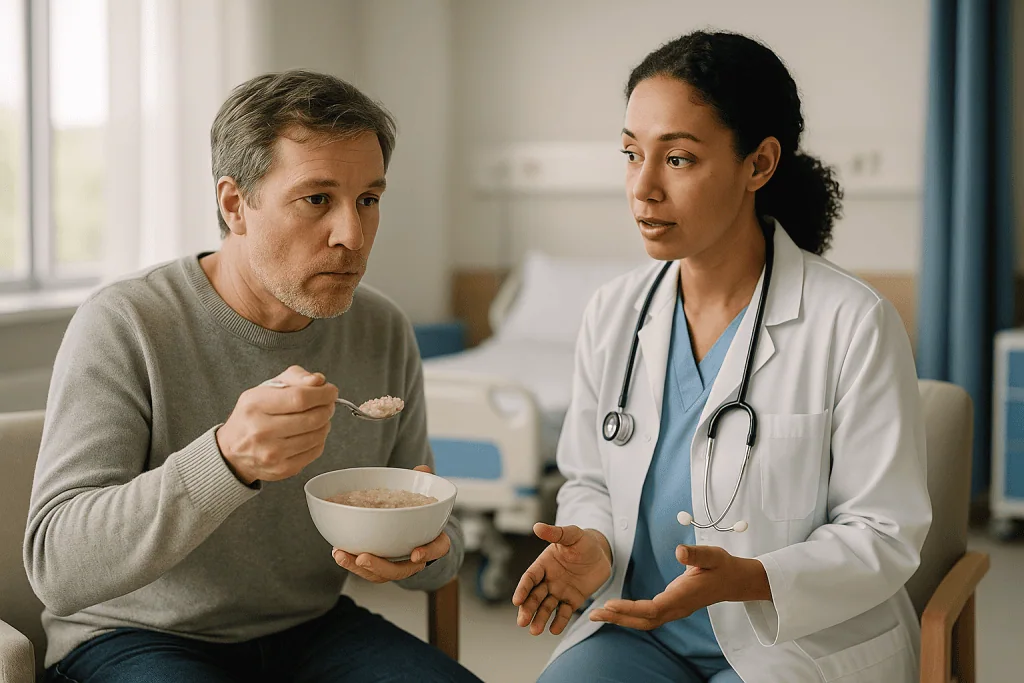
The first day or two usually mean liquids that need no chewing at all: broths, smooth soups, yogurt, protein drinks, thinned oatmeal. Cool or lukewarm is safer than hot for a numb lip. Many surgeons suggest a spoon or a cup rather than a straw, because sucking tightens the very muscle ring that has just been repaired; ask your team whether a straw is allowed in your case, since advice varies with the technique.
Over the following days people move to foods that mash with a fork: scrambled eggs, soft fish, well-cooked pasta, mashed vegetables, ripe bananas, soft cheeses. Things to hold back on until the team gives the word include anything that needs a wide bite (apples, burgers, corn on the cob), anything sharp or crusty that can catch a stitch (chips, hard bread crusts), and anything very salty, acidic or spicy, which stings raw tissue.
Nutrition matters more than people expect. Wound healing demands protein and calories, and a person eating three cups of broth a day is short of both. If you can manage it, add a protein-rich soft food to each small meal, and eat five or six times rather than three. Rinsing the mouth gently with water after eating keeps food debris away from the inner suture line, where it is hard to see.
Lip stitches care: keeping the incision clean without disturbing it
Suture care on the lip has one complication other wounds lack: the incision often crosses from dry skin into wet mouth, so half of it is bathed in saliva and food all day. The instructions your team gives will reflect that, and they override anything general written here.
The principles are straightforward. MedlinePlus’s guidance on closed surgical wounds advises washing hands before touching the area, cleaning gently with mild soap and water or as instructed, patting rather than rubbing, and keeping any recommended ointment or dressing in place. Many surgeons want a thin layer of ointment kept on the external stitches so a hard crust does not form; crusts trap bacteria and can pull the wound edges when they crack. Others prefer the wound left dry. There is no universal right answer, which is exactly why you should follow the sheet you were given.
Inside the mouth, the usual advice is a gentle rinse with water or a prescribed mouthwash after meals, and careful toothbrushing that avoids the suture line. Do not pick at dissolving stitches; they soften and fall away on their own, often within a couple of weeks, and pulling one early can open the inner layer.
External stitches that do not dissolve are removed at a follow-up visit. MedlinePlus notes that removal typically happens somewhere between 3 and 21 days depending on the site, and the face tends to sit at the earlier end because facial skin heals quickly and early removal leaves less track marking. Some teams then apply skin tape for extra support for a few days.
Watch, but do not obsess. A little clear or pale-yellow ooze in the first days is common. Increasing redness spreading beyond the wound, thick discharge, a bad smell or wound edges pulling apart are not, and belong in the “When to call your doctor” section below.
Weeks two to six: stitches out, scar beginning, life restarting
Once the external stitches are out, the mood usually lifts. The wound is sealed, the swelling has settled enough that the lip looks like a lip again, and the diet loosens. This is also the stage where impatience does the most damage, so it helps to know what is actually happening beneath the surface.
The NHS explains that a scar forms as the body lays down new collagen to bridge the wound, and that in these early weeks the scar is typically raised, red or purple and firm. On the lip this can look like a small ridge along the vermilion border or a tight band through the pink tissue. It is normal, and it is temporary. The NHS notes that this early appearance changes considerably as the scar matures over the following months.
Activity returns gradually. Most teams allow desk work and light walking within days and ask people to avoid heavy lifting, straining and contact sports for a few weeks, because raised blood pressure and a stray elbow both threaten a fresh repair. Ask specifically about swimming, wind instruments and anything that involves wide mouth opening; the answer depends on your reconstruction.
Sun protection starts now and does not stop. A fresh scar exposed to ultraviolet light tends to darken permanently, and the lower lip catches more sun than almost any other facial surface. A lip balm with sun protection, a wide-brimmed hat and shade in the middle of the day are the practical measures, and they also reduce the risk of a new skin cancer developing on the same sun-damaged lip.
If a flap was used, this window may include a planned second procedure to divide the flap’s connection or refine its shape. That is not a complication; it is part of the design.
Lip reconstruction scar: what changes over months, and what does not
The scar is where expectations most often go wrong, so it helps to know the real timeline. The NHS states that scars can take up to two years to fully mature, and that in the interim they typically fade from red to pink to something closer to the surrounding skin tone, flatten and soften. On the lip, the red phase is often less noticeable than elsewhere simply because the vermilion is already red; the skin part of the scar above or below the border is where color changes show.
Massage is the single most useful thing most people can do once the team confirms the wound is fully closed. Gentle, firm pressure in small circles along the scar, a few minutes at a time, helps soften the collagen and reduce tightness. Timing and technique should come from your team; starting too early can open a wound that looks healed but is not yet strong.
Silicone gels or sheets are widely recommended for maturing scars; the NHS lists silicone among the options used to improve scar appearance. Evidence for exactly how much difference they make is modest and mixed, and they work best on the skin portion of the lip rather than the wet vermilion, where they will not stay put.
Some features may not fully resolve. A flap brings tissue with slightly different color, texture or hair growth, and a repaired vermilion may have a subtle change in outline. Small irregularities are sometimes improved with minor revision procedures, typically considered only after the scar has matured, because operating on an immature scar often trades one problem for another. Whether revision is appropriate, and when, is a judgment your surgeon makes with you after the year mark, not before.
Speech, sensation and lip function after reconstruction
People worry about how their lip will look. They are often more surprised by how it feels and works. Three functions are affected: sensation, movement and competence, which is the clinical term for the lip’s ability to seal so that food, drink and saliva stay in.
Sensation returns slowly and incompletely. Cut nerve endings regrow at roughly the pace of a fingernail, so a numb patch may shrink over many months, and a flap moved from the cheek may never feel quite like native lip. Many people describe a lasting sense of tightness or a lip that feels “thick” even when it looks normal. This matters for everyday safety: check the temperature of drinks with the unaffected side, and glance in a mirror after meals until you trust the lip again.
Movement depends on the muscle repair. When the orbicularis oris ring has been reconnected well, most people regain the ability to purse, whistle and smile symmetrically, though the smile may look slightly different for months while swelling and scar stiffness settle. Speech sounds that need firm lip closure, such as p, b and m, may be soft or slushy at first. A speech and language therapist can help if this persists; children who have had cleft repair are routinely followed by one, as the NHS describes in its cleft treatment pathway.
Drooling in the early weeks is common and embarrassing, and it usually improves as sensation and muscle tone return. Persistent drooling, or an inability to keep liquids in when leaning forward, is worth raising with the team, because it can indicate a lip that has been left too tight or too short and may benefit from a later adjustment.
Cleft lip repair recovery in children: what parents can expect
Cleft lip repair is the most common form of lip reconstruction worldwide, and its recovery has its own rhythm. The NHS describes surgery to repair a cleft lip usually taking place when a baby is around three to six months old, with palate repair, if needed, following later in the first year. MedlinePlus gives a similar window and notes that most babies go home within a day or two of lip repair.
Feeding is the immediate concern. Babies are usually able to feed soon after surgery, though the method may be adjusted for a short period; MedlinePlus describes teams giving specific instructions about bottles, breastfeeding or syringe feeding to protect the repair. The cleft team, which typically includes a specialist nurse, will demonstrate whatever method they want you to use before you leave.
Protecting the wound from small hands is the other task. Many teams use soft arm restraints or long sleeves for a period so the baby cannot rub the lip, and ask parents to avoid pacifiers and anything hard near the mouth. The suture line is cleaned gently as instructed, and stitches are either dissolvable or removed at a short follow-up.
Swelling and a red, raised scar are expected in the early weeks and improve over the following months. The NHS notes that the scar usually fades considerably during the first year, though it remains visible to some degree, and that some children are offered scar revision later in childhood if needed.
Comfort, not medicine detail, is the parent’s job: feeding on schedule, keeping the baby upright and settled, and reporting anything that worries you. Cleft care is a long relationship with a team that follows speech, hearing, teeth and growth for years, and the lip repair is only its first chapter.
What people often get wrong about lip reconstruction recovery
“Lip reconstruction is the hardest plastic surgery to recover from.” There is no ranking of that kind in the medical literature, and the question itself mixes up different things: pain, duration, visibility and functional disruption. Lip surgery scores low on pain compared with many operations, but high on daily inconvenience, because you cannot hide it and you use the site every time you eat or speak. Large body-contouring operations involve far more physical recovery. The honest answer is that lip surgery is not the hardest; it is among the most noticeable.
“Swelling means something has gone wrong.” Pronounced early swelling is expected in lip surgery for the anatomical reasons described earlier. What matters is the direction of travel: swelling that improves after the first few days is normal, swelling that increases after day three or becomes hot and tense is not.
“If the scar looks bad at one month, it will always look bad.” The NHS is clear that scars continue to mature for up to two years. Judging the result early is like reviewing a house from the scaffolding.
“Vitamin E or a special cream will erase the scar.” No cream removes a surgical scar. Evidence for topical vitamin E is weak, and it causes skin irritation in some people. Sun protection, time and, where recommended, massage and silicone have better support.
“Once the stitches are out I can eat anything.” Suture removal means the skin has sealed, not that the deep repair has full strength. Teams usually ask for a gradual return to a normal diet over the following weeks.
“A new spot on my lip is just a mole.” It may be. It is also exactly how many lip skin cancers first appear, which is why a new or changing lip lesion is a reason to see a clinician, not a reason to wait.
Questions to ask your care team before and after lip reconstruction
Good questions turn a frightening operation into a plan. Bring these to your consultation and follow-up visits, and write down the answers; post-surgery memory is unreliable.
- Which technique are you planning for my lip: direct closure, a local flap or a graft? What made you choose it over the alternatives?
- Will the reconstruction happen at the same time as the cancer removal, or will you wait for pathology results first?
- How large do you expect the wound to be, and where exactly will the scar lie? Will it cross the vermilion border?
- Is a second, planned procedure part of this reconstruction? If so, roughly when?
- What should my lip look like on day two, day seven and at one month, so I know what is normal for this operation?
- Exactly how should I clean the stitches, inside and outside the mouth? Should I use ointment, keep it dry or use a dressing?
- What can I eat in the first three days, and when do you expect me to move to soft, then normal foods? Can I use a straw?
- When will stitches be removed, and who do I contact if one comes loose before then?
- How much numbness should I expect, and how long might it last?
- When can I start scar massage, and do you recommend silicone or any other scar measure?
- Which activities should I avoid, and for how long: exercise, swimming, wind instruments, dental work?
- What changes in the lip would you want to hear about immediately, and which number do I call outside office hours?
- How often will you see me afterward, and for how long will you follow the site for signs of the cancer returning or a new one appearing?
Notice that none of these questions asks the surgeon to promise a result. They ask what the plan is, why, and how you will know if it is working. That is the conversation that serves you best.
When to call your doctor after lip reconstruction
Most lip reconstruction recoveries are uneventful, but a small number develop problems that are far easier to fix when caught early. The Centers for Disease Control and Prevention lists the classic signs of a surgical site infection as redness and pain around the wound, drainage of cloudy fluid, and fever; on the lip, where the wound sits partly inside the mouth, these can be subtle, so err toward calling.
Contact your surgical team the same day if you notice any of the following:
- Swelling that increases after the third day rather than easing, or a lip that becomes hot, tense and shiny.
- Thick yellow or green discharge, a foul taste or smell, or spreading redness beyond the wound edges.
- A fever or chills.
- Wound edges that gape or pull apart, a stitch that has come out early, or a flap that changes color to dusky purple, very pale or black. A flap losing its blood supply is a time-critical problem.
- Bleeding that does not stop after ten minutes of steady, gentle pressure with clean gauze.
- Pain that escalates rather than settles, or that is not controlled by what your clinician prescribed.
- New difficulty swallowing, breathing or opening the mouth.
Seek emergency care immediately for heavy bleeding that soaks through dressings, any difficulty breathing, or rapidly spreading facial swelling.
In the months afterward, tell your team about a scar that is thickening, tightening or restricting your mouth opening, a lip that cannot keep liquids in, or any new lump, ulcer, crust or color change at or near the site. People who have had one lip skin cancer are at higher risk of another, which is why follow-up skin checks are part of the plan.
When in doubt, call. Surgical teams would far rather answer an unnecessary question than treat a preventable complication a week late. Every decision about treatment, from antibiotics to revision, rests with the clinicians who know your wound.
Frequently asked questions
How long does it take to recover from lip reconstruction surgery?
The wound is usually sealed and stable within about two weeks, but the lip keeps changing for far longer. Swelling is greatest in the first few days, non-dissolving stitches typically come out within one to three weeks, and the scar softens and fades over a year or more. Flap reconstructions take longer at each stage than simple closures. Your surgical team will give you a timeline specific to the technique used.
What soft foods after lip surgery are usually recommended?
Liquids and smooth foods that need no chewing come first: broths, smooth soups, yogurt, protein drinks and thinned oatmeal, served cool or lukewarm. Over the following days most people move to foods that mash with a fork, such as scrambled eggs, soft fish, well-cooked pasta and ripe bananas. Avoid anything requiring a wide bite, anything crusty or sharp, and very salty or acidic foods until your team says otherwise.
How do I take care of lip stitches at home?
Follow your team’s written instructions, because advice differs by technique. In general, wash your hands first, clean the outside gently with mild soap and water or as directed, pat dry, and apply ointment only if told to. Rinse the mouth gently with water after meals to keep food away from the inner suture line, avoid brushing directly over the stitches, and never pick at dissolving sutures.
How is basal cell carcinoma on the lip treated?
Almost always with surgery. Mohs surgery, where tissue is removed in thin layers and checked under a microscope during the operation, is often preferred on the lip because it spares healthy tissue. Standard excision is also used. Radiation or topical treatments are alternatives in specific situations. Once the cancer is removed, the resulting defect is closed directly or reconstructed with a flap, depending on its size.
Is lip reconstruction the hardest plastic surgery to recover from?
No formal ranking exists, and the evidence does not support the claim. Lip surgery tends to involve less pain than large body operations, but more daily disruption, because the site is visible and used every time you eat or speak. Numbness, swelling and a soft diet make the first two weeks inconvenient rather than debilitating. Recovery difficulty depends far more on the size of the reconstruction than on the body part.
Why is my lip so swollen after reconstruction?
Lip tissue is loose, richly supplied with blood and hangs from the face, so fluid from the normal inflammatory phase of healing collects there and shows dramatically. A reconstructed lip can look nearly twice its size on day two while healing normally. Swelling should begin to ease after the first few days; if it increases, becomes hot or tense, or the skin looks shiny and stretched, contact your surgical team.
How long does a lip reconstruction scar take to fade?
Scars change for a long time. The NHS notes that scars can take up to two years to fully mature, moving from raised and red to flatter and paler. On the lip the pink portion often hides color change, while the skin portion above or below the border fades more visibly. Sun protection, and scar massage or silicone once your team approves, support the process. Judging the result before a year is premature.
When can I eat normally after lip surgery?
Most teams ask for liquids for the first day or two, soft foods for roughly the next week or two, and a gradual return to a normal diet over the following weeks. Stitch removal signals that the skin has sealed, not that the deep repair has full strength, so wide bites and hard, crusty foods usually wait a little longer. Your surgeon will confirm the timing for your reconstruction.
What is a new mole on my lip, and should I worry?
A new spot on the lip may be a harmless pigmented mark, a small blood vessel change or a sun-related lesion, but it can also be how a skin cancer first appears. No home assessment can tell the difference reliably. A clinician will examine it and may take a small biopsy. Early assessment matters because smaller lesions generally mean smaller repairs if surgery is ever needed.
Will feeling come back to my lip after reconstruction?
Usually partly, and slowly. Cut sensory nerves regrow over many months, so a numb area often shrinks with time, though tissue moved as a flap may never feel exactly like native lip. Many people describe lasting tightness or a thick feeling even when the lip looks normal. Check drink temperatures with the unaffected side in the meantime, and mention persistent numbness or drooling to your team.
References
- MedlinePlus: Surgical wound care – closed
- MedlinePlus: Cleft lip and palate repair
- NHS: Scars
- NHS: Cleft lip and palate – Treatment
This article is for general information only and is not a substitute for professional medical advice. Please consult a qualified doctor about your individual situation.

More from the Blog

Buccal Fat Removal Recovery Week by Week: Liquids, Soft Foods and When Cheeks Settle
Buccal fat removal recovery time is usually measured in weeks for the visible part and months for the final shape. Most people manage daily…
How a Combined Neck and Face Lift Is Performed: Incisions, Deeper Tissue Work and Closure
A combined neck and face lift is one operation, usually under general anesthesia and typically lasting two to four hours or longer. The surgeon…
Do Facial Augmentation Results Last? Implants vs Fat Transfer Over the Years
Facial augmentation results vary by method. Solid cheek and chin implants are designed to stay in place indefinitely and usually keep their shape for…
Preparing for Face Aesthetics Surgery: Blood Tests, Anesthesia Review and Medicine Changes
Preparing for facial surgery usually means a pre-assessment visit where blood tests check clotting, blood count and kidney function, an anesthesia review covers your…
Supporting Someone After a Neck and Face Lift: Drains, Dressings and the First Days Home
In the first days after a neck and face lift, a helper's main tasks are keeping the head raised, emptying and recording any drains,…
Facial Augmentation With Fat Transfer or Implants: Which Option Suits Which Face?
Facial fat transfer uses a person's own fat, taken by gentle liposuction and injected into the face, to add soft, natural-looking volume; facial implants…