

What Recovery From Nasal Reconstruction Involves: Congestion, Flap Care and Stage Intervals

Key Takeaways
- A paramedian forehead flap stays connected to its original blood vessel for about three weeks before the stalk is divided, because that is roughly how long it takes to grow a new supply from the nose.
- Congestion after septal surgery is driven mainly by lining swelling, splints and crusting rather than by the operation failing, and the Mayo Clinic advises judging breathing only after swelling resolves.
- The Mayo Clinic advises keeping eyeglasses and sunglasses off the nose for at least four weeks after rhinoplasty-type surgery, and flap reconstruction often requires longer.
- Cartilage does not regenerate, which is why surgeons remove it conservatively during septoplasty and borrow it from the septum, ear or rib when a framework must be rebuilt.
- Saline rinses should use only sterile, distilled or boiled-and-cooled water, per the CDC, and should be started only when the surgeon confirms splints and repairs can tolerate them.
- Scars typically look their worst between about six weeks and three months as collagen builds, then soften over the following year, especially with consistent sun protection.
Recovery from nasal reconstruction usually unfolds in stages rather than as one healing period. Expect heavy congestion for the first one to two weeks while internal swelling and any splints remain, daily care of a skin flap that keeps its own blood supply, and gaps of roughly three weeks between staged surgeries. Fine swelling can keep settling for up to a year, and your surgical team sets every interval.
The first thing many people notice after nasal reconstruction is not the mirror. It is the strange fact that breathing through the nose has become a project. The mouth is dry by morning, tea tastes of nothing, and there is a padded, pressurized feeling behind the cheekbones that no amount of gentle sniffing shifts. Then there is the flap: a strip of skin from the forehead, still attached at one end, curving down to a nose that does not yet look like a nose.
That in-between state is exactly what nasal reconstruction recovery looks like when it is going well. It is unglamorous, it is staged, and it asks for patience that most other operations do not.
This explainer walks through what actually happens: why the congestion is so heavy, how a flap stays alive between operations, why surgeons space the stages the way they do, and which signs mean you should pick up the phone rather than wait for the next appointment.
What nasal reconstruction recovery actually involves
Nasal reconstruction is surgery that rebuilds part or all of the nose after skin cancer removal, injury, or a birth difference, using tissue borrowed from elsewhere on the body. A septoplasty, by contrast, is an operation on the wall of cartilage and bone that divides the two sides of the nose (the septum); it straightens that wall to improve airflow. Recovery from either is often lumped under “nose surgery,” yet the two ask very different things of a person.
Reconstruction rebuilds in layers. The nose has a lining on the inside, a framework of cartilage and bone in the middle, and skin on the outside. When a defect is deep, each layer may need replacing, and surgeons usually cannot do all of it in one sitting without starving the new tissue of blood. So they work in stages, letting one layer establish its own circulation before the next is shaped. The Mayo Clinic notes that even after a single-stage nose operation, the final shape can take up to a year to refine as swelling resolves.
The practical consequences for you are three. First, the inside of the nose swells, so breathing through it is limited for a while. Second, if a skin flap is used, that flap needs protecting and moisturizing every day until it is finally set in place. Third, life is arranged around intervals: the second and sometimes third operation are scheduled weeks apart, and the weeks between are where most of the real healing happens. None of this is a sign of a problem. It is the design of the operation, and knowing that in advance makes the middle weeks far easier to live with.
Who nasal reconstruction is usually for, and who is asked to wait
The most common reason for reconstruction is a gap left after Mohs surgery, a technique that removes skin cancer layer by layer and checks each layer under a microscope until the margins are clear. Johns Hopkins Medicine describes it as a method that spares as much healthy skin as possible, which is exactly why the nose, where every millimeter matters, is such a frequent site. Other candidates include people with defects from trauma, infection, or earlier operations that did not heal as hoped.

Not everyone is booked straight away. Surgeons commonly ask people to wait when:
- The cancer margins are not yet confirmed clear; reconstructing over uncertain tissue risks a second, harder operation.
- Nicotine is still in the picture. Smoking narrows small blood vessels, and a flap lives or dies by those vessels. The Mayo Clinic lists stopping smoking as a standard step before rhinoplasty-type surgery, and the stakes are higher for a flap.
- Blood sugar, blood pressure, or a bleeding tendency is not yet well controlled, since each affects wound healing or the risk of a collection of blood under the skin (a hematoma).
- Radiation to the area is recent, because irradiated skin heals more slowly.
Septoplasty has its own gate. The Mayo Clinic notes that surgeons generally prefer to wait until facial growth is complete, so teenagers are often asked to defer unless breathing is severely affected. A deviated septum by itself is not a reason to operate; it is the symptoms that count.
Who decides? Always the treating team, weighing the size and depth of the defect against your general health and what you want the outcome to be. A good consultation ends with you understanding why now, or why not yet.
Why congestion is so heavy in the first weeks
People often expect pain and are surprised that the dominant sensation is blockage. There are four reasons the nose feels packed with wet cotton.
The lining swells. Any surgery inside the nose irritates the mucous membrane, the moist tissue that lines the airway, and swollen membrane leaves less room for air. The Mayo Clinic describes stuffiness after septoplasty as expected and explains that swelling gradually resolves over weeks.
Splints take up space. After septal work, thin internal splints or soft packing are often placed to hold the septum straight and reduce bleeding. MedlinePlus notes that packing is typically removed within a day or two, while splints may stay about a week, and both feel like a blocked nose while in place.
Crusting narrows the passage further. Dried blood and mucus collect on healing tissue. It is tempting to pick or blow hard; both risk bleeding and shifting repairs, which is why the Mayo Clinic advises against blowing the nose for several weeks after septoplasty.
In reconstruction, the airway itself may be temporarily reshaped. If the lining was rebuilt, or a flap folds inward to create a new nostril rim, the opening can be smaller until later refinement.
What helps, within your surgeon’s instructions: sleeping with the head raised above the chest, which the Mayo Clinic recommends to reduce swelling; running a humidifier; and saline sprays once your team says they are safe. A dry mouth from breathing through it is normal; sipping water and using lip balm are small comforts that matter at 3 a.m. The congestion is real, it is temporary, and it is not a sign the operation has failed.
Forehead flap recovery: keeping a flap alive between stages
A skin flap is a piece of skin and underlying tissue moved to a new location while still connected to its original blood supply. The workhorse for nasal reconstruction is the paramedian forehead flap: skin from the forehead, fed by a vessel that runs up from near the inner eyebrow, is rotated down to cover the nose while its stalk (the pedicle) stays attached. The Cleveland Clinic describes this as a staged operation because the flap must first grow new blood vessels from the nose before that stalk can be cut.
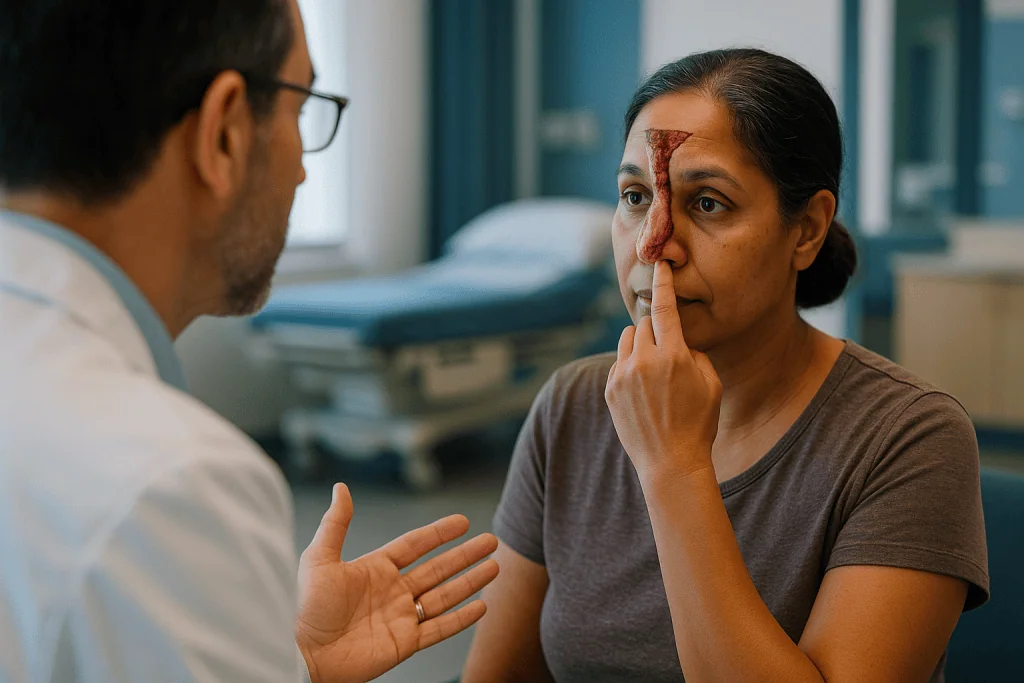
Between stages, the flap is quite literally living on borrowed circulation, and daily care is about protecting it:
- Keep it moist. Exposed raw edges and the underside of the pedicle are usually kept covered with a thin layer of ointment and a light dressing, as directed by your team. Dry tissue heals poorly.
- Avoid pressure and twisting. Glasses, tight hats, face-down sleeping, and rubbing can kink the pedicle and reduce flow.
- Watch the color. A healthy flap is pink and blanches then refills when gently pressed. Pale white, dusky purple, or black areas mean the blood supply is struggling and need a same-day call.
- Keep it warm and yourself hydrated. Cold and dehydration both narrow small vessels.
- No nicotine in any form, for the same reason.
The donor site on the forehead is often closed directly, but the top portion may be left to heal on its own over several weeks; MedlinePlus notes that open surgical wounds are typically cleaned and redressed daily, and your team will show you how. Bruising around the eyes, some numbness of the forehead, and a tight feeling when raising the eyebrows are all common. It is a lot to manage at home, and asking for written, step-by-step wound instructions before discharge is entirely reasonable.
Stage intervals: what happens at each operation and why the gaps matter
Timing in staged reconstruction is not arbitrary. It follows the biology of how a flap picks up a new blood supply from the tissue beneath it, a process called neovascularization. Cut the pedicle too early and the flap may not survive; wait far longer than needed and the person carries an awkward bridge of skin for no benefit.
| Stage | What is done | Typical interval to next stage | What you are managing at home |
|---|---|---|---|
| Stage 1 | Lining and cartilage framework rebuilt if needed; forehead flap raised and set onto the nose with pedicle attached | About three weeks (Cleveland Clinic) | Flap and donor-site dressings, congestion, head elevation, no pressure on the flap |
| Stage 2 | Pedicle divided; flap inset at the bridge; forehead stalk returned or trimmed. Some surgeons use this stage to thin the flap | Roughly three to six weeks if a third stage is planned | Smaller wounds, swelling, early scar care, gradual return to routine |
| Stage 3 (when used) | Refinement: thinning, contouring the nostril and tip, scar revision | Final | Scar massage and sun protection as advised; waiting for swelling to settle |
The Cleveland Clinic describes the classic two-stage approach with division at about three weeks; a three-stage plan simply adds an intermediate thinning step for thicker flaps or deeper defects. Which plan you get depends on how much of the nose is being rebuilt and how thick your forehead skin is.
Between stages, most people can be at home and lightly active. Each subsequent operation is usually shorter than the first and, according to the Cleveland Clinic, is often done under lighter anesthesia. Keep all interval appointments even when things look fine: those visits are where the surgeon checks flap color, removes stitches, and confirms the next date. If a stage is postponed because of a cold, a wound concern, or scheduling, that does not undo the work already done.
A realistic nasal reconstruction recovery timeline, week by week
Every plan differs, so treat this as the shape of a typical course rather than a schedule to hold your surgeon to.
Days 1 to 3. Congestion is at its worst. Oozing of pink fluid from the nose is common; MedlinePlus notes that a small dressing under the nostrils is often used and changed as it soaks. Bruising around the eyes peaks around day two or three. Sleep propped up. Most people go home the same day or after one night.
Days 4 to 7. Packing, if used, is usually already out. External splints or internal splints are commonly removed at about a week, per the Mayo Clinic. Breathing improves noticeably once splints go. Flap dressings continue daily.
Weeks 2 to 3. Swelling and bruising fade. Many people feel well enough for desk work, though a visible flap makes some prefer to stay home. Stage 2 typically falls around week three.
Weeks 4 to 6. The Mayo Clinic advises avoiding strenuous exercise and anything that raises blood pressure in the face for several weeks after nose surgery; many teams use roughly a month to six weeks as the window. Glasses remain off the bridge unless taped or supported. Numbness of the tip and forehead is common and slow to change.
Months 2 to 6. Scars are pink and slightly raised, then soften. The Mayo Clinic notes that nasal tissues are relatively stable within three to six months after septoplasty.
Up to a year. Subtle swelling in the tip, especially where skin is thicker, keeps settling. Mayo Clinic guidance on nasal surgery puts final refinement at up to twelve months. Judging the result before then is like judging a cake while it is still in the oven.
How bad is recovery from deviated septum surgery? Septoplasty recovery time explained
Honest answer: less painful than most people fear, more congested than they expect. Septoplasty is usually done through the nostrils with no external cuts, and the Mayo Clinic describes it as an outpatient operation for most people, with wound healing that is relatively quick.
The first week is about blockage and drainage rather than pain. Discomfort is typically an ache across the bridge and upper teeth, managed with whatever the surgeon prescribes; the medicine choice, and how long you take it, is theirs to decide. MedlinePlus lists common early experiences as swelling, congestion, and light bleeding, and notes that many people return to routine activities within a couple of weeks while avoiding heavy lifting or straining.
Where septoplasty recovery time frustrates people is the mismatch between feeling fine and still not breathing freely. Membranes stay swollen after the person feels ready to run. The Mayo Clinic explains that improvement in breathing often becomes apparent as swelling subsides over weeks, with tissues stabilizing at three to six months and cartilage potentially continuing to shift for longer.
Things that make it harder than it needs to be: blowing the nose in the first weeks, bending with the head low, alcohol early on (it dilates vessels and can increase bleeding), and hot showers that do the same. Things that help: head elevation, saline as advised, cool compresses around but not on the nose, and a plan for time off work that assumes two weeks rather than two days.
One caution on expectations. Septoplasty addresses the septum; if congestion also comes from allergies, enlarged turbinates (the shelves of tissue on the side walls), or sinus disease, those may need their own management. That is a conversation for your treating team before surgery, not after.
Can nose cartilage grow back?
Not in any useful sense. Cartilage is a firm, flexible tissue with very few cells and almost no blood supply of its own; it gets nutrients by slow diffusion from surrounding tissue. That is why a torn knee cartilage does not knit the way skin does, and why cartilage removed from the septum does not regenerate. What remains can scar, stiffen, or shift, but it does not refill the gap.
This matters for recovery in two ways.
First, it is why surgeons are conservative about how much septal cartilage they remove during septoplasty. Enough is straightened or trimmed to open the airway; a supporting strut is left at the top and front to keep the bridge and tip from sagging. The Mayo Clinic notes that cartilage and tissue can continue to move gradually over time after surgery, which is one reason a small proportion of people notice a change months later.
Second, it is why reconstruction borrows cartilage rather than waiting for it to return. When the framework of the nose has been lost to cancer surgery or injury, surgeons harvest cartilage from the septum itself, from the ear, or from the rib and carve it into struts and shields. The graft survives by picking up nourishment from the tissue around it, much as a flap does. Ear and rib donor sites have their own small recoveries: a sore, bandaged ear for a week or so, or a chest incision that aches with deep breaths and coughing.
A related question is whether a septum can “re-deviate.” Straightened cartilage retains some memory of its old curve, and healing forces can pull on it. Splints, careful suturing, and avoiding nose trauma in the early weeks are how surgeons work against that. If breathing worsens again long after recovery, the answer is an assessment, not an assumption.
How long after septoplasty can I wear glasses? Wearing glasses after septoplasty and reconstruction
The concern is pressure. Glasses rest their weight on the bridge, exactly where a straightened septum, repositioned bones, or a freshly inset flap are most vulnerable. The Mayo Clinic advises against resting eyeglasses or sunglasses on the nose for at least four weeks after rhinoplasty-type surgery, and many surgeons apply the same caution to septoplasty when the bones or the upper part of the septum were worked on.
If your septoplasty involved only the lower cartilage and no bone work, your surgeon may allow glasses much sooner, sometimes once the external splint (if any) is off. Wearing glasses after septoplasty is therefore a question with a personal answer, and the person to ask is the one who knows what was done inside.
For flap reconstruction the rule is stricter and lasts longer. A frame sitting across a pedicle can compress the very vessel keeping the flap alive; after the flap is inset, pressure can flatten a carefully contoured bridge while swelling is still settling. Expect to keep frames off the nose until your surgeon clears you, often not before the final stage has healed.
Workarounds people find useful in the meantime:
- Taping the bridge of the glasses to the forehead so the nose pads hover just above the skin.
- Propping frames on a small foam pad or the external splint while it is still on, if your team agrees.
- Switching to contact lenses for the recovery weeks, if you already tolerate them and your surgeon has no objection.
- Choosing the lightest frames you own for the first weeks after clearance.
Sunglasses count too, and so do heavy safety goggles at work. If your job requires them, raise it before surgery so time off or an adaptation can be planned.
Is a sinus rinse after septoplasty recommended?
Saline irrigation is widely used after septoplasty and sinus surgery, and the Mayo Clinic lists saline spray among the measures that can ease dryness and crusting during recovery. Salt water thins mucus, softens crusts so they detach without picking, and rinses away small clots that would otherwise sit on healing tissue. Whether you should use a full-volume rinse from a squeeze bottle rather than a gentle mist, and when to start, is a decision your surgeon makes based on what was done and whether splints are still in.
Typical patterns look like this: nothing forceful while packing or splints are in place; gentle spray once they are out; larger-volume rinses only if the surgeon specifically recommends them. If you were also given an ointment or a prescribed spray, the order and timing of those is theirs to set.
Technique matters more than frequency. Lean forward over a sink, aim the stream along the floor of the nose rather than upward, keep the mouth open, and let the fluid run out the other nostril. Do not sniff hard or blow afterward; let it drip. Use only sterile, distilled, or previously boiled and cooled water for rinses, as the CDC advises, because tap water can carry organisms that are harmless to drink but not to introduce into the nasal passages. Wash and dry the bottle between uses.
For flap reconstruction, irrigation is more cautious still. If the nasal lining has been rebuilt, forceful fluid can disturb it, and rinse solution running over a fresh external wound is unwelcome. Many surgeons prefer sprays and a cotton swab dipped in saline to clean the nostril rim, and they will say so.
A sinus rinse after septoplasty is helpful for most people at the right moment. Its value lies in restraint: gentle, clean, and on your surgeon’s schedule.
Swelling, numbness and the slow year of settling
The most common worry at the six-week visit is not pain or breathing. It is “why does the tip still look thick?” The answer is fluid. Surgery interrupts the tiny lymphatic channels that drain the skin of the nose, and the tip, where skin is thickest and drainage slowest, holds onto swelling longest. The Mayo Clinic’s guidance on nasal surgery is blunt about this: subtle changes continue as swelling resolves, and the final shape can take up to a year.
Flap skin from the forehead is thicker than native nasal skin and swells more. This is why a thinning stage is sometimes planned, and why a flap that looks bulky at two months may look quite different at nine.
Numbness follows a similar arc. The nerves supplying the tip and the forehead donor site are small and are often stretched or cut. Sensation typically returns patchily over months; some people describe pins and needles as nerves wake up, and a few retain a small permanent area of reduced feeling. The forehead may feel tight when raising the eyebrows, which usually eases as the scar matures.
Things that can slow the settling: heavy salt intake, alcohol, prolonged head-down positions, and heat. Things that help within your team’s guidance: sleeping elevated well past the first week, gentle walking to keep circulation moving, and sun protection, since ultraviolet light inflames healing skin.
Photographs help perspective. Taking one at the same angle and light each month lets you see change that a daily mirror hides. If swelling is asymmetric, growing rather than shrinking, or accompanied by redness and warmth, that is a reason to call rather than to compare pictures.
Scars, sun protection and the forehead donor site
Two scars usually matter after forehead flap reconstruction: the vertical line on the forehead where the flap was taken, and the fine seams around the edge of the new nasal skin. Both go through a predictable arc. Fresh scars are flat and pink for a few weeks, then often become firmer, redder, and slightly raised between roughly six weeks and three months as the body lays down collagen, then soften and fade over the following year. That temporary worsening is normal and alarms almost everyone.
The forehead donor site is often closed as a straight vertical line, which aligns with natural forehead creases and tends to fade well; if the top portion is left open to heal on its own, it fills in from the edges over several weeks with daily cleaning and dressing, as MedlinePlus describes for open surgical wounds. Hair-bearing skin at the very top is avoided where possible so that hair does not grow on the nose.
Care that most surgeons agree on:
- Keep wounds clean and lightly moist until the edges have sealed; scabs that dry hard heal slower and leave wider marks.
- Once closed, protect from sun for at least the first year. Ultraviolet light darkens and thickens young scars. A broad-brimmed hat and a mineral sunscreen on healed skin are simple habits.
- Gentle scar massage may be suggested once your team says the wound can take pressure, typically after several weeks; do not start on your own initiative over a flap.
- Do not pick stitches, glue, or crusts.
If a scar stays thick, itchy, and raised beyond what your team expects, they may discuss options such as silicone products or an injected medicine that softens scar tissue; those are decisions for the clinic, not the pharmacy aisle. Most scars quietly improve without any of it.
What people often get wrong about nasal reconstruction recovery
“The flap looks like a tube of skin, so something has gone wrong.” That is what a stage-one forehead flap is supposed to look like. The pedicle is temporary and is divided at the next stage; the Cleveland Clinic describes this bridge as an expected part of the process.
“If I can breathe fine on day one, the septoplasty worked; if I cannot, it failed.” Neither is true. Splints and swelling govern early breathing. The Mayo Clinic advises judging airway improvement after swelling has resolved, over weeks to months.
“I should blow my nose to clear it.” Forceful blowing can restart bleeding and shift repairs; sniffing gently and letting drainage drip, then using saline as advised, is safer in the early weeks.
“Cartilage will grow back where they took it.” It will not, which is exactly why surgeons remove conservatively and graft when structure is missing.
“Sun does not matter in winter.” Ultraviolet exposure reaches the face year-round and darkens young scars; a hat is a twelve-month habit, not a summer one.
“The result at three months is the result.” Tip swelling and flap thickness keep changing well beyond that, with Mayo Clinic guidance putting final refinement at up to a year.
“Vaping is fine because it is not smoke.” Nicotine in any form narrows small blood vessels, the very vessels a flap depends on. Most teams ask for complete abstinence from all nicotine before and between stages.
“A staged plan means the first surgery was not good enough.” Staging is chosen in advance because of the biology of blood supply, not as a rescue. Knowing the plan from the start turns the second and third operations from setbacks into milestones.
Questions to ask your care team before and between stages
A staged operation gives you several chances to ask, and the answers change as healing progresses. Bring a written list; post-anesthesia memory is unreliable, and having a companion take notes helps.
Before the first stage:
- How many stages are planned for my nose, and roughly how far apart? What would make you change that plan?
- Which layers are being rebuilt: lining, cartilage, skin, or all three? Where will any cartilage come from, and what will that donor site feel like?
- Will I have packing or splints, and for how long? When may I start saline?
- What exactly should I do each day for the flap and the forehead wound? Can I have that in writing?
- How long should I plan to be off work, and when can I drive, exercise, and wear glasses?
- What are the specific signs that the flap is struggling, and who do I call, including out of hours?
Between stages:
- Does the flap look the way you expect at this point?
- Is the next date still right, or should it move?
- Are there activities I can now resume, and any I should still avoid?
- How should I care for the forehead as it closes?
After the final stage:
- When will swelling settle enough to judge the shape and breathing?
- What scar care do you recommend, and when should I start?
- Is any refinement likely, and how would that decision be made?
- What follow-up do I need for the original skin cancer, and who coordinates it?
None of these are awkward questions. Surgeons who do this work expect them, and clear answers are part of good care.
When to call your doctor: red-flag signs during nasal reconstruction recovery
Most of recovery is uncomfortable rather than dangerous, but a few signs need a same-day call to your surgical team, or emergency care if you cannot reach them. When in doubt, call; a flap or a septal repair is far easier to rescue early.
Contact your team the same day if you notice:
- A flap that turns pale white, dusky purple, blue, or black, or that feels cold, or whose color does not return within a few seconds after gentle pressure. This can mean the blood supply is compromised.
- Bleeding that soaks through dressings repeatedly or streams rather than drips, or bleeding that does not slow with gentle pressure and head elevation. The Mayo Clinic lists heavy bleeding as a reason to seek prompt care after septoplasty.
- Fever, spreading redness, increasing warmth, foul-smelling discharge, or pus from the nose or forehead wound, which can signal infection.
- Rapidly increasing swelling or a tense, painful lump under the skin, suggesting a hematoma.
- Clear, watery fluid dripping steadily from one nostril, especially when leaning forward, which should always be assessed.
- Sudden severe headache, neck stiffness, vision change, or confusion.
- A wound edge that opens, or a graft or splint that has shifted.
- Chest pain, shortness of breath, or a swollen painful calf, which can indicate a blood clot and need emergency assessment.
Call sooner rather than later if pain is escalating instead of easing after the first few days, if you cannot keep fluids down, or if a medicine you were prescribed seems to be causing a reaction such as rash or breathing difficulty.
Keep the clinic number and the out-of-hours line somewhere you can find them half-asleep. Every decision about what happens next, from a dressing change to bringing a stage forward, sits with the team who operated. Their job includes being called.
Frequently asked questions
How bad is recovery from deviated septum surgery?
For most people it is more congested than painful. Septoplasty is usually an outpatient operation done through the nostrils, and the Mayo Clinic describes the wound healing as relatively quick. Expect a blocked nose, light bleeding and an ache across the bridge for the first week, then gradual improvement in breathing over weeks as swelling settles, with tissues stabilizing at around three to six months.
Can nose cartilage grow back after surgery?
No. Cartilage has very few cells and almost no blood supply, so removed septal cartilage does not regenerate. Surgeons therefore trim conservatively during septoplasty and leave supporting struts in place. When the nasal framework has been lost to cancer surgery or injury, cartilage is borrowed from the septum, ear or rib and carved into grafts that survive by taking nutrients from surrounding tissue.
How long after septoplasty can I wear glasses?
It depends on what was done. The Mayo Clinic advises keeping glasses off the nose for at least four weeks after rhinoplasty-type surgery, and many surgeons apply the same caution when bones or the upper septum were treated. If only lower cartilage was straightened, clearance may come sooner. Taping frames to the forehead or using contact lenses are common workarounds until your surgeon says otherwise.
Is a sinus rinse after septoplasty recommended?
Saline is widely used to soften crusts and thin mucus, and the Mayo Clinic lists saline spray among helpful recovery measures. Whether to use a gentle mist or a full-volume rinse, and when to start, is your surgeon’s call, usually after packing and splints are out. Use only sterile, distilled or boiled-and-cooled water, as the CDC advises, and never sniff or blow hard afterward.
What does forehead flap recovery feel like between stages?
Mostly manageable but visually striking. A bridge of skin connects the forehead to the nose for about three weeks, according to the Cleveland Clinic, and needs daily moisturizing, protection from pressure and close attention to its color. The forehead donor site may be closed or left to heal from the edges. Bruising around the eyes, forehead numbness and tightness when raising the eyebrows are common and gradually ease.
How long is septoplasty recovery time before breathing improves?
Breathing often feels worse before it feels better, because splints and swollen lining block the airway in the first week or two. The Mayo Clinic notes that nasal tissues become relatively stable within three to six months, and that cartilage can continue to shift gradually after that. Most people notice steady improvement over the first several weeks once splints are out and swelling declines.
Why is nasal reconstruction done in stages instead of all at once?
Because moved tissue needs time to grow its own blood supply. A forehead flap is left attached to its original vessel until the nose beneath it has fed new vessels into it, typically around three weeks per the Cleveland Clinic. Only then can the stalk be divided safely. Some plans add a thinning stage between the two, especially when the flap skin is thick.
When can I exercise again after nasal reconstruction or septoplasty?
The Mayo Clinic advises avoiding strenuous activity such as jogging and aerobics for several weeks after nose surgery, because raised blood pressure in the face increases bleeding and swelling. Gentle walking is usually encouraged early to help circulation. Anything with a risk of a blow to the nose, including contact sports, is generally deferred longer, and the exact clearance comes from your surgeon.
How long does swelling last after nasal reconstruction?
Longer than most people expect. Bruising fades within a couple of weeks, but the nasal tip and any flap skin hold fluid because their lymphatic drainage is disrupted. Mayo Clinic guidance on nasal surgery puts final refinement at up to a year. Thick forehead skin swells more than native nasal skin, which is one reason a flap that looks bulky early on often changes markedly later.
What are the warning signs that a nasal flap is failing?
Color change is the key sign: a flap that turns pale white, dusky purple, blue or black, feels cold, or does not pink up within a few seconds after gentle pressure needs a same-day call to your surgical team. Rapidly increasing swelling, heavy bleeding, fever, spreading redness or foul discharge also warrant urgent contact. Early assessment gives the team the best chance to act.
References
This article is for general information only and is not a substitute for professional medical advice. Please consult a qualified doctor about your individual situation.

More from the Blog

Cheek Augmentation Recovery: Swelling Stages, Sleeping Upright and When Contours Emerge
Cheek augmentation recovery follows a fairly predictable arc: swelling and bruising usually peak within the first two to three days, ease noticeably over two…

What Age Is Right for Otoplasty? Ear Growth, Timing and Readiness in Children and Adults
Otoplasty, surgery to reshape or set back prominent ears, is usually considered from about age five, when the outer ear has reached most of…

How Cheek Augmentation Surgery Is Done: Implant Placement Through the Mouth or Lower Eyelid
Cheek implant surgery places a shaped, solid implant over the cheekbone through a small incision either inside the mouth, above the upper gum, or…

When Is a Scar Ready for Scar Revision Surgery? Why Surgeons Wait for Scars to Mature
Most surgeons wait until a scar has fully matured before revising it, which commonly takes about 12 to 18 months and sometimes up to…

Can Buccal Fat Removal Be Reversed? Fat Grafting and Fillers After Over-Removal
Buccal fat removal cannot be truly reversed, because the removed fat pad does not grow back. What surgeons can do is rebuild lost cheek…

Do Surgical Dimples Look Natural? How Dimpleplasty Results Settle Over the First Months
Surgical dimples can look natural, but rarely in the first weeks. Dimpleplasty results usually begin as a fixed indentation that shows even when the…