

What Vitiligo Repigmentation Really Looks Like: Why Color Returns Slowly and Unevenly

Key Takeaways
- The first visible sign of vitiligo repigmentation is usually a scatter of brown dots around hair follicles, because surviving melanocyte stem cells migrate up from the follicle bulge before spreading across the surface.
- Mayo Clinic describes light therapy as taking one to three months before change is noticeable and six months or longer for the full effect, so judging any treatment at a few weeks is premature.
- Hair-rich sites such as the face, neck and trunk respond far more readily than hair-poor, high-friction sites such as knuckles, fingertips, feet and lips, which depend entirely on slow edge-inward repigmentation.
- White hairs inside a patch (leukotrichia) signal a depleted follicular reserve and predict a weaker response, while dark hairs inside a patch are an encouraging sign.
- Regained color is not guaranteed to last: the autoimmune tendency remains, pigment can be lost again, and many care plans include a maintenance and monitoring phase after visible improvement.
- Vitamin B12 and vitamin D deficiencies are worth diagnosing and treating in their own right, but neither supplement is an established vitiligo repigmentation therapy, and excess vitamin D can be harmful.
Vitiligo repigmentation usually appears as small brown dots around hair follicles and a slow creep of color inward from patch edges. With treatment, first changes typically take one to three months, and fuller results six months or longer, according to Mayo Clinic. Faces and necks tend to respond sooner than hands, feet and lips, and regained color can fade again, so progress is uneven and never guaranteed.
Six weeks into a new cream, she stood at the bathroom mirror with her phone torch angled at her jaw, hunting for evidence. Nothing obvious. Then, on closer inspection, a scatter of freckle-sized brown specks inside the white patch, each one sitting exactly where a fine hair emerged. Was that it? Was that supposed to be progress?
It was. That speckled, unimpressive start is what most vitiligo repigmentation timelines actually look like, and it catches people off guard because nobody warned them that color returns in dots before it returns in patches, and in months before it returns in weeks.
This explainer walks through the biology that makes recovery so slow and patchy, what dermatology references describe as typical timeframes, why the hands lag stubbornly behind the face, and which widely repeated claims about vitamins and miracle destinations simply do not hold up. Every decision about treatment stays with your dermatology team; the aim here is to make their explanations easier to recognize on your own skin.
How vitiligo repigmentation actually happens under the skin
Vitiligo is a condition in which the immune system attacks melanocytes, the pigment-producing cells that give skin its color. Once a patch has lost its melanocytes, the skin surface has no local supply of pigment, so color cannot simply be switched back on. It has to be rebuilt from cells that survived somewhere nearby.
Those survivors live in two main places. The first is the hair follicle. Deep in the follicle sits a small reserve of immature melanocyte stem cells, tucked away in a region that the immune attack often spares. When treatment calms the immune response, those cells wake up, multiply, and migrate up the follicle and out across the skin surface. That migration is why the earliest sign of recovery is a ring of brown dots, one per hair, known as perifollicular repigmentation. The dots widen into islands, and the islands merge.
The second reserve is the healthy skin at the edge of the patch. Melanocytes there can slowly creep inward, narrowing the white area from the border. This marginal repigmentation is usually thinner and slower than the follicular kind, and it tends to move only a few millimeters at a time.
Put those two mechanisms together and the uneven look makes sense. A patch on a hairy forearm has hundreds of tiny pigment factories inside it. A patch on the knuckle, the lip or the sole of the foot has few or none, so it depends entirely on the borders, and the borders are slow. The National Institute of Arthritis and Musculoskeletal and Skin Diseases and Cleveland Clinic both describe this follicular and edge-based pattern as the expected route of recovery rather than a sign of partial failure.
The vitiligo repigmentation timeline: what a realistic year looks like
The phrase that matters most in any honest vitiligo repigmentation timeline is months, not weeks. Melanocytes multiply and migrate at a biological pace that no cream or light box can hurry beyond a point. Mayo Clinic notes that with light therapy, people may not notice change for one to three months, and that the full effect can take six months or longer. Topical medicines are described in similar terms: several months before a difference becomes visible.

A typical course, as dermatology references outline it, tends to unfold in overlapping phases rather than tidy stages:
- Early weeks: often nothing visible. Inflammation is settling and follicular cells are being activated below the surface.
- Around one to three months: the first perifollicular dots on responsive sites such as the face and neck. Edges may look slightly less crisp.
- Three to six months: dots enlarge and coalesce on responsive areas; slower sites may only just be starting.
- Six to twelve months and beyond: continued filling in, with hands, feet and bony areas frequently trailing far behind or remaining unchanged.
Two caveats keep this timeline honest. First, these ranges come from population descriptions, not from any promise about one person. Second, the response depends heavily on whether the disease is currently active. When new patches are still appearing, the immune attack is ongoing, and treatment usually has to stabilize the condition before repigmentation becomes the main goal. Your dermatologist will judge which phase you are in, and that judgment shapes every expectation that follows.
Why some patches respond and others barely move
People are often puzzled that the same medicine, applied the same way, produces visible change on the cheek and nothing on the fingers. The explanation is anatomy, not technique.
Hair density is the first factor. Sites with plentiful, actively growing hairs, such as the face, neck, trunk and upper arms, hold large melanocyte reserves in their follicles. Sites with sparse or no terminal hair, including the fingertips, knuckles, wrists, ankles, lips, nipples and genitals, are commonly described in dermatology references, including Cleveland Clinic and Mayo Clinic, as the most resistant to repigmentation. There are simply fewer cells available to do the work.
The second factor is how long the patch has been white. Long-standing patches, especially those where the fine hairs within them have also turned white (a sign called leukotrichia, meaning pigment loss in hair), may have lost their follicular reserve as well. A patch with white hairs inside it is generally expected to respond less well than one where the hairs remain dark, because the follicle reservoir itself has been depleted.
The third factor is friction and repeated minor injury. Vitiligo can appear at sites of rubbing or trauma, a phenomenon known as the Koebner response, and those same mechanical stresses continue on hands, elbows and waistbands during treatment. Skin that is constantly being knocked, scrubbed or pressed has a harder time holding on to new pigment.
None of this means resistant areas are hopeless, and it does not mean the treatment has failed when the face improves before the hands do. It means the map of your body sets a different pace for every patch, and a good care plan usually prioritizes the sites where response is most likely and most meaningful to you.
Which treatments prompt repigmentation, and how each one works
Every established vitiligo treatment works through one of two levers: quieting the immune attack on melanocytes, or stimulating the surviving cells to multiply and migrate. Many do both. What follows describes mechanisms only; which option suits you, and for how long, is a decision for your prescribing dermatologist.
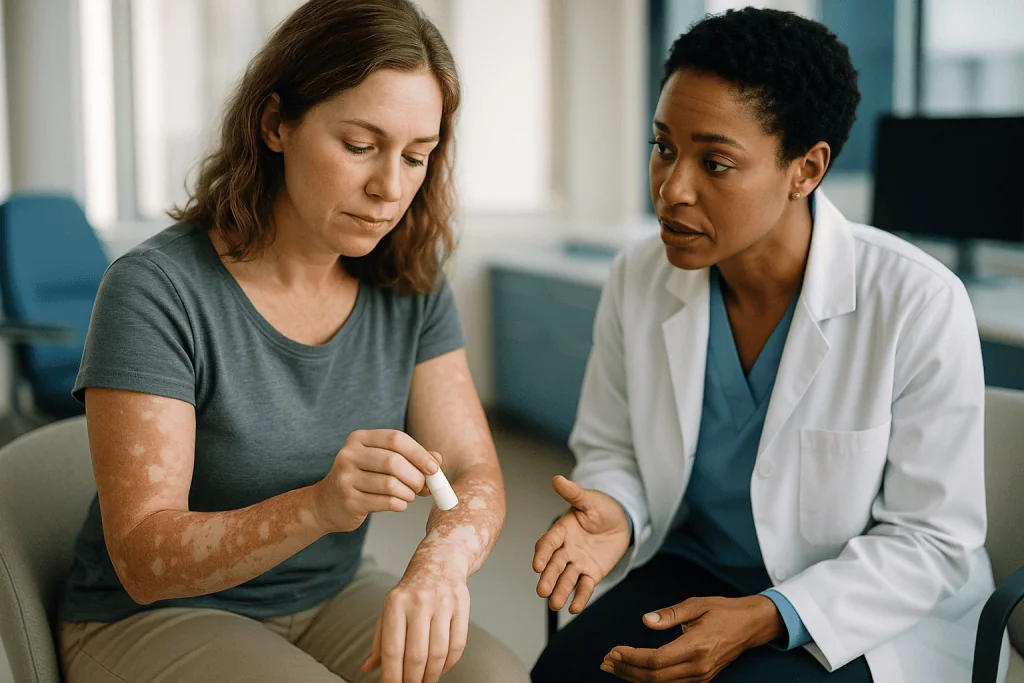
Topical corticosteroids dampen local inflammation and are often used for limited areas. Mayo Clinic describes them as taking several months to show results and notes side effects such as skin thinning with prolonged use, which is why they are typically supervised and time-limited.
Topical calcineurin inhibitors block a signaling pathway in immune cells and are often considered for delicate areas such as the face and neck, where steroid side effects are a greater concern.
Topical JAK inhibitors interrupt the chemical messengers (Janus kinases) that carry the inflammatory signal into cells. This is the newest class in routine use, and Mayo Clinic lists a JAK inhibitor cream among current nonsegmental vitiligo treatments. Like the others, it works over months.
Narrowband UVB phototherapy uses a specific wavelength of ultraviolet light, delivered in a clinic cabinet or with a handheld device under supervision, usually two to three times a week. Light both calms the local immune response and directly stimulates follicular melanocytes to divide and migrate. Excimer lasers apply a similar wavelength to small targeted patches.
Surgical options, including blister grafting and cellular suspension transplants, move melanocytes from unaffected skin into a stable patch. They are reserved for disease that has stopped spreading and carry risks such as scarring, uneven texture and infection.
Combining a topical medicine with phototherapy is common practice, because the two levers reinforce each other. What no option does is act quickly.
Who repigmentation treatment is usually for, and who is asked to wait
Not everyone with vitiligo wants treatment, and not everyone who wants it is offered the same thing at the same time. Dermatology guidance, including the NHS, treats vitiligo as a condition to be managed according to the person in front of the clinician, not a checklist.
Active repigmentation treatment is most commonly considered when patches are on visible or emotionally significant sites, when the disease is relatively recent (newer patches tend to hold more follicular reserve), and when hairs inside the patches are still pigmented. People with darker skin tones often feel the contrast more sharply and may be more motivated to treat, which is a legitimate reason in itself.
Several groups are typically asked to wait, adjust, or choose a different route:
- People whose vitiligo is spreading quickly. When new patches appear over weeks, the priority is usually to stabilize the immune activity first; grafting in particular is not offered while the disease is active.
- Young children, for whom phototherapy schedules and long courses of topical medicine are weighed carefully against practicality and safety; many families choose sun protection and monitoring initially.
- People who are pregnant or breastfeeding, where some medicines are avoided and phototherapy may be preferred; the prescriber decides.
- People with a history of skin cancer or conditions worsened by ultraviolet exposure, for whom phototherapy may be unsuitable.
- Anyone whose main goal is an even appearance on very extensive disease, for whom depigmentation of the remaining color, camouflage, or no medical treatment at all may be more realistic options to discuss.
Waiting is not the same as being dismissed. A period of observation often tells the dermatologist whether the condition is stable, and stability changes what is on the table.
Body site, treatment type and typical timeframes at a glance
The single most useful conversation to have early on is about what a specific patch can realistically do. The table below summarizes patterns described in mainstream dermatology references; it is a guide to expectation, not a forecast for any individual.
| Factor | Tends to favor repigmentation | Tends to slow or limit it |
|---|---|---|
| Body site | Face, neck, trunk, upper arms and thighs (hair-rich) | Fingers, knuckles, wrists, feet, ankles, lips, nipples, genitals (hair-poor, high friction) |
| Hair inside patch | Still dark, indicating a surviving follicular reserve | White (leukotrichia), indicating depleted reserve |
| Duration of patch | Recent onset | Many years, especially with white hairs |
| Disease activity | Stable, no new patches | Rapidly spreading; stabilizing comes first |
| First visible change | Around 1–3 months with phototherapy (Mayo Clinic); several months with topical creams | May be longer, or absent, on resistant sites |
| Fuller effect | 6 months or longer (Mayo Clinic), often continuing beyond a year | Partial or patchy despite a full course |
| Durability | Follicular-pattern color that has fully merged | Marginal-only color on friction sites; relapse can occur |
Read across a row and you can see why two patches on the same person can behave like two different diseases. A fresh patch on the cheek with dark hairs in it ticks the left column at every step. A ten-year-old patch on the back of the hand with white hairs ticks the right. Neither outcome is certain, but the odds are shaped long before the first application, and a dermatologist who explains this early is doing you a service, not lowering the bar.
How long does vitiligo repigmentation take once treatment starts? The first weeks and months
The most common question, asked in a hundred different ways, is how long. The honest answer has a shape rather than a number.
In the first few weeks, expect to see nothing and to feel mild things. Topical medicines can cause stinging, warmth or dryness where applied; phototherapy typically produces faint pinkness a few hours after a session that settles by the next day. This is the stage when many people quietly stop, convinced the treatment is doing nothing. Under the surface, inflammation is falling and follicular melanocytes are being recruited, but the skin has no way of showing that yet.
Somewhere in the one to three month window that Mayo Clinic describes for phototherapy, the first brown dots appear on responsive sites. They are usually easier to spot in good natural light, or under a Wood’s lamp (an ultraviolet examination light) at the clinic, than in a bathroom mirror. Photographing patches under the same light every month, without editing, is the single most practical thing you can do, because week-to-week comparison is almost useless and memory is a poor witness.
Between months three and six, dots enlarge and merge on the face, neck and trunk. Slower sites may still look unchanged. This is often when dermatologists reassess: continue, add a second modality, switch, or accept that a particular site is unlikely to move.
Beyond six months, Mayo Clinic notes that light therapy may need to continue for the full effect, and courses stretching past a year are common. Most references also flag that repigmentation is unpredictable and that pigment can be lost again later. Patience, in this condition, is not a virtue; it is a treatment requirement.
Does repigmentation in vitiligo last, or does the color fade again?
Regained color can be durable, and it can also disappear. Both are true, and pretending otherwise sets people up for a second grief.
Mayo Clinic is direct on this point: even with successful treatment, the results may not last, and color loss can return. Repigmentation does not remove the underlying autoimmune tendency; it repopulates an area while the immune attack is quiet. If the immune activity flares again, whether from illness, skin injury, severe sunburn, or no identifiable reason at all, the new melanocytes are as vulnerable as the old ones were.
Some patterns are more likely to hold than others. Pigment that arrived through follicles, spread into islands, and merged into a uniform tone is generally considered more stable than a thin rim that crept in from the edges. Sites with constant friction and repeated small injuries, such as knuckles and feet, lose color more readily. Patches that repigmented during a long stable phase tend to fare better than those treated while the disease was still spreading.
This is why dermatologists frequently talk about maintenance rather than finishing. Some plans involve tapering phototherapy gradually rather than stopping abruptly, or continuing a topical medicine at a reduced frequency on previously affected skin for a period after color returns. Whether that applies to you, and how it is structured, is entirely a prescribing decision; the point is that the end of visible improvement is not automatically the end of care.
It helps to frame vitiligo the way clinicians frame other autoimmune conditions: something controlled over time, with good stretches and occasional setbacks. A recurrence is information about the immune system, not a verdict on the effort you put in.
Vitamin B12 and vitiligo: can it reverse the patches?
Vitamin B12 comes up constantly in vitiligo forums, usually alongside folate, and the appeal is understandable: a simple supplement with a hopeful backstory. The evidence does not support the hope.
The backstory is real but narrow. Vitiligo is an autoimmune condition, and people with one autoimmune condition are more likely to have another. Pernicious anemia, in which the immune system attacks the stomach cells needed to absorb B12, is one of the conditions seen more often alongside vitiligo, as is autoimmune thyroid disease. So some people with vitiligo genuinely are B12 deficient, and that deficiency deserves diagnosis and treatment on its own terms. The NIH Office of Dietary Supplements describes the symptoms of deficiency, which include fatigue, tingling and cognitive changes, none of which are skin pigmentation.
Correcting a true deficiency is good medicine. It is not a vitiligo treatment. Small, older studies that reported repigmentation with B12 and folate combinations were uncontrolled or paired the vitamins with sun exposure or phototherapy, which makes it impossible to say what the vitamins contributed. No major guideline body, and none of the mainstream references on vitiligo, lists B12 as an effective repigmentation therapy.
Taking large amounts of B12 when you are not deficient does not push more pigment into skin, because melanocyte loss is an immune problem, not a nutritional one. Excess B12 is mostly excreted. If your dermatologist orders blood tests, it is often precisely to look for associated conditions such as thyroid disease or B12 deficiency, and finding one changes your general health care, not your skin’s prognosis. Ask about testing if it has not been discussed; do not self-treat a skin condition with a vitamin aimed at a different one.
Can vitamin D reverse vitiligo?
Vitamin D has a stronger scientific rationale than B12, which is exactly why the claims around it need careful handling.
Vitamin D receptors are present on melanocytes and on immune cells, and laboratory work suggests vitamin D influences both immune regulation and melanocyte function. Observational studies have found lower vitamin D levels in some groups of people with vitiligo. That is a correlation with an obvious confounder: people with vitiligo are, quite reasonably, told to protect their skin from the sun, and sun exposure is the body’s main route to making vitamin D. Lower levels may be a consequence of good sun habits rather than a cause of the disease.
What the evidence does not show is that swallowing vitamin D restores color. Trials of supplementation as a stand-alone vitiligo treatment are small, mixed and not of the quality that would move a guideline. The NIH Office of Dietary Supplements is clear that vitamin D is fat-soluble, that excessive intake can raise blood calcium to harmful levels, and that more is not better beyond correcting a deficiency. Very high self-directed supplementation carries real risk for no established skin benefit.
Where vitamin D does belong in the conversation is general health. If you are covering up and using high-factor sunscreen year-round, as the NHS advises for people with vitiligo, your clinician may want to check your level and address a deficiency for the sake of bone and muscle health. That is worth doing. It is not the same as reversing vitiligo, and any supplement decision should go through the clinician who knows your blood results.
A separate point sometimes causes confusion: topical vitamin D analogues, prescription creams chemically related to vitamin D, have been studied in combination with other vitiligo treatments. Those are medicines applied to skin under supervision, not supplements, and they are a decision for your dermatologist.
Is there a country with the best vitiligo treatment?
Search for vitiligo treatment and the results fill quickly with clinics in one city or another promising superior outcomes. It is worth being blunt about what that reflects: marketing budgets, not medical geography.
The treatments that produce repigmentation are not secret and they are not regional. Topical anti-inflammatory medicines, narrowband UVB phototherapy, targeted lasers, JAK inhibitors and surgical grafting are described in the same terms by the NHS, Mayo Clinic, Cleveland Clinic and the National Institutes of Health, and the same underlying evidence base informs dermatology guidelines across countries. The biology that limits how fast color returns, the follicular reserve and the immune activity, travels with the patient. No border changes it.
What does vary is access: waiting times, cost structures, whether a phototherapy unit is nearby, and whether a particular medicine is licensed in your health system. Those are practical questions for you and your local dermatologist, and they can influence the order in which options are tried. They do not make one nation’s melanocytes migrate faster.
Travel for a long-course condition also carries a specific problem. Repigmentation unfolds over six to twelve months or more, with regular reassessment. Phototherapy in particular needs sessions two to three times a week for months. A treatment begun far from home, then interrupted, is often worse than a slower one that can be sustained and monitored where you live. If relocation or extended travel is genuinely part of your life, the useful step is to ask your existing dermatologist how continuity of care would work, not to trust a ranking.
There is no best country for vitiligo. There is a best fit between a person, a stable plan and a team that can follow it through.
What people often get wrong about vitiligo repigmentation stages
Much of the frustration around vitiligo comes from expectations that were never accurate. A few corrections do a lot of work.
Dots mean failure. The opposite. Perifollicular dots are the expected first stage of repigmentation. A patch that begins speckling has a functioning follicular reserve, which is good news.
Two weeks with no change means the cream is not working. Dermatology references consistently describe months, not weeks, before visible change. Judging a topical medicine at two weeks is like judging a planted seed at two days.
Tanning beds are a shortcut to phototherapy. Tanning beds emit predominantly UVA and broad-spectrum light rather than the narrowband UVB used in clinics, deliver uncontrolled doses, increase skin cancer risk, and can burn depigmented skin that has no melanin to protect it. They are not a substitute.
Sunburning a patch will bring color back. Sunburn is skin injury, and skin injury can trigger new vitiligo through the Koebner response. Mayo Clinic and the NHS both advise protecting affected skin from the sun.
Vitiligo is contagious or caused by diet. It is an autoimmune condition. It cannot be passed to anyone and no food causes it, although associated conditions such as thyroid disease or B12 deficiency may need their own management.
Once color returns, treatment is over. Pigment can be lost again; maintenance and monitoring are often part of the plan.
Vitiligo is only cosmetic. It is an autoimmune disease with well-documented effects on mood, self-image and social life, and it can travel with other autoimmune conditions. Treating it seriously is not vanity.
Resistant patches mean the whole treatment failed. Site-specific response is normal. Hands staying white while the face fills in is the textbook pattern, not an anomaly.
Living alongside slow change: sun, skin care and mental health
Because the timeline is measured in seasons, the way you live during treatment matters as much as the treatment itself.
Sun protection is the non-negotiable. Depigmented skin has no melanin, so it burns quickly, and burning risks both new patches and damage to the areas you are trying to repopulate. The NHS advises a high-factor sunscreen and covering up, and Mayo Clinic notes that protecting skin also keeps the contrast between affected and unaffected areas from deepening as surrounding skin tans. If you are having phototherapy, your team will give specific guidance on sun exposure around sessions; follow theirs over general advice.
Be gentle with friction. Tight watch straps, harsh scrubbing, aggressive exfoliation and repeated pressure on the same spot are all small injuries, and small injuries are exactly what the Koebner response feeds on. This does not mean wrapping yourself in cotton wool; it means noticing habits.
Camouflage is legitimate, not cheating. Medical-grade cover creams, self-tanning products and simple makeup can even out tone while you wait for biology, and the NHS describes skin camouflage as a recognized option. Using them does not interfere with most treatments, though check with your team about applying anything before phototherapy.
Mind the mind. Vitiligo is consistently associated with anxiety, low mood and social withdrawal, particularly when patches are on the face or hands. A long, uncertain timeline can wear people down. Talking therapies, patient support organizations and simply telling your dermatologist that the condition is affecting you are all reasonable steps, and they can change what your team prioritizes. Slow progress is easier to tolerate when you are not tolerating it alone.
Questions to ask your care team
A good appointment about vitiligo is less about which cream and more about what to expect and how progress will be measured. These questions tend to produce the most useful answers.
- Is my vitiligo currently active or stable, and how did you decide? What signs would suggest it is spreading?
- Looking at my specific patches, which are most likely to respond and which are likely to be resistant, and why?
- Are the hairs inside my patches still pigmented, and what does that tell you about the follicular reserve?
- What is the first sign of response I should look for, and roughly when should I expect it on each site?
- How will we document progress? Would clinic photographs or a Wood’s lamp assessment be useful, and how often?
- At what point would you reassess and consider adding, switching or stopping a treatment?
- If color returns, what does maintenance look like, and how would we handle a relapse?
- Which side effects should I expect, which should I report promptly, and how will you monitor for them?
- Should I be tested for associated conditions such as thyroid disease or vitamin B12 deficiency?
- How should I manage sun exposure, exercise, swimming and skin care around treatment sessions?
- Are there options, such as camouflage or, for extensive disease, depigmentation, that I should understand even if I do not choose them now?
- Who do I contact between appointments if something changes quickly?
Write the answers down, or ask whether they can be included in your clinic letter. Six months from now, when you are staring at a patch and wondering whether it has changed, the record of what you were told to expect will be worth more than your memory of it. Every treatment decision that follows belongs to you and the clinician who can examine your skin, and these questions simply make that shared decision better informed.
When to call your doctor
Most of the vitiligo journey is slow and undramatic, but some situations deserve prompt contact with your dermatology team or, occasionally, urgent care.
Contact your care team promptly if you notice:
- Rapid spread of existing patches or several new patches appearing over a few weeks, which may signal active disease needing a change of approach.
- New white patches at sites of recent injury, burns or friction.
- Significant redness, blistering, pain or peeling after a phototherapy session, beyond the mild pinkness that usually settles within a day.
- Persistent stinging, burning, thinning, easy bruising, visible small blood vessels or unusual hair growth in skin where a topical medicine is applied.
- Any new lesion within a patch that is dark, irregular, growing, bleeding or changing, since depigmented skin still needs skin cancer surveillance.
- Symptoms suggesting an associated autoimmune condition, such as unexplained weight change, palpitations, heat or cold intolerance, marked fatigue, or tingling in the hands and feet, which may prompt testing for thyroid disease or vitamin B12 deficiency.
- Low mood, anxiety or social withdrawal linked to your skin that is affecting daily life; this is a valid reason to call, not a footnote.
Seek urgent medical care if you develop a widespread severe burn after light exposure, signs of skin infection such as spreading redness, warmth, pus or fever, or an allergic reaction to a new medicine with facial swelling, wheeze or difficulty breathing.
Do not stop or change a prescribed treatment on your own because progress feels slow; slow is expected. Do raise it, though, because the people best placed to decide whether to wait, adjust or switch are the ones who can examine the patch, compare it with earlier photographs and weigh your goals. That decision, at every stage, sits with your treating team.
Frequently asked questions
How long does vitiligo repigmentation take to become visible?
Typically one to three months before the first change with phototherapy, and several months with topical creams, according to Mayo Clinic. The earliest sign is usually small brown dots around hair follicles on responsive sites such as the face and neck. Fuller results commonly take six months or longer, and hands and feet may lag well behind or not respond. These are population ranges, not promises for any individual.
What are the stages of vitiligo repigmentation?
Repigmentation usually begins with perifollicular dots, one around each hair, which enlarge into islands that gradually merge. Color may also creep inward from the healthy border, a slower pattern called marginal repigmentation. Before either becomes visible there is often a silent phase of weeks in which inflammation settles. Sites with dense hair pass through these stages sooner than hair-poor areas, and some resistant patches never progress beyond the earliest stage.
Does repigmentation in vitiligo last?
It can, but it is not guaranteed. Mayo Clinic notes that color loss may return even after successful treatment, because the underlying autoimmune tendency persists. Fully merged follicular-pattern pigment on stable, low-friction sites tends to hold better than thin marginal color on hands or feet. Many dermatologists plan a maintenance or monitoring phase after improvement, and a relapse is treated as new information rather than a failure.
Can vitamin B12 reverse vitiligo?
No. Vitamin B12 deficiency, including the autoimmune form called pernicious anemia, is seen more often in people with vitiligo and should be diagnosed and treated for general health. Correcting it does not restore skin pigment, because melanocyte loss is an immune process, not a nutritional one. Small older studies pairing B12 with sun exposure or phototherapy cannot separate the vitamin’s effect, and no major guideline lists B12 as a vitiligo treatment.
Can vitamin D reverse vitiligo?
There is no good evidence that oral vitamin D restores pigment. Lower levels are seen in some people with vitiligo, which may reflect careful sun avoidance rather than a cause. Trials of supplementation are small and mixed. The NIH Office of Dietary Supplements warns that excess vitamin D can raise blood calcium harmfully. Checking and correcting a deficiency is sensible for bone health; it is not a repigmentation strategy.
Is there a permanent fix for vitiligo?
Vitiligo is currently a condition that is managed and controlled rather than permanently resolved. Treatments can quiet the immune attack and restore color, sometimes extensively, but the autoimmune tendency remains and pigment can be lost again. Newer medicines such as JAK inhibitors have broadened options, and research continues, but claims of a definitive, lasting fix are not supported by mainstream medical references. Long-term management with periodic reassessment is the realistic frame.
Which country has the best vitiligo treatment?
None. The treatments that produce repigmentation, including topical anti-inflammatory medicines, narrowband UVB phototherapy, JAK inhibitors and grafting for stable disease, are described identically by major references worldwide and rely on the same evidence base. Access and waiting times vary by health system, but the biology limiting speed of recovery does not. Because courses run for many months with regular reassessment, continuity of care close to home usually matters more than location.
Why do my hands stay white when my face is repigmenting?
Because hands have very few hair follicles, and follicles are the main reservoir of surviving melanocytes that repopulate a patch. Fingers and knuckles must rely on slow inward creep from the patch edge, and they also suffer constant friction and minor injury, which vitiligo tends to exploit. Dermatology references consistently list hands, feet and lips among the most resistant sites. It is the expected pattern, not a sign that treatment has failed.
Should I stop treatment if nothing has changed after a month?
Not on your own. A month is inside the period in which dermatology references expect no visible change; Mayo Clinic describes one to three months before phototherapy shows results and several months for creams. Stopping early is one of the commonest reasons courses appear to fail. Raise your concern with your prescribing clinician, who can compare photographs, check with a Wood’s lamp and decide whether to continue, adjust or switch.
Do tanning beds or sunbathing speed up vitiligo repigmentation?
No, and both can make things worse. Tanning beds emit mostly UVA at uncontrolled doses, unlike the specific narrowband UVB wavelength used in supervised phototherapy, and they raise skin cancer risk. Depigmented skin has no melanin and burns quickly; sunburn is a skin injury that can trigger new patches through the Koebner response. The NHS and Mayo Clinic advise high-factor sun protection for people with vitiligo instead.
References
This article is for general information only and is not a substitute for professional medical advice. Please consult a qualified doctor about your individual situation.

More from the Blog
Is Coconut Oil Good for Your Skin? Where It Helps, Where It Clogs
Coconut oil moisturizes dry body skin well: small clinical trials found virgin coconut oil hydrated as effectively as mineral oil and improved mild-to-moderate eczema…
What a Scalp Injection Session for Alopecia Areata Involves: Comfort, Timing and Repeat Visits
Alopecia areata scalp injections are corticosteroid shots placed just under the skin of a bald patch to calm the immune attack on hair follicles.…
Hyperpigmentation: Types, Causes and the Treatment Ladder Dermatologists Use
Hyperpigmentation is a patch or spot of skin that has become darker than the surrounding skin because pigment cells have produced or deposited extra…

What Regrowth After Alopecia Areata Treatment Usually Looks Like: Fine, Pale Hairs First
Regrowth after alopecia areata treatment usually begins as a soft fuzz of fine, short hairs that are pale or white, appearing inside the patch…

Does Laser Hair Removal Hurt? Honest Answers Before a First Session
Yes, laser hair removal usually causes brief, tolerable discomfort, most people compare each pulse to a rubber band snapping against warm skin. Pain varies…

Face Taping and Face Yoga: Do the Viral Wrinkle Hacks Work?
Face yoga has weak but real evidence: one small 2018 study with no control group found slightly fuller cheeks and a modest drop in…