

Is It Rosacea or Acne? Why Dermatologists Look at Flushing, Age and Blackheads Before Treating
Key Takeaways
- Rosacea never produces blackheads or whiteheads because it does not clog pores, so their presence on a red, bumpy face points toward acne.
- The NHS places typical rosacea onset between 30 and 50, while about 95% of people aged 11 to 30 experience some acne and only about 3% of adults over 35 still have it.
- Episodes of flushing triggered by heat, alcohol, spicy food, sun or stress are a hallmark of rosacea and are not a feature of acne.
- Bumps on the chest, back or shoulders are acne; rosacea stays on the central face and can involve the eyes, which acne never does.
- Acne mainstays such as retinoids and benzoyl peroxide can inflame rosacea-prone skin, and steroid creams on the face can worsen rosacea when stopped.
- The NHS advises that acne treatments may take two to three months to show results and rosacea treatments several weeks, so judging a plan too early is a common mistake.
Rosacea and acne both cause red bumps on the face, but they are different conditions. Rosacea usually begins after age 30, brings flushing and persistent redness across the central face with visible blood vessels, and never produces blackheads. Acne typically starts in the teens, includes blackheads and whiteheads, and can spread to the chest and back. Because treatments differ, a clinician's examination, not a self-check, should settle the question.
She is 38, standing at the bathroom mirror at 6:40 in the morning, and the cleanser she has just used, the same brand she bought at 16, has left her cheeks stinging. The bumps are still there. So is the redness, which now seems to arrive on schedule: after her coffee, after the gym, after a glass of wine at dinner. Her sister says it looks like breakouts. Her mother says her own face did the same thing at that age and it was not acne at all.
The rosacea vs acne question lands in dermatology clinics every day, usually carried in by someone who has already spent months treating the wrong thing. The two conditions share a face, a color and a habit of flaring at inconvenient moments. They do not share a cause, and they do not respond to the same care.
Dermatologists untangle them with three deliberately ordinary questions: Does your face flush? How old were you when this started? Do you ever get blackheads? The answers point in surprisingly different directions.
Why rosacea vs acne trips up so many adults
Acne is so common that most of us assume any red bump on the face belongs to it. The NHS estimates that about 95% of people between 11 and 30 are affected to some degree, so nearly everyone has a working mental picture of what a breakout looks like. When bumps appear at 35 or 45, the brain reaches for the familiar label.
Rosacea, meanwhile, hides in plain sight. One of its four recognized patterns, the papulopustular type, produces small red bumps and pus-filled spots across the cheeks and nose that look convincingly like acne from arm’s length. The word papulopustular simply means made of papules (solid bumps) and pustules (bumps with a white or yellow head). Older textbooks even called the condition “acne rosacea,” a name dermatologists have largely dropped because it kept steering people toward the wrong treatments.
The overlap is real, and so is the cost of guessing. Acne routines built around drying, exfoliating and unclogging can inflame rosacea-prone skin, while the anti-redness approach used for rosacea does nothing for a clogged pore. Someone who misreads the situation may spend a year making their face angrier while feeling they are being diligent.
There is also a mixing problem. Adults can have both conditions at once, or can carry acne scars from their teens onto skin that has since developed rosacea. That is why clinicians rarely rely on a single feature. They weigh flushing, age of onset, the presence or absence of blackheads, the map of where bumps sit, and what else is happening around the eyes and on the body. Each clue is modest on its own; together they usually tell a clear story.
What is actually happening under the skin
The two conditions begin in different places, and that difference explains almost everything else.
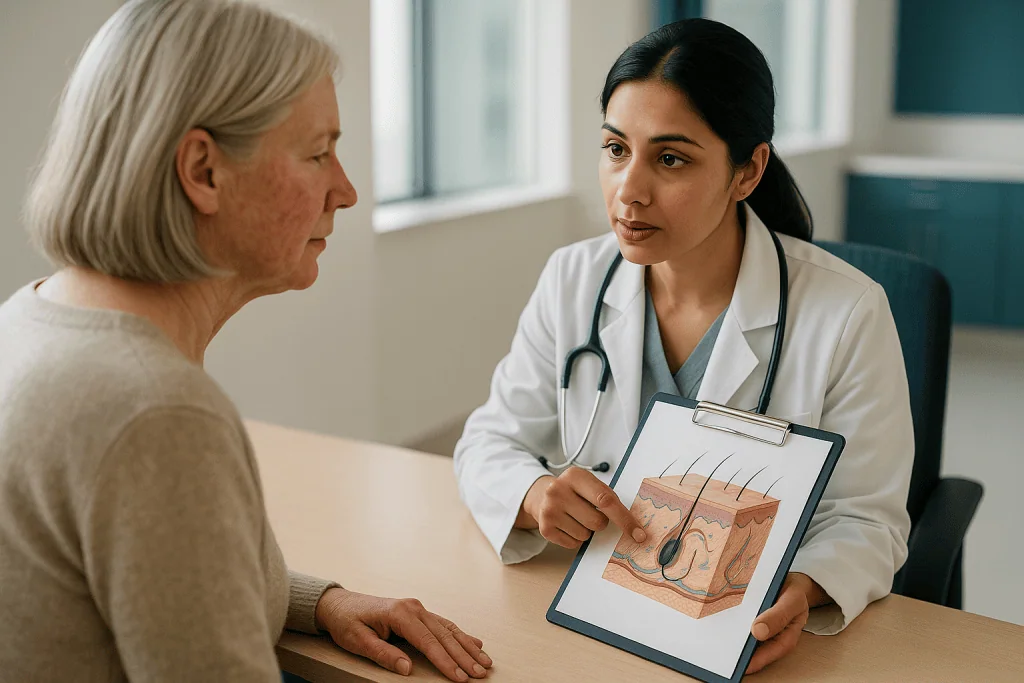
Acne is a disease of the hair follicle and its attached oil gland. According to Mayo Clinic, the sequence is fairly consistent: hormones called androgens prompt the glands to make more sebum (skin oil); dead skin cells fail to shed cleanly and mix with that oil; the plug that forms becomes a comedone, which is the medical name for a blackhead or whitehead; bacteria that normally live harmlessly in the follicle multiply in the trapped oil; and the immune system responds with inflammation, producing the red papules, pustules and deeper nodules people recognize as pimples. Everything in acne starts with a blocked pore.
Rosacea does not. It is primarily a disorder of blood vessels and of an immune system that overreacts in the skin of the central face. The exact cause remains unknown, and mainstream sources such as the NHS and Mayo Clinic are candid about that. The leading ideas include an inherited tendency, an exaggerated inflammatory response to ordinary triggers, and possibly an overreaction to Demodex, a microscopic mite that lives in most people’s facial skin without causing trouble. Blood vessels near the surface dilate too easily and, over time, stay dilated. The bumps of papulopustular rosacea are inflammation arising in already reddened skin, not eruptions from a clogged follicle.
This is why rosacea never produces blackheads: there is no plug to darken. It is also why rosacea can thicken skin over years, most visibly on the nose, and why it can involve the eyes, which share the same vascular and inflammatory sensitivity. Acne does neither. The two conditions may share a color, but they are built on different plumbing.
Flushing: the clue dermatologists ask about first
Ask a room of people with acne whether their faces flush and most will shrug. Ask people with rosacea and you will see nods before you finish the sentence. Flushing, a sudden wave of warmth and redness across the cheeks, nose, chin and forehead, is close to a signature of rosacea and almost irrelevant to acne.
The NHS describes episodes of blushing or flushing that may last for minutes, often set off by specific triggers, as an early feature. Common provocations listed by the NHS and Mayo Clinic include alcohol, spicy food, hot drinks, hot or cold weather, wind, sun exposure, exercise, stress and certain cosmetics. Over months and years, that transient redness can settle into a persistent one, a background flush that no longer waits for a trigger. Fine, visible blood vessels called telangiectasia, which look like tiny red threads, often appear on the cheeks and nose as the vessel walls lose their spring.
Acne can leave skin red, but the redness is local, sitting around individual spots or in the pink marks left behind as they heal. It does not sweep across the central face in response to a bowl of curry. If someone describes their cheeks going hot and crimson during a presentation and staying that way for twenty minutes, a clinician’s attention shifts toward rosacea regardless of how many bumps are present.
One caveat matters. Flushing is easier to see on lighter skin. Cleveland Clinic notes that rosacea affects people of every skin tone but can be underrecognized in darker skin, where redness may read as a subtle dusky or violet tint, or be felt as warmth and stinging rather than seen. Clinicians increasingly ask about sensation, burning, tightness and a sense of heat, not only about color.
Why the age you started matters
Timing is the second question, and it carries more weight than people expect. Acne is overwhelmingly a condition of adolescence and early adulthood. The NHS notes it most often begins around puberty, typically settles by the mid-twenties, and persists in only about 3% of adults over 35. Rosacea runs on a later clock: the NHS and Cleveland Clinic both place typical onset between 30 and 50, and Mayo Clinic describes it as most common in middle age.
Read those two curves side by side and a pattern emerges. A 17-year-old with facial bumps has acne until proven otherwise. A 42-year-old whose skin was clear at 25 and has recently turned red and bumpy has, statistically, a much stronger chance of rosacea, and clinicians will probe for the other signs.
The history behind the age matters as much as the number. A dermatologist will usually ask whether the current problem feels like a continuation of teenage skin or like something new. Continuous acne from adolescence into the thirties happens, particularly in women, and often tracks with the menstrual cycle, jawline distribution and oiliness. A fresh onset of central-face redness after years of unremarkable skin fits the rosacea story.
Family history adds a further clue. The NHS reports that rosacea appears to run in families and is more common in people with fair skin who burn easily, though it can affect anyone. Acne also has a hereditary component, but the relevant relatives are usually remembered for teenage spots rather than for adult flushing. When the woman at the mirror recalls that her mother’s face “did the same thing at that age,” a clinician hears something useful.
Age alone never settles the question. It shifts the odds, and it tells the examiner where to look next.
Blackheads, body breakouts and eyes: the tiebreakers
If flushing and age leave doubt, three physical findings usually resolve it.
The first is the comedone. Blackheads are open comedones, follicles plugged with oil and dead cells whose surface has darkened on exposure to air. Whiteheads are closed comedones, the same plug under a thin skin roof. Both are defining features of acne and simply do not occur in rosacea, because rosacea does not clog pores. A dermatologist examining a bumpy face will look closely at the nose, forehead and chin for these small, non-inflamed plugs. Their presence points firmly toward acne. Their complete absence, on a face full of red bumps, is one of the strongest single arguments for rosacea.
The second is geography. Rosacea is centrofacial: it favors the cheeks, nose, chin and central forehead and largely spares the rest of the body. Acne, as Mayo Clinic notes, commonly appears on the face but also the forehead, chest, upper back and shoulders, wherever oil glands are densest. Bumps on the back are acne. Redness confined to a butterfly across the nose and cheeks, with clear skin everywhere else, is not.
The third is the eyes. The NHS describes ocular rosacea, in which eyelids become sore, red or crusted, eyes feel dry or gritty, and styes recur. Mayo Clinic notes that eye symptoms can sometimes appear before the skin changes. Acne has no such connection to the eyes. A clinician who notices red eyelid margins alongside cheek bumps has a further reason to lean toward rosacea.
Two smaller observations often join the list. Acne skin tends to be oily; rosacea skin is more often dry, sensitive and quick to sting. And acne can leave pitted or raised scars, whereas rosacea rarely scars, though longstanding disease can thicken the skin, especially on the nose.
Rosacea vs acne at a glance
Laid out side by side, the two conditions separate more cleanly than they do in the mirror. The table below summarizes what clinicians weigh, drawing on descriptions from the NHS, Mayo Clinic and Cleveland Clinic. No single row decides the matter; the pattern across rows does.
| Feature | Rosacea | Acne |
|---|---|---|
| Typical age of onset | Usually 30 to 50 | Usually puberty to mid-twenties |
| Flushing episodes | Common and often triggered by heat, alcohol, spicy food, sun, stress | Not a feature |
| Blackheads and whiteheads | Absent | Present and defining |
| Location | Central face: cheeks, nose, chin, forehead | Face, plus chest, back and shoulders |
| Visible blood vessels | Common on cheeks and nose | Not a feature |
| Skin type | Often dry, sensitive, stinging | Often oily |
| Eye involvement | Sore, gritty eyes, red eyelids, styes can occur | None |
| Scarring | Rare; skin may thicken over years | Pitted or raised scars possible |
| Deep painful nodules or cysts | Unusual | Occur in severe acne |
A few rows deserve emphasis. Blackheads and body involvement are the closest things to hard evidence, because each is essentially specific to acne. Flushing and telangiectasia carry similar weight for rosacea. Skin type and age are softer clues that tilt rather than decide.
The table also shows why treating by appearance alone fails. Two faces can look equally red and bumpy while sitting in opposite columns on almost every other line. That is the case for letting a clinician examine the skin in good light rather than matching a photograph online.
How did I suddenly develop rosacea?
People with new rosacea often describe it as arriving from nowhere, and they want to know what they did. The honest answer, echoed by the NHS and Mayo Clinic, is that no one fully knows what causes rosacea, and it is not brought on by poor hygiene or by anything a person ate once.
What clinicians can say is that rosacea usually reflects a tendency that was present long before the skin showed it. Many people, looking back, recall being “the one who blushed” in school, or noticing their cheeks stayed pink after a run for longer than their friends’ did. That easy dilation of facial blood vessels appears to be the underlying trait. Over years, repeated dilation seems to leave the vessels less able to constrict, and the immune system in the skin becomes more reactive to ordinary stimuli. The visible disease is the accumulated result.
Why it declares itself in one particular season of life is less clear. Sun exposure over decades is thought to damage the supporting tissue around facial vessels, which may explain why fair-skinned people who burn easily are more often affected. Periods of intense stress, a run of hot weather, a new job in a warm kitchen, or a change in skincare that strips the skin barrier can all pull a latent tendency into the open. Some medicines that widen blood vessels can worsen flushing, and steroid creams applied to the face for other rashes can provoke a rosacea-like eruption; these are conversations to have with the prescriber, never reasons to stop a medicine on your own.
Research into Demodex mites and into differences in skin bacteria continues, but Mayo Clinic frames these as possible contributors rather than established causes. The sensible takeaway is that rosacea is not a verdict on your habits. It is a predisposition that has surfaced, and it can be managed.
Adult acne vs rosacea: what if I'm over 30 and confused?
Age is a strong clue, but the over-30 crowd is exactly where the two conditions overlap most, so it deserves a closer look.
Adult acne is real and, per the NHS, affects roughly 3% of adults over 35, more often women than men. It has a recognizable style. Bumps cluster along the jawline, chin and lower cheeks rather than across the nose. They often flare in the week before a period, reflecting the hormonal fluctuations Mayo Clinic identifies as a driver of oil production. Blackheads and whiteheads are usually present if you look for them, and deeper, tender nodules can appear. The rest of the face may be oily, and the redness stays attached to individual spots.
Rosacea in the same age group looks different once you know what to seek. Its bumps favor the center of the face, the nose and the apples of the cheeks. They sit on skin that is already pink or red, and they come with flushing, stinging when products are applied, and often visible thread veins. There are no comedones. Skin tends toward dryness rather than shine.
The complicating truth is that a person can have both. Someone with lifelong hormonal acne along the jaw can develop rosacea across the cheeks in their forties. Their face then presents two different diseases in two different zones, and each needs its own approach. Treating the whole face as acne will irritate the cheeks; treating it all as rosacea will leave the jawline breakouts untouched.
This is where a clinician’s mapping of the face earns its keep. Dermatologists routinely note where each type of lesion sits, whether comedones are present anywhere, and how the two regions behave over a cycle. When the picture is mixed, the plan is usually mixed as well, and the treating team decides the sequence.
What else can look like rosacea or acne
Not every red, bumpy face belongs to either condition, and part of a dermatologist’s job is to consider the lookalikes before committing to a label.
Perioral dermatitis produces clusters of tiny red bumps and scale around the mouth, sometimes around the nose and eyes, classically sparing a thin border of skin right next to the lips. It is strongly associated with steroid creams used on the face and with heavy occlusive products. Seborrheic dermatitis causes flaky, pink patches in the eyebrows, beside the nose and along the hairline; it can coexist with rosacea and confuse the picture. Folliculitis, an infection or irritation of hair follicles, can mimic acne on the beard area or scalp margin.
Lupus can produce a butterfly-shaped rash across the cheeks and nose that superficially resembles rosacea. Mayo Clinic notes that clinicians may order tests to rule out conditions such as lupus or psoriasis when the pattern is unusual, when joint pain, fatigue or fever accompany the rash, or when the skin does not behave as rosacea should. Contact dermatitis from a new cosmetic can redden the whole face and sting, and a careful product history often exposes it.
Medication effects deserve a mention. Certain drug classes can trigger acne-like eruptions or flushing as side effects. If a facial change began soon after a new prescription, that timing belongs in the conversation with the prescriber, who can weigh it against the reason the medicine was started. Stopping or changing a medicine is never a decision to make alone.
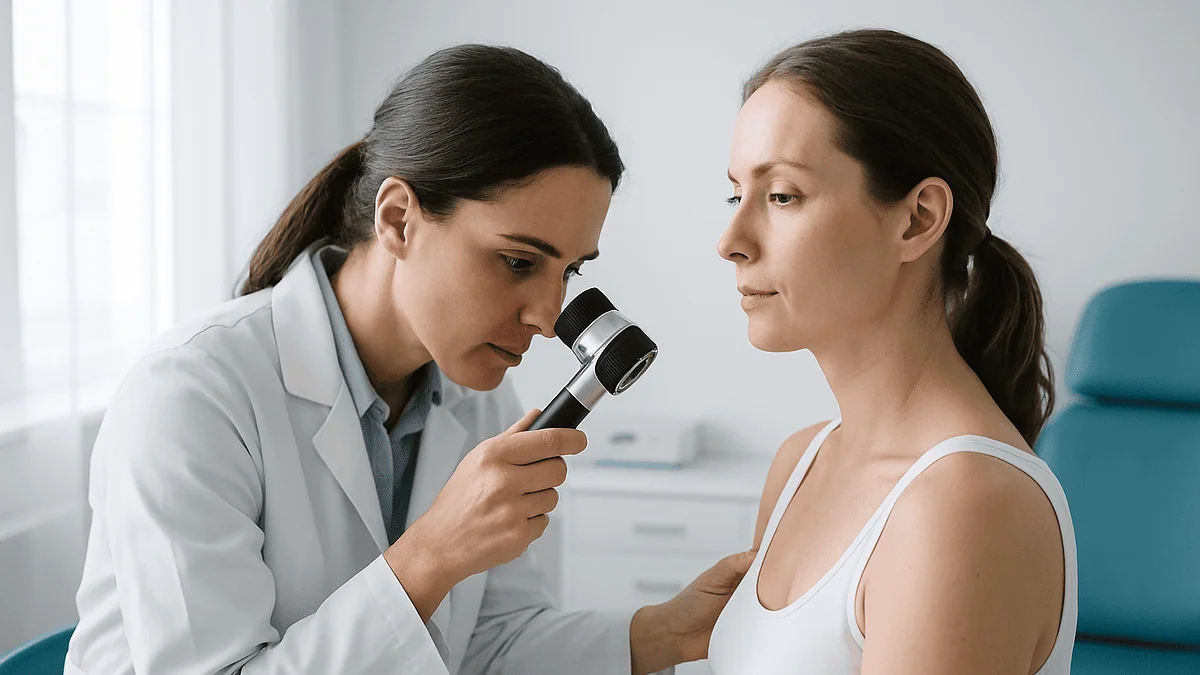
There is no blood test that confirms rosacea or acne; both are diagnosed by examining the skin and taking a history. That is precisely why the examination matters. An experienced eye distinguishes the fine scale of seborrheic dermatitis from the smooth redness of rosacea, or the spared lip border of perioral dermatitis from an acne breakout, in ways that a photograph search cannot.
Who is usually treated now, and who is asked to wait and watch
Once a clinician has a working diagnosis, the next decision is how urgently to act, and the answer depends on the type and pattern rather than on how upset the person is about their skin, though that matters too.
For rosacea, the NHS describes treatment as aimed at controlling symptoms, since there is no way to switch the tendency off. People with frequent papules and pustules are usually started on treatment promptly, because the inflammatory bumps respond well and because uncontrolled inflammation over years contributes to persistent redness and, in some people, thickened skin. Anyone with eye symptoms, gritty, sore or crusted eyelids, is generally treated early and may be referred for an eye examination, since ocular rosacea can affect the surface of the eye if left alone.
People whose rosacea consists mainly of occasional flushing and mild background redness, without bumps, are often asked to begin with trigger management, gentle skincare and daily sun protection, and to observe. That is not dismissal. It reflects the fact that prescription treatments for redness alone have modest and temporary effects, and that many people gain more from identifying their personal triggers than from a cream. If redness is distressing or thread veins are prominent, vascular laser or intense pulsed light may be discussed, usually after the inflammatory component is settled.
For acne, the NHS advises that mild acne can often be managed with over-the-counter approaches for several weeks before a prescription is considered, while moderate to severe acne, especially with nodules, cysts or early scarring, warrants earlier medical treatment because scars are far easier to prevent than to repair.
Mixed cases, uncertain diagnoses and any rash accompanied by systemic symptoms tend to be seen sooner rather than later. In every scenario, the plan and its timing belong to the treating clinician, who weighs the skin against the person’s history and preferences.
How treatment differs, and why the wrong one can backfire
The most practical reason to get the diagnosis right is that the two conditions call for nearly opposite strategies.
Acne treatment works by unclogging follicles, reducing oil, lowering bacterial load and calming inflammation. The classes the NHS lists include benzoyl peroxide, topical retinoids, topical and oral antibiotics, azelaic acid, certain hormonal treatments for women, and, for severe or scarring acne, oral isotretinoin under specialist supervision. Several of these deliberately increase cell turnover or dry the skin. That is the point in acne, where a stubborn plug needs loosening.
Rosacea treatment works by damping inflammation, reducing the immune response in the skin and, for redness, temporarily narrowing dilated vessels. The NHS and Mayo Clinic describe topical options such as metronidazole, azelaic acid and ivermectin for papules and pustules, brimonidine for persistent redness, and oral tetracycline-class antibiotics used for their anti-inflammatory effect rather than to kill bacteria. Low-dose oral isotretinoin is sometimes considered for resistant cases. Laser and light treatments target visible vessels. Every one of these is chosen by the clinician for the person in front of them, and none is a self-start medicine.
Now consider the collision. Retinoids and benzoyl peroxide, mainstays for acne, can sting, dry and inflame rosacea-prone skin, worsening the very redness the person is trying to hide. Aggressive scrubs and alcohol-based toners do the same. In the other direction, an anti-redness gel does nothing for a blackhead. And steroid creams, sometimes reached for because they calm redness within hours, are a known trap: the NHS and Mayo Clinic note that rosacea can flare badly when they are stopped, and prolonged facial use can create a steroid-induced rosacea of its own.
Timelines also differ. The NHS advises that acne treatments may take two to three months to show their effect, while rosacea treatments typically need several weeks. Both require patience, and both require the prescriber’s guidance on when to reassess.
What the first weeks of treatment usually look like
Whatever the diagnosis, the early weeks tend to follow a recognizable arc, and knowing it in advance saves a lot of discouraged late-night mirror checks.
For rosacea, the first change most people notice is a settling of the inflamed bumps rather than of the redness. Topical anti-inflammatory treatments generally need several weeks of consistent use before pustules become fewer, according to the NHS and Mayo Clinic, and the background pinkness usually lags behind. Some people find their skin feels slightly irritated in the first days of a new topical; the prescriber will have advised whether to persist, reduce frequency or stop, and that advice, not a general rule, is what to follow. Redness-reducing gels behave differently: their effect appears within hours and fades by evening, and a minority of users experience a rebound flush afterward, which is worth reporting. Trigger diaries kept during these weeks often prove as informative as the medicine, revealing that a particular hot drink or a specific sunscreen is doing more damage than expected.
For acne, the first weeks can be discouraging. Retinoids in particular may cause dryness, peeling and a temporary increase in visible spots as plugs are pushed to the surface. The NHS is explicit that acne treatments can take two to three months to work, and Mayo Clinic advises a similar window before judging a regimen. Most clinicians schedule a review at around that point rather than sooner.
In both conditions, the middle stretch, weeks three to eight, is where people most often abandon treatment because change feels slow. The evidence suggests holding steady through this period, using only the products the clinician has agreed, and photographing the skin in the same light once a week rather than scrutinizing it daily. If the skin is clearly worsening rather than plateauing, that is a reason to contact the prescriber, not to improvise.
What calms rosacea quickly? The honest answer
People searching for what calms rosacea quickly are usually mid-flare, hot-faced and about to walk into a room. The truthful reply is that nothing switches rosacea off in minutes, but a handful of measures reliably shorten a flush and, over weeks, reduce how often flares happen.
In the moment, cooling helps. Moving somewhere cooler, sipping a cold drink, and applying a cool, damp cloth to the cheeks encourage dilated vessels to narrow. Avoid ice directly on the skin, which can provoke a rebound. Removing the trigger matters more than any product: if the flush followed a hot coffee or a spicy dish, the episode will usually fade on its own within minutes once the stimulus is gone, as the NHS describes.
Day to day, the evidence-backed foundations are unglamorous. The NHS recommends a high-factor sunscreen of SPF 30 or above every day, since ultraviolet light is among the most consistently reported triggers. Gentle, fragrance-free cleansers used with lukewarm water and fingertips, followed by a plain moisturizer, protect the skin barrier that rosacea leaves fragile. Products containing alcohol, menthol, witch hazel, physical scrubs and exfoliating acids tend to sting and should generally be set aside unless a clinician suggests otherwise. Green-tinted cosmetics can neutralize redness visually and are a legitimate part of managing the condition.
What the evidence does not support is the online promise of a rapid natural fix. Mayo Clinic notes that alternative remedies have little research behind them for rosacea. Some botanical ingredients are soothing for some people, but they are not a substitute for a clinician-led plan, and any new product should be tested on a small area first.
When flushes are frequent and disruptive despite these steps, that is the point to return to the prescribing clinician, who may consider treatments aimed specifically at redness or refer for vascular laser.
What people often get wrong
Several beliefs circulate so widely that clinicians correct them almost daily. Each one steers people toward worse skin.
“Rosacea is adult acne.” It is not, and the shared word in the old term “acne rosacea” is the source of the confusion. Acne begins with a blocked pore; rosacea begins with reactive blood vessels and inflammation. Treating one as the other tends to fail.
“Rosacea means you drink too much.” Alcohol is a trigger for many people, but the NHS is clear that rosacea is not caused by drinking and occurs in people who never touch it. The stereotype causes real distress and delays people from seeking help.
“My skin is oily, so it must be acne.” Oiliness does lean toward acne, but plenty of people with rosacea have combination skin, and plenty with adult acne have dry patches. Blackheads are a far more reliable marker than shine.
“Scrubbing harder will clear it.” For rosacea, mechanical exfoliation is among the most consistent aggravators, and for acne, harsh scrubbing does not remove the plug that sits inside the follicle. Gentle cleansing serves both.
“A steroid cream fixed the redness, so I’ll keep using it.” Steroid creams can quieten facial redness briefly, then worsen rosacea markedly when stopped and, with prolonged use, cause a rosacea-like condition themselves. Mayo Clinic and the NHS both flag this. Anything already prescribed should be discussed with the prescriber before changing.
“If I can’t see redness, it isn’t rosacea.” On darker skin, redness may appear as a subtle deepening of tone or be felt mainly as heat and stinging. Cleveland Clinic notes the condition is underdiagnosed in people with darker skin for exactly this reason.
“It will go away on its own.” Teenage acne often does. Rosacea, per the NHS, is long-term and tends to progress without management, though it can be controlled well with the right approach.
Questions to ask your care team
A consultation goes further when you arrive with specific questions. These are the ones dermatologists say they wish more people asked.
- Which condition do you think this is, and which features of my skin led you there? Understanding the reasoning helps you notice changes that matter later.
- Do I have signs of both acne and rosacea, and if so, which areas belong to which?
- Are there any lookalike conditions you are considering, and would any tests help rule them out?
- Is there anything in my current skincare or medicine list that could be aggravating this? Bring the products and a list of prescriptions with you.
- What is the goal of the treatment you are suggesting: fewer bumps, less redness, fewer flushes, or protection against thickening or scarring?
- How many weeks should I give this before we judge whether it is working, and what would make you want to see me sooner?
- What side effects are common in the first days, and which ones mean I should stop and contact you?
- Should my eyes be examined, and what eye symptoms would you want to know about?
- Once things settle, what does maintenance look like, and is it usual to keep using treatment long-term?
- Are laser or light treatments relevant for me, and at what stage would they be considered?
- What daily sun protection and cleansing routine do you recommend for my skin type?
Take notes or ask whether you may record the plan, and confirm who to contact between appointments. The treating team will tailor every answer to your skin and history; general articles like this one can only describe the usual shape of the conversation.
When to call your doctor
Most rosacea and most acne can be assessed at a routine appointment, but some situations deserve a prompt call rather than a wait for the next available slot.
Contact your doctor soon if the skin has changed suddenly and dramatically after starting a new medicine or cream, if you have eye symptoms such as persistent redness of the eyelid margins, gritty or painful eyes, sensitivity to light or blurred vision, since ocular rosacea can affect the surface of the eye, or if facial redness is accompanied by joint pain, unexplained fatigue, fever, mouth ulcers or a rash that worsens sharply in sunlight, which are features clinicians consider when ruling out lupus. Deep, painful nodules or cysts, or early pitted scars from acne, also warrant earlier review because scarring is easier to prevent than to treat.
Seek urgent care the same day if the face becomes rapidly swollen, hot and tender, particularly with fever or spreading redness beyond the usual area, which can indicate a skin infection needing prompt treatment, or if a rash is accompanied by difficulty breathing, swelling of the lips or tongue, or feeling faint, which are signs of a serious allergic reaction.
Between those extremes, get in touch if a prescribed treatment is causing burning, peeling or worsening redness beyond what you were told to expect, if your skin is clearly deteriorating after several weeks on a plan, or if the condition is affecting your mood, sleep or willingness to leave the house. The psychological weight of visible facial conditions is well recognized, and the NHS notes that support is part of care, not an afterthought.
Whatever you observe, do not stop or alter a prescribed medicine on your own. Describe what is happening to the clinician who prescribed it and let them adjust the plan.
Frequently asked questions
Do I have rosacea or just acne?
Only an examination can tell you for certain, but the pattern differs. Rosacea usually starts after 30, brings flushing and persistent redness across the cheeks and nose, often with visible thread veins, and never produces blackheads. Acne typically begins in the teens, includes blackheads and whiteheads, tends toward oily skin and can appear on the chest and back. If you are over 30 with new central-face redness and no blackheads, ask a clinician to assess for rosacea.
Can rosacea be mistaken for acne?
Yes, and it happens often. The papulopustular form of rosacea produces small red bumps and pus-filled spots on the cheeks and nose that look like pimples, and the condition was once called acne rosacea. The key differences are the absence of blackheads, the presence of flushing and background redness, later age of onset and confinement to the central face. Because acne treatments can irritate rosacea, a clinician’s diagnosis matters before starting any routine.
What is the main difference between rosacea and acne?
The main difference is where each begins. Acne starts in a blocked hair follicle, where oil and dead cells form a comedone that bacteria and inflammation then aggravate. Rosacea starts with blood vessels in the central face that dilate too easily and an immune system that overreacts, producing flushing, persistent redness and inflammatory bumps without any plugged pores. That difference explains why blackheads occur only in acne and flushing mainly in rosacea.
How can I tell rosacea pimples vs acne pimples apart?
Rosacea bumps sit on skin that is already red or flushed, cluster across the nose and cheeks, and are not accompanied by blackheads or whiteheads anywhere on the face. Acne pimples arise on otherwise normal or oily skin, often along the jawline or forehead, coexist with visible comedones and may include deeper painful nodules. Acne can scar; rosacea rarely does. A clinician examining your skin in good light can usually distinguish them.
How did I suddenly develop rosacea?
Rosacea usually reflects a long-standing tendency of facial blood vessels to dilate easily, which surfaces in adulthood rather than appearing from nowhere. The exact cause is unknown, according to the NHS and Mayo Clinic, but genetics, cumulative sun exposure, an overactive skin immune response and possibly reaction to Demodex mites are thought to contribute. Stress, heat, new skincare or certain medicines can bring a latent tendency into view. It is not caused by poor hygiene.
What calms rosacea quickly during a flare?
Nothing switches a flush off instantly, but moving somewhere cool, sipping a cold drink and holding a cool damp cloth on the cheeks help dilated vessels narrow within minutes. Removing the trigger, such as a hot drink or spicy food, lets the episode fade naturally. Over the longer term, daily SPF 30 or higher sunscreen, gentle fragrance-free cleansing and avoiding alcohol-based or exfoliating products reduce how often flares occur. Persistent redness should be discussed with a clinician.
Is adult acne vs rosacea hard to tell apart after 30?
It can be, because both occur in this age group and a person can have both. Adult acne tends to cluster along the jawline and chin, flare before periods, include blackheads and leave the rest of the face oily. Rosacea favors the nose and cheeks, sits on flushed skin, stings with products and has no comedones. When the picture is mixed, a dermatologist maps which lesions sit where and may treat each zone differently.
Can I have rosacea and acne at the same time?
Yes. Some adults carry hormonal acne along the jawline while developing rosacea across the cheeks and nose in their thirties or forties, and others have acne scars from adolescence on skin that has since turned rosacea-prone. Each condition needs its own approach, since acne treatments can aggravate rosacea and rosacea treatments do not unclog pores. The treating clinician decides how to sequence and combine care.
Does rosacea go away on its own like teenage acne often does?
Generally not. The NHS describes rosacea as a long-term condition that tends to persist and can progress, with persistent redness, visible vessels and occasionally thickened skin developing over years if unmanaged. Teenage acne, by contrast, settles by the mid-twenties for most people. The encouraging part is that rosacea responds well to trigger management, sun protection and clinician-prescribed treatment, and many people keep it well controlled long-term.
Why do dermatologists ask about my eyes when I come in about bumps on my face?
Because rosacea can involve the eyes, a form called ocular rosacea, whereas acne never does. Sore, red or crusted eyelid margins, dry or gritty eyes and recurring styes can accompany or even precede the skin changes, according to the NHS and Mayo Clinic. Eye involvement strengthens a rosacea diagnosis and may prompt earlier treatment or an eye examination, since untreated ocular rosacea can affect the surface of the eye.
References
This article is for general information only and is not a substitute for professional medical advice. Please consult a qualified doctor about your individual situation.

More from the Blog
How Narrowband UVB Phototherapy Works for Vitiligo: Sessions, Timing and Care Between Visits
Narrowband UVB phototherapy for vitiligo exposes depigmented patches to a narrow band of ultraviolet B light, usually two to three times a week in…

Living With Chronic Hives: Heat, Cold, Pressure and the Everyday Triggers Worth Tracking
Living with chronic hives means managing welts that recur for six weeks or longer, often without a single clear cause. Heat, cold, pressure, friction,…

Questions to Ask at Your Eczema Consultation: Treatment Steps, Maintenance and When to Return
At an eczema consultation, the most useful questions cover four areas: what type of eczema you have and what may be driving it, which…
Double Cleansing and Oil Cleansing: Who Benefits and Who Is Over-Washing
Double cleansing means washing the face twice in a row: first with an oil or balm that dissolves sunscreen, makeup and sebum, then with…
Puffy Eyes and Eye Bags: Fluid, Fat or Skin? How the Cause Decides the Fix
Puffy eyes come from one of three things: fluid pooling in the thin eyelid tissue, orbital fat pushing forward as the tissue holding it…
How to Exfoliate: The Right Way for Your Skin Type
To exfoliate safely, match the method to your skin type: a soft washcloth or gentle chemical exfoliant for dry or sensitive skin, and an…