

When a Night Guard Is Not Helping Bruxism: Adjustment, Replacement and Next Steps

Key Takeaways
- Mayo Clinic and a Cochrane review on PubMed describe night guards as protective for the teeth, not as treatments that reliably stop grinding, so persistent clenching does not mean the guard has failed.
- Uneven contact on a guard, found with marking paper and polished away in minutes, is one of the most common and least recognized reasons for jaw soreness after wearing one.
- Soft boil-and-bite guards can provoke harder clenching and wear through fastest, which is why heavy grinders are often moved to a custom hard or dual-layer design.
- A bite that feels off for a few minutes after removal is normal; a bite that stays changed, or a jaw that locks, needs examination rather than more nights of wear.
- Mayo Clinic links bruxism to stress, sleep apnea, caffeine, alcohol, tobacco and some antidepressants, and none of these drivers is reached by a device worn on the teeth.
- Hot water, dishwashers and sealed damp cases warp guards and grow mold; cool rinsing, gentle brushing without gritty toothpaste, and air drying keep the fit and the hygiene intact.
A night guard that is not working usually means one of three things: it fits poorly or has worn out, it is the wrong design for your pattern of clenching or grinding, or the underlying driver (stress, disrupted sleep, a breathing problem during sleep, or a medicine side effect) has not been addressed. A dentist can adjust, reline or replace the guard and check your jaw, bite and sleep history before suggesting next steps.
The guard sits in its case on the bathroom shelf, cloudy and chewed at one corner, and the morning headache is back anyway. You wore it. You did everything the dentist said. So why does your jaw still ache before the coffee is even poured, and why has your partner started mentioning the sound again?
A night guard not working is one of the most common complaints dental teams hear after fitting one, and it is rarely a sign that the person did something wrong. Guards are a shield, not a switch. They protect enamel from grinding forces, but they do not reach the brain circuits, stress responses or breathing patterns that set the jaw muscles off in the first place.
This explainer walks through what a guard can and cannot do, how to tell a fit problem from a design problem, when adjustment or replacement makes sense, and what the next conversation with your care team should cover.
Why a night guard not working is more common than people think
Dentists prescribe guards because they are low-risk and reversible, not because they fix grinding. That distinction matters. Mayo Clinic describes splints and mouth guards as devices that keep the teeth separated to limit damage from clenching and grinding; it does not describe them as treatments that stop the behavior itself. A Cochrane systematic review of occlusal splints for sleep bruxism, indexed on PubMed, reached a similar conclusion: there was not enough evidence to say splints reduce grinding activity, although they may protect the teeth from wear.
Bruxism is the clinical term for clenching or grinding the teeth, and it comes in two flavors. Awake bruxism happens during the day, often while concentrating or stressed. Sleep bruxism happens at night and is classified as a sleep-related movement disorder, which means the muscles are firing on instructions from the sleeping brain, not from habit.
So when someone says their night guard is not working, the first question is: not working at what? If the goal was to stop chipped teeth and the chipping has stopped, the guard is doing its job even if the jaw still aches. If the goal was to make the clenching go away, the guard was never the right tool for that, and the disappointment is about expectations rather than failure.
There are also genuine failures. A guard that no longer seats fully, one that has cracked, one built from a soft material that invites chewing, or one made for a bite that has since shifted can all make symptoms stay the same or even worsen. The sections below sort these apart, because the fix for each is different.
How a night guard actually works (and what it cannot do)
Picture the jaw as a nutcracker. The hinge sits just in front of each ear at the temporomandibular joint, the sliding joint that connects the lower jaw to the skull. The masseter and temporalis muscles supply the squeeze. During sleep bruxism those muscles contract in bursts, and the teeth take the load.

A guard changes the physics in two ways. First, it puts a layer of acrylic or thermoplastic between the upper and lower teeth, so enamel grinds against plastic instead of enamel. Second, a well-made hard guard gives the lower teeth a smooth, flat surface to slide across, which spreads force more evenly and can take the edge off the muscle contraction by removing the interlocking cusps the jaw would otherwise brace against.
What a guard cannot do is change the signal. Sleep bruxism is linked to brief arousals during sleep, the micro-awakenings that happen dozens of times a night in everyone. Cleveland Clinic and Mayo Clinic both list sleep disorders such as obstructive sleep apnea, where the airway narrows or closes repeatedly during sleep, among the factors associated with bruxism. A piece of plastic in the mouth has no influence on airway collapse or on stress hormones.
It also cannot correct a bite on its own. Some people hope a guard will “retrain” the jaw. Guards are passive; they hold space, they do not teach. Any bite change that is needed is a separate conversation with a dentist, and most people with bruxism do not need one.
Knowing these limits is not defeatist. It tells you where to look next when the guard is in place, the teeth are protected, and the symptoms are still there.
Who a night guard is usually for, and who is usually asked to wait
Guards are usually offered to adults with evidence of tooth wear, cracked or chipped teeth, worn-down fillings, or morning jaw and temple soreness that a dentist links to grinding. NHS guidance on teeth grinding describes a mouth guard or splint as a way to protect the teeth and reduce the noise and strain of grinding, and it notes that dentists can make a custom version or that ready-made versions exist. Custom guards fit the person’s own dental arch; the molded-at-home type is a compromise that some people tolerate and others do not.
Children are a different case. Mayo Clinic notes that bruxism is common in children and often resolves on its own by adolescence, so dentists frequently monitor rather than fit a device, partly because a growing mouth outgrows any guard quickly. Decisions for a child always sit with the pediatric dental team.
Some adults are asked to wait or to use a different approach first:
- People with active, untreated gum disease or loose teeth, where a guard can trap plaque or stress the teeth.
- People mid-way through orthodontic treatment, because the teeth are moving and a guard made today will not fit next month.
- People whose main problem is locking, clicking or restricted opening at the joint, where the NHS advises assessment for temporomandibular disorder (TMD), the umbrella term for pain and dysfunction of the jaw joint and its muscles, before any appliance is chosen.
- People with symptoms of a sleep breathing disorder, where a guard that pushes the lower jaw backward could be the wrong device entirely.
If you were fitted quickly without this kind of screening, a second look is reasonable, and it is a fair thing to raise with the dentist who made the guard.
Why does my night guard make my jaw hurt?
Soreness in the first week or two of wearing a new guard is common and usually settles as the muscles get used to holding the jaw slightly open. Pain that persists, worsens, or shows up only after months of comfortable use points to something specific.
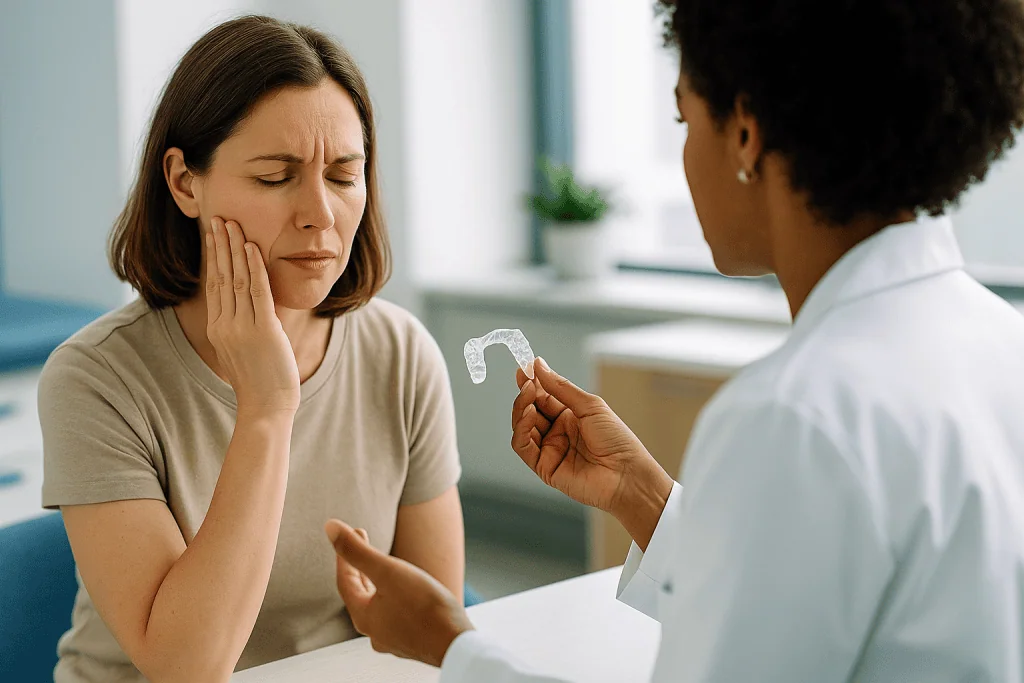
Thickness is the usual suspect. A guard that props the teeth too far apart changes the resting length of the jaw muscles, and muscles held at an unfamiliar length for seven hours can ache the way your calves do after a day in new shoes. Dentists can thin a hard guard where the bite is heaviest.
Uneven contact is the second suspect. If only the back teeth or only one side touches the guard, the jaw muscles work asymmetrically all night, and the pain often lands on the overworked side or in the joint that is being levered. A dentist checks this with thin marking paper and polishes down the high spots; it takes minutes and is the single most common adjustment.
Soft guards deserve their own mention. Some people clench harder on a soft, rubbery surface, the same reflex that makes you chew gum. Cleveland Clinic lists both soft and hard guards and notes that the right choice depends on the person; for someone whose jaw hurts more with a soft guard, a hard or dual-layer design may be discussed.
Finally, the guard may have landed on a joint that was already irritated. NHS guidance on TMD describes jaw pain, clicking and difficulty opening as the typical picture, and it is possible to have TMD and bruxism together. In that case a guard may protect teeth while doing little for the joint, and the care plan needs to cover both. Pain that keeps you from eating, or a jaw that locks, belongs in the red-flag section below.
Do night guards loosen over time? Fit problems and what they mean
Yes, and a loose guard is often the quiet reason behind a night guard not working. Thermoplastic softens slightly with warm water and body heat, acrylic can warp if left in a hot car or boiled by mistake, and the material itself slowly wears where the teeth strike it. Teeth also move a fraction over years, and dental work such as a new crown or filling changes the surface the guard was molded to.
Signs that fit has drifted include a guard that clicks loose with the tongue, one that leaves a dent in the gum on one side, one you keep finding on the pillow, or one that needs real effort to seat and feels tight on waking. A guard that is tight everywhere may simply have shrunk from drying out, which a dentist can sometimes relieve; one that is loose everywhere has usually stretched or the teeth have shifted, and relining or remaking is the typical answer.
Over-the-counter boil-and-bite guards loosen fastest because the material is soft and the fit was never precise. Custom hard guards hold their shape longest but can crack along stress lines, and a cracked guard should be retired rather than glued.
Here is a simple test you can do at home: seat the guard, then try to move it with light pressure from the tongue and fingertip. A well-fitting custom guard resists gentle pressure and comes off only when you pull. If it rocks, lifts at the back, or drops with a tongue push, bring it to your dentist. How often a guard needs replacing varies with grinding intensity and material, and your dental team will give a range based on the wear they see at check-ups rather than a fixed calendar.
Bite feels off after wearing a night guard: should you worry?
Many people notice that for a few minutes after removing the guard their teeth do not quite meet the way they expect. The jaw has rested in a slightly open, forward position all night, and the muscles and joint ligaments take a moment to return to their usual path. A short-lived odd feeling that fades over breakfast is not a cause for alarm.
A bite that stays off, or that feels different by the end of the day, is a different matter and should be examined. There are two broad explanations. The first is that the guard itself is uneven and is guiding the jaw into a new closing position; this is correctable by adjusting the guard. The second is that the guard covers only some of the teeth. Partial-coverage appliances can allow uncovered teeth to drift or over-erupt over months, which does change the bite. This is why most dentists prefer full-arch coverage for long-term nightly use.
Appliances designed to hold the lower jaw forward, sometimes used for snoring or mild sleep apnea, are a known cause of lasting bite changes and are a separate category from standard bruxism guards. If you are not sure which type you have, ask.
People with TMD may also feel their bite shifting as the joint itself becomes inflamed or as a displaced disc inside the joint changes how the jaw seats. NHS guidance on TMD points to assessment by a dentist or doctor when symptoms are persistent, because the appliance is only one part of managing a joint problem.
The practical rule: a bite that feels wrong for longer than it takes to eat breakfast, or any new difficulty bringing the back teeth together, should be checked rather than waited out.
Soft, hard or dual-layer: how guard types compare
Not all guards are built for the same job, and a mismatch between design and grinding pattern is a frequent reason a guard disappoints. The table below summarizes the main types in neutral terms; your dentist will weigh these against the wear pattern and joint findings in your own mouth.
| Guard type | Material and fit | Usually considered for | Common drawbacks |
|---|---|---|---|
| Soft (boil-and-bite or lab-made) | Flexible thermoplastic; molded at home or by a lab | Mild clenching, short-term use, trial of tolerance | Can provoke chewing and harder clenching; wears and loosens fastest |
| Hard acrylic (custom) | Rigid acrylic from a dental impression or scan | Moderate to heavy grinding, documented tooth wear | Adaptation period; cracks under extreme force; needs periodic adjustment |
| Dual-layer (hard outside, soft inside) | Soft lining for comfort with a rigid biting surface | People who could not tolerate a fully hard guard | Thicker; soft layer can degrade sooner than the shell |
| Stabilization splint (flat-plane) | Custom hard splint shaped for even, balanced contacts | Bruxism with jaw muscle pain or TMD features | Requires careful adjustment visits; not a quick fix for joint disease |
Two patterns are worth knowing. People who clench rather than grind often do better with a hard, flat surface that gives the muscles nothing to grip. People who grind side to side chew through soft guards quickly and may find the ragged surface actually catches the teeth. Upper versus lower placement is a matter of comfort, speech and gag reflex more than efficacy, though lower guards are sometimes preferred for people who breathe through the mouth.
If your current guard is the type that the table flags as a poor match for your pattern, that is a concrete point to raise, and switching type is a legitimate next step before anything more involved is considered.
Adjustment, reline or replacement: how dentists decide
When a guard is not helping, the dentist’s visit usually runs in a set order, and knowing it helps you ask the right questions.
First comes the wear check. Scuffs and grooves on the guard tell the dentist where and how hard the teeth are striking, and whether the grinding is side to side, front to back, or a pure clench. Asymmetric wear often explains one-sided jaw pain.
Second is the fit check: does the guard seat fully, does it rock, is it tight at the gumline? A loose but otherwise sound hard guard can often be relined, which means adding a thin fresh layer of material to the inside so it hugs the teeth again. A guard that has thinned through, cracked, or warped is replaced.
Third is the contact check with marking paper. The dentist looks for even, simultaneous contact across both sides when you close, and for smooth gliding without catches when you slide. High spots are polished away. This adjustment is where many “not working” guards start working, because uneven contacts are a common and invisible cause of muscle soreness.
Only after those steps does design come up. A soft guard that is being chewed through may be swapped for a hard one; a bulky guard may be thinned; a partial-coverage appliance may be replaced with full coverage.
Throughout, the dentist is also looking past the guard. Mayo Clinic lists the examination points for bruxism as tenderness in the jaw muscles, dental abnormalities such as broken or missing teeth, and damage to the teeth, underlying bone and inside of the cheeks, and it notes a dentist may ask about sleep habits, medicines and daily stress. Those questions are not small talk; they are the part of the visit that determines what comes after the adjustment.
What the first days and weeks after an adjustment or new guard usually look like
A freshly adjusted or newly made guard rarely feels perfect on night one. The usual arc is a short adaptation phase, then a plateau where you can judge whether anything has changed.
The first few nights often bring extra saliva, a slightly tired jaw on waking, and the sensation that the guard is bigger than it is. Speech is affected if you try to talk with it in. People sometimes take it out in their sleep without remembering. None of this means the guard is wrong; it means the mouth is learning a new object. Wearing it for a short period in the evening while reading can shorten the adjustment.
Over the following weeks, the questions to track are specific. Is morning jaw soreness shorter, the same, or longer? Has the headache pattern shifted? Is the guard showing wear in the same places as the old one? Has the bite returned to normal within minutes of removal each morning? A simple note on your phone each morning gives the dentist far better information than memory does at the follow-up.
If a guard is going to help with muscle soreness, most dentists expect to see a trend within a handful of weeks rather than months; the exact review window is something your dentist sets, and it is reasonable to ask for a follow-up appointment to be booked before you leave. A guard that makes pain worse from the start, rather than merely feeling strange, should not be pushed through; call and ask to be seen sooner.
Keep in mind the goal was set at the first visit. If it was tooth protection, success looks like no new chips and a guard that is wearing instead of the enamel. If it was pain, the guard is one piece, and the next section covers the others.
What else may be driving the grinding: sleep, stress, medicines and airway
A guard that is now fitting well, adjusted and still leaving you sore has done you a favor: it has ruled itself out as the problem and pointed at the cause.
Stress and anxiety are the most cited drivers. Mayo Clinic and NHS guidance both list emotional stress, anxiety, frustration and tension among the factors linked to bruxism, and many people can map a bad grinding stretch onto a difficult month. NHS guidance suggests that where stress is the likely cause, a conversation with a GP about managing it is part of the plan, and it mentions approaches such as cognitive behavioral therapy, a structured talking therapy that targets unhelpful thought and behavior patterns.
Sleep is the second. Sleep bruxism clusters around arousals, and anything that fragments sleep can feed it. Mayo Clinic lists sleep apnea among associated conditions, along with loud snoring and daytime sleepiness as reasons a doctor may refer for a sleep study, an overnight test that records breathing, oxygen levels and muscle activity.
Substances are the third. Caffeine, alcohol, tobacco and recreational stimulants all appear in Mayo Clinic’s list of risk factors for bruxism, and evening caffeine is a quiet contributor people rarely connect to their jaw.
Medicines are the fourth. Mayo Clinic notes that bruxism can be an uncommon side effect of some psychiatric medicines, including certain antidepressants. If your grinding started or worsened after a prescription change, that is worth telling the prescribing clinician. Do not stop or alter any medicine on your own; the decision about whether a switch is appropriate belongs to the prescriber, who can weigh the jaw against the reason the medicine was started.
None of these is reached by a guard. All of them are reached by the questions a dentist or doctor asks when a guard is not enough.
Beyond the guard: next steps when the night guard is still not working
Once fit, design and the usual drivers have been reviewed, the next tier of options is broader than most people expect, and it is worth knowing the shape of it so the conversation with your care team is informed.
Behavioral approaches come first because they carry the least risk. Mayo Clinic lists stress and anxiety management, behavior change such as practicing proper mouth and jaw position, and biofeedback, a technique that uses sensors to show you when the jaw muscles are tensing so you can learn to relax them, among the approaches used for bruxism. For awake clenching, simple awareness cues during the day (lips together, teeth apart, tongue resting on the palate) are a common starting point.
Dental approaches beyond guards exist but are reserved for specific situations. Mayo Clinic notes that correcting misaligned teeth or reshaping chewing surfaces may be considered in severe cases where wear has caused sensitivity or affected chewing, and that this does not necessarily stop the bruxism itself.
Medicines are not a routine treatment for bruxism. Mayo Clinic describes them as generally not very effective and lists short-term muscle relaxants, medicines for anxiety or stress, and botulinum toxin injections into the jaw muscles for severe cases that do not respond to other treatments. Botulinum toxin works by temporarily weakening the injected muscle; its effect is time-limited and wears off over months, so it is repeated if used. Whether any of these is appropriate, and in what form, is a decision for the treating clinician based on your history, and this article does not recommend any of them.
Referral is the final step: to a sleep physician if a breathing disorder is suspected, to a dentist with a focus on jaw joint disorders if TMD features dominate, or to a mental health clinician if stress is the engine. The guard stays in the picture throughout, protecting the teeth while the cause is worked on.
How to clean a night guard, and what happens if you don't
A guard spends seven or eight hours a night in a warm, wet, bacteria-rich environment. Left unwashed, it develops a sticky biofilm, the same kind of film that forms on teeth as plaque, and within weeks it can smell, discolor and feel rough. Calcium deposits from saliva build up as white crust, and a soft guard can absorb odors permanently.
The health consequences are real if undramatic. A dirty guard reintroduces bacteria and yeast to the mouth every night, which can irritate gums, worsen bad breath, and in people prone to oral thrush, a yeast overgrowth that shows as white patches and soreness, provide a reservoir for it. Rough, crusted surfaces also wear the guard faster and can abrade the gumline.
Cleaning is simple and the routine matters more than the product:
- Rinse the guard in cool water as soon as you take it out, before saliva dries on it.
- Brush it gently with a soft toothbrush and mild soap or a non-abrasive cleaner; many dentists advise against regular toothpaste because its grit scratches the surface and gives bacteria more to cling to.
- Let it dry fully in a ventilated case. A sealed, damp case grows mold.
- Avoid hot water, dishwashers and boiling, which warp both acrylic and thermoplastic and can turn a well-fitting guard into a loose one in a single wash.
- Bring it to dental check-ups so it can be inspected and, if the practice offers it, professionally cleaned.
Deep-cleaning tablets sold for dentures are used by some people on an occasional basis; follow the dentist’s advice on frequency, because some soft materials do not tolerate them. A guard that smells despite cleaning, or one with a cloudy, pitted surface that will not scrub clean, has probably reached the end of its useful life and is a candidate for replacement rather than more scrubbing.
What people often get wrong about night guards
Myth one: a guard stops grinding. It does not. It stops grinding from damaging the teeth. The Cochrane review on PubMed found insufficient evidence that occlusal splints reduce sleep bruxism activity, and Mayo Clinic frames guards as protective. People who expect the clenching to vanish feel let down by a device that is working exactly as designed.
Myth two: a store-bought guard is as good as a custom one. Sometimes it is enough, and NHS guidance acknowledges ready-made versions exist. The difference is fit and material. A boil-and-bite guard is thicker, softer and less precise, and it is the type most often chewed through or spat out during sleep. For heavy grinders, that gap is the whole story.
Myth three: if a guard hurts, you are not used to it yet. A few days of strangeness is normal; a few weeks of worsening pain is not. Persistent pain usually means uneven contact, excess thickness or the wrong design, all of which are fixable in a short visit.
Myth four: guards cause TMD. A poorly made or partial-coverage guard can aggravate a joint or shift a bite, which is why adjustment visits exist. A well-adjusted full-coverage guard is the standard conservative approach for jaw muscle pain, not its cause.
Myth five: wearing it during the day helps more. Daytime clenching is better managed by awareness and posture cues, and some soft guards worn all day encourage more clenching, not less.
Myth six: once you have a guard, you are done. Teeth move, materials wear, and the drivers of bruxism change with life. A guard is a maintenance item that gets checked at each visit, like the tires on a car, and it is one part of a plan rather than the plan.
Questions to ask your care team
A productive follow-up visit depends on asking the questions that move the plan forward. Bring the guard, bring your morning notes, and consider these.
- What does the wear pattern on my guard tell you about how I clench or grind, and is this the right type of guard for that pattern?
- Does it fit the way it should, and if not, is this a reline, an adjustment or a remake?
- Are the contacts even when I close and slide? Can you check with marking paper today?
- Is my jaw pain coming from the muscles, the joint, or both, and does that change which appliance you would use?
- Do I have signs of a sleep breathing problem that would justify a sleep study before we go further?
- Could any of my current medicines be contributing, and should my prescriber be told?
- What is the goal we are measuring: tooth protection, pain, headaches or sleep quality? How will we know in a few weeks whether this is working?
- If stress is the likely driver, who should I talk to and what approaches would you suggest discussing?
- What signs mean I should stop wearing the guard and call you?
- How should I clean this particular material, and how often do you want to inspect it?
Two of these deserve emphasis. The question about the goal sets the yardstick for everything else, and a surprising number of people have never been told what their guard was meant to achieve. The question about sleep breathing is the one most often skipped, and it can redirect the entire plan. If any answer leaves you unsure, say so; a care team would rather repeat an explanation than have you abandon a guard that could have been fixed in ten minutes.
When to call your doctor or dentist
Most night guard problems are inconveniences that wait for the next routine appointment. A smaller number are signals that something beyond the guard needs attention, and these should prompt a call rather than a wait.
Contact your dentist promptly if:
- Your jaw locks open or closed, or you cannot open wide enough to eat comfortably. NHS guidance on TMD flags locking and restricted opening as reasons for assessment.
- Your bite stays noticeably changed for more than a short time after removing the guard, or you develop new difficulty bringing the back teeth together.
- Pain is worsening rather than settling after adjustment, or it spreads into the ear, temple or neck and does not ease.
- A tooth cracks, a filling or crown breaks, or a tooth becomes loose or very sensitive.
- You notice sores, swelling or white patches on the gums or cheeks where the guard sits.
- The guard itself cracks, warps or no longer seats; stop wearing a damaged guard rather than forcing it.
Contact a doctor if you have loud snoring with pauses in breathing noticed by a partner, waking gasping, marked daytime sleepiness, or morning headaches that are new or severe. Mayo Clinic lists these among the features that may prompt referral for a sleep evaluation. Also tell your prescribing clinician if grinding began or worsened after a medicine change, and do not stop the medicine on your own.
Seek urgent care the same day for a jaw that is stuck after a yawn or injury, facial swelling with fever, or jaw pain accompanied by chest pressure, shortness of breath or pain radiating down the arm, which needs emergency assessment for causes unrelated to the teeth.
Every decision about adjusting, replacing or moving beyond a guard rests with your treating team, who can see what the guard and the mouth are telling them. The purpose of this article is to help you arrive at that appointment knowing what to ask.
Frequently asked questions
Why is my night guard not working for my jaw pain?
Usually because the guard is doing a different job than you expected: it shields enamel but does not switch off the muscles. If the fit has loosened, the contacts are uneven, or the material is too soft or too thick, the guard itself can add to soreness. A dentist can check wear marks and contacts, adjust or remake it, and then look at sleep, stress and medicines as possible drivers.
Why does my mouth guard make my jaw hurt?
Early soreness is common as the muscles adapt, but lasting pain usually points to a guard that is too thick, that touches unevenly so one side works harder, or that is soft enough to invite chewing. Each of these is correctable by thinning, adjusting contacts, or changing the guard type. Pain that worsens over weeks, or a jaw that locks, should be examined rather than tolerated.
Do night guards loosen over time?
Yes. Thermoplastic and acrylic wear where the teeth strike, warm water and heat can warp them, and teeth shift a fraction over years or after new dental work. A guard that rocks, lifts at the back, or drops with a tongue push has lost its fit. A dentist can often reline a sound hard guard; a cracked, thinned or warped one is replaced.
What happens if you don't wash your night guard?
Biofilm, calcium crust and odor build up within weeks, and the guard reintroduces bacteria and yeast to the mouth each night. That can irritate gums, worsen bad breath and provide a reservoir for oral thrush in people prone to it. Rough, crusted surfaces also wear faster. Cool rinsing, gentle brushing without abrasive toothpaste, and air drying in a ventilated case prevent most of this.
How should I use a mouth guard for grinding teeth?
Seat it fully each night after brushing, wear it for the whole sleep period, and remove and rinse it in cool water on waking. Expect a few nights of extra saliva and a strange feeling; wearing it briefly in the evening can speed adaptation. Keep a short morning note on jaw soreness and headaches so your dentist can judge at follow-up whether the guard is helping.
Can a night guard make bruxism worse?
A poorly matched guard can. Soft guards sometimes trigger harder clenching, the same reflex as chewing gum, and an uneven hard guard can make the jaw muscles work asymmetrically. Mayo Clinic notes that guards do not always reduce grinding. If your symptoms worsened after starting a guard, that is a reason for an adjustment visit, not a reason to give up on the approach.
Why does my bite feel off after wearing a night guard?
The jaw rests in a slightly open, forward position all night, so a brief odd feeling after removal is normal and fades within minutes. A bite that stays changed suggests the guard is guiding the jaw into a new position, covers only some teeth and has let others drift, or that the joint itself is inflamed. Persistent bite change should be examined by a dentist.
Can night guards cause TMJ problems?
A badly adjusted, overly thick or partial-coverage guard can aggravate the jaw joint or shift the bite, which is why follow-up adjustment visits matter. A well-adjusted full-coverage guard is a standard conservative approach for jaw muscle pain rather than a cause of joint disorder. Locking, clicking with pain, or restricted opening should be assessed as possible TMD regardless of the guard.
Should I wear my night guard during the day for clenching?
Daytime clenching is generally managed with awareness cues (lips together, teeth apart, tongue on the palate) rather than a guard, because a device worn all day can encourage more clenching and interferes with speech and eating. Some dentists do use a thin daytime appliance in specific cases. Whether that applies to you is a question for your dental team.
When should I replace my night guard instead of adjusting it?
Replace it when it has cracked, thinned through at the biting surface, warped so it no longer seats, or become permanently rough, cloudy or odorous despite cleaning. Adjustment or relining suits a guard that is structurally sound but has uneven contacts or a slightly loose fit. Your dentist will base the interval on the wear they see at check-ups rather than a fixed schedule.
References
- NHS: Teeth grinding (bruxism)
- NHS: Temporomandibular disorder (TMD)
- Cleveland Clinic: Teeth grinding (bruxism)
This article is for general information only and is not a substitute for professional medical advice. Please consult a qualified doctor about your individual situation.

More from the Blog

What an Oral Health Therapy Visit Involves: Cleaning, Gum Checks and a Personal Plan
An oral health therapy appointment is a preventive dental visit led by a hygienist or oral health therapist. It usually includes a review of…
Root Canal vs Extraction and Implant: What Keeping the Natural Tooth Changes Long Term
A root canal removes infected pulp and keeps your natural tooth, root and surrounding ligament in place; extraction and implant replace the whole tooth…
What Periodontal Measurements Reveal About Gum Recession: Pocket Depths and Bone Support
Periodontal measurements translate gum recession into numbers a dental team can track. A probe measures pocket depth, the gap between gum and tooth, and…

When Do Children Get Removable Appliances? How Jaw Growth Shapes the Timing
Removable appliances for children are usually fitted during the mixed dentition years, when baby and adult teeth share the mouth and the jaws are…
Why a Cleaning Comes Before Teeth Whitening: Checking Enamel, Gums and Old Fillings
A professional cleaning usually comes before teeth whitening because whitening gel works on clean enamel, not on plaque and tartar, and because the dentist…

How Fiber Application Works in One Visit: Bonding the Fiber Into Composite Resin
A fiber reinforced composite procedure adds a ribbon of glass or polyethylene fiber inside tooth-colored composite resin so the restoration resists bending and cracking.…