

When a Spinal Cord Stimulator Stops Helping: Reprogramming, Lead Checks and Revision

Key Takeaways
- Reprogramming is non-invasive, uses an external programmer through the skin, and is almost always the first step because it can restore coverage that drifted without any surgery.
- Impedance readings from the programmer show whether each electrical circuit is intact: unexpectedly high values point to a fracture or loose connection, low values to a short between contacts.
- Lead migration is confirmed by comparing a current spine X-ray with the film taken immediately after implantation, since even a one-level shift can move stimulation away from the painful area.
- A generator left in MRI mode or switched off by a strong magnet delivers no therapy, so checking device status on the handheld remote comes before assuming hardware has failed.
- Battery replacement swaps only the generator and reuses the existing leads, provided impedance testing shows those leads still work and sit where they should.
- In the PROCESS trial, meaningful relief was defined as at least a 50 percent reduction in leg pain, and fewer people met that bar at later follow-up than early on, which is why slow fading is treated as a recognised pattern rather than a mystery.
A spinal cord stimulator that has stopped helping is usually assessed in stages. The care team first reviews the device log and tries reprogramming, then checks whether a lead has moved or a battery is failing using the programmer, X-rays and impedance readings. If the hardware is intact but relief has faded, options include a different waveform, revision or replacement of components, or removal; every decision rests with the treating team.
Somewhere around the second winter, she noticed the tingling had wandered. It used to sit squarely in the left calf, exactly where the burning was. Now it fluttered across her ribs when she bent to load the dishwasher and vanished altogether when she stood up. The remote said everything was fine. Her leg disagreed.
That gap between what the device reports and what the body feels is the usual starting point when someone types spinal cord stimulator not working into a search bar at midnight. It is also, encouragingly, a very ordinary clinical problem. Pain teams see it often and work through it in a fairly predictable order.
This article follows that order: the non-invasive checks first, then the imaging, then the harder conversations about habituation, revision and, occasionally, removal. None of it replaces a visit to the team that implanted the device, but knowing the sequence makes that visit far less daunting.
Why is my spinal cord stimulator not working anymore?
Loss of relief rarely has a single cause, which is why a careful team works through the possibilities in order rather than leaping to surgery. Broadly, the explanations fall into four groups.
The first is mechanical: the device is not delivering stimulation. A rechargeable battery may have run flat, a generator may have switched itself off after exposure to a magnet or an MRI scanner, or a lead (the thin insulated wire that carries current to the spine) may have cracked or worked loose from the generator.
The second is positional. Everything is switched on, but the pulses are landing in the wrong place. A lead can slip a short distance within the epidural space, the fat-filled gap between the spinal cord’s protective membrane and the bone, and even a small shift can carry the stimulation away from the painful region. Scar tissue forming around the metal contacts can also change how the current spreads.
The third is biological. Hardware and settings are unchanged, yet the nervous system seems to have stopped answering. Clinicians call this habituation or loss of efficacy, and its mechanisms remain only partly understood.
The fourth is the easiest to overlook: the pain itself has changed. A new disc problem, worsening arthritis in a facet joint, progression of nerve damage, or a hip or shoulder problem can produce pain the stimulator was never positioned to treat. Low mood, poor sleep and inactivity can also turn the volume up on existing pain, a point the general chronic pain literature makes repeatedly (MedlinePlus).
Sorting these groups apart is the work of the first appointment. Most of it is done with a programmer tablet, a few questions and, where needed, an X-ray.
How spinal cord stimulation actually works, in plain language
A stimulator has two main parts. Leads sit in the epidural space over the back of the spinal cord, where the dorsal columns run; these are bundles of nerve fibres carrying touch and position sense upward to the brain. A pulse generator, essentially a battery and a small computer, sits in a pocket under the skin of the buttock, flank or abdomen and sends tiny electrical pulses along the leads.
Why this eases pain is usually explained by gate control: non-painful electrical signals arriving at the spinal cord compete with pain signals and reduce how many reach the brain. Johns Hopkins and Cleveland Clinic both describe the effect as masking or interrupting pain messages before they are perceived. Nobody claims the underlying disc, scar or nerve injury is repaired. The signal is modified, not the cause.
Traditional systems produce paresthesia, a tingling sensation, and the clinician’s task at the first programming visit is to make that tingling overlap the painful area. Newer waveforms, including high-frequency and burst stimulation, aim to relieve pain without any tingling. That difference matters when the device stops helping. With tingling-based stimulation, a shift in where the sensation is felt is an immediate clue that a lead may have moved. With paresthesia-free stimulation there is no sensation to track, so the team leans more heavily on the device log, impedance readings and imaging.
Everyone with a permanent implant has already completed a trial, wearing temporary leads for about a week to test whether the approach helps at all (Cleveland Clinic). A trial result is a snapshot, though. It shows the method can work for that person’s pain at that moment, not that the same settings will keep working unchanged for years.
Spinal cord stimulator reprogramming: what happens at the visit
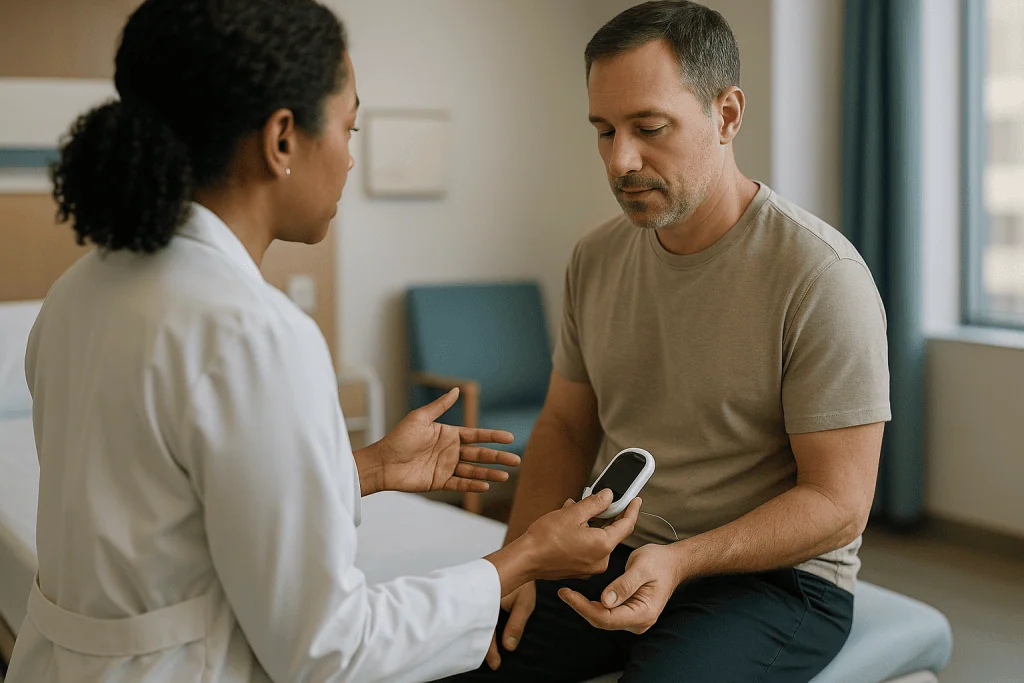
Reprogramming is the adjustment of the stimulator’s settings using an external programmer that communicates with the generator through the skin. It is non-invasive, takes place in a clinic room, and is nearly always the first step when a spinal cord stimulator is not working as it once did.
Several things can be changed. Amplitude is the strength of each pulse. Pulse width is how long each pulse lasts. Frequency is how many pulses arrive each second. Beyond those, the clinician or device specialist chooses which metal contacts on the lead are active and which act as positive or negative poles, effectively steering the electrical field up, down or sideways along the cord. If the system supports more than one waveform, they may switch from tingling-based stimulation to a paresthesia-free mode, or the reverse.
Expect to be asked to move. Stimulation can feel stronger lying down and weaker standing, because the distance between lead and cord changes with posture. Some devices adjust automatically; others need separate programs for sitting, walking and sleeping.
One visit is often not enough. A new program has to be lived with for days before anyone can judge it fairly, so teams commonly send people home with two or three programs to compare and a short diary of pain, sleep and activity. Written notes beat memory, and they give the next appointment something concrete to work from.
Reprogramming cannot fix a flat battery or a broken wire, and it cannot create relief where none existed. What it can do is restore coverage that drifted and test whether the nervous system still responds. If several well-designed programs fail, that result is itself diagnostic and points the team toward a hardware check or a conversation about other options.
How does the team check for spinal cord stimulator lead migration?
Lead migration means the lead has moved from the position where it was placed. It is among the most frequently reported hardware problems with these devices, which is why anchoring the lead and limiting bending, twisting and lifting in the early weeks after implantation are standard advice (Johns Hopkins; Cleveland Clinic).

Three tools do most of the work. First is the programmer itself, which reads impedance, a measure of electrical resistance across each pair of contacts. Values that are unexpectedly high suggest a break in the circuit, such as a fractured wire or a loose connection at the generator; values that are unexpectedly low suggest a short between contacts. Normal impedance across the board makes a fracture less likely and shifts attention to position or biology.
Second is a plain X-ray of the spine, taken in the same views as the film recorded immediately after implantation. Comparing the two shows whether the lead tip has slipped up, down or sideways, sometimes by a whole vertebral level. Fluoroscopy, a live X-ray used in the operating room, serves the same purpose during a revision.
Third is the person wearing the device. Someone with tingling-based stimulation may report that the sensation has moved to the ribs instead of the leg, or faded on one side. That description is useful information for the clinician, not a diagnosis, because scar tissue, a change in posture or a new pain source can produce similar accounts. The team weighs the story against the readings and the film.
Minor migration is sometimes managed by reprogramming alone, steering the field back toward the painful area. Larger shifts, or a confirmed fracture, usually mean a revision procedure to reposition or replace the lead.
Is it the battery? Charging habits, end of service and spinal cord stimulator battery replacement
Two kinds of generator exist. A rechargeable unit is topped up through the skin with an external charger and is built to last many years before replacement. A non-rechargeable unit cannot be topped up and is replaced when it reaches end of service; Cleveland Clinic notes that battery life depends on how intensively the device is used, so a person on high settings drains a generator faster than one on low settings.
Charging problems are a common and fixable reason for a stimulator that seems to have failed. If the charger sits slightly off-centre, if the generator lies deeper than usual, or if sessions are cut short, the battery can drift into a low state that reduces output or shuts the device down. The programmer displays charge level and charging history, and a few minutes with the device specialist often sorts it out.
End of service is different. Every generator carries a built-in indicator, and the programmer flags a warning as the battery approaches its limit. Stimulation may become intermittent before stopping altogether. Spinal cord stimulator battery replacement is a short procedure in which the old generator is lifted out of its pocket and a new one connected to the existing leads, provided those leads still work and sit where they should. Impedance testing before the swap confirms this.
Two more points deserve a mention. Generators have an MRI mode, and some scans require the device to be switched into that mode and back; a stimulator left in MRI mode delivers no therapy. Strong magnets, including some phone cases and bag clasps, can switch older generators off. Checking device status on the handheld remote is a sensible first move before assuming anything has broken.
Spinal cord stimulator not working after years: tolerance, habituation and a changing body
Many people describe the same arc: a dramatic trial, a good first year, then a slow fade with nothing obviously wrong on the X-ray. This is the pattern most often labelled tolerance or habituation, the nervous system adapting to a constant input until it responds less.
The honest position is that the mechanism is not settled. Long-term follow-up of randomised and observational studies shows that a proportion of people lose some or all of their relief in the years after implantation, and that this happens even when hardware is intact. In the PROCESS trial, which compared stimulation plus medical management with medical management alone for persistent leg pain after spine surgery, meaningful benefit was defined as at least a 50 percent reduction in leg pain, and the share of people meeting that bar was lower at later follow-up than early on (Kumar et al., Pain, 2007). That tells us fading is real; it does not tell us why.
Several strategies are used in practice. Switching waveform, for example from tingling-based to high-frequency or burst stimulation, gives the cord a different pattern of input. Cycling the device on and off in blocks, sometimes called a stimulation holiday, is another approach. Evidence for each is limited and largely observational, so a care team may frame them as reasonable trials rather than proven fixes.
Bodies change too. Weight change, new spinal curvature or further degeneration can alter the distance between lead and cord, or add a pain source the device was never aimed at. Depression, poor sleep and deconditioning amplify pain through well-described pathways (MedlinePlus). A thorough reassessment therefore looks at the whole person, and sometimes finds that the stimulator still works for the original pain while a new problem has arrived beside it.
Troubleshooting at a glance: what might be wrong and how it is checked
Teams rarely say so out loud, but most of them carry a mental flowchart for a stimulator that has stopped helping. Laying it out in one place shows why the cheapest, least invasive checks come first and why surgery sits at the far end of the table rather than the beginning.
| What may be happening | What people commonly describe | How the team checks | Usual next step |
|---|---|---|---|
| Battery low or depleted | Stimulation weak, intermittent or absent | Charge level and charging history on the programmer | Charging guidance, or generator replacement at end of service |
| Device off or in MRI mode | No sensation at all, remote shows a status message | Status screen on remote and programmer | Switch therapy back on |
| Lead migration | Tingling in a new place, or on one side only | Plain X-ray compared with post-implant film; impedance | Reprogramming first; lead revision if coverage cannot be restored |
| Lead fracture or loose connection | Sudden loss, or brief shocks with movement | Abnormal impedance on specific contacts; imaging | Lead or connector revision |
| Habituation | Same sensation, less relief, slow decline | Normal hardware checks; pain diary review | Waveform change, program rotation, reassessment of goals |
| New or changed pain source | Pain in a different pattern or region | Clinical examination; imaging of the spine or joints | Treat the new problem; stimulator may be unchanged |
| Infection or skin breakdown over hardware | Redness, warmth, drainage, fever | Examination, blood tests, sometimes imaging | Urgent review; antibiotics and possible removal |
Two patterns are worth noticing. Problems in the top half of the table are often resolved without an operating room. Problems in the bottom rows need a clinician’s eyes rather than a remote, and the final row needs them quickly.
Who is usually offered revision surgery, and who is asked to wait
Revision is any operation that repairs, repositions or replaces part of an existing stimulator system. Teams tend to offer it when three conditions line up: the device gave meaningful relief in the past, a specific hardware problem has been confirmed, and reprogramming has already been tried and found wanting. A fractured lead with abnormal impedance, a migrated lead visible on X-ray, or a generator at end of service in someone who still benefits are the classic examples.
Being asked to wait is not a refusal; it is usually a sign that something else needs settling first. Common reasons include:
- Active infection anywhere in the body, since implanting hardware during an infection raises the risk of seeding it onto the device.
- Uncertainty about whether the current pain is the kind that stimulation can address at all, in which case the team may suggest a repeat trial before committing to new leads.
- Unexplained fading with intact hardware, where a waveform change or program rotation has not yet been given a fair run.
- A pending spine operation or injection that could change the pain picture, making it sensible to see the result before altering the stimulator.
- Medication or medical issues that affect surgical safety, such as anticoagulation or poorly controlled diabetes, which the prescribing and surgical teams coordinate between themselves.
- Expectations that outrun what the evidence supports, which a frank conversation and sometimes a repeat psychological assessment can address.
People often find the waiting period frustrating, and that frustration is legitimate. It helps to ask the team to name what they are waiting for and what would move the decision forward. A clear answer, such as a repeat X-ray after a program change or a surgical review once an infection has cleared, turns an open-ended delay into a plan.
What spinal cord stimulator revision surgery involves
The shape of a revision depends on what has gone wrong. Johns Hopkins and Cleveland Clinic describe the main variants, and most people encounter one of four.
Generator replacement is the simplest. A small incision reopens the pocket, the old unit is disconnected and a new one attached to the existing leads, with impedance checked on the table to confirm a sound connection. It is commonly done under local anaesthetic with sedation.
Lead repositioning or replacement is more involved. Under fluoroscopy, the surgeon frees the lead from its anchor, advances or withdraws it to the target level, or removes it and threads a fresh percutaneous lead (a wire placed through a needle) into the epidural space. Anchoring is redone, often more securely.
Conversion to a paddle lead is sometimes proposed when a wire lead keeps moving or cannot deliver stable coverage. A paddle lead is a flat, wider electrode array placed through a small opening in the bone, called a laminotomy, under general anaesthesia. It tends to sit more firmly but requires a larger operation.
Explant means removal of the system. Leads and generator are taken out, although a fragment of lead can occasionally remain if scar tissue grips it tightly; the team will say so if that happens.
Risks are those of the original implant: bleeding, infection, a puncture of the dural membrane with a spinal headache, nerve irritation and, rarely, nerve injury or bleeding around the cord. Scar tissue from the first operation can make a revision technically harder. No team can state in advance what relief a revision will produce, and most are careful to say so.
What the days and weeks after reprogramming or revision usually look like
After reprogramming alone, the main task is patience. Settings that feel promising in a clinic chair can behave differently during a supermarket trip or a night’s sleep, so most teams ask for a few days on each program before judging it. A simple diary, noting pain level, activity and which program was running, pays for itself at the follow-up visit. Expect a second or third adjustment; that is the method working, not failing.
After a generator swap, the pocket site is sore for a while and may show bruising. Stimulation is usually restarted before leaving the recovery area, since the leads have not moved. Keeping the incision clean and dry and watching it for redness or drainage are the practical priorities.
After lead revision or a new paddle lead, the recovery looks more like the original implant. Teams typically ask people to avoid bending, twisting and lifting during the early healing weeks so that scar tissue can form around the lead and hold it in place (Johns Hopkins; Cleveland Clinic). Stimulation may feel different at first, and the initial programming is often deliberately conservative, with fine-tuning scheduled once swelling settles.
A few experiences are common across all three scenarios. Sensation can fluctuate in the first fortnight as tissues heal. Posture-related changes in intensity are normal and are usually addressed with position-specific programs. Sleep may be disrupted for a short time by incision discomfort.
What is not normal, and should prompt a call, is covered in the final section. Between those extremes, the best resource is the device team’s contact number, which most people are given on discharge and which exists precisely for the small, uncertain questions.
What people often get wrong about a stimulator that has stopped helping
Myths cluster around failing devices, partly because the subject is frightening and partly because online forums amplify the worst outcomes. A few deserve direct correction.
“If it stops working, it has to come out.” Removal is one option among several and sits at the end of the pathway, after reprogramming, hardware checks and revision have been considered. Many people whose devices faded are still using them after a settings change or a lead repair.
“The trial proved it would work forever.” A trial shows that stimulation can help a particular pain at a particular time. Long-term studies, including PROCESS, document that relief can decline over years even with intact hardware (Kumar et al., Pain, 2007). Fading is a recognised pattern, not evidence that the trial was wrong.
“Turning it up always helps.” Higher amplitude can make tingling uncomfortable, drain the battery faster and, with some waveforms, worsen rather than improve relief. Steering the field to the right contacts matters more than raw strength.
“If I cannot feel it, it is off.” Paresthesia-free waveforms are designed to produce no sensation. Device status is read from the remote, not from tingling.
“Reprogramming failed, so I failed.” A program that does not help is a data point about the device and the pain, not a judgement about the person. Clinicians expect several iterations.
“An MRI is impossible with a stimulator.” Many modern systems are conditionally compatible under specific settings, and the radiology and device teams coordinate this. Older systems have tighter restrictions. The answer depends on the exact hardware and is not a blanket no.
“Stronger medication will simply replace the device.” Current guidance treats medicines as one part of a broader plan rather than a swap-in, a point addressed in the next section.
What if the stimulator comes out? Alternatives in neutral terms
If a system is removed, or if the team concludes that stimulation is no longer the right tool, the conversation turns to what else exists. None of these options is a replacement in the one-for-one sense; most people end up with a combination.
Non-drug approaches sit at the foundation. Structured physical therapy, graded activity, pain-focused psychological therapies such as cognitive behavioural therapy, and sleep treatment all have supporting evidence in chronic pain and are recommended across mainstream guidance (MedlinePlus). They also help people who keep their stimulator, which is why many programmes build them in from the start.
Medicines are discussed by class rather than by name. Anticonvulsant-type medicines and certain antidepressants are used for nerve-related pain because they dampen abnormal signalling in nerves and the spinal cord; their effect typically builds over weeks rather than hours. Anti-inflammatory medicines target joint and tissue pain. Opioids are approached cautiously; the CDC’s 2022 clinical practice guideline recommends maximising non-opioid and non-drug treatments and weighing benefits against harms individually (CDC). Any change to a prescription is a matter for the prescribing clinician.
Other forms of neuromodulation exist. Dorsal root ganglion stimulation targets a nerve cluster just outside the spine and is used for focal pain in a limb. Peripheral nerve stimulation places a lead near a single nerve. An intrathecal pump delivers medicine directly into the fluid around the spinal cord through an implanted reservoir. Each has its own trial process and its own evidence base, and suitability varies widely.
Finally, a repeat stimulator trial is sometimes offered when the original device failed for a mechanical reason rather than a biological one. Whether that makes sense depends on the history, the imaging and the person’s goals, and the treating team weighs all three.
Questions to ask your care team
Appointments about a failing device can feel rushed, and it is easy to leave with the sense that something was decided without quite understanding what. Writing questions down beforehand changes the dynamic. These are the ones that tend to produce the most useful answers.
- What does the device log show about how many hours a day the stimulator has actually been delivering therapy, and does that match my experience?
- Were the impedance readings normal on every contact, and if not, which ones were abnormal and what does that suggest?
- Has a current X-ray been compared with the film taken right after my implant, and did the lead position change?
- Is my generator rechargeable or non-rechargeable, how close is it to end of service, and is my charging routine adequate?
- Which waveforms does my system support, and have we tried all of them?
- Could part of my pain now be coming from somewhere the stimulator was never positioned to treat, and how would we find out?
- If you are recommending revision, exactly which component will be repaired or replaced, and what are the specific risks for me given my previous surgery?
- If you are recommending we wait, what are we waiting for, and what result would move the decision forward?
- How will my other treatments, including any medicines, be reviewed alongside the device decision, and who is coordinating that?
- If the system were removed, what would the plan look like in the first three months?
A good team welcomes this list. Answers that come back clearly, with reference to readings and images rather than reassurance alone, are a sign that the troubleshooting is being done properly.
When to call your doctor
Most stimulator problems are inconvenient rather than dangerous, and a routine appointment is the right response to fading relief, wandering tingling or a device that seems to have switched itself off. A small number of situations need faster action.
Contact the implanting team or seek urgent care the same day if the skin over the generator or along the lead track becomes red, hot, swollen or starts to leak fluid, or if you develop a fever without another explanation. Infection around implanted hardware can progress quickly and is far easier to treat early.
Treat as an emergency any new weakness in the legs, new numbness in the groin or inner thighs, difficulty controlling the bladder or bowel, or a sudden severe increase in back pain. These can signal pressure on the spinal cord or nerves from bleeding or infection and need evaluation without delay.
Call promptly, though not necessarily as an emergency, for sudden painful shocks or jolts that come with movement, since these can indicate a fractured lead or a loose connection; for a persistent headache that worsens on standing after a procedure, which can suggest a leak of spinal fluid; for skin that is thinning or breaking down over any part of the hardware; and for a generator that will not charge or communicate with the remote despite following the instructions.
If you are unsure which category a problem falls into, the device team’s contact line exists for exactly that question, and out-of-hours services can advise when the clinic is closed. Erring toward a call is reasonable. The team would rather hear about a false alarm than miss an infection, and every decision about what happens next, from a settings change to removal, remains theirs to make with you.
Frequently asked questions
Why is my spinal cord stimulator not working anymore?
The most common explanations are a low or depleted battery, a device switched off or left in MRI mode, a lead that has moved or fractured, gradual habituation of the nervous system, or a new pain source the device was never positioned to treat. The care team sorts these out with the programmer, impedance readings and an X-ray compared with your post-implant film.
What does spinal cord stimulator reprogramming involve?
Reprogramming adjusts the stimulator’s settings through the skin using an external programmer, with no incision. The clinician can change pulse strength, width and frequency, choose which contacts on the lead are active, and switch waveforms where the system allows. You are usually asked to sit, stand and lie down during testing, then live with two or three programs for several days and report back.
How do doctors check for spinal cord stimulator lead migration?
They combine three sources: impedance readings that show whether each electrical circuit is intact, a plain spine X-ray compared with the film taken straight after implantation to see whether the lead tip has shifted, and your description of where any tingling is felt. Minor shifts are often corrected by reprogramming; larger shifts or a fracture usually need a revision procedure.
How do I know if my stimulator battery needs replacing?
Your remote and the clinic programmer display charge level, and non-rechargeable generators carry an end-of-service indicator that triggers a warning as the battery approaches its limit. Stimulation often becomes intermittent before stopping. Spinal cord stimulator battery replacement is a short procedure that swaps the generator and reuses the existing leads if testing shows they still work (Cleveland Clinic).
Can a spinal cord stimulator stop working after years even if nothing is broken?
Yes. Long-term studies, including the PROCESS trial, document that a proportion of people lose some or all of their relief in the years after implantation despite intact hardware (Kumar et al., Pain, 2007). The mechanism is not fully understood. Teams often try a different waveform or program rotation before concluding that stimulation is no longer helping.
Does spinal cord stimulator revision surgery mean starting over?
Not usually. Revision targets the component that has failed: a generator swap leaves the leads in place, while a lead repositioning or replacement keeps the generator. Only a full explant removes everything. Risks mirror the original implant, including infection, bleeding and dural puncture, and scar tissue can make the procedure technically harder, so the team will discuss your specific situation.
Can I have an MRI if my stimulator has stopped working?
It depends on the exact hardware. Many modern systems are conditionally compatible when switched to MRI mode under specific scanner settings, while older systems have tighter restrictions. The radiology and device teams check your implant records before scheduling. Remember that a generator left in MRI mode afterwards delivers no therapy until it is switched back.
Will I need stronger pain medicine if the stimulator is removed?
Not automatically. Current guidance, including the CDC’s 2022 clinical practice guideline, encourages maximising non-drug and non-opioid approaches and weighing any opioid use individually. Medicines for nerve pain work by dampening abnormal signalling and typically take weeks to show their effect. Any change to a prescription is a decision for the prescribing clinician, made alongside the device plan.
Can my stimulator be switched to a different waveform instead of being replaced?
If your generator supports more than one waveform, yes, and this is a common step before any surgery. Switching from tingling-based stimulation to high-frequency or burst modes, or the reverse, gives the spinal cord a different pattern of input. Evidence that this restores faded relief is limited and mostly observational, so teams present it as a reasonable trial rather than a proven fix.
Is it safe to just turn the stimulator off and leave it in place?
Many people do this for a period, and an inactive system is generally not harmful, though the team will want to know. Leaving hardware in place keeps the option of restarting or revising later. Reasons to consider removal include infection, skin breakdown over the device, discomfort at the generator site or a firm decision not to use stimulation again. That choice rests with you and the treating team.
References
This article is for general information only and is not a substitute for professional medical advice. Please consult a qualified doctor about your individual situation.

More from the Blog

Diagnostic Nerve Blocks: How a Temporary Block Helps Find the Source of Your Pain
A diagnostic nerve block is a short-acting local anesthetic injected near a specific nerve to test whether that nerve carries your pain. If the…

The Day After an Epidural Injection: Soreness, a Brief Pain Flare and Getting Back to Activity
Mild soreness at the injection site and a short-lived increase in pain are common in the first one to three days after an epidural…

Spinal Cord Stimulator Recovery: Bending and Lifting Limits, Wound Checks and Programming
Spinal cord stimulator recovery usually means walking on the day of surgery, keeping incisions dry and inspected daily, and avoiding bending, twisting and lifting…

Living With a Spinal Cord Stimulator: Charging, Travel Scanners, MRI Rules and Daily Habits
Living with a spinal cord stimulator mostly means building a few routines: charging a rechargeable unit on a regular schedule, carrying your device ID…

Protecting a Numb Limb After a Nerve Block: Heat, Pressure, Driving and Signs to Report
After a nerve block, a limb can stay numb, weak and unable to sense heat or pressure for several hours to about a day.…

How Shock Wave Therapy (ESWT) Works on Stubborn Tendons: What Happens in a Session
Shockwave therapy (ESWT) sends brief, high-energy pressure pulses through the skin into a painful tendon. The pulses create controlled micro-stress that appears to stimulate…