

When Can You Fly After Foot Surgery? Clot Prevention, Swelling and Seat Planning

Key Takeaways
- NHS guidance says a plaster cast applied within the last 24 hours may need splitting before flights under two hours, and within 48 hours for longer flights, because the limb can swell inside it.
- CDC travel guidance identifies journeys longer than four hours as the point where clot risk rises, and recent surgery is one of the additional factors that compounds it.
- The calf muscle is the pump that returns blood from the leg; ankle movements in the seat keep it working even when walking the aisle is impractical.
- Exit-row seats usually require fully able-bodied passengers, so a traveler in a boot or cast should ask for an aisle seat with the operated leg toward the aisle instead.
- Graduated compression stockings are tightest at the ankle and may be recommended for raised clot risk, but they may not fit or be advisable over a fresh dressing or cast, so ask the surgical team.
- A one-sided swollen, warm, painful calf or sudden breathlessness after a flight are signs of a possible clot that need same-day or emergency assessment wherever you are.
There is no fixed date for flying after foot surgery. Most surgical teams want the wound checked, swelling settling and any cast assessed before travel, and airlines may ask for a fitness-to-fly letter. Flights longer than four hours raise clot risk, which is already higher for weeks after an operation. Timing depends on the procedure, your personal clot risk and flight length, so ask your treating team before booking.
The boarding pass is already in her email. A daughter’s graduation, two flights and a layover, and a right foot that still looks like it belongs to someone else: bruised across the top, puffy around the toes, held together under a surgical boot. She is three weeks out from bunion correction and the question keeps circling: is it safe, or is it stubborn, to get on that plane?
People ask when can you fly after foot surgery far more often than the leaflets anticipate, and the honest answer is less about the calendar than about three separate things: whether a clot could form in the leg, whether the healing tissue and any cast can cope with cabin pressure and hours of dangling, and whether you can physically get through an airport with a foot that cannot bear weight.
This explainer walks through each of those, with the figures that come from mainstream guidance and plain language about where the evidence runs out. It will not give you a date. Your surgeon, who has seen the inside of your foot, is the only person who can.
Why "when can you fly after foot surgery" has no single answer
Foot surgery is a label that covers a hammertoe correction done under local anesthetic and finished before lunch, and it also covers an ankle fusion with plates, screws and three months of restricted weight-bearing. Asking for one flying date across that range is like asking how long it takes to drive across a country without saying which country.
What guidance does offer is a way of thinking. The NHS advice on flying after an operation makes the point that the waiting period depends on the type of surgery, that your surgeon or GP should be consulted first, and that airlines commonly want a medical certificate stating you are fit to travel. For plaster casts specifically, the same guidance notes that a cast applied within the last 24 hours may need to be split before a flight of under two hours, and within 48 hours for longer flights, because the limb can swell inside it.
Beyond that, three variables do most of the work. The first is the procedure itself: how much bone was cut, whether metalwork was placed, and how long the foot must stay elevated and unloaded. The second is you: age, body weight, previous clots, hormone use, pregnancy, smoking and cancer history all change the clot picture. The third is the trip: a 50-minute domestic hop and a 14-hour long-haul flight with a cramped middle seat are different medical events.
Surgeons weigh these together. Some will clear a short flight once the first dressing change has shown the wound is dry and closed; others will ask for the two-week review, the six-week X-ray or the removal of sutures first. None of that is caution for its own sake. It is the recognition that the aircraft cabin, and the hours of immobility around it, stress a healing foot in ways a sofa at home does not.
What actually happens to a healing foot at cruising altitude
Three things change the moment the cabin door closes, and each one matters to a foot that is still repairing itself.
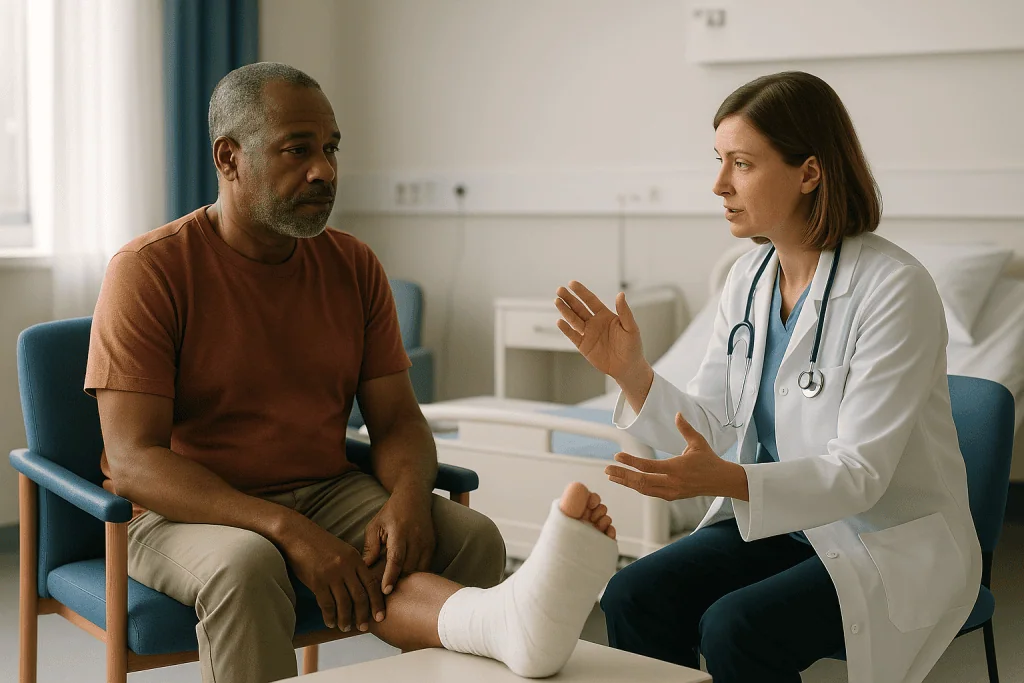
Pressure drops. Cabin air is kept at a pressure closer to a high mountain town than to sea level, which is why ears pop and sealed snack bags puff up. Any trapped gas expands. In a limb that was wrapped or cast in the last day or two, swelling and gas expansion together can tighten the space inside a rigid cast, and that is the reason behind the NHS note about splitting recent plaster before flying.
Fluid pools. Sitting with the feet below the heart for hours lets blood and tissue fluid settle in the lower leg under gravity. Healthy people notice tight shoes after a long flight; a freshly operated foot, already inflamed, swells more and hurts more. Elevation, which the surgeon probably prescribed at home, is hard to achieve in an economy seat.
Blood slows. The calf muscles are the pump that pushes venous blood back toward the heart, and they only work when you walk or flex. Hours of sitting, cramped knees and a leg you are reluctant to move all reduce that pumping. Slowed flow is one of the three classic contributors to a deep vein thrombosis, the medical term for a blood clot forming in a deep leg vein, alongside vessel injury (which surgery causes directly) and blood that clots more readily (which the body’s response to surgery also causes).
Put those together and the picture is clear. The aircraft does not create a new risk; it amplifies the ones surgery already set in motion. That is why the sensible questions are not only “how many days since the operation” but “how long is the flight, how mobile am I, and what is my personal clot risk”. The sections that follow take each in turn.
When can you fly after foot surgery? Typical patterns by operation
Because published guidance does not set procedure-specific flying dates for the foot, what follows describes the pattern surgeons commonly use rather than fixed numbers. Treat every row as a conversation starter for your own appointment, not a timetable.
| Type of operation | What the surgeon usually wants to see first | Factors that tend to push the date later |
|---|---|---|
| Minor soft-tissue or toe procedures (small lumps, ingrown nail, simple hammertoe) | Wound dry and closed at first check; pain controlled without strong medicines | Any sign of infection; difficulty walking through an airport |
| Forefoot bone surgery (bunion correction, toe fusions) | First dressing review done; swelling clearly reducing; protective shoe or boot tolerated | Long flights; inability to elevate; higher personal clot risk |
| Midfoot and hindfoot fusions, major reconstruction | Often the formal follow-up with X-ray; cast or boot plan settled | Non-weight-bearing status; recent cast; multi-leg journeys |
| Fracture fixation (ankle, heel, metatarsal plates and screws) | Cast assessed or split per NHS guidance if recent; wound checked | Flights over four hours (CDC threshold for raised clot risk); prior DVT |
Two cited anchors sit underneath this table. The NHS guidance on flying after an operation states that the appropriate wait depends on surgery type and that casts applied within 24 hours (short flights) or 48 hours (longer flights) may need splitting. The CDC states that the risk of a travel-related clot rises for journeys of more than four hours and that the risk is higher again in people who have had recent surgery.
Notice what the table does not contain: a column of day counts. Where a surgeon tells you a number, that number comes from their judgment about your foot, and it carries more weight than anything printed here.
Who is usually cleared sooner, and who is usually asked to wait
Think of clearance as a scale rather than a switch. On one side sit factors that make early travel reasonable; on the other, factors that make the team pause.
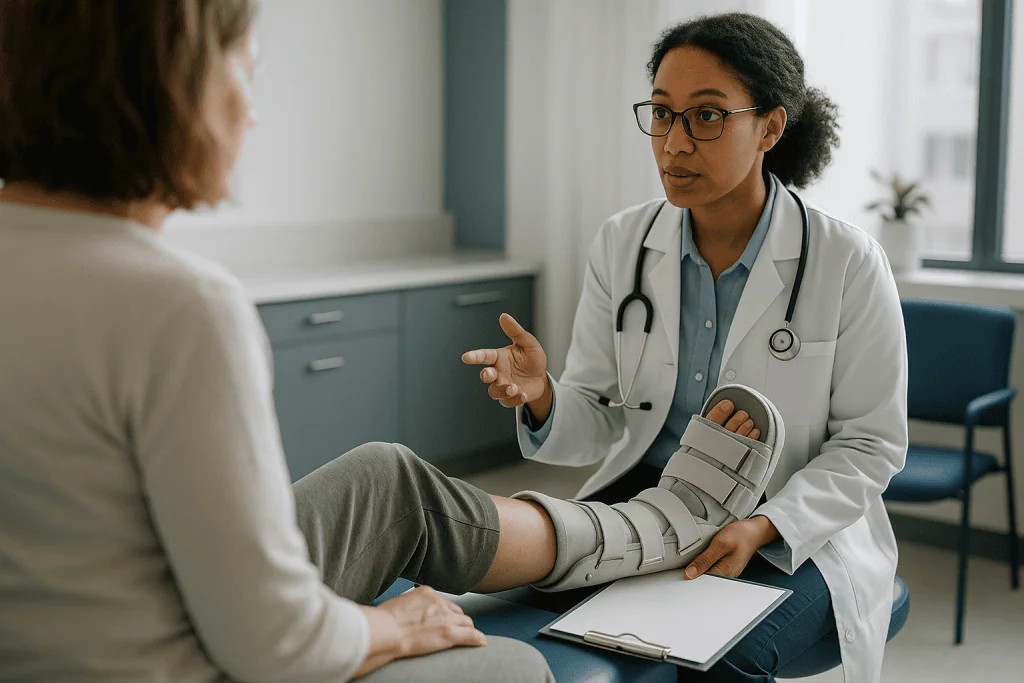
People more likely to be cleared for a short flight relatively early tend to share a profile: a small procedure with little bone work, a wound that closed cleanly, no cast or a well-settled one, the ability to walk at least short distances in a protective shoe, and no personal or family history of clots. The flight itself is short, direct and in daylight, and someone is traveling with them to carry bags.
People more often asked to wait, or to fly only with extra precautions, include those with any of the following, each of which appears in mainstream clot-risk lists from the CDC, Mayo Clinic and Cleveland Clinic:
- A previous deep vein thrombosis or pulmonary embolism, or a close relative with one
- Major surgery with bone cuts, plates or screws, particularly when weight-bearing is restricted
- A cast or splint, especially one applied in the last two days
- Pregnancy or the weeks after delivery
- Use of estrogen-containing contraception or hormone therapy
- Active cancer or cancer treatment
- Obesity, smoking, or age over about 40 as cited in CDC travel guidance
- A flight longer than four hours, overnight, or with long connections
Being on the second list does not mean you cannot fly. It means the team may want more time, may discuss a clot-prevention plan for the journey, or may suggest breaking the trip. Some surgeons will also ask whether you can get to a hospital quickly at your destination if something goes wrong, which is a fair question to ask yourself too.
The scale tips for reasons that are personal and clinical, which is why two people with the same operation can get two different answers and both be right.
DVT risk after foot surgery flight: why clots are the concern that matters most
If one risk deserves the top of your list, it is this one. Swelling is uncomfortable; a wound problem is a nuisance that can usually be managed; a clot that travels to the lung can be life-threatening.
A deep vein thrombosis forms when blood clots inside a deep vein, most often in the calf or thigh. Part of that clot can break away, travel through the heart and lodge in the lung, which is a pulmonary embolism. The Mayo Clinic lists leg swelling, pain or cramping that often starts in the calf, skin that is warm or discolored, and sudden breathlessness or chest pain as the warning signs, and it describes surgery and prolonged sitting during long travel as recognized risk factors.
Foot and ankle surgery sits in an awkward middle ground. It is not hip or knee replacement, where routine clot-prevention medicine after surgery is standard. But it does involve a leg that is injured, immobilized and often held in a cast or boot, and immobility of the lower limb is exactly what slows venous flow. The NHS notes that people who have had an operation remain at raised risk for some weeks afterward, not just the first few days.
Layer a long flight on top. The CDC states that the risk of a travel-related clot rises when total travel time exceeds four hours, and that most people who develop one have an additional risk factor, with recent surgery named among them. The combination is the issue: a leg that cannot pump properly, in a seat that prevents walking, on a body still in post-surgical clotting mode.
Some patients are already on a prescribed blood-thinning medicine after their operation; that decision, including whether to extend it for a journey, belongs to the prescribing clinician and should be raised before booking rather than at the gate. Clot risk is manageable. It is simply not something to leave to chance.
Clot prevention on the plane: what the evidence supports
Most of what works is unglamorous, and the CDC’s travel guidance on blood clots lists it plainly.
Move. Get up and walk the aisle whenever it is safe, roughly every couple of hours on longer flights, and if walking is awkward with a boot, work the calf in the seat: ankle circles, pressing the toes down then pulling them up, tightening and releasing the calf muscle. The pump does not care whether you are standing; it cares that the muscle contracts. If the operated foot cannot move freely, keep the other leg working and ask the surgeon which movements are safe on the healing side.
Avoid the aisle blockers. A bag under the seat in front steals the space your legs need to stretch. Crossing legs or tucking a foot under you compresses the veins behind the knee.
Stay hydrated. Cabin air is dry, and dehydration thickens the blood slightly. Water and the occasional juice are the sensible choices; alcohol and large amounts of caffeine both increase fluid loss, and alcohol also makes people sleepier and less likely to get up.
Consider graduated compression stockings. These are elastic stockings, tightest at the ankle and looser toward the knee, that help squeeze blood upward. The CDC notes they may be recommended by a healthcare professional for people at raised risk. After foot surgery there is a catch: a stocking may not fit over a dressing, boot or cast, and squeezing a freshly operated foot is not always wise. Whether and how to use one is a specific question for the surgical team.
Medicines. Some people at higher risk are prescribed an anticoagulant, a medicine that makes blood less likely to clot, for the period after surgery or specifically around travel. That is a prescribing decision based on individual risk and bleeding risk, and it is not something to self-start, borrow or extend. Aspirin bought over the counter is not a substitute for a prescribed plan, and starting it without advice can interact with other medicines.
Flying with a cast on your foot: the pressure problem
A cast and an airplane cabin have an uneasy relationship, and the reason is physics rather than policy.
In the first day or two after surgery or a fracture, the limb is still swelling. A full plaster cast is rigid; it has no room to give. Add reduced cabin pressure, which allows tissues and any trapped air to expand slightly, and the result can be a cast that is suddenly too tight. The NHS guidance on flying after an operation describes the standard response: a cast applied within the previous 24 hours should be split along its length before a flight of under two hours, and within 48 hours for a longer flight. Splitting a cast means cutting a line down one side so it can open slightly, held with bandage, while still supporting the bone.
A cast that is too tight is not a comfort issue. Pressure that cuts off blood supply can cause numbness, pins and needles, pain out of proportion to the injury, and toes that go pale or cold. Those are the signs that mean the cast needs loosening urgently, and they are harder to deal with at 35,000 feet.
Practical points follow from this:
- Tell the airline at booking that you are traveling with a cast; many have their own rules about recent casts and may require a doctor’s letter.
- Ask the surgical team whether your cast should be split, replaced with a removable boot, or left as it is for the date you plan to fly.
- Wear loose clothing that can get on and off over the cast.
- Keep the toes visible so you can check color and warmth during the flight.
Removable walking boots avoid the tightening problem but create another: people take them off for comfort and forget the foot inside still needs protection. If your team has said the boot stays on, that includes on the plane.
Swelling, elevation and seat planning after foot surgery
Ask any foot surgeon what they say most often after an operation and the answer is some version of “get that foot up”. Swelling is the body’s normal response to surgical injury; it peaks in the first days and can linger for months, and the Cleveland Clinic and Mayo Clinic both describe elevation above the level of the heart as the simplest way to limit it. A plane is designed to defeat that advice.
Seat planning is therefore a real medical decision, not a luxury. The things worth weighing:
- An aisle seat on the side that lets the operated leg stretch into the aisle gives the most freedom to move and get up, which matters more for clot prevention than any other seat feature.
- Bulkhead rows offer legroom but can prohibit under-seat bags, and some have fixed armrests; check before choosing.
- Exit rows usually require passengers to be fully able-bodied, which excludes someone in a boot or cast.
- Seats with extra pitch or lie-flat positions allow some elevation, but a knee bent for hours is still a knee bent for hours; keep moving regardless.
- Propping the foot on a bag in the footwell does not raise it above heart level, but it does reduce the dangle, and some patients find it eases throbbing.
On arrival, plan an early opportunity to lie down with the foot raised on pillows. Many people find swelling is worst the evening after a flight and settles over the following day; if it does not, or if it is one-sided, warm and painful, that pattern needs medical assessment rather than patience, as the DVT section explains.
Footwear deserves a thought too. The foot will be larger at landing than at takeoff. Whatever you wear on, make sure it can be loosened, and never force a swollen foot back into a shoe to get through the terminal.
Flying after bunion surgery: what is different about forefoot operations
Bunion correction, often called a bunionectomy, is one of the most common reasons someone googles this question, so it earns its own section. A bunion is a bony bump at the base of the big toe caused by the toe drifting out of line; correction usually involves cutting and realigning the bone, sometimes with small screws or a plate, and the wound sits on the top or side of the foot.
Several features shape flying decisions:
- The surgery involves bone, so healing is measured in weeks rather than days, and the foot swells more and for longer than after soft-tissue work.
- Patients are usually in a stiff-soled post-operative shoe or boot rather than a full cast, which sidesteps the cast-splitting rule but still restricts walking speed and distance.
- Weight-bearing instructions vary widely by technique; some surgeons allow heel-walking from day one, others restrict loading for weeks. Airport distances are long, so that instruction decides whether you need wheelchair assistance.
- The wound sits where a tight shoe or seatbelt bag can rub, so dressings need checking after travel.
Clot risk after bunion surgery is generally considered lower than after hip or knee surgery, but it is not zero, and the general CDC point stands: recent surgery plus a flight of more than four hours is a recognized combination that raises risk. A surgeon may feel comfortable clearing a short domestic flight once the first dressing check shows a clean wound, while asking for a later review before a long-haul trip.
Patients often underestimate the swelling. The foot after bunion surgery can stay noticeably larger than its partner for a long time, and a flight tends to set that back by a day or two. That is not a complication in itself, but it is a reason not to plan a walking-heavy itinerary immediately after landing.
What the first weeks after foot surgery usually look like
Recovery is rarely a straight line, but it does have a recognizable shape, and knowing it helps you see where a flight would land.
The first few days are about pain control, strict elevation and keeping the dressing dry. Swelling is at its height; this is the period in which a fresh cast can become dangerously tight, and it is the window the NHS cast-splitting guidance targets. Almost no surgeon will endorse flying in this phase unless there is no alternative, and even then only with a cast plan and a medical letter.
The first review, often around the end of the first week or during the second, is when the wound is inspected, the dressing changed and sutures sometimes removed. Many surgeons regard this as the earliest sensible moment to discuss a short flight, because they have now seen with their own eyes that the wound is closed and there is no infection brewing.
The following weeks bring gradual loading. A boot or protective shoe replaces the cast in many cases, and the patient begins to walk further, which is itself the best clot prevention there is. Clot risk, which the NHS notes stays raised for some weeks after surgery, slowly settles as mobility returns.
Around six weeks, bone surgery usually has a check X-ray to confirm the realignment is holding. For major reconstructions and fusions, this is frequently the point at which surgeons feel comfortable with longer journeys.
Swelling can outlast all of these milestones. Residual puffiness at the end of a day is common for months after forefoot bone surgery and does not by itself mean something is wrong.
Map your intended flight onto this shape. If it falls in the first days, the conversation is about whether it can move. If it falls after the first review, the conversation is about precautions. If it falls after the six-week check, it is mostly about comfort.
Getting through the airport on a healing foot
The flight is sometimes the easiest part. Airports demand walking distances that a person on crutches or in a boot cannot comfortably manage, and the stress of hurrying is exactly what makes people drop the elevation and the crutch technique the physiotherapist drilled into them.
Assistance is routine, not an admission of defeat. Airlines and airports provide mobility help that typically includes wheelchair transport from check-in to the gate, priority boarding and help at the far end. It needs to be requested in advance, usually at booking or at least a couple of days before, and it costs nothing in effort compared with limping half a mile to a remote gate.
Security is a frequent worry for people with metalwork. Small screws and plates in the foot rarely set off detectors, but a boot or cast cannot go through a scanner on your body, so expect a manual check and allow extra time. A brief letter from the surgical team describing the operation and any implants smooths the process and is the same letter many airlines want anyway.
Crutches travel free on most carriers and can be stowed near your seat; ask the cabin crew where. A walking boot can be kept on through the flight unless your team has said otherwise, and if it comes off for comfort, the foot still needs protection when you stand.
Medicines go in hand luggage, in original packaging, with a copy of the prescription. If you are on a prescribed anticoagulant, carry the details; emergency staff anywhere will want to know.
Build slack into the day. A connection that would be comfortable for an able-bodied traveler becomes a sprint on crutches, and sprinting is how people fall, reopen wounds and undo weeks of careful healing. One direct flight at a civilized hour is worth more to a recovering foot than any seat upgrade.
What people often get wrong about flying after foot surgery
Some beliefs circulate so widely they feel like facts. The evidence says otherwise.
“It was only foot surgery, clots are a hip-and-knee problem.” Clot risk after foot and ankle surgery is lower than after major joint replacement, but immobilization of the lower leg, especially in a cast, is a recognized contributor to deep vein thrombosis, and the CDC lists recent surgery of any kind among the factors that compound travel-related risk.
“Short flights are safe, so I only need to worry on long-haul.” The four-hour threshold in CDC guidance reflects where risk rises measurably, not a line below which risk is zero. Short flights also come bundled with hours of airport sitting, which counts toward total immobility.
“Compression socks sort it.” Graduated compression stockings help, and the CDC notes they may be recommended for people at raised risk. They are one layer of protection, not a replacement for moving, and they may not be practical or advisable over a fresh dressing or cast.
“If I can walk to the car, I can walk through an airport.” Airports involve distances, queues and stairs that bear no relation to a trip to the car. Request assistance.
“Aspirin from the pharmacy will do the job of a prescribed blood thinner.” Whether any medicine is appropriate, and which one, is a decision for the clinician who knows your bleeding and clotting risks. Self-prescribing is not a safety measure.
“Swelling after the flight means something went wrong.” Usually it means gravity did what gravity does. The exception is swelling that is one-sided, painful, warm or accompanied by breathlessness, which needs urgent assessment.
“The surgeon said two weeks, so day 14 is fine.” Any number a surgeon gives is conditional on the wound and the swelling behaving. A review before you fly is the point of the number, not the number itself.
Questions to ask your care team, including the fit to fly letter
Appointments are short and the flying question tends to come up as the surgeon’s hand reaches the door. Bring the list.
- Given this operation and my own history, when would you be comfortable with a flight of this length? What would change your answer?
- Is my clot risk higher than average, and do you recommend anything specific for the journey: stockings, a medicine, or a change to one I already take?
- Should my cast be split, replaced with a removable boot, or left as it is for the date I plan to travel?
- What are my weight-bearing instructions at that stage, and should I book wheelchair assistance?
- Which movements of the operated foot are safe to do in the seat, and which should I avoid?
- Will you provide a fitness-to-fly letter, and what should it state about my implants and medicines?
- Who do I contact, and where, if the foot changes or I develop breathing problems while away?
- When is my next review, and does the trip clash with it?
On the letter: airlines vary in whether they require one, but the NHS guidance notes that many ask for a medical certificate after recent surgery, and some have firm rules about recent casts. A good letter is short. It gives the date and nature of the operation, confirms that the clinician considers you fit for the specific journey, lists any metalwork for security purposes, and names any prescribed anticoagulant. Ask for it before the final appointment rather than by phone afterward.
Write the answers down during the appointment. Half the value of the list is that it turns a vague “should be fine” into a plan with conditions attached, and a plan is what lets you cancel without guilt if the foot does not cooperate.
When to call your doctor
Most post-surgical travel passes without incident. The point of knowing the warning signs is not to worry on every flight; it is to act fast on the rare occasion that something is wrong.
Call emergency services or go to the nearest emergency department immediately if you have:
- Sudden shortness of breath, chest pain that worsens with deep breathing, a racing heartbeat, or coughing up blood: these are warning signs of a pulmonary embolism listed by the Mayo Clinic and Cleveland Clinic and need urgent care wherever you are.
- Toes that have gone pale, blue or cold, with severe pain, numbness or pins and needles inside a cast or tight dressing.
Contact your surgical team or a doctor the same day if you notice:
- New swelling, pain, warmth or discoloration in one calf or thigh, particularly if it is only on one side and not explained by the surgery itself; this is the pattern of a deep vein thrombosis described in MedlinePlus and NHS guidance.
- Increasing redness spreading from the wound, a discharge that is cloudy or foul-smelling, or a fever.
- A wound that has opened, bled through the dressing, or been soaked.
- Pain that is escalating rather than easing day on day, especially pain out of proportion to what you were told to expect.
Before you travel, know where you would go at your destination and keep your surgeon’s contact details and the fitness-to-fly letter with you. If you are far from home and uncertain, local emergency services and any emergency department can assess a suspected clot; it is far better to be examined and reassured than to wait for a return flight.
Every decision about treating a suspected problem, including imaging, medicines and whether you can continue the trip, sits with the clinicians who see you. The job of this section is only to make sure you do not delay getting in front of them.
Frequently asked questions
How soon can you fly after foot surgery?
There is no single interval; it depends on the type of operation, your clot risk and the length of the flight. NHS guidance notes that waiting times vary with surgery type and that airlines may require a fitness-to-fly letter. Many surgeons want to see a closed, dry wound at the first review before discussing a short flight, and a later review before long-haul travel. Ask your treating team before booking.
Is flying after bunion surgery riskier than after other foot operations?
Bunion correction involves bone, so it swells more and heals more slowly than soft-tissue procedures, but it usually avoids a full cast and the cast-splitting issue. Clot risk is generally lower than after hip or knee replacement, though recent surgery still counts as a risk factor in CDC travel guidance. Surgeons often differentiate between a short domestic flight after the first dressing check and a long-haul journey requiring a later review.
What is the DVT risk after a foot surgery flight?
It is raised compared with a healthy traveler because surgery injures vessels, immobilizes the leg and makes blood clot more readily, and a flight adds hours of slowed blood flow. The CDC notes risk rises on journeys over four hours and is higher again with recent surgery. Exact numbers for foot surgery vary by procedure and are not set out in general guidance; your surgeon can assess your individual risk.
Do I need a fit to fly after surgery letter?
Often, yes. The NHS guidance on flying after an operation notes that many airlines ask for a medical certificate confirming you are fit to travel after recent surgery, and some have specific rules about casts. A useful letter states the date and type of operation, confirms fitness for the specific journey, lists any metal implants and names any prescribed anticoagulant. Request it before your last pre-travel appointment.
Can I fly with a cast on my foot?
Usually, with precautions. The concern is swelling inside a rigid cast as cabin pressure drops. NHS guidance advises that a cast applied within the previous 24 hours may need splitting before a flight under two hours, and within 48 hours for longer flights. Tell the airline in advance, ask your surgical team whether the cast should be split or swapped for a removable boot, and keep the toes visible to check color and warmth.
Should I take a blood thinner before flying after foot surgery?
That is a decision for the prescribing clinician, not something to start on your own. Some people at higher risk are prescribed an anticoagulant for the period after surgery or specifically around travel, based on their individual clotting and bleeding risks. Over-the-counter aspirin is not a substitute for a prescribed plan and can interact with other medicines. Raise the question with your surgeon well before the trip.
Which seat is best after foot surgery?
An aisle seat on the side that lets the operated leg extend into the aisle is usually the most practical, because it makes getting up to move easy and that movement is the core of clot prevention. Exit rows generally exclude passengers in boots or casts. Bulkhead seats give legroom but may restrict bags. No seat replaces walking the aisle and doing ankle exercises every couple of hours.
Will my foot swell more after flying?
Very likely, and usually it is harmless. Hours with the foot below the heart lets fluid pool in a limb that is already inflamed from surgery. Most people find the swelling worst that evening and easing over a day of elevation. The exception is swelling that is one-sided, painful, warm or discolored, or that comes with breathlessness, which could indicate a clot and needs prompt medical assessment.
Can I wear compression stockings over my surgical dressing?
Sometimes, but it depends on the dressing, the wound and the swelling, so ask your surgical team rather than guessing. Graduated compression stockings may be recommended for travelers at raised clot risk, according to CDC guidance, yet squeezing a freshly operated foot or forcing a stocking over a cast can do harm. If a stocking is not practical, moving the calf regularly and staying hydrated remain the priorities.
What if I develop chest pain or breathlessness during or after the flight?
Treat it as an emergency. Sudden shortness of breath, chest pain that worsens on breathing in, a rapid heartbeat or coughing up blood are warning signs of a pulmonary embolism listed by the Mayo Clinic and Cleveland Clinic. Alert cabin crew in flight, or call emergency services or go to the nearest emergency department on the ground. Do not wait for your return flight or your scheduled follow-up appointment.
References
- Cleveland Clinic: Deep Vein Thrombosis (DVT)
- MedlinePlus: Deep venous thrombosis
- NHS: Deep vein thrombosis (DVT)
This article is for general information only and is not a substitute for professional medical advice. Please consult a qualified doctor about your individual situation.
Add us as a Preferred Source to see more of our trusted health content across Google Search, AI Overviews and Discover.

More from the Blog

Pain in the Upper Right Chest or Pectoral Muscle: Common Causes and When It Needs Urgent Care
Pain in the upper right chest most often comes from the chest wall: a strained pectoral muscle, inflamed rib cartilage, or a nerve pinched…

Hand Surgery in Older Adults: How Bone Quality and Health Conditions Shape the Plan
Hand surgery for older adults is planned around bone density, overall health and the person's goals rather than age alone. Thinner bone can change…

Pain in the Fingertips: Nerve, Nail and Infection Causes and How It Differs from Joint Pain
Pain in the fingertips most often comes from the nail fold, the skin pad, a small nerve or the blood supply, while pain in…

Walking, Hiking and Sport After Ankle Replacement: What Is Encouraged and What to Avoid
After ankle replacement, most care teams encourage walking, cycling, swimming, golf and low-impact hiking on even ground once the surgeon has cleared full weight-bearing…

Mid and Upper Back Pain: Thoracic Spine, Muscle and Organ Causes and When to Get It Checked
Mid back pain most often comes from strained muscles, stiff thoracic joints or long hours in one posture, and it usually eases within a…

How Long Does a Bruised Tailbone Take to Heal? The Usual Timeline and Signs of a Fracture
A bruised tailbone usually takes up to about four weeks to heal, although tenderness when sitting can linger a little longer; a fractured tailbone…