

When Does Leukemia Treatment Include a Stem Cell Transplant, and Who Is Assessed for It?

Key Takeaways
- Most people with leukemia never have a stem cell transplant; it is reserved for high-risk, relapsed or non-responding disease rather than used as routine first-line treatment.
- Transplant decisions track the leukemia's chromosome and mutation profile, so two people with the same diagnosis can receive opposite recommendations.
- Leukemia transplants are almost always allogeneic because donor immune cells provide a graft-versus-leukemia effect that a person's own cells cannot.
- Full HLA matches are inherited from siblings, with about a one in four chance per sibling according to the NHS; parents and children are usually half-matches.
- Reduced-intensity conditioning has made transplant possible for older adults and people with other health conditions, shifting the gatekeeper from age to fitness.
- Engraftment typically takes a few weeks, hospital stays last several weeks, and the NHS describes full recovery as taking a year or more.
A stem cell transplant becomes part of leukemia treatment when the disease is judged likely to return after chemotherapy alone, or when it has already relapsed or not responded. It is usually considered for acute leukemias with high-risk genetic features, and for people fit enough to tolerate intensive treatment. The treating team assesses disease risk, remission status, organ function, age, donor availability and the person's own goals before recommending it.
The folder on the kitchen table is already thick. Blood counts, a bone marrow report, a page of gene names that look like license plates. Somewhere near the bottom is the sentence that changed the week: “We would like to refer you to the transplant team for assessment.” Nobody said the transplant was happening. Nobody said it was not. The word simply arrived, and with it the question of when a leukemia stem cell transplant is needed at all.
That uncertainty is normal, and it is not a sign that the team is being vague. A transplant is one of the most intensive treatments in medicine, and the decision to use it rests on a careful weighing of how dangerous the leukemia looks against how much the body can safely carry.
This explainer walks through that weighing: what a transplant actually does, which leukemias prompt the conversation, who is assessed, who is asked to wait, and what the weeks afterward tend to look like.
What does a stem cell transplant actually do in leukemia?
Start with the factory. Bone marrow is the soft tissue inside large bones where blood cells are made. Blood stem cells are the immature cells in that marrow that can grow into red cells, white cells and platelets. Leukemia is a cancer of the blood-forming cells, in which abnormal white cells crowd the marrow and spill into the bloodstream.
A stem cell transplant is not a surgery and nothing is cut out. It is a sequence: high-dose chemotherapy, sometimes with radiation, is given first to destroy the leukemia cells and the diseased marrow. Healthy stem cells are then infused through a vein, much like a blood transfusion. Those cells travel to the marrow spaces and, over the following weeks, begin producing new blood. MedlinePlus describes this rescue of the marrow as the core purpose of the procedure.
Two different things are being attempted, and this is where the logic of “when it is needed” begins. The first is intensity: the chemotherapy before a transplant is deliberately stronger than the body could survive without a stem cell rescue, so it can reach leukemia cells that ordinary treatment leaves behind. The second, when the cells come from another person, is immunity. Donor immune cells can recognize residual leukemia as foreign and attack it, an effect the National Cancer Institute calls graft-versus-tumor, or graft-versus-leukemia in this setting.
So a transplant is chosen when a team believes the leukemia will probably outlast standard chemotherapy, and when the person’s body is likely to withstand the stronger approach. Both halves of that sentence matter. Neither half alone is enough.
Leukemia stem cell transplant: when is it needed, and when is it not?
The honest answer is that most people diagnosed with leukemia will never have a transplant, and that is not a failure of care. The NHS lists stem cell transplants as an option when a blood cancer is unlikely to be controlled by other treatments, or has come back after treatment, rather than as a routine first step.

Broadly, transplant enters the plan in three situations. The first is high-risk disease in first remission. Remission means no leukemia can be found on standard tests after initial chemotherapy. Some leukemias carry chromosome or gene changes that make relapse likely even after a good remission, and for those, teams often recommend consolidating with a transplant while the disease is quiet. The second is relapse: leukemia that returns after initial treatment is generally harder to control with chemotherapy alone, and transplant is frequently the proposed next step once a second remission is reached. The third is refractory disease, meaning leukemia that never responded adequately in the first place.
Transplant is usually not needed when the leukemia has favorable genetic features and responds fully to chemotherapy, because the added risk is unlikely to improve the outlook. It is also often set aside in chronic myeloid leukemia, where targeted tablets that block the abnormal protein driving the disease have changed the calculation, and in many cases of chronic lymphocytic leukemia, which can be managed for years with other therapies. The National Cancer Institute notes that transplant is now reserved in CML largely for people whose disease stops responding to those targeted drugs.
Alternatives the team may weigh include further chemotherapy cycles, targeted therapy matched to a specific mutation, immunotherapy, and in some acute lymphoblastic leukemias, CAR T-cell therapy, in which a person’s own immune cells are engineered to attack the leukemia. Which path fits depends on the disease subtype, and that choice belongs to the treating team.
Which types of leukemia most often lead to a transplant discussion?
Leukemia is a family of diseases, and the family members behave very differently. The main division is between acute leukemias, which develop quickly and need prompt treatment, and chronic leukemias, which progress slowly and are sometimes monitored for long periods before any treatment at all.
Acute myeloid leukemia, or AML, generates the largest share of transplant referrals in adults. Its risk is sorted by cytogenetics, the study of chromosome changes in the leukemia cells, and by molecular testing for specific mutations. The combination places a person’s disease into favorable, intermediate or adverse risk categories, and the adverse group is where transplant in first remission is most often proposed.
Acute lymphoblastic leukemia, or ALL, is the most common childhood leukemia but also occurs in adults. In children, modern chemotherapy protocols control the disease in most cases without transplant, so it is reserved for high-risk features or relapse. In adults, particularly those with certain chromosome rearrangements or a slow early response, transplant is discussed more often.
Chronic myeloid leukemia, or CML, was once the classic transplant disease. Targeted therapy has moved transplant to the margins, used mainly when the disease resists several of those drugs or transforms into an acute phase. Chronic lymphocytic leukemia, or CLL, rarely leads to transplant today, and when it does it is usually in younger people with high-risk disease that has failed other approaches.
The pattern across all four is consistent. Transplant tracks the biology of the disease, not the diagnosis label alone. Two people with the same diagnosis can receive opposite recommendations because the chromosome and mutation reports in their folders tell different stories. Asking the team which risk group the leukemia falls into is often the quickest route to understanding why transplant has, or has not, been raised.
Allogeneic vs autologous transplant for leukemia: what is the difference?
The source of the stem cells defines the type of transplant, and it changes almost everything about the risk and the reasoning.
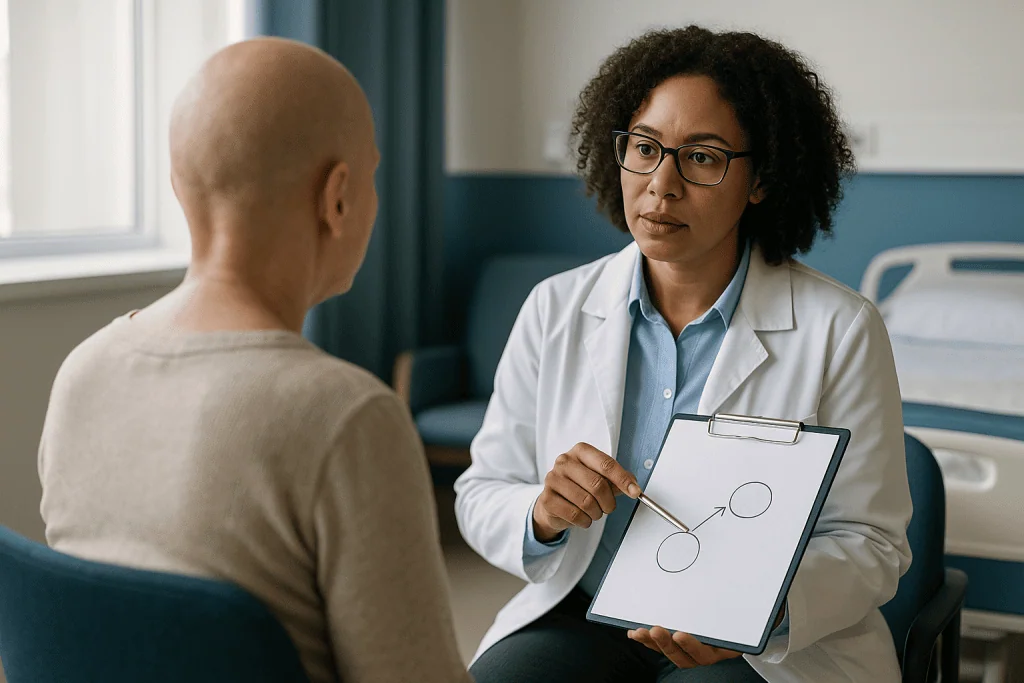
An autologous transplant uses the person’s own stem cells, collected and stored before high-dose chemotherapy, then returned afterward. An allogeneic transplant uses cells from a donor, who may be a relative or an unrelated volunteer. The Mayo Clinic explains that allogeneic transplants carry the possibility of the donor immune system attacking the recipient’s tissues, a complication autologous transplants avoid entirely.
For leukemia specifically, allogeneic transplants dominate. The reason returns to graft-versus-leukemia: the point is partly to borrow a new immune system that treats leftover leukemia as an invader. A person’s own stem cells cannot do that, and they also risk carrying hidden leukemia cells back in. Autologous transplants are far more commonly used for lymphoma and myeloma than for leukemia.
| Feature | Allogeneic | Autologous |
|---|---|---|
| Cell source | Donor (related, unrelated, cord blood) | The person’s own cells |
| Main use in leukemia | Most leukemia transplants | Uncommon in leukemia |
| Anti-leukemia immune effect | Yes, graft-versus-leukemia | No |
| Graft-versus-host disease risk | Yes | No |
| Need for donor matching | Yes, tissue typing required | No |
| Immune suppression afterward | Months or longer | Shorter |
Within allogeneic transplants, the donor relationship matters too. A fully matched sibling, a matched unrelated donor, a half-matched family member and umbilical cord blood each carry different timelines and trade-offs, which is why the donor search runs alongside the eligibility assessment rather than after it. The table above is a map, not a verdict; the team’s recommendation will depend on the leukemia’s features, the person’s fitness and the donors actually available.
Who is assessed for a leukemia stem cell transplant when it may be needed, and who is asked to wait?
A referral for transplant assessment is a conversation starter, not a decision. Teams tend to refer early, sometimes at diagnosis, so that a donor search can begin in case it is later needed. Being assessed and being transplanted are two different events, often separated by months.
People most likely to be assessed share a few features. Their leukemia carries adverse-risk genetics, or has relapsed, or has not cleared on the expected schedule. They are in, or approaching, a remission, since transplanting into active leukemia is generally less successful and is usually avoided. Their general health is reasonable. The NHS notes that transplants are generally offered to people who are otherwise in relatively good health and whose cancer is unlikely to be controlled by other treatments, and that the balance of risk and benefit is assessed individually rather than by a fixed cut-off.
Who is asked to wait? Several groups. People whose leukemia is favorable-risk and responding well are often advised to complete chemotherapy and hold transplant in reserve, because the procedure’s risks would outweigh its likely gain. People not yet in remission are typically asked to continue treatment first. People with an active infection, uncontrolled heart, lung, liver or kidney problems, or very limited physical reserve may be asked to wait while those issues are addressed, or may be guided toward a gentler conditioning approach or a different treatment altogether.
Age by itself is a weaker gatekeeper than it once was. The Mayo Clinic observes that older adults can be considered when reduced-intensity conditioning is used, and that fitness and organ function carry more weight than a number on a birth certificate. Even so, waiting is sometimes the recommendation, and it is not a dismissal. It usually means the team believes the current plan is working, or that the body needs time before the harder path.
What does the transplant eligibility assessment involve?
The assessment is thorough because the treatment is unforgiving of surprises. It usually unfolds over several visits and asks three questions: how risky is the leukemia, how resilient is the body, and is there a suitable donor?
Disease risk is read from the marrow. Cytogenetic and molecular tests are repeated or reviewed, and many centers now use measurable residual disease testing, often shortened to MRD, a sensitive technique that can detect tiny amounts of leukemia below the threshold of a standard microscope. A remission that still shows MRD may tilt the recommendation toward transplant.
Resilience is read from the organs. Expect blood tests of liver and kidney function, an echocardiogram or similar scan of the heart’s pumping strength, pulmonary function tests that measure how well the lungs move air and exchange gases, and screening for viruses such as hepatitis, HIV and cytomegalovirus, a common virus that can reactivate when immunity is low. Dental review is common, because mouth infections during the low-count period can become serious. The Johns Hopkins patient guidance describes this pre-transplant evaluation as a full review of medical history and physical condition to confirm the body can withstand the procedure.
Many teams also score comorbidities, meaning other health conditions, using structured tools, and assess performance status, a simple measure of how much daily activity a person manages independently. Psychological and social evaluation sits alongside, including who will act as caregiver during recovery, how far a person lives from the center, and what support exists at home.
None of these tests produces a yes or no on its own. They are assembled into a picture, and that picture is discussed in a multidisciplinary meeting before any recommendation reaches the kitchen table.
How is a stem cell transplant donor match found?
Donor matching rests on HLA typing. HLA stands for human leukocyte antigen, a set of proteins on the surface of cells that the immune system uses to tell self from non-self. The closer the match between donor and recipient HLA types, the lower the chance that the new immune system attacks the body, and the better the odds that the graft settles in.
Siblings are tested first because HLA genes are inherited as a block from each parent. According to the NHS, a brother or sister has roughly a one in four chance of being a full match. Parents and children are usually half-matches rather than full ones.
When no sibling matches, the search moves to volunteer donor registries, which hold tissue-type data on millions of people worldwide. The likelihood of finding a well-matched unrelated donor varies with ancestry, because HLA types cluster within populations and registries have historically under-represented some groups. This is a real and documented inequity, not a personal shortcoming.
Two further options have widened access. Haploidentical transplants use a half-matched relative, often a parent, child or sibling, with adjusted post-transplant medicines to tame the immune reaction; nearly everyone has at least one half-matched relative. Umbilical cord blood, collected after healthy births and stored in public banks, tolerates a less exact match, though the cell dose is smaller and recovery of blood counts tends to be slower, as the National Cancer Institute explains.
Donors themselves give either bone marrow, collected from the hip bone under anesthesia, or peripheral blood stem cells, drawn from a vein after a few days of injections that coax stem cells into the bloodstream. The transplant team, not the recipient, manages which route is used and why.
What happens during conditioning before the transplant?
Conditioning is the treatment given in the days immediately before the stem cell infusion. Its jobs are to destroy remaining leukemia cells, to clear space in the marrow, and in allogeneic transplants, to suppress the recipient’s immune system enough that it does not reject the incoming cells.
Two broad intensities exist. Myeloablative conditioning uses chemotherapy, sometimes combined with total body irradiation, at doses that permanently wipe out the marrow. Reduced-intensity conditioning, sometimes called non-myeloablative, uses gentler regimens that lean more heavily on the donor immune system to do the anti-leukemia work over time. The Mayo Clinic notes that reduced-intensity approaches have made transplant possible for older people and those with other health conditions who could not tolerate full-dose regimens.
The choice between them is a judgment about trade-offs. Higher intensity tends to mean fewer early relapses but more organ toxicity and a harder immediate recovery. Lower intensity is kinder in the first weeks but may carry a higher chance of the leukemia returning. The leukemia’s behavior, the person’s fitness and the type of donor all feed into which regimen the team selects.
Conditioning typically takes several days to about a week, and it is delivered in hospital through a central venous catheter, a long thin tube placed into a large vein in the chest or neck that stays in for weeks and spares the arm veins from repeated needles. Side effects during and just after conditioning commonly include nausea, mouth soreness, fatigue, hair loss and, with radiation, skin changes. Supportive medicines for nausea and infection prevention run alongside; their selection and scheduling belong entirely to the prescribing team.
What happens on transplant day and in the first weeks after?
Transplant day is often described by patients as anticlimactic. The stem cells arrive in a bag, and the infusion through the central line resembles a blood transfusion that takes an hour or a few. Some people notice a garlicky taste or smell from the preservative used when cells have been frozen. Many centers call this “day zero,” and every later milestone is counted from it.
Then comes the wait for engraftment. Engraftment is the moment the new stem cells have settled in the marrow and started producing enough blood cells to show up in counts. In the interval, the body has almost no white cells to fight infection, few platelets to stop bleeding and falling red cells, so people are usually in a protected hospital room and often receive transfusions. The NHS explains that it can take a few weeks for the transplanted cells to begin producing new blood cells, and that the hospital stay typically lasts several weeks, with the exact duration depending on how quickly counts recover and whether complications arise.
During this period, fever is treated as an emergency, because without white cells an infection can accelerate quickly. Mouth and gut lining damaged by conditioning may make eating difficult, and some people need nutrition through a drip for a time. Fatigue is near universal.
Engraftment is announced not by how a person feels but by numbers on a daily blood draw: neutrophils, the main infection-fighting white cells, climbing above a threshold for consecutive days. Platelets usually follow. Discharge generally comes once counts are rising, fever is absent and the person can take oral medicines and fluids. Leaving hospital is a milestone, not a finish line; close outpatient monitoring continues for months.
What are the main stem cell transplant risks in leukemia?
Transplant is proposed only when the leukemia itself poses a serious threat, because the procedure carries serious risks of its own. Describing them plainly is part of consent.
Graft-versus-host disease, usually shortened to GVHD, is the signature complication of allogeneic transplant. It occurs when donor immune cells attack the recipient’s tissues. The National Cancer Institute distinguishes acute GVHD, which typically appears in the first months and most often affects skin, gut and liver, from chronic GVHD, which can develop later and may involve skin, mouth, eyes, lungs, joints and other organs. GVHD is treated with medicines that dampen the immune system, which in turn raise infection risk. A modest degree of GVHD is sometimes accompanied by a stronger anti-leukemia effect, which is why teams aim to balance rather than abolish it.
Infection is the second major threat. Bacterial, fungal and viral infections are possible for many months, and the immune system may take a year or more to rebuild fully, as the NHS notes. Childhood vaccinations are usually repeated on a schedule set by the transplant team.
Organ injury from conditioning can affect liver, lungs, kidneys and heart. Relapse of the leukemia remains possible after transplant and is one of the most common reasons for a poor outcome. Longer-term effects include infertility, which should be discussed before conditioning so that fertility preservation can be considered where time allows, as well as thyroid changes, cataracts and a raised risk of second cancers.
Finally, graft failure, where the donor cells do not take hold, is uncommon but serious. Every one of these risks is weighed against the person’s leukemia risk in the eligibility discussion, which is why the same transplant can be the right call for one person and the wrong one for another.
What is the typical stem cell transplant recovery time, month by month?
Recovery is measured in seasons, not weeks. The first hundred days after an allogeneic transplant are the most closely watched; many protocols schedule clinic visits more than once a week at first, with blood counts, drug level checks and screening for viral reactivation. The number 100 is not magic, but acute GVHD and the most dangerous infections concentrate in that window.
Fatigue dominates the early months. Simple tasks such as showering or preparing a meal may require rest afterward. Appetite returns unevenly, and taste changes from conditioning can linger. Most people are advised to avoid crowds, construction dust, gardening soil and undercooked food until the team confirms immune recovery, and to have a caregiver available continuously for the first weeks after discharge.
Between roughly three and six months, many people notice a slow return of energy and begin reintroducing light activity. Immune-suppressing medicines after an allogeneic transplant are often tapered during this period if GVHD is quiet, with the schedule set entirely by the transplant physician. Bone marrow tests are commonly repeated to confirm the leukemia remains undetectable and that the marrow is fully donor-derived, a measurement called chimerism.
Around one year, re-vaccination typically begins, and many people return to work or study, sometimes part-time. The NHS describes full recovery as taking a year or more, and for those with chronic GVHD the timeline stretches further. Long-term follow-up continues for years, watching for late effects such as thyroid, bone and heart changes.
None of these ranges is a promise. Recovery varies with age, conditioning intensity, complications and the leukemia itself. What the ranges offer is a realistic shape for planning: time off work, caregiver rotas and the patience that the months after transplant demand.
What people often get wrong about stem cell transplants for leukemia
The first misconception is that a transplant is surgery. It is an infusion, preceded by chemotherapy and followed by weeks of monitoring. The hard part is not the day of the transplant but the conditioning before it and the immune rebuilding after.
The second is that transplant is the “strongest” option and therefore always better. The evidence is clearer than that: for favorable-risk leukemia responding to chemotherapy, adding a transplant generally increases risk without improving the outlook, which is why it is reserved for higher-risk disease. More intensive is not automatically more effective.
Third, people often assume that being referred means being transplanted. Referral starts a donor search and an assessment; many people assessed are advised to continue their current plan. Conversely, some assume that once chemotherapy has worked, transplant is off the table. For adverse-risk disease the opposite is true, since first remission is often the preferred moment.
Fourth, there is a persistent belief that a parent or child is the best donor. In fact, full HLA matches are inherited from siblings; parents and children are usually half-matches. Half-matched transplants are now routine in many centers, but the hierarchy is not what instinct suggests.
Fifth, donor stem cells are sometimes imagined as a brief procedure for the donor with no recovery. Bone marrow donation involves anesthesia and some days of hip soreness; peripheral blood donation involves several days of injections and a long collection session. Donors are screened carefully and deserve honest information too.
Finally, many people believe recovery ends at discharge. The NHS and Mayo Clinic both describe recovery stretching over many months, with immune suppression and infection risk persisting well beyond the hospital stay. Planning for that reality, rather than for a quick return to normal, spares a great deal of frustration.
Questions to ask your care team about transplant assessment
Good questions turn a daunting consultation into a conversation. These are the ones transplant clinicians most often say they wish people asked earlier.
- Which risk group does my leukemia fall into, and which genetic or molecular findings put it there?
- Am I currently in remission, and has measurable residual disease testing been done? What did it show?
- Is transplant being proposed now, held in reserve, or ruled out, and what would change that recommendation?
- Which type of transplant are you considering, and which donor options are realistic for me?
- What conditioning intensity do you have in mind, and why that one for me?
- What are the most likely complications in my case, and how would each be managed?
- What are the alternatives if I decline or am not eligible, and how do they compare for my specific disease?
- Should fertility preservation be discussed before conditioning, and is there time?
- How long should I expect to be in hospital, and what support will I need at home afterward?
- Who do I call, at any hour, if I develop a fever or feel unwell after discharge?
Bring someone with you and ask permission to record the conversation or take notes. Ask for written information about the specific transplant type proposed. If the team’s answer to any question is “we are not sure yet,” that is often the honest response at an early stage; ask what information would settle it and when it is expected.
The decision about whether and when to proceed belongs to the treating team working together with you. Questions do not challenge that; they make the shared decision a genuinely informed one.
When to call your doctor during leukemia treatment and after a transplant
Low blood counts and a suppressed immune system change the rules for ordinary symptoms. Signs that would be minor in a healthy person can signal an emergency during leukemia treatment and for months after a transplant. Teams give specific thresholds and contact numbers; the guidance below describes the categories of warning that clinicians consistently flag.
Call the transplant or oncology team immediately, at any hour, or seek emergency care, if any of these occur:
- Fever, chills or shivering, even without an obvious source; the team will have given a specific temperature threshold.
- Shortness of breath, chest pain, a new cough or coughing up blood.
- Bleeding that does not stop, blood in urine or stool, or widespread small red or purple spots on the skin.
- Severe or persistent diarrhea, vomiting, or inability to keep fluids and medicines down.
- A new skin rash, yellowing of the skin or eyes, or dark urine, which can signal GVHD or liver problems after an allogeneic transplant.
- Confusion, severe headache, sudden weakness, or difficulty speaking.
- Redness, swelling, pain or discharge around the central line.
- Any sudden change that feels wrong to you or to your caregiver.
Contact the team the same day, without waiting for the next appointment, for new mouth sores that prevent eating, painful or difficult urination, a painful rash that may be shingles, falls, or sustained inability to eat or drink.
Caregivers should know the warning list as well as the patient does, since fatigue and medicines can blunt a person’s own sense of how unwell they are. Keep the team’s emergency number by the phone and in a wallet, and never let worry about “bothering” the team delay a call. In this setting, early calls are expected and welcomed.
Frequently asked questions
When is a stem cell transplant needed for leukemia?
A transplant is usually proposed when leukemia is judged likely to return after chemotherapy alone, has already relapsed, or has not responded to initial treatment. High-risk genetic features in acute leukemias are the most common trigger, and it is typically timed for a remission. People with favorable-risk disease responding well to chemotherapy are generally not offered one.
What determines stem cell transplant for leukemia eligibility?
Eligibility rests on three pillars: the risk level of the leukemia, the fitness of the body, and the availability of a suitable donor. Teams review cytogenetic and molecular results, remission status, heart, lung, liver and kidney function, infection screening, other health conditions and home support. No single test decides; the picture is discussed at a multidisciplinary meeting.
Is there an age limit for a leukemia stem cell transplant?
There is no universal age cut-off. Fitness, organ function and other health conditions carry more weight than age alone, and reduced-intensity conditioning has allowed many older adults to be considered. Each center sets its own approach, and the treating team weighs individual risk and benefit rather than applying a fixed number.
What is the difference between an allogeneic vs autologous transplant for leukemia?
An allogeneic transplant uses stem cells from a donor; an autologous transplant uses the person’s own stored cells. Leukemia transplants are almost always allogeneic because donor immune cells can attack residual leukemia, an effect called graft-versus-leukemia. Autologous transplants avoid graft-versus-host disease but lack that immune effect and are used mainly in lymphoma and myeloma.
How is a stem cell transplant donor match found?
Matching is based on HLA typing, a set of cell-surface proteins the immune system uses to recognize self. Siblings are tested first, with roughly a one in four chance of a full match per the NHS. If none matches, volunteer registries, half-matched relatives and umbilical cord blood are explored, each with different trade-offs the team will explain.
What is the typical stem cell transplant recovery time?
The NHS describes recovery as taking a year or more. Engraftment of new blood cells usually occurs within a few weeks, the hospital stay typically lasts several weeks, and the first hundred days are watched most closely for infection and graft-versus-host disease. Energy returns gradually over months, and re-vaccination usually starts around one year.
Can leukemia come back after a stem cell transplant?
Yes. Relapse after transplant remains possible and is one of the most serious concerns the team monitors for. Follow-up bone marrow tests, measurable residual disease testing and chimerism studies, which measure how much of the marrow is donor-derived, are used to detect early signs. Options after relapse depend on the disease and are individual.
What is graft-versus-host disease and how common is it?
Graft-versus-host disease occurs when donor immune cells attack the recipient’s tissues after an allogeneic transplant. Acute forms typically appear in the early months and affect skin, gut and liver; chronic forms can develop later and involve many organs. Frequency varies widely with donor match, conditioning and preventive medicines, so ask your team about your specific risk.
Why would a doctor advise waiting rather than proceeding with transplant?
Waiting is usually advised when the current treatment is working well, when remission has not yet been reached, or when an infection or organ problem needs to be controlled first. For favorable-risk leukemia, teams often hold transplant in reserve because its risks would likely outweigh its benefit. Waiting reflects judgment about timing, not withdrawal of care.
Does a stem cell transplant for leukemia involve surgery?
No. The stem cells are infused through a vein, similar to a blood transfusion, after several days of chemotherapy with or without radiation. The demanding parts are the conditioning before the infusion and the weeks of low blood counts and immune suppression afterward. Donors who give bone marrow do have a minor procedure under anesthesia.
References
This article is for general information only and is not a substitute for professional medical advice. Please consult a qualified doctor about your individual situation.

More from the Blog
Bleeding, Fever or Pain After Endometrial Cancer Surgery: Which Signs Need a Call
After a hysterectomy for endometrial cancer, call your surgical team the same day for bleeding heavier than a light period or that suddenly restarts,…
Staging Before Cancer Treatment Starts: How Imaging and Pathology Set the Plan
Cancer staging before treatment describes how large a tumor is and whether it has reached nearby lymph nodes or distant organs, most often using…
Surgery or Radiation for Prostate Cancer? How Specialists Compare the Two Paths
For localized prostate cancer, surgery and radiation therapy are both standard treatments, and the largest long-term randomized trial found deaths from prostate cancer were…

How Is HIPEC Performed? Tumor Removal Followed by Heated Chemotherapy Inside the Abdomen
HIPEC is performed in two stages during a single operation. Surgeons first carry out cytoreductive surgery, removing every visible tumor deposit from the abdominal…
TURBT for Bladder Cancer: How the Endoscopic Tumor Removal Is Performed
A TURBT (transurethral resection of bladder tumor) removes a bladder growth through the urethra with a thin telescope and an electrified wire loop, so…

Life After Bladder Removal Surgery: Urinary Diversion Options and Daily Adjustments
After bladder removal (cystectomy), urine must leave the body by a new route called a urinary diversion: an ileal conduit draining into an external…