

When Is a Cesarean Delivery Planned in Advance? Placenta Position, Breech and Other Reasons

Key Takeaways
- About 32 percent of US births are cesarean deliveries according to the CDC, and the leading reason for a planned one is a previous cesarean rather than any single pregnancy complication.
- A low-lying placenta on the 20-week scan often moves clear of the cervix as the lower uterus grows, which is why a repeat scan at around 32 weeks usually comes before any cesarean date is set.
- External cephalic version turns a breech baby head down in about half of attempts according to the NHS, so breech at 36 weeks does not automatically mean surgery.
- Mayo Clinic reports that roughly 60 to 80 percent of people who attempt labor after a low transverse cesarean give birth vaginally, with uterine rupture occurring in under 1 percent.
- Planned cesareans are usually timed from 39 weeks because babies delivered earlier are more likely to have temporary breathing difficulties needing special care.
- Each cesarean scar raises the chance of placenta previa and placenta accreta in later pregnancies, so the number of children you hope to have is a genuine part of the decision.
A cesarean is planned in advance when something known before labor makes vaginal birth riskier for the mother or baby. The most frequent reasons are a previous cesarean, a baby lying breech or sideways near term, a placenta covering the cervix (placenta previa), some twin pregnancies, and certain maternal conditions such as active genital herpes or severe preeclampsia. Some are scheduled after counseling at the mother's request. Most are timed from 39 weeks.
The sonographer’s hand stops moving. At 36 weeks the picture on the screen is unmistakable even to an untrained eye: the baby’s head is tucked up under the ribs, feet pointing toward the exit. “Still breech,” she says gently, and the birth plan written weeks ago suddenly feels like a draft.
Moments like this are how most people first meet the reasons for planned cesarean. Not in an emergency, with alarms and running feet, but in a quiet clinic room, with time to ask questions and weigh options. Roughly a third of babies in the United States now arrive by cesarean, and a sizable share of those are scheduled rather than decided on in labor.
This explainer walks through why a date gets written in the diary, what the evidence actually shows for each reason, what happens on the day, and the questions worth asking before you decide anything with your care team.
What is a planned cesarean, and how is it different from an emergency one?
A cesarean delivery is an operation in which the baby is born through a cut in the abdomen and the womb (uterus) rather than through the vagina. The word “planned” simply means the decision was made before labor started, usually days or weeks ahead, and a date was agreed. Clinicians sometimes call this an elective or scheduled cesarean, which can sound like a lifestyle choice; in practice most planned cesareans have a clear medical reason behind them.
An unplanned or emergency cesarean is decided during pregnancy or labor because a problem appears: labor stalls, the baby’s heart rate pattern becomes worrying, or bleeding starts. Obstetric teams grade urgency on a scale from “immediate threat to life” down to “at a time that suits the woman and the unit,” and planned procedures sit at that calm end of the scale.
The numbers give a sense of scale. According to the Centers for Disease Control and Prevention, about 32 percent of US births are cesarean deliveries. Globally, the World Health Organization reports that cesarean births account for more than one in five deliveries (21 percent), a figure it projects will keep climbing. Those totals mix planned and emergency operations, which is why the reasons for planned cesarean deserve a closer look on their own.
Timing matters too. The NHS and Mayo Clinic both note that a planned cesarean is usually carried out from around the 39th week of pregnancy, because babies born earlier are more likely to have temporary breathing difficulties. Exceptions exist, and they are discussed later, but 39 weeks is the default anchor around which most scheduling conversations turn.
Understanding this distinction helps with everything that follows. A planned cesarean is a considered decision with a reason attached, not a shortcut and not a failure.
What is the most common reason for a C-section?
The honest answer depends on whether you are counting all cesareans or only planned ones. Across every cesarean, including emergencies, the biggest single category in most high-income settings is labor that is not progressing: the cervix stops opening or the baby does not descend despite strong contractions. Mayo Clinic lists this first among the reasons a cesarean is done. The second large group is concern about the baby’s wellbeing during labor, usually judged from the heart rate trace.
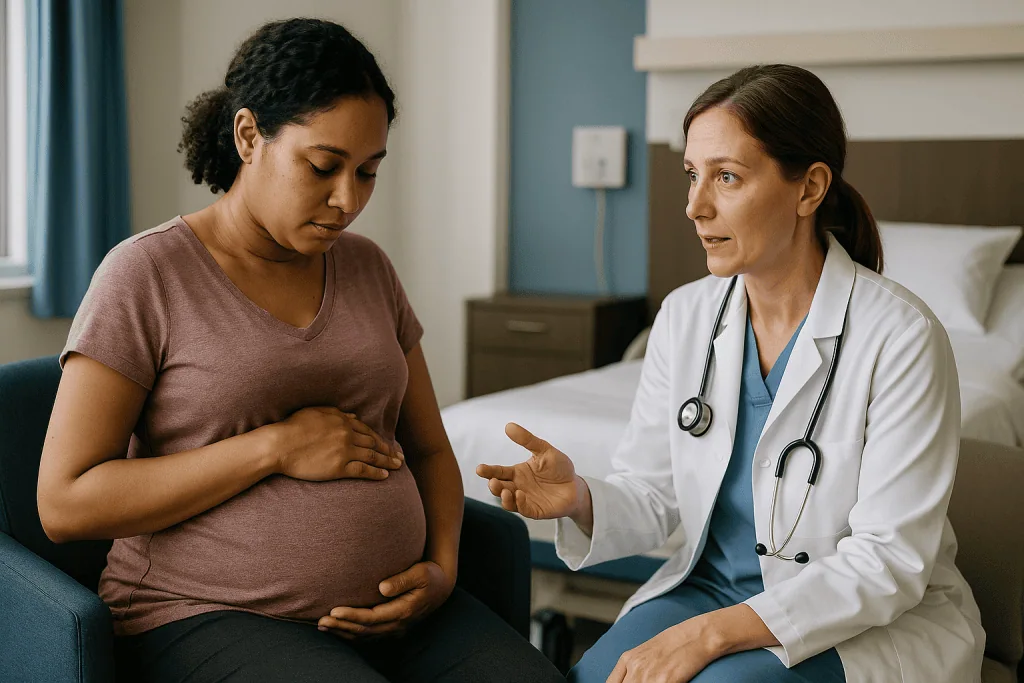
Among planned cesareans, the picture shifts. Having had a previous cesarean is the leading reason a date is set in advance, because many people either choose a repeat operation or are advised toward one when the type of earlier incision or other factors make labor less suitable. Abnormal position of the baby, chiefly breech, comes next, followed by placenta problems, multiple pregnancy and maternal medical conditions.
People searching for “five indications for a cesarean” are usually looking for a neat list. The MedlinePlus summary of cesarean delivery and Mayo Clinic’s overview between them cover these core indications:
- Labor that stalls or fails to progress
- Signs the baby is not coping with labor
- Breech, transverse or other unfavorable position
- Placenta previa, where the placenta covers the cervix
- A previous cesarean or other surgery on the uterus
Other recognized indications include some twin and higher-order pregnancies, a prolapsed umbilical cord, a mechanical obstruction such as a large fibroid or pelvic fracture, and infections or illnesses in the mother that make vaginal birth hazardous. Which of these is “most common” also varies by country and by hospital case mix, which is one reason the World Health Organization cautions against reading rates alone as a measure of good or bad care.
Placenta previa and cesarean: why placenta position matters so much
The placenta is the organ that feeds the baby and usually attaches high up on the uterine wall, well away from the cervix. Placenta previa means it has implanted low enough to partially or completely cover the cervical opening, the very channel the baby would need to pass through. Mayo Clinic describes it plainly: with a complete previa, vaginal birth is not safe, and a cesarean is required.
The reason is mechanical and vascular. As the cervix thins and opens in late pregnancy or labor, the attached placenta tears away from it and bleeds. The classic sign, described by Mayo Clinic, is painless, bright red vaginal bleeding in the second half of pregnancy. Bleeding may be slight or heavy, may stop and restart, and is never something to watch at home.
A low-lying placenta on the 20-week scan is common and often resolves. Mayo Clinic explains that the lower part of the uterus stretches and grows during the third trimester, so a placenta that looked close to the cervix early on frequently ends up a safe distance away. This is why most people with a low placenta at 20 weeks are rescanned around 32 weeks rather than given a cesarean date straight away.
Two related conditions deserve a sentence each. Placenta accreta is when the placenta grows too deeply into the uterine wall and will not separate normally after birth; Cleveland Clinic notes the risk rises with previa and with the number of previous cesareans, and that delivery is planned by cesarean, sometimes with the uterus removed at the same time to control bleeding. Vasa previa is when fetal blood vessels run unprotected across the cervix, another situation where a planned cesarean is advised.
For all of these, the decision is rarely a surprise on the day. The scan report and the bleeding history usually make the path clear well ahead of time.
Breech baby and C-section: when turning the baby does not work
Breech means the baby is positioned bottom or feet first rather than head first. Plenty of babies are breech at 28 weeks and turn by themselves; by term the NHS reports that about 3 in every 100 babies remain breech. It is one of the best known reasons for planned cesarean, and also one of the most misunderstood, because breech does not automatically mean surgery.
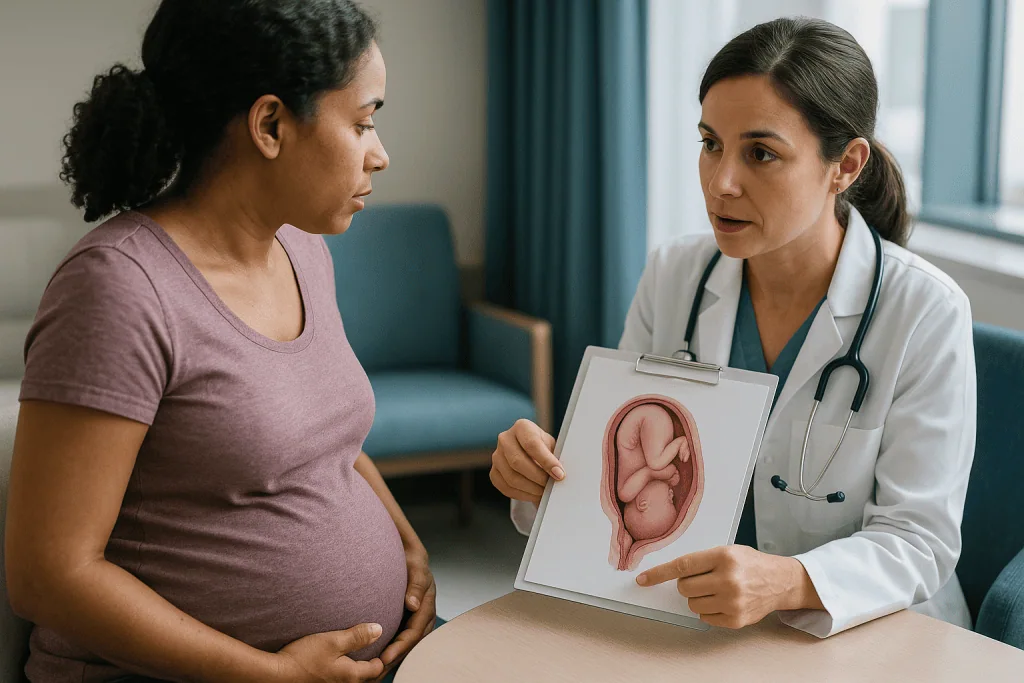
The first offer is usually external cephalic version (ECV), a procedure in which an obstetrician uses firm hand pressure on the abdomen to encourage the baby to somersault into a head-down position. It is typically offered from around 36 weeks in a first pregnancy and 37 weeks in later ones, with the baby monitored before and after. The NHS states that ECV is successful in about half of attempts. It can be uncomfortable, and a medicine from the class that relaxes the uterine muscle is sometimes given beforehand to improve the odds; that decision sits with the team doing the procedure.
If ECV does not work or is unsuitable, there are two paths: a planned cesarean or a planned vaginal breech birth. A large randomized trial found fewer short-term problems for babies born by planned cesarean than by planned vaginal breech birth, which is why the NHS says cesarean is usually recommended for a baby that remains breech at term. The same guidance acknowledges that vaginal breech birth remains an option with an experienced team and appropriate selection, and that longer-term outcomes for the children in that trial were similar.
Why cesarean is favored comes down to mechanics. In a head-first birth, the largest part, the head, molds and leads the way. In a breech birth the body is born first and the head, the widest part, comes last, with less time to adapt and a small risk of the cord being compressed. For many families, knowing these mechanics makes the recommendation feel less arbitrary.
Previous cesarean: is it really once a cesarean, always a cesarean?
No. That phrase comes from an era of vertical incisions on the uterus, and it no longer reflects mainstream practice. Today most cesareans use a low transverse (side to side) cut on the thin lower part of the uterus, which heals into a strong scar. People with one such scar are often candidates for a trial of labor after cesarean, with the goal of a vaginal birth after cesarean, usually shortened to VBAC.
Mayo Clinic reports that about 60 to 80 percent of people who attempt a trial of labor go on to have a vaginal birth. The chief concern is uterine rupture, where the old scar tears open during labor; Mayo Clinic puts that risk at less than 1 percent for those with a low transverse scar, while noting it is serious when it happens and requires an emergency cesarean. Hospitals offering VBAC therefore want an operating room and team available during labor.
Some factors push the balance toward a planned repeat cesarean rather than a trial of labor:
- A previous vertical (classical) incision or a scar of unknown type
- A history of uterine rupture or extensive uterine surgery such as a myomectomy that entered the cavity
- Two or more previous cesareans, where evidence is less reassuring and individual counseling matters
- A current reason for cesarean, such as previa or breech, regardless of history
- A short gap since the last cesarean, which some guidelines treat cautiously
Previous cesarean is the single biggest contributor to planned repeat operations, which is why the question of VBAC is so important for overall cesarean rates. Both Mayo Clinic and the NHS frame the choice as shared decision-making: the chances of success, the risks of each route, and plans for future pregnancies all belong in the conversation, and no one should feel pressured in either direction.
Twins, the baby's lie and size estimates: other reasons for planned cesarean
Multiple pregnancy is a frequent reason for a scheduled date, but not an automatic one. The NHS notes that if the first twin is head down, a vaginal birth is often possible and the second twin can frequently be born vaginally even if not head first. A planned cesarean is more likely to be recommended when the first twin is breech or lying sideways, when twins share a placenta or sac, when one twin is much smaller, or when triplets or more are expected.
The baby’s lie refers to the angle of the baby’s spine relative to the mother’s. A transverse lie, with the baby across the uterus like a hammock, cannot deliver vaginally because neither the head nor the bottom is over the cervix. Like breech, it is often checked again near term because babies move, and ECV may be attempted. An oblique lie sits between the two and is treated case by case.
Size is the trickiest reason on the list. Fetal macrosomia, usually defined as an estimated weight well above average for term, raises the risk of shoulder dystocia, where the shoulders catch after the head is born. Mayo Clinic is candid that ultrasound estimates of fetal weight are imprecise and can be off by a meaningful margin in either direction. For that reason, most guidelines reserve planned cesarean for suspected macrosomia at very high estimated weights, or at lower thresholds when the mother has diabetes, because babies of diabetic pregnancies carry proportionally more weight in the shoulders and trunk.
A baby who is growth restricted, meaning smaller than expected with signs of reduced placental supply, may also be delivered by planned cesarean if the team doubts the baby will tolerate contractions. In each of these situations the reasons for planned cesarean rest on individual measurements and monitoring, not a single rule, and the plan is often revisited at the final appointments.
Maternal health reasons: infections, blood pressure and heart conditions
Sometimes the reason for a planned cesarean lies with the mother’s health rather than the baby’s position. These indications are less visible to friends and family, which can make them harder to explain, so it helps to know the mechanisms.
Infections come first because the logic is direct. Mayo Clinic lists active genital herpes at the time of labor as an indication, since passing through the birth canal can transmit the virus to the baby and neonatal herpes is serious. Antiviral medicines from late pregnancy are commonly used to reduce outbreaks, and whether a cesarean is still needed depends on whether lesions are present when labor begins. For HIV, MedlinePlus and Mayo Clinic note that a planned cesarean is advised when the viral load is high or unknown near term, while people with well-suppressed virus on treatment can often plan a vaginal birth. Hepatitis B and C are generally not reasons for cesarean.
Severe preeclampsia, a pregnancy disorder of high blood pressure with signs of organ stress, sometimes leads to a planned early delivery. Whether that is by induction or cesarean depends on how unwell the mother is, how ready the cervix is and how the baby is coping. The same is true of some kidney and liver conditions of pregnancy.
Certain heart conditions, severe lung disease, some brain and eye conditions where straining is risky, and previous pelvic injuries or surgeries can all tip the balance. So can a large fibroid sitting low in the uterus or a previous severe perineal tear, where the team may offer a cesarean to protect repaired tissue.
Each of these calls for joint planning between obstetricians and the relevant specialists. The reasons for planned cesarean here are about reducing a specific, named risk, and the final recommendation always comes from the treating team who know the full picture.
Elective C-section reasons without a medical indication: maternal request
Not every scheduled cesarean follows a scan finding or a diagnosis. Some people ask for one. The reasons vary: a previous traumatic birth, severe fear of labor (sometimes called tokophobia), concern about pelvic floor injury, a wish for predictability around work or childcare, or a past experience of assault that makes vaginal examinations distressing. These are legitimate reasons to raise, and a good team will take them seriously rather than dismiss them.
UK guidance, summarized on the NHS website, sets out a process rather than a yes or no. Someone requesting a cesarean without a medical reason should be offered a discussion of the benefits and risks of both routes, and where fear or anxiety is a factor, support from a clinician with expertise in perinatal mental health. If after that discussion the person still wants a planned cesarean, the NHS states that it should be offered; if the individual obstetrician is not willing to perform it, they should refer to a colleague who is.
What does the evidence say about outcomes? For a first birth at term with no complications, the differences between planned cesarean and planned vaginal birth are real but modest in either direction. Planned cesarean lowers the chances of perineal tearing, urinary incontinence in the early years and emergency surgery in labor. It raises the chances of a longer hospital stay, wound problems, blood clots and, importantly, placenta problems and scar complications in later pregnancies. Babies born by planned cesarean have more short-term breathing difficulties, especially before 39 weeks.
The size of the family you hope to have is therefore one of the most useful things to put on the table. Risks that look small for a single operation accumulate across repeat cesareans. None of this makes maternal request wrong or right; it makes it a decision worth making with full information, in a room where no one is judging you.
Reasons for planned cesarean at a glance
Seeing the main indications side by side makes the pattern clearer: some reasons are near absolute, while most are judgment calls that depend on scans, history and preference. The table below summarizes how commonly each reason leads to a scheduled operation and what tends to drive the timing, drawing on the NHS, Mayo Clinic and Cleveland Clinic resources cited in this article.
| Reason | What it means | How often it leads to a planned cesarean | What shapes the timing |
|---|---|---|---|
| Complete placenta previa | Placenta fully covers the cervix | Nearly always | Often before 39 weeks, earlier if bleeding |
| Placenta accreta spectrum | Placenta grown into the uterine wall | Nearly always, with a specialist team | Usually scheduled early in a planned setting |
| Breech at term | Bottom or feet first | Usually, after ECV is offered | From 39 weeks unless labor starts first |
| Transverse lie at term | Baby lying sideways | Nearly always if it persists | From 39 weeks, or earlier if cord risk |
| Previous cesarean | One or more uterine scars | Often, but VBAC is an option for many | Around 39 weeks |
| Twins with first twin not head down | Leading baby breech or transverse | Usually | Typically 37–38 weeks for twins |
| Active genital herpes near term | Lesions present when labor expected | Usually if lesions are present | Decided close to or at labor |
| HIV with high viral load | Virus not suppressed | Usually | Around 38 weeks in many guidelines |
| Suspected very large baby | High estimated weight on scan | Sometimes, more so with diabetes | Around 39 weeks |
| Maternal request | No medical indication | After counseling, if still preferred | Not before 39 weeks |
Two caveats. First, “nearly always” is not “always”; even previa is graded by how much of the cervix is covered, and partial or marginal cases are individualized. Second, the timing column reflects typical practice described in the cited sources, not a promise. Your date will depend on your scans, your history and your unit’s protocols, and it may move.
What actually happens on the day of a planned cesarean
Most people are asked to stop eating several hours beforehand and to arrive early in the morning. After checks of blood pressure, the baby’s heartbeat and blood tests, a small cannula is placed in the hand or arm. You will meet the anesthetist, who explains the plan. The NHS notes that the great majority of planned cesareans are done under spinal or epidural anesthesia, meaning you are awake and numb from the chest down, with a general anesthetic reserved for specific situations or preference.
In the operating room the spinal injection is given while you sit or curl on your side; it takes effect within minutes. A thin tube (catheter) is placed in the bladder once you are numb, the abdomen is cleaned, and a screen is raised at chest level. Many units now offer to lower the screen at the moment of birth if you wish. An antibiotic from a class active against skin and vaginal bacteria is given before the first cut; Mayo Clinic explains this lowers the chance of wound infection.
The operation itself is quick. The NHS describes the whole procedure as taking about 40 to 50 minutes, with the baby usually born within the first 5 to 10 minutes. Expect pressure, tugging and odd sensations, but not pain; tell the anesthetist immediately if you feel pain, because they can act. After the baby is lifted out, the cord is clamped, and if all is well skin-to-skin contact can begin while the team completes the surgery.
The placenta is delivered, and a medicine that makes the uterus contract (oxytocin is the generic name) is given to limit bleeding. The uterus and layers of the abdomen are closed with stitches or staples. You then go to a recovery area where feeling gradually returns, pain relief is set up, and you can feed your baby. Compression stockings or an injectable anticoagulant are often used to reduce clot risk; the team decides what suits you.
Who is usually offered a date, and who is usually asked to wait
The clearest candidates for an early appointment to set a date are people with a complete placenta previa, placenta accreta, a persistent transverse lie, or a maternal condition where labor itself carries risk. Their plan is usually written by the early third trimester, with a specific week chosen to balance the baby’s maturity against the chance of bleeding or labor starting unexpectedly.
Many more people fall into a wait-and-see group, and the waiting is not indecision. It reflects what the evidence shows about how pregnancy changes over its final weeks:
- Low-lying placenta at 20 weeks. Mayo Clinic explains that the lower uterus grows and the placenta often ends up clear of the cervix, so a repeat scan at around 32 weeks usually comes before any decision.
- Breech before 36 weeks. Most babies still turn on their own, so ECV and planning conversations are deferred until the position is likely to be final.
- Maternal request. Even when agreed, the NHS and Mayo Clinic describe 39 weeks as the earliest sensible timing, because babies born by planned cesarean before then have more breathing problems that may need special care.
- Suspected large baby. Estimates are rechecked and diabetes control reviewed before any date is set.
Then there is a third group: those who hoped for a vaginal birth and are told the balance has shifted, perhaps because a scan late in pregnancy found a breech baby or because preeclampsia has worsened. For them the “date” may be only days away, and the emotional adjustment is real. Asking for a longer appointment, bringing a partner or friend, and writing questions down beforehand all help.
Whichever group you are in, the reasons for planned cesarean are reviewed right up to the day. Babies turn, placentas move and blood pressure settles or climbs. A plan is a plan, not a prediction, and your treating team holds the final call.
What the first days and weeks after a planned cesarean usually look like
Hospital stays are longer than after a vaginal birth. The NHS describes an average of 3 or 4 days after a cesarean, and Mayo Clinic describes 2 to 3 days in US practice, with earlier discharge possible if recovery is straightforward. Within the first day you will be helped to sit up and walk; this reduces clot risk, helps the bowels wake up and, counterintuitively, eases pain over the following days. The catheter usually comes out once you are walking.
Pain is managed with a combination approach. Regular simple pain relievers are the backbone, often with a stronger medicine for the first few days; the ward team sets this up and adjusts it with you. Anti-inflammatory and acetaminophen-type medicines are generally considered compatible with breastfeeding, but confirm with your own clinicians rather than assuming.
The wound is covered with a dressing for a day or two. Afterward it should be kept clean and dry, patted rather than rubbed, and checked daily for spreading redness, oozing or separation. Stitches may dissolve or be removed around a week later. Vaginal bleeding (lochia) occurs after a cesarean too and lightens over several weeks.
The NHS gives about 6 weeks as the typical time to feel back to normal activities, though many people describe good days and bad days well within that window. Lifting is usually limited to roughly the weight of your baby for the first weeks. Driving should wait until you can brake sharply without pain and can twist to check mirrors; some insurers have their own conditions, so check your policy.
Emotionally, the first weeks can be a mix of relief, soreness and, for some, grief about a birth that was not the one imagined. These feelings deserve airtime. Mention them at your postnatal check, especially if low mood persists or interferes with daily life.
Why do doctors discourage C-sections? The risks, weighed honestly
It is a fair question, given that cesareans save lives when indicated. The short answer is that clinicians are not against cesareans; they are wary of cesareans done without a good reason, because the operation carries risks that a straightforward vaginal birth does not, and some of those risks only appear in the next pregnancy.
For the mother, Mayo Clinic and the NHS list the main surgical risks: wound and uterine infection, heavier bleeding sometimes needing transfusion, blood clots in the legs or lungs, reactions to anesthesia, and uncommon injury to the bladder or bowel. Recovery is slower and the hospital stay longer. For the baby, the most frequent issue is transient breathing difficulty, more likely when birth is before 39 weeks; small skin nicks during the incision are rare.
The quieter concern is cumulative. Each cesarean leaves a scar that raises the chance, in later pregnancies, of placenta previa, placenta accreta and uterine rupture during labor. Cleveland Clinic notes accreta has become more common as cesarean rates have risen, and it is one of the most dangerous conditions in modern obstetrics because of bleeding risk. Someone planning several children therefore has more at stake in avoiding an unnecessary first cesarean than someone planning one.
At the population level, the World Health Organization points out that rates above roughly 10 to 15 percent have not been shown to lower maternal or newborn deaths further, while rates continue to climb in many countries. That is the origin of the discouragement you may have sensed: a public health worry, not a judgment of individuals.
Set against all this is the other side of the ledger. For breech, complete previa, transverse lie or a scarred uterus of the wrong type, a planned cesarean prevents harms that are far from theoretical. The skill lies in matching the operation to the indication, which is exactly what the reasons for planned cesarean discussed here are meant to do.
What people often get wrong about planned cesareans
Myths cluster around this topic, and some of them shape decisions in unhelpful ways. Here are the ones clinicians hear most, with what the evidence actually says.
“Once a cesarean, always a cesarean.” Covered above, but worth repeating: Mayo Clinic reports that most people with a low transverse scar who attempt labor go on to have a vaginal birth, and uterine rupture is uncommon. The old rule applied to vertical incisions.
“A planned cesarean is the easy way out.” Phrases like this shame people who had no choice and misrepresent major abdominal surgery. Recovery takes weeks, the risks are real, and the NHS is explicit that choosing a cesarean is a decision to be respected after proper counseling.
“Breech always means surgery.” About half of babies turn with ECV according to the NHS, and vaginal breech birth remains an option with an experienced team for suitable cases.
“A big baby on the scan means I need a cesarean.” Mayo Clinic notes that ultrasound weight estimates are imprecise. Most suspected large babies are born vaginally without problems, and planned cesarean is reserved for very high estimates or diabetes-related concerns.
“A cesarean protects my pelvic floor completely.” It lowers the risk of some problems, especially early urinary incontinence and perineal tearing, but pregnancy itself stretches and loads the pelvic floor, and long-term differences narrow over the years.
“I will not be able to breastfeed or hold my baby straight away.” Skin-to-skin contact in the operating room and early feeding are standard in many units; initial milk supply can be slightly slower to come in, and lactation support helps.
“A low placenta at 20 weeks means a cesarean is certain.” Most low-lying placentas move clear as the uterus grows, which is why a repeat scan comes first.
Each correction above traces back to the cited sources, and each one tends to make the real decision calmer.
Questions to ask your care team about a planned cesarean
A planned cesarean gives you something an emergency never does: time to ask. Use it. Write questions down before the appointment, bring someone to listen with you, and ask the team to note the answers in your records. The following cover the ground most people later wish they had explored.
- What is the specific reason you are recommending a planned cesarean for me, and how certain is that reason? Could it change before the date?
- Are there alternatives, such as ECV for a breech baby, a repeat scan for a low placenta, or a trial of labor after a previous cesarean? What are the chances each would work in my situation?
- Why have you chosen this particular week? What would make you move the date earlier or later?
- What should I do if labor starts or my waters break before the planned date?
- What type of anesthesia do you expect, and what are my options if I feel pain during the operation?
- Can my partner or support person be present, and can we have skin-to-skin contact and delayed cord clamping if the baby is well?
- What kind of incision will you make on the uterus, and will that affect my options in a future pregnancy?
- How many children am I hoping for, and how does that change the balance of risks for me?
- What is the plan for pain relief and clot prevention afterward, and are those medicines compatible with breastfeeding?
- How long should I expect to stay, and who do I contact once home if something worries me?
- Is there support available if I feel anxious or upset about the change from the birth I had planned?
You are entitled to clear answers in plain language, and to a second conversation if the first one leaves you unsure. The reasons for planned cesarean should be ones you understand and, ideally, agree with. If a recommendation does not make sense to you, say so; a good team will explain it again rather than simply repeat it.
When to call your doctor
Before the planned date, certain symptoms should never wait for the next appointment. Call your maternity unit straight away, at any hour, if you have any of the following; they are urgent regardless of whether a cesarean is already scheduled.
- Any vaginal bleeding, especially if you have been told your placenta is low or covering the cervix. Mayo Clinic describes painless bright red bleeding as the hallmark of placenta previa, and it needs assessment the same day.
- Your waters break, particularly if your baby is breech or lying sideways, because of the risk of the cord slipping ahead of the baby. Lie down and call immediately.
- Regular painful contractions before your date, or a sudden change in the pattern of your baby’s movements, including fewer or weaker movements than usual.
- A severe headache, visual disturbance, pain under the ribs or sudden swelling of the face and hands, which can signal preeclampsia.
- Constant severe abdominal pain or a hard, tender uterus, which may indicate the placenta separating early.
After the operation, the NHS and Mayo Clinic highlight these red flags:
- Fever, chills, or a wound that is increasingly red, hot, swollen, oozing or coming apart
- Heavy vaginal bleeding that soaks a pad in an hour, large clots, or foul-smelling discharge
- Pain, swelling or redness in one calf, or sudden breathlessness, chest pain or coughing blood, which can signal a blood clot
- Pain or burning when passing urine, or being unable to pass urine
- Worsening abdominal pain not relieved by the pain relief you were given
- Thoughts of harming yourself, or low mood and anxiety that make it hard to care for yourself or your baby
If you are unsure whether something counts, call anyway. Maternity triage lines exist for exactly this, and the team that planned your cesarean would far rather hear from you early. Every decision about how to respond rests with them; your job is simply to let them know.
Frequently asked questions
What is the most common reason for a cesarean section?
Across all cesareans, labor that stalls or fails to progress is the most frequent reason, followed by concern about the baby’s heart rate during labor. Among planned cesareans specifically, having had a previous cesarean is the leading reason a date is set in advance, with breech position, placenta previa, twins and maternal medical conditions making up most of the rest. The mix varies between countries and hospitals.
What are 5 indications for a caesarean section?
Five widely recognized indications are labor that does not progress, signs the baby is not coping with labor, a breech or transverse position at term, placenta previa where the placenta covers the cervix, and a previous cesarean or other major uterine surgery. Other accepted reasons include some twin pregnancies, a prolapsed cord, a mechanical obstruction such as a large fibroid, and maternal infections or illnesses that make vaginal birth hazardous.
Who is at higher risk for a C-section?
People with a previous cesarean, a breech or sideways-lying baby near term, placenta previa, twins or more, or conditions such as preeclampsia or diabetes with a suspected large baby are more likely to need one. First births, older maternal age, a higher body mass index, induction of labor and certain fetal growth problems also raise the likelihood. Many of these factors can be discussed and sometimes modified before labor with your care team.
Why do doctors discourage C-sections?
Clinicians discourage cesareans done without a clear medical reason, not cesareans in general. The operation carries risks of infection, bleeding, blood clots and slower recovery, and each scar increases the chance of placenta previa, placenta accreta and uterine rupture in later pregnancies. The World Health Organization notes that population rates above roughly 10 to 15 percent have not been shown to further reduce maternal or newborn deaths.
At what week is a planned cesarean usually done?
Most planned cesareans are carried out from around 39 weeks of pregnancy, according to the NHS and Mayo Clinic, because babies born earlier are more likely to have temporary breathing difficulties. Earlier timing is used when there is a specific reason, such as placenta previa with bleeding, placenta accreta, twins, or a maternal condition that is worsening. Your team chooses the week by weighing the baby’s maturity against those risks.
Does a breech baby always mean a C-section?
No. If your baby is still breech at around 36 to 37 weeks, you will usually be offered external cephalic version, where an obstetrician tries to turn the baby by hand; the NHS reports this works about half the time. If it does not work, a planned cesarean is usually recommended, but a planned vaginal breech birth remains an option with an experienced team for suitable cases.
Does placenta previa always need a cesarean?
A complete placenta previa, where the placenta fully covers the cervix at term, requires a cesarean because the placenta would tear and bleed as the cervix opens. A partial or marginal previa is assessed individually, and a placenta that merely looked low at 20 weeks often moves clear as the uterus grows. Most people are rescanned at about 32 weeks before any decision about placenta previa cesarean timing is made.
Can I request an elective C-section without a medical reason?
You can ask, and guidance summarized by the NHS sets out a process: a full discussion of benefits and risks of both routes, support from a perinatal mental health specialist if fear or a previous traumatic birth is involved, and, if you still prefer a planned cesarean afterward, the operation should be offered or you should be referred to a clinician willing to perform it. It is not scheduled before 39 weeks.
Can I have a vaginal birth after a previous cesarean?
Often, yes. Mayo Clinic reports that about 60 to 80 percent of people who attempt labor after a low transverse cesarean go on to have a vaginal birth, and the risk of the old scar tearing is under 1 percent. A previous vertical incision, a history of uterine rupture, or a current reason for cesarean such as previa usually point toward a planned repeat operation instead. The choice is made jointly with your team.
What happens if labor starts before my planned cesarean date?
Call your maternity unit immediately if contractions begin, your waters break or you have any bleeding before the scheduled date. Depending on the reason for your planned cesarean, the team may bring the operation forward the same day, especially for placenta previa, a breech or transverse baby, or a scar they consider unsuitable for labor. Having the plan written in your notes helps the on-call team act quickly.
References
- NHS: Caesarean section
- NHS: If your baby is breech
- CDC National Center for Health Statistics: Births, Method of Delivery
This article is for general information only and is not a substitute for professional medical advice. Please consult a qualified doctor about your individual situation.

More from the Blog

How Amniocentesis Is Done: Ultrasound Guidance, the Needle and the Minutes It Actually Takes
Amniocentesis is done with continuous ultrasound guidance: a clinician maps the baby, placenta and a pocket of fluid, cleans the abdomen, then passes a…

How Gestational Diabetes Treatment Is Planned: Diet, Glucose Tracking, Activity and Beyond
A gestational diabetes treatment plan usually starts with a tailored eating pattern, home blood sugar checks several times a day, and regular moderate activity,…

Which Conditions May Be Treated With Fetal Surgery? Spina Bifida, TTTS and Diaphragmatic Hernia
Fetal surgery is most established for three conditions: open spina bifida (myelomeningocele), where the spinal defect is closed before birth; twin-to-twin transfusion syndrome, where…

Cesarean Incision Care: What Normal Healing Looks Like and Which Changes Need a Call
A healing cesarean incision is usually pink or slightly red at the edges, mildly tender, and gradually flatter and paler over about six weeks.…

When Can You Drive, Climb Stairs and Carry Your Baby After a Cesarean Delivery?
Most people are asked not to drive after a cesarean until they can twist, look over a shoulder and brake hard without pain, are…

When Would You Be Asked to Leave the Birthing Pool? Water Birth Safety Checks Explained
You would usually be asked to leave the birthing pool during labor if a safety check changes the picture: your temperature or the water…