

When Is a Hair Operation the Next Step? Stable Loss, Medical Therapy and the Timing Question

Key Takeaways
- A hair transplant relocates existing follicles from a resistant donor zone; it does not create new hair, so the donor supply is a finite budget to spend over decades.
- Mayo Clinic and the NHS put the minimum trial for topical minoxidil or oral finasteride at about six months, and their benefit lasts only while they are used.
- The NHS describes transplanted hair shedding in the first weeks, new growth at around six months and the full result at roughly 12 to 18 months.
- FUE harvests individual follicular units and leaves dot scars; FUT removes a strip and leaves a linear scar; both methods grow the same hair.
- Transplanted hair keeps its resistance to pattern loss, but native hair around it continues to thin unless the underlying process is slowed, which shapes how a result looks twenty years on.
- Sudden, patchy or painful hair loss, or loss with fatigue or weight change, needs medical assessment first because it may not be pattern loss at all.
A hair operation is usually considered the next step only after hair loss has been diagnosed as pattern hair loss, has stayed stable for a period, and medical therapy has been tried long enough to judge its effect, typically at least six months. Surgery moves existing follicles rather than creating new ones, so timing, age, donor supply and realistic goals all shape the decision, which rests with the treating team.
The bathroom mirror is where most people first notice it: a little more scalp at the crown under the ceiling light, a hairline that seems to have quietly moved north since the last haircut. For a while you tell yourself it is the lighting. Then a photo from a family dinner settles the argument.
That is often the moment the question forms. Is a hair operation the next step, or is it a leap over several steps you have not yet taken? Most people searching “hair operation next step” are not asking how the surgery works. They are asking whether they are ready for it, and how they would know.
The honest answer has three parts: whether the loss is stable, what medical therapy can still do, and whether the timing favors a good long-term result. This explainer walks through each, using what mainstream guidance actually says rather than what a brochure might promise.
Is a hair operation the next step, or just the next option?
A hair transplant does not grow new hair. It relocates hair you already have. A surgeon takes follicles, the tiny living structures in the skin that produce each hair, from an area of the scalp that is genetically resistant to thinning, usually the back and sides, and places them where coverage has thinned. MedlinePlus describes the procedure as typically performed under local anesthesia, often taking several hours, with the transplanted hair then growing in the new site because the follicle carries its own programming with it.
That single fact shapes every timing question that follows. The donor area is a finite bank. Follicles spent on a hairline at 24 are not available for a crown at 44. A thoughtful team treats the donor supply as something to budget over decades, not a single afternoon.
So “next step” is better read as “next step in a sequence.” The sequence usually runs: confirm the diagnosis, rule out reversible causes, stabilize the loss with medical therapy where appropriate, watch how the pattern settles over time, and only then weigh surgery against the alternatives. Skipping to the end can work out for some people, but it carries a specific risk: transplanting into a scalp that is still actively thinning, so that the native hair around the grafts keeps disappearing and the result looks unnatural a few years on.
The NHS frames hair transplantation as a procedure for people with permanent baldness, most often male pattern baldness, and notes that it is not usually available through public health services because it is considered cosmetic. That framing matters: it is an elective choice, and elective choices reward patience.
Why stable loss matters before any hair operation
Pattern hair loss, called androgenetic alopecia in clinical language, is the slow miniaturization of follicles in genetically sensitive areas of the scalp. Hormones derived from testosterone shorten each follicle’s growth phase and shrink the hair it makes, until a thick terminal hair becomes a fine, pale one and eventually stops appearing at all. Mayo Clinic identifies this hereditary pattern as the most common cause of hair loss in both men and women, typically appearing as a receding hairline and crown thinning in men and a widening part in women.
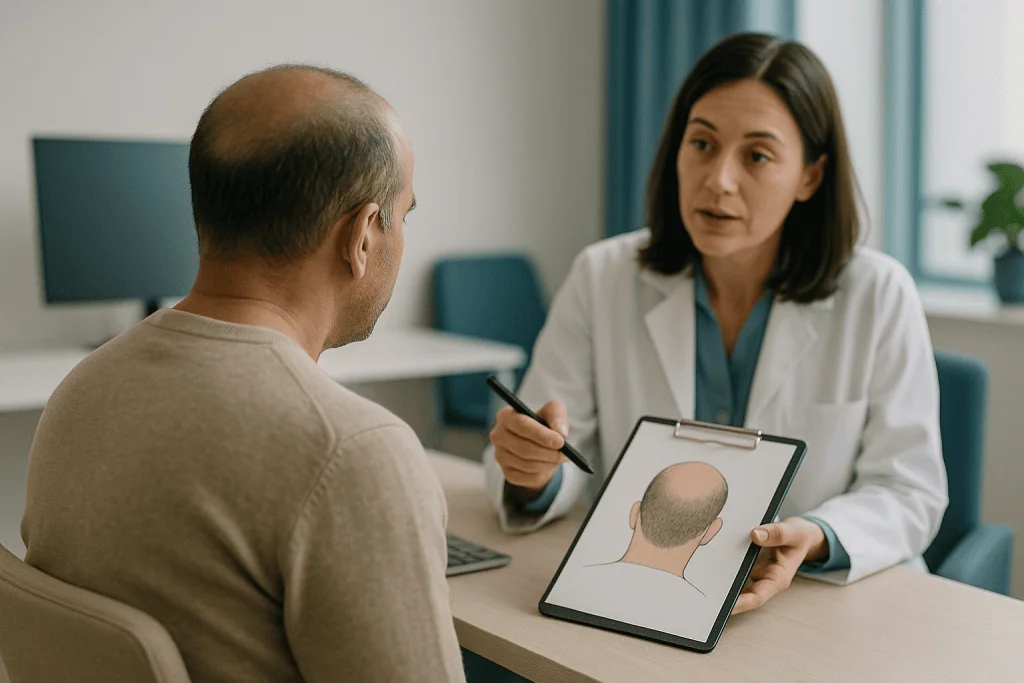
The process is gradual and, crucially, it does not stop on its own. A transplant placed into the middle of an actively receding pattern is like planting a hedge in a field that is still being cleared. The grafts survive, because they came from a resistant zone, but the surrounding native hair continues its slow exit. Over years the person can be left with an island of transplanted hair and bare scalp behind it.
Stability is therefore the first gate. Clinicians look for several things before they call a pattern stable enough: a loss pattern that has not visibly changed across repeat examinations, a donor area with good density and no signs of thinning itself, and ideally a period on medical therapy to slow the underlying process. Scalp photographs taken months apart, standardized lighting, and sometimes magnified views of hair shaft diameter all help make that judgment less subjective.
Stability is also why age enters the conversation so often. A pattern seen at 22 is a snapshot, not a forecast. The same pattern at 35 tells a far more complete story about where the loss is heading and how much donor hair can safely be spent.
What medical therapy actually does, and why it usually comes first
Two medicines dominate guideline-level discussion of pattern hair loss, and both work by changing the environment around existing follicles rather than replacing them.
Topical minoxidil is applied to the scalp. Its precise mechanism is not fully understood, but it is thought to prolong the growth phase of the hair cycle and improve blood supply around follicles, which can thicken miniaturizing hairs. Mayo Clinic notes it is used by both men and women, that it takes at least six months to prevent further loss and start regrowth, and that benefit continues only while it is used.
Oral finasteride belongs to a class called 5-alpha reductase inhibitors. It blocks the enzyme that converts testosterone into the more potent hormone that drives follicle miniaturization. Mayo Clinic describes it as a prescription medicine for men that can slow loss and produce some regrowth, again over months rather than weeks, with effects that fade if it is stopped. It carries recognized side effects that a prescriber will discuss, and it is not used in the same way in women.
The NHS summarizes both as treatments that do not work for everyone, work only as long as they are used, and need several months before any judgment can be made.
Why first? Because the best transplant candidate has a stabilized scalp, and medical therapy is the main tool for stabilizing it. Many surgeons also ask patients to continue therapy after surgery for the same reason: to protect the native hair around the grafts. Whether either medicine is appropriate, and for how long, is a decision for the prescribing clinician who knows your history. Nothing here is a recommendation to start, stop or change anything.
How long before a hair transplant should you give medication a chance?
The question most people are really asking is how long the waiting room lasts. The evidence-based floor is clear: at least six months, because that is how long Mayo Clinic and the NHS say both minoxidil and finasteride typically need before their effect can be judged. Shedding in the first weeks of therapy is common and does not mean failure; the hair cycle has to turn over before thicker hairs appear.

Many clinicians prefer a longer runway. Twelve months on therapy gives a cleaner picture of three things at once: whether the medicine is holding the line, where the pattern is settling, and how the person feels about the result. Some discover they are satisfied with slowed loss and modest thickening and never book a surgical consultation. Others reach the end of the year with a stable scalp and a clear sense of what surgery would need to add.
The waiting period is not wasted time. It is when the diagnosis gets confirmed, because not all hair loss is pattern loss. Mayo Clinic lists thyroid disease, iron deficiency, certain medicines, scalp conditions, stress-related shedding and autoimmune patchy loss (alopecia areata) among causes that look different and are treated differently. A transplant for a condition that would have resolved on its own, or that will attack transplanted hair as readily as native hair, is a poor use of a finite donor supply.
There is no guideline that fixes a single correct interval, and that uncertainty is worth stating plainly. What exists is a consensus logic: treat first, observe, confirm stability, then consider surgery. The treating team translates that logic into a timeline for the person in front of them.
Who is usually a candidate, and who is usually asked to wait
Candidacy is less about wanting more hair and more about whether the arithmetic works. Three variables dominate the assessment.
The first is donor supply. The NHS and MedlinePlus both describe the back and sides of the scalp as the usual source, and a surgeon will examine density there closely. Someone with diffuse thinning across the whole scalp, including the back, often has little safe donor hair to move.
The second is the size and trajectory of the recipient area. A modest, stable hairline recession in someone in their thirties with a dense donor zone is a very different proposition from extensive crown and frontal loss in someone whose pattern is still evolving.
The third is the person’s goals and health. Realistic expectations, no active scalp disease, and no medical conditions that impair healing all matter. MedlinePlus notes that people with significant medical problems may be advised against surgery, and that bleeding, infection and scarring are recognized risks that increase with certain health factors.
Who is typically asked to wait? People in their early twenties with a recently noticed pattern, because the eventual extent is unknowable. People who have not yet tried medical therapy, or tried it for less than six months. People with unstable or undiagnosed loss, especially sudden or patchy loss that may be inflammatory or autoimmune. And people whose expectations exceed what the donor supply can deliver.
Women deserve a specific note. Female pattern loss is often diffuse rather than confined to the front and crown, which can make the donor area less reliable. Cleveland Clinic describes transplantation as an option for some women, but candidacy depends on finding a stable, dense zone to harvest from. None of these categories is a verdict. They are reasons a careful team might say “not yet” rather than “no.”
What is the process of a FUE hair transplant?
Two surgical methods are in mainstream use, and both end the same way: individual follicular units, the natural groupings of one to four hairs that grow together, are placed into tiny incisions in the thinning area.
Follicular unit excision, commonly abbreviated FUE, removes each unit directly from the donor scalp using a small circular punch. The NHS describes this as taking individual hairs one by one from the back of the head and placing them into small cuts in the recipient area. The donor zone is usually trimmed short first. Because each graft is harvested separately, the donor area heals as scattered tiny dots rather than a single line, which many people prefer if they wear their hair short.
Follicular unit transplantation, often called FUT or the strip method, removes a narrow strip of scalp from the back of the head, closes the wound with stitches, and divides the strip under magnification into individual units. The NHS notes this leaves a linear scar that is usually concealed by surrounding hair. The strip method can yield large graft numbers in a single session and spares the rest of the donor area from trimming.
On the day, MedlinePlus describes local anesthesia to numb the scalp, sometimes with a mild sedative, with the session lasting several hours depending on how many grafts are moved. The NHS describes it as usually a day-long procedure with a return home the same evening. Recipient incisions are made at angles that mimic how native hair exits the skin, which is where surgical artistry and anatomy meet.
Neither method grows hair that the other cannot. The choice depends on donor characteristics, graft numbers needed, scalp laxity, hairstyle preferences and surgeon judgment, and the treating team explains which suits a particular scalp.
Medication, FUE, FUT or waiting: how the options compare
Seeing the paths side by side makes the timing logic easier to hold in mind. The table summarizes what mainstream sources describe for each option; it is a map, not a menu, and the treating team decides which roads are open.
| Option | What it does | Typical time to judge | Main trade-offs |
|---|---|---|---|
| Watchful waiting | Observes the pattern; no intervention | Months to years | Loss continues; preserves future options |
| Topical minoxidil | Prolongs growth phase of existing follicles | At least 6 months (Mayo Clinic) | Ongoing use; scalp irritation possible |
| Oral finasteride (men) | Blocks hormone that miniaturizes follicles | At least 6 months (Mayo Clinic) | Ongoing use; prescriber-managed side effects |
| FUE transplant | Moves individual follicular units | Full result 12–18 months (NHS) | Dot scarring; donor trimmed; finite supply |
| FUT (strip) transplant | Moves a strip, divided into units | Full result 12–18 months (NHS) | Linear scar; higher single-session yield |
Two patterns stand out. Medical therapy and surgery are not rivals; they address different problems, one slowing the underlying process and the other redistributing what remains. And every option that acts on the scalp has a judgment window measured in months, which is why rushing any of them tends to produce disappointment rather than speed.
The NHS also lists wigs, hairpieces and, for some people, no treatment at all as legitimate paths, and notes that counseling can help where hair loss is affecting wellbeing. Those belong in any honest comparison.
How should a hair transplant look after 5 days?
The first week is when reality and expectation most often collide, because the scalp looks worse before it looks better. Knowing what is ordinary helps people avoid unnecessary alarm and, just as importantly, recognize the few things that are not ordinary.
In the first two to three days, both donor and recipient areas are typically tender, pink and mildly swollen. MedlinePlus notes the scalp may be sore and that a bandage may be worn briefly, with mild discomfort managed as the surgical team advises. Swelling sometimes drifts downward toward the forehead or around the eyes over days two to four before settling; this is gravity moving fluid, not a complication in itself.
By around day five, most people see small crusts or scabs at each graft site, giving the recipient area a stippled, slightly reddened look. The transplanted hairs are usually still visible as short stubble inside those crusts. The donor area, whether dotted from FUE or a closed line from FUT, is typically healing and may itch. The NHS advises that most people can return to work within about three days, though strenuous activity and anything that risks knocking the grafts is usually restricted for longer, according to the team’s instructions.
Over the second week the crusts loosen and come away with gentle washing as directed. What surprises people next is shedding: the NHS explains that the transplanted hair typically falls out within the first few weeks. This is expected. The follicle has survived the move and entered a resting phase; the hair shaft it was carrying is simply discarded before a new cycle begins.
Every surgical team gives its own washing, sleeping and activity instructions, and those override anything general. The point of knowing the usual picture is to know when something falls outside it, which the final section covers.
Hair transplant timing after surgery: the months of growth
If the first fortnight is about healing, the following year is about patience, and the timeline is slower than most people assume.
After the early shedding, the recipient area usually looks much as it did before surgery, sometimes slightly pinker, for several weeks. New hair growth typically becomes noticeable at around six months, according to the NHS, with hairs emerging fine and sometimes slightly curly or uneven at first. MedlinePlus gives a similar range, describing visible results in roughly six to nine months. Texture generally normalizes over subsequent cycles as each hair thickens.
The NHS describes the full result as taking about 12 to 18 months. Crown areas often lag behind the hairline, so someone judging a transplant at the nine-month mark is grading an unfinished piece of work. Photographs taken under the same lighting at three-month intervals are more useful than a daily check in the mirror, which is a reliable way to see nothing change.
This long horizon is itself a timing argument. Someone who needs a second session to extend coverage is usually asked to wait until the first result has fully declared itself, so that grafts are not placed where hair is already coming through. Donor areas also need time to recover before further harvesting.
What about the surrounding native hair during this period? It follows its own trajectory, which is why many teams discuss continuing medical therapy after surgery. The transplant improves what has been lost; it does nothing to change what has not been lost yet. Decisions about ongoing therapy belong with the prescribing clinician, informed by how the pattern behaves over this same year.
What happens 20 years after a hair transplant?
This is one of the most searched questions about the procedure, and the least often answered honestly. The long view depends on two separate biological stories running at once.
The first story is the transplanted hair. Follicles taken from the resistant donor zone keep their resistance, which is the entire premise of the operation. MedlinePlus and the NHS both describe transplanted hair as generally permanent in that sense. It grows, grays and thins with ordinary aging the way the hair at the back of the head does, but it is not driven out by the hormonal process that caused the original loss.
The second story is everything else on the scalp. Native hair around and behind the grafts remains subject to pattern loss. Two decades on, a person whose loss kept progressing may have transplanted hair at the front with thinner native hair behind it. Whether that looks natural depends heavily on decisions made at the start: how conservatively the hairline was placed, how much donor hair was held in reserve, and whether medical therapy slowed the surrounding process. A hairline designed for a 25-year-old face can look out of proportion on a 50-year-old scalp that has lost the hair behind it.
The donor area has its own long-term story. Harvesting leaves permanent scars, dot-type with FUE and linear with FUT, which become more visible if the donor hair itself thins with age or is cut very short. The NHS lists scarring among the risks for exactly this reason.
None of this is a reason to avoid surgery. It is a reason to treat the first consultation as planning for the person you will be in twenty years, which is why experienced teams tend to favor conservative hairlines and staged sessions over a single ambitious one.
Risks, side effects and the alternatives worth hearing about
Any honest discussion of whether surgery is the next step has to include what can go wrong and what else is on offer.
MedlinePlus lists the general risks of hair transplantation as bleeding, infection, scarring, and the possibility that transplanted hair fails to take or looks unnatural. The NHS adds swelling, pain, numbness or altered sensation in the scalp, and a small risk of a reaction to the anesthetic. Temporary numbness around the donor and recipient sites is common and usually resolves over weeks to months, though it can occasionally persist.
Two outcomes deserve particular mention because they are specific to this surgery. Shock loss is temporary shedding of native hair near the surgical sites, thought to be caused by the stress of the procedure on neighboring follicles; it usually regrows, but it can be distressing in the interim. Poor graft survival, where fewer transplanted hairs grow than expected, can result from handling, scalp conditions, or healing problems and may leave a result thinner than planned.
Alternatives span a wide range. Continued medical therapy alone suits many people. Low-level laser devices are marketed for hair loss; Mayo Clinic notes that studies suggest some improvement in density but that more research is needed on long-term effects, which is a fair summary of uncertain evidence. Platelet-rich plasma injections, in which a person’s own concentrated platelets are injected into the scalp, are offered in many places; the NHS does not list them among established treatments, and the evidence remains limited. Scalp micropigmentation, a form of tattooing that mimics stubble, changes appearance without moving any hair. Wigs and hairpieces remain the simplest reversible option.
The choice among these is a conversation, and it belongs with a clinician who can examine the scalp rather than with any article.
What people often get wrong about hair transplants
Myths cluster around this procedure more than most, partly because so much online content comes from people with something to sell. A few corrections, grounded in what mainstream sources actually say.
“A transplant creates new hair.” It does not. It relocates existing follicles. The total amount of hair on the head is the same the day after surgery as the day before; it is simply distributed differently.
“Once you have surgery, you can stop the medicine.” Surgery does nothing to protect native hair. Mayo Clinic is explicit that the benefit of minoxidil and finasteride lasts only while they are used. Whether to continue is a prescriber’s decision, but the premise that surgery replaces therapy is wrong.
“The hair that falls out after surgery means it failed.” The NHS describes early shedding of transplanted hair as expected. The follicle, not the visible shaft, is what was moved.
“Younger is better because you have more hair to work with.” Younger means less information about where the pattern is going. Teams often ask younger adults to wait and stabilize precisely because donor supply is finite.
“Results are visible in a few weeks.” The NHS puts the full result at 12 to 18 months. Anyone promising a transformed look in a couple of months is describing something other than hair biology.
“A celebrity had one, so it must work.” Private medical history is private, and public speculation about any named individual says nothing about another person’s scalp, donor supply or pattern. The right benchmark is a clinician’s examination, not a headline.
“It is a one-and-done procedure.” MedlinePlus notes that more than one session may be needed, and ongoing loss elsewhere can prompt further work years later.
Questions to ask your care team before deciding
A good consultation leaves you with fewer certainties and better questions. These are the ones that tend to separate a well-timed decision from a premature one.
- What is my diagnosis, and how confident are you that this is pattern hair loss rather than another cause?
- Do you consider my loss stable, and what are you basing that on? Would repeat photographs over the next few months change your view?
- Have I given medical therapy enough time to judge, and would you want me to continue it after any surgery?
- How dense is my donor area, and how much of it would this plan use? What would be left for future sessions?
- Where would you place the hairline, and how would that look on my face in twenty years?
- Which method, FUE or FUT, suits my scalp, and why?
- How many sessions do you anticipate over my lifetime, not just this year?
- What are the specific risks for me, given my health and medicines?
- What would you expect my scalp to look like at one week, six months and eighteen months?
- What are the signs that something is wrong after surgery, and whom do I contact?
- What happens if I decide not to have surgery at all?
Notice that most of these are about time. The right answer to “is a hair operation the next step” often comes not from a single appointment but from a sequence of them, during which the pattern, the response to therapy and your own goals all become clearer. A team that encourages that sequence, and is comfortable saying “not yet,” is giving you the most useful kind of advice.
When to call your doctor
Two situations call for a conversation with a clinician rather than more reading, one before any surgery and one after.
Before surgery, hair loss itself sometimes signals something that needs attention. Mayo Clinic advises seeing a doctor when loss is sudden or patchy, when more hair than usual comes out with washing or combing, when it is accompanied by itching, burning, scaling, pain or sores on the scalp, or when it occurs alongside other changes such as fatigue, weight change or irregular periods. These patterns point away from simple pattern loss and toward conditions such as alopecia areata, scalp infection, thyroid disease or iron deficiency that are treated very differently. A transplant is not the next step for any of them until the underlying cause is addressed.
After surgery, contact the surgical team promptly if you notice any of the following, which MedlinePlus and the NHS flag as signs of complications:
- Bleeding from donor or recipient sites that does not stop with the gentle pressure you were instructed to apply
- Spreading redness, warmth, increasing pain, pus or an unpleasant smell from the scalp, which can indicate infection
- Fever or chills
- Swelling that worsens after the first few days rather than settling, or that closes the eyes
- Severe pain not controlled by what the team advised
- Numbness that is spreading rather than easing, or any new weakness
- A large area where grafts appear to have come away, especially after a knock
Seek urgent care for breathing difficulty, facial swelling that affects the airway, chest pain, or signs of a reaction to any medicine given around the procedure. In every case the treating team, not this article, decides what comes next.
Frequently asked questions
When is a hair operation the next step after medication?
Usually once hair loss has been confirmed as pattern loss, has stayed stable across repeat examinations, and medical therapy has been given at least six months to show its effect, with many clinicians preferring a full year. At that point the team can judge donor supply, the extent of the thinning area and realistic goals. The decision rests with the treating team after an in-person scalp examination.
How should a hair transplant look after 5 days?
At around day five the recipient area typically shows small crusts at each graft site with short stubble inside, mild redness and some tenderness, while swelling that drifted toward the forehead usually begins to settle. The donor area is healing and may itch. Spreading redness, pus, fever or bleeding that will not stop are not part of the normal picture and should be reported to the surgical team.
What is the process of a FUE hair transplant?
In follicular unit excision, the donor area at the back of the scalp is trimmed and numbed with local anesthetic, and individual follicular units are removed one at a time with a small punch. They are kept in solution, then placed into tiny angled incisions in the thinning area. The session lasts several hours, and most people go home the same day with care instructions from their team.
What happens 20 years after a hair transplant?
Transplanted hair generally keeps growing because it came from a zone resistant to pattern loss, though it ages and grays like the rest. Native hair around it may keep thinning unless the underlying process was slowed, which can leave a transplanted front with sparser hair behind. Donor scars also persist. Conservative hairline design and staged sessions are how teams plan for that long view.
How long before a hair transplant should I wait if I am in my twenties?
There is no fixed rule, but teams commonly ask younger adults to wait because the eventual extent of pattern loss cannot yet be predicted and donor hair is finite. A period on medical therapy of at least six to twelve months, with photographs to track stability, usually comes first. The treating clinician weighs age, family pattern, donor density and goals before advising on timing.
Did a famous cricketer or actor really have a hair transplant?
Private medical history is private, and public speculation about any named person is not evidence about the procedure or about your scalp. Celebrity examples also tend to show results under studio lighting and professional styling. The useful comparison is a clinician’s examination of your own donor area, loss pattern and stability, which is what determines whether surgery is a sensible next step.
Does hair transplant timing depend on whether my loss is stable?
Yes, and it is the central question. Surgery into an actively receding pattern risks grafts that survive while native hair behind them keeps disappearing, producing an unnatural look years later. Stability is judged by repeat examinations, standardized photographs and often a period on medical therapy. Teams generally prefer to operate on a scalp whose pattern has settled rather than one still in motion.
Can I stop minoxidil or finasteride after surgery?
Surgery does not protect the native hair around the grafts, and Mayo Clinic notes that both medicines work only while they are used, so many teams discuss continuing therapy afterward. Whether to continue, change or stop any medicine is a decision for the prescribing clinician based on your response, side effects and goals. Do not alter a prescription on the basis of an article.
What is the difference between FUE and FUT hair transplants?
FUE removes follicular units individually with a small punch, leaving scattered dot scars and requiring the donor area to be trimmed. FUT removes a narrow strip of scalp, closed with stitches, which is then divided into units under magnification, leaving a linear scar hidden by surrounding hair. Both methods grow the same hair; the choice depends on donor characteristics, graft numbers and surgeon judgment.
What are the alternatives to a hair operation?
Continued medical therapy, watchful waiting, wigs or hairpieces, and scalp micropigmentation are the main established alternatives described by the NHS. Low-level laser devices and platelet-rich plasma injections are offered in many places, but Mayo Clinic notes the evidence for lasers needs more research and the evidence for platelet injections remains limited. A clinician can explain which options suit your pattern and goals.
References
This article is for general information only and is not a substitute for professional medical advice. Please consult a qualified doctor about your individual situation.
Add us as a Preferred Source to see more of our trusted health content across Google Search, AI Overviews and Discover.

More from the Blog

How Surgeons Plan a Soft, Rounded Hairline in a Hair Transplant for Women
Surgeons plan a soft, rounded female hairline by first confirming the diagnosis and that hair loss has stabilized, then marking a lower, curved line…

What Your Doctor Checks Before PRP for Hair Loss: Blood Thinners, Smoking and Alcohol
Before PRP for hair loss, a clinician usually reviews any blood thinners you take, how much you smoke and how much alcohol you drink,…
When Is a Female Hair Transplant Considered? Medical Treatment First, Then Stable Loss
A female hair transplant is usually considered only after two conditions are met: the cause of hair loss has been diagnosed and treated medically,…

Aesthetic Scalp Surgery Recovery: Dressing Days, Scalp Tightness and When Swelling Settles
Recovery after aesthetic scalp surgery, including hair transplantation, usually follows a predictable arc: any dressing comes off within the first day or two, swelling…

How to Read an FUE Treatment Plan: Zones, Graft Distribution and What the Numbers Mean
To read an FUE hair transplant plan, start with the scalp diagram: each labeled zone (hairline, frontal, mid-scalp, crown) carries a graft count and…

What Happens on the Day of a Hair Operation: Check-In, Hairline Drawing and Graft Placement
On the day of a hair operation, you check in, confirm consent and your medical history, and the surgeon draws and agrees the new…