

When Is It Safe to Fly Home After Facial Aesthetic Surgery? Stay Length and Follow-Up Abroad

Key Takeaways
- The NHS advises avoiding flights for about 7 to 10 days after facial cosmetic procedures such as a facelift, and that range assumes an in-person follow-up has already happened.
- Mayo Clinic lists haematoma as the most common facelift complication and one that usually needs prompt treatment, which is why the first days after surgery are not a flying window.
- The CDC identifies journeys over four hours as the point where travel-related clot risk rises, and recent surgery within three months as a factor that compounds it.
- After rhinoplasty the external splint typically stays on for about a week and nose-blowing is restricted, so surgeons usually want the splint off and the lining inspected before any flight.
- Calf exercises in the seat, walking the aisle and staying hydrated are the CDC's core clot-prevention steps on long journeys, and they still matter weeks after the face looks healed.
- Both the NHS and CDC advise leaving with written records of the procedure, implants and medicines so that home clinicians can manage any problem that appears after you return.
Most people are asked to wait at least a week before flying home after facial aesthetic surgery, and often longer for a facelift or rhinoplasty, so that bleeding, swelling and early wound problems can be checked in person first. Clot prevention matters on any flight over four hours. The exact clearance always comes from the operating surgeon, based on how your recovery is going.
The return ticket is already booked. That is usually how this question arrives: not as an abstract medical query, but as a person sitting in a rented apartment with a compression garment under their chin, a bruise fading from purple to yellow, and a flight in four days that they are no longer sure they should take.
Flying home after facial surgery is a genuine clinical decision, not an admin detail, and the honest answer is less about a magic number and more about three things: whether the wound has passed its riskiest window, whether your body can cope with hours of sitting in dry, low-pressure air, and whether someone qualified has looked at your face before you leave. Those three questions have real evidence behind them.
This explainer walks through what the guidance actually says, which procedures carry which concerns, and how to set up follow-up so that the surgeon who operated is not the only person who ever sees the result.
Why flying home after facial surgery is a timing question, not a date
Surgeons rarely give a single universal number for flying because the risk is not a single thing. The first few days after an operation are when bleeding into the tissues (a haematoma, which means a collection of blood under the skin) is most likely. The first week or two is when infection and wound separation tend to show themselves. Clot risk in the legs stays raised for weeks. Each of these has a different curve, and the safe flying window sits where enough of those curves have fallen.
The UK NHS, in its guidance on cosmetic surgery abroad, advises people to avoid flying for roughly 7 to 10 days after facial cosmetic procedures such as a facelift, and to build in enough time for a follow-up appointment with the operating team before leaving. That range is not a promise of safety on day eight; it is the point at which the early complications most likely to need a surgeon’s hands are usually behind you.
Why in person? Because some problems are easy to miss over a video call. A patch of skin that is cooler and paler than its neighbours, a stitch line that has started to gape by a millimetre, a firm swelling on one side only: these are things an experienced eye checks by touch and by comparison with the other side. Once you are on an aircraft, that examination is hours away in either direction.
What this means in practice is that the decision belongs to the person who operated, informed by what they see at that pre-departure check, not by the airline’s change fee or the date on the boarding pass. Everything below is designed to help you have that conversation well, not to replace it.
What actually happens to a healing face in an aircraft cabin
Picture the cabin as a sealed room pressurised to roughly the air pressure of a mountain town, with humidity far lower than most homes. Three things follow from that, and each one touches a fresh surgical site.
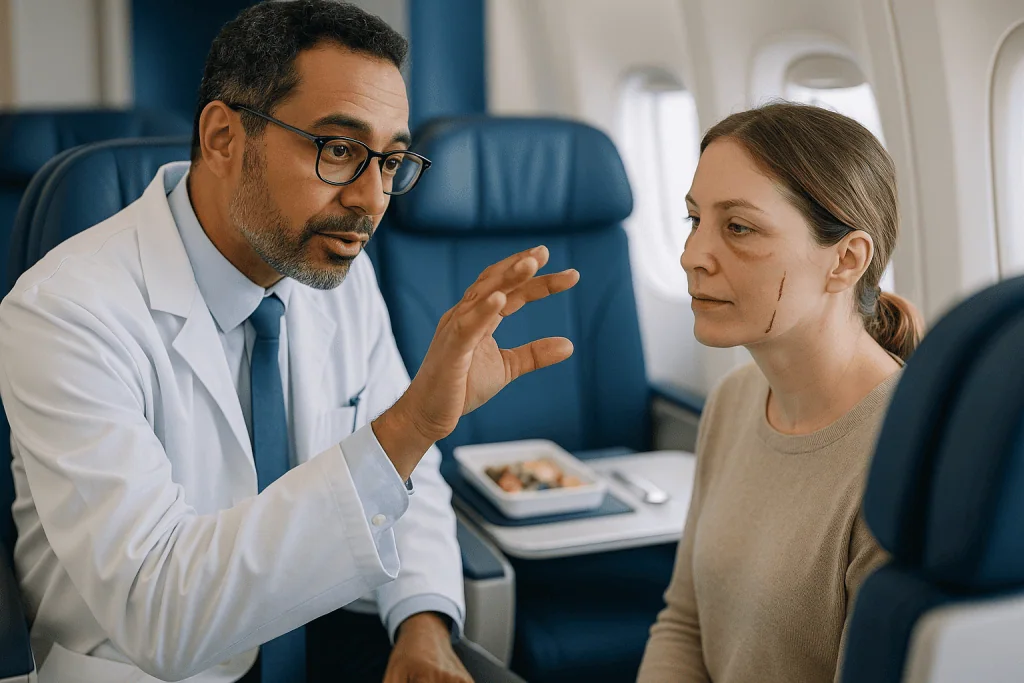
First, pressure. Any gas trapped inside the body expands as cabin pressure falls during climb. After nasal or sinus work, or after procedures where air can be trapped under the skin, that expansion can cause discomfort, and in the nose it can nudge a fragile clot loose and restart bleeding. This is why the nose gets its own section later.
Second, dry air. Low humidity dries the lining of the nose and the surface of the eyes. If your eyelids do not yet close fully after eyelid surgery, which is common for a short while, the cornea (the clear front window of the eye) is exposed to that dry air for hours, and that is uncomfortable at best and a risk to the eye surface at worst.
Third, sitting still. Blood flow in the calves slows when the legs are bent and motionless. The CDC notes that clot risk rises on journeys of more than four hours, and that recent surgery is one of the factors that stack on top of that baseline. A face operation does not seem to involve the legs, but the clotting system does not know which part of you was cut.
Add the practical layer: swelling tends to be worse when the head is level or lower than the heart, so a cramped seat where you doze with your chin on your chest is not neutral for a face that has been asked to drain upward. None of this makes flying forbidden. It explains why the timing matters and why the surgeon’s clearance is not a formality.
How soon can I fly after a facelift? What the guidance says
A facelift (rhytidectomy, an operation that tightens the skin and deeper support layer of the lower face and neck) is the procedure that most often raises the flying question, because the recovery is longer and the early days are busier than people expect.
Mayo Clinic describes the typical sequence: a drain may be placed under the skin to carry away excess blood or fluid, dressings usually come off the day after surgery, and stitches are generally removed within about a week. Bruising and swelling can remain noticeable for two to three weeks, and Mayo advises that most people are back to normal activity in around four to six weeks, with a longer wait for strenuous exercise.
Set that against the NHS advice of 7 to 10 days before flying after facial cosmetic surgery and the logic becomes visible. The drain needs to be out. The stitches, or at least the ones that are not dissolvable, need to be removed by someone who can inspect the line while doing it. The highest-risk window for a haematoma, which Mayo lists as the most common facelift complication and one that usually needs prompt treatment, needs to have passed.
Two caveats are worth stating plainly. The NHS range is a floor, not a target; many surgeons ask for longer when the operation was extensive, when a neck lift was combined, or when the person has risk factors for bleeding. And the range assumes a follow-up visit actually happened. A ten-day wait with no examination is not what the guidance describes.
If you are reading this before the operation, the useful move is to ask your surgeon for their own expected clearance point and to book accommodation that can stretch if that point moves. Recovery does not read the itinerary.
Flying after rhinoplasty: the nose has its own rules
Rhinoplasty (surgery that reshapes the bone and cartilage of the nose) sits apart from other facial procedures because the operated area is also an airway, and because it is the part of the face most exposed to cabin pressure changes.
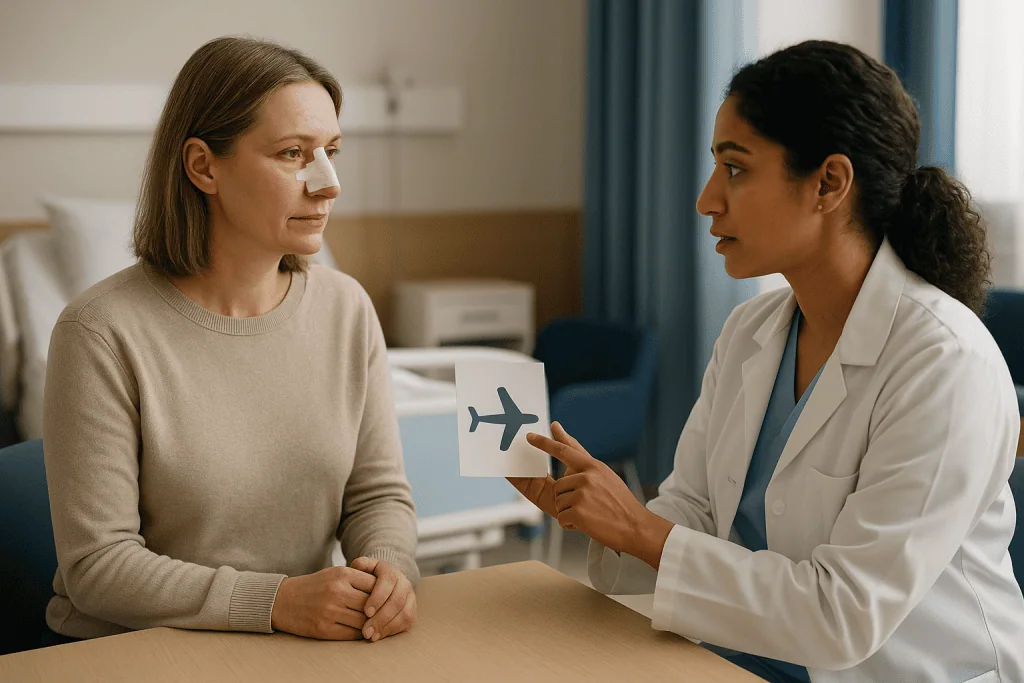
Mayo Clinic’s description of recovery is instructive. An external splint is usually worn for about a week. Internal packing or splints, if used, are removed in the first days. Mayo advises against blowing the nose and against activities that raise pressure in the head during the early period, and warns that bleeding and mucus drainage are expected for a few days after surgery or after packing removal. Full settling of swelling, particularly at the tip, can take up to a year.
Why does this change the flying calculation? Because a nosebleed at altitude is both more likely and harder to manage. Dry cabin air cracks the delicate lining, pressure changes stress healing vessels, and the standard first-aid response, leaning forward and pinching firmly, is exactly what a surgeon has asked you not to do to a freshly set nasal bridge. Congestion from the surgery can also make equalising ear pressure on descent uncomfortable.
Most surgeons will therefore want the splint off, the early bleeding phase finished and the inside of the nose inspected before they are comfortable with a flight. That lines up with the 7 to 10 day NHS range but often lands at the later end or beyond it.
Practical points that are reasonable to discuss with your team rather than decide alone: whether a saline spray is appropriate to keep the lining moist, whether it is better to stay awake during descent so you can swallow and equalise gently, and what to do, step by step, if bleeding starts in flight. Having that plan written down before you board is worth more than any generic tip.
Eyelid, brow and chin procedures: smaller operations, same checklist
It is tempting to assume that a shorter operation means an earlier flight. Sometimes that is true. The checklist, though, does not get shorter; it just gets answered faster.
Eyelid surgery (blepharoplasty, which removes or repositions skin and fat around the eyes) usually involves fine stitches along the lid crease, and many people have a short period when the eyes feel gritty or do not close completely during sleep. On a long flight, dry cabin air makes that exposure worse, so the questions to settle before travel are whether the lids close fully, whether lubricating drops are appropriate and which ones, and whether the stitches have been removed and the line checked. Mayo Clinic notes that swelling and bruising after eyelid surgery generally improve over one to two weeks, which again sits inside the NHS facial-procedure range rather than below it.
Brow lifts, chin implants and fat grafting carry fewer airway or eye-surface concerns, but they share the haematoma and infection windows with every other facial procedure, and the NHS 7 to 10 day guidance still applies as the starting point. Chin implants in particular are often placed through an incision inside the mouth, where the wound is bathed in saliva and food; a surgeon will want to see that site is clean before anyone spends twelve hours away from care.
Non-surgical treatments such as injectables are a different category and usually involve far shorter restrictions, but bruising and swelling can still peak a day or two after treatment. If a combination of surgical and non-surgical procedures was done, the longest restriction governs.
The pattern across all of these is the same three questions: has the early bleeding risk passed, has the wound been examined by someone qualified, and can you move, hydrate and protect the operated area during the journey? A smaller scar does not change the questions. It only changes how soon the answers are likely to be yes.
Blood clot risk after a surgery flight: the part nobody should skip
Deep vein thrombosis (DVT, a blood clot that forms in a deep vein, usually in the leg) is the complication most people underestimate when the operation was on the face. The reasoning is understandable: nothing was done to the legs. The physiology disagrees.
Surgery itself tips the blood toward clotting for a period afterward; the CDC lists recent surgery or injury within the past three months as a risk factor for travel-related clots. Immobility during and after the procedure slows venous flow. Then a long flight adds hours of bent, motionless legs and mild dehydration. The CDC flags journeys longer than four hours as the point where travel itself becomes a factor, and notes that the risk compounds when other factors such as recent surgery, older age, obesity, hormonal contraception, pregnancy or a previous clot are present.
The consequence to understand is pulmonary embolism, which is a piece of a leg clot breaking off and lodging in the lungs. MedlinePlus and the NHS both describe it as a medical emergency.
What reduces risk is unglamorous and well supported. The CDC’s advice for long journeys includes getting up and walking the aisle when it is safe, exercising the calf muscles while seated by raising and lowering the heels and toes, choosing an aisle seat if possible to make moving easier, avoiding tight clothing around the waist and legs, and staying hydrated. Graduated compression stockings are suggested for people at raised risk; whether they are appropriate for you is a question for your team, since fit matters.
Some surgeons prescribe a short course of a blood-thinning medicine after larger procedures. If that applies to you, the mechanism is simply to dampen the clotting tendency during the window of highest risk; the duration and whether it should cover the flight is a decision for the prescriber and should never be adjusted to suit a departure time.
Who is usually cleared sooner, and who is usually asked to wait
Two people can have the same operation on the same day and receive different flying advice. That is not inconsistency; it is the surgeon weighing the factors that actually change risk.
People who tend to be cleared toward the earlier end of a range usually share a few features: a single, limited procedure with no drain; no bleeding problems during or after surgery; a short flight, well under the four-hour threshold the CDC uses for travel-related clot risk; no personal or family history of clots; and a follow-up visit that has already confirmed the wound is settled.
People who are commonly asked to wait longer include those who had combined procedures, for example a facelift with a neck lift and eyelid surgery in one sitting, because more tissue was disturbed and the swelling and bleeding windows run longer. Anyone who developed a haematoma, an infection or wound separation will be held until that has been treated and reassessed. Smokers are often asked for extra time, since nicotine narrows blood vessels and slows wound healing; Mayo Clinic and the NHS both list smoking as a factor that raises the risk of skin healing problems after a facelift.
Clot risk factors push the other way too. A previous DVT or pulmonary embolism, a known clotting disorder, pregnancy, hormone-containing medicines, older age or a high body weight all feature on the CDC’s list, and a surgeon may ask for a longer stay, a different seat or specific prevention steps before signing off on a long-haul flight.
There is also the question of who is travelling with you. Someone recovering alone, with no one to notice a change in colour on one side of the face or help if bleeding starts, is in a different position from someone with a companion. That is not a medical criterion in the textbook sense, but it is one that experienced teams quietly factor in.
A week-by-week picture of recovery and travel readiness
The table below summarises what is typically happening at each stage after a facelift or rhinoplasty, drawn from Mayo Clinic’s recovery descriptions and the NHS guidance on cosmetic surgery abroad. It is a map of typical ranges, not a schedule; your team’s version takes precedence.
| Stage | What is typically happening | Why it matters for a flight |
|---|---|---|
| Days 1–3 | Peak bleeding risk; drains may be in place; dressings usually removed day one (Mayo Clinic) | Flying is not usually considered; a haematoma needs prompt in-person treatment |
| Days 4–7 | Swelling and bruising near their peak; nasal splint still on after rhinoplasty (Mayo Clinic) | Still inside the NHS 7–10 day avoidance window for facial procedures |
| Days 7–10 | Stitches commonly removed; splint usually removed; follow-up examination typically happens (Mayo Clinic) | Earliest point many surgeons consider clearance, after examination (NHS) |
| Weeks 2–3 | Bruising fading; swelling still visible after a facelift (Mayo Clinic) | Flying often acceptable; clot risk from surgery still raised (CDC: within three months) |
| Weeks 4–6 | Most daily activity resumed; strenuous exercise still limited (Mayo Clinic) | Clot prevention basics still apply on long journeys |
Two things stand out when the stages are laid side by side. The first is that the pre-flight examination lands naturally in the days 7 to 10 window, which is why the NHS range reads the way it does. The second is that clot risk does not switch off when the face looks fine; the CDC’s three-month window outlasts the visible recovery by a long way, so the calf exercises and hydration habits matter even on a flight taken weeks later.
Cosmetic surgery abroad follow up: how to arrange it before you leave
The single most useful thing to sort out happens before the operation, not after it: who will look after you once you are home.
The NHS guidance on cosmetic surgery abroad is direct about this. It recommends finding out, in advance, what aftercare the operating team provides, how you will be followed up, and who you should contact if something goes wrong after you return. It also notes that complications may need treatment at home, sometimes in an emergency department, and that your own doctor should be told what was done.
In practice that means leaving with a written summary. The CDC’s medical tourism guidance suggests obtaining copies of your medical records, including details of the procedure, any implants used, the medicines given and the names of the medicines you were sent home with, in a language your home clinicians can read. A photograph of the wound taken at the last in-person check, dated, gives a baseline that a doctor at home can compare against.
Ask the operating team how remote follow-up will work: which platform, how quickly they respond, what they want you to photograph and under what lighting. Ask what their threshold is for telling you to seek local care rather than waiting for their reply, and get that threshold in writing.
Then line up the home side. Let your general practitioner know the dates and the procedure. Find out, before you fly, where you would go locally for an urgent wound problem. If stitches are still to come out after you return, confirm who is willing to do that; it is not safe to assume a walk-in service will remove sutures placed elsewhere.
None of this is pessimism. Most recoveries are uneventful. Follow-up planning is what turns an uneventful recovery from luck into something you can rely on.
Planning the flight itself: seat, movement, hydration, sun
Once clearance is given, the journey can still be made easier or harder by a handful of choices, most of them small.
Seating. An aisle seat makes it easier to stand and walk, which the CDC recommends on long journeys for clot prevention. A window seat offers a wall to rest against but makes movement awkward. If sleep is likely, a travel pillow that keeps the head upright rather than slumped forward helps with facial swelling, which drains better when the head is above the heart.
Movement. The CDC’s advice for anyone on a flight over four hours applies with extra weight after surgery: calf raises in the seat, ankle circles, a walk down the aisle when the seatbelt sign is off. Set a phone reminder rather than relying on noticing time pass.
Hydration. Cabin air is dry, and dehydration thickens the blood slightly. Water, not alcohol, which also widens blood vessels and can increase bruising and swelling. If you had nasal surgery, ask whether a saline spray is appropriate for the lining.
Protection. Scars and bruised skin darken readily in sunlight during the first months; the NHS advises keeping healing scars out of the sun and using high-factor sun protection. A hat and a window shade are enough on the aircraft, but the airport walk at the other end counts too.
Timing. Night flights invite long periods of motionless sleep; a daytime flight on which you stay mostly awake makes it easier to keep moving and to notice bleeding or a change in how the face feels. Build time between the pre-flight check and departure so that a last-minute concern does not become a last-minute scramble. Carry the written summary, the surgeon’s contact details and any prescribed medicines in hand luggage, in their original packaging, with the prescription.
What people often get wrong about flying home after facial surgery
Myths cluster around this question because the rules feel arbitrary. They are not, and correcting a few of them makes the real guidance easier to trust.
Myth: once the bruising fades, flying is safe. Visible bruising is a poor proxy for internal healing. A facelift’s deeper layers are still knitting at three weeks, and the CDC’s three-month clot window outlasts any bruise.
Myth: a short flight does not count. Shorter flights do carry lower clot risk, and the CDC’s four-hour threshold is a reasonable dividing line, but the pressure and dry-air concerns, particularly after nasal or eyelid surgery, exist on a ninety-minute flight too. Short does not mean exempt from the surgeon’s check.
Myth: compression stockings or a blood-thinning medicine make an early flight fine. They reduce one risk, the clot risk, and only when used correctly. They do nothing about a haematoma, an infection or a nasal bleed, which are the reasons the early window exists in the first place.
Myth: business class fixes it. A flat bed helps with posture and movement, and that is genuinely useful, but a flat bed does not shorten the bleeding window or examine the wound.
Myth: a video call is as good as the in-person check. Remote follow-up is valuable for the weeks after you return. It is not a substitute for the pre-departure examination, where a clinician can feel for firmness, test skin temperature and compare sides under proper light.
Myth: the surgeon’s flying advice is about liability, not medicine. The 7 to 10 day NHS figure exists because that is where early complications fall away, and the same window appears across independent sources. A surgeon who asks you to wait is reading the same evidence.
The thread through all of these is the same: the question is not whether you can tolerate the flight, but whether anyone would be able to help if the flight is when something changes.
Medicines, sedation and the airport: what to clear with your team
Medicines come up twice in this decision: the ones you take for recovery, and the ones you might be tempted to take for the flight.
Pain relief. After facial surgery, teams commonly favour pain relievers that do not increase bleeding tendency, and they may specifically ask you to avoid certain over-the-counter anti-inflammatory medicines for a period because of the effect on platelets, which are the blood cells that help form clots. Which medicines, and for how long, is a prescribing decision; the point for travel is to carry what you were given, in original packaging, and not to swap it for something from an airport shop without asking.
Sleep and anxiety medicines. Some people consider a sedative for a long flight. After surgery that is worth a specific conversation, because a sedated passenger moves less, which works against clot prevention, and because combining sedatives with prescribed pain medicines can depress breathing. The CDC’s long-journey advice leans toward staying mobile; sedation pulls the other way.
Blood thinners. If one was prescribed after your operation, the mechanism is to reduce the clotting tendency during the highest-risk weeks. The CDC and NHS both stress that such medicines should be taken exactly as prescribed and never stopped or stretched to fit travel plans; the prescriber decides whether the course covers the flight.
Antibiotics. Where a short course was given, finishing it as directed is part of the aftercare, and the timing relative to the flight is the team’s call.
Documentation. A letter listing the procedure, the medicines and their generic names, and the surgeon’s contact details helps at security, at a pharmacy abroad if something is lost, and in an emergency department at home. Keep it with your passport rather than in checked baggage.
What all of this comes back to is a single instruction: do not change anything about your medicines to make the flight work. Change the flight.
Questions to ask your care team
A good pre-departure conversation covers more than a date. These are the questions that experienced patients and clinicians tend to agree matter most. Take them in writing and leave with written answers.
- What is your expected clearance point for me to fly, and what would make you move it later?
- Will you examine me in person before I leave, and what are you checking for at that visit?
- Which of the following still needs to happen before I go: drain removal, stitch removal, splint removal, packing removal?
- What are my personal clot risk factors, and do you want me to use compression stockings, a particular seat, or a prescribed medicine for the journey?
- If I had nasal surgery, what exactly should I do if bleeding starts in flight, and when does it become an emergency?
- If I had eyelid surgery, do my eyes close fully yet, and should I use lubricating drops on board?
- Which signs mean I should seek care wherever I am, rather than wait to contact you?
- How will remote follow-up work after I return: platform, response time, what to photograph, and for how long?
- Who removes any remaining stitches at home, and will you provide a letter for them?
- What written records will I leave with, and in what language?
- Is there anything about my flight length, connections or airport walking that changes your advice?
Two questions deserve particular attention. The first is the one about what would move the clearance later, because it tells you the surgeon is thinking in terms of your recovery rather than a fixed protocol. The second is the one about seeking care locally, because the honest answer, that some problems need hands within hours rather than a message across time zones, is the one that keeps people safe.
If any answer is vague, ask again. A team that has thought this through will have specific answers, and the specificity itself is reassuring.
When to call your doctor
Most recoveries pass without any of the signs below. When they do appear, they tend to appear in the first two weeks, which is precisely why the pre-flight examination sits where it does. Treat the following as reasons to contact the operating team the same day, or to seek urgent local care if you cannot reach them.
- Swelling that is rapidly increasing on one side, especially with tightness, pain or a change in skin colour; Mayo Clinic notes that a haematoma after a facelift usually needs prompt treatment.
- Bleeding that soaks a dressing or does not stop with gentle, surgeon-approved pressure, or a nosebleed after rhinoplasty that continues beyond the expected early ooze.
- Fever, spreading redness, warmth, pus or a foul smell at the wound, which can indicate infection.
- Skin near the incision turning dark, dusky or blistering, which can signal a problem with blood supply.
- Any new numbness, weakness or asymmetry of facial movement that was not present after surgery.
- Eye pain, worsening vision or an eye that cannot close after eyelid surgery.
Treat these as emergencies, and call the local emergency number wherever you are:
- Sudden shortness of breath, chest pain that worsens when breathing in, coughing up blood, or a racing heartbeat; the NHS and MedlinePlus list these as signs of a pulmonary embolism.
- Swelling, pain, warmth or redness in one calf or thigh, which the NHS describes as the common signs of a deep vein thrombosis.
- Difficulty breathing or swallowing after neck or jaw surgery.
In the air, tell cabin crew early rather than late. Many airlines have access to ground-based medical advice, and a crew that knows a passenger has had recent surgery can respond faster. After landing, do not wait to get home before being seen if any of the emergency signs are present. Every decision about treatment, from a wound check to anticoagulation, belongs to the clinicians in front of you, informed by the written record you carried with you.
Frequently asked questions
How soon can I fly after a facelift?
The NHS suggests avoiding flying for roughly 7 to 10 days after facial cosmetic surgery such as a facelift, and many surgeons ask for longer when procedures were combined or recovery was slower than expected. The practical gate is the pre-departure examination, where drains and stitches are usually dealt with and the wound is checked. Your surgeon’s clearance, based on what they see, is the figure that counts.
Is flying after rhinoplasty riskier than after other facial procedures?
It carries a different set of concerns. Cabin pressure changes and dry air stress a healing nasal lining, which raises the chance of a nosebleed at altitude, and the usual first-aid position is one surgeons ask you to avoid on a freshly set nose. Mayo Clinic describes the splint staying on for about a week and nose-blowing restricted during early recovery, so clearance often lands at the later end of typical ranges.
What is the blood clot risk after a surgery flight if the operation was only on my face?
Surgery anywhere in the body increases clotting tendency for a period afterward; the CDC lists surgery within the previous three months as a risk factor for travel-related clots, alongside flights longer than four hours. Immobility and dehydration on board add to that. Walking the aisle, calf exercises in the seat and good hydration are the basic prevention steps, and compression stockings or prescribed medicines are decided by your team.
How do I arrange cosmetic surgery abroad follow up once I am home?
Settle it before the operation. The NHS advises finding out in advance what aftercare the team provides, how remote follow-up works and whom to contact if something goes wrong, and the CDC recommends leaving with copies of your records in a language your home doctors can read. Tell your own general practitioner what was done, and confirm who will remove any remaining stitches.
Can I take a shorter flight earlier than a long one?
Shorter flights carry lower clot risk, and the CDC’s four-hour threshold is a reasonable dividing line, but the bleeding and pressure concerns that define the early no-fly window do not depend on flight length. A ninety-minute flight on day four still falls inside the period when a haematoma is most likely. Flight length changes the clot-prevention plan more than it changes the earliest sensible date.
Does a video consultation replace the in-person check before I fly?
No. Remote follow-up is valuable for the weeks after you return, but the pre-departure examination involves things a camera cannot do: feeling for firmness that suggests a collection of blood, checking skin temperature and colour side by side, and inspecting inside the nose or along the eyelid crease under proper light. The NHS guidance assumes that in-person follow-up has taken place before travel.
What should I do if my nose starts bleeding on the plane?
Follow the written plan your surgeon gave you before departure, which is why asking for one matters. Generally that means sitting upright, staying calm, not blowing the nose and alerting cabin crew early so they can access ground-based medical advice if needed. Bleeding that does not settle or is heavy is a reason to seek care on landing rather than continuing home untreated.
Will compression stockings let me fly sooner?
They address only one risk, the leg clot risk, and only when fitted correctly. They do nothing about bleeding under the skin, infection or wound separation, which are the reasons the early window exists. Whether stockings are appropriate for you, and whether a prescribed medicine is also needed, depends on your personal risk factors and is a decision for your surgical team rather than a travel hack.
Can I drink alcohol on the flight home after facial surgery?
It is generally discouraged in early recovery. Alcohol widens blood vessels, which can worsen bruising and swelling, dehydrates the body in an already dry cabin, and can interact with prescribed pain medicines. Water is the better choice on board. If you want a clear answer for your own situation, ask the team at the pre-departure visit rather than deciding at the drinks trolley.
What records should I carry with me when flying home after facial surgery?
The CDC’s medical tourism guidance recommends a written summary of the procedure, any implants used, the medicines given and those prescribed for home, with generic names, in a language your home clinicians can read. Add the surgeon’s contact details and a dated photograph of the wound from the last in-person check. Keep all of it in hand luggage alongside your medicines in their original packaging.
References
This article is for general information only and is not a substitute for professional medical advice. Please consult a qualified doctor about your individual situation.

More from the Blog

What to Disclose Before a Liquid Facelift: Blood Thinners, Supplements and Cold Sore History
Before a liquid facelift, tell the injector about every blood-thinning medicine (anticoagulants and antiplatelets, including low-dose aspirin), all supplements and herbal products, any history…

How Nasal Reconstruction Rebuilds the Nose in Stages: Forehead Flaps and Cartilage Grafts
Forehead flap nasal reconstruction rebuilds a missing part of the nose using a strip of forehead skin that stays attached to its own blood…

Does Revision Rhinoplasty Take Longer to Heal? Swelling, Splints and a Realistic Timeline
Yes, revision rhinoplasty usually heals more slowly than a first nose operation. The early steps look similar: the external splint typically comes off after…
Can Filler Fix a Dorsal Hump? What Liquid Rhinoplasty Changes and What Only Surgery Can
Filler cannot remove a dorsal hump; it can only camouflage one. In liquid rhinoplasty, a clinician injects a hyaluronic acid gel above and below…

Zygoma Reduction Risks: Cheek Sagging, Nerve Numbness and Bone Healing Concerns Explained
Zygoma reduction, or reduction malarplasty, carries risks that include cheek soft-tissue sagging, numbness in the cheek and upper lip from irritation of the infraorbital…

When Do Forehead Lines Need a Forehead Lift Rather Than Injectables?
Forehead lines usually respond to botulinum toxin injections when they come from muscle movement and the brows still sit at a normal height. A…