

When Is Spinal Fusion Recommended? Instability, Deformity and Failed Non-Surgical Care

Key Takeaways
- Spinal fusion treats motion and alignment, which is why it is recommended for instability, progressive deformity, unstable fractures, infection and tumors rather than for back pain alone.
- Degenerative changes on MRI are common in people with no pain, so a scan report alone is never sufficient reason for fusion; the findings must match the symptoms and examination.
- The NIH defines chronic back pain as lasting 12 weeks or longer, and fusion for degenerative problems is usually discussed only after that threshold and a genuine course of structured non-surgical care.
- Fusion is commonly added to a decompression when freeing a nerve would leave the segment unstable, such as in spondylolisthesis, whereas nerve compression without instability is often treated by decompression alone.
- Bone typically takes several months to fuse after surgery, the NHS cites roughly 4–6 weeks before return to light work, and full recovery is often described as taking up to a year.
- Smoking, poor bone density and uncontrolled diabetes raise the risk of nonunion, which is why surgeons often ask people to address these before operating.
Spinal fusion is usually recommended when a segment of the spine is unstable or misaligned, when a deformity such as severe scoliosis or a slipped vertebra is progressing or compressing nerves, or when a fracture, infection or tumor threatens the spine's structure. It is generally considered only after a sustained course of non-surgical care has not controlled symptoms, and the final decision rests with the treating surgical team.
She had already done the exercises. Twice a week for most of a year, then the injections, then a second opinion that agreed with the first. Now a surgeon was sketching two vertebrae on the back of a form and drawing a small bridge between them. “This is what fusion does,” he said. She asked the question most people in that chair eventually ask: how do you know I actually need this?
It is a fair question, and the honest answer is more specific than many people expect. When is spinal fusion recommended? Not for back pain alone, and not because a scan looks worn. It is recommended when the spine is structurally unreliable, when its shape is drifting in a way that will cause harm, or when a long, genuine effort at non-surgical care has failed to control symptoms that are limiting a life.
This explainer walks through each of those situations, what the operation actually does, who is usually asked to wait, and what the weeks afterward tend to look like.
When is spinal fusion recommended, and who makes the call?
Spinal fusion is an operation that permanently joins two or more vertebrae, the stacked bones of the spine, so that they heal into a single solid piece and stop moving against each other. That definition matters, because it tells you what the surgery is for: it treats motion. When motion is the problem, fusion can help. When motion is not the problem, fusion has little to offer, however painful the back may be.
Mainstream guidance from the Mayo Clinic and MedlinePlus groups the accepted reasons into a short list. A vertebra that has slipped forward on the one below. A curvature that is progressing or pressing on nerves. A fracture that has left the spine unstable. Infection or tumor that has eaten into bone. And, in carefully selected cases, degenerative disease with instability that has not responded to a full course of non-surgical treatment.
Notice what is absent. “Chronic low back pain” by itself is not on the list. Neither is “disc degeneration on MRI,” which is close to universal by middle age. The NHS is blunt about this in its guidance on lumbar spine surgery: operations are usually considered only when non-surgical treatments have not helped and symptoms are severe or worsening.
Who decides? In practice it is a team: a spine surgeon, often a physiatrist or pain specialist, a physical therapist who knows how the person moves, and the patient. The surgeon is the one who can say whether the anatomy supports a fusion. The patient is the only one who can say whether the symptoms are worth an operation. Both voices are needed, and a good team will say so out loud. Everything that follows is meant to make that conversation more informed, not to replace it.
What actually happens during a spinal fusion?
Think of two bricks that keep shifting. Rather than glue them, a builder would clamp them together and pour concrete between them, then leave the clamp on until the concrete sets. That is a spinal fusion in one image.
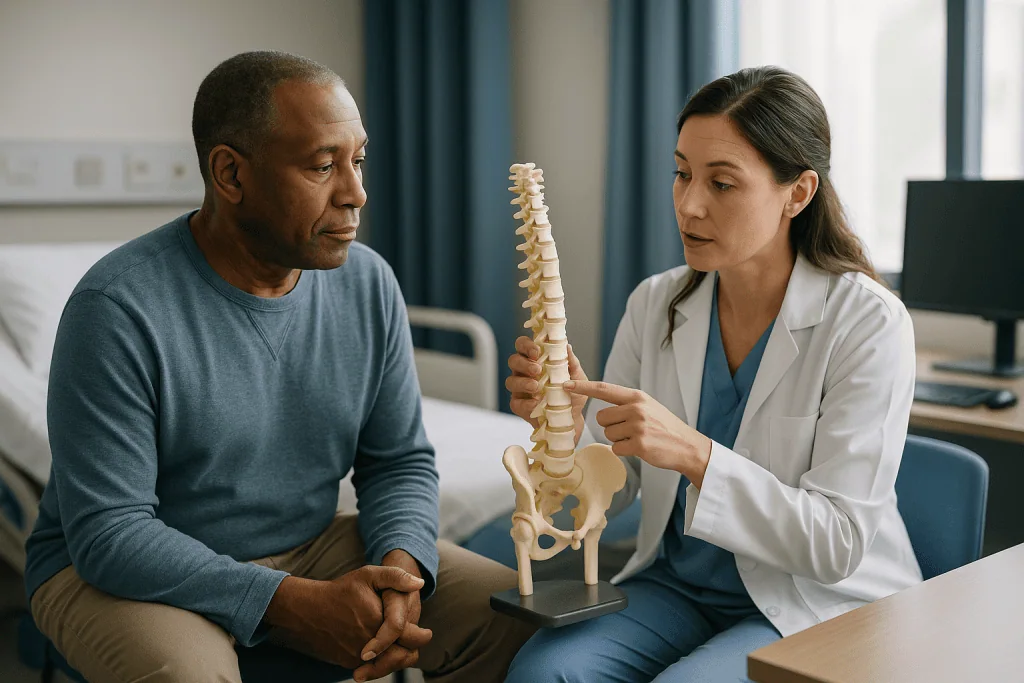
Under general anesthesia, the surgeon reaches the target vertebrae from the back, the front through the abdomen, or the side, depending on the level and the problem. If a nerve is being pinched, the surgeon usually performs a decompression first: removing part of the bone or disc that is pressing on it. A laminectomy, for example, removes the bony roof at the back of the spinal canal to make room.
Then comes the concrete. Bone graft is packed between or alongside the vertebrae. It may come from the patient’s own pelvis, from a donor bank, or from a manufactured bone substitute; each has trade-offs the surgeon will weigh. The graft does not fuse anything by itself. It acts as scaffolding that the body’s own bone cells grow through over the following months.
The clamp is the hardware: titanium screws set into the vertebrae and connected by rods, sometimes with a cage placed in the space where a disc was removed. According to the Mayo Clinic, this metalwork holds the segment still while bone grows across the gap. Once solid fusion is achieved, the hardware has done its job, though it is usually left in place rather than removed in a second operation.
Operating time varies with how many levels are fused and whether both a decompression and a fusion are performed; a single-level lumbar fusion is a shorter operation than a multi-level deformity correction. Surgeons will give a realistic range for the specific plan rather than a universal number, and it is reasonable to ask for one.
Instability: when the spine moves in ways it should not
Instability is the clearest indication, and the one surgeons feel most confident about. A stable spine allows movement within limits set by discs, joints and ligaments. An unstable spine allows movement beyond those limits, and the structures inside, the spinal cord and the nerve roots, pay for it.
The textbook example is spondylolisthesis: one vertebra sliding forward over the vertebra beneath it. In younger people it usually follows a stress fracture in a small bridge of bone at the back of the vertebra. In older adults it is more often degenerative, the result of worn facet joints that can no longer hold the alignment. Either way, the slip narrows the space where nerves exit and can produce leg pain, numbness or weakness alongside back pain.
Not every slip needs surgery. Many low-grade slips are stable, cause few symptoms and are managed with exercise and activity adjustment for years. The case for fusion strengthens when imaging shows the slip progressing between studies, when flexion-extension X-rays show the vertebra actually moving with posture, or when nerve symptoms are worsening despite good non-surgical care. Johns Hopkins lists spondylolisthesis among the core reasons fusion is performed, and the logic is mechanical: a decompression alone can free the nerve but may leave the segment even less stable, so fusion is added to hold it.
Instability also follows trauma. A fracture that has disrupted the supporting columns of a vertebra, or torn the ligaments that link one to the next, can leave the spine unable to protect the cord. Fusion here is not about pain relief; it is about preventing a catastrophe. The same reasoning applies to some cases of severe arthritis in the neck where the top two vertebrae have lost their normal relationship.
Deformity: scoliosis, kyphosis and the tipping point for surgery
Deformity is about shape rather than motion, but the two overlap. Scoliosis is a sideways curve of the spine; kyphosis is an exaggerated forward rounding. Both can be present without symptoms, and most curves are mild and never operated on. The question surgeons ask is not “is there a curve?” but “is this curve going somewhere harmful?”

In adolescents, the concern is growth. A curve that is still increasing while the skeleton is maturing can reach a size where it affects breathing, posture and the ability to sit or stand comfortably. Bracing is the first line for moderate curves, and fusion is reserved for larger or rapidly progressing ones. The Mayo Clinic identifies scoliosis correction as one of the established uses of fusion, precisely because a curve, once fused, cannot progress further.
In adults, deformity tends to arrive slowly, through disc collapse and facet wear that let the spine tilt forward or sideways. The result can be a person who cannot stand upright for long, whose trunk lists to one side, or whose nerves are compressed in the concavity of the curve. Surgery is considered when the imbalance is causing disabling symptoms that physical therapy and pain management have not controlled, or when it is clearly progressing on serial imaging.
Adult deformity surgery is a bigger undertaking than a single-level fusion. It often involves multiple levels, longer operating times and a more demanding recovery, and it carries higher complication rates than smaller fusions. That is why surgeons weigh age, bone density, overall health and the person’s own goals so heavily before recommending it. The decision is rarely urgent, and taking time to understand the trade-offs is part of good care rather than a delay.
Failed non-surgical care: what "failed" really means
“We tried everything and nothing worked” is a sentence surgeons hear daily. What they need to know is what, specifically, was tried, for how long and how well. Failed non-surgical care is a real indication for fusion in selected people, but the word “failed” is doing a lot of work.
Timing comes first. The NIH’s National Institute of Neurological Disorders and Stroke defines acute back pain as lasting a few days to a few weeks, and chronic back pain as pain continuing for 12 weeks or longer. Most acute episodes settle without any procedure, which is why almost no guideline supports fusion for back pain of a few weeks’ duration. The conversation about surgery belongs in the chronic phase, after the natural course has had time to play out.
Content comes second. A meaningful non-surgical program usually includes supervised, progressive exercise aimed at strength and movement rather than rest; education about pain and activity; and often a trial of medicines that reduce inflammation or calm nerve pain, prescribed and adjusted by a clinician. Some people also try targeted injections around an irritated nerve root. Two weeks of a heat pad and a week of a home stretching sheet is not the same as this, and an experienced team will say so kindly.
Outcome comes third. “Failed” means symptoms remain severe enough to limit work, sleep or basic activity despite a good program. It does not mean the program produced no benefit, and it does not mean the person is simply tired of exercising. This is where honesty runs both ways: patients deserve a clear account of what surgery can and cannot change, and surgeons deserve an accurate picture of what has actually been done.
Do I need spinal fusion? Who it is usually for, and who is asked to wait
The people most likely to be offered fusion share a pattern: a structural problem that imaging confirms, symptoms that match that problem, and a history that shows time and good non-surgical care have not been enough. When those three line up, surgeons speak with more confidence, and results tend to be more predictable.
Typical candidates include someone with a progressive spondylolisthesis and leg pain that tracks the compressed nerve; a person with an unstable fracture; an adult whose deformity has tipped them forward until standing is a daily struggle; and someone whose spine has been damaged by infection or a tumor. In each case, fusion addresses a defined mechanical or structural fault.
People commonly asked to wait, or steered toward other options, include those whose main complaint is diffuse low back pain without nerve involvement or clear instability. Cleveland Clinic’s guidance notes that fusion for degenerative disc disease alone is controversial, because pain and the appearance of a disc on a scan are only loosely related. Others are asked to wait because a modifiable factor stands in the way: uncontrolled diabetes, active smoking, very low bone density, or untreated depression, all of which are associated with poorer healing or poorer outcomes after spine surgery.
Smoking deserves a specific word. Nicotine impairs the blood supply that new bone depends on, and surgeons will often ask a person to stop before operating. This is not moralizing; it is about giving the graft a fair chance to fuse.
Being asked to wait is not the same as being dismissed. It usually means the team believes the odds are not yet in the patient’s favor and wants to change that. Asking “what would need to be different for you to recommend surgery?” tends to produce a useful, specific answer.
Fusion, decompression alone or disc replacement: how the options compare
Fusion is one tool among several, and the choice depends on what is wrong. The table below summarizes how the main surgical options differ. It is a starting point for a conversation, not a menu.
| Option | What it does | Usually considered for | Key trade-off |
|---|---|---|---|
| Decompression alone (laminectomy, discectomy) | Removes bone or disc pressing on a nerve; leaves the segment mobile | Nerve compression without instability, such as a herniated disc or spinal stenosis | Preserves motion but does not correct slippage or deformity |
| Decompression plus fusion | Frees the nerve, then locks the segment with graft and hardware | Nerve compression combined with instability, spondylolisthesis or deformity | Stabilizes but permanently removes motion at that level; longer recovery |
| Artificial disc replacement | Replaces a worn disc with a mobile implant | Selected single-level disc disease, more established in the neck than the low back | Keeps motion but requires healthy facet joints and good alignment; not suitable when instability is present |
| Continued non-surgical care | Exercise, education, medicines, injections | Symptoms without progressive deficit or instability | Avoids surgical risk; may not resolve severe or worsening symptoms |
The NHS, in its guidance on lumbar decompression surgery, describes fusion as one of several procedures that may be combined in the same operation, chosen according to the cause of the compression. The decision to add fusion to a decompression is one of the most common judgment calls in spine surgery, and reasonable surgeons can disagree. If one surgeon proposes decompression alone and another proposes decompression with fusion, that is a reason to ask each what specific finding drives the difference, not a sign that one is wrong.
Fractures, infections and tumors: the less common but clearest reasons
Most people who search for fusion are thinking about wear and tear. A smaller group faces something more urgent, and for them the question of “whether” often answers itself.
Traumatic fractures come first. A fall from height, a road collision or a sporting injury can crack a vertebra in ways that leave the spine unable to bear load safely. Some fractures heal in a brace. Others, particularly those involving the back of the vertebra or the ligaments between vertebrae, are inherently unstable. MedlinePlus lists fracture stabilization among the standard reasons for fusion, and in these cases the goal is protection of the spinal cord rather than relief of chronic pain.
Osteoporotic fractures sit in a gray zone. Many compression fractures in older adults heal with time and pain management. Fusion is reserved for those that progress, collapse further, or begin to pinch nerves, and even then surgeons weigh the fragility of the surrounding bone carefully, because screws hold poorly in weak bone.
Infection is rarer but serious. Bacteria can seed a disc or vertebra, often from the bloodstream, and destroy bone over weeks. Antibiotics are the mainstay. Surgery, including fusion, is added when there is an abscess pressing on nerves, when bone destruction has produced instability, or when infection does not respond to medicine alone.
Tumors, whether starting in the spine or spreading from elsewhere, can weaken a vertebra until it is at risk of collapse. Here fusion works alongside cancer treatment to keep the spine load-bearing and protect nerve function. The decision involves oncologists as well as surgeons and depends heavily on overall prognosis and goals of care.
In all three situations, fusion is not a lifestyle choice. It is structural engineering performed to prevent paralysis or protect life, and the discussion tends to be about how and when rather than whether.
What imaging can and cannot tell you about needing fusion
A remarkable number of people arrive at a surgeon’s office convinced that their MRI has already made the decision. It has not, and understanding why saves a great deal of anxiety.
MRI is superb at showing soft tissue: discs, nerves, ligaments, the fluid around the spinal cord. It reliably reveals herniations, stenosis and inflammation. What it cannot do is show pain. Disc bulges, dark “dehydrated” discs and facet arthritis appear in large numbers of people who have no back pain at all, and their frequency climbs steadily with age. A report describing “multilevel degenerative changes” is often a description of a normal spine at that age.
The findings that push toward fusion are more specific. Flexion-extension X-rays, taken bending forward and back, can show a vertebra actually shifting position, which is instability in action rather than in theory. Standing full-length films measure alignment and reveal whether a deformity is pulling the body forward or sideways. CT shows bone detail, including whether a previous fusion has actually healed. Serial studies over time show progression, which matters more than any single image.
The other half of the equation is the examination. A surgeon is looking for a match: does the numbness follow the nerve that the scan says is compressed? Does the weakness correspond to the level of the slip? When the story, the examination and the images all point to the same place, confidence rises. When the scan shows changes at one level and the symptoms suggest another, the team will hesitate, and rightly so.
Asking “which specific finding on my imaging is the reason you are recommending fusion?” is one of the most useful questions a patient can put to a surgeon. A clear answer is reassuring. A vague one is worth exploring further.
Alternatives to spinal fusion and what the evidence actually shows
For instability, deformity, fracture, infection and tumor, the alternatives to fusion are limited, and the discussion is mostly about surgical technique. For degenerative back pain, the alternatives are the main event, and the evidence deserves a plain account.
Structured exercise sits at the center. The NHS and the NIH’s neurological institute both describe staying active and following a graded exercise program as the foundation of managing persistent back pain. Programs that combine strengthening, aerobic work and education about pain tend to perform better than passive treatments alone. This is unglamorous, and it is also the intervention with the broadest support.
Medicines have a role as tools rather than solutions. Anti-inflammatory drugs reduce the chemical irritation around a compressed nerve; certain medicines developed for nerve pain dampen abnormal signaling. Which, whether and for how long are decisions for the prescribing clinician, and they depend on kidney function, other conditions and how the person responds. Opioids are not recommended for long-term back pain in mainstream guidance because the risks outweigh the benefit for most people.
Injections of steroid around an irritated nerve root can reduce leg pain for a period and help some people engage in rehabilitation. They do not change the underlying anatomy, and their benefit for back pain without nerve involvement is modest.
Decompression without fusion, and in selected cases disc replacement, are surgical alternatives when the problem is compression rather than instability. Some treatments marketed for back pain, including certain devices and injections of biological products, lack good-quality evidence, and a reputable team will say so rather than offer them as established options.
The candid summary: for back pain without instability or deformity, well-delivered non-surgical care is the alternative to fusion, and for many people it is also the better choice.
Spinal fusion recovery time: what the days and weeks afterward usually look like
Recovery from fusion is a long arc with a short, intense beginning. Knowing the shape of it helps.
The first days are spent in hospital. MedlinePlus notes that people typically stay in the hospital for a few days after spinal fusion, with the exact length depending on how many levels were fused and how the person is moving. Getting out of bed happens early, often the day of or the day after surgery, because walking reduces the risk of blood clots and pneumonia and helps the bowels wake up after anesthesia. Physical therapists teach how to roll, sit and stand without twisting the trunk.
The first weeks at home are about protected movement. Walking is encouraged and gradually extended. Bending, lifting and twisting are restricted. The NHS, describing recovery after lumbar spine operations that may include fusion, indicates that many people can return to light, non-manual work after roughly 4–6 weeks and that driving is generally possible again once the person can sit comfortably and perform an emergency stop, commonly within a few weeks. Physically demanding jobs take considerably longer.
The middle months are when the real work happens invisibly. The Mayo Clinic explains that it can take several months for the bones to heal and fuse into a single unit, and surgeons often follow this with X-rays or CT. Formal physical therapy usually starts in this window and builds strength around the fused segment.
People often ask specifically about fusion at the lower lumbar levels, L3 through L5, which carry the most load. The general timelines above apply, with the caveat that multi-level lumbar fusions tend toward the longer end of every range. Full recovery, meaning a stable new baseline of function, is commonly described as taking up to a year. None of these figures is a promise; they are typical ranges, and the surgical team’s guidance for the individual case takes priority.
Is spinal fusion one of the most painful surgeries? Risks discussed honestly
Fusion has a reputation for being painful, and the reputation is not baseless. Muscle is moved aside, bone is cut and drilled, and graft is packed against raw surfaces that must knit. In the first days, pain is expected and is managed actively by the anesthesia and surgical teams with a combination of approaches that the prescribing clinician will tailor to the person. Most people find the pain of surgery changes character quickly, from sharp incisional pain to a deeper ache that eases over weeks. Whether it is “one of the most painful” depends on the person and the size of the operation, and comparisons to other surgeries are not meaningful enough to plan around.
The risks that matter more are the ones that change outcomes. The Mayo Clinic and MedlinePlus list infection, bleeding, blood clots in the legs or lungs, nerve or blood vessel injury, and reactions to anesthesia as general surgical risks. Two are specific to fusion.
The first is nonunion, also called pseudarthrosis: the bone fails to grow across the gap and the segment never becomes solid. Smoking, poor bone quality, diabetes and multi-level surgery increase this risk. Nonunion may cause no symptoms, or it may cause persistent pain and require a second operation.
The second is adjacent segment disease: the levels above and below a fusion absorb the motion that the fused segment no longer provides, and over years they may wear faster. Some of this is the natural aging of a spine that was already degenerating, and some is the consequence of the fusion. Surgeons disagree about how much of each, and the honest position is that the risk is real but not precisely quantifiable for an individual.
Any team recommending fusion should walk through these without being asked. If they do not, ask.
What people often get wrong about spinal fusion
Myths gather around any operation with a long recovery. These are the ones that most often distort decisions.
“If the MRI shows degeneration, I will eventually need fusion.” Degenerative changes on imaging are common in people with no pain, and most never require surgery. Fusion is recommended for specific structural problems, not for the appearance of a scan.
“Fusion will get rid of my back pain.” Fusion reliably addresses instability and deformity, and it can relieve nerve pain by allowing a thorough decompression. Its effect on back pain itself is less predictable, and mainstream sources including Cleveland Clinic describe this use as debated. People who expect a pain-free back are more likely to be disappointed than those who expect a more stable, more functional one.
“I will never bend again.” A single-level lumbar fusion removes a small fraction of overall spinal motion, and the remaining segments, hips and knees compensate for most everyday tasks. Multi-level deformity fusions do reduce flexibility noticeably, which is one reason they are reserved for serious cases.
“A high regret rate proves fusion is a bad operation.” Studies of satisfaction after fusion vary widely by indication, and no guideline publishes a single figure. What is consistent across the evidence is that regret is more common when fusion is performed for back pain without clear instability, and less common when it is performed for a defined structural problem. The lesson is about selection, not about the operation itself.
“Once fused, the hardware has to come out.” Screws and rods are generally left in place permanently. They are removed only if they cause problems, which is uncommon.
“Surgery means I failed at rehab.” Some spines have mechanical problems that exercise cannot fix. Choosing surgery after genuine effort is a reasonable decision, not a defeat.
Questions to ask your care team before agreeing to fusion
A good consultation leaves a person able to explain, in their own words, why fusion is being proposed and what the alternatives are. These questions help get there. Bring them written down; consultations move quickly.
- Which specific finding, on which image, is the reason you are recommending fusion rather than decompression alone or continued non-surgical care?
- Is the problem you are treating instability, deformity, nerve compression, or a combination? Which of my symptoms do you expect to change, and which may not?
- How many levels would be fused, and from which approach? What difference does that make to the operation and to my recovery?
- What is your realistic expectation for my leg pain, my back pain and my function, and what does the evidence say for people with my particular diagnosis?
- What happens if I choose to wait? What signs would tell us that waiting is no longer safe?
- What are the risks of nonunion and adjacent segment problems in my case, given my age, bone density, smoking status and other conditions?
- What would you want me to do before surgery to improve my odds: stop smoking, improve blood sugar control, build strength, address weight or mood?
- How long do you expect me to be in hospital, off work, and away from driving? Who manages my rehabilitation afterward?
- If the fusion does not heal or symptoms return, what would the next step be?
- Would you support a second opinion, and is there anything in my imaging you would want that surgeon to look at specifically?
None of these questions is adversarial. Experienced surgeons welcome them, because a patient who understands the plan recovers with more confidence and fewer surprises. If the answers are vague, or if the recommendation seems to rest on the scan alone rather than on how the scan matches the symptoms, that is a reasonable cue to seek a second view before committing.
When to call your doctor: red-flag signs before and after spinal fusion
Most spine symptoms are not emergencies. A small number are, and they change the question from “should I have surgery someday?” to “do I need to be seen today?”
Before any surgery, seek urgent care, the same day, if back pain is accompanied by new difficulty controlling the bladder or bowels, numbness in the area that would touch a saddle, weakness in both legs, or numbness spreading rapidly. The NHS lists these among the warning signs of cauda equina syndrome, a compression of the bundle of nerves at the base of the spinal cord that can cause permanent damage if not decompressed quickly. Also seek prompt assessment for back pain with fever, unexplained weight loss, a history of cancer, recent significant injury, or pain that wakes you consistently at night and does not ease with position.
After fusion, contact the surgical team promptly if you notice:
- Fever, chills, or a wound that becomes increasingly red, warm, swollen or begins to leak fluid.
- New or worsening weakness or numbness in the legs or arms, or any new difficulty with bladder or bowel control.
- Calf pain, swelling or warmth in one leg, which can indicate a blood clot.
- Sudden shortness of breath or chest pain, which can indicate a clot that has traveled to the lungs; call emergency services.
- Severe headache that is worse when upright, which may follow a leak of spinal fluid.
- Pain that escalates sharply rather than easing, or a sudden change in how the back feels after a fall or twist.
The Mayo Clinic and MedlinePlus both emphasize that infection and blood clots are among the most important early complications, and both are far more manageable when caught early. Teams would rather take a call about a symptom that turns out to be nothing than miss one that mattered. Keep the after-hours number somewhere visible, and use it.
Frequently asked questions
How do you know when you need spinal fusion?
You are most likely to need fusion when imaging confirms a structural problem, such as a slipped vertebra, progressive deformity or unstable fracture, your symptoms match that problem, and a sustained course of non-surgical care has not controlled them. Back pain alone, or degenerative changes on a scan, do not by themselves indicate fusion. A spine surgeon assesses the combination of history, examination and imaging and makes the recommendation with you.
Do I need spinal fusion if my MRI shows degenerative disc disease?
Usually not. Disc degeneration appears on MRI in a large share of adults who have no back pain, and its presence does not predict who will benefit from surgery. Fusion for degenerative disc disease without instability or nerve compression is considered controversial in mainstream guidance. Ask your team which specific finding, beyond degeneration, would justify surgery, and whether your symptoms actually correspond to that level.
What percentage of people regret spinal fusion?
No guideline publishes a single regret figure, and studies vary widely depending on why the fusion was performed. The consistent pattern is that dissatisfaction is more common when fusion is done for back pain without clear instability, and less common when it addresses a defined structural problem such as spondylolisthesis or deformity. Careful patient selection and realistic expectations matter more than any headline percentage.
How long does it take to recover from spinal fusion in the L3, L4 and L5 vertebrae?
General fusion timelines apply to the lower lumbar levels. MedlinePlus describes a hospital stay of a few days, the NHS cites roughly 4–6 weeks before returning to light work after lumbar spine surgery, and the Mayo Clinic notes that bones take several months to fuse. Multi-level lumbar fusions tend toward the longer end of each range, and full recovery is often described as up to a year.
Is spinal fusion one of the most painful surgeries?
Fusion involves cutting bone and moving muscle, so significant pain in the first days is expected and is actively managed by the surgical and anesthesia teams. Most people find the pain shifts from sharp to a deep ache that eases over weeks. Whether it ranks as one of the most painful depends on the individual and the number of levels fused, and such comparisons are not reliable enough to base a decision on.
What is spinal fusion recovery time for returning to driving and work?
The NHS indicates that after lumbar spine surgery, many people return to light, non-manual work after roughly 4–6 weeks and resume driving once they can sit comfortably and perform an emergency stop, typically within a few weeks. Physically demanding jobs take longer, sometimes several months. These are typical ranges rather than guarantees, and your surgical team’s advice for your specific operation takes priority.
Is spinal fusion for spondylolisthesis always necessary?
No. Many low-grade slips are stable, cause few symptoms and are managed with exercise and activity modification for years. Fusion becomes more likely when the slip progresses on serial imaging, when the vertebra visibly moves on bending X-rays, or when nerve symptoms worsen despite good non-surgical care. Because a decompression alone can make a slipped segment less stable, fusion is often added when surgery is needed.
What are the alternatives to spinal fusion?
For nerve compression without instability, decompression alone such as laminectomy or discectomy may be sufficient, and selected single-level disc problems, especially in the neck, may suit artificial disc replacement. For back pain without structural instability, structured exercise, education, clinician-directed medicines and targeted injections are the main alternatives. For unstable fractures, infection or tumor, alternatives are limited and the discussion centers on surgical approach.
Can a spinal fusion fail?
Yes. The main way is nonunion, also called pseudarthrosis, where bone does not grow across the gap and the segment never becomes solid. Smoking, low bone density, diabetes and multi-level surgery raise the risk. Nonunion may cause no symptoms or may cause ongoing pain that requires revision surgery. Over years, levels next to the fusion can also wear faster, a problem called adjacent segment disease.
Will I lose flexibility after spinal fusion?
A single-level lumbar fusion removes only a small portion of total spinal motion, and the remaining segments, hips and knees compensate for most daily activities. Multi-level fusions, particularly for deformity correction, reduce flexibility more noticeably, which is one reason they are reserved for serious cases. Your surgeon can describe the expected change for the specific levels planned.
References
- Spinal fusion, MedlinePlus Medical Encyclopedia
- Lumbar decompression surgery, NHS
- Back Pain, National Institute of Neurological Disorders and Stroke (NIH)
This article is for general information only and is not a substitute for professional medical advice. Please consult a qualified doctor about your individual situation.

More from the Blog

What Scoliosis Surgery Can Change: Posture, Height, Balance and Realistic Expectations
Scoliosis surgery, usually spinal fusion, is designed to stop a curve from worsening and to partially straighten it, which typically improves trunk alignment, evens…

Who Needs a Scoliosis Brace? Curve Size, Growth Remaining and the Cases Where Bracing Helps
Doctors usually consider a scoliosis brace for a child or teenager who is still growing and whose spinal curve measures roughly 25 to 40…

What Herniated Disc Surgery Usually Relieves: Leg Pain First, Numbness Later, Back Pain Less
Herniated disc surgery, usually a discectomy, most reliably relieves the shooting leg pain caused by a nerve root under pressure; many people notice that…
What Happens During Spinal Stenosis Surgery: How a Laminectomy Frees the Pinched Nerves
In spinal stenosis surgery, most often a laminectomy, a surgeon makes an incision over the affected part of the spine, moves the muscles aside,…

Decompression Alone vs With Fusion: How Spinal Stenosis Surgery Is Tailored
A laminectomy removes bone and ligament pressing on spinal nerves; fusion is added only when the spine at that level is judged unstable or…
Preparing for Scoliosis Surgery: Imaging, Blood Tests, Anesthesia Review and Home Planning
Preparing for scoliosis surgery usually involves four strands: fresh spinal imaging so the surgeon can plan exactly which vertebrae to fuse; blood tests that…