

When to Get a Second Opinion on Dental Implants: Differing Graft Advice and Implant Count

Key Takeaways
- Graft recommendations for the same jaw can legitimately differ because bone loss is a continuum and clinicians set different thresholds for what counts as enough.
- Implant count for a span of missing teeth reflects trade-offs among bite load, bone distribution, and long-term cleaning demands, not a fixed rule.
- A cone-beam CT scan shows bone height, width, and nerve and sinus position in 3D, and its absence in a complex plan is a reasonable reason to seek another view.
- Mayo Clinic notes that a significant bone graft needs several months to mature before an implant is placed, so grafted plans run longer than non-grafted ones.
- Untreated periodontal disease destroys the bone that supports teeth and undermines implants, so it should be addressed before either plan proceeds.
- A failed implant can often be removed and replaced after the site heals, but only after the cause of failure has been identified and corrected where possible.
Consider a dental implant second opinion when two dentists disagree about whether you need bone grafting, how many implants the plan requires, or when a proposed plan feels rushed, unexplained, or lacks a 3D scan. Differences often reflect legitimate clinical judgment rather than error, so a second review helps you understand the reasoning. Any final decision stays with your treating team.
Two folders sit on the kitchen table. One says a sinus lift and a bone graft come first, then two implants, then a wait of most of a year. The other says one implant, no graft, and a crown by summer. Same jaw, same X-rays, same missing molar. The person who owns that jaw is now doing what many people do at this point: searching for whether a dental implant second opinion is worth the awkwardness of asking for one.
It usually is, and not because one dentist is right and the other is careless. Implant planning involves judgment calls about bone volume, gum health, bite forces, and how much biology to rebuild before placing a titanium post. Two careful clinicians can weigh those factors differently and land on different plans.
What follows is a plain account of why graft advice and implant counts diverge, what the evidence can and cannot settle, and how to use a second review to understand your options rather than to shop for the answer you hoped to hear.
What a dental implant second opinion actually involves
A second opinion is a fresh clinical assessment of the same problem by a different qualified professional, ideally one who has not seen the first plan before forming a view. For implants, that assessment normally includes a review of your medical history, an examination of the gums and remaining teeth, and a look at imaging. A dental implant is a screw-shaped post, usually titanium, placed into the jawbone to hold a replacement tooth; the post has to fuse with living bone, so bone quality is central to every plan.
The most useful second opinions work from the same evidence base as the first. Bring the written treatment plan, any panoramic X-ray, and any cone-beam CT scan, which is a low-dose 3D image of the jaw that shows bone height, width, and the position of nerves and sinuses. MedlinePlus notes that dentists use imaging to check whether there is enough bone to hold an implant, and a plan formed without 3D imaging in a complex case is one reasonable trigger for asking someone else to look.
Expect the second clinician to do one of three things: agree with the plan, propose a different route to the same end, or identify something that changes the picture, such as untreated gum disease or a medical factor that affects healing. All three outcomes are useful. Agreement builds confidence; a different route gives you a real choice to discuss; a new finding may protect the implant you eventually receive.
What a second opinion is not: a referee. The reviewing clinician cannot tell you which dentist to trust, only what they would do and why. That reasoning is the product you are actually there for.
Why bone graft advice differs so much between dentists
A bone graft is a procedure that adds bone or a bone substitute to the jaw so that an implant has enough support. Mayo Clinic explains that grafting is recommended when the jawbone is too soft or too thin, because chewing exerts strong pressure on bone and an implant in inadequate bone is likely to fail. The material may come from elsewhere in your own body, from a donor, from an animal source, or from a synthetic product; your surgeon will explain which is being proposed and why.
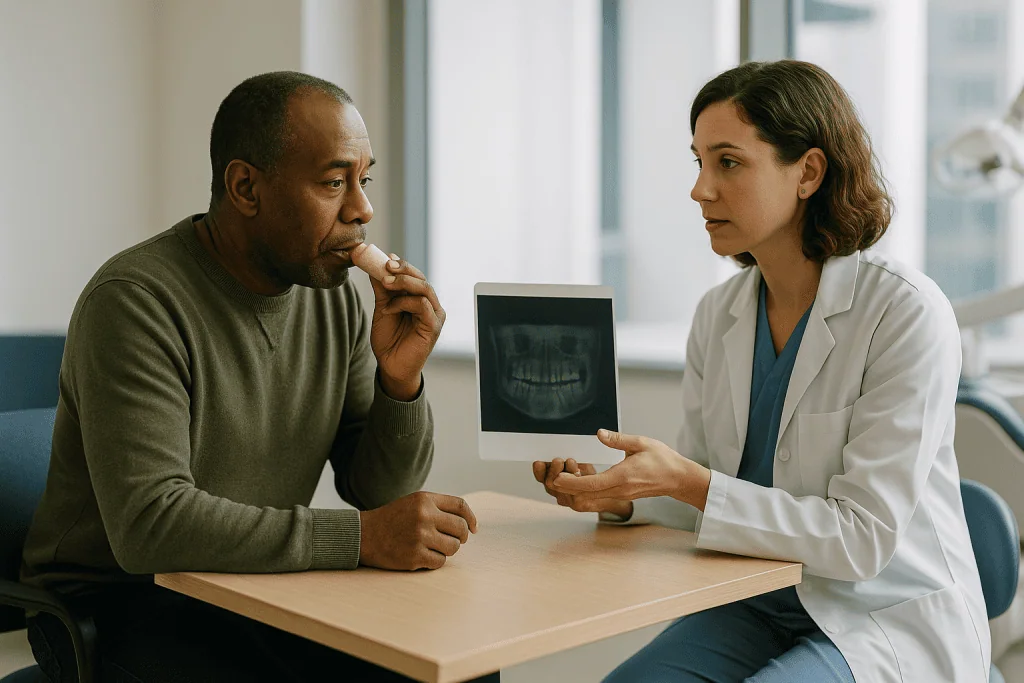
Here is where honest disagreement begins. Bone loss after tooth extraction is a continuum, not a switch. One clinician may see a ridge that is narrow but workable with a slimmer or shorter implant. Another may see the same ridge and prefer to rebuild width first so that a standard implant sits fully in bone with a thick layer covering it. Both are defensible. Mayo Clinic notes that minor grafting can sometimes be done at the same time as implant placement, while larger grafts need several months of healing before an implant can go in.
Training and habit matter too. Surgeons who place many implants in compromised bone tend to graft more readily; general dentists placing straightforward cases may prefer to work with what exists. Neither approach is a red flag on its own.
What should prompt questions is a graft recommendation with no measurement behind it. Ask how much bone height and width exists at the site, what the minimum is for the implant proposed, and what would happen if the graft were skipped. A clear, numbers-based answer tells you the recommendation rests on your anatomy rather than on routine.
Is a bone graft for dental implants necessary? What the evidence supports
Sometimes yes, sometimes no, and the evidence is clearer at the extremes than in the middle. Where bone is plainly insufficient, particularly in the upper back jaw near the sinus, grafting or a sinus lift (a procedure that raises the sinus membrane and adds bone beneath it) is the standard route to a stable implant. Where bone is ample, adding graft material offers no clear benefit and adds a healing phase, a second surgical site, and its own small risks of infection or graft loss.
The middle ground is genuinely uncertain. Cleveland Clinic describes grafting as something “some people” need before implants, language that reflects a case-by-case judgment rather than a rule. Shorter and narrower implants have widened the range of ridges that can be treated without grafting, but long-term comparisons between grafted standard implants and non-grafted shorter implants are still evolving, and no single approach has been shown superior across all situations.
A second opinion is most valuable precisely in this gray zone. Questions worth raising with either clinician:
- Is the graft being proposed for function, for appearance of the gum line, or for both?
- How thick will the bone be around the implant after each plan, and does that difference matter for a molar versus a front tooth?
- What is the fallback if the graft does not take?
An appearance-driven graft in the smile zone is a legitimate recommendation, but it is a different kind of recommendation from one that keeps an implant from failing, and you are entitled to know which you are being offered. When two clinicians disagree, the disagreement is often about this distinction rather than about anatomy.
How many implants do I need? Why the count changes for the same mouth
Implant count is the second most common source of conflicting plans. For a single missing tooth, the answer is usually one implant and one crown. For a span of several missing teeth, the choices multiply: one implant per tooth, or fewer implants supporting a bridge (a connected row of replacement teeth resting on two or more posts). For a full arch with no remaining teeth, Cleveland Clinic and Mayo Clinic both describe fixed bridges or dentures held by a small number of implants as established options alongside individual implants.
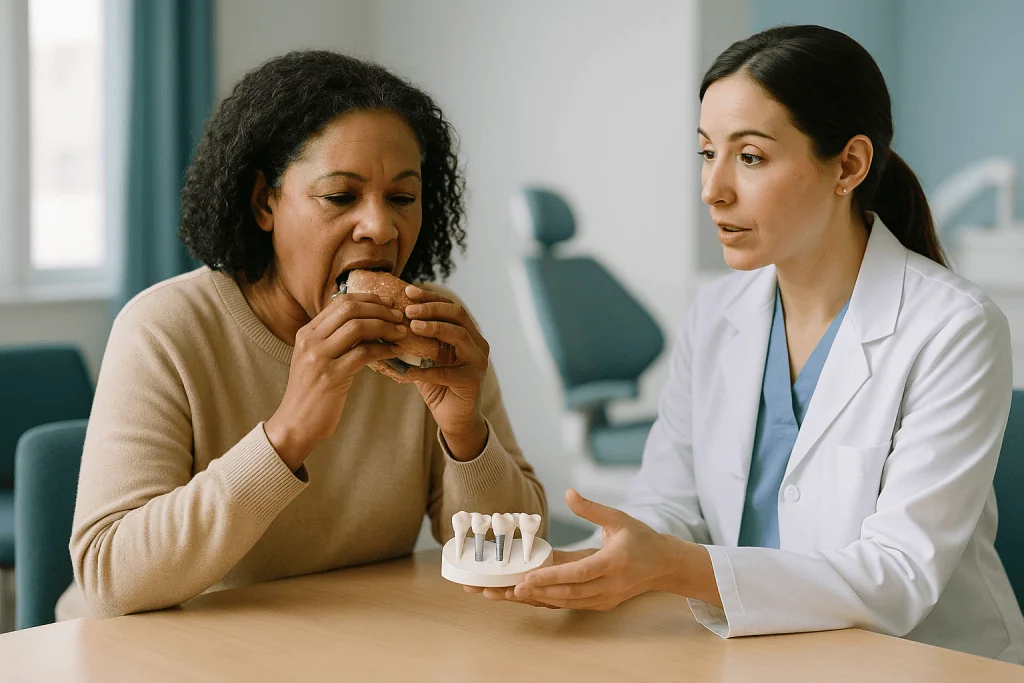
Why would two dentists propose different counts? Bite force is one reason. Back teeth take more load than front teeth, and a clinician worried about long-term stress on the posts may add an implant. Bone distribution is another; if bone is thin in one spot, spreading load across more posts elsewhere may avoid a graft there. Cost and complexity pull the other way, and a clinician may reasonably favor fewer implants when the biology allows.
Maintenance is a factor patients rarely hear about. More implants mean more surfaces to clean and more places where peri-implantitis, an inflammatory disease of the tissue around an implant similar to gum disease, can take hold. Fewer implants carry fewer cleaning demands but concentrate load.
Ask each clinician to explain the count in terms of these trade-offs. A plan that says “we always place four” or “one per tooth, always” deserves the same scrutiny as a graft recommendation without measurements. The right count is the one that matches your bone, your bite, and your ability to keep the area clean over decades, and the reasoning should be specific to you.
Signs it is time for a second opinion before dental implant surgery
Most people who seek a second view do so because something in the first consultation felt incomplete rather than wrong. That instinct is worth trusting when it attaches to specifics. The following situations commonly justify another assessment:
- Two plans for the same site differ on whether grafting is needed or on how many implants are proposed, and neither dentist has explained the difference in terms you can repeat back.
- Extractions of teeth you consider healthy are recommended without a clear diagnosis for each tooth.
- No 3D scan has been taken for a plan involving the upper back jaw, the lower back jaw near the nerve, or a full arch.
- Gum disease has not been discussed even though you have bleeding, receding, or loose teeth. NIH’s dental research institute notes that periodontal disease destroys the bone that supports teeth, and untreated disease undermines implants too.
- Medical conditions that affect healing, such as diabetes, prior radiation to the jaw, or medicines that slow bone turnover, have not been asked about.
- You are being asked to commit to the entire plan at the first visit.
A second opinion is also reasonable when nothing is wrong but the stakes are high. A full-arch reconstruction is major, largely irreversible surgery, and asking a second surgeon to look is proportionate to that.
You do not need to justify the request to your first dentist, though telling them is courteous and practical; they can forward the scan and plan, and most clinicians would rather a patient ask than proceed unconvinced. If a dentist reacts to the request with pressure or irritation, that reaction is itself information.
Who is usually a candidate, and who is usually asked to wait
Mayo Clinic describes a suitable implant candidate as someone with healthy oral tissues, enough bone to secure the implant or the ability to have a graft, no health conditions that would impair bone healing, and a willingness to commit to a process that can take many months. Most adults with a missing tooth fit that description, and age alone is not a barrier once jaw growth is complete.
Being asked to wait is different from being turned away, and a good second opinion will make that distinction clear. Common reasons for a pause:
- Active gum disease. Treating and stabilizing it first protects the implant site and the neighboring teeth.
- A recent extraction. Sockets need time to fill with bone unless an immediate placement is planned and the anatomy allows it.
- Poorly controlled diabetes or other conditions that affect healing, until the medical team considers them stable.
- Smoking. CDC lists smoking as a major risk factor for gum disease and impaired healing, and many surgeons ask patients to stop before and after surgery.
- Certain medicines that affect bone remodeling. Your prescribing clinician and your surgeon should confer; do not change any medicine on your own.
- Radiation to the jaw for head and neck cancer, which changes bone blood supply and requires specialist planning.
Children and adolescents are usually asked to wait until jaw growth is finished, because an implant placed in a growing jaw does not move with the surrounding teeth.
When a first plan skips over any of these and a second clinician raises them, that is not a contradiction to be resolved by choosing a side. It is a gap that needs filling before either plan proceeds, and the treating team should decide when the conditions are right.
Comparing two implant plans side by side
When plans conflict, laying them out in parallel makes the real differences visible and stops the conversation from being about personalities. The table below shows the kind of comparison a second-opinion visit should let you complete. Fill it in with your own numbers; if a clinician cannot supply a figure, that blank is a question to ask.
| Element | Plan A (example) | Plan B (example) | What to ask |
|---|---|---|---|
| Imaging used | Panoramic X-ray only | Cone-beam CT | Was 3D bone volume measured at the site? |
| Bone graft | Sinus lift plus ridge graft | None; shorter implant | What bone height and width exist now, and what is the minimum for each implant? |
| Implant count | Two | One | How is chewing load distributed in each plan? |
| Staging | Graft, heal, place, heal, restore | Place and heal, then restore | How many surgical visits, and how many months of healing between each? |
| Main risks named | Sinus complications, graft loss | Implant instability, less bone margin | Which risk does each clinician consider more important, and why? |
| Fallback if it fails | Regraft and retry | Graft and retry | Is the fallback for one plan the starting point of the other? |
Notice what the table leaves out: cost, and any claim about which plan “works better.” Both are deliberate. Cost belongs in a separate conversation with the practice and your insurer, and neither plan can promise an outcome. What the comparison does reveal is whether each recommendation is anchored to measurements and to a stated risk preference. A plan that fills every row with specifics is easier to trust than one that does not, whichever direction it points.
What the days and weeks after implant surgery usually look like
Whatever plan you choose, the timeline has the same shape: surgery, quiet healing, then restoration. Mayo Clinic describes the whole process as taking many months, most of it waiting for bone to grow around the implant.
In the first few days, Mayo Clinic lists the usual discomforts as swelling of the gums and face, bruising, minor bleeding, and pain at the site. Soft foods, ice for swelling, and gentle cleaning around the area are the standard advice. Your surgeon will discuss pain relief and, if needed, an antibiotic; the choice, the amount, and the duration belong to the prescribing clinician, and this article gives none of those details.
Over the following weeks, osseointegration takes over. That is the term for bone cells growing onto the implant surface and locking it in place. Cleveland Clinic describes this phase as lasting several months. Nothing visible happens, which is why people find it the hardest part: the mouth feels normal, yet the surgeon asks you to avoid loading the site.
If a graft came first, add a separate healing period before implant placement. Mayo Clinic notes that a significant graft may need several months to mature before the implant can be placed, which is why grafted plans span longer.
A second opinion should include a realistic calendar for each plan. Compare the number of surgical episodes and the total span, and ask what you will be wearing in the gap. A temporary tooth or denture is usually available, but the type differs, and for a front tooth this practical detail can matter more to daily life than any other difference between the plans.
Second-stage surgery and the healing cap: what actually happens
Many implant plans involve two surgical stages, and the second is the one people ask about most. Mayo Clinic explains that once the implant has fused with bone, a small procedure reopens the gum to attach the abutment, the connector piece on which the crown will sit. Some surgeons attach the abutment at the first surgery so that it sits above the gum line during healing; others prefer to cover the implant fully and return later. This is another point where plans can legitimately differ.
The second-stage procedure is usually brief and done under local anesthetic. Mayo Clinic describes it as a minor outpatient step: a small incision, placement of the abutment, and closing the gum around but not over it. Discomfort afterward is typically less than after the initial placement because no bone is being drilled, though the gum is tender for a few days and there may be mild swelling.
After the gum settles around the abutment, impressions or digital scans are taken for the crown. Cleveland Clinic notes that the final restoration is fitted once the tissue has healed, adding a further interval to the overall timeline.
For someone comparing two plans, the relevant questions are whether a second surgery is planned at all, how the temporary tooth is handled between stages, and who makes the final crown. When one clinician proposes a single-stage approach and another a two-stage approach, ask each what they gain by their choice. Single-stage saves a visit; two-stage protects the healing implant from disturbance. Neither is inherently better, and the choice often depends on how stable the implant felt at placement, which only the surgeon in the room can judge.
Can a failed dental implant be redone?
Often, yes, though “redone” hides a sequence of steps and a cause that has to be found first. Implant failure has two main patterns. Early failure means the implant never fused with bone, usually noticed as looseness or persistent pain in the first months. Late failure means an implant that worked for years loses its bone support, most often through peri-implantitis, the inflammatory disease of the surrounding tissue. Mayo Clinic notes that if bone does not fuse sufficiently, the implant is removed, the site is cleaned, and another attempt can be made after healing, typically around three months later.
Why the cause matters: an implant that failed because of infection, smoking, uncontrolled diabetes, or excessive bite force will likely fail again if the same conditions persist. A second opinion on a failed implant should therefore look beyond the site itself. Ask what the reviewing clinician believes caused the failure and what would change the second time.
Bone is the other constraint. Removing a failed implant leaves a defect, and the second attempt may need grafting even if the first did not. This is a situation where a graft recommendation that seemed optional before becomes harder to avoid.
Alternatives deserve honest airing at this stage. A bridge on neighboring teeth or a removable partial denture is a legitimate option, especially where bone is poor or a medical condition has changed. A good second opinion presents these without judgment.
Nobody can promise the second implant will hold. What a careful team can do is identify what went wrong, correct what is correctable, and set expectations that reflect your specific situation rather than averages.
What people often get wrong about a dental implant second opinion
Several assumptions get in the way of using a second opinion well.
The second opinion is the correct one. Recency is not accuracy. The second clinician has the advantage of seeing the first plan, but their judgment is subject to the same variation. Treat both as expert views and weigh the reasoning behind each.
Disagreement means someone is incompetent. As the sections above show, graft thresholds and implant counts sit in zones where evidence supports more than one approach. Two good dentists can differ.
Less treatment is always better. Skipping a graft avoids surgery now but may leave an implant with thin bone around it; the trade-off is real in both directions.
More treatment is always safer. Extra grafts and extra implants add healing time, surgical sites, and cleaning demands. Overtreatment is a recognized concern in implant dentistry, not a myth.
Implants are maintenance-free. Cleveland Clinic and MedlinePlus both stress that implants need the same daily cleaning and professional check-ups as natural teeth, and that gum disease around an implant can cause bone loss just as it does around a tooth.
You must tell the first dentist everything the second said. You can, and it often helps, but the goal is your understanding, not a debate between practices.
Asking is rude. Second opinions are routine in medicine and dentistry. Clinicians who are confident in their plan tend to welcome them.
Online forums can settle it. Other people’s jaws are not yours. Forum accounts can suggest good questions, but they cannot see your scan, and reassurance or alarm from strangers is not evidence.
Questions to ask your care team at either consultation
The quality of a second opinion depends heavily on the questions you bring. These are the ones that tend to expose the real reasoning behind graft advice and implant counts.
- What measurements from my scan led you to recommend, or not recommend, a bone graft at this site?
- If a graft is proposed, is its purpose primarily to hold the implant, to shape the gum line, or both?
- Which implant length and width are you planning, and how much bone will surround it on each side?
- Why this number of implants for this span? What would change if there were one more or one fewer?
- Are any of my remaining teeth being extracted, and what is the diagnosis for each?
- Do I have any gum disease that should be treated before implants, and how will you check?
- Which of my medical conditions or medicines could affect healing, and have you spoken with my physician?
- How many surgical visits are involved, and how long is each healing gap likely to be in my case?
- What will I wear in the gaps, and how will it look and function?
- What are the specific risks of this plan for me, including nerve injury, sinus involvement, and infection?
- What is your plan if the graft does not take or the implant does not integrate?
- Who will make the crown, and who do I call if something feels wrong afterward?
- Would you be comfortable if I took this plan and my scan to another clinician for review?
Write the answers down or ask permission to record them. When you place the two sets of answers next to each other, the differences that matter usually become clear without anyone having to be declared right or wrong.
When to call your doctor
Most implant recovery is uneventful, but some signs need prompt attention from the surgeon who placed the implant or, if they are unavailable, from an urgent dental or medical service. Do not wait for a scheduled review if you notice any of the following after implant, graft, or second-stage surgery:
- Bleeding that does not slow with firm pressure on clean gauze, or that restarts heavily after the first day.
- Swelling that keeps increasing after the second or third day, spreads toward the eye or neck, or makes swallowing or breathing difficult. Difficulty breathing is an emergency; call emergency services.
- Fever, chills, or a spreading area of redness and heat over the jaw.
- Pain that worsens rather than eases after the first few days, or pain that is not controlled by what your surgeon advised.
- Numbness or tingling of the lip, chin, or tongue that persists beyond the expected wearing-off of the anesthetic, which may indicate nerve involvement and needs prompt assessment.
- A loose, moving, or visibly exposed implant, or a graft membrane or bone particles coming away from the site.
- Clear or bloody fluid from the nose after upper-jaw surgery, or air passing between mouth and nose, which can signal sinus communication.
- Pus, a persistent bad taste, or a gum that looks purple or grey around the site.
Months or years later, bleeding when brushing around the implant, gum recession exposing metal, or a crown that feels loose are reasons to book a review rather than wait, because peri-implantitis is easier to manage early. Whatever the timing, the decision about what to do next belongs to the treating team, and calling early costs nothing but a phone conversation.
Bringing two opinions back to one decision
At some point the folders have to close. The aim of the whole exercise was never to find a winner but to reach a plan you can explain to yourself, and there are a few ways to get there.
Look first for convergence. Even conflicting plans usually agree on the fundamentals: that gum disease must be stable, that bone volume determines implant size, that healing takes months. Whatever both clinicians agree on is your firmest ground.
Then locate the disagreement precisely. Is it about anatomy (how much bone exists), about threshold (how much bone is enough), or about preference (appearance, staging, fewer surgeries)? Anatomy disputes can often be resolved by sharing the same 3D scan. Threshold disputes reflect genuine scientific uncertainty, and you may legitimately choose the approach whose risk profile you prefer. Preference disputes are yours to decide.
Consider a third conversation, not necessarily a third opinion. Many people find that returning to one clinician with the other’s plan produces a clearer explanation than either first visit did. A dentist who says “yes, that is also a reasonable approach; here is why I lean the other way” is giving you exactly what a second opinion is for.
Finally, remember what no plan can offer. No clinician can promise that an implant will integrate, that a graft will take, or that a crown will last a stated number of years. What they can offer is a plan anchored to your measurements, honest about its trade-offs, and backed by a team that will answer the phone if something changes. Choose that, and let the treating team carry the decision from there.
Frequently asked questions
Is a second opinion before dental implant surgery worth the extra visit?
Usually yes when plans conflict or the treatment is extensive. Implant surgery is largely irreversible, and a second assessment either confirms the plan or surfaces an alternative or an overlooked factor such as gum disease. The visit is most useful if you bring your scan and written plan so both clinicians are working from the same evidence.
Is a bone graft for dental implants necessary in every case?
No. Grafting is recommended when bone is too thin or soft to hold an implant securely, and it is unnecessary when bone is ample. In between lies a gray zone where shorter or narrower implants may avoid a graft, and reasonable clinicians differ. Ask for the bone measurements behind the recommendation.
How many implants do I need for several missing teeth?
It depends on the span, the bite forces in that part of the mouth, bone distribution, and how much cleaning you can manage. Options range from one implant per tooth to fewer implants supporting a bridge. A plan that explains the count in terms of these trade-offs is more trustworthy than one based on a fixed formula.
Can a failed dental implant be redone?
Often, yes. Mayo Clinic describes removing an implant that has not fused, cleaning the site, and attempting again once the bone has healed. Success the second time depends on finding and correcting the cause, whether infection, smoking, medical factors, or bite overload, and the site may now need grafting.
Will dental insurance pay for a second opinion?
Coverage varies by plan and by country. Some policies treat a consultation and imaging review as a covered examination; others limit the number of examinations per year or exclude specialist visits. Contact your insurer before booking and ask what documentation the second clinician will need to submit. Practice staff can usually help with the wording.
How painful is the second stage of a dental implant?
Generally less uncomfortable than the initial placement. Mayo Clinic describes the second stage as a minor procedure under local anesthetic to reopen the gum and attach the abutment; no bone is drilled. Gum tenderness and mild swelling for a few days are typical. Your surgeon will advise on pain management for your situation.
What does no one tell you about dental implants?
Mostly that the waiting is the hard part and that maintenance never ends. Bone fusion takes months of doing nothing visible, temporary teeth vary in how they look and feel, and implants need daily cleaning and regular professional checks because the surrounding tissue can develop inflammation and bone loss much like gum disease.
Should I tell my first dentist that I am getting a second opinion?
It is courteous and practical, though not required. Your first dentist can forward the scan and plan, saving you a repeat X-ray. Most clinicians support second opinions, and a confident plan is easy to defend. If the request meets pressure or irritation, factor that into your decision.
What if the second dentist recommends more treatment than the first?
More is not automatically safer, just as less is not automatically better. Ask what specific finding or risk drives each added element, whether it is for function or appearance, and what happens if it is omitted. If the added treatment addresses something the first plan missed, such as gum disease, that is different from a preference for grafting.
Can I use online forums to judge which implant plan is right?
Forums can suggest good questions and show the range of experiences, but they cannot see your scan or examine your gums, so they cannot judge your plan. Treat them as a source of questions to bring to a qualified clinician rather than as evidence for one option over another.
References
This article is for general information only and is not a substitute for professional medical advice. Please consult a qualified doctor about your individual situation.

More from the Blog
Zygomatic Implant Complications Explained: Sinus Problems, Gum Recession and Screw Loosening
Zygomatic implants anchor into the cheekbone rather than the upper jaw, so their complications differ from standard implants. The most frequently reported problem in…
Smoking and Dental Implants: The Pre-Surgery Facts Every Smoker Should Know
Smokers can get dental implants, but the odds shift against them: pooled studies show implant failure roughly twice as often in smokers, with reported…

E-Max Crown Treatment Step by Step: Minimal Tooth Preparation, Scanning and Bonding Explained
The e max crown procedure typically involves an examination and X-rays, conservative reshaping of the tooth, a digital scan or impression, fabrication of a…

Dental Implants With Bone Loss: Grafts, Zygomatic Options and Realistic Paths
Bone loss rarely rules out dental implants entirely. Depending on how much bone remains, options include bone grafting, sinus lifts, ridge augmentation, shorter or…

How Long Does Full Mouth Reconstruction Take? Phases, Healing Gaps and Temporary Teeth
Full mouth reconstruction usually unfolds over several months to more than a year rather than in a single procedure. Planning takes weeks, gum and…

Zirconium Crown Problems: A Bite That Feels High, Sensitivity and Gum Irritation Explained
Most zirconium crown problems fall into three groups: a bite that feels high because the crown sits a fraction too tall, sensitivity because the…