

Zygomatic Implant Complications Explained: Sinus Problems, Gum Recession and Screw Loosening
Key Takeaways
- Zygomatic implants anchor in the cheekbone rather than the shrunken upper jaw, which is why their complications involve the sinus and palate rather than the jaw alone.
- Systematic reviews identify sinusitis as the single most frequently reported zygomatic implant complication, appearing anywhere from weeks to years after surgery.
- In pooled data on more than 4,000 zygomatic implants, most failures occurred within the first six months, making early symptoms the most important to report.
- Screw loosening is a prosthetic problem fixed at the chairside; it does not mean the implant has failed, but ignoring it overloads the remaining components.
- Gum recession around the implant neck reflects thin palatal tissue, pressure or plaque, and is usually managed by adjusting the bridge and cleaning routine rather than removing the implant.
- Active sinus disease, heavy smoking, uncontrolled diabetes and certain bone-turnover medicines are the usual reasons a team asks a patient to wait or reconsider.
Zygomatic implants anchor into the cheekbone rather than the upper jaw, so their complications differ from standard implants. The most frequently reported problem in systematic reviews is sinusitis, because the implant passes beside or through the maxillary sinus. Gum recession around the implant neck, loosening of prosthetic screws, infection and rare loss of integration also occur. Most issues are manageable when reported early to the surgical team.
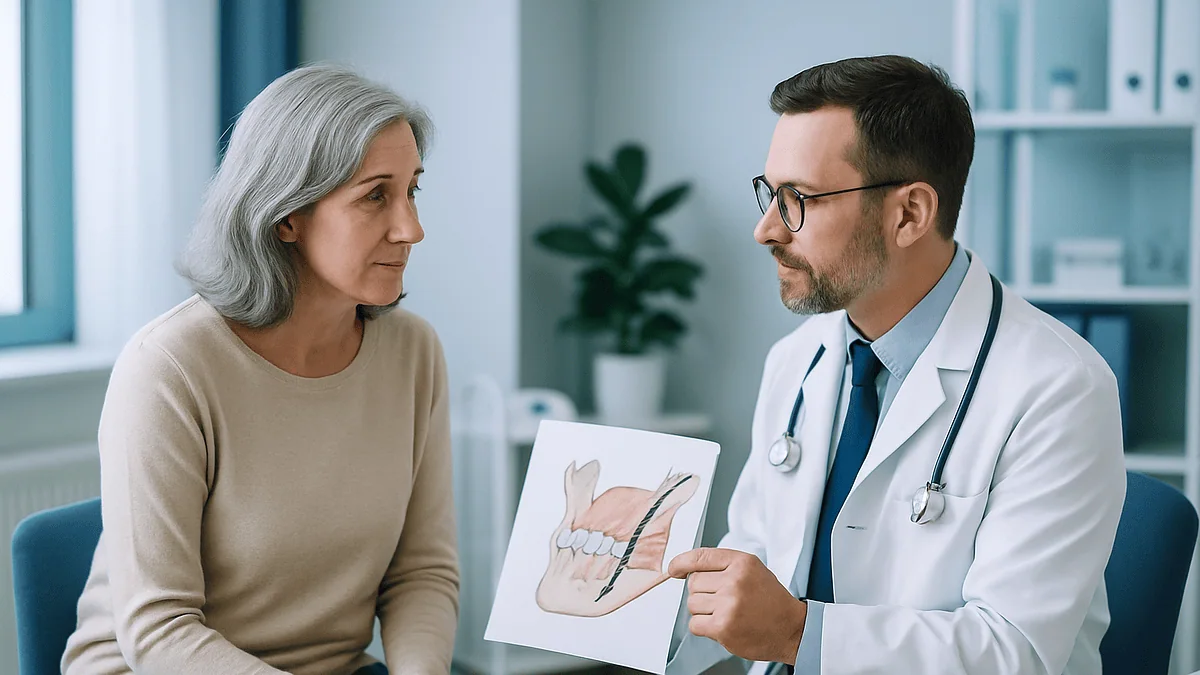
The X-ray on the screen showed almost nothing where bone should have been. Years of wearing an upper denture had quietly hollowed out the jaw, and the surgeon was explaining a different kind of anchor: a long implant reaching up past the sinus into the cheekbone. The patient’s first question was not about how it works. It was about what could go wrong.
That is a fair question, and the honest answer takes more than a sentence. Zygomatic implant complications are real, they are well documented, and they are not the same as the problems people read about with ordinary dental implants. The sinus sits right next door. The gum over the implant neck is thin. The screws that hold a full-arch bridge work hard every time you chew.
This explainer walks through what the evidence actually shows about sinus trouble, gum recession and screw loosening, what recovery usually looks like, and when a symptom deserves a same-day call rather than a wait-and-see.
What is a zygomatic implant and how does it actually work?
A zygomatic implant is an unusually long titanium implant that passes through or alongside the upper jaw and screws into the zygoma, the cheekbone. Ordinary dental implants are short posts that sit entirely within the jawbone; a zygomatic implant may be four to five times longer, because the jaw it is bypassing no longer has enough bone to hold anything.
The idea is borrowed from a simple engineering principle. When the ground floor is too weak, you anchor to a stronger structure above it. The cheekbone is dense, does not shrink after tooth loss the way the jaw does, and sits in a predictable position. The surgeon drills a channel from inside the mouth, angles it upward and outward, and threads the implant so that its tip bites into the zygoma while its head emerges near the roof of the mouth where a bridge can attach.
Osseointegration, the process by which living bone grows onto the implant surface and locks it in place, still has to happen. What differs is where. With a standard implant, integration occurs along its whole length in the jaw. With a zygomatic implant, meaningful anchorage comes mostly from the cheekbone segment, which is why the technique tolerates a severely resorbed maxilla, the medical term for a shrunken upper jaw.
Because the head of the implant sits toward the palate and the shaft runs beside the maxillary sinus, two anatomical neighbors become part of the story: the sinus lining and the thin gum over the implant neck. Most of the specific problems described in the literature, from sinusitis to soft-tissue recession, trace back to that path. The original long-term series describing the method followed patients for 5 to 10 years and set the pattern for how these implants are placed and monitored (Brånemark et al., 2004).
Why zygomatic implant complications differ from standard implant problems
Standard implant problems tend to be local: a small pocket of infection around one post, a crown that chips, an implant that never integrates and is simply removed. Zygomatic implant complications tend to involve neighboring structures, because the implant travels a longer and more crowded route.

Three differences matter most. The first is proximity to the sinus. The maxillary sinus is an air-filled cavity behind the cheek, lined with a delicate membrane. A zygomatic implant may pass directly through it or sit against its outer wall. If that lining is disturbed, or if a small opening between mouth and sinus fails to seal, sinus symptoms can follow. Systematic reviews consistently report sinusitis as the single most frequent complication of zygomatic implants (Chrcanovic et al., 2016).
The second is the position of the implant head. Emerging near the palate means the surrounding gum is often thinner and more mobile than the tissue around a conventional implant, which makes recession and inflammation around the neck more likely to be noticed.
The third is mechanics. Zygomatic implants are almost always part of a full-arch fixed bridge, often combined with a few conventional implants at the front. A long, angled implant supporting a heavy prosthesis experiences leverage that a short vertical post does not. Screws that connect the bridge to the implant can work loose under that load if the fit is imperfect or the bite is heavy.
None of this makes the procedure inherently unsafe. It does mean that the questions a patient should ask, and the symptoms worth reporting, are different. A blocked nose, a change in how the bridge feels when you bite, or a sore spot on the palate deserve attention that a similar symptom after a single front-tooth implant might not.
Who is usually offered zygomatic implants, and who is asked to wait
The typical candidate has an upper jaw that has lost so much bone that conventional implants would have nothing to grip, and either cannot have or does not want extensive bone grafting. Long-term denture wear, advanced gum disease, trauma, or surgery for a tumor are the common paths there (Aparicio et al., 2014). A three-dimensional scan called cone-beam CT, which produces a detailed image of the jaw, sinus and cheekbone, is used to confirm that the zygoma itself is healthy and thick enough.
Some people are asked to wait or to consider a different route. Active sinus disease is the most important reason, because placing an implant beside an already inflamed sinus raises the risk of the very complication surgeons work hardest to avoid; an ear, nose and throat assessment may be requested first. Uncontrolled diabetes, heavy smoking and untreated gum disease around any remaining teeth are also common reasons to pause, since each slows healing and feeds infection.
Medicines that alter bone turnover deserve a specific conversation. Bisphosphonates and some other bone-strengthening drugs work by slowing the cells that break down bone; that same mechanism can impair the jaw’s ability to heal after surgery. Anyone taking them, or who has had radiotherapy to the head and neck, needs the surgical team and the prescribing doctor to weigh the timing together. No one should stop or alter such a medicine on their own.
Age by itself is rarely a barrier. What the team is really assessing is whether bone, sinus and general health give the implant a fair chance to integrate, and whether the person can manage the daily cleaning a full-arch bridge demands. Those judgments belong to the treating team, who see the scan and the whole medical history.
Zygomatic implant complications at a glance
Complications cluster into a handful of recognizable patterns. The table summarizes what each one is, roughly when it tends to appear, and what the surgical team usually looks at. Timing is drawn from the pattern described in systematic reviews, not a schedule anyone can promise (Chrcanovic and Abreu, 2013; Chrcanovic et al., 2016).
| Complication | What it is | When it tends to show | What the team typically checks |
|---|---|---|---|
| Sinusitis | Inflammation or infection of the maxillary sinus lining | Weeks to years after placement; the most reported complication | Symptoms, nasal exam, CT of the sinus, seal around the implant |
| Oroantral communication | A small persistent opening between mouth and sinus | Early weeks, sometimes later | Air or fluid passing between nose and mouth, imaging |
| Soft-tissue recession | Gum shrinking back from the implant neck near the palate | Months onward | Tissue thickness, exposed threads, cleaning access |
| Screw loosening | Prosthetic or abutment screw losing tightness | Any time after the bridge is fitted | Bridge movement, bite balance, screw fit |
| Peri-implant infection | Inflammation in gum and bone around the implant | Months onward | Bleeding, pus, pocket depth, X-ray bone level |
| Loss of integration | Implant never bonds, or bond fails | Most within the first six months | Mobility, pain on loading, imaging |
Two points stand out. Sinus-related problems dominate the list, which is why so much of a good consultation is spent on the sinus. And outright implant failure, when it happens, tends to happen early, so the first months carry more of the risk than the years that follow.
Zygomatic implants and sinus infection: how the sinus becomes involved
The maxillary sinus is lined by a thin membrane that produces mucus and sweeps it toward a natural drainage opening near the nose. Anything that irritates that lining, blocks drainage or lets bacteria in from the mouth can set off sinusitis, which simply means inflammation of the sinus. Symptoms of sinusitis in general include facial pressure, a blocked or runny nose, reduced sense of smell and post-nasal drip (Cleveland Clinic, sinusitis).
A zygomatic implant can involve the sinus in several ways. During placement, the membrane may be lifted or torn where the drill passes. If the seal between the mouth and the sinus around the implant head does not fully heal, a tiny channel called an oroantral communication remains, letting saliva and oral bacteria reach the sinus. And the implant shaft itself, if it sits inside the sinus cavity, can become a surface where bacteria gather.
Systematic reviews are consistent that sinusitis is the most frequently reported zygomatic implant complication, appearing anywhere from the early weeks to several years after surgery (Chrcanovic et al., 2016). Some cases are mild and settle with the kind of medical treatment used for sinusitis from other causes; others are persistent and need an ear, nose and throat specialist to restore drainage or seal the opening. In a minority, the implant is removed.
Newer surgical approaches try to keep the implant outside the sinus wall wherever the anatomy allows, precisely to reduce this risk, and the technique has evolved considerably since the original description (Aparicio et al., 2014). Whether that is possible depends on the shape of an individual’s cheekbone and jaw, which is one reason the pre-operative scan matters so much.
Symptoms on one side only, a bad taste that keeps returning, or the sensation of air moving between mouth and nose when you drink are the signals surgeons ask patients to report promptly. Left alone, a chronic sinus infection is harder to treat and can undermine the implant.
Gum recession and thinning soft tissue around the implant neck
Gum recession around a zygomatic implant looks different from the recession people picture around a natural tooth. Because the implant head usually emerges toward the palate, the tissue covering it is often thin, and as it settles after surgery it can shrink back to expose the polished neck of the implant or, in some cases, the first few threads.
Why does this matter? Exposed metal near the palate is a magnet for plaque and is awkward to clean beneath a fixed bridge. Inflamed, receding tissue makes a shallow trough that traps food. Over time that inflammation can extend to the bone around the implant, a condition called peri-implantitis, which is inflammation that destroys the supporting bone around an implant. Soft-tissue problems are among the complications catalogued in the zygomatic literature, alongside sinusitis and prosthetic issues (Chrcanovic and Abreu, 2013).
Several factors push the tissue in the wrong direction. Thin gum to begin with, a bridge that presses too hard on the palate, poor access for brushing, and smoking all contribute. Smoking is particularly unhelpful because nicotine narrows small blood vessels, starving the healing tissue of oxygen.
Managing recession is usually a matter of adjustment rather than crisis. The team may reshape the underside of the bridge to relieve pressure and open cleaning access, coach a different brushing technique using interdental brushes or a water flosser, and monitor the site at each review. Where tissue has receded significantly, a small grafting procedure to thicken the gum may be discussed. Removing the implant for recession alone is uncommon.
What patients notice first is often not the recession itself but its consequences: a sore patch on the palate, persistent bad breath despite good brushing, or bleeding when the area is cleaned. Those are worth mentioning at the next visit rather than waiting for a scheduled check.
Why do zygomatic implant screws loosen?
A full-arch bridge on zygomatic implants is held on by small screws, and there are two kinds. Abutment screws connect a small intermediate component to the implant itself; prosthetic screws fasten the bridge to those abutments. When a screw loosens, the bridge may feel slightly mobile, click when chewing, or develop a sore or smelly gap where food packs in.
Loosening is fundamentally a mechanics problem. A screw stays tight because it is stretched slightly when tightened to a specified torque, the twisting force applied by a calibrated wrench, and that stretch clamps the parts together. Chewing forces try to undo that clamp thousands of times a day. On zygomatic implants the leverage is greater than usual because the implants are long, angled and support a large prosthesis. A bite that hits harder on one side, night-time grinding, or a bridge that does not sit perfectly passively on its abutments all magnify the effect.
Prosthetic complications, including screw loosening and fractures of the bridge or its components, are a recurring category in reviews of zygomatic implant outcomes (Chrcanovic et al., 2016). They are also, in most cases, the least serious category. A loose screw is typically re-tightened or replaced at a chairside visit; a worn screw is swapped for a new one.
What patients should not do is ignore it. A bridge rocking on a loose screw concentrates force on the remaining tight screws and on the implants themselves, and can allow bacteria into the gap between components. Some teams schedule periodic checks specifically to confirm screw tightness, and many recommend a night guard for people who clench or grind. Whether either applies is a decision for the prosthodontist who fitted the bridge.
Zygomatic implant failure signs: infection, peri-implantitis and loss of integration
Implant failure means the implant has not bonded to bone, or the bond has broken down, and it must be removed. Recognizing the warning signs early gives the team the best chance to intervene before that point.
Early failure is the more common pattern. In pooled data from more than 4,000 zygomatic implants, most failures occurred within the first six months after placement, when osseointegration was still forming (Chrcanovic et al., 2016). Signs during this window include pain that worsens rather than eases in the second or third week, a bridge that feels newly mobile, pus or a persistent bad taste from the implant site, or fever.
Late problems are usually driven by infection. Peri-implantitis begins as inflamed gum around the implant and, if unchecked, dissolves the supporting bone. Around a zygomatic implant, that bone is the thin shelf of jaw near the palate; the deeper anchorage in the cheekbone may keep the implant stable even while the neck becomes unhealthy, which is why regular X-rays and probing at reviews are part of long-term care. Sinus infection can also travel along the implant and threaten integration at the zygoma end.
Signs the team asks people to watch for over the long term:
- Bleeding or pus when brushing around the implant heads
- A dull ache in the cheek or under the eye on one side
- Recurrent sinus symptoms on the implant side
- Any change in how the bridge fits or feels when biting
Failure of one zygomatic implant does not always mean the whole bridge is lost. Depending on how many other implants support the arch, the bridge may be temporarily adjusted while the site heals and a replacement is planned. What that looks like in an individual case is a decision for the surgical and prosthetic team together.
Rarer risks: bleeding, nerve changes and the eye socket
Beyond the three headline problems, the anatomy around the cheekbone carries a short list of rarer risks that any thorough consent discussion should cover.
Bleeding and bruising are expected to a degree after any implant surgery; the cheek may swell and discolor for several days (Mayo Clinic, dental implant surgery). Heavier bleeding is uncommon but possible, since vessels run through the region between the jaw and the cheekbone.
Nerve changes are another. The infraorbital nerve, which carries sensation from the cheek, side of the nose and upper lip, exits the bone just below the eye socket, close to where the implant tip enters the zygoma. Temporary numbness or tingling in that distribution has been reported and usually reflects swelling or stretching rather than a cut nerve; persistent altered sensation is rare (Aparicio et al., 2014).
The eye socket, or orbit, sits directly above the cheekbone. Because the implant is aimed at the zygoma from below, an incorrectly angled drill could in principle breach the orbital floor. This is a recognized, serious and very uncommon complication, and it is the main reason planning relies on three-dimensional imaging and, in many centers, surgical guides or navigation. Any change in vision, double vision, or swelling around the eye after surgery is an emergency-level symptom.
Skin-side problems can also occur. Because the implant runs close to the cheek surface, a small number of people develop a tender area or, rarely, a fistula, an abnormal channel that opens onto the skin of the cheek. These are usually managed by the surgical team once the source of infection is identified.
The purpose of listing these is not to alarm but to make the pre-operative scan and the surgeon’s experience with this specific technique feel like the safeguards they are. They are also good prompts for the questions covered later in this article.
Zygomatic implant recovery time: what the first days and weeks usually look like
Recovery has two overlapping timelines: the surgical wound healing in the mouth and cheek, and the slower, invisible process of bone bonding to the implant.
The first few days resemble recovery from any significant oral surgery. Swelling of the cheek typically peaks around the second or third day, bruising can spread toward the eye and jawline, and the nose on the operated side may feel blocked or produce a little blood-tinged discharge because the sinus lining has been disturbed. Pain, minor bleeding and swelling are the expected after-effects listed for implant surgery generally (Mayo Clinic). Pain relief and any antibiotic are prescribed by the surgical team according to the individual case, and the plan should be followed exactly as written.
Many protocols described in the zygomatic literature attach a provisional fixed bridge within the first day or two, because the anchorage in dense cheekbone is often stable enough to support it immediately (Aparicio et al., 2014). Whether that applies depends on how firmly the implants seated at surgery, which is measured in the operating room. A soft diet for several weeks is standard so that chewing forces stay low while bone integrates.
Sinus precautions are specific to this procedure. Patients are usually asked to avoid blowing the nose forcefully, to sneeze with the mouth open, and to avoid drinking through straws or flying for a period set by the surgeon, all to protect the seal between mouth and sinus while it heals.
Over the following months, the bone remodels around the implant; for conventional implants this integration phase is measured in months rather than weeks (Mayo Clinic), and zygomatic implants follow a similar biological pace. The definitive bridge is usually made once the team is satisfied that healing is complete, on a timeline they set based on healing and imaging, not the calendar.
Living with zygomatic implants: hygiene, smoking, medicines and bone
The implants are placed once; the maintenance lasts for life. Most late complications, from gum recession to peri-implantitis, are shaped by what happens at the bathroom sink and in the review chair.
Cleaning a fixed full-arch bridge is genuinely harder than brushing teeth. Food and plaque collect where the bridge meets the gum, and the implant heads near the palate are out of sight. Teams usually teach a routine combining a soft brush, interdental brushes sized to the gaps, and a water flosser to rinse under the bridge. Periodic professional cleaning, often with the bridge removed so the implant heads can be inspected and cleaned directly, is part of the standard care pathway described for these implants (Aparicio et al., 2014).
Smoking deserves plain language. Nicotine constricts small blood vessels and tobacco smoke impairs the immune cells that keep gum tissue healthy; both slow healing and raise infection risk around any implant. People who smoke are generally advised to stop before surgery and to stay stopped, and a doctor or pharmacist can discuss support for doing so.
Bone health and medicines are the third strand. Drugs that suppress bone turnover, such as bisphosphonates used for osteoporosis, and some cancer treatments, reduce the activity of the cells that remodel bone; that can make the jaw slower to heal after any surgery. Anyone prescribed such a medicine, or starting one after implants are placed, should tell both the prescribing doctor and the dental team, so that timing and monitoring can be coordinated. Decisions about these medicines rest with the prescribing clinician.
Reviews typically include probing around each implant, checking screw tightness, examining the sinus side for symptoms, and periodic X-rays to track bone levels. Attending them is the single most useful thing a patient controls.
Are zygomatic implants safe? What the evidence actually shows
Safety questions deserve numbers, and the numbers deserve context. The best available summary comes from systematic reviews that pool many small studies rather than from any single center’s results.
The updated systematic review by Chrcanovic and colleagues gathered data on more than 4,000 zygomatic implants and reported a cumulative survival rate at 12 years of just over 95 percent, with most failures occurring in the first six months and sinusitis as the most common complication (Chrcanovic et al., 2016). Survival here means the implant was still in place; it does not measure comfort, function or freedom from problems.
That figure needs three caveats. First, most of the underlying studies were small, retrospective and came from experienced surgical units, so real-world outcomes across all settings are not necessarily identical. Second, the studies used different definitions of success, different surgical techniques and different follow-up periods, which limits how precisely they can be combined; the earlier review by the same group made the same point (Chrcanovic and Abreu, 2013). Third, survival of the implant is not the same as absence of complications: an implant can remain firmly in the cheekbone while its owner deals with a recurring sinus infection.
What the evidence supports, stated plainly, is this. Zygomatic implants are an established option for people with a severely resorbed upper jaw, with a documented track record over more than two decades since the original long-term series (Brånemark et al., 2004). Their complication profile is distinctive and dominated by sinus problems. Outcomes appear closely tied to careful case selection, three-dimensional planning and long-term follow-up.
What the evidence does not support is any promise about an individual’s result, or any claim that a particular surgeon, technique or location eliminates the risks. A candid consultation will say the same.
What people often get wrong about zygomatic implant complications
Because zygomatic implants are unfamiliar, myths fill the gap. A few of the most common deserve correction.
“They go into the sinus, so sinus infection is inevitable.” Sinusitis is the most reported complication, but the reviews describe it as a minority experience, not a certainty (Chrcanovic et al., 2016). Placement technique, sinus health before surgery and how quickly symptoms are reported all influence whether it develops and how it resolves.
“If a screw comes loose, the implant has failed.” Screw loosening is a prosthetic problem, not a bone problem. The implant is usually perfectly stable; the fastener holding the bridge needs attention. Confusing the two causes needless alarm.
“Gum recession means the implant is being rejected.” Titanium is not rejected in the way a transplanted organ can be. Recession reflects thin tissue, pressure or plaque, and is managed by adjusting the bridge and the cleaning routine.
“Once they are in, the sinus side of things is finished.” Sinus symptoms can appear years later. A blocked nose or facial pressure on the implant side always merits a mention to the dental team, even long after surgery.
“Complications mean the surgery was done badly.” Some complications relate to technique; many relate to anatomy, healing biology and habits such as smoking. Systematic reviews report complications even in the most experienced hands (Chrcanovic and Abreu, 2013).
“Zygomatic implants replace the need for follow-up.” The opposite is true. A fixed full-arch bridge on angled implants needs more structured maintenance than a set of natural teeth, not less.
Holding the accurate version of each of these makes the whole experience calmer, and makes it easier to tell which symptoms are routine and which need a call.
Questions to ask your care team
A good consultation should leave you able to describe, in your own words, why this option suits your anatomy and what the plan is if a complication occurs. These questions help get there.
- What does my three-dimensional scan show about my cheekbone and sinuses, and are my sinuses healthy enough to proceed now?
- Will the implants pass through the sinus or sit outside its wall in my case, and why?
- How many zygomatic implants and how many conventional implants will support the bridge, and what happens to the bridge if one implant fails?
- Will a provisional bridge be fitted immediately, and what will decide that on the day?
- What sinus precautions should I follow, and for how long?
- Which symptoms in the first weeks should I report the same day, and how do I reach the team out of hours?
- How will gum health around the implant heads be checked at reviews, and what cleaning tools do you recommend I learn to use?
- How often will screw tightness be checked, and should I have a night guard?
- Are any of my current medicines, including bone-strengthening drugs, relevant to healing, and who coordinates that with my prescribing doctor?
- What are the alternatives for me, including bone grafting with conventional implants or a removable prosthesis, and how do their risks compare?
- What is the long-term review schedule, and who provides it if I move?
Write the answers down or bring someone who will. The value of these questions lies less in any single reply than in hearing how the team reasons about your case, which is the best predictor that problems, if they arise, will be handled well. Every decision about whether and how to proceed remains with you and the treating team.
When to call your doctor
Most recovery from zygomatic implant surgery is uneventful, and most later problems announce themselves gently. A short list of signs, however, should prompt a same-day call to the surgical team or, where noted, emergency care.
Call the surgical team promptly if you notice:
- Pain that increases after the third day instead of easing, or pain that returns after settling
- Swelling that grows after the peak of the first few days, or that spreads toward the eye or neck
- Pus, a persistent foul taste, or bleeding around an implant head
- Fluid or air passing between your mouth and nose when drinking or breathing
- Nasal discharge, blockage or facial pressure on one side that persists beyond the early days or appears weeks to years later
- A bridge that moves, clicks or feels different when you bite
- Numbness or tingling of the cheek or upper lip that does not improve over the following weeks
Seek emergency care immediately if you experience any change in vision, double vision, rapidly increasing swelling around the eye, bleeding that does not stop with firm pressure after twenty minutes, difficulty breathing or swallowing, or a high fever with feeling generally unwell. These are uncommon, but they are the situations in which waiting is the wrong choice.
Between those extremes, trust the principle that the team would rather hear about a symptom that turns out to be nothing than learn about a sinus infection or a loosening bridge months later. Early reporting is the factor most within a patient’s control, and the evidence on when failures cluster suggests the first months are the time to be most alert (Chrcanovic et al., 2016).
Frequently asked questions
Are zygomatic implants safe compared with regular implants?
They are an established option with a documented long-term record, but their complication profile differs. Pooled data on more than 4,000 zygomatic implants reported a 12-year cumulative survival just over 95 percent, with sinusitis the most common complication (Chrcanovic et al., 2016). Survival does not equal freedom from problems, and individual outcomes depend on anatomy, sinus health, technique and follow-up, which your treating team assesses.
What are the early zygomatic implant failure signs I should watch for?
Pain that worsens after the third day, a bridge that feels newly mobile, pus or a persistent bad taste, fever, or swelling that grows rather than settles. Most failures in the literature occurred within the first six months, so these signs deserve a same-day call during that period. Later, bleeding or pus at the implant heads and recurring one-sided sinus symptoms are the main warnings.
Can zygomatic implants cause a sinus infection years later?
Yes. Systematic reviews describe sinusitis appearing from the early weeks to several years after placement. A small persistent opening between mouth and sinus, or bacteria colonizing the implant surface inside the sinus, can trigger it long after healing seemed complete. One-sided nasal blockage, facial pressure or a recurring bad taste should be reported to the dental team, who may involve an ear, nose and throat specialist.
How long is zygomatic implant recovery time?
Surgical healing in the mouth and cheek takes days to a few weeks, with swelling usually peaking around the second or third day. Bone bonding to the implant continues for months, as with conventional implants (Mayo Clinic). Many protocols fit a provisional bridge within a day or two if the implants are firm at surgery; the definitive bridge follows once the team confirms healing, on a timeline they set.
Why does the gum recede around zygomatic implants?
The implant head usually emerges near the palate, where gum tissue is thin and mobile, so it can shrink back after surgery and expose the implant neck. Pressure from the bridge, poor cleaning access and smoking make it worse. Recession itself rarely threatens the implant, but the exposed surface traps plaque and can lead to peri-implant inflammation, so the team monitors it and adjusts the bridge or hygiene routine.
What happens if a screw on my zygomatic implant bridge comes loose?
The bridge may click, rock slightly or trap food and smell. It is a mechanical issue with the fastener, not a sign the implant has failed. The prosthodontist typically re-tightens or replaces the screw at a chairside visit and checks the bite for uneven loading. Leaving it loose concentrates force on the other screws and implants and lets bacteria into the gap, so book a visit promptly.
Who should not have zygomatic implants?
People with active sinus disease are usually asked to have it assessed and treated first, because it raises the risk of the most common complication. Uncontrolled diabetes, heavy smoking, untreated gum disease and certain bone-turnover medicines or prior head and neck radiotherapy are other reasons a team may delay or advise alternatives. The final judgment rests with the treating team after reviewing the scan and full medical history.
Can a failed zygomatic implant be replaced?
Often, yes, though it depends on why it failed and on the remaining bone in the cheekbone and jaw. If sinus infection was the cause, the sinus is usually treated first. The existing bridge may be adapted to the remaining implants while the site heals. Whether replacement is advisable in an individual case is a decision for the surgical and prosthetic team together.
Do zygomatic implants affect the eye or facial nerves?
Rarely. The implant tip sits in the cheekbone below the eye socket and near the infraorbital nerve, which supplies sensation to the cheek and upper lip. Temporary tingling or numbness can occur and usually settles; persistent changes are uncommon. Breaching the orbit is a recognized but very rare complication, which is why three-dimensional planning is standard. Any vision change after surgery needs emergency assessment.
What are the alternatives to zygomatic implants for a shrunken upper jaw?
The main alternatives are bone grafting, including sinus lift procedures, followed by conventional implants after the graft matures; shorter or angled conventional implants where some bone remains; and a well-made removable denture. Each carries its own risks, timelines and demands. Grafting adds surgical stages and healing time, while dentures avoid surgery but do not stop further bone loss. Your team can compare them for your anatomy.
This article is for general information only and is not a substitute for professional medical advice. Please consult a qualified doctor about your individual situation.

More from the Blog
Which Dental Bone Graft Material Is Used? Your Own Bone, Donor, Animal-Derived and Synthetic
Dental bone graft material comes in four families: autograft (your own bone, usually taken from the jaw), allograft (processed human donor bone), xenograft (processed…
Are Zirconium Teeth Right for You? Bite Force, Smile Goals and When Another Ceramic Fits Better
A good zirconium teeth candidate usually needs a strong restoration for a back tooth, an implant crown, or a bridge, especially with a heavy…

All-on-4 vs All-on-6: When Two More Implants Make Sense
All-on-4 and All-on-6 both anchor a full arch of fixed replacement teeth; the difference is how many implants carry the load. Four implants suit…
What to Ask Before a Dental Crown: Material, Margin Placement and What Happens to the Nerve
Before agreeing to a dental crown, ask what the crown is for, which material is proposed and why, where the edge of the crown…
Dental Implants After Gum Disease: When They Are Possible, and What Comes First
Yes, people with periodontal disease can often get dental implants, but not while the disease is active. Infection and inflammation must be treated first,…

How Long Do All-on-4 Implants Last? Longevity, Care and What Can Go Wrong
With diligent daily cleaning and regular professional maintenance, the four titanium implants supporting an All-on-4 restoration commonly last 20 years or longer, and long-term…