

Where the Ovaries Are, How Big They Are, and How Many You Have
Key Takeaways
- Your ovaries sit low in the pelvis on either side of the uterus, below the navel and a few inches in from each hip bone, not up near the stomach.
- A reproductive-age ovary measures roughly 3 to 4 centimeters, about the size of an almond, and shrinks so much after menopause it can be hard to see on ultrasound.
- You're born with one to two million immature eggs, yet only about 300 to 400 are ever ovulated, which is why one ovary can do the whole job.
- The fallopian tubes don't attach directly to the ovaries, fringed ends called fimbriae catch the egg after it's released into the open pelvis.
- Most functional ovarian cysts disappear on their own within two to three menstrual cycles, per the Mayo Clinic.
- Sudden, severe one-sided pelvic pain with nausea, vomiting, or fainting can signal ovarian torsion or a ruptured cyst and needs emergency care the same day.
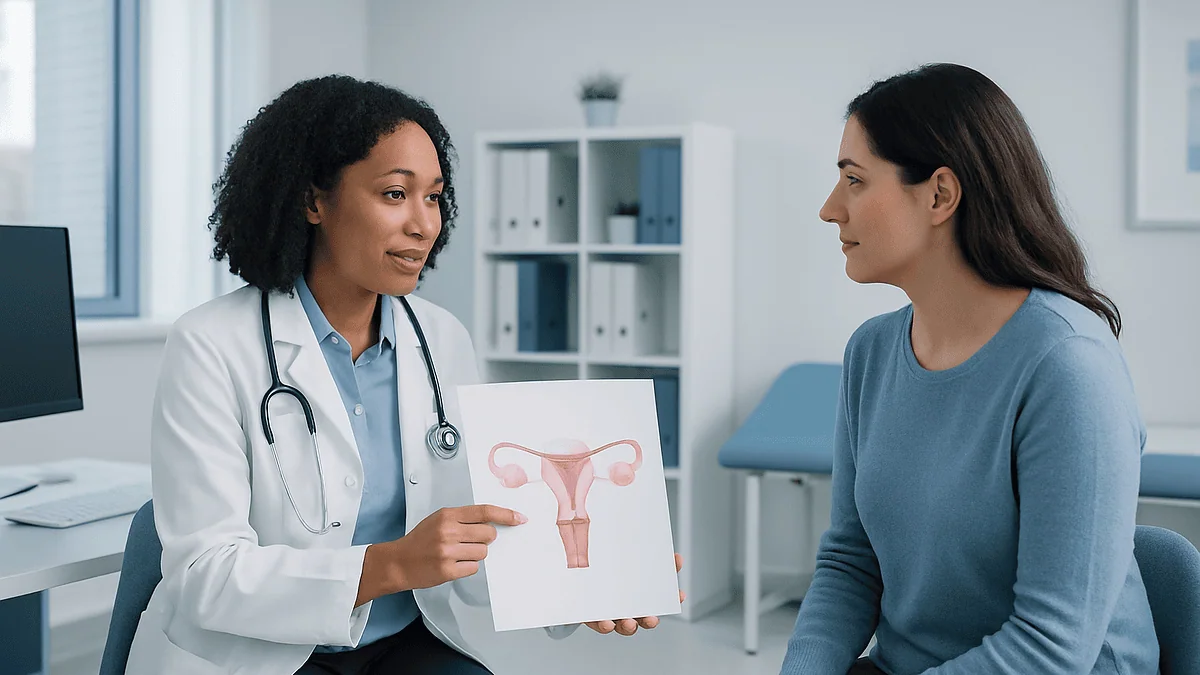
You have two ovaries, one on each side of the uterus, low in the pelvis, roughly a few inches below the belly button and a few inches in from each hip bone. During the reproductive years each ovary is about the size of an almond, around 3 to 4 centimeters long, and both shrink after menopause. Most people function fully with only one.
Ask ten people to point to their ovaries and most will tap somewhere near the stomach: a good six inches too high. It’s an understandable miss. The ovaries are small, deep, and quiet for most of the month, and school health class rarely got past a fuzzy diagram of a uterus with two dots floating beside it.
Yet knowing where those dots actually sit turns out to be surprisingly practical. It helps you make sense of a mid-cycle twinge, describe pain accurately to a clinician, and understand why an ultrasound wand sometimes finds an ovary easily and sometimes has to go hunting.
So consider this a proper map: the real location, the honest measurements, what anchors these organs in place, and, because this is what most people are really asking, how to tell an ordinary ovarian ache from one that deserves a medical appointment.
Where exactly are your ovaries in your body?
Lower than you think, and farther apart than the diagrams suggest. The ovaries sit deep in the pelvis, one on each side of the uterus, tucked into a shallow depression on the pelvic sidewall. In practical terms, that’s below the level of your belly button, closer to the line of your underwear than the line of your waistband, and a few inches in from each hip bone, according to the Cleveland Clinic’s anatomy overview.
A useful home landmark: place your hands so your thumbs meet at your navel and your fingers fan down toward your pubic bone, fingertips angled toward the bony points at the front of your hips. Each ovary lies roughly under the lower, outer part of that triangle, though ‘roughly’ is doing real work in that sentence, because ovaries are not bolted down. They shift with a full bladder, with pregnancy, and simply from person to person.
They also sit close to some noisy neighbors: loops of bowel, the ureters carrying urine from the kidneys, and on the right side, the appendix. That crowding is exactly why one-sided lower abdominal pain is genuinely hard to self-diagnose, several different organs can produce an ache in nearly the same spot. Clinicians untangle this all the time; it’s one reason the physical exam and ultrasound remain so useful.
One more location note worth filing away: because the ovaries lie behind the abdominal wall and beneath layers of muscle and bowel, you cannot normally feel a healthy ovary from the outside. If you can feel a distinct lump low in your abdomen, that’s a finding for a clinician, not a normal ovary announcing itself.
How big is a normal ovary?
About the size of an almond: the comparison nearly every major medical source reaches for, including the Cleveland Clinic, because it’s accurate. In the reproductive years, a typical ovary runs roughly 3 to 4 centimeters in length: small enough to hide behind a loop of bowel on ultrasound, large enough to house tens of thousands of immature eggs.
That said, ‘normal’ is a moving target within any single month. Each cycle, a group of fluid-filled follicles begins to grow, and the winning follicle can reach about 2 centimeters, half the length of the ovary itself, before it releases its egg. After ovulation, that follicle collapses into a hormone-producing structure called the corpus luteum, which can also be sizable. So an ovary scanned on day 13 of a cycle can look meaningfully different from the same ovary scanned on day 3, and both can be perfectly healthy.
The surface texture changes over a lifetime, too. A child’s ovary is smooth; decades of monthly ovulation leave the adult ovary with a slightly pitted, walnut-shell look. It’s honest wear from an organ that ruptures a tiny bit of its own surface every month, on schedule, for around four decades.
Why does size matter to your doctor? Because it’s one of the most objective things an ultrasound can measure. An ovary that is substantially enlarged for a person’s age and cycle stage prompts questions, usually answered by something as ordinary as a functional cyst, but worth answering all the same.
How many ovaries do you have, and do you need both?
Two is the standard issue, and it comes with a generous built-in redundancy. If one ovary is removed, for a cyst, torsion, endometriosis, or as part of cancer treatment, the remaining ovary typically carries the full workload. It continues releasing eggs and producing estrogen and progesterone, and pregnancy remains entirely possible with a single ovary and at least one open fallopian tube, as the Cleveland Clinic notes.
The raw numbers explain why. According to the Cleveland Clinic, you’re born with somewhere between one and two million immature eggs, a supply that dwindles to roughly 300,000 by puberty. Of those, only about 300 to 400 will ever actually be ovulated across a reproductive lifetime. Even one ovary holds vastly more eggs than a lifetime of cycles could ever use.
Rarer arrangements exist. Some people are born with one ovary, or with an extra, smaller patch of ovarian tissue. Others have both ovaries removed surgically, an operation called bilateral oophorectomy, which brings on menopause immediately if it happens before natural menopause, because the body’s main source of estrogen is gone. That abrupt transition is precisely why decisions about removing ovaries are weighed so carefully between a patient and their surgical team, balancing the reason for surgery against long-term bone, heart, and hormonal considerations.
The takeaway is reassuring rather than alarming: the two-ovary design is less like two engines a plane needs to fly and more like a spare fuel tank you’ll likely never draw on.
What holds your ovaries in place?
Not much, honestly, and that’s by design. Each ovary hangs in a kind of soft-tissue hammock made of ligaments, which in this part of the body are folds of connective tissue and peritoneum rather than the rope-like ligaments of your knee.
Three attachments do most of the work:
- The ovarian ligament tethers the ovary to the side of the uterus: this is the answer to the classic anatomy-exam question about what attaches ovary to uterus. It’s a short, fibrous cord, not a tube; eggs do not travel through it.
- The suspensory ligament anchors the ovary upward and outward to the pelvic wall, and it matters enormously because the ovary’s blood vessels and nerves travel inside it: the organ’s supply line.
- The mesovarium, a fold of the broad ligament (the wide drape of tissue over the uterus and tubes), holds the ovary from the front like a curtain clip.
This loose mooring lets the ovary shift as the bladder fills, the bowel moves, and, in pregnancy, the uterus expands dramatically. Flexibility is the feature. The rare but serious downside is ovarian torsion, when an ovary twists on its own supporting tissue and pinches off its blood supply, most often when a cyst has made it heavier and more prone to swinging. The result is sudden, severe, one-sided pelvic pain, frequently with nausea or vomiting, and it’s a surgical emergency: the ovary can be saved, but the clock matters. It’s one anatomical fact genuinely worth memorizing.
Are your ovaries attached to your fallopian tubes?
Here’s the detail that surprises almost everyone: no, not directly. The fallopian tube does not plug into the ovary the way a hose screws onto a tap. Instead, the tube’s open, trumpet-shaped end hovers near the ovary, fringed with delicate finger-like projections called fimbriae.
At ovulation, the egg is released from the ovary’s surface into the open space of the pelvis: a genuinely free-floating moment. The fimbriae, which sweep gently over the ovary, then coax the egg into the tube, where wafting cilia and muscular contractions carry it toward the uterus. The system works remarkably well for something with an actual gap in the middle.
This small anatomical truth explains several bigger ones:
- Eggs can cross sides. Because the pelvis is an open space, an egg released from the right ovary can occasionally be picked up by the left tube. Pregnancy has been documented in people with one ovary on one side and one functioning tube on the other.
- Ectopic pregnancy is possible. A fertilized egg that implants in the tube, or, rarely, elsewhere in the pelvis, rather than the uterus is a medical emergency, and the open design is part of why it can happen.
- Conditions can spread through the pelvis. Endometriosis and some infections take advantage of the same open real estate.
So when a diagram shows tube and ovary fused together, read it as artistic shorthand. The reality, a catcher’s mitt positioned beside a pitcher, is stranger and more elegant.
What do your ovaries actually do all day?
Two jobs, both essential, and only one of them involves eggs.
The famous job is ovulation. Each month during the reproductive years, hormonal signals from the brain, follicle-stimulating hormone and luteinizing hormone, recruit a cohort of follicles to start growing. One becomes dominant, matures its egg, and releases it around the midpoint of the cycle; in a textbook 28-day cycle, that’s near day 14, per the Cleveland Clinic, though real cycles vary widely and ovulation day shifts with them.
The quieter, arguably bigger job is hormone production. The ovaries are the body’s principal source of estrogen and progesterone, plus small amounts of testosterone. These hormones do far more than run the menstrual cycle. Estrogen helps maintain bone density, influences cholesterol handling and blood vessel function, and affects skin, mood, and memory. Progesterone prepares the uterine lining each month and helps sustain early pregnancy, after ovulation, the corpus luteum acts as a temporary progesterone factory until either a pregnancy takes over the signaling or the cycle resets.
This dual role is why ovarian health echoes through the whole body, and why the hormonal wind-down of menopause is felt in bones, blood vessels, sleep, and skin, not just in the calendar. It’s also why clinicians think about the ovaries even in appointments that seem unrelated to fertility: an organ the size of an almond is helping set conditions for systems far outside the pelvis.
In short: part-time egg dispenser, full-time endocrine gland. The second title is the one that never takes a month off, until menopause, when both roles wind down together.
Do your ovaries change size over your lifetime?
Substantially: the ovary may change more over a lifetime than almost any other organ, because its size tracks its hormonal workload.
| Life stage | What the ovary is like | What’s happening |
|---|---|---|
| Childhood | Small, smooth, quiet | Follicles present but dormant; minimal hormone output |
| Reproductive years | Almond-sized, roughly 3–4 cm; surface grows pitted over time | Monthly follicle growth, ovulation, and full hormone production |
| Early pregnancy | Often temporarily larger on one side | The corpus luteum enlarges to supply progesterone through the first trimester |
| Perimenopause | Gradually smaller, fewer follicles | Egg supply dwindling; cycles and hormone levels become irregular |
| After menopause | Noticeably shrunken; can be hard to find on ultrasound | Ovulation has ended; estrogen and progesterone output falls sharply |
The postmenopausal change deserves emphasis. According to the NHS, menopause usually arrives between ages 45 and 55, with an average around 51 in the UK. Afterward, the ovaries atrophy enough that sonographers sometimes struggle to see them at all: a completely normal finding.
It also flips one clinical rule on its head. In a 30-year-old, a small ovarian cyst is usually a routine byproduct of ovulation. In a 70-year-old, whose ovaries should be small and inactive, any new growth or enlargement gets a closer look precisely because ovulation-related explanations no longer apply. Same finding, different life stage, different level of attention: a good example of why age and context matter more than any single measurement.
Do your ovaries take turns each month?
This is one of the most durable myths in reproductive health: the tidy idea that the right ovary handles odd months and the left takes the evens, like siblings sharing chores. The reality is messier and more interesting.
Which ovary ovulates in a given cycle is determined by which follicle happens to mature fastest, essentially a monthly race among the recruited follicles, wherever they live. Sometimes the same ovary ovulates several months running; sometimes the sides trade off for a stretch and then break the pattern. There is no fixed alternation, and imaging studies of tracked cycles bear this out. The Cleveland Clinic describes ovulation as occurring from one ovary each cycle without a set left-right schedule.
Why does this bit of trivia matter beyond winning a pub quiz?
- It explains uneven symptoms. If you feel ovulation pain three months in a row on the right, nothing is wrong with your left ovary. The right side simply keeps winning the race.
- It reframes single-ovary fertility. Since there’s no mandatory rotation, one ovary doesn’t mean ovulating ‘every other month.’ A solo ovary typically steps up and ovulates in most cycles.
- It’s a reminder that the system is centrally run. The brain’s hormonal signals go out to both ovaries simultaneously; the ovaries respond based on which follicles are ready, not on whose turn it is.
File this under useful myth-busting: your ovaries are not polite colleagues taking turns. They’re competitors, and the fastest follicle wins, every single month.
Where can you feel ovary pain?
Low and to one side: that’s the signature. Ovary-related pain typically registers in the lower quadrant of the abdomen, below the level of the navel and off the midline, on whichever side the active ovary sits. Some people describe it as deep rather than surface-level, and it can radiate into the lower back or down the inner thigh, because pelvic organs share nerve pathways with those regions.
The most common, and most benign, version is ovulation pain, known by its German name mittelschmerz (‘middle pain’). It strikes mid-cycle, on one side, and according to the Mayo Clinic it typically lasts from a few minutes to a few hours, though it can persist for a day or two. It may feel like a sharp twinge, a dull cramp, or a pressure sensation, and it can switch sides from month to month for the reason covered above: ovulation doesn’t alternate on a schedule.
Here’s the honest caveat, though. The pelvis is a crowded neighborhood, and your brain is not great at pinpointing which resident is complaining. Pain in the classic ‘ovary spot’ can just as easily come from:
- The bowel, gas, constipation, or irritable bowel symptoms are frequent impostors
- The appendix, on the right side specifically
- The bladder or a urinary tract infection
- A kidney stone traveling down the ureter
- Muscles and ligaments of the abdominal wall or pelvis
- Endometriosis, which can cause pain well beyond the ovaries themselves
So treat location as a clue, not a verdict. Pattern matters more: pain that tracks with your cycle points toward the ovary; pain tied to eating, bowel movements, or urination points elsewhere.
What are the warning signs of an ovarian cyst?
Start with the most underreported fact about ovarian cysts: most cause no symptoms at all, and most go away on their own. The NHS notes that ovarian cysts are extremely common, usually harmless, and often discovered by accident during a scan done for another reason. Functional cysts, the kind produced by ordinary ovulation, typically disappear without treatment within two to three menstrual cycles, according to the Mayo Clinic.
When a cyst does make itself known, the signs tend to be:
- Pelvic pain on one sidea dull, heavy ache or a sharper pain that comes and goes
- A feeling of fullness, pressure, or bloating in the lower abdomen
- Pain during sex, particularly deep pain on one side
- Changes in periodsheavier, lighter, or more irregular than usual
- Needing to urinate more often or difficulty fully emptying the bowel, if a larger cyst presses on neighboring organs
Those symptoms warrant a routine appointment, not panic. An ultrasound usually settles the question, and the most common plan for a simple cyst is ‘watchful waiting’: a follow-up scan to confirm it has shrunk or resolved.
Two scenarios change the urgency entirely. A cyst can rupture, spilling fluid and causing sudden sharp pain, or it can cause the ovary to twist (torsion), cutting off blood flow. Both announce themselves the same way: abrupt, severe, one-sided pelvic pain, often with nausea, vomiting, faintness, or fever. The NHS is unambiguous that this picture needs emergency care, not a wait-and-see approach. The difference between ‘ache for a routine visit’ and ‘pain for the emergency department’ is speed and severity of onset.
What are early warning signs of ovarian cancer?
The old label ‘silent killer’ has been quietly retired, and good riddance: it discouraged people from paying attention to symptoms that, in hindsight, were often there. Ovarian cancer does produce early signals; the challenge is that they’re easy to attribute to diet, stress, or ‘just getting older.’
The NHS lists the key symptoms to know:
- Persistent bloatingthe NHS benchmark is feeling bloated more than 12 times a month, not the occasional post-meal puffiness everyone experiences
- Feeling full quickly when eating, or loss of appetite
- Pelvic or abdominal pain that doesn’t resolve
- Needing to urinate more urgently or more often than usual
Additional symptoms can include unexplained weight loss, fatigue, back pain, changes in bowel habit, and, importantly, any vaginal bleeding after menopause, which always deserves evaluation regardless of the suspected cause.
The single most useful word in that list is persistent. Every symptom above overlaps heavily with common, benign conditions like irritable bowel syndrome. What separates ‘watch and wait’ from ‘book an appointment’ is frequency and duration: symptoms that are new for you, occur most days, and stick around for roughly three weeks or more should be checked, per NHS guidance. Risk also rises with age, most cases occur after menopause, and with certain inherited gene changes and family history, which is worth mentioning to your clinician.
To be equally honest in the other direction: these symptoms are far more often caused by something benign than by cancer. The point of knowing them isn’t fear. It’s that early evaluation is simple, an exam, a blood test, an ultrasound, and early-stage disease is more treatable than late-stage disease. Persistence is the signal; checking it out is the response.
How do doctors actually check your ovaries?
Given that you can’t see or feel your own ovaries, how does anyone assess them? Three main tools, in escalating order of detail.
The pelvic exam. During a bimanual exam, a clinician places two fingers in the vagina and the other hand on the lower abdomen, gently pressing the pelvic organs between them. A normal ovary is often not distinctly palpable at all, it’s small and mobile, which is partly the point: an ovary that’s easy to feel may be enlarged. The exam also checks for tenderness, which helps localize pain.
Ultrasound. This is the workhorse of ovarian imaging. A transabdominal scan (probe on the belly, often with a full bladder to push bowel out of the way) gives the wide view; a transvaginal scan gets the probe within a few centimeters of the ovaries for far sharper detail. Ultrasound can measure ovarian size, count follicles, characterize cysts as simple or complex, and, with Doppler, check blood flow, which matters when torsion is suspected. It’s painless apart from mild pressure, involves no radiation, and usually takes under half an hour.
Blood tests and further imaging. Depending on the question, clinicians may add hormone tests, a pregnancy test (always, when relevant, to rule out ectopic pregnancy), or a marker called CA-125, useful in context but famously imperfect, since benign conditions like endometriosis and fibroids can raise it too. MRI or CT is reserved for cases where ultrasound leaves questions unanswered.
Worth knowing: no screening test for ovarian cancer is currently recommended for people at average risk without symptoms, trials haven’t shown that routine screening saves lives in that group. Symptoms, not scans, are the trigger for evaluation, which is exactly why knowing the symptoms matters.
When should you see a doctor about ovary pain?
Most pelvic twinges never need an appointment. But some patterns do, and a few demand one urgently, so here is the honest triage.
Seek emergency care now if you have sudden, severe pelvic pain, especially one-sided pain with nausea, vomiting, fever, dizziness, or fainting. That combination can signal ovarian torsion, a ruptured cyst with bleeding, or a ruptured ectopic pregnancy, and all three are time-critical, per NHS guidance. If there is any chance you could be pregnant and you develop one-sided pain, shoulder-tip pain, or unusual bleeding, treat it as an emergency until proven otherwise.
Book a prompt routine appointment for symptoms that are persistent rather than dramatic:
- Bloating, pelvic pain, early fullness, or urinary urgency occurring most days for around three weeks or more
- A one-sided ache that keeps returning across multiple cycles
- Pain during sex that’s new or worsening
- Periods that have changed significantly, much heavier, much more painful, or newly irregular
- Any vaginal bleeding after menopause, full stop
You can reasonably watch and wait if you have a familiar, brief, mid-cycle twinge that resolves within a day or two, the classic mittelschmerz pattern, or mild cramping that tracks predictably with your period and responds to your usual comfort measures.
A practical tip that clinicians genuinely appreciate: keep brief notes before your appointment. When the pain happens, where in your cycle you are, what makes it better or worse, and any bowel, bladder, or appetite changes. Three weeks of notes often does more for a diagnosis than an hour of trying to remember. Vague symptoms are hard to evaluate; patterned symptoms are not.
Frequently asked questions
Where can you feel ovary pain?
Ovary-related pain is typically felt low in the abdomen, below the navel and to one side, and it can radiate into the lower back or inner thigh. The most common version is mid-cycle ovulation pain (mittelschmerz), which is one-sided and usually brief. Because the bowel, bladder, appendix, and pelvic muscles all share the same neighborhood, location alone can’t confirm the ovary is the source: the pattern and timing of the pain matter more.
What are the warning signs of an ovarian cyst?
One-sided pelvic ache, bloating or pressure, pain during sex, irregular periods, and more frequent urination are the classic signs, though most cysts cause no symptoms and resolve on their own within a few cycles. The urgent exception: sudden, severe one-sided pain with nausea, vomiting, fever, or faintness can mean the cyst has ruptured or twisted the ovary, and that needs emergency care immediately.
What are early warning signs of ovarian cancer?
Persistent bloating (the NHS benchmark is more than 12 times a month), feeling full quickly, ongoing pelvic or abdominal pain, and urinary urgency or frequency are the key early symptoms. The crucial word is persistent, symptoms most days for about three weeks or more deserve a medical review. These symptoms are far more often caused by benign conditions, but checking them early is simple and worthwhile.
How do I know if there's something wrong with my ovaries?
Watch for patterns rather than single twinges: recurring one-sided pain, significant changes in your periods, persistent bloating, pain during sex, or any bleeding after menopause. A clinician can usually assess the ovaries with a pelvic exam and an ultrasound, sometimes adding blood tests. Sudden severe pain with vomiting or fainting is different: that’s an emergency, not something to monitor at home.
Can you feel your ovaries from the outside?
No: a healthy ovary is too small and too deep to feel through the abdominal wall, sitting beneath muscle, fat, and loops of bowel. Even clinicians often can’t distinctly feel a normal ovary during a pelvic exam. If you can feel a definite lump or firm mass low in your abdomen, that’s a reason to book an appointment rather than a normal anatomical finding.
Can you live, and get pregnant, with one ovary?
Yes to both. A single ovary typically produces enough estrogen and progesterone for normal health and usually ovulates in most cycles, since ovaries don’t work on an alternating schedule. Pregnancy is entirely possible with one ovary and at least one open fallopian tube, and because the pelvis is an open space, an egg can even be caught by the tube on the opposite side.
Do ovaries alternate sides each month?
No: that’s a myth. Which ovary ovulates each cycle depends on which follicle matures fastest, and that’s essentially random. The same ovary can ovulate several months in a row, which is why you might feel ovulation pain on the same side repeatedly without anything being wrong. There’s no fixed left-right rotation, and a single ovary doesn’t mean ovulating only every other month.
Do your ovaries shrink after menopause?
Yes, considerably. Once ovulation ends, usually between ages 45 and 55, with an average around 51 per the NHS, the ovaries atrophy and can become difficult to see on ultrasound, which is normal. This shrinkage is also why any new ovarian enlargement or growth after menopause gets a closer look: ovulation-related cysts, the most common benign explanation in younger people, no longer apply.
Why does ovary pain sometimes shoot into my back or thigh?
Because pelvic organs share nerve pathways with the lower back and upper legs, the brain can misattribute where the signal originates: a phenomenon called referred pain. An irritated ovary or a cyst can therefore ache into the lower back or inner thigh. That said, back and leg pain more often comes from muscles, joints, or nerves, so persistent pain deserves evaluation rather than self-diagnosis.
Is one-sided lower abdominal pain always an ovary problem?
No: the ovary is only one of several suspects in that spot. Gas, constipation, irritable bowel symptoms, urinary tract infections, kidney stones, muscle strain, and on the right side, appendicitis, can all produce nearly identical pain. Clues that point toward the ovary include pain that tracks with your menstrual cycle. Clues pointing elsewhere include pain tied to eating, bowel movements, or urination. When in doubt, a clinician can sort it out quickly.
References
- Cleveland Clinic: Ovaries: Anatomy, Function & Common Conditions
- NHS: Ovarian cyst
- NHS: Symptoms of ovarian cancer
- NHS: Menopause
This article is for general information only and is not a substitute for professional medical advice. Please consult a qualified doctor about your individual situation.

More from the Blog
Can Fibroids Be Cancerous, Burst, or Be Dangerous?
Fibroids are almost always benign and do not turn into cancer; a cancerous growth in the uterine wall (leiomyosarcoma) is found in fewer than…

Life After Robotic Hysterectomy: Scars, Bleeding That Is Expected and Returning to Work
Life after robotic hysterectomy usually involves a hospital stay of a night or less, a few small abdominal scars that fade over months, and…

Prolapse Surgery Recovery: Lifting, Constipation Prevention and When Intercourse Resumes
Prolapse surgery recovery usually unfolds over about six weeks, though heavy lifting is often restricted longer. Most surgeons advise avoiding lifting anything heavier than…

After Hysteroscopy: Heavy Bleeding, Fever or Severe Pain and When to Call Your Gynecologist
After a hysteroscopy, light spotting and period-like cramping for a few days are expected. Warning signs that need a same-day call to your gynecologist…

Why Do Pelvic Floor Assessment and Urodynamic Testing Come Before Prolapse Surgery?
Pelvic floor assessment and urodynamic testing come before prolapse surgery because a dropped bladder, uterus or vaginal wall can disguise how the bladder actually…

Is PCOS a Chronic Illness? Pain, Periods and Weight Explained
Yes. PCOS is widely classified as a chronic, lifelong hormonal and metabolic condition rather than a passing illness. It cannot be cured, but its…