

Which Acne Treatment Comes First? Choosing Between Topical, Oral and Procedural Options

Key Takeaways
- Topical retinoids, benzoyl peroxide and azelaic acid are the usual first step for mild to moderate acne and need at least 4–8 weeks of whole-area use before results can be judged, according to NHS guidance.
- Oral antibiotics are generally used for moderate to severe inflammatory acne, take about 6 weeks to show improvement, run for a defined course of roughly 4–6 months and are always paired with a non-antibiotic topical.
- Using a topical and an oral antibiotic at the same time is discouraged because it increases bacterial resistance without adding benefit.
- Isotretinoin is not oral tretinoin; it is a different retinoid that shrinks oil glands, is reserved for severe or scarring acne, requires strict pregnancy prevention and typically runs 16–24 weeks.
- Progestin-only contraceptives, including the levonorgestrel hormonal IUD, can list acne as a side effect, whereas combined estrogen-progestin pills are the hormonal option used to treat it in suitable women.
- Mayo Clinic rates the evidence for light and laser acne therapies as still limited; procedures work best as adjuncts, rescues for single cysts, or treatments for scars once active acne is controlled.
For most people, acne treatment starts with topical options such as a retinoid, benzoyl peroxide or azelaic acid, used for at least six to eight weeks before judging results. Oral treatments, including short antibiotic courses, hormonal therapy or isotretinoin, are usually added when acne is moderate to severe, widespread, scarring or not responding. Procedures such as extraction, peels, steroid injections or light therapy are generally adjuncts, not first steps. The order is decided with a clinician.
The bathroom shelf tells the story before anyone says a word. A half-used cleanser bought after a friend swore by it, a spot gel that stung, a sample-sized cream that ran out before it could have worked. Somewhere under all of that sits the real question: should the next step be another tube, a tablet, or something a clinician does in a treatment room?
People who arrive at that question have usually been patient already. Acne is common enough that it can feel unworthy of an appointment, yet stubborn enough to shape how someone dresses, sits in a meeting or looks at photographs. Choosing between topical, oral or procedural acne treatment is not about finding the strongest weapon. It is about matching the type and severity of acne to the tool most likely to work with the fewest side effects, then giving that tool a fair trial.
What follows is the evidence behind that sequence, where the exceptions sit, and which questions are worth carrying into the consultation.
What topical, oral or procedural acne treatment actually means
The three categories describe where the treatment acts, not how serious the acne is. Topical means applied to the skin. Oral means swallowed and carried through the bloodstream to every oil gland at once. Procedural means something performed in a clinic, from squeezing out a stubborn blackhead with a sterile tool to shining a specific wavelength of light onto the face.
Topical products work on the skin surface and in the upper part of the pore. A retinoid (a vitamin A relative) unclogs pores by speeding up how skin cells turn over; benzoyl peroxide kills acne bacteria and loosens debris; azelaic acid calms inflammation and reduces bacteria; topical antibiotics lower bacterial counts. The NHS notes that most of these need at least 6 weeks of steady use before improvement shows, and often longer.
Oral treatments reach the deeper dermis where cysts and nodules form. Antibiotics from the tetracycline class reduce inflammation as well as bacteria. Combined hormonal contraceptives and anti-androgens lower the hormonal signal that drives oil production in women. Isotretinoin, an oral retinoid, shrinks the oil glands themselves.
Procedures fill gaps that creams and tablets cannot. A clinician might extract comedones that refuse to clear, inject a diluted corticosteroid into a painful cyst to shrink it within days, apply a chemical peel to smooth texture, or use light or laser energy that targets bacteria or oil glands. Mayo Clinic describes these as options used alone for mild acne or alongside medicines, while noting that evidence for light-based approaches is still limited.
Understanding these three levels makes the sequencing logical rather than arbitrary. Treatment escalates from the surface inward, and from lowest risk toward higher, only as the acne demands it.
How acne forms, and why that decides the first move
Four things go wrong inside a pore for a pimple to appear, and every effective treatment blocks at least one of them. Skin cells lining the pore stick together instead of shedding, creating a plug. Oil glands, prompted by androgens (hormones present in all sexes), produce more sebum than the pore can drain. A bacterium that normally lives harmlessly on skin, Cutibacterium acnes, multiplies in the trapped oil. The immune system responds with inflammation, turning a quiet blackhead into a red, tender bump or a deep nodule.
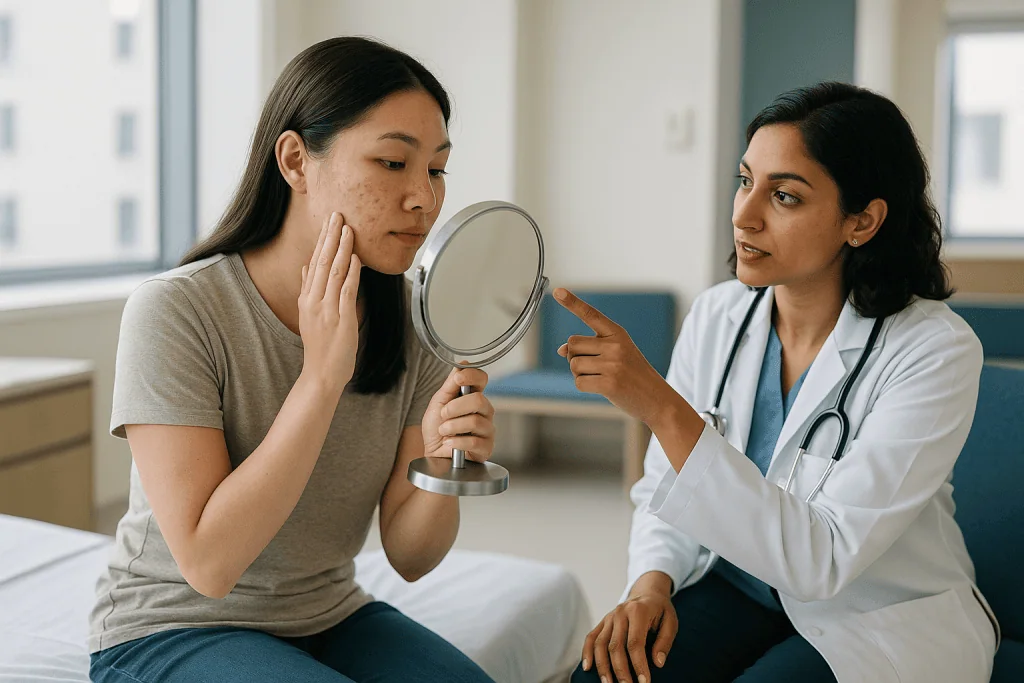
This four-part mechanism explains a great deal about first-line choices. A plug of dead cells is a surface problem, so a topical retinoid that normalizes cell shedding targets the earliest step. Bacteria near the surface respond to benzoyl peroxide applied directly. Only when inflammation runs deep, or oil production is driven by a strong hormonal signal across the whole face, chest and back, does a systemic treatment become the more sensible tool.
Severity is graded on what a clinician sees rather than how a person feels. Mild acne is mostly blackheads and whiteheads with a few inflamed spots. Moderate acne includes many red papules and pustules. Severe acne brings nodules and cysts that sit deep in the skin, often painful, often leaving scars. MedlinePlus and the NHS both describe treatment as scaling with this grading.
Age matters too. The NHS reports that around 95% of people aged 11 to 30 have acne to some extent, peaking in the mid-teens, while about 3% of adults over 35 continue to have it. Adult-onset acne in women often follows the lower face and jawline and tracks with the menstrual cycle, which points clinicians toward hormonal contributors early in the conversation.
Why topical treatment almost always comes first
Starting on the skin surface is not a matter of caution for its own sake. The topical route delivers medicine exactly where the problem begins, at concentrations that would be impossible to achieve safely through the bloodstream, while sparing the rest of the body.
Guidelines from the NHS and the summary on Mayo Clinic converge on the same core options for mild to moderate acne: a topical retinoid, benzoyl peroxide, azelaic acid, or a topical antibiotic combined with benzoyl peroxide. Combinations are common because each ingredient hits a different step in the four-part mechanism described above. A retinoid clears the plug; benzoyl peroxide lowers bacteria and, crucially, reduces the risk of those bacteria becoming resistant to any antibiotic used alongside it.
Side effects are real but mostly local. Dryness, peeling, redness and stinging are the usual complaints in the first weeks, especially with retinoids, and the NHS advises applying to the whole affected area rather than dabbing single spots, since the aim is to prevent new lesions rather than shrink existing ones. Benzoyl peroxide bleaches fabric, a small practical detail that catches many people out.
Patience is the price of the lower-risk route. The NHS states that topical retinoids should be used for at least 6 weeks, topical antibiotics for 6 to 8 weeks, and azelaic acid for about a month before an improvement is expected. Judging a product after ten days, then abandoning it, is one of the most common reasons acne seems untreatable when in fact it was never fully treated.
Only when a well-used topical regimen has had that fair trial, or when the acne is clearly beyond what surface treatment can reach, does the conversation move to the oral options.
Who is usually offered oral treatment, and who is asked to wait
Oral treatment is generally reserved for three situations: acne that is moderate to severe, acne that covers large areas such as the back and chest where creams are impractical, and acne that has not responded to a properly used topical regimen. Scarring, or a high risk of it, pushes the decision toward earlier escalation because scars are far harder to treat than active spots.

Oral antibiotics, usually from the tetracycline class, are the most common first oral step for inflammatory acne. They are almost always prescribed together with a topical retinoid or benzoyl peroxide, partly to attack the plug the antibiotic cannot reach and partly to limit resistance. The NHS notes it usually takes about 6 weeks to notice improvement and that a course typically lasts 4 to 6 months, after which the topical treatment continues as maintenance.
Hormonal options are considered for women whose acne flares with the menstrual cycle, sits along the jawline or persists into adulthood. Isotretinoin is held for severe nodulocystic acne, acne that is scarring, or acne that has failed other systemic treatments, and in many countries it can only be prescribed by a specialist.
Some people are asked to wait or to take a different path. Anyone who is pregnant, planning pregnancy or breastfeeding cannot use isotretinoin, and several other oral and topical retinoids are also avoided. Tetracycline antibiotics are unsuitable in pregnancy and in young children because of effects on developing teeth and bone. People with a history of depression are not excluded from isotretinoin, but the treating team will discuss monitoring carefully. Combined hormonal contraceptives carry clot risks that rule them out for some, including smokers over 35 and those with migraine with aura.
Each of these judgments belongs to the prescribing clinician, who weighs the acne against the whole person in front of them.
Oral vs topical antibiotics for acne: which is better?
The honest answer is that neither is better in the abstract; each is better for a particular pattern of acne, and both are now used more sparingly than a generation ago.
Topical antibiotics suit mild to moderate inflammatory acne confined to the face. They act locally, so systemic side effects such as stomach upset or sun sensitivity are rare. Their weakness is resistance. Used alone, they encourage acne bacteria to adapt within weeks, which is why the NHS and Mayo Clinic both describe them as being combined with benzoyl peroxide rather than used as a single agent.
Oral antibiotics reach deeper, inflamed lesions and large areas at once. Their anti-inflammatory effect matters as much as their antibacterial one. The trade-off is exposure of the whole body: photosensitivity, gastrointestinal effects, and, for some agents, dizziness or rare pigment changes. Resistance is a concern here too, not just in acne bacteria but in the wider microbiome, which is why courses are time-limited and paired with a non-antibiotic topical that continues afterward.
Two points settle most versions of this question. First, using a topical and an oral antibiotic at the same time is discouraged because it doubles resistance pressure without adding benefit. Second, an oral antibiotic is not a long-term plan; the goal is to calm inflammation enough for topical maintenance to hold the line.
So the practical sequence looks like this: mild to moderate facial acne, topical antibiotic plus benzoyl peroxide or a retinoid; moderate to severe or widespread inflammatory acne, an oral antibiotic for a defined course alongside a topical retinoid. If an oral antibiotic has not produced meaningful improvement after roughly 3 months, guidelines steer toward a different class of treatment rather than another antibiotic.
Hormonal acne treatment options, from combined pills to anti-androgens
Hormonal acne is not a separate disease. The same four steps occur in the pore; the difference is that the oil-production step is being turned up by androgens, or by skin that is unusually sensitive to normal androgen levels. That is why hormonal treatments target only one part of the mechanism yet can be transformative for the right person.
Combined oral contraceptives, which contain both an estrogen and a progestin, lower circulating free androgens and therefore sebum output. The NHS notes that they can take several months to improve acne, and Mayo Clinic lists them among treatments for women who also want contraception. They are not appropriate for everyone, particularly people at increased risk of blood clots, and the choice of pill is made by the prescriber.
Anti-androgens block androgen receptors on the oil gland directly. Spironolactone, originally a blood pressure medicine, is used off-label for adult women with persistent acne, particularly along the jaw and lower face. Because it affects hormone signalling, it is unsuitable during pregnancy, and clinicians consider the person’s blood pressure, kidney function and potassium when deciding whether it fits.
Progestin-only methods behave differently. Some progestins have androgen-like activity, and acne is a recognized side effect of the levonorgestrel intrauterine device, the implant and the injection for some users. A hormonal IUD is therefore not an acne treatment, and a person choosing it for contraception may find their skin unchanged or occasionally worse.
Men and boys with acne do not receive anti-androgens or contraceptives; for them, retinoids, benzoyl peroxide, antibiotics and isotretinoin remain the ladder. Anyone with acne plus irregular periods, excess facial or body hair or unexplained weight change should mention it, since conditions such as polycystic ovary syndrome can underlie the acne and change the plan.
Is isotretinoin just oral tretinoin? What it is and who it is for
The names invite confusion, but the answer is no. Tretinoin is a topical retinoid applied to the skin, where it normalizes how pore-lining cells shed. Isotretinoin is a different molecule, a mirror-image form of retinoic acid taken by mouth, and it does something no cream can: it shrinks the oil glands themselves, reduces bacterial numbers as oil falls, and dampens inflammation across the whole body at once. It is the only acne treatment that acts on all four steps of the mechanism.
Because of that reach, isotretinoin is reserved for severe nodular or cystic acne, acne that is scarring, or acne that has failed adequate courses of other systemic treatment. The NHS describes a typical course as lasting 16 to 24 weeks, with many people achieving long remission after a single course and some needing a second.
Its side effects follow from its mechanism. Dry lips, dry eyes, dry skin and nosebleeds are almost universal because oil output drops everywhere. Muscle aches, raised blood fats and liver enzyme changes are monitored with blood tests. Mood changes have been reported, and although a causal link remains debated, the NHS advises anyone on isotretinoin who notices low mood or changes in thinking to tell their doctor promptly.
The most serious risk is to a pregnancy. Isotretinoin causes severe birth defects, so anyone who could become pregnant must use reliable contraception before, during and for a period after treatment, with pregnancy testing built into the program. Blood donation is paused for the same reason.
Acne often worsens briefly in the first weeks, which can be discouraging. Sun sensitivity rises, and waxing or procedures that abrade the skin are usually postponed until months after the course ends. None of these are reasons to avoid it when it is indicated; they are reasons it sits at the top of the ladder, prescribed and supervised by a specialist.
Laser treatment for acne and other procedures: what the evidence shows
Procedures occupy an odd place in the acne conversation. They are the most visible, the most photographed and the most heavily marketed, yet in mainstream guidelines they are supporting players rather than leads.
Comedone extraction is the simplest. A clinician uses a sterile loop to express blackheads and whiteheads that have not cleared with topical treatment. Mayo Clinic notes it can temporarily improve appearance but may cause scarring if done carelessly, which is why home squeezing is discouraged.
Intralesional corticosteroid injection treats a single large, painful cyst or nodule. A small amount of diluted steroid is injected directly into the lesion, and Mayo Clinic describes rapid improvement and pain reduction, usually within days. Possible side effects include skin thinning or a small dent at the site. It is a rescue for one spot before an important event, not a program for the whole face.
Chemical peels apply an acid solution, commonly salicylic or glycolic acid, to exfoliate the surface. They can help mild acne and shallow marks, but results are not long lasting and repeat sessions are usually needed. Light-based treatments range from blue light aimed at acne bacteria to lasers targeting oil glands. Mayo Clinic’s assessment is direct: a variety of these therapies have been tried with some success, but more study is needed to determine the ideal method, light source and dose.
Photodynamic therapy combines a light-sensitizing solution with a light source and has been used for inflammatory acne where antibiotics are unsuitable, though evidence remains limited and redness and peeling afterward are expected.
The realistic role of procedures, then, is threefold: rescuing an individual lesion, offering an option to people who cannot use standard medicines, and addressing texture and scarring once active acne is controlled. As a first-line replacement for a well-chosen topical regimen, the evidence does not yet support them.
Topical, oral or procedural acne treatment: a side-by-side comparison
Seeing the three routes together clarifies why they are sequenced rather than chosen at random. The table summarizes what each is typically used for, how long it takes to judge, and the trade-offs a clinician weighs. Timelines follow NHS guidance and are typical ranges, not promises.
| Route | Typical role | Time before judging effect | Main trade-offs |
|---|---|---|---|
| Topical (retinoid, benzoyl peroxide, azelaic acid, topical antibiotic with benzoyl peroxide) | First line for mild to moderate acne; long-term maintenance after any oral course | About 4–8 weeks, longer for full effect | Dryness, irritation, sun sensitivity; requires consistent daily use; resistance if a topical antibiotic is used alone |
| Oral antibiotic (tetracycline class) | Moderate to severe inflammatory acne, or acne on the back and chest | About 6 weeks to notice; course 4–6 months | Stomach upset, photosensitivity; resistance concerns; always paired with a non-antibiotic topical |
| Oral hormonal (combined contraceptive, anti-androgen) | Women with cyclical, jawline or persistent adult acne | Several months | Clot risk with estrogen-containing pills; not usable in pregnancy; requires health screening |
| Oral isotretinoin | Severe nodulocystic acne, scarring acne, or failure of other systemic treatment | Course 16–24 weeks; early flare common | Dryness, blood monitoring, mood watch; strict pregnancy prevention; specialist prescribing |
| Procedural (extraction, steroid injection, peel, light or laser) | Adjunct: rescue of single lesions, alternative when medicines are unsuitable, treatment of texture and scarring | Days for a steroid injection; multiple sessions for peels and light | Temporary results for peels; limited evidence for light; risk of marks with poor extraction; not a substitute for medical treatment |
One pattern stands out. The lower rows carry more risk and more supervision, and none of them replaces the top row. Even after isotretinoin, many people return to a topical retinoid to hold their gains. The ladder is climbed only as far as the acne requires, and the rungs below stay in use.
How long does acne treatment take? What the following weeks usually look like
Acne treatment rewards people who understand its rhythm, because the early weeks can look like failure. A pimple visible today started forming under the skin two to eight weeks ago. Any treatment that prevents new plugs has to wait for the pipeline of existing ones to empty before the face reflects the change.
With a new topical retinoid, the first fortnight often brings dryness, flaking and sometimes a flush of new spots as blocked pores open. This settles for most people by week three or four. The NHS advises persisting for at least 6 weeks before judging, and many clinicians talk in terms of 12 weeks for the full picture. Benzoyl peroxide behaves similarly, with irritation peaking early then easing.
An oral antibiotic typically shows its anti-inflammatory effect first: spots become less red and tender within a few weeks, then fewer new ones appear. The NHS gives about 6 weeks as the point at which improvement is usually noticeable, and 4 to 6 months as the usual course length. At the end, the antibiotic stops and the topical continues.
Hormonal treatments are the slowest, needing several menstrual cycles before the oil glands respond. Isotretinoin follows its own arc: a possible flare in the first month, steady clearing through the middle of the 16 to 24 week course, and continued improvement for weeks after the last capsule.
Across all routes, the practical milestones are the same. A review at around 6 to 8 weeks checks tolerability and adherence, with adjustments to how products are applied rather than wholesale changes. A review at roughly 3 months decides whether the regimen is working well enough to continue, needs a step up the ladder, or should switch class. Keeping simple dated photographs in the same light helps both patient and clinician see a trend that memory tends to flatten.
Scars, dark marks and when procedures become the right next step
Two very different things get called acne scars, and telling them apart changes the plan. Post-inflammatory hyperpigmentation is a flat brown or grey mark left where a spot healed; it is more common and more persistent in deeper skin tones. Post-inflammatory erythema is a flat pink or red mark, more visible in lighter skin. Neither is a true scar. Both fade over months with sun protection and time, and topical retinoids or azelaic acid can speed the process.
True scars involve a change in skin texture. Atrophic scars are dents: shallow rolling scars, sharper boxcar scars, or narrow deep ice-pick scars. Hypertrophic and keloid scars are raised, more common on the chest, shoulders and jawline. Once collagen has been lost or overgrown, no cream restores the contour.
This is the point at which procedures move from adjunct to main event. Resurfacing lasers, microneedling, chemical peels of varying depth, subcision (releasing the fibrous band beneath a tethered scar) and fillers are used for atrophic scars, usually in combination and over several sessions. Raised scars may be treated with steroid injections or silicone dressings. Results vary with scar type and skin tone, and darker skin needs careful device selection to avoid new pigment changes.
Sequencing matters here as well. Most clinicians treat active acne first, because resurfacing inflamed skin risks spreading infection and creating fresh scars. A waiting period after isotretinoin before ablative procedures has traditionally been advised, though guidance is evolving and the treating team makes that call.
The best scar treatment remains prevention. Escalating quickly when acne is nodular, avoiding picking, and using a retinoid consistently all reduce the chance of ever needing a laser. Someone weighing a procedure for texture should ask what type of scar they have, because the answer decides which tool has evidence behind it.
What people often get wrong about acne treatment
Some of the most persistent acne beliefs come from advertising, some from folklore, and some from a reasonable guess that happens to be wrong. Several deserve a direct correction.
The idea that acne comes from dirty skin drives over-washing, harsh scrubs and alcohol-based toners, all of which irritate the skin barrier and can worsen breakouts. Acne begins beneath the surface in the pore. Washing twice a day with a gentle cleanser is enough; scrubbing does not reach the plug and can inflame it.
Spot treatment is another trap. Dabbing a retinoid or benzoyl peroxide only on visible pimples treats the ones that already exist and ignores the dozens forming under the surface. The NHS is explicit that these products should be applied to the whole affected area.
People also assume a national skincare routine holds a secret. Asked how any country’s population manages hormonal acne, the honest answer is that no dietary habit, ingredient sequence or product count has been shown to replace the treatments in guidelines. Barrier-friendly moisturizing and daily sunscreen, often emphasized in multi-step routines, are genuinely helpful supporting habits, but they support prescription treatment rather than substitute for it.
Stronger is not faster. Jumping to oral antibiotics for mild acne trades a manageable topical side-effect profile for systemic exposure and resistance without a better result. Conversely, waiting years with nodules because tablets seem drastic invites scars that are far harder to treat than the acne itself.
Diet deserves nuance rather than dismissal. Evidence links high-glycemic diets and, less consistently, dairy with acne in some people, but no food causes acne in everyone and no elimination diet treats it reliably. Toothpaste on a pimple, sunbathing to dry out spots and popping cysts at home all cause more harm than help.
Questions to ask your care team before choosing a route
A good consultation produces a plan the person can explain back. These questions help get there, and none of them needs a medical vocabulary.
- How would you grade my acne, and what type of lesions do you see most? The answer decides whether topical treatment alone is reasonable or whether an oral option should be considered from the start.
- Which step in the acne process is this treatment meant to block? Knowing whether a product targets plugging, oil, bacteria or inflammation makes it easier to understand why two products are being combined.
- How long should I use this before we judge whether it is working, and what will “working” look like? A clear timeline, such as a review at 6 to 8 weeks and a decision at about 3 months, prevents premature switching.
- What side effects are expected in the first weeks, and which ones should make me stop and call?
- If this does not work, what is the next rung, and what would make you skip a rung? People at risk of scarring benefit from hearing the escalation plan early.
- Is there anything about my health, medicines, plans for pregnancy or family history that rules out any of the options?
- For an oral antibiotic: how long is the course, and what will I continue afterward to keep the improvement?
- For hormonal treatment: which option fits my contraceptive needs and my clot risk, and how will we monitor it?
- For isotretinoin: what monitoring is involved, how is pregnancy prevention handled, and who do I contact about mood changes?
- For a procedure: what type of mark or scar do I have, what evidence supports this method for it, how many sessions are typical, and what are the risks for my skin tone?
Writing the answers down during the appointment, or asking for a printed summary, turns a rushed ten minutes into a plan that survives the drive home.
When to call your doctor: red-flag signs during acne treatment
Most acne treatment is uneventful, and most side effects are the expected dryness and irritation that ease with time and a moisturizer. A few situations, however, warrant a prompt call rather than waiting for the next scheduled review.
Seek urgent care for signs of a severe allergic reaction to any treatment: swelling of the face, lips or tongue, difficulty breathing, widespread hives or feeling faint. These are rare but require immediate medical attention.
Contact your doctor promptly if you notice any of the following:
- Skin that becomes intensely red, blistered, weeping or painful after applying a topical product, beyond ordinary peeling and stinging.
- Sudden, rapidly spreading painful nodules with fever or feeling unwell, which can signal a severe inflammatory flare or infection needing assessment.
- While taking an oral antibiotic: severe headache with visual changes, persistent diarrhoea, dark urine, yellowing of the skin or eyes, or a sunburn-like reaction after minimal sun exposure.
- While taking isotretinoin: low mood, anxiety, thoughts of self-harm or changes in thinking; severe abdominal pain; blood in the stool; persistent muscle weakness; vision changes or difficulty seeing at night; or any possibility of pregnancy.
- While taking a combined hormonal contraceptive or anti-androgen: chest pain, shortness of breath, a swollen painful leg, severe headache, or one-sided weakness or numbness, which need emergency assessment for a clot.
- After a procedure: increasing pain, spreading redness, pus, fever or wound breakdown at the treated site.
Also call if acne is worsening steadily despite months of consistent treatment, if scarring is appearing, or if the emotional weight of acne is affecting daily life, sleep or mood. Acne’s psychological impact is a recognized reason to escalate treatment, not a footnote.
Every one of these judgments, from whether to pause a product to whether to step up the ladder, belongs with the treating team, who know the full picture. Reporting early gives them the chance to adjust before a small problem becomes a large one.
Frequently asked questions
Which is better for treating acne, oral or topical antibiotics?
Neither is universally better; the choice follows the acne pattern. Topical antibiotics, combined with benzoyl peroxide, suit mild to moderate inflammatory acne on the face with few systemic effects. Oral tetracycline-class antibiotics reach deeper lesions and large areas such as the back, at the cost of body-wide exposure and resistance concerns. Both are used for limited periods, never together, and always alongside a retinoid or benzoyl peroxide that continues as maintenance.
How do Koreans get rid of hormonal acne?
There is no country-specific method that outperforms guideline treatment. Multi-step routines popular in some skincare cultures emphasize gentle cleansing, barrier-repairing moisturizers and daily sunscreen, which genuinely support skin tolerating prescription treatment. Hormonal acne itself, wherever a person lives, is managed with topical retinoids, benzoyl peroxide or azelaic acid first, then, for suitable women, combined contraceptives or anti-androgens under medical supervision. Routines help; they do not replace treatment.
Is isotretinoin just oral tretinoin?
No. Tretinoin is a topical retinoid that works on the pore lining where it is applied. Isotretinoin is a different form of retinoic acid taken by mouth that shrinks oil glands throughout the body, reducing sebum, bacteria and inflammation at once. That systemic action makes it effective for severe acne but also brings dryness, blood monitoring and a strict requirement to avoid pregnancy because of severe birth defects.
Will a hormonal IUD help with acne?
A hormonal IUD is not an acne treatment and may make acne worse for some users. It releases a progestin, and progestins with androgen-like activity can increase oil production; acne appears among its listed possible side effects. Combined pills containing estrogen are the hormonal contraceptives associated with acne improvement. Anyone choosing contraception with acne in mind should raise this with their prescriber so both needs are weighed together.
What are the main hormonal acne treatment options for adults?
For women, combined oral contraceptives lower free androgens and reduce oil, typically over several months, and the anti-androgen spironolactone blocks androgen receptors on the oil gland and is used off-label for persistent jawline acne. Both need health screening and are avoided in pregnancy. Men are not given these; their ladder runs from topical retinoids through antibiotics to isotretinoin. Underlying conditions such as polycystic ovary syndrome should be considered when acne accompanies irregular periods.
How long does acne treatment take to work?
Typical ranges from NHS guidance: topical retinoids and benzoyl peroxide need at least 6 weeks, topical antibiotics 6 to 8 weeks, azelaic acid about a month, oral antibiotics about 6 weeks to notice change over a 4 to 6 month course, hormonal treatments several months, and isotretinoin a 16 to 24 week course. Because spots take weeks to form, the face lags behind the treatment. A review at about 3 months usually decides the next step.
Does laser treatment for acne work better than creams or tablets?
Current evidence does not show that. Mayo Clinic describes light and laser therapies as having some success in trials but notes that more study is needed to identify the best method and settings. Guidelines place them as adjuncts or as options when medicines are unsuitable, and as primary tools for scarring once acne is controlled. A well-used topical regimen remains the first line, with oral treatment for moderate to severe disease.
Can a cortisone injection get rid of a cyst quickly?
An intralesional corticosteroid injection can shrink a single large, painful cyst or nodule within days and reduce pain, which is why clinicians offer it before important events. It is a rescue for one lesion rather than a treatment plan, and possible side effects include thinning of the skin or a small dent at the injection site. Ongoing acne still needs a topical or oral regimen to prevent the next cyst.
Why did my acne get worse when I started treatment?
A temporary flare is common in the first weeks with topical retinoids and with isotretinoin, as blocked pores open and lesions already forming beneath the surface come up together. Dryness and irritation can also make existing spots look redder. This usually settles within three to four weeks. Contact your clinician if the flare is severe, painful or accompanied by fever, or if skin becomes blistered or weeping rather than simply flaky.
Do I need to keep using treatment after my skin clears?
Usually yes, in a lighter form. Acne is a tendency of the skin rather than an infection that ends, so once an oral antibiotic course finishes, a topical retinoid or benzoyl peroxide typically continues as maintenance to stop new plugs forming. After isotretinoin, some people stay clear without further treatment while others return to a topical. The treating team decides the maintenance plan based on how the skin behaves over the following months.
References
This article is for general information only and is not a substitute for professional medical advice. Please consult a qualified doctor about your individual situation.

More from the Blog
Microneedling at Home vs in Clinic: The Depth Difference and the Infection Risk
Microneedling at home typically uses needles 0.25–0.5 mm long that reach only the outer skin layers, while clinic devices reach 1–2.5 mm into the…

Which Folliculitis Type Is It? Why Bacterial, Fungal and Razor Causes Are Treated Differently
Folliculitis is inflammation of hair follicles, and the main types are bacterial (usually staphylococcal, or Pseudomonas after hot tubs), fungal (a yeast called Malassezia),…

Milia: The Tiny White Bumps That Are Not Pimples, and Why Squeezing Fails
Milia are tiny, firm, white or yellowish cysts, usually 1 to 2 millimeters wide, that form when the skin protein keratin gets trapped just…

Hormonal Acne: The Jawline Pattern, the Hormones Behind It and the Treatments With Evidence
Hormonal acne is adult acne driven by the skin's response to androgens, typically appearing as deep, tender bumps along the jawline, chin and neck…

Acne Scars: Ice Pick, Boxcar, Rolling: Which Treatments Work for Which Type
Acne scars are treated according to their shape. Narrow, deep ice pick scars respond best to TCA CROSS or punch excision; wide, sharp-edged boxcar…
How Is Facial Seborrheic Dermatitis Treated? Beards, Eyebrows and the Cosmetics to Pause
Facial seborrheic dermatitis is usually treated with topical antifungal creams or shampoos that reduce Malassezia yeast, short courses of mild anti-inflammatory creams for flares,…