

Which Female Hair Transplant Side Effects Are Normal? Redness, Scabbing and Swelling Explained
Key Takeaways
- Forehead swelling after a hair transplant usually appears on day two or three, not on the day of surgery, because injected and inflammatory fluid drifts downhill under the skin.
- Transplanted hairs are expected to fall out around two to six weeks after surgery, according to the NHS and MedlinePlus, while the follicles stay in place and regrow from about six months.
- Crusts around each graft protect it during the first week; picking them off early is one of the few patient actions that can genuinely dislodge grafts.
- Expected side effects improve daily and affect the treated area evenly, whereas infection and compromised blood flow tend to worsen and stay localized to one patch.
- Shock loss of native hair is more common in women because grafts are often placed among diffusely thinning hairs, and most of it recovers as those follicles cycle back into growth.
- Transplanted follicles keep the growth pattern of their origin, but female pattern hair loss continues in the surrounding hair, so the appearance at ten years depends on how untreated hair behaves and whether background loss is managed.
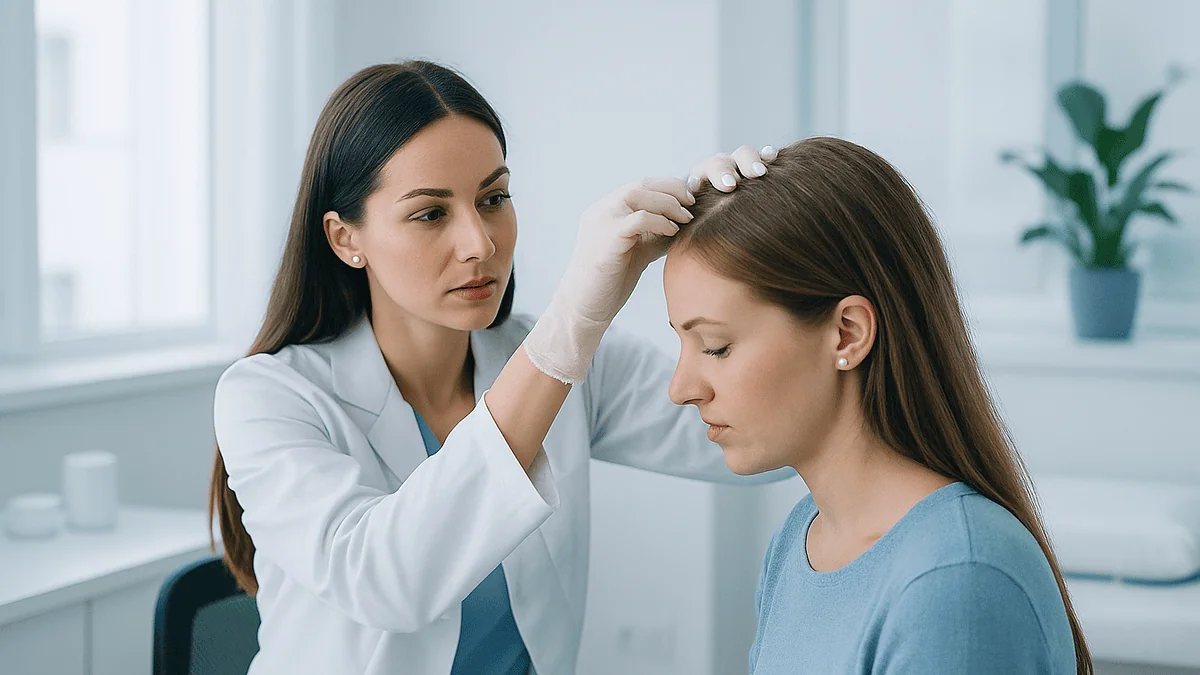
After a female hair transplant, a tight or achy scalp, pinkness, small scabs around each graft, mild forehead swelling and temporary shedding of the transplanted hairs are expected and usually settle over days to a few weeks. Spreading redness, pus, fever, worsening pain or a patch of skin turning dark are not normal and should be reported to the surgical team the same day.
The mirror on day three is where most people lose their nerve. The hairline that looked so tidy on the operating table is now dotted with hundreds of tiny reddish crusts, the forehead has a soft puffiness that seems to be sliding toward the eyebrows, and the scalp feels like a hat two sizes too small. Nobody warned you it would look like this, or perhaps they did and it sounded abstract at the time.
Women describe this moment differently from men. Longer hair hides more, but it also makes the crusting harder to clean around, and a swollen brow is more noticeable when you are the only one in the office who had a procedure last week. Understanding female hair transplant side effects, which ones the skin produces on purpose and which ones signal trouble, turns that day-three panic into a checklist.
This explainer walks through what is happening under the crusts, what the usual timeline looks like, and the handful of signs that deserve a phone call rather than patience.
What actually happens during a female hair transplant
A hair transplant is a skin procedure, not a hair procedure. The surgeon moves living follicles, the tiny sacs in the skin that grow each hair, from an area where they are genetically programmed to keep growing (usually the back and sides of the head) to an area that is thinning. Cleveland Clinic and MedlinePlus describe the two standard methods. Follicular unit extraction, or FUE, removes follicles one small group at a time through punch incisions roughly the width of a pencil tip. Follicular unit transplantation, or FUT, removes a narrow strip of scalp, closes the gap with stitches, and dissects the strip into grafts under magnification.
Either way, the recipient area is prepared with hundreds of small incisions, and each graft is placed by hand at an angle that matches the surrounding hair. The procedure is done under local anesthetic, meaning the scalp is numbed while you stay awake, and typically takes several hours because the work is slow and repetitive.
For women, two details matter more than for men. First, the donor area is often thinner and more diffusely affected, so surgeons tend to be more conservative about how much they take. Second, many women choose not to shave the whole head, which means the surgeon works in a narrow shaved strip hidden under longer hair. That preserved hair is a blessing for privacy and a nuisance during aftercare, because it tends to stick to healing crusts.
Every side effect in the sections that follow traces back to this basic fact: the scalp has just received hundreds to a few thousand controlled micro-wounds, and it responds the way skin always responds to injury, with inflammation, fluid, crust and a temporary pause in hair production.
Which female hair transplant side effects are normal in the first week?
The NHS lists the expected early effects plainly: a tight, achy and swollen scalp for a few days, temporary scabbing where hair was transplanted, and either a single line scar (after FUT) or many very small scars (after FUE). MedlinePlus adds bruising and mild discomfort to that list. None of these are complications. They are the visible side of healing.
Tightness usually peaks in the first 48 hours. The scalp has been injected with anesthetic fluid and has responded with its own inflammatory fluid, so it feels stretched. Achiness in the donor area is common, particularly after FUT, where the closed strip pulls slightly when you turn your neck.
Numbness is the one that surprises people. Small sensory nerves in the scalp are inevitably cut during grafting, and the skin over the recipient area, and sometimes the donor area, can feel wooden or tingly. Cleveland Clinic notes that reduced sensation is a recognized short-term effect; most of it returns over weeks as the nerve endings regrow, though small patches can take longer. Numbness alone, without other symptoms, is not a red flag.
Pinkness across the whole grafted zone is expected, and the individual graft sites look like a fine rash of red dots. A little clear or slightly blood-tinged oozing from the sites in the first day or two is also ordinary; the team will have given you instructions about how to sleep and rinse to manage it.
Bruising, when it happens, tends to appear under the eyes or along the temples a couple of days later, having migrated down from the scalp under gravity. It looks dramatic in photographs and is almost always harmless.
Hair transplant swelling forehead: why it slides toward the eyes
Forehead swelling is the effect most likely to keep a woman home longer than planned. It rarely appears on the day of surgery. Instead, it shows up on day two or three, often as a soft bulge just above the eyebrows that can drift down to puff the upper eyelids and, in some people, briefly narrow the eyes.
The mechanism is simple plumbing. Local anesthetic is delivered in a dilute solution, and the surgeon also injects fluid to lift the scalp so grafts can be placed safely. Add the body’s own inflammatory fluid, and the scalp is holding far more liquid than usual. That fluid has nowhere to go but downhill along the loose tissue plane under the forehead skin, which is why it pools above the brow rather than staying where the grafts are.
The NHS describes this swollen, tight phase as lasting a few days. Most surgical teams advise sleeping with the head elevated for the first several nights and avoiding bending forward, both of which use gravity in your favor. Cool compresses on the forehead (never directly on the grafts) are commonly suggested; the team will tell you exactly what is permitted for your case.
What swelling should not do is hurt sharply, feel hot to the touch, turn deep red, or come with a fever. Those features point to infection rather than fluid, and they are covered in the red-flag section later.
One practical note: because swelling appears after the anesthetic has fully worn off, some women interpret it as a sign that something went wrong on day three. The timing is the tell. Fluid that arrives late and drifts downward is behaving exactly as expected.
Scabbing, redness and itching: what the skin is doing under those crusts
Each graft sits in a small incision, and each incision seals itself with a crust made of dried plasma and a few blood cells. Multiply that by the number of grafts and the recipient area looks stippled with tiny brownish-red dots. The NHS lists this scabbing as an expected, temporary side effect.
Those crusts are doing useful work for roughly the first week, protecting the graft while new capillaries grow in to feed it. Most teams then guide patients through gentle soaking and rinsing so the crusts lift on their own. Picking them off early risks pulling the graft with them, which is one of the few ways a patient can genuinely harm the result. Longer hair around the grafted zone tends to catch in the crusts, so women often need extra patience during washing.
Itching arrives predictably as the crusts loosen and the nerve endings wake up. It is a healing signal, not an allergic one, though it can be intense for a few days. The team may suggest specific rinses or approved products; anything else on the scalp, including home remedies, should be cleared with them first.
Redness lingers after the crusts are gone. New blood vessels in freshly healed skin make it look pink, and in fair-skinned women this can be noticeable for several weeks. Cleveland Clinic describes redness as one of the common effects that fades with time. Sun exposure can prolong or deepen it, which is why hats and shade are part of nearly every aftercare plan.
Small whiteheads appearing weeks later around graft sites are a separate phenomenon, usually mild folliculitis or a trapped hair fragment, and are discussed under the less common effects.
Shock loss after hair transplant: the shedding that alarms everyone
Around two to four weeks after surgery, the transplanted hairs fall out. The NHS describes this shedding window directly, and MedlinePlus notes that the transplanted hair typically falls out within about six weeks, calling it normal. The follicles are still in place under the skin; they have simply entered a resting phase because they were cut off from their blood supply for several hours during the move. When they wake, they push out the old shaft and begin a new one.
A second kind of shedding is more distressing and, for women, more common: shock loss of native hair around the grafts. Thinning hair in a female pattern is often diffuse, meaning grafts are placed among existing, weaker hairs. The trauma of incisions and swelling can tip some of those neighbors into a resting phase too. The result is a temporary thinning that can make the area look worse before it looks better.
Most shock loss recovers as those follicles cycle back into growth over the following months, provided the follicles themselves were healthy. Hairs that were already miniaturized and near the end of their natural lifespan may not return, which is part of why surgeons assess the strength of surrounding hair carefully before recommending surgery to a woman with diffuse thinning.
Shedding is distressing partly because it is silent. Nothing hurts, there is no redness, and the hair simply appears on the pillow. It helps to know in advance that a bare-looking scalp at week four is on the timeline, not off it. New growth, according to the NHS, generally begins around six months, with the fuller picture emerging over 12–18 months.
Who a hair transplant is usually for, and who is usually asked to wait
Not every woman with thinning hair is a surgical candidate, and this matters directly to side effects: the wrong candidate experiences all the same healing but may not gain the growth to justify it.
The best-understood indication is stable female pattern hair loss, the hereditary, hormone-sensitive thinning that Harvard Health and Mayo Clinic describe as widening at the part while the frontal hairline is often preserved. Women with a strong, dense donor area at the back of the scalp and a defined thin zone tend to be the ones offered surgery. Scarring from previous surgery, burns or traction, and hair loss along the temples after facelift procedures, are other situations where grafting is commonly considered.
Several groups are usually asked to wait or are steered toward other management first. Mayo Clinic emphasizes that hair loss needs a cause before it needs a treatment. Women with diffuse shedding across the whole scalp, including the donor zone, may not have enough stable hair to move. Anyone with an active inflammatory scalp condition, such as a scarring alopecia, is generally told that surgery into inflamed skin risks losing grafts and provoking further loss. Recent thyroid disease, iron deficiency, significant weight change, pregnancy, or a new medicine that coincided with shedding all point toward a medical work-up, not a scalpel.
Age and expectations also come up. Hair loss that is still evolving quickly makes it hard to plan a hairline that will look right a decade later. And because a transplant redistributes hair rather than creating it, the treating team will want to know that the hoped-for result matches what the donor area can supply. These decisions rest with the dermatologist or surgeon assessing you; a good consultation spends as long on whether as on how.
Is FUE hair transplant painful? What the sensations actually feel like
Pain during the procedure is mostly about the anesthetic injections. The scalp is numbed with a series of small injections around the donor and recipient areas, and those first minutes sting. Once the local anesthetic takes effect, patients typically feel pressure and vibration rather than sharp pain, and many describe the hours that follow as tedious rather than painful. MedlinePlus and Cleveland Clinic both describe hair transplantation as a local-anesthetic outpatient procedure for this reason.
Afterwards, sensations differ by method. Following FUE, the donor area feels like a large patch of grazed skin: raw and tender for a couple of days, then itchy. Following FUT, the strip site feels tight and can ache when the neck stretches, and the stitches or staples themselves are a source of discomfort until they are removed. Cleveland Clinic notes that FUT recovery tends to involve more donor-site soreness because of the linear wound.
The recipient area is usually less sore than people expect. Numbness dominates in the first week, sometimes for longer, and mild throbbing on the first night is common. Pain that escalates after the second day, rather than easing, is not the usual pattern and should be reported.
Surgical teams typically prescribe or recommend pain relief for the first few days. What is appropriate depends on your other medicines and conditions, so the specific choice and how long to use it belong to the prescribing clinician. Anti-inflammatory tablets, for instance, can affect bleeding and may or may not be suitable in your case.
Women who have had other minor skin procedures often say the recovery discomfort is comparable, with the difference that it is spread across a large area and sits where a hairbrush wants to go.
Normal healing or a problem? A side-by-side guide
Most of the anxiety after surgery comes from not knowing which column a symptom belongs in. The table below summarizes the patterns described by the NHS, MedlinePlus and Cleveland Clinic. It is a guide for deciding when to pick up the phone, not a tool for diagnosing yourself; when in doubt, the team that operated would rather hear from you than not.
| What you notice | Usually expected | Worth a call the same day |
|---|---|---|
| Swelling | Soft forehead puffiness appearing day 2–3, easing over a few days | Hot, hard, rapidly enlarging, or with fever |
| Redness | Even pinkness over the grafted zone, fading over weeks | Spreading, streaky, deep red or purple, or painful to touch |
| Scabs | Fine dry crusts that lift with gentle washing after the first week | Wet, yellow or green crusts, foul smell, or scabs that keep re-forming |
| Pain | Tightness and aching for a few days, improving daily | Pain that increases after day 2 or is severe on one side |
| Bleeding | Light oozing in the first 24–48 hours | Bleeding that soaks a dressing or does not stop with gentle pressure |
| Shedding | Transplanted hairs falling out at 2–6 weeks | Skin coming away with the hair, or bald patches with open sores |
| Numbness | Reduced sensation over weeks, gradually returning | New weakness of the face or scalp muscles |
| Skin color | Pink or slightly bruised | Any area turning grey, dusky or black |
Two patterns cut across every row. Expected effects improve day by day, even if slowly; problems get worse or plateau. And expected effects are symmetrical, affecting the whole treated area evenly, whereas infection and compromised blood flow tend to be localized to one patch. If a symptom breaks either rule, treat it as belonging to the right-hand column.
Hair transplant recovery for women: what the weeks usually look like
Timelines below are typical ranges drawn from the NHS, MedlinePlus and Cleveland Clinic, not guarantees. Individual healing varies with skin type, the method used, the number of grafts and general health, and your own team’s schedule for check-ups and washing should always override a general article.
In the first two to three days, expect tightness, pinkness, light oozing and, from day two, the migrating forehead swelling. Sleeping propped up and keeping hands away from the scalp are the main tasks. Many women plan to be at home during this window.
Days four to ten bring the crusting phase. Swelling recedes, bruising may appear and fade, and itching starts. Gentle washing as instructed loosens crusts progressively. Stitches after FUT are commonly removed toward the end of this period. Redness persists but the scalp starts to look like skin again rather than a wound.
Weeks two to six are the shedding weeks. Transplanted hairs fall out, some native hair may thin from shock loss, and the area can look sparser than before surgery. Numbness is usually improving. This is the emotionally hardest stretch precisely because the visible evidence seems to be going backwards.
Months two to five are quiet. The scalp looks settled, redness has largely faded, and little appears to be happening on the surface while follicles rebuild underneath. Fine, sometimes lighter or curlier hairs begin to appear toward the end of this window.
From around six months, according to the NHS, new growth becomes visible, thickening progressively. The fuller result is generally assessed at 12–18 months, when the new hairs have matured in texture and length. Any judgment about density, or about whether a second session is worthwhile, is normally deferred until then.
Is there a downside? Less common female hair transplant side effects
The everyday effects above are near-universal and self-limiting. A second tier of problems is uncommon but real, and honest counseling covers them. The NHS names the main risks: bleeding, infection, allergic reaction to the anesthetic, transplanted follicles dying so no new hair grows, and hair growth that does not look natural.
Infection is the complication patients fear most and, with sterile technique and aftercare, the one they are least likely to meet. When it occurs it is usually localized: a cluster of graft sites becomes increasingly red, tender and moist, sometimes with fever. Prompt assessment matters because untreated infection can destroy grafts and leave scarring. Folliculitis, an inflammation of individual follicles that looks like small pimples, is a milder and more frequent cousin, often appearing weeks later as hairs try to emerge through healing skin.
Poor graft survival shows up not as a symptom but as an absence: patches where expected growth never arrives. Causes range from grafts drying out during the procedure to disturbed crusts to smoking, which narrows small blood vessels. Skin necrosis, where a patch of scalp loses its blood supply and darkens, is rare but serious and is a reason to seek same-day care.
Scarring differs by method. FUT leaves a linear donor scar that can widen in some people; FUE leaves scattered pale dots. Both are usually concealed by hair of ordinary length, but women who wear very short styles, or who form thick keloid scars, need a specific conversation about this. Small cysts at graft sites, persistent numbness, and a hairline placed too low or at the wrong angle round out the recognized downsides. Cleveland Clinic and MedlinePlus list these as recognized but infrequent risks; how often each occurs varies widely between reports, and your team should discuss their own experience with you.
Is hair transplant successful in females, and what happens 10 years later?
Success depends on how the question is framed. The follicles that survive the move keep the genetic programming of their origin, so hair transplanted from the resistant zone at the back of the head generally continues to grow in its new location for as long as it would have grown where it came from. Cleveland Clinic describes transplanted hair as permanent in this sense. That is the biological basis of the procedure.
The honest caveat is that a transplant does nothing to the hair around it. Female pattern hair loss is a progressive condition; Harvard Health and Mayo Clinic both describe it as tending to advance with age and after menopause. A decade on, the grafts may be exactly where they were placed while the native hair between them has continued to thin, which can leave the transplanted area looking isolated or the overall pattern looking uneven. Some women choose a further session; others combine surgery with medical management aimed at slowing the background loss. Mayo Clinic notes that medicines for female pattern loss work by extending the growth phase or modifying hormone effects on follicles and need to be continued to keep their benefit. Whether any of those is suitable, and for how long, is a decision for the prescribing clinician.
Published success rates vary widely with how success is defined (graft survival, density gained, patient-reported satisfaction) and with patient selection, so a single percentage would be misleading and none is quoted here. What the evidence supports is a more modest statement: in well-selected women with a stable donor area, transplanted follicles generally survive and grow long term, while the appearance over ten years depends on how the untreated hair behaves and on whether the original plan anticipated that change.
What people often get wrong about side effects after a female hair transplant
“If the hair falls out, the transplant failed.” The opposite is closer to the truth. Shedding of transplanted hair at two to six weeks, described by both the NHS and MedlinePlus, is the follicle resetting its cycle. Failure looks like an area that never grows at all many months later, not like early shedding.
“Swelling on day three means infection.” Delayed forehead swelling is fluid moving downhill and is expected. Infection is hot, localized, increasingly painful and often accompanied by fever or discharge. The two are distinguishable by feel and by trajectory.
“Scabs should be removed so the grafts can breathe.” Crusts protect grafts during the first week and are meant to lift gradually with the washing routine your team prescribes. Early picking is one of the few patient actions that can genuinely dislodge grafts.
“Women don’t get good results.” The distinction is not sex but pattern. Women with a stable donor area and a defined thin zone have the same biological prospects as men; women with diffuse loss affecting the donor area are poor candidates of either sex. Careful selection, not gender, predicts outcome.
“Redness that lasts a month means something is wrong.” New skin is pink because it is full of new capillaries, and fair skin stays pink longer. Cleveland Clinic lists lingering redness among the ordinary effects. Redness that spreads, darkens or hurts is the version to report.
“Once it heals, it’s finished.” The surgery is finished; the condition is not. Background thinning continues, and any plan that ignores this tends to disappoint a decade later. The most useful mindset is to treat the transplant as one part of managing a long-term condition rather than as a one-time fix.
Questions to ask your care team before and after surgery
A well-informed consultation is the best protection against both avoidable complications and avoidable disappointment. These are questions women commonly find useful; the answers belong to the treating team, not to a magazine article.
- What is the cause of my hair loss, and has it been confirmed? Has anyone checked for thyroid, iron or hormonal contributors, as Mayo Clinic recommends before treatment?
- Is my donor area stable enough, and how many grafts can it realistically supply over my lifetime, not just for this session?
- Which method are you recommending for me, FUE or FUT, and why? What will the donor scar look like with my usual hairstyle?
- How much of the surrounding hair is at risk of shock loss, and how do you plan the hairline to allow for future thinning?
- What exactly should the first week look like, and what is your protocol for washing, sleeping and returning to exercise or work?
- Which medicines and supplements should I stop or continue beforehand, and who decides that?
- What pain relief will be provided, and what should I avoid taking on my own?
- Which signs should prompt a same-day call, and how do I reach the team out of hours?
- When are the follow-up visits, and at what point will you judge the result?
- Is medical management of the background hair loss part of the plan, and who will supervise it long term?
Write the answers down. Recovery instructions given on the day of surgery are easily forgotten under the influence of a long procedure and a sore scalp, and having them in writing removes the temptation to rely on online forums when a crust looks odd at midnight.
When to call your doctor
Most of what you will see and feel after a female hair transplant is healing, and most of it improves a little each day. The signs below are the exceptions. They are drawn from the risks the NHS, MedlinePlus and Cleveland Clinic list for the procedure, and each warrants contacting the surgical team the same day, or urgent care if the team cannot be reached.
- Fever, chills or feeling generally unwell in the days after surgery.
- Redness that spreads outward from the grafted or donor area, becomes streaky, or turns deep red or purple.
- Swelling that is hot, hard, painful to touch, or enlarging rapidly rather than softening.
- Pus, yellow or green discharge, a foul smell, or crusts that stay wet and keep re-forming.
- Pain that increases after the second day instead of easing, or severe pain confined to one spot.
- Bleeding that soaks through a dressing or does not stop with several minutes of gentle pressure.
- Any patch of scalp turning grey, dusky or black, which can indicate compromised blood supply.
- New weakness or drooping of facial muscles, or numbness that is worsening rather than improving.
- Signs of an allergic reaction: hives, facial or lip swelling, wheeze or difficulty breathing, which need emergency care immediately.
- Stitches that open, or a donor wound that gapes or bleeds.
Two other situations deserve a scheduled, rather than urgent, conversation. If the shedding phase seems to be taking your native hair well beyond the treated zone, or if by the six-to-nine-month mark you see no sign of new growth at all, the team should review you. Neither is an emergency, but both are questions the operating surgeon is best placed to answer, and both are easier to address early than late. Whatever the concern, every decision about further treatment, medicines or revision belongs with the clinicians who know your scalp.
Frequently asked questions
Is hair transplant successful in females?
It can be, when the candidate is well selected. Women with a stable, dense donor area at the back of the scalp and a defined thin zone have the same biological prospects as men, because transplanted follicles keep growing in their new site. Women with diffuse thinning that also affects the donor area are usually poor candidates. Published success figures vary so widely with definitions and patient selection that no single percentage is reliable, and your team’s assessment of your own scalp matters more.
Is FUE hair transplant painful?
The anesthetic injections sting for a few minutes; after that, most people feel pressure and vibration rather than pain. Afterwards the donor area feels like a large grazed patch for a couple of days, then itches, and the recipient area is often more numb than sore. Pain that eases day by day is expected. Pain that increases after the second day, or is severe in one spot, should be reported to the surgical team the same day.
How long does hair transplant swelling on the forehead last?
Typically a few days. The NHS describes the tight, swollen phase as lasting a few days after surgery. Swelling usually appears on day two or three, drifts toward the eyebrows and sometimes the eyelids, and then softens. Sleeping with the head raised and avoiding bending forward help gravity drain it. Swelling that is hot, hard, painful or accompanied by fever is a different pattern and needs same-day assessment.
Is shock loss after hair transplant permanent?
Usually not. Shock loss is the temporary shedding of native hairs around the grafts, triggered by the trauma of incisions and swelling; the follicles enter a resting phase and most cycle back into growth over the following months. Hairs that were already severely miniaturized may not return, which is why surgeons assess the strength of surrounding hair before recommending surgery to women with diffuse thinning. Persistent thinning well beyond the treated area should be reviewed by the team.
What does hair transplant recovery for women usually involve?
The first three days bring tightness, pinkness and delayed forehead swelling. Days four to ten are the crusting and itching phase, with gentle washing lifting scabs. Weeks two to six bring shedding of transplanted hairs and sometimes shock loss. Months two to five are quiet while follicles rebuild. New growth generally becomes visible from around six months, and the fuller result is assessed at 12–18 months, according to the NHS. Individual timelines vary.
What happens 10 years after a hair transplant?
Surviving grafts generally continue to grow, because they keep the genetic programming of the resistant donor zone they came from. The surrounding native hair, however, continues to follow the pattern of female hair loss, which Harvard Health and Mayo Clinic describe as progressive. A decade on, the grafts may look isolated if background thinning was not managed or anticipated in the original plan. Further sessions or ongoing medical management are options your team can discuss.
Is there a downside to hair transplant?
Yes, several. The NHS lists bleeding, infection, allergic reaction to anesthetic, follicles failing to grow, and unnatural-looking results as recognized risks. Scarring is inevitable, either a line after FUT or scattered dots after FUE. Shock loss can temporarily worsen appearance, numbness can persist, and the procedure does not stop the underlying condition. Time, cost in effort, and the need to plan for future thinning are practical downsides that a thorough consultation should cover.
Why do I have pimples on my scalp weeks after a hair transplant?
Small whiteheads appearing weeks after surgery are usually folliculitis, an inflammation of individual follicles, often caused by new hairs struggling to emerge through healing skin or a trapped hair fragment. It is a recognized, generally mild effect. A few scattered spots are common; a cluster that is spreading, painful, or draining pus should be checked by the team, since occasionally it represents infection or a small cyst that needs attention.
How long does redness last after a hair transplant?
Pinkness over the grafted area commonly persists for several weeks and fades gradually, longer in fair-skinned people, because newly healed skin is full of fresh capillaries. Cleveland Clinic lists lingering redness among the ordinary effects. Sun exposure can deepen and prolong it, which is why shade and head covering feature in most aftercare plans. Redness that spreads, becomes streaky, darkens toward purple, or becomes painful is not the normal pattern and should be reported.
Can I wash my hair after a transplant, and when?
Yes, but only according to the schedule your surgical team gives you. Most teams begin gentle rinsing within the first few days and progress to careful washing that loosens crusts over the first week or two. The aim is to let scabs lift on their own without dislodging grafts. Products, water pressure and technique vary between teams, so follow their written instructions rather than general advice, and ask before using anything not on their list.
References
This article is for general information only and is not a substitute for professional medical advice. Please consult a qualified doctor about your individual situation.

More from the Blog
Who Is a Good Candidate for DHI Hair Transplant? Hairline Refinement and Small-Area Density
A good DHI hair transplant candidate usually has stable pattern hair loss, a healthy donor area at the back and sides of the scalp,…
Hair Operations After 60: How Age, Scalp Laxity and Health Conditions Change the Plan
People over 60 can often have hair transplant surgery, because age alone is not the deciding factor. Surgeons weigh scalp laxity, how much stable…
Hair Transplant Cost: Turkey vs USA vs UK: the Honest Comparison Table
A hair transplant in Turkey typically costs a fraction of the same procedure in the USA or UK. Our guide range for an all-inclusive…
DHI Hair Transplant Recovery: When Scabs Lift, When Hats Are Allowed and When Sport Returns
After a DHI hair transplant, the tiny crusts around each graft usually loosen and lift over roughly one to two weeks, helped by the…
Second Hair Transplants: When a Touch-Up Makes Sense and How Many You Can Have
A second hair transplant can make sense when hair loss has progressed around a first procedure, when you want more density, or when an…
PRP for Hair Loss Myths: One Session, Instant Regrowth and Other Misconceptions Corrected
PRP for hair loss is a series of scalp injections using a concentrate of a person's own platelets, not a single-visit fix. Published protocols…