

Which Sleeping Position Protects Grafts After an FUE Hair Transplant? Elevation and Pillows
Key Takeaways
- Grafts are held only by clot and tissue fluid in the first days, so the real risk from sleep is repeated friction or hours of pressure on the recipient area, not a single light touch.
- Raising the head and upper body above heart level gives swelling a downhill route away from the forehead, which is why most teams ask for elevation for roughly the first week.
- NHS guidance frames about the first 2 weeks as the period for extra care of the scalp, and many surgeons reintroduce side sleeping only after examining the grafts at that point.
- The donor area at the back and sides generally tolerates gentle resting pressure, so a frontal-only case can often rest the back of the head on a normal pillow.
- Shedding of transplanted hairs within about 6 weeks, described by MedlinePlus as normal, is a follicle cycle event and not a sign that sleeping position damaged the grafts.
- No pillow product has evidence of improving graft survival; what matters is elevation, blocking head rotation, a clean pillowcase, and keeping partners and pets off the bed early on.
After an FUE hair transplant, most care teams ask patients to sleep on their back with the head raised on pillows or a wedge for roughly the first week, keeping the newly placed grafts off the pillow. Elevation helps limit forehead swelling, and a supported neck stops the head rolling onto the recipient area. Side sleeping is usually reintroduced only when the clinician confirms the grafts have settled.
It is 2 a.m. on the night of the procedure, and you are lying stiffly on your back, eyes open, convinced that one wrong turn of the head will undo the whole day. The scalp feels tight, the bandage crinkles, and every time you drift off you jolt awake to check that the pillow has not migrated. Almost everyone who has had a follicular unit extraction feels some version of this on night one.
The worry is understandable, but it is also out of proportion to the actual risk, provided you follow a few simple mechanics. Sleeping after FUE hair transplant surgery is less about staying frozen and more about two things: keeping pressure and friction off the recipient area, and keeping the head above heart level so fluid drains away from the forehead rather than into it.
This explainer walks through why those two principles matter, what the evidence and mainstream guidance actually say about timing, which pillow setups people find workable, and when a restless night is simply a restless night versus a sign to pick up the phone.
Why sleeping after FUE hair transplant matters more than most people expect
Follicular unit extraction, or FUE, is a method of hair transplant in which individual follicular units (natural clusters of one to four hairs) are removed one by one from a donor area, usually the back and sides of the scalp, and placed into tiny incisions in the thinning area. MedlinePlus describes the procedure as day surgery done under local anesthesia, with the scalp typically sore for a few days afterward.
What makes sleep relevant is the state of those grafts in the first nights. Each transplanted unit sits in a shallow slit held in place initially by clotted blood and tissue fluid, not by anything structural. The tiny wound has to be left undisturbed long enough for the surrounding skin to knit around it. Sleep is the longest stretch of the day in which you are not consciously protecting your head, and it involves a pillow, a partner, possibly a pet, and several hours of unplanned movement.
The other issue is fluid. Local anesthetic solution and the body’s inflammatory response both add volume to the scalp. Cleveland Clinic lists swelling among the expected effects after a hair transplant, and gravity decides where that fluid goes. Lying flat lets it track forward toward the brow and, in some people, down around the eyes over the next two or three days. Raising the head does not prevent swelling, but it gives fluid a downhill route away from the face.
None of this means the grafts are fragile in the way a soap bubble is fragile. It means the first week rewards a boring, predictable routine at bedtime, and that is a very achievable goal.
What actually happens to a graft in the first nights
Understanding the biology takes most of the fear out of the pillow question. When a follicular unit is placed into its recipient slit, it is out of its blood supply. For the first day or so it survives on diffusion of oxygen and nutrients from the surrounding tissue fluid, a process sometimes called plasmatic imbibition. Over the following days, small blood vessels from the scalp begin to grow into the graft and reconnect it to the circulation.
During this window three things can dislodge or damage a graft: direct pulling, sustained pressure, and shearing (a sideways rub across the surface). A pillow does not pull, but it can rub if the head slides across it, and it can press if the recipient area rests on it for hours. This is why the standard advice is not “do not touch your head” in a vague sense, but specifically “keep the recipient area off surfaces” until the grafts are anchored.
The scabs that form around each graft are part of that anchoring. NHS guidance on hair transplants notes that small crusts form in the recipient area and fall away on their own over the following weeks, and that gentle washing is usually permitted after a couple of days. A pillowcase that catches those crusts and pulls them prematurely is the realistic hazard, far more than a moment of light contact.
Timing is where most sources converge. The NHS advises taking extra care of the scalp for about the first 2 weeks after a hair transplant. MedlinePlus notes that the transplanted hairs commonly shed within roughly 6 weeks before regrowth begins, which is expected and not a sign the grafts were lost. Your own surgeon will give a more specific day count for your case, and that instruction overrides anything general.
How to sleep after hair transplant surgery: the back-and-elevated position
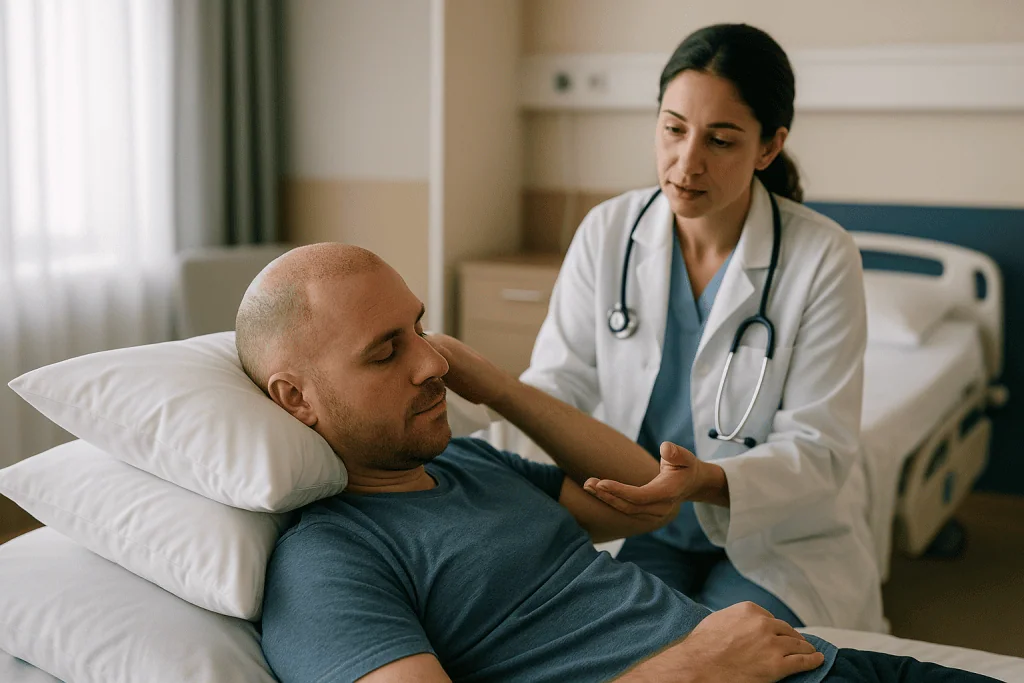
Most care teams recommend the same starting position: on your back, head and upper body raised, with the neck supported so the head does not roll to one side. The point of the elevation is drainage; the point of the neck support is to stop involuntary turning while you sleep.
Elevation does not have to be dramatic. A raise of the head and shoulders that would let you comfortably read a book is generally the target described in patient information from Cleveland Clinic and similar sources. Propping only the head, with the neck bent sharply forward, tends to cause neck ache and is harder to hold for a full night. Raising the whole torso on a wedge or a stack of pillows that begins under the shoulder blades is more sustainable.
The recipient area should rest on nothing. If grafts were placed at the crown, the head needs to float slightly above the pillow surface, which is where a horseshoe-shaped travel pillow around the neck earns its reputation. If grafts were placed only along the hairline and front, a normal pillow behind the back of the head is usually acceptable because the back of the head is donor tissue, which tolerates gentle pressure.
Getting in and out of bed matters as well. Lowering yourself onto the wedge slowly, rather than flopping backward, avoids a head-first landing. When rising, roll toward the side, push up with the arms and keep the head still. These are small habits, but they remove the two moments in the night when most accidental contact happens.
Finally, bedtime is a good moment to check the first-night dressing if you were sent home with one. MedlinePlus notes bandages are typically worn for a day or two; the surgeon will tell you whether to remove it before sleep or leave it until the follow-up visit.
How much elevation is enough, and can you overdo it?
Patients often ask for an exact angle. The honest answer is that no guideline specifies one, because the goal is functional rather than geometric: keep the head above the heart and keep the recipient area off the pillow. In practice, people describe this as sleeping “half sitting” for the first few nights and then “slightly propped” as swelling subsides.

Too little elevation and you may wake with a puffier forehead than necessary; the swelling is not dangerous, but it is uncomfortable and can drift toward the eyelids by the second or third day. Too much elevation, closer to fully upright in a chair, tends to cause a different problem: the head drops forward or sideways as you fall into deeper sleep, and the neck stiffens. Fully upright sleeping is also associated with restless, fragmented sleep, which slows recovery in its own right.
A useful test is to lie in the chosen position for ten minutes while awake. If your chin is on your chest or you feel pressure at the back of the neck, the setup is too steep or the support is in the wrong place. If your head can swivel freely, add something on each side to block the roll.
Where you feel the elevation also depends on where the grafts are. Frontal hairline work is mostly about swelling control, so moderate elevation is the priority. Crown work is mostly about keeping the top of the head off the surface, so the neck pillow arrangement matters more than the height. Combined cases need both.
Whatever you settle on, the surgeon’s written aftercare sheet is the reference. If it names a number of nights or a number of pillows, follow that figure rather than a forum consensus.
Hair transplant pillow setups compared
There is no single correct pillow, and no product needs to be bought for recovery to go well. What matters is that the arrangement achieves three things: elevation of the torso, support that stops head rotation, and no contact between the recipient area and any surface. The table below compares the common approaches patients describe, with their practical trade-offs.
| Setup | What it does well | Typical drawback | Most useful when |
|---|---|---|---|
| Two or three ordinary pillows stacked under head and shoulders | Uses what you have; adjustable height | Pillows slip apart overnight; head can roll | Frontal grafts only, light sleeper |
| Foam wedge under the upper body | Stable, even elevation from waist up | Bulky; some find the firmness uncomfortable | Noticeable swelling, or a history of reflux |
| Horseshoe travel pillow around the neck | Keeps crown and back of head off the surface | Can shift if too loose; does not raise the torso by itself | Crown or mid-scalp grafts |
| Wedge plus travel pillow combined | Elevation and rotation control together | Takes a night or two to get used to | Combined frontal and crown cases |
| Recliner chair | Hard to roll over accidentally | Neck stiffness; poorer sleep quality | Short term only, if bed setups fail |
A soft, clean pillowcase is more important than the pillow inside it. Many surgeons suggest a fresh case each night for the first week and a dark or disposable cover on the first night, when a little tissue fluid or blood-tinged ooze from the donor area is common. MedlinePlus lists minor bleeding among the expected early effects, so a stained pillowcase on night one is not, by itself, a reason for alarm.
Sleeping on side after hair transplant: when is it usually allowed?
Side sleeping is the position most people miss. It is also the one that causes the most anxiety, because it puts the temple and the side of the head, where hairline grafts often extend, directly onto the pillow.
The general pattern in patient guidance is staged. During the period of highest caution, which the NHS frames as roughly the first 2 weeks of taking extra care with the scalp, back sleeping is preferred and side sleeping is discouraged where it would bring grafts into contact with the pillow. Many surgeons relax this earlier for people whose grafts are confined to the front, once crusts have begun to lift and the grafts feel secure at a follow-up check. Others hold the line for the full two weeks. Both approaches are reasonable; the difference reflects the surgeon’s assessment of graft placement and density, not a right-or-wrong answer.
If you roll onto your side involuntarily during the night, the practical question is what part of the head landed where. Donor tissue at the back and sides can tolerate gentle resting pressure. Recipient grafts along the temples cannot, at least not repeatedly. A rolled towel or a firm pillow placed against each side of the torso acts as a physical reminder and is the simplest fix for habitual rollers.
Stomach sleeping is the one position that almost every team asks patients to avoid outright in the early weeks, because it puts the whole front of the scalp in contact with the pillow and encourages face-first pressure. If stomach sleeping is your only comfortable position, raise this with the surgeon before the procedure rather than after, because it may change how they coach you.
Whatever you were told, the return to side sleeping should follow the clinician’s confirmation, not a calendar milestone read online.
When can I sleep normally after hair transplant? A typical timeline
Recovery from sleeping after FUE hair transplant surgery follows a fairly predictable arc, though individual instructions vary and always take priority over the ranges below.
Nights one to three. This is the period of maximum caution. Back sleeping with elevation is the norm, and most people notice the scalp is tender rather than painful. MedlinePlus describes the scalp as sore for a few days and notes that bandages, if used, come off within a day or two. Forehead swelling, when it happens, often appears on day two or three rather than immediately.
Days four to seven. Swelling usually starts to recede. Crusts are well formed around each graft. Elevation can often be reduced gradually as swelling settles, but the recipient area still needs to stay off surfaces. Gentle washing, which the NHS says is usually permitted after a couple of days, begins to soften the crusts.
Week two. The NHS advises continued extra care for the scalp through about 2 weeks. Many surgeons review patients around this point and, if the grafts are anchored and crusts are lifting, clear a return to preferred sleeping positions. Some ask for one more week of caution on the recipient area specifically.
Weeks two to six. Expect shedding. MedlinePlus notes that transplanted hairs commonly fall out within 6 weeks of surgery, with new growth beginning over the following months. This shedding is a normal phase of the follicle’s cycle and is not caused by how you slept.
Beyond six weeks. Sleep position no longer affects graft survival. The remaining question is comfort, and any residual donor-area tenderness typically resolves on its own. Regrowth is gradual; the NHS notes it can take around 6 months for the new hair to begin appearing meaningfully.
Swelling, itching and the medicines that affect your nights
Two symptoms drive most of the poor sleep in the first week: forehead swelling that makes the face feel tight, and itching once the scalp begins to heal.
Swelling is fluid, and elevation is the main non-drug tool against it. Some surgeons also prescribe a short course of an anti-inflammatory medicine, which works by dampening the body’s inflammatory response and the fluid leakage that comes with it. Whether one is appropriate, and for how long, is a decision for the prescribing clinician, who weighs it against your other conditions and medicines. Cool compresses applied to the forehead, never to the grafts themselves, are a commonly suggested comfort measure.
Pain is usually modest after FUE. Mayo Clinic lists soreness, bruising and swelling among the expected effects of hair transplant surgery, and most patients describe the donor area as the tender part rather than the recipient area. Simple pain relief may be advised; the clinic will tell you which class is preferred and which to avoid, since some over-the-counter pain relievers affect bleeding. Follow that guidance exactly and do not add or swap medicines on your own.
Itching typically arrives around day three to seven as nerve endings recover and crusts dry. It is a healing sign, but it is also the moment when a sleeping hand does the most damage, because scratching in half-sleep can lift a crust and the graft beneath it. Keeping fingernails short, wearing soft cotton gloves for a few nights, and asking the care team whether a saline spray or an antihistamine is appropriate are the usual strategies. Antihistamines work by blocking histamine receptors involved in the itch response; some cause drowsiness, which is why they should only be used if your clinician agrees.
If you were given an antibiotic, which MedlinePlus notes some patients receive, complete it as prescribed regardless of how the scalp looks.
Setting up the bedroom: partners, pets and the small details that matter
The mechanics of protecting grafts extend beyond the pillow. A few practical adjustments make the first week far easier.
Bed partners are the most common unplanned contact. A stray arm across the head at 3 a.m. is more likely to disturb a graft than anything you do yourself. For the first several nights, many people sleep alone, or place a firm pillow barrier between the two sides of the bed. Sharing this plan with your partner in advance avoids awkwardness later.
Pets that sleep on the bed are a different kind of risk: they carry bacteria on paws and fur, and cats in particular are drawn to heads. Keeping animals out of the bedroom for the first week or two is a reasonable infection-prevention step, and it removes the chance of a paw landing on a fresh crust.
Headboards and walls catch people who sit up suddenly. Moving the bed a few inches from the wall, or hanging a soft blanket over a hard headboard, removes one of the most common ways people bump the recipient area in the first days.
Room temperature deserves a thought. A hot room makes the scalp sweat, which softens crusts prematurely and worsens itching. A cool, well-ventilated room is more comfortable and reduces the urge to scratch.
Finally, prepare the bedside: water, tissues, a phone with the clinic’s after-hours number, and whatever saline spray or aftercare product you were given. Fumbling in the dark for these things is how heads get knocked. Keep the path to the bathroom clear, since anesthetic fluid and any prescribed anti-swelling medicine can increase night-time trips.
None of this is complicated. The theme is simply reducing the number of times, per night, that something unexpected reaches your head.
Who FUE is usually for, and who is usually asked to wait
Sleeping advice only matters if the procedure itself is appropriate, so it is worth being clear about who generally proceeds and who is typically asked to hold off.
FUE is most often offered to adults with pattern hair loss, called androgenetic alopecia, who have a stable donor area at the back and sides of the scalp dense enough to supply grafts without visible thinning. Mayo Clinic describes hair transplantation as an option when medical treatments are insufficient, and notes that more than one session may be needed to achieve the intended density. The NHS characterizes it as a cosmetic procedure that is rarely funded by public health services and that requires careful consideration of expectations.
People commonly asked to wait or to consider alternatives include those whose hair loss is still progressing rapidly, because grafts placed today may end up isolated as surrounding hair continues to thin; those with active scalp conditions such as uncontrolled inflammation or infection; those with diffuse thinning that also affects the donor area; and those with certain autoimmune forms of hair loss, where transplanted follicles may be attacked in the same way as native ones. Cleveland Clinic also flags that people with unrealistic expectations of density or coverage are better served by a frank conversation before surgery.
Medical factors matter too. Conditions or medicines that affect clotting, poorly controlled diabetes, and smoking all influence healing and may prompt the team to optimize those issues first. The decision to proceed, delay or choose a non-surgical route sits with the treating team after examination.
Alternatives include medical therapies for pattern hair loss, which work by different mechanisms and require ongoing use to maintain effect, and non-intervention with cosmetic camouflage. MedlinePlus and Mayo Clinic both describe these as legitimate paths, not consolation prizes.
What can go wrong if the grafts are disturbed during sleep
It helps to be specific about risk, because vague fear leads to sleepless nights and specific knowledge leads to sensible caution.
The realistic consequence of a single light brush against the pillow is nothing. Grafts are placed with a small amount of tissue tension holding them, and the clot forms quickly. The realistic consequence of repeated rubbing, sustained pressure on the recipient area for several hours, or a crust being pulled off with force is that a small number of grafts may be dislodged or fail to establish. Cleveland Clinic and MedlinePlus both note that not every transplanted follicle survives even under ideal care, so a scattering of lost grafts is not a catastrophe, though it is worth avoiding.
Bleeding from a dislodged graft is typically minor and stops with gentle pressure using clean gauze, not rubbing. If a graft is visibly out and lying on the pillow, it cannot be replaced at home; the instruction from most teams is to leave the site alone and mention it at follow-up.
Infection is uncommon but is the outcome that changes management. MedlinePlus lists infection among the possible complications of hair transplantation. Risk factors include contamination of the wound surface, which is where dirty pillowcases, pets and scratching with unwashed hands come in. Signs are covered in the red-flag section below.
Folliculitis, an inflammation of hair follicles that looks like small pimples in the recipient or donor area, can occur in the weeks after surgery and is generally manageable; it is not usually caused by sleep position but can be irritated by friction.
The point of listing these is proportion. Sleeping badly for a night is not a disaster. A consistent routine over the first two weeks is what protects the result, and that routine is achievable for almost everyone.
What people often get wrong about sleep after a hair transplant
“I have to stay awake or sleep sitting bolt upright.” Neither is necessary. Moderate elevation on your back is the standard; fully upright sleeping worsens sleep quality and neck strain without adding protection.
“If I roll over once, the grafts are gone.” A brief, light contact is very unlikely to dislodge anything. The concern is repeated friction or hours of pressure on the recipient area, not a single movement.
“The shedding at week three means I damaged them while sleeping.” MedlinePlus notes that transplanted hairs commonly fall out within about 6 weeks as the follicle enters a resting phase before regrowth. This is expected and unrelated to sleep position.
“A special pillow guarantees success.” No product has evidence of improving graft survival. Pillows of any kind are tools for elevation and rotation control. The evidence base supports the principles, not the merchandise.
“Elevation prevents all swelling.” It reduces where fluid collects and how much reaches the face, but some swelling after a hair transplant is expected according to Cleveland Clinic, and a puffy forehead on day three does not mean you slept wrong.
“Once the crusts are gone, I can do anything.” Crust loss is a good sign, but the timing of a return to side or stomach sleeping is the surgeon’s call based on examination. Two weeks is a common reference point in NHS guidance, not a universal switch.
“Donor area scabs mean I should not lie on the back of my head at all.” The donor area heals differently from the recipient area and generally tolerates gentle resting pressure. The exception is if your surgeon has said otherwise for your case.
“Alcohol will help me sleep through it.” Alcohol fragments sleep, increases restless movement and can worsen swelling and bleeding tendency. Most teams ask patients to avoid it in the early recovery period.
Questions to ask your care team before you go home
The most useful conversation about sleep happens before the procedure, when you can plan the bedroom. If it did not, the discharge appointment is the second-best moment. These questions tend to surface the information that generic articles cannot give you.
- Where exactly are my grafts placed? Knowing whether the crown, the temples or only the frontal hairline was treated tells you which parts of the head can touch a pillow.
- For how many nights do you want me elevated, and how many nights on my back only? Ask for a number written on the aftercare sheet.
- When will you check the grafts, and is that the point at which I can return to side sleeping?
- Should I leave the dressing on for the first night or remove it before bed?
- What should I do if I wake up and notice blood or a graft on the pillowcase?
- Which pain relievers are acceptable, and which should I avoid because they affect bleeding?
- Are you prescribing anything for swelling or itching, and does it cause drowsiness or affect sleep?
- When can I first wash my hair, and how does that change my bedtime routine?
- Is there an after-hours number I can call if something worries me at night?
- Are there signs that would make you want to see me sooner than the planned follow-up?
Write the answers down. The combination of a long day, local anesthetic and mild sedation, if any was used, makes verbal instructions easy to misremember. A partner or friend at the discharge conversation is worth more than any pillow.
If instructions from the clinic and something you read online disagree, the clinic wins. They have seen your scalp; the internet has not.
When to call your doctor
Most nights after FUE are uneventful, and a little oozing, tightness or itching is part of normal healing. Certain signs, however, should prompt a same-day call to the clinic or, if severe, urgent medical attention. Mayo Clinic and MedlinePlus both list bleeding, infection and swelling among the possible complications of hair transplantation; the task is telling expected from concerning.
Contact the care team promptly if you notice any of the following:
- Bleeding that does not slow after several minutes of gentle pressure with clean gauze, or that soaks through dressings.
- Increasing pain after the first few days rather than steady improvement, or pain that wakes you and is not eased by the relief you were advised to use.
- Spreading redness, warmth, or a hard, tender area in the donor or recipient region.
- Pus, cloudy discharge, or a foul smell from any part of the scalp.
- Fever, chills, or feeling generally unwell.
- Swelling that closes an eye, involves the face beyond the forehead, or worsens sharply after day three or four.
- Numbness or tingling that spreads or intensifies rather than gradually settling.
- Several grafts visibly out of place, or an area that suddenly looks bald where grafts were.
Seek emergency care immediately for difficulty breathing, swelling of the lips or tongue, a widespread rash, or a feeling of faintness, since these can indicate a serious allergic reaction to a medicine or dressing.
Do not wait until the scheduled follow-up if something feels wrong. Clinics expect these calls, and early assessment of a suspected infection is far easier than treating one that has established itself. Every decision about changing medicines, adjusting the sleep plan or returning for review belongs with the treating team, who can examine the scalp directly.
Frequently asked questions
How to sleep after hair transplant surgery on the first night?
On the first night, most care teams ask patients to sleep on their back with the head and shoulders raised on a wedge or stacked pillows, keeping the grafted area off any surface. A travel-style neck pillow helps stop the head rolling. Expect some tightness and a little ooze from the donor area, which MedlinePlus lists as normal. Follow the clinic’s instruction about whether to keep the dressing on overnight.
When can I sleep normally after hair transplant surgery?
Many surgeons allow a return to your usual position once they have checked that the grafts are anchored, often around the two-week mark that the NHS describes as the period of extra scalp care. Some clear frontal-only cases earlier and some ask for slightly longer. Treat the clinician’s confirmation, not a date read online, as the signal that normal sleeping is fine.
Is sleeping on side after hair transplant safe in the first week?
Side sleeping in the first week is generally discouraged where it would put grafted areas such as the temples onto the pillow. If only the back of the head touches the pillow, that is donor tissue and usually tolerates gentle pressure. Placing a firm pillow along each side of the body helps habitual side sleepers stay on their back until the surgeon confirms the grafts have settled.
Do I really need a hair transplant pillow or is a normal one fine?
A normal pillow is fine as long as the arrangement raises the upper body and keeps the recipient area off the surface. A horseshoe travel pillow around the neck is a practical way to keep the crown floating, and a foam wedge gives stable elevation, but neither is essential. No pillow product has evidence of improving graft survival; the principles matter, not the purchase.
What happens if I accidentally roll onto my grafts while asleep?
A brief, light contact is very unlikely to dislodge grafts, which are held by clot and tissue tension within hours of placement. The concern is repeated rubbing or sustained pressure over several hours. If you wake on your side, gently return to your back and check the pillowcase for blood or a loose graft. Mention any visible graft loss at your next follow-up rather than trying to fix it at home.
Why is my forehead swollen on day three, and does elevation stop it?
Swelling after a hair transplant is expected, as Cleveland Clinic notes, because anesthetic fluid and the inflammatory response add volume to the scalp, and gravity carries that fluid forward over two or three days. Elevation reduces how much reaches the brow and eyes but does not prevent swelling entirely. Cool compresses on the forehead, never on the grafts, are commonly suggested. Swelling that shuts an eye should be reported.
Can I take something to help me sleep after the procedure?
Only with the agreement of your prescribing clinician, who knows what else you were given and whether a sleep aid or sedating antihistamine could interact with it or affect bleeding. Alcohol is usually discouraged because it fragments sleep, increases restless movement and can worsen swelling. Good sleep hygiene, a cool room, and a stable pillow setup solve most first-week sleeplessness without medication.
How long does itching last and how do I avoid scratching at night?
Itching commonly starts around day three to seven as nerves recover and crusts dry, and it eases as crusts fall away over the following weeks. To protect grafts overnight, keep nails short, consider soft cotton gloves for a few nights, and ask the care team whether a saline spray or an antihistamine is appropriate. Scratching in half-sleep is one of the more common ways grafts are disturbed.
Is it normal to see blood on the pillowcase after FUE?
A small amount of blood-tinged fluid on the pillowcase during the first night or two is common, particularly from the donor area, and MedlinePlus lists minor bleeding among expected early effects. Use a dark or disposable cover on night one. Bleeding that soaks through a dressing or does not slow with several minutes of gentle pressure using clean gauze should prompt a call to the clinic.
Does poor sleep position explain why my transplanted hair fell out at week three?
No. MedlinePlus notes that transplanted hairs commonly shed within about 6 weeks of surgery as the follicles enter a resting phase before regrowth begins. This is a normal part of the process and is not caused by how you slept. The NHS describes new growth becoming visible over roughly 6 months. If you are worried, the follow-up appointment is the place to have the scalp examined.
References
This article is for general information only and is not a substitute for professional medical advice. Please consult a qualified doctor about your individual situation.

More from the Blog

Norwood 6: What Advanced Loss Means for Donor Supply and Expectations
Norwood 6 is advanced male pattern hair loss: the frontal and crown bald areas have merged into one, leaving only a horseshoe of hair…
Mature Hairline or Receding? How to Tell the Difference Honestly
A mature hairline moves back evenly, about a finger's width, or 1 to 1.5 centimeters, above the adolescent line, and then stabilizes, with the…
The Norwood Scale: How Surgeons Stage Hair Loss to Plan a Transplant
The Norwood scale is a seven-stage classification of male pattern hair loss, running from a full youthful hairline (stage 1) to a single horseshoe…

Why Hair Transplant Repair Is Often Staged: Sequencing Graft Removal, Redesign and Regrafting
Hair transplant repair is usually staged because each step changes the conditions for the next. Misplaced grafts are typically removed first, the scalp is…
DHI Explained: What Direct Hair Implantation Changes in Practice
DHI (direct hair implantation) is a variation of the FUE hair transplant in which extracted follicles are loaded into a spring-driven implanter pen and…

Preparing for an Eyebrow Transplant: Brow Design Consultation, What to Pause and the Day Before
Eyebrow transplant preparation usually involves a brow design consultation where the surgeon maps shape, hair direction and donor area; a medical review of medicines…