

Who Benefits From Robotic Rehabilitation After Stroke, Spinal Injury or Surgery?
Key Takeaways
- A Cochrane review of 45 trials found robot-assisted arm training after stroke produced modest gains in daily activities and arm function, with evidence certainty graded low to moderate.
- In a Cochrane review of 62 walking trials, people who could not yet walk and those in the first three months after stroke gained most from robotic gait training added to physiotherapy.
- The American Heart Association guideline rates robotic training as something that "may be considered" alongside conventional therapy, not as a replacement for it.
- For complete spinal cord injury, exoskeletons provide supported standing and stepping with benefits for bone, bowel, spasticity and mood, which is different from restored walking.
- Robotic rehabilitation and robotic surgery share a word and nothing else; one happens in an operating room, the other in a therapy gym with the patient awake and working.
- People with mild weakness who can already practice with real objects are unlikely to gain much extra from a robot, and their therapy time is usually better spent on daily tasks.
Robotic rehabilitation tends to help people who need many supervised movement repetitions they cannot yet perform alone: those with moderate to severe arm weakness after stroke, people relearning to walk in the early months after stroke, and some people with incomplete spinal cord injury. It works alongside, not instead of, hands-on therapy, and evidence quality is mixed. Suitability is decided by the treating rehabilitation team.
Three weeks after a stroke, a retired schoolteacher sits at the edge of a therapy plinth trying to lift a plastic cup. Her right arm gets about a third of the way there, then shakes and drops. Her physiotherapist has already guided that movement a dozen times this morning, and both of them are tired. Down the corridor, a machine is being wheeled in that will guide the same movement, and correct it, several hundred more times before lunch.
That scene is the honest starting point for anyone asking who benefits from robotic rehabilitation. The machines are not miraculous, and they do not “fix” a brain or a spinal cord. They are, at their best, tireless assistants that let a damaged nervous system practice far more than a human therapist’s arms and back can safely deliver in a day.
The interesting questions are narrower than the marketing suggests: which patients, at which stage, for which goals, and with what evidence behind the claim.
What robotic rehabilitation actually is, and what it is not
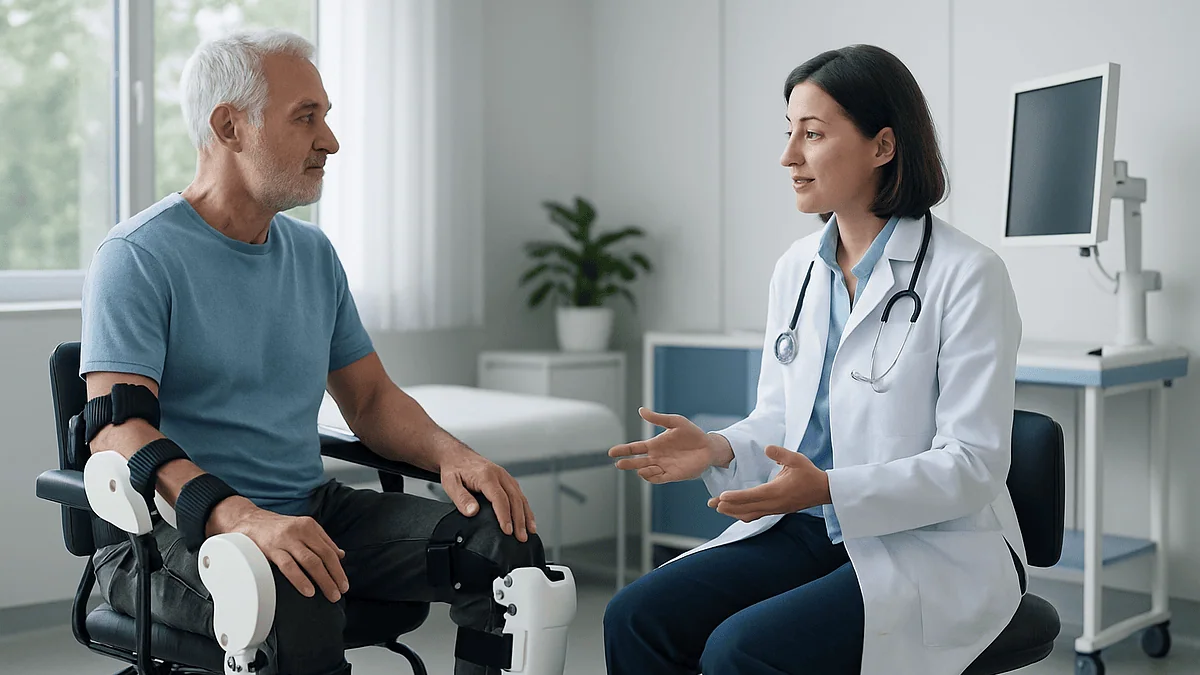
Robotic rehabilitation is the use of motorized, sensor-equipped devices to help a person practice movement during physical or occupational therapy. The device might be a padded frame that moves the forearm across a table, a treadmill with robotic legs strapped to the patient’s own, or a wearable exoskeleton, which is a powered brace worn over the limbs that supplies some of the force a weakened muscle cannot. None of these replaces the therapist. In every mainstream program, a licensed clinician sets the goals, fits the device, chooses the task and watches the person throughout.
It also is not robotic surgery. That confusion comes up constantly, and it matters. Robotic surgery is a surgeon controlling instruments through a console during an operation. Robotic rehabilitation begins after the operation, or after the stroke or injury, when the wound has been closed and the harder work of relearning movement starts. The two share a word and nothing else.
The devices fall into two broad families. End-effector robots hold the hand or foot at a single point and move it through space, leaving the joints in between free. Exoskeleton robots align with each joint and control every segment of the limb. Both usually come with a screen: a game, a target, a score. That screen is doing real work, because attention and reward appear to matter for how the brain relearns, a point the American Heart Association’s stroke rehabilitation guideline makes when it recommends task-specific, engaging practice.
Think of the robot as a very patient training partner with a stopwatch and a ruler. It will guide, it will measure, and it will never get bored. Whether that helps a particular person is a clinical question, which the rest of this article works through.
How does robotic rehabilitation work inside the nervous system?
The underlying idea is neuroplasticity, the brain’s ability to rewire connections in response to repeated experience. After a stroke, the damaged tissue does not regrow, but neighbouring regions can take over some of the lost function if they are pushed to do so. Pushing means repetition, and the numbers are sobering. Animal and human studies summarized in the AHA guideline suggest meaningful rewiring requires hundreds of purposeful attempts per session, far more than a typical hands-on session achieves.
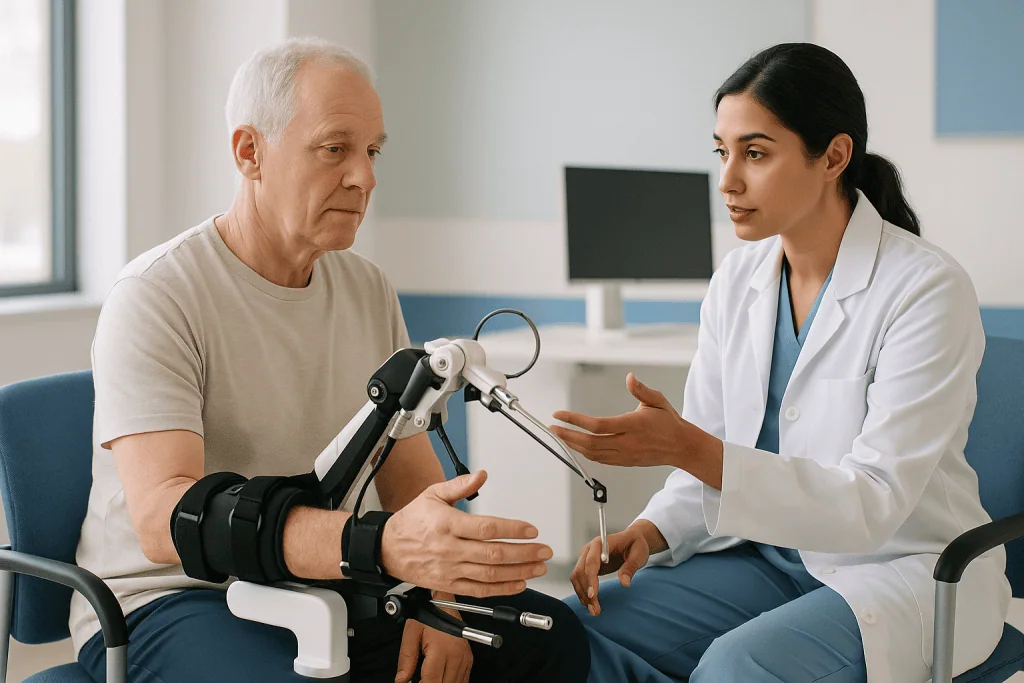
A robot closes that gap in three ways. First, volume: it can guide the same reach or step several hundred times without the therapist’s shoulders giving out. Second, precision: sensors record joint angle, speed and force on every attempt, so the machine can notice when a person is quietly letting it do all the work and dial its assistance down. This “assist-as-needed” setting is the feature most therapists care about, because the patient’s own effort, not passive movement, is what seems to drive change.
Third, feedback. The screen turns an abstract instruction (“reach further”) into an immediate visible result, and people tend to try harder when they can see a target move. That engagement is not a gimmick; the AHA guideline notes that active participation is a core ingredient of effective motor training.
Spinal cord injury adds a different mechanism. Below the injury, networks in the cord itself can generate rhythmic stepping when the legs receive the right sensory input. Robotic gait trainers deliver that input, loading the feet in a walking pattern while supporting body weight, in the hope of coaxing those circuits back toward function. Whether that produces walking outside the lab depends heavily on how complete the injury is, as the spinal injury section below explains.
Who benefits from robotic rehabilitation after stroke? Robot assisted therapy for the arm
The clearest evidence sits with the arm. A Cochrane systematic review of electromechanical and robot-assisted arm training pooled 45 randomized trials involving 1,619 people after stroke and found that those who received robotic training improved somewhat more in activities of daily living, arm function and arm strength than those who did not. The authors graded the certainty of that evidence as low to moderate and cautioned that the size of the benefit was modest and varied a great deal between studies.
So who, within that group, tends to gain? Reading across the trials and the AHA guideline, a pattern emerges:
- People with moderate to severe arm weakness who cannot yet practice reaching on their own, and who would otherwise get very few repetitions.
- People early in recovery, when the nervous system is most responsive, though benefit has also been reported in the chronic phase.
- People who can follow instructions and stay engaged with a task for the length of a session.
- People whose shoulder can tolerate being moved without significant pain.
The person with only mild weakness who can already lift a cup is a different case. For them, hands-on task practice with real objects often serves as well or better, and the guideline gives robotic training a “may be considered” grade rather than a strong endorsement precisely because it has not been shown superior to an equal dose of conventional therapy.
Put plainly: robot assisted therapy after stroke earns its place when it adds practice a person could not otherwise get. It is a multiplier of effort, not a substitute for it, and the treating team’s judgment about where a person sits on that spectrum is what determines whether it is offered.
Does robotic gait training help people walk again after stroke?
Walking is where families pin their hopes, so the evidence deserves careful handling. A separate Cochrane review of electromechanical-assisted training for walking after stroke, drawing on 62 trials and more than 2,400 participants, found that people who received robotic gait training combined with physiotherapy were more likely to be walking independently at the end of treatment than those who received physiotherapy alone. Two subgroups appeared to gain the most: people in the first three months after stroke, and people who could not yet walk at all when training began.
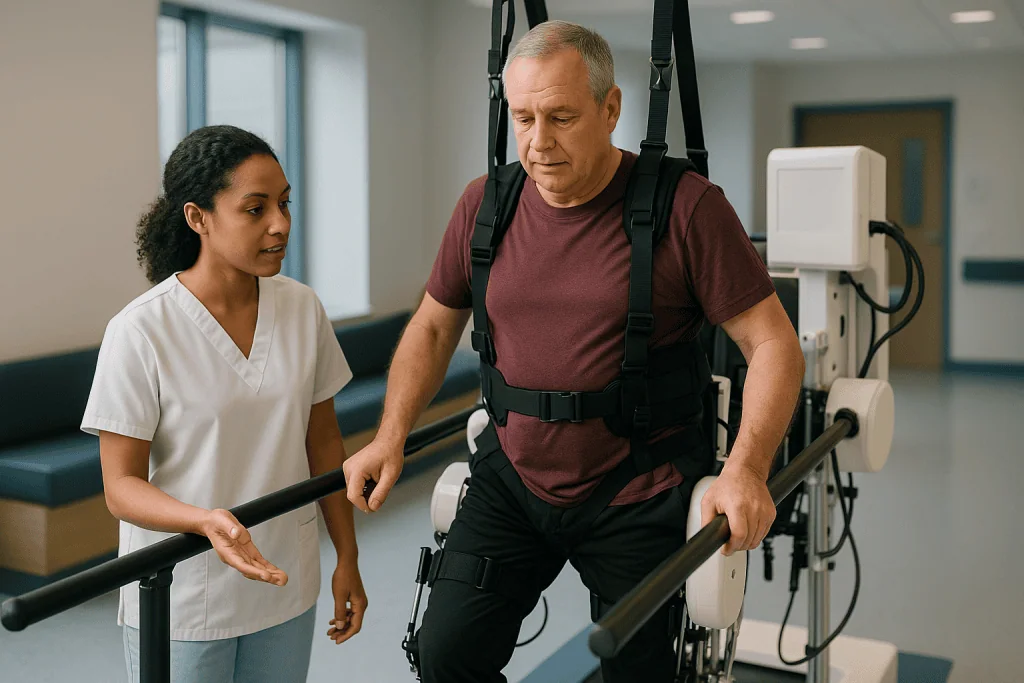
That second finding is intuitive once you picture the alternative. Teaching a non-walking adult to step usually needs two or three staff members physically moving the legs and steadying the trunk, a task that is exhausting, slow and hard to sustain for more than a few minutes. A body-weight-supported treadmill robot can hold the person upright and cycle the legs through a realistic stepping pattern for far longer, giving the nervous system the volume of practice it appears to need.
The review was equally clear about what the evidence did not show. Walking speed and endurance did not improve reliably more than with conventional training, and the certainty of the findings was again graded as moderate at best. For someone who is already walking, even slowly, the added value of a machine is uncertain and may be small.
Robotic gait training, then, is a tool for a specific window: early, severe, not yet stepping. Outside that window the treating team may reasonably prefer overground practice, which has the advantage of looking exactly like the thing the person is trying to do.
Exoskeleton rehabilitation for spinal cord injury: what can it realistically do?
A spinal cord injury is described as complete when no movement or sensation is preserved below the level of damage, and incomplete when some signal still gets through. That single distinction shapes almost everything about who benefits from robotic rehabilitation in this population.
People with incomplete injuries have surviving pathways that training can strengthen, and robotic gait devices give them a way to load the legs and rehearse stepping while their own muscles are too weak to do so safely. The rationale mirrors stroke: high repetition, accurate sensory input, progressive reduction of assistance. Mayo Clinic describes rehabilitation for spinal injury as a combination of muscle strengthening, redeveloping fine motor skills and learning adaptive techniques, and robotic gait work slots into the first of those.
For complete injuries the honest picture is different. Powered exoskeletons can allow some people to stand and take steps with the device doing the work, and clinicians report benefits that have nothing to do with recovering neurological function: standing tolerance, bowel and bladder routine, bone loading, spasticity, mood. Those are meaningful outcomes. They are not the same as walking, and reputable programs are careful never to let the two blur together.
Exoskeleton rehabilitation for spinal cord injury also has practical gatekeepers. Bone density must be adequate to bear weight without fracture risk, joints must have enough range to fit the device, blood pressure must tolerate the upright position, and skin must be intact where straps sit. Height and weight limits exist for every device. A person with a recent, unstable spine is asked to wait until the surgical team confirms the fixation can bear the load. None of this is gatekeeping for its own sake; it is what keeps the sessions safe.
Robotic rehabilitation after orthopedic or neurological surgery
The third group in the title, people recovering from surgery, is the least studied and the most likely to be oversold. Robotic rehabilitation can appear in three surgical contexts, and the evidence for each is quite different.
After brain or spine surgery that leaves new weakness, the situation resembles stroke or spinal injury, and the same reasoning applies: robotic devices may add repetitions for a person who cannot generate them alone. After a joint replacement, some rehabilitation centres use motorized devices to move the knee or hip through its range in the early days. Here the goal is not rewiring but preventing stiffness and managing swelling, and simpler methods often do the job. Guidelines from orthopedic and rehabilitation bodies generally emphasize early mobilization and progressive exercise rather than any particular technology.
After a lengthy stay in intensive care, robotic tilt tables and bedside cycling devices have been trialled to counter the profound deconditioning that follows weeks of immobility. This is an active research area rather than settled practice.
The candid summary for the surgical patient is that robotic rehabilitation is rarely essential. It becomes worth discussing when a surgical complication or an underlying neurological problem means the person genuinely cannot practice movement without substantial physical help. For an uncomplicated joint replacement in someone who can already walk with a frame, the treating team is likely to reach for conventional physiotherapy first, and there is no evidence that they are shortchanging the patient by doing so.
What all three surgical scenarios share is a clear surgical sign-off. No rehabilitation robot should touch a healing joint, spine or skull until the operating team has confirmed the repair can bear the forces involved.
Who is usually asked to wait, or offered something else instead?
Every rehabilitation program keeps a list of reasons to defer or decline robotic training, and understanding it helps families see that a “not yet” is a safety decision rather than a lack of ambition. The specifics vary by device and centre, but the broad categories are consistent.
- Medical instability. Uncontrolled blood pressure, an unstable heart rhythm, an active infection or a recent clot in the leg all mean the cardiovascular strain of upright, repetitive training is not yet safe.
- Unhealed structures. Fractures, unstable spinal fixation and open or fragile skin under strap sites are reasons to wait until the surgical or wound team signs off.
- Severe spasticity or fixed contractures. Spasticity is involuntary muscle tightness after nervous system injury; when it is severe, a joint cannot be moved through the arc the device requires, and forcing it risks harm.
- Marked pain, particularly a painful shoulder after stroke, which repetitive arm movement can worsen.
- Cognitive or communication barriers that stop a person following instructions or reporting discomfort during a session.
- Body size outside the device’s engineered limits.
A second group is not unsafe but is simply unlikely to gain much: people who already move well enough to practice the task with real objects. For them, robotic training is neither harmful nor especially helpful, and the time is usually better spent on function that looks like daily life.
Asked to wait is not the same as ruled out. Blood pressure settles, wounds heal, spasticity is managed, and the question can be reopened. The decision belongs with the treating team, who can weigh the person’s whole clinical picture rather than a single measurement.
Is robotic rehabilitation effective? What the evidence really shows
Strip away the enthusiasm and the sceptic’s shrug, and the evidence lands in a fairly narrow place. The two Cochrane reviews described above, one for the arm and one for walking, both found statistically real but modest benefits over control conditions, and both graded their confidence as low to moderate. The AHA stroke rehabilitation guideline translates that into a “may be considered” recommendation, to be used alongside conventional therapy rather than in place of it.
Three caveats recur in every serious appraisal. The first is dose matching. In many trials the robotic group simply practiced more than the comparison group, so it is hard to know whether the machine or the extra minutes produced the difference. Where studies matched the total time, the advantage of the robot often shrank or disappeared. The second is heterogeneity: different devices, different stages of recovery, different outcome measures, pooled together because individual trials were small. The third is the outcome that matters most to patients, real-world function at home, which was measured less often and improved less consistently than laboratory scores of arm movement.
What the evidence does not show is that robotic rehabilitation is ineffective. It shows that its effect is real, that it depends on choosing the right person, and that it is probably an efficient way to deliver something we already knew works: lots of active, task-focused practice.
Anyone quoting a single impressive percentage for robotic rehabilitation should be asked which trial, which population, and compared with what. The honest answer to “is robotic rehabilitation effective” is a qualified yes, for the right patient, as one part of a broader program.
Robotic versus conventional therapy: a side-by-side summary
Families often frame the choice as either-or. In practice almost no program works that way; the robot fills a slot within a week that also contains hands-on therapy, practice with everyday objects and home exercise. The table below sets out how the two approaches differ, drawing on the Cochrane reviews and the AHA guideline rather than on any manufacturer’s claims.
| Feature | Robotic training | Conventional hands-on therapy |
|---|---|---|
| Repetitions per session | Very high, limited by the patient’s fatigue | Lower, limited by therapist stamina and safety |
| Measurement | Automatic, objective, every attempt recorded | Clinical observation and periodic formal scales |
| Adaptability to daily tasks | Simulated; movements may not match real objects | High; can use the person’s own cup, stairs, doorway |
| Best-supported group | Moderate to severe weakness, early after injury | All stages, including mild impairment |
| Evidence grade (AHA guideline) | “May be considered” as an adjunct | Core recommended treatment |
| Staffing | One therapist can supervise safely | Severe cases may need two or three staff |
| Availability | Specialist centres, device-dependent | Widely available |
Two rows deserve emphasis. “Adaptability” is the robot’s genuine weakness: a person who can reach a virtual target on a screen still has to learn to reach a real kettle in a real kitchen, and that transfer is not automatic. “Staffing” is its genuine strength, and the reason many programs value it for the most severely affected patients.
Read together, the rows describe complementary tools rather than rivals. The treating team’s task is to decide what proportion of a limited number of therapy hours each deserves for a particular person, and to revisit that mix as recovery unfolds.
What the first days and weeks of robotic rehabilitation usually look like
Mayo Clinic notes that stroke rehabilitation commonly begins within 24 to 48 hours of the stroke, once the person is medically stable, and that early work is about sitting balance, transfers and preventing complications. Robotic devices rarely appear in those first days. They tend to enter the picture in the first weeks, once the team can see what has and has not returned and where the biggest gaps in independent practice lie.
The first robotic session is largely an assessment. A therapist fits the device, adjusts straps and cuffs, sets safe joint limits, and runs a short trial to check that blood pressure, skin and pain all tolerate the movement. Expect this to feel clinical rather than exciting; the point is calibration.
Subsequent sessions typically run alongside conventional therapy in the same day or week. A person might spend part of a session in the device and part practicing the same movement with real objects, so that what the robot has drilled is immediately tested against life. The machine’s assistance is reduced as effort improves, which can feel like the task getting harder even as scores rise. Therapists usually warn people about this, because it is discouraging if unexpected.
Fatigue is the most common complaint in the early weeks. Hundreds of repetitions, even assisted ones, tax muscles that have been idle, and the brain’s effort to attend and correct is tiring in its own right. Mild soreness the next day is expected; sharp or escalating pain is not, and should be reported.
How long the robotic component continues varies enormously and is set by progress, not the calendar. The NHS describes stroke recovery as continuing for months and sometimes years, with the fastest gains usually early. Robotic training is generally concentrated in that early period and phased out as the person can practice independently.
What is the downside of robotic rehabilitation? Risks, limits and trade-offs
People ask about the downside of robotic surgery far more often than robotic rehabilitation, but the rehabilitation devices carry their own honest list of drawbacks, and a good program will walk through them before the first session.
Physical risks are mostly mechanical and mostly minor. Skin irritation or pressure marks under straps and cuffs are the commonest, and matter most for people with reduced sensation who cannot feel a developing sore. Joint strain can occur if the device’s range is set wider than the person’s tissues tolerate, which is why the fitting session is meticulous. Blood pressure can drop on standing in gait devices, producing dizziness, and occasionally a fall risk when transferring in and out. Serious adverse events were rare in the trials pooled by the Cochrane reviews, but small trials are poor at detecting rare harms.
The larger downsides are not injuries. One is opportunity cost: every hour in a device is an hour not spent on stairs, dressing or the kitchen, and for someone with mild impairment that trade may not favour the machine. Another is the transfer problem already mentioned, where gains on a screen do not automatically become gains at home. A third is expectation. Families who have seen a video of an exoskeleton walking may assume the device restores walking, and the disappointment when it does not can undermine the rest of rehabilitation.
Finally, access is uneven. Devices live in specialist centres, and the person who might benefit most, someone severely affected early after a stroke, is often the person least able to travel to one. None of these is a reason to avoid robotic rehabilitation; they are reasons to be clear-eyed about what it offers and to let the treating team weigh it against alternatives.
What people often get wrong about robotic rehabilitation
Some misunderstandings surface so often in clinic that they are worth correcting directly.
“Robotic rehabilitation is a kind of robotic surgery.” It is not. Robotic surgery happens in an operating room under anesthesia; robotic rehabilitation happens in a therapy gym with the person awake and working. Search results that ask which surgery is better, robotic or manual, or why surgeons prefer robotic surgery, are about a completely different technology and say nothing about recovery afterward.
“The robot does the work, so I can relax.” The opposite is true. Devices are set to assist only as much as needed, and the person’s own effort is what appears to drive nervous system change. Passive movement has a role in preventing stiffness, but it is not what the evidence for functional improvement rests on.
“If the machine can make me walk, I will be able to walk.” An exoskeleton can move legs that cannot move themselves. For a complete spinal cord injury, that is a supported standing and stepping experience with real physical benefits, not restored walking. Reputable programs say so plainly.
“Newer technology means better outcomes.” The AHA guideline places robotic training below core hands-on approaches in strength of recommendation, and trials that matched total therapy time often found little difference. Novelty is not evidence.
“If my hospital does not offer it, I am missing out.” For many people, particularly those with mild weakness or already walking, conventional therapy of equal intensity is likely to serve just as well. The question to ask is whether you are getting enough active practice, not which machine delivers it.
“It is too late for me.” Benefit has been reported in people years after stroke. The gains are usually smaller than early on, but the door is not closed, and the treating team can advise whether a trial makes sense.
Questions to ask your care team before starting robotic rehabilitation
The most useful conversations happen before the first session, when goals can still shape the plan. These questions are drawn from what rehabilitation clinicians say they wish patients asked more often.
- What specific goal is the robotic training meant to serve for me, and how will we know whether it is working?
- Why do you think I am a good candidate now, and what would make you decide to pause or stop?
- How will this fit with my hands-on therapy? Is it replacing any of that time or adding to it?
- How many sessions do you expect before we review, and what measures will you use at that review?
- What will the device feel like, and what discomfort is normal versus something I should report immediately?
- If I have reduced sensation, how will we check my skin under the straps?
- What is the plan for turning what I practice in the device into things I do at home?
- If this centre cannot offer it or I cannot get here often enough, what is the best alternative for getting the same amount of practice?
- Who do I contact between sessions if something changes?
Notice that none of these asks which device is best. That is deliberate. Brand and model matter far less than the match between the person, the goal and the amount of active practice delivered. A team that can answer the questions above clearly, including the ones about stopping and about alternatives, is a team thinking about the patient rather than the equipment.
Write the answers down or ask a family member to. Rehabilitation goals shift as recovery unfolds, and having the original reasoning on paper makes later reviews easier and more honest.
When to call your doctor during robotic rehabilitation
Robotic training is generally well tolerated, and mild muscle soreness or tiredness after a session is expected. Some signs, however, mean the session should stop and the rehabilitation physician or supervising therapist should be contacted the same day. Seek urgent or emergency care if any of the following occur:
- Sudden new weakness, numbness, facial droop, slurred speech or confusion, which can signal a new stroke and need emergency services immediately.
- Chest pain, pounding or irregular heartbeat, or shortness of breath that does not settle with rest.
- Fainting, or dizziness that persists after sitting or lying down.
- Sharp, escalating or new joint pain during or after movement, especially in a shoulder after stroke or near any surgical site.
- A red, warm, swollen or painful calf, which can indicate a blood clot and should be assessed promptly.
- Any break in the skin, blister or dark pressure mark under a strap or cuff, particularly if you have reduced sensation.
- In spinal cord injury, a sudden pounding headache, flushing and sweating above the injury level with a slow pulse, which may indicate autonomic dysreflexia, a dangerous blood pressure surge that needs immediate attention.
- A fall, even without obvious injury, during transfers in or out of a device.
- New or worsening spasticity, a sudden change in bladder or bowel function, or fever.
Less urgent but still worth a call: pain that lingers for more than a day or two after sessions, mood that is sinking rather than lifting as weeks pass, or a sense that progress has stalled. Rehabilitation teams expect to adjust plans, and a plateau is information rather than failure. Every decision about continuing, pausing or changing the program rests with the treating team, who can see the full picture and weigh it against the alternatives.
Frequently asked questions
Who benefits most from robotic rehabilitation after stroke?
People with moderate to severe weakness who cannot yet practice reaching or stepping without substantial physical help tend to gain the most, particularly in the early months. Cochrane reviews found the largest walking benefit in people who were not yet walking when training began. Those with mild weakness who can already use real objects usually do as well with conventional therapy.
Is robotic rehabilitation effective, or is it hype?
It is modestly effective for selected people, according to systematic reviews, and not superior to an equal dose of hands-on therapy in most comparisons. The benefit seems to come from delivering more active, repetitive practice than a therapist can physically provide. The American Heart Association guideline recommends it as an adjunct that may be considered, not as a first-line treatment.
Does robotic gait training help people walk again after stroke?
It can increase the chance of walking independently when added to physiotherapy, especially for people who cannot walk at all in the first three months after stroke, according to a Cochrane review of 62 trials. Walking speed and endurance did not improve reliably more than with conventional training. The treating team decides whether the early, severe window applies.
Can exoskeleton rehabilitation for spinal cord injury restore walking?
For incomplete injuries, robotic gait training may strengthen surviving pathways and contribute to walking recovery as part of a broader program. For complete injuries, exoskeletons allow supported standing and stepping with the device doing the work, which brings benefits for bone loading, bowel and bladder routine, spasticity and mood, but does not restore independent walking.
What is robot assisted therapy after stroke actually like in a session?
A therapist fits the device, sets safe joint limits and chooses a task shown on a screen. The person then performs the movement many times while the robot assists only as much as needed, reducing help as effort improves. Sessions usually sit alongside hands-on practice with real objects, and fatigue afterward is common in the first weeks.
What is the downside of robotic rehabilitation?
The main drawbacks are skin pressure under straps, joint strain if limits are set poorly, dizziness on standing in gait devices, and the time it takes away from practicing real daily tasks. Gains on a screen do not automatically transfer to the kitchen or stairs. Serious harms were rare in trials, and access is limited to specialist centres.
Is robotic rehabilitation the same as robotic surgery?
No. Robotic surgery is a surgeon controlling instruments through a console during an operation under anesthesia. Robotic rehabilitation uses motorized devices in a therapy gym to help an awake person practice movement after a stroke, injury or operation. Questions about which surgery is better, robotic or manual, concern a different technology entirely.
How soon after a stroke can robotic rehabilitation start?
Rehabilitation itself often begins within 24 to 48 hours once a person is medically stable, according to Mayo Clinic, but robotic devices usually enter in the following weeks after the team has assessed what movement has returned. Medical stability, blood pressure, skin integrity and pain all need to be acceptable before a device is fitted.
Is it too late for robotic rehabilitation years after a stroke or injury?
Not necessarily. Trials have reported benefit in people in the chronic phase, though gains are usually smaller than early after injury. Whether a trial of robotic training makes sense depends on the person’s current abilities, goals and medical status, and is a decision for the treating rehabilitation team rather than a fixed rule about time since the event.
Why might my rehabilitation team say I am not a candidate?
Common reasons include unstable blood pressure or heart rhythm, unhealed fractures or surgical fixation, fragile skin under strap sites, severe spasticity or fixed contractures, marked shoulder pain, difficulty following instructions, or body size outside the device’s limits. Some people are simply too able to gain much. Many of these are temporary, and the question can be revisited.
References
This article is for general information only and is not a substitute for professional medical advice. Please consult a qualified doctor about your individual situation.

More from the Blog

Vestibular Rehabilitation: Retraining Balance After Dizziness
Vestibular rehabilitation therapy is an exercise-based program that retrains the brain to compensate for inner-ear balance problems. Guided by a specially trained physical therapist,…
Who May Need to Avoid Manual Therapy? Osteoporosis, Blood Thinners and Recent Surgery
People with osteoporosis, those taking blood thinners and anyone recovering from recent surgery are the groups most often asked to avoid or modify manual…

Feeling Dizzier After Vestibular Rehabilitation Exercises? Why It Happens and When to Call
Feeling dizzier after vestibular exercises is usually expected rather than a sign of harm. The exercises deliberately provoke mild symptoms so the brain can…
What Is Physiotherapy? What Physiotherapists Actually Do, Session by Session
Physiotherapy (called physical therapy in the United States) is a regulated health profession that restores movement, strength, and everyday function after injury, surgery, or…

When Does a Sports Injury Need Supervised Rehabilitation Rather Than Rest Alone?
A sports injury usually needs supervised rehabilitation rather than rest alone when pain, swelling or weakness has not clearly improved after about two weeks…
Gait Training and Gait Analysis: Relearning to Walk, Properly
Gait training is supervised, task-specific physical therapy that rebuilds a safe, efficient walking pattern after injury, surgery, stroke, or a neurological condition. Gait analysis…