

Who Is a Candidate for Clear Aligners? Bite Types, Gum Health and Wear Commitment

Key Takeaways
- Clear aligners work by sustained pressure that remodels bone, so they move teeth only during the hours they are actually worn, which Cleveland Clinic puts at about 20–22 hours a day.
- Problems of tooth position such as crowding, gaps and mild overbite suit aligners; problems of jaw position such as skeletal underbite or full posterior crossbite usually do not respond to trays alone.
- Active gum disease is the most common reason candidacy is delayed, because orthodontic force on infected, receding bone can accelerate tooth loss.
- Fillings and crowns rarely affect suitability, but dental implants are fused to bone and cannot be moved, so orthodontics is usually sequenced before implant placement.
- There is no upper age limit for tooth movement, but aligners generally wait until most permanent teeth have erupted in younger patients.
- Retainers are required after every course of aligners, often at night indefinitely, because NHS guidance notes teeth drift back without them.
Clear aligners candidates are usually adults and teenagers with healthy gums, no untreated tooth decay, and mild to moderate problems such as crowding, gaps or a modest overbite. Severe jaw-size mismatches, large tooth rotations or active gum disease often point toward braces, jaw surgery or gum treatment first. Because aligners are removable, suitability also depends on realistically wearing them about 20–22 hours a day. An orthodontist makes the final assessment.
She has been covering her mouth in photographs since her twenties. Not dramatically, just a hand near the chin, a smile that stops short. Now, sitting in a dental chair for a routine cleaning, she finally asks the question she has rehearsed in the car: could she do the clear kind, the trays, rather than metal braces at forty-three?
It is one of the most common questions in orthodontics, and the honest answer is more interesting than yes or no. The list of clear aligners candidates is longer than it was a decade ago, but it is still a list with edges. Those edges are drawn by three things: how your teeth actually meet, how healthy the bone and gum around them are, and whether you can live with a plastic tray in your mouth for most of every day.
This explainer walks through each of those in turn, with the evidence, so you can arrive at the consultation already knowing what the orthodontist is looking for.
How do clear aligners actually move teeth?
A clear aligner is a thin, transparent plastic tray molded to fit over your teeth, shaped very slightly differently from where your teeth sit today. That slight mismatch is the whole mechanism. When you seat the tray, it presses on specific teeth, and that gentle, sustained pressure is what does the work.
Teeth are not fused to the jaw. Each one sits in a socket of bone, cushioned by a ligament. Press on a tooth for long enough and the bone on the pressure side is slowly resorbed while new bone is laid down on the trailing side. Braces exploit the same biology with wires; aligners do it with a series of trays, each nudging the teeth a fraction of a millimeter further. Cleveland Clinic notes that people typically switch to a new tray every one to two weeks, following the sequence their orthodontist has planned digitally.
Two accessories often surprise first-time patients. Attachments are small tooth-colored bumps of dental composite bonded to certain teeth; they give the plastic something to grip so it can rotate or pull a tooth rather than simply push it. Interproximal reduction, usually shortened to IPR, is the careful shaving of a hair’s breadth of enamel between teeth to create room when crowding is the problem. Neither hurts, but both matter for candidacy, because a plan that needs many attachments and heavy IPR is telling you the case is not simple.
The tray only works while it is in your mouth. That sounds obvious, yet it is the single fact that separates aligners from braces in practice. Braces work around the clock whether you cooperate or not. Aligners work exactly as many hours as you wear them, and no more.
Who is usually a good candidate for clear aligners?
Orthodontists tend to describe the ideal clear aligners candidates in fairly consistent terms, and the profile is less about age than about the shape of the problem and the health of the foundation.
The teeth themselves should have mild to moderate misalignment. Malocclusion is the clinical word for teeth that do not meet properly when you bite; MedlinePlus groups it into classes based on how the upper and lower teeth relate. The cases that suit aligners best sit at the gentler end: front teeth that overlap a little, small gaps, a modest overbite where the upper front teeth sit too far ahead of the lower ones, or teeth that have drifted after braces worn years ago.
Underneath those teeth, the gums and bone need to be stable. Active gum disease, loose teeth or unfilled cavities are usually addressed first, for reasons the gum-health section below explains.
Then there is you. Aligners are removable, which is their great appeal and their great vulnerability. A candidate needs to be able to wear the trays for roughly 20–22 hours a day, according to Cleveland Clinic, taking them out only to eat, drink anything other than water, and brush. That means adults with settled routines, and teenagers who genuinely want the treatment rather than having it chosen for them, tend to do well.
Finally, a good candidate has realistic expectations. Aligners are excellent at tidying crowded or spaced front teeth. They are less reliable at large movements of back teeth or at changing how the jaws themselves relate. Someone hoping to fix a pronounced underbite with trays alone may be asked to consider other options, and that conversation is a sign of a careful clinician, not a reluctant one.
What disqualifies you from clear aligners, or asks you to wait?
Very few people are disqualified for life. Far more are told to wait, or told that aligners will be one part of a larger plan. The distinction matters, because a temporary no often becomes a yes after a few months of groundwork.
The most common reason to pause is the mouth’s baseline health. Untreated cavities, cracked fillings, an abscess or gums that bleed and have pockets around the teeth all need attention before any tooth is moved. NHS guidance on orthodontics is explicit that teeth and gums should be healthy before treatment starts.
Skeletal problems are a different category. If the lower jaw is markedly larger or smaller than the upper jaw, the mismatch is in bone, not in tooth position. Aligners move teeth; they cannot move a jaw in an adult. Such cases may involve braces combined with elastics, or, at the severe end, jaw surgery planned jointly by an orthodontist and a maxillofacial surgeon.
Certain individual tooth movements are also hard for plastic. Rotating a rounded canine or premolar by a large angle, pulling a tooth that never fully erupted down into line, or moving back teeth bodily forward to close a large space are all movements where the evidence base for aligners is weaker and clinicians often prefer fixed appliances.
Then there are practical factors. A child whose baby teeth are still falling out, a person with a severe gag reflex who cannot tolerate a tray, or someone who honestly knows they will leave the trays in a drawer are all likely to hear a gentle redirection. None of these is a judgment. The orthodontist’s job is to match the tool to the problem and the person, and to say so plainly.
Clear aligners for overbite, crowding and gaps: which bite types respond best?
Ask an orthodontist about bite types and the conversation quickly becomes a tour of the mouth in three dimensions. Each direction of misfit behaves differently under a plastic tray.
Crowding is the classic aligner case. When there is slightly too little room in the arch, teeth twist and overlap. Aligners can expand the arch modestly, tip teeth upright and use IPR to find the missing space. Spacing, the opposite problem, responds well for similar reasons; closing small gaps between front teeth is a straightforward tipping movement.
Overbite, in everyday usage, means the upper front teeth sit too far ahead of the lower ones. Clinicians split this into overjet, the horizontal gap, and overbite, the vertical overlap. Mild to moderate versions of both are generally within reach of aligners, sometimes with elastics hooked to small buttons on the teeth. A deep overbite, where the lower front teeth are nearly hidden, is harder because it requires the front teeth to move up into the bone, a movement called intrusion that aligners perform less predictably.
Crossbite means one or more upper teeth bite inside the lower teeth rather than outside. A single tooth in crossbite is often manageable; a whole side of the mouth in crossbite usually points to a jaw-width problem.
Open bite, where the front teeth do not touch at all when the back teeth are together, is a mixed picture. Some anterior open bites respond surprisingly well to aligners because the tray covering the back teeth can help settle them. Others, driven by tongue habits or jaw shape, tend to return.
Underbite, with the lower teeth ahead of the upper, is the bite type most often rooted in jaw size, and therefore the one most often referred beyond aligners alone.
Bite problems at a glance: typical aligner suitability
The table below summarizes how orthodontists commonly categorize the main bite problems. It is a guide to the conversation you are likely to have, not a substitute for an examination; the same label can describe a trivial case in one mouth and a complex one in another.
| Bite problem | What it means in plain terms | Typical aligner suitability | Common caveat |
|---|---|---|---|
| Mild to moderate crowding | Teeth overlap because the arch is slightly too small | Often well suited | May need IPR or modest arch expansion |
| Spacing or gaps | Teeth sit apart, often at the front | Often well suited | Large gaps from missing teeth may need a restorative plan |
| Mild to moderate overbite or overjet | Upper front teeth too far ahead of lower | Frequently suitable | Elastics or attachments are common |
| Deep overbite | Lower front teeth almost hidden | Case by case | Intrusion is less predictable with trays |
| Single-tooth crossbite | One upper tooth bites inside the lower | Often suitable | Depends on bone and root position |
| Full posterior crossbite | A whole side bites inside | Usually not aligners alone | Often a jaw-width issue |
| Anterior open bite | Front teeth do not touch | Case by case | Habit-related cases may relapse |
| Underbite from jaw size | Lower jaw sits ahead of upper | Usually not aligners alone | May involve braces or surgery |
Two patterns stand out. Problems of tooth position lean toward aligners; problems of jaw position lean away. And the words “case by case” appear where the evidence is genuinely mixed, which is exactly where an experienced clinician’s judgment, and sometimes a second opinion, earns its keep.
Why gum health decides clear aligner candidacy before your teeth do
Here is the part of the assessment that patients least expect and clinicians care about most. Before anyone looks at how crooked your teeth are, they look at what is holding them in.
Gum disease begins as gingivitis, inflammation confined to the gum tissue, and can progress to periodontitis, in which the infection destroys the ligament and bone that anchor each tooth. The National Institute of Dental and Craniofacial Research reports that a substantial share of American adults over thirty have some degree of periodontitis, and many do not know it because it is often painless.
Why does this matter for aligners? Tooth movement works by remodeling bone. If that bone is already being lost to infection, applying orthodontic force can accelerate the damage, loosen teeth further and, in the worst cases, cost a tooth that might otherwise have been kept. So orthodontists measure the depth of the pockets around each tooth, check for bleeding, and often request X-rays to see bone levels. Where periodontitis is found, the sequence is nearly always the same: treat and stabilize the gums first, confirm the disease is controlled, then begin moving teeth.
The encouraging part is that treated, stable periodontal disease is not a permanent barrier. Many adults with a history of gum problems complete aligner treatment successfully once their periodontist confirms stability, often with closer monitoring during treatment.
Aligners can even help gum health indirectly. Because the trays come out, brushing and flossing are easier than with brackets, and straighter teeth are simpler to clean. That advantage evaporates, though, if trays are worn over unbrushed teeth, trapping plaque against the enamel and gums for twenty hours a day. Candidacy, in other words, includes a willingness to brush after every meal.
Can you get clear aligners with fillings, crowns, implants or missing teeth?
Most adults arriving for an orthodontic assessment have some dental history, and the good news is that fillings and crowns rarely rule anyone out. Aligners grip the shape of the tooth, not its material. The tray fits over a porcelain crown as readily as over natural enamel.
There are practical wrinkles. Attachments bond less reliably to porcelain and some other restorative materials than to enamel, so the orthodontist may plan attachments on neighboring natural teeth or use a different bonding technique. Large fillings close to where IPR is planned may need to be checked or replaced first. And any restoration that is failing, with decay underneath or a fracture line, should be sorted out before treatment, because it is far easier to do that work on an accessible tooth than partway through a sequence of trays.
Dental implants are the one hard limit. An implant is a titanium post fused directly to the jawbone with no ligament, so it cannot be moved at all. Aligners can move the teeth around an implant, and an implant can serve as a convenient anchor, but the implant itself stays exactly where it was placed. Someone planning both implants and aligners is usually advised to sequence the orthodontics first, so the implant is placed once the neighboring teeth have reached their final positions.
Missing teeth call for a joint plan. A gap left by a lost molar can sometimes be closed by moving other teeth into it, but more often the orthodontist’s job is to hold or create the correct space for a future bridge or implant. That is a decision made with your general dentist, and it shapes whether aligners are the right tool for your case.
Are teenagers and older adults candidates for clear aligners?
Age appears on almost every list of candidacy questions, and it turns out to be one of the least decisive factors, with two important exceptions at either end of life.
For younger patients, the question is dental development rather than years. Aligners generally wait until most or all permanent teeth have erupted, because a tray designed around a mouth that is still changing will quickly stop fitting. NHS guidance describes orthodontic treatment typically starting once the adult teeth are through. Some systems accommodate erupting teeth with built-in space, but this is a specialist judgment. The larger teenage question is motivation. A fourteen-year-old who wants the treatment tends to manage the wear time; one who has been talked into it may not, and honesty about this at the consultation saves months of frustration.
For adults, there is no upper age limit in the guidelines. Bone continues to remodel throughout life, so teeth can be moved at seventy as well as at seventeen, though the process may be somewhat slower and the orthodontist may plan gentler stages. What changes with age is the likelihood of the complicating factors already discussed: gum disease, worn or heavily restored teeth, missing molars and bone loss. These shape the plan rather than forbid it.
Certain medical situations warrant a conversation with your physician as well as your orthodontist. Conditions or medicines that affect bone turnover, uncontrolled diabetes, which impairs gum healing, and some autoimmune conditions can alter how teeth respond to force. Pregnancy is not a contraindication in itself, but hormonal changes make gums more prone to inflammation, so extra hygiene care is often advised. In every case, the decision to proceed rests with the treating team, informed by your full medical picture.
How long do you wear aligners each day? The commitment nobody should underestimate
Ask former patients what they wish they had understood before starting, and the answer is rarely about discomfort. It is about hours.
Cleveland Clinic advises wearing aligners for about 20–22 hours a day. Subtract three meals, a couple of coffees and brushing, and you are already brushing against that limit. Every snack, every glass of wine, every lunch meeting that runs long is a small withdrawal from the account. The trays cannot tell the difference between a good reason and a bad one; they simply stop working when they are out.
The consequences of under-wearing are not dramatic, which is precisely why they are easy to ignore. Teeth drift a little back toward where they started. The next tray in the sequence does not seat fully. The orthodontist notices at a review that the teeth are behind the digital plan, and the options are to wear each tray longer, to order a revised sequence, or, in persistent cases, to switch to braces. NHS guidance places orthodontic treatment broadly in the range of many months to a couple of years; poor wear stretches that range rather than shrinking it.
Small habits make the difference. People who do well tend to eat at defined times rather than grazing, carry a travel toothbrush, keep the trays in their case rather than a napkin, and put the aligner back in before doing anything else after a meal. Many find that the trays become a quiet ally against snacking.
Candidacy, then, is partly an honest self-assessment. If you know your days are unpredictable and your discipline uneven, that is useful information, not a character flaw. Braces exist for exactly that reason, and a good orthodontist will help you weigh the trade-off rather than sell you the tray.
How do you tell if you're a candidate? What the assessment actually involves
Online quizzes that promise to tell you whether you qualify in ninety seconds are asking the wrong questions, because the things that decide candidacy cannot be seen in a selfie. Here is what a proper assessment looks like.
It begins with a conversation about what bothers you and what you hope to change. This matters more than it sounds. Someone troubled by a single rotated front tooth and someone unhappy with their whole profile have different problems, and the second may not be solvable with aligners regardless of how the teeth look.
A clinical examination follows. The orthodontist checks each tooth for decay and mobility, measures gum pockets, looks at how the jaws open and close, and listens for clicking or pain in the jaw joints. They note the bite relationship in three planes: front to back, side to side and vertically.
Imaging comes next. A panoramic X-ray shows every tooth root and the bone around them, revealing hidden problems such as short roots, impacted teeth or bone loss. Some cases warrant a cone-beam CT, a three-dimensional scan, especially when jaw position or unerupted teeth are in question. Photographs document the starting point.
Then the digital scan. A small wand captures the surfaces of your teeth and builds a three-dimensional model. On that model the orthodontist plans the movements, stage by stage, and can show you a simulation of the intended end point. It is worth treating that animation as a proposal rather than a promise; it shows the plan, not a guaranteed result.
Only after all of this can someone honestly say whether you are among the clear aligners candidates, and what the alternative would be if you are not.
What the first days and weeks with clear aligners usually look like
Once a plan is agreed and the trays arrive, the first appointment is longer than the rest. Any attachments are bonded, IPR is done if planned, and you learn to seat and remove the trays. Getting a tray out is a small skill, and most people find a technique within a few days, usually starting at the back molars.
The first week is when you meet the pressure. New trays feel tight, and the front teeth may ache when you bite into something firm. Cleveland Clinic describes this soreness as typically settling within a few days of each new tray. Speech may lisp slightly for a day or two as the tongue adjusts to the plastic. Saliva flow often increases briefly. None of this is a sign something is wrong; it is the biology described earlier, felt from the inside.
By the second and third weeks, routine takes over. You move to the next tray on the schedule your orthodontist sets, typically every one to two weeks. Many patients are asked to photograph their teeth with the tray seated so the clinician can check fit remotely between visits. In-person reviews are commonly spaced several weeks apart, at which the orthodontist checks that teeth are tracking with the plan and hands over the next batch of trays.
Eating changes more than people expect. Trays come out for anything other than water, and go back in only after brushing, or at minimum rinsing thoroughly. Hot drinks warp the plastic, and colored drinks stain it.
Toward the end of the sequence, a refinement stage is common: a fresh scan and a short set of additional trays to fine-tune positions. This is normal planning, not failure. After that come retainers, which the next sections address.
Clear aligners vs braces: an honest comparison for people deciding
Aligners and fixed braces are two routes to the same destination, and the choice is less about which is better than about which is better for your mouth and your life.
On tooth movement, braces remain the more versatile instrument. Wires and brackets can rotate, extrude and bodily shift teeth in ways that plastic struggles to replicate, which is why complex cases and jaw-related problems still default to fixed appliances. Aligners excel in the mild to moderate middle, where their predictability is well established and their comfort is a genuine advantage.
On daily life, the balance tips the other way. Aligners are nearly invisible, come out for meals and photographs, and impose no food restrictions beyond timing. Braces stay on, catch food, and rule out sticky and very hard foods for the duration. Cleaning around brackets is harder, and NHS guidance notes the extra effort needed to keep teeth healthy in braces.
On reliance on the patient, braces win. They work whether you think about them or not. Aligners depend on those 20–22 hours, day after day.
On comfort, aligners generally cause less irritation to lips and cheeks, since there are no wires to rub. Both produce pressure soreness when adjusted or changed.
On duration, both fall within the broad range NHS describes for orthodontic treatment, with simpler cases finishing sooner and complex ones taking longer regardless of appliance. Claims that one is inherently faster are not supported by consistent evidence.
Neither option is finished when the active phase ends. Both require retainers afterward, indefinitely, because teeth have a lifelong tendency to drift back. A plan that omits that conversation is incomplete, whichever appliance it favors.
What people often get wrong about who qualifies for clear aligners
The myths around aligner candidacy tend to cluster into two camps: the over-optimistic and the over-cautious. Both lead people astray.
The first myth is that aligners fix anything braces can. They cannot. Large rotations, significant back-tooth movements and jaw-size discrepancies remain the territory of fixed appliances or surgery. Anyone promising otherwise is describing marketing, not orthodontics.
The second is the mirror image: that aligners are only for cosmetic tidying of front teeth. In fact, mild to moderate bite problems, including many overbites and single-tooth crossbites, are well within their range when planned carefully.
The third is that you can skip the dentist and go straight to trays. The gum-health checks, X-rays and decay screening described earlier exist because moving teeth over hidden disease causes harm. An assessment that omits them is not a shortcut; it is a gap.
The fourth is that treatment ends when the last tray comes out. NHS guidance is clear that retainers are needed afterward, often at night indefinitely, because teeth drift back without them. Skipping retention is the most common reason people find themselves back in the chair years later.
The fifth is that adults are too old. Bone remodels throughout life. Age shapes the plan through gum health and dental history, not through any biological cutoff.
The sixth is that a digital simulation is a guarantee. It is a plan. Teeth are living tissue anchored in living bone, and they do not always follow the animation. Refinement trays and, occasionally, a change of approach are normal parts of honest orthodontics.
Finally, some believe aligners are painless. They are gentler than braces on soft tissue, but the pressure of each new tray is real and expected.
Questions to ask your care team before starting clear aligners
The consultation is your opportunity to understand not only whether you are a candidate but what kind of candidate you are. A few well-aimed questions turn a sales conversation into a clinical one.
- Which of my bite problems are you confident aligners can address, and which are you less sure about?
- Did my X-rays show anything about my gums, bone levels or roots that affects the plan?
- Will I need attachments, IPR or elastics, and roughly how many teeth are involved?
- What would you recommend if I were not choosing between appliances at all, and why?
- How many hours a day do you expect me to wear the trays, and what happens to the plan if I fall short?
- How will you monitor progress, and how often will I be seen in person?
- What is the plan if my teeth do not track with the simulation?
- What will retention involve afterward, and for how long?
- Are there any dental treatments I should complete first?
- Who do I contact between appointments if something feels wrong?
Listen for the texture of the answers. A clinician who says “this movement is less predictable, so I have planned it in smaller steps and may need refinements” is showing you the evidence base at work. One who says every case is straightforward is not.
Bring your medical history, including any conditions or medicines that affect bone or healing, and be candid about your routines. An orthodontist can only plan around the life you actually live if you describe it accurately. And if the answers leave you uncertain, a second opinion is a reasonable step, not an insult. The decision belongs to you and the team who will carry it through together.
When to call your doctor or orthodontist during aligner treatment
Most of what you feel during aligner treatment is expected: pressure for a few days after each new tray, mild tenderness when biting, a brief lisp. The following signs are different, and warrant a call rather than waiting for the next scheduled review.
- Severe or worsening pain in a single tooth, especially pain that throbs, wakes you at night or responds to hot and cold. This can signal a problem with the tooth’s nerve rather than ordinary orthodontic pressure.
- A tooth that feels noticeably loose, or that moves when you touch it. Slight mobility can occur during treatment, but obvious looseness needs assessment.
- Gums that bleed heavily, swell, look purple or pull away from the teeth, or a bad taste that does not clear with brushing. These can indicate gum disease progressing under the trays.
- Swelling of the face or jaw, fever, or difficulty swallowing. These are signs of possible infection and need urgent dental or medical care the same day.
- Persistent jaw joint pain, locking or clicking that began or worsened with treatment.
- A tray that will not seat despite full-time wear for several days, a cracked tray, or an attachment that has come off. These are not emergencies, but they stall progress and are easily fixed early.
- Any mouth sore that does not heal within two weeks, whether or not it seems related to the tray.
Sudden facial swelling with fever or trouble breathing is a medical emergency; seek emergency care rather than waiting for an orthodontic appointment.
Keep the contact details your care team gave you accessible, and do not stop or change your treatment on your own. Pausing wear because of a worry can undo weeks of movement; the right move is to ask, promptly, and let the team decide.
Frequently asked questions
What disqualifies you from clear aligners?
Active gum disease, untreated cavities and loose teeth are the most common reasons to postpone aligners until the mouth is stable. Severe jaw-size mismatches, large tooth rotations and major back-tooth movements often point toward braces or surgery instead. Unerupted permanent teeth in younger patients and an honest inability to wear trays most of the day are also considered. Few people are ruled out permanently; most are redirected or asked to wait.
How do you tell if you're a candidate for clear aligners?
Only a clinical assessment can tell you reliably. An orthodontist examines each tooth and the gums, takes X-rays to check roots and bone, evaluates how your jaws meet, and scans your teeth to model the planned movements. Online quizzes cannot see gum pockets or bone loss, which are decisive. Mild to moderate crowding, spacing or overbite in a healthy mouth usually indicates good candidacy.
Who qualifies for clear aligners if they have a history of gum disease?
People whose periodontitis has been treated and confirmed stable by a dentist or periodontist can often proceed with aligners, usually with closer monitoring during treatment. Active, uncontrolled gum disease is treated first, because moving teeth through infected bone can worsen bone loss. The treating team decides the timing based on pocket measurements, bleeding and X-ray bone levels.
Can clear aligners fix an overbite?
Mild to moderate overbites and overjets, where the upper front teeth sit too far ahead of or over the lower ones, are frequently treatable with aligners, sometimes combined with elastics attached to small buttons. Deep overbites are harder because they require the front teeth to move up into the bone, a movement aligners perform less predictably. Overbites caused by jaw shape may need other approaches.
How long do you have to wear aligners each day?
Cleveland Clinic advises about 20–22 hours a day, removing the trays only to eat, drink anything other than water, and brush. Falling short lets teeth drift back and stops the next tray from fitting, which lengthens treatment. Consistent full-time wear is the single factor most within the patient’s control.
Are clear aligners painful?
Aligners cause pressure and mild soreness for a few days after each new tray, which is the expected sign that teeth are moving. They are generally gentler on lips and cheeks than braces because there are no wires or brackets. Sharp, persistent or throbbing pain in a single tooth is not typical and should be reported to your care team.
Can adults over 50 or 60 get clear aligners?
Yes. Bone continues to remodel throughout life, so teeth can be moved at any adult age, though sometimes more slowly. What changes with age is the likelihood of gum disease, missing or heavily restored teeth and bone loss, all of which shape the plan rather than forbid it. A thorough gum and X-ray assessment is especially important.
Do you still need retainers after clear aligners?
Yes, and this applies to braces too. NHS guidance describes retainers as necessary after orthodontic treatment, often worn at night indefinitely, because teeth naturally drift back toward their original positions. Skipping retention is the most common reason people need repeat treatment years later. Your orthodontist will specify the type and schedule.
How long does clear aligner treatment usually take?
Duration depends on complexity rather than appliance. NHS guidance places orthodontic treatment broadly in a range from many months to around two years, with simpler cases finishing sooner. Trays are typically changed every one to two weeks according to Cleveland Clinic, and a refinement stage with additional trays is common. Any timeline given is an estimate, not a promise.
Can you get clear aligners with crowns, fillings or a dental implant?
Fillings and crowns rarely prevent treatment, though attachments bond less reliably to porcelain and failing restorations should be repaired first. An implant cannot be moved because it is fused to bone, but the teeth around it can be, and it may serve as an anchor. Orthodontics is usually completed before new implants are placed.
References
- NHS: Orthodontics
- NHS: Gum disease
- MedlinePlus: Malocclusion of teeth
- NIH National Institute of Dental and Craniofacial Research: Periodontal (Gum) Disease
This article is for general information only and is not a substitute for professional medical advice. Please consult a qualified doctor about your individual situation.

More from the Blog

Daily Life With a Removable Appliance: Wear Schedule, Cleaning and Storing It Safely
A removable appliance stays healthiest when you rinse it every time it comes out, brush it daily with a soft brush and mild soap…
Eating After a Dental Filling: Numbness, Hard Foods and When the Tooth Feels Normal
With a composite (white) filling you can usually eat as soon as the numbness fades, typically within a few hours; with a silver amalgam…
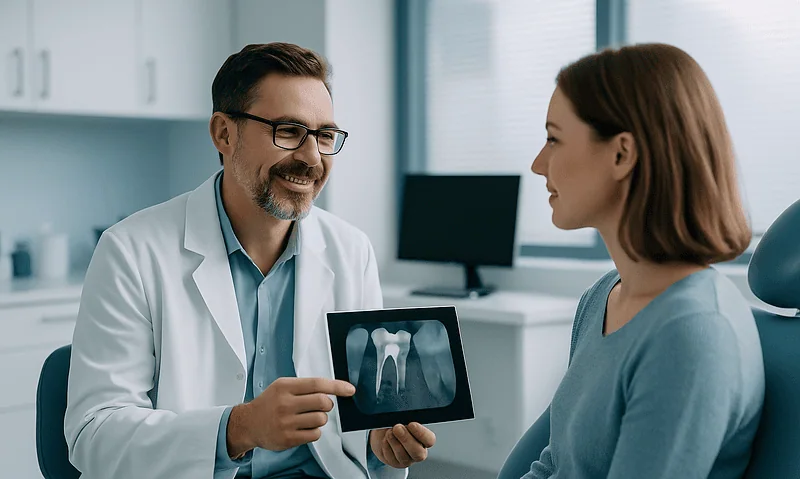
What a Root Canal X-Ray Shows: Infection at the Root Tip and How It Shapes the Plan
A root canal X-ray shows the tooth's inner canals, the bone around the root tip, and any dark area (a radiolucency) where infection has…

How Orofacial Myology Retrains Tongue Thrust and Mouth Breathing Patterns
Orofacial myology, also called myofunctional therapy, retrains tongue thrust and mouth breathing through supervised exercises that teach the tongue to rest on the palate,…
When Fiber Application Is Used: Loose Teeth, Weak Teeth and Root Canal Restorations
Fiber application in dentistry means bonding a thin ribbon of glass or polyethylene fibers, set in tooth-colored resin, to teeth. Dentists use it to…
Questions to Ask Before Teeth Veneers: Enamel Removal, Repairs and Future Replacement
Before veneers, ask how much enamel will be removed (a thin layer, often around half a millimeter, that never grows back), whether porcelain or…