

Who Is a Candidate for Robotic Thyroidectomy? Nodule Size, Early Cancer and Scar Concerns

Key Takeaways
- The robotic approach changes where the incision is placed, usually the armpit, behind the ear, or inside the lip, not what part of the thyroid is removed.
- The strongest candidates have a small to moderate nodule or an early cancer confined to the gland, no prior neck surgery, no large goiter, and a strong preference against a neck scar.
- Robotic cases take longer than open ones and raise a tunnel of tissue from the incision to the neck, so recovery adds chest, arm, or ear numbness that usually improves over months.
- Voice-nerve injury, low calcium from parathyroid disturbance, and bleeding are the main risks of any thyroidectomy, and most are temporary according to MedlinePlus and the Mayo Clinic.
- For very small low-risk papillary cancers and for benign nodules without symptoms, monitoring rather than immediate surgery is an established option worth discussing first.
- After total thyroidectomy, lifelong thyroid hormone replacement is adjusted through blood tests over weeks to months, and weight change is usually modest and manageable once levels are settled.
Robotic thyroidectomy candidates are usually people with a small or moderate thyroid nodule, an early, low-risk thyroid cancer confined to the gland, or a benign condition, who strongly prefer no visible neck scar and have no prior neck surgery, large goiter, or spread beyond the thyroid. Body build, neck anatomy and surgeon experience also matter. Suitability is a case-by-case judgment made by the treating team, not a fixed rule.
She had already learned to tilt her chin when she talked, as if she could hide the walnut-sized lump before anyone noticed it. The ultrasound had been reassuring in most respects, the biopsy less so, and now the endocrinologist was talking about surgery. Her first question was not about the operation at all. It was about the scar, and whether the line across the front of her throat was really the only option.
That question is why many people go looking for information on robotic thyroidectomy candidates. The technique moves the incision away from the neck, tunnels toward the gland, and lets the surgeon operate through a magnified camera and robot-held instruments. It is a genuine option for some. It is not the right tool for everyone, and the reasons it gets declined are as important as the reasons it gets offered.
What follows is an honest map of who tends to qualify, who is usually steered elsewhere, and what the evidence can and cannot promise.
What does being one of the robotic thyroidectomy candidates actually mean?
A thyroidectomy is an operation to remove all or part of the thyroid, the butterfly-shaped gland low in the front of the neck that makes hormones controlling metabolism. The word robotic describes how the surgeon reaches the gland, not what is removed. The same lobe or the same whole gland comes out; the difference lies in where the skin is opened and how the instruments get there.
Candidacy, then, is a matching exercise. On one side sits the disease: how big the nodule is, whether it is benign or cancerous, whether it has grown outside the thyroid capsule, and whether lymph nodes in the neck look involved. On the other side sits the person: prior neck operations, body build, distance from armpit to collarbone, shoulder mobility, other medical conditions, and how strongly they feel about a visible scar. A surgeon experienced in the approach weighs both columns.
The Mayo Clinic describes thyroidectomy as an option for thyroid cancer, noncancerous enlargement, and overactive thyroid that does not respond to other treatment. Robotic access sits within that same list of reasons, narrowed to the situations where a longer tunnel to the gland is safe. When a team says someone is not a candidate, it rarely means the surgery is unnecessary. It usually means the conventional neck incision offers better exposure and a lower chance of trouble for that particular anatomy.
One more distinction matters. Being medically suitable and being well served are not identical. A person with a small benign nodule who is indifferent to the scar may be a technically perfect candidate and still be better off with a shorter operation through the neck. The decision belongs to the treating team, in conversation with the patient, and it should feel like a choice rather than a sales pitch.
How does robotic thyroid surgery actually work?
Picture the thyroid sitting behind a thin sheet of neck muscles, hugging the windpipe. In a conventional operation, the surgeon opens a horizontal line in a natural skin crease above the collarbones and lifts those muscles aside. In a robotic operation, the opening moves to the armpit, behind the ear, or inside the lower lip, and a working space is created under the skin toward the neck.
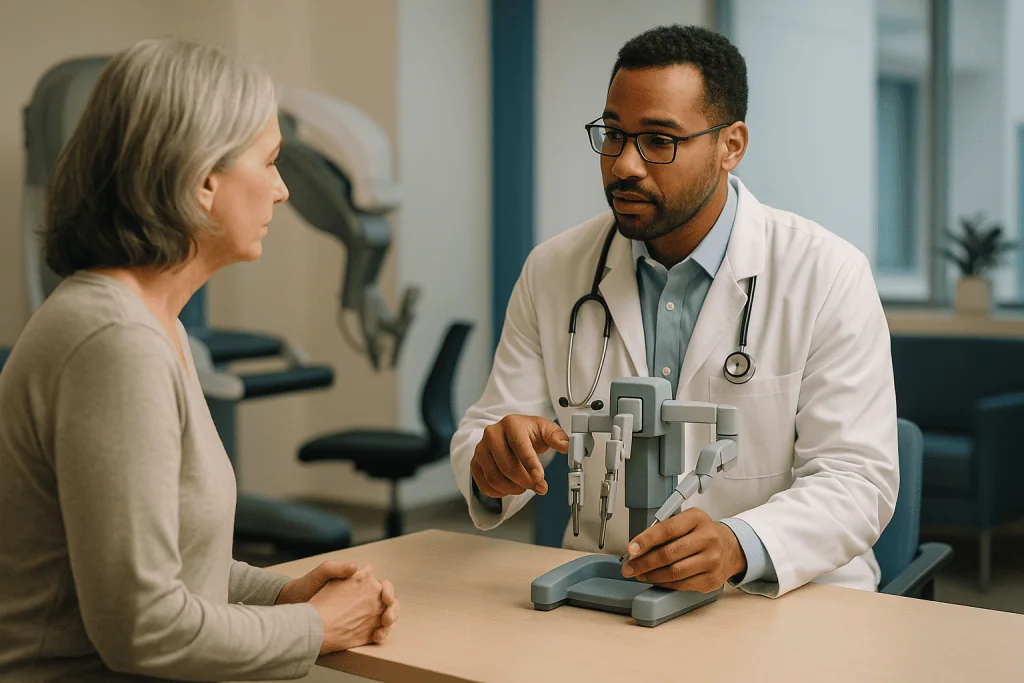
Once that tunnel exists, a camera and two or three slender instruments are passed through it. The surgeon sits at a console a few feet away, looking at a magnified three-dimensional image, and moves hand controls that the robotic arms translate into fine motions at the instrument tips. The robot does nothing on its own; every movement originates with the surgeon. A second team member stands at the patient’s side to swap instruments and manage suction.
The critical work is identical to open surgery. The surgeon finds and protects the recurrent laryngeal nerve, the nerve that runs behind the thyroid and moves the vocal cord, and the parathyroid glands, four rice-grain-sized glands that regulate blood calcium. Blood vessels feeding the thyroid are sealed. The lobe, or the whole gland, is freed from the windpipe and drawn out through the same tunnel. Nerve monitoring, which uses a small electrode to confirm the nerve is signaling normally, is commonly used in both approaches.
Because of the tunnel and the setup, robotic cases typically take longer than a comparable open operation, a point surgical reviews consistently raise. General anesthesia is used either way, and according to the Cleveland Clinic most people having thyroid surgery go home the same day or the following morning.
Transaxillary thyroidectomy and other approaches: where does the scar go?
Several robotic routes exist, and the choice depends on anatomy, the side of the nodule, and what the surgeon trained in. The transaxillary approach, meaning through the armpit, is the most widely reported. A retroauricular or facelift approach hides the incision behind the ear and in the hairline. A transoral approach places small openings inside the lower lip, leaving no external mark at all. A bilateral axillo-breast approach uses small incisions at both armpits and the upper chest.
| Approach | Incision location | Visible neck scar | Common trade-offs |
|---|---|---|---|
| Conventional open | Front of neck, skin crease | Yes, usually fades to a fine line | Shortest operation, widest exposure, best for large or complex disease |
| Transaxillary robotic | Armpit | No | Longer tunnel; risk of arm or chest numbness; harder for opposite-side nodules |
| Retroauricular robotic | Behind ear and hairline | No | Shorter tunnel than armpit; ear numbness possible; single-side work suits it best |
| Transoral robotic | Inside lower lip | None externally | Chin and lip numbness; limited to smaller glands |
The table is a rough guide, not a menu. A right-sided nodule approached from the left armpit, for example, is technically harder because instruments must cross the windpipe. Many surgeons only offer the robotic route for the side nearest the incision or for total removal where the tunnel can reach both lobes.
Each hidden route trades the neck scar for a different footprint: a longer scar in the armpit, temporary skin numbness over the chest or ear, or altered sensation in the chin. Those are not reasons to avoid the approach, but they belong in the conversation, and a candid surgeon will show photographs of typical healed incisions from their own practice rather than a stock image.
Who is usually a good candidate for robotic thyroidectomy?
Across published surgical experience, the people most consistently offered a robotic approach share a recognizable profile. The nodule or gland is small to moderate in size, so it can be dissected safely through a tunnel and removed without fragmenting. Ultrasound shows the disease confined to the thyroid, without growth into surrounding muscle or the windpipe. If cancer is present, it is a well-differentiated type, most often papillary thyroid cancer, the most common and generally slow-growing form, without suspicious lateral neck lymph nodes.

The person has not had previous neck or chest wall surgery, because scar tissue distorts the planes the surgeon relies on. They have reasonable shoulder mobility, since the transaxillary approach requires the arm to be positioned above the head for the duration of the case. Their body build allows a tunnel of manageable length; a very long distance between armpit and collarbone, or a thick neck, makes exposure harder. Most importantly, the scar matters to them enough to accept a longer operation and a different set of potential side effects.
Common reasons someone in this profile might be referred for surgery in the first place include a benign nodule that is growing or causing pressure symptoms, a nodule with an indeterminate biopsy where the pathology cannot be settled without removing it, and a small confirmed cancer. The NHS notes that for thyroid cancer the extent of surgery, removing one lobe or the whole gland, depends on the type and stage; the robotic question comes after that decision, not before it.
Programs differ in their upper size limits and in whether they accept Graves’ disease or Hashimoto’s thyroiditis, conditions where the gland tends to be more inflamed and bloody. Ask what the team’s own criteria are and how many of these operations they perform. Experience with this specific approach is one of the strongest predictors of a smooth course, and it is a fair thing to ask about.
Nodule size: why bigger is not better for the robot
Size is the first filter most surgeons apply, and the logic is mechanical rather than mysterious. The tunnel from armpit or ear to neck is only so wide. A gland the size of a plum can be maneuvered and lifted out; a gland the size of an orange cannot be, at least not without pulling on tissues the surgeon would rather leave undisturbed.
Large nodules also change the anatomy. They push the recurrent laryngeal nerve out of its expected path, stretch the parathyroid glands thin, and draw in extra blood vessels. In an open operation, the surgeon can widen the view and work from several angles. In a robotic case, the view is fixed by the tunnel, and a nerve displaced to an unexpected position is harder to find early. Most published selection criteria therefore cap nodule size at a level each program has validated in its own hands, and the Mayo Clinic’s description of thyroidectomy for noncancerous enlargement reflects the general principle that goiters large enough to cause swallowing or breathing difficulty are treated to relieve pressure, a situation that usually favors direct neck access.
Nodules that extend below the collarbone into the chest, called substernal goiters, are generally excluded from robotic approaches altogether. So are glands that are diffusely enlarged on both sides when only a one-sided tunnel is planned.
The size of the nodule is not the only measurement that counts. Surgeons also look at the total volume of the lobe, the length of the neck, and the distance the instruments must travel. Two people with identical nodules can receive different recommendations because one has a short, slim neck and the other does not. Rather than fixating on a single centimeter threshold found online, it is more useful to ask the surgeon how they judge fit for your anatomy and what they would do if the gland proved larger than the scan suggested.
Early thyroid cancer and robotic surgery: what the evidence supports
Most people asking about robotic thyroidectomy after a cancer diagnosis have a small papillary cancer found on ultrasound or by chance during imaging for something else. This is the setting where the robotic approach has been studied most, and the honest summary is measured: for carefully selected, low-risk cases, surgical series report completeness of removal and complication patterns broadly comparable to open surgery, with longer operating times and no visible neck scar. Long-term recurrence data remain shorter and less mature than for the conventional approach, which has decades of follow-up behind it.
What the robot cannot do is change the cancer’s biology or the guideline-level decisions around it. The NHS explains that treatment for differentiated thyroid cancer may involve removing part or all of the gland, sometimes followed by radioactive iodine, a capsule or liquid of iodine that thyroid cells absorb and that destroys leftover tissue. Whether nodes in the central neck are removed is a judgment about the cancer, not the approach, though central node dissection can be performed robotically in experienced hands.
Certain features usually rule out the robotic route. Cancer that has grown through the thyroid capsule into muscle, the windpipe, or the nerve needs the widest possible exposure. Suspicious lymph nodes in the side of the neck call for a lateral neck dissection, a much larger operation that most teams perform through an open incision. Aggressive subtypes, including medullary and anaplastic cancer, are typically managed conventionally.
A separate development changes the conversation for the smallest cancers. Active surveillance, meaning scheduled ultrasound monitoring rather than immediate surgery, is now an accepted option for some very small, low-risk papillary cancers in guidelines referenced by major centers. If your cancer is small enough to be a robotic candidate, it may also be small enough to discuss watching. Both paths deserve airtime with your team.
Who is usually asked to wait or to choose the conventional approach?
Being steered away from robotic surgery is common, and it is not a verdict on the seriousness of your condition. Several groups are routinely advised toward the open approach or toward postponing any operation.
People with prior neck surgery, radiation to the neck, or chest wall procedures on the side of the planned tunnel are usually excluded because scarring makes the dissection unpredictable. Those with large goiters, substernal extension, or disease on both sides when a single-side tunnel is planned fall into the same category. Cancer with suspected invasion beyond the thyroid, or lymph nodes in the lateral neck, generally requires open access.
Body build matters more than many expect. A long torso, broad shoulders, or a thick neck lengthens the tunnel and reduces instrument reach. Limited shoulder movement, from arthritis or a previous rotator cuff injury, makes the arm positioning required for a transaxillary approach uncomfortable or unsafe, since the brachial plexus, the bundle of nerves supplying the arm, can be stretched during long cases.
Some people are asked to wait rather than switch approaches. An overactive thyroid should be brought under control before any operation, because unmanaged excess hormone raises the risk of a dangerous heart rhythm during anesthesia; medicines from the antithyroid class are often used for this, on a schedule set by the endocrinologist, and the Mayo Clinic notes that preparation may include such treatment. Pregnancy, uncontrolled blood pressure, recent heart events, or blood-thinning medicines that need careful pausing are all reasons to schedule later rather than sooner.
Finally, some teams simply do not offer the technique, or offer it only for the smallest cases, because their published outcomes are strongest with open surgery. A surgeon who says no for that reason is being responsible. The right question is not how to find someone who will say yes, but whether the reasons given fit your situation.
Thyroidectomy without a neck scar: what a hidden incision does and does not change
For many people the scar is the whole reason they are reading this, and it deserves a straight answer. A conventional thyroidectomy leaves a horizontal scar in a lower neck crease, and Johns Hopkins notes it is typically placed to fall within a natural fold. In most people it fades over a year or more to a fine pale line. In some, particularly those with darker skin tones or a personal history of keloids, raised or thickened scars occur, and that history is a legitimate reason to ask about alternatives.
A robotic approach does not eliminate scarring; it relocates it. The armpit incision is usually longer than a neck incision would have been, but sits where a shirt sleeve covers it. The retroauricular incision hides behind the ear and in the hairline. Transoral incisions leave no visible mark. Each comes with a zone of temporary skin numbness where the tunnel was raised, over the chest, the ear, or the chin, which most people report resolving over months, though a minority notice lasting changes.
Robotic thyroid surgery scar concerns are therefore a matter of preference rather than medical necessity. No guideline recommends the robotic approach on the basis of cosmetic outcome alone, and no guideline forbids choosing it for that reason when the disease is suitable. What the evidence does not show is any advantage in how well the thyroid is treated. Choosing a hidden incision is choosing a longer operation and a different side-effect profile in exchange for the absence of a neck line.
People who work in front of cameras, who have a strong cultural reason to keep the neck unmarked, or who have had distressing scars before often feel that trade is worth it. People who mostly want the smallest operation and the quickest return to normal often decide it is not. Both are reasonable conclusions from the same facts.
Is thyroidectomy a high risk surgery? And is robotic thyroidectomy safe?
Thyroidectomy is major surgery in the sense that it requires general anesthesia and works next to structures that matter enormously: the nerves that move the vocal cords, the glands that regulate calcium, and large blood vessels. It is not high risk in the sense of threatening life for most healthy people. MedlinePlus lists the main specific complications as injury to the parathyroid glands causing low calcium, injury to the nerves controlling the voice causing hoarseness, and bleeding or a collection of blood in the neck. Most nerve and parathyroid injuries are temporary; a smaller number are permanent.
Voice change is the complication people fear most. A weakened or paralyzed vocal cord produces a breathy, hoarse voice and sometimes difficulty with high notes or projecting across a room. The Mayo Clinic describes temporary hoarseness after thyroidectomy as common, often from the breathing tube or minor nerve irritation, with recovery over weeks. Low calcium after total thyroidectomy causes tingling around the mouth and fingertips and, if untreated, muscle cramps; teams monitor blood calcium and treat as needed.
Robotic approaches carry the same core risks plus a handful specific to the tunnel. Numbness of the skin over the chest, arm, ear, or chin is expected in the short term. Stretch injury to the brachial plexus from prolonged arm positioning is uncommon but reported, causing arm weakness or tingling that usually resolves. Longer operating times mean longer anesthesia. Conversion to an open incision is occasionally needed when bleeding or anatomy demands it, and every candidate should know that possibility exists.
Is robotic thyroidectomy safe? For appropriately selected patients in experienced hands, surgical literature reports safety broadly in line with open surgery. That qualifier, appropriately selected and experienced, is not boilerplate. It is the whole answer.
Is there an alternative to thyroid surgery?
Often, yes, and a good consultation lays them out before any talk of incisions. The right alternative depends on why surgery was raised.
For a benign nodule that is not causing symptoms, watchful waiting with periodic ultrasound is standard. The Cleveland Clinic notes that most thyroid nodules are noncancerous and that many require no treatment at all. Growth, pressure on the windpipe or esophagus, or a change in appearance on ultrasound are what usually shift the conversation toward removal.
For very small, low-risk papillary cancers, active surveillance is an established option in guidelines used by major centers, involving scheduled ultrasounds and the understanding that surgery can be done later if the cancer grows. Not everyone is comfortable living with a known cancer under observation, and that discomfort is a valid reason to choose surgery; it is just not the only path.
For an overactive thyroid, the alternatives are medicines from the antithyroid class, which reduce hormone production over weeks, and radioactive iodine, which shrinks the gland from within. The Mayo Clinic lists all three, including surgery, as options whose selection depends on age, pregnancy plans, eye disease, and personal preference. Decisions about starting or continuing any of these belong with the prescribing clinician.
For benign nodules causing pressure, image-guided ablation techniques that heat or freeze the nodule through a needle are being studied and are offered in some centers. Evidence is growing but shorter-term than for surgery, and they are not appropriate for suspected cancer. Anyone offered ablation should ask what the evidence shows for their specific nodule type rather than accept it as an established equivalent.
None of these alternatives is robotic or open. They come before the approach question, and skipping past them to debate scars misses the most consequential decision.
What the days and weeks after surgery usually look like
The first evening is mostly about the throat and the neck. Expect soreness where the breathing tube sat, a feeling of tightness, and, after a robotic case, stiffness across the chest or behind the ear where the tunnel was raised. According to the Cleveland Clinic, most people go home the same day or the next day; those having total thyroidectomy may stay overnight so calcium can be checked.
The first week is for gentle activity. Walking is encouraged from day one. Lifting heavy objects and vigorous exercise are usually deferred, and after a transaxillary approach the arm on the operated side may feel weak or heavy for several days. Neck stiffness responds to slow range-of-motion stretches once the team clears them. Swallowing is often uncomfortable for a few days; soft foods help.
By the second week most people are back to desk work and ordinary routines, a timeline the Cleveland Clinic describes as typical, though fatigue can linger longer, particularly after total thyroidectomy while hormone levels settle. Incisions are usually closed with dissolving stitches or skin glue; the team will say when showering and when sun exposure of the scar are fine.
The thyroid hormone question runs on a slower clock. After a lobectomy, the remaining half often produces enough hormone, though some people eventually need replacement. After total thyroidectomy, lifelong replacement with synthetic thyroid hormone is required, and the Mayo Clinic explains that blood tests over the following weeks and months guide adjustment. This is a process of several visits, not a single prescription, and it belongs entirely to the endocrine team.
Skin numbness from a robotic tunnel typically improves over months. A voice that was hoarse at discharge usually strengthens over weeks; if it does not, referral to a voice specialist is standard.
Do you gain weight after a total thyroidectomy?
This is one of the most searched questions about thyroid surgery, and the evidence gives a more nuanced answer than the internet forums suggest. The thyroid sets the pace of metabolism, so it is reasonable to worry that removing it will slow everything down. In practice, once hormone replacement is adjusted to normal blood levels, metabolism is expected to return to roughly where it was, and MedlinePlus describes replacement therapy as restoring what the gland previously supplied.
Several things can cloud that picture. In the weeks between surgery and a settled dose, hormone levels may run low, and low thyroid function does cause fatigue, fluid retention, and a modest weight increase. People who had an overactive thyroid before surgery often gain weight afterward because they are returning from an artificially fast metabolism to a normal one; that is a correction rather than a side effect. Reduced activity during recovery, changes in appetite, and the general drift of weight with age all contribute, and observational studies of weight after thyroidectomy have struggled to separate these factors.
The honest reading of the evidence is that some people report weight gain after total thyroidectomy, that the effect is usually modest, and that it is not inevitable. Anyone experiencing persistent fatigue, cold intolerance, constipation, or steady weight change should have thyroid blood tests reviewed rather than assume it is permanent. Adjustment of replacement is a clinical decision for the prescribing team, and increasing or decreasing hormone on one’s own to influence weight is unsafe.
Notably, this question has nothing to do with the robotic approach. The gland is removed either way, and the hormone consequences are identical.
What people often get wrong about robotic thyroidectomy candidates
The first misconception is that the robot operates. It does not. The surgeon controls every movement from a console; the machine steadies and translates their hands. Outcomes track the surgeon’s experience with the approach far more than the technology itself.
The second is that robotic means smaller surgery. The incision in the neck is gone, but the total amount of tissue disturbed is greater, because a tunnel must be raised from the armpit or ear to reach the gland. Operating time is longer. Recovery in the neck may be similar, but the chest or ear adds its own soreness and numbness.
The third is that a hidden scar signals a more advanced or better treatment. No major guideline recommends robotic access over open surgery for treating the disease. It is a cosmetic and preference-driven option, offered when the disease is suitable, and that is a perfectly good reason to choose it, provided no one is told it is medically superior.
The fourth is that all thyroid cancer needs the whole gland removed. The NHS explains that for some smaller, lower-risk cancers, removing one lobe may be enough, and for the smallest cancers surveillance may be reasonable. The extent of surgery is decided first; the approach comes second.
The fifth is that being declined for the robotic route means the surgeon is old-fashioned or the condition is dire. Most declines are about anatomy, prior surgery, or size, and reflect sound judgment.
The sixth is that weight gain and lifelong fatigue are unavoidable. They are not, and they are manageable with proper hormone monitoring.
The last is that someone must find a different surgeon until they hear yes. A second opinion is always reasonable. Shopping for a yes is different, and a good second surgeon will tell you honestly if the first one was right.
Questions to ask your care team
A consultation goes better when you arrive with questions that get past the brochure. These are the ones surgeons and endocrinologists say they wish more people asked.
- Do I need surgery at all right now, or is monitoring or another treatment a reasonable option for my nodule or cancer?
- Are you recommending removing one lobe or the whole gland, and what drives that choice?
- Based on my ultrasound and body build, am I a candidate for a robotic approach, and if not, what specifically rules it out?
- Which robotic approach would you use, where exactly will the incision be, and can I see healed photographs from your own patients?
- How many of these robotic operations have you performed, and how do your complication rates for voice, calcium, and bleeding compare with your open cases?
- What happens if you need to convert to an open incision during surgery, and how often has that occurred in your hands?
- Will nerve monitoring be used, and will my vocal cords be checked before and after surgery?
- Will lymph nodes be removed, and how will that be decided?
- What numbness or arm symptoms should I expect from the tunnel, and how long do they usually last?
- If I need thyroid hormone replacement, who will manage it, and how often will blood tests be needed in the first months?
- What should I do about my current medicines before surgery, and who will tell me what to pause?
- Who do I call after hours if something feels wrong?
Write the answers down or bring someone to listen. If the responses feel rushed, or if the emphasis lands on the technology rather than on your disease and your anatomy, it is fair to ask for a second opinion. Good teams welcome that.
When to call your doctor
Most recovery from thyroid surgery, robotic or open, is uneventful. A short list of warning signs needs same-day attention, and one or two need emergency care.
Call emergency services or go to the nearest emergency department if you notice rapidly increasing swelling in the neck, difficulty breathing, a sensation of the throat closing, or noisy breathing. MedlinePlus identifies bleeding into the neck as a complication that can press on the airway, and it can develop within the first day or two after surgery. This is rare but urgent.
Call your surgical team the same day if you develop tingling or numbness around the lips, fingertips, or toes, muscle cramps or twitching, or a feeling of the hands cramping into a claw shape. These are signs of low calcium after total thyroidectomy and are treatable when reported promptly. Also call for a fever, spreading redness, warmth, or discharge from any incision, including the armpit, ear, or lip site after a robotic operation; for a voice that is worsening rather than improving after the first week, or choking when swallowing liquids; for new weakness, heaviness, or persistent tingling in the arm on the operated side; or for pain that is escalating rather than easing.
In the months that follow, contact your endocrine team if you experience unexplained fatigue, cold intolerance, constipation, steady weight change, a racing heart, sweating, or anxiety. These can signal that hormone replacement needs review. Never adjust thyroid hormone on your own.
Every timeline in this article is a typical range drawn from the cited sources, not a prediction for any one person. If something feels wrong to you, that is reason enough to make the call. Your treating team knows your operation and remains the right place for every decision about it.
Frequently asked questions
Is thyroidectomy a high risk surgery?
For most otherwise healthy people, thyroidectomy is a common operation with a low rate of serious complications, though it works beside important structures. The main specific risks, per MedlinePlus, are temporary or occasionally permanent voice change from nerve injury, low calcium from parathyroid disturbance, and bleeding. Experienced surgical teams and nerve monitoring reduce these risks. Your own risk depends on your health and the extent of surgery.
Is thyroidectomy a big surgery?
It is major surgery in that it requires general anesthesia and precise work in the neck, yet most people go home the same day or next morning according to the Cleveland Clinic and return to routine activities within about one to two weeks. A robotic approach involves more tissue dissection to reach the gland than an open neck incision, even though the visible incision is hidden.
Is there an alternative to thyroid surgery?
Frequently, yes. Benign nodules without symptoms are usually monitored with ultrasound. Some very small, low-risk papillary cancers can be watched under active surveillance. Overactive thyroid may be managed with antithyroid medicines or radioactive iodine, per the Mayo Clinic. Image-guided ablation for benign nodules is emerging but less established. Which option fits depends on the diagnosis and is a decision for your treating team.
Do you gain weight after a total thyroidectomy?
Some people do, usually modestly, and it is not inevitable. Weight can rise while hormone replacement is being adjusted, or when a previously overactive thyroid returns to normal pace. Once blood levels are settled, metabolism is expected to be close to normal. Persistent fatigue or weight change should prompt a review of thyroid tests by your endocrine team, never self-adjustment of hormone.
Is robotic thyroidectomy safe?
In carefully selected patients treated by surgeons experienced in the approach, surgical literature reports safety broadly comparable to open thyroidectomy for voice, calcium, and bleeding complications. It adds approach-specific issues such as skin numbness over the chest or ear, possible arm nerve stretch from positioning, longer anesthesia, and occasional conversion to an open incision. Selection and surgeon experience are the key safety factors.
What is a transaxillary thyroidectomy?
It is a robotic thyroidectomy performed through an incision in the armpit. A working tunnel is created under the skin to the neck, and a camera and instruments pass through it to remove the thyroid lobe or gland. It avoids a neck scar but requires the arm to be raised during surgery and typically causes temporary chest and arm numbness while the tunnel heals.
How large can a nodule be for robotic thyroidectomy?
There is no universal cutoff; each surgical program sets a limit based on its own experience and the person’s anatomy. In general, small to moderate nodules that fit through the tunnel without fragmenting are considered, while large goiters, nodules extending below the collarbone, and diffusely enlarged glands are usually directed to open surgery. Ask your surgeon how they judge size for your neck and build.
Can early thyroid cancer be treated with robotic surgery?
Small, well-differentiated cancers, most often papillary, that are confined to the thyroid without suspicious lateral neck nodes are the group most commonly offered a robotic approach. Cancer growing outside the gland, aggressive subtypes, or lateral node involvement generally need open access. Whether one lobe or the whole gland is removed is decided by cancer type and stage first, as the NHS outlines.
What does the robotic thyroid surgery scar look like?
It depends on the route. A transaxillary scar sits in the armpit and is usually longer than a neck incision would have been, hidden by clothing. A retroauricular scar hides behind the ear and in the hairline. Transoral surgery leaves no external scar. All routes cause temporary numbness where the tunnel was raised. Ask to see healed photographs from your surgeon’s own patients.
How long is recovery after robotic thyroidectomy?
Typical timelines mirror open surgery for the neck: home the same day or next morning and back to desk work in about one to two weeks, per the Cleveland Clinic. Robotic cases add chest, arm, ear, or chin numbness that usually eases over months. Hormone replacement after total thyroidectomy is adjusted over weeks to months. These are typical ranges, not promises, and your team will guide your pace.
References
- MedlinePlus Medical Encyclopedia: Thyroid gland removal
- Cleveland Clinic: Thyroidectomy (Thyroid Surgery): What It Is & Recovery
- NHS: Thyroid cancer, Treatment
This article is for general information only and is not a substitute for professional medical advice. Please consult a qualified doctor about your individual situation.

More from the Blog

Robotic Thyroidectomy Recovery: Armpit Soreness, Shoulder Movement and Overhead Limits
After a robotic thyroidectomy done through the armpit, most people go home within a day, return to desk work within roughly one to two…

Minimally Invasive or Four-Gland Exploration Parathyroidectomy: How Is the Approach Chosen?
Surgeons choose between a minimally invasive (focused) parathyroidectomy and a four-gland exploration mainly on whether preoperative imaging clearly points to a single overactive gland.…

Exercise With Type 1 Diabetes: How Activity Affects Glucose and How Plans Are Adjusted Safely
People with type 1 diabetes can exercise safely, and most guidelines encourage regular aerobic and strength activity. The challenge is that injected insulin cannot…
When Does Hashimoto Thyroiditis Need Treatment, and When Is Monitoring Enough?
Hashimoto thyroiditis itself is not treated; the underactive thyroid it can cause is. Treatment with thyroid hormone replacement is usually recommended when blood tests…

What Does Radiosurgery Change for Pituitary Tumors Compared With Open Surgery?
Radiosurgery for a pituitary tumor replaces cutting with precisely aimed radiation, so there is no incision, usually no hospital stay, and no direct removal…
Why Can Voice Changes and Low Calcium Follow Thyroidectomy, and When Do They Need a Call?
Voice changes and low calcium can follow thyroidectomy because the thyroid sits against the nerves that move the vocal cords and beside the four…