Robotic Thyroidectomy
Robotic thyroidectomy is a minimally invasive way to remove part or all of the thyroid gland using a robotic surgical system controlled by the surgeon. Instead of a cut on the front…
Quick answer
Robotic thyroidectomy is surgery to remove all or part of the thyroid gland using a surgeon-controlled robotic system through an incision hidden in the armpit or behind the ear, avoiding a visible neck scar. It is used for selected small thyroid nodules and cancers, takes longer than conventional surgery, and has broadly comparable complication rates in experienced hands.
What is robotic thyroidectomy?
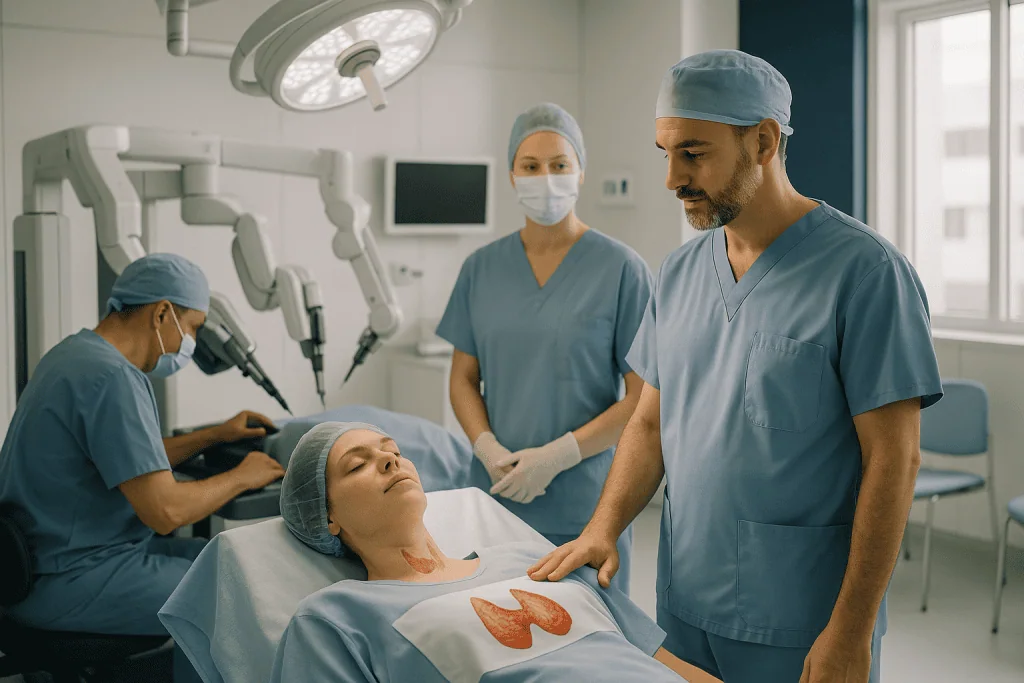
A thyroidectomy is surgery to remove all or part of the thyroid gland, the butterfly-shaped gland at the front of the neck that makes hormones controlling metabolism, heart rate and body temperature. A robotic thyroidectomy is a version of this operation in which the surgeon uses a robotic surgical system to remove the gland through an incision placed away from the front of the neck, most often in the armpit (the transaxillary approach) or, less commonly, behind the ear or along the hairline.
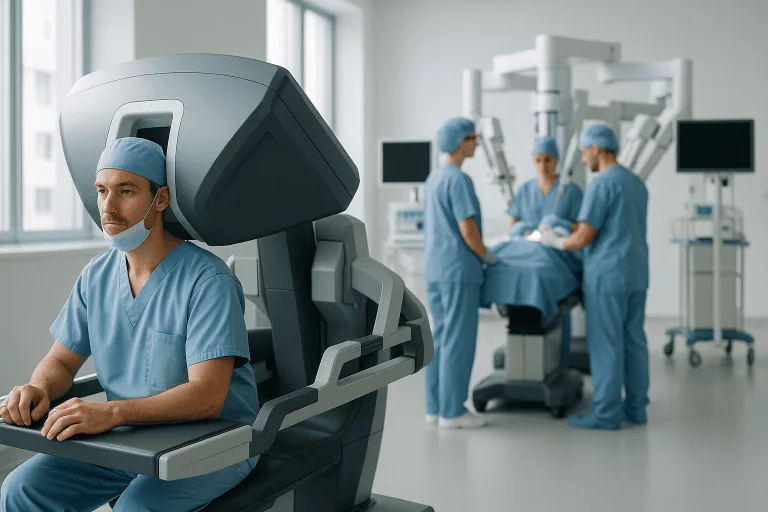
The word “robotic” can be misleading. The robot does not operate on its own. The surgeon sits at a console a few feet from the patient and controls very small instruments and a high-definition three-dimensional camera. The system translates the surgeon’s hand movements into fine, steady movements of the instruments inside the body. Because the cut is hidden under the arm or behind the ear, this approach is sometimes called a scarless thyroidectomy, although it is more accurate to say that the scar is moved to a less visible place rather than avoided altogether.
Robotic thyroid surgery is used for many of the same conditions as conventional thyroid surgery, including:
- Thyroid nodules (lumps) that are suspicious for cancer or that have been shown to be cancerous, usually small, well-differentiated cancers
- Benign (non-cancerous) nodules that are large enough to cause pressure, swallowing difficulty or cosmetic concern
- An overactive thyroid (hyperthyroidism) that has not responded to medication or other treatments, in selected cases
- Nodules with indeterminate biopsy results, where removal is needed to reach a diagnosis
In some hospitals, including Acibadem, this operation is performed by head and neck or endocrine surgeons working within a dedicated robotic surgery program.
Who is a candidate
Not every person who needs thyroid surgery is a suitable candidate for the robotic approach. Surgeons weigh the size and location of the nodule, the overall size of the gland, the person’s body shape and their reasons for wanting a hidden scar.
Robotic thyroidectomy is often considered when:
- The thyroid nodule is relatively small and confined to the gland
- Only one side of the thyroid needs to be removed (a hemithyroidectomy or lobectomy), although total removal is also possible in selected patients
- The person has a strong preference to avoid a visible neck scar, for example because of a tendency to form thick or dark scars (keloids)
- The person is otherwise healthy enough for general anesthesia and a longer operation
The robotic approach may not be suitable when:
- The thyroid is very large, such as a bulky goiter (enlarged thyroid) that extends down into the chest
- The cancer appears to have spread outside the thyroid capsule or into lymph nodes on both sides of the neck, requiring a wider operation
- There has been previous surgery or radiation to the neck, which can distort the tissue planes
- The person has significant obesity or a very short neck, which can make the long tunnel from the armpit to the neck difficult
- The person has a shoulder condition that makes it hard to hold the arm raised during surgery
- Certain heart or lung conditions make a longer anesthetic undesirable
Your surgeon will explain whether the robotic route is a reasonable option in your specific situation and how it compares with the conventional operation through the front of the neck. In many cases both are acceptable, and the choice comes down to personal preference and surgical judgment.
How the procedure works
Before the operation. You will have an ultrasound of the neck, blood tests to check thyroid hormone and calcium levels, and usually a fine-needle biopsy of the nodule. Your voice and vocal cord movement may be checked, since the nerves that control the voice run right behind the thyroid. You will meet the anesthesiologist, who will review your medications and general health.
During the operation. The procedure is carried out under general anesthesia, meaning you are fully asleep. For a transaxillary thyroidectomy, the surgical team positions your arm raised above your head to open up the path between the armpit and the neck. The surgeon makes an incision of a few centimeters in the natural fold of the armpit, then creates a narrow working space under the skin and over the collarbone up to the thyroid. This space is held open by a small retractor. The robotic arms, carrying the camera and instruments, are then docked into position.
From the console, the surgeon identifies and protects the structures around the thyroid: the recurrent laryngeal nerve (the nerve to the vocal cord), the parathyroid glands (four tiny glands that regulate calcium), and the blood vessels. The thyroid lobe, or the whole gland, is freed and removed through the same armpit incision. If lymph nodes need to be sampled, this can sometimes be done through the same approach. The tissue is sent to the pathology laboratory for examination.
After the operation. The incision is closed with stitches or surgical glue. A small drain tube may be left in place for a day or so to prevent fluid from collecting. You wake up in the recovery area and are monitored for breathing, voice, calcium levels and bleeding before returning to the ward.
The robotic operation typically takes longer than a conventional thyroidectomy because of the time needed to create the working space and set up the equipment. Many procedures last roughly two to four hours, depending on how much of the gland is removed.
Preparation for robotic thyroid surgery
Preparation follows the same general principles as any thyroid surgery, with a few additional points specific to the robotic approach.
- Medication review. Tell your surgical team about all medicines, supplements and herbal products. Blood thinners such as aspirin, clopidogrel or warfarin may need to be paused before surgery, but only on your doctor’s instructions.
- Thyroid function. If you have an overactive thyroid, your doctor may want it controlled with medication before the operation to lower the risk of a sudden surge of thyroid hormone.
- Fasting. You will usually be asked not to eat or drink for several hours before the anesthetic. Follow the exact instructions you are given.
- Shoulder mobility. Because the arm is held raised during a transaxillary approach, your surgeon may check your shoulder range of motion and ask about any shoulder pain or previous injury.
- Skin. Avoid shaving the armpit in the day or two before surgery unless told otherwise, as small cuts can increase infection risk. The team will prepare the skin in the operating room.
- Smoking. Stopping smoking before surgery helps wound healing and lung function under anesthesia.
- Practical planning. Arrange for someone to take you home and to help for the first few days, since lifting and reaching with the arm on the operated side will be uncomfortable at first.
Recovery and aftercare after robotic thyroidectomy
Robotic thyroidectomy recovery is broadly similar to recovery after conventional thyroid surgery, with the added element of soreness in the armpit and chest wall where the working space was created.
Hospital stay. Many patients stay one or two nights. Some centers discharge selected patients the same day after a lobectomy. Before you go home, your calcium level and voice will be checked.
The first few days. Expect discomfort under the arm and across the upper chest, along with numbness or tingling in that area. This often feels different from the pain of a neck incision and is caused by the tunnel made beneath the skin. Simple pain relievers usually control it. The drain, if used, is typically removed within a day or two. You may feel a sore throat or mild hoarseness from the breathing tube.
The first two weeks. Most people can walk, shower and do light activities within a few days. Many return to desk work within one to two weeks. Heavy lifting, vigorous exercise and overhead reaching with the affected arm are generally avoided until your surgeon clears you. Gentle shoulder movements are encouraged to prevent stiffness.
Weeks three to six. Numbness over the chest and neck typically fades gradually, although a patch of altered sensation can persist for several months. The armpit scar usually softens and flattens over time and is hidden when the arm is at the side.
Medication and follow-up. If the whole thyroid was removed, you will need daily thyroid hormone tablets (levothyroxine) for life, with blood tests to adjust the dose. After removal of one lobe, many people do not need hormone replacement, but this is checked with blood tests. Calcium and vitamin D supplements may be needed temporarily if the parathyroid glands were disturbed. Your pathology results are usually discussed at a follow-up visit, and further treatment or monitoring is planned based on those results.
Risks and side effects
Robotic thyroid surgery carries the general risks of any thyroid operation plus a few that relate specifically to the route through the armpit. Serious complications are uncommon in experienced hands, but no operation is risk-free.
- Voice change. Injury to the recurrent laryngeal nerve can cause hoarseness or a weak voice. This is often temporary, but in a small number of cases it is permanent. Injury to a second nerve, the superior laryngeal nerve, can affect pitch and singing.
- Low calcium. Bruising or removal of the parathyroid glands can cause low blood calcium (hypocalcemia), leading to tingling around the mouth and in the fingers, or muscle cramps. This is usually temporary but can occasionally be long-lasting after total thyroidectomy.
- Bleeding. Bleeding into the neck after surgery is rare but potentially serious because it can press on the airway. This is why patients are observed closely in the first hours.
- Infection or fluid collection. A seroma (pocket of fluid) can form in the tunnel under the skin and may need to be drained.
- Numbness and skin changes. Altered sensation over the chest, collarbone and neck is common after the transaxillary route and usually improves over months.
- Arm and shoulder problems. Prolonged positioning of the arm can, rarely, stretch the nerves of the arm (brachial plexus), causing temporary weakness or tingling. Shoulder stiffness can also occur.
- Conversion to open surgery. If bleeding, unexpected findings or technical difficulty arise, the surgeon may need to switch to a conventional neck incision.
- Longer anesthesia. Because the operation takes more time, the total anesthetic exposure is greater than with conventional surgery.
- Underactive thyroid. After total removal, lifelong hormone replacement is needed. After partial removal, some people later develop an underactive thyroid (hypothyroidism).
Your surgeon will discuss which of these risks are most relevant to you and how they compare with the conventional approach.
Results and outlook
Published experience with robotic thyroidectomy, much of it from centers that perform large numbers of these operations, generally shows that when patients are carefully selected, the completeness of thyroid removal and the rates of major complications such as nerve injury and low calcium are broadly comparable to those of conventional surgery. The main established advantage is cosmetic: no scar on the front of the neck. Many patients report satisfaction with the appearance of the hidden incision.
The main trade-offs are a longer operation, more early discomfort in the chest and armpit, a period of numbness over the chest wall, and the need for a surgeon and team with specific training in the technique. The evidence base is still developing, particularly for long-term cancer outcomes and for larger tumors, so many specialist societies advise reserving the robotic approach for selected patients treated in experienced centers.
For thyroid cancer, the outlook depends mainly on the type and stage of the cancer, not on the route used to remove the gland. Small, well-differentiated thyroid cancers generally have a favorable prognosis when appropriately treated and monitored, regardless of surgical approach. Your specialist will explain the pathology results and any need for additional treatment, such as radioactive iodine, or for long-term surveillance.
Cost considerations
The cost of robotic thyroid surgery varies widely between countries, hospitals and insurance arrangements. Factors that commonly influence the total include:
- Robotic equipment. The surgical system and its single-use instruments add to the cost compared with conventional surgery, and some insurers do not cover this difference.
- Operating time. Longer procedures mean more operating room and anesthesia time.
- Extent of surgery. Removal of one lobe generally costs less than total thyroidectomy with lymph node removal.
- Hospital stay. The number of nights in hospital and the level of monitoring required.
- Diagnostic tests. Ultrasound, biopsy, blood tests, vocal cord assessment and pathology examination of the removed tissue.
- Follow-up care. Clinic visits, blood tests to adjust thyroid hormone, and any additional treatment such as radioactive iodine.
- Medication. Lifelong thyroid hormone replacement after total thyroidectomy, and temporary calcium and vitamin D if needed.
Ask the hospital’s finance office and your insurer for a written estimate covering all of these elements, and check whether the robotic approach is covered in the same way as conventional thyroid surgery.
Frequently asked questions
Is robotic thyroidectomy really scarless?
Not entirely. A scarless thyroidectomy is a common name for the procedure, but a scar does exist; it is placed in the armpit, behind the ear or along the hairline instead of on the front of the neck. When the arm is at the side, the armpit scar is usually not visible. How well any scar heals varies from person to person.
How long does robotic thyroidectomy recovery take?
Many patients are home within one to two days and back to desk work within one to two weeks. Soreness and numbness over the chest and armpit often last longer than neck pain would after conventional surgery and can take several weeks to months to fade fully. Strenuous activity is usually avoided for a few weeks, and the exact timeline depends on your surgeon’s advice and how much of the gland was removed.
Is transaxillary thyroidectomy safe?
In experienced hands and in carefully selected patients, the transaxillary approach appears to have complication rates broadly similar to conventional thyroid surgery for the major risks, such as voice nerve injury and low calcium. It does carry additional, mostly temporary, risks related to the route through the armpit, such as chest wall numbness and, rarely, arm nerve irritation from positioning.
Can robotic thyroid surgery be used for thyroid cancer?
Yes, but usually for small, well-differentiated cancers that are confined to the thyroid. Larger cancers, cancers that have spread outside the gland or those requiring extensive lymph node removal are generally treated with a conventional approach. Your surgeon will base the recommendation on imaging and biopsy findings.
Will I need to take thyroid medication afterward?
If the whole thyroid is removed, daily thyroid hormone replacement is needed for life. If only one lobe is removed, many people do not need medication, although some later develop an underactive thyroid and require it. Blood tests after surgery guide this decision.
Why does robotic thyroid surgery take longer than the standard operation?
Time is needed to position the arm, create the working space from the armpit to the neck, and set up and dock the robotic system. Once the instruments are in place, the removal of the thyroid itself proceeds in a similar way to the conventional operation.
How do I choose between robotic and conventional thyroidectomy?
The decision depends on the size and nature of your thyroid problem, your body shape, your feelings about a neck scar, and the availability of a surgeon experienced in the robotic technique. Both approaches aim to remove the gland safely; the robotic route trades a longer operation and some chest wall discomfort for a hidden scar. A frank discussion with your surgeon about the pros and cons in your case is the best way to decide.
When to see a doctor
You should be assessed by a specialist if you notice a lump in the front of the neck, a sense of pressure or difficulty swallowing, persistent hoarseness without a cold, or if a thyroid nodule has been found on imaging done for another reason. Symptoms of an overactive thyroid, such as unexplained weight loss, palpitations, tremor or heat intolerance, or of an underactive thyroid, such as fatigue, weight gain and feeling cold, also warrant evaluation. These symptoms have many possible causes, and only a clinical assessment can determine whether thyroid surgery of any kind is appropriate.
After a robotic thyroidectomy, seek urgent medical attention if you experience:
- Rapidly increasing swelling in the neck or around the incision, or difficulty breathing, which can signal bleeding that needs immediate treatment
- Tingling or numbness around the mouth or in the fingertips, muscle cramps or spasms, which may indicate low calcium
- Fever, spreading redness, warmth or pus at the incision
- Severe or worsening pain not relieved by prescribed medication
- Complete loss of voice, choking when drinking, or noisy breathing
- New weakness, severe tingling or loss of movement in the arm on the operated side
Keep your scheduled follow-up appointments so that your pathology results can be reviewed and your hormone and calcium levels monitored.
Preparation
- Have the recommended ultrasound, biopsy, blood tests and vocal cord check before surgery. Tell your team about all medicines, especially blood thinners, and pause them only on medical instruction. Follow fasting instructions, avoid shaving the armpit just before surgery, and arrange help at home for the first few days.
Aftercare
- Expect soreness and numbness in the armpit and chest that gradually fades over weeks. Avoid heavy lifting and overhead reaching until cleared, but do gentle shoulder movements to prevent stiffness. Take thyroid hormone or calcium supplements exactly as prescribed and attend follow-up visits for blood tests and pathology results.
Medically reviewed by the Acıbadem International Medical Board September 8, 2026
See our medical review board →
Update history
- PublishedSeptember 8, 2026
- Medical review approvedSeptember 8, 2026
- Last content updateSeptember 8, 2026
References2
From the Acibadem Blog

Robotic Thyroidectomy Recovery: Armpit Soreness, Shoulder Movement and Overhead Limits
After a robotic thyroidectomy done through the armpit, most people go home within a day, return to desk work within roughly one to two…

Who Is a Candidate for Robotic Thyroidectomy? Nodule Size, Early Cancer and Scar Concerns
Robotic thyroidectomy candidates are usually people with a small or moderate thyroid nodule, an early, low-risk thyroid cancer confined to the gland, or a…