

Who Needs a Porcelain Crown? Cracked, Heavily Filled and Root-Treated Teeth Explained
Key Takeaways
- A crown protects a weakened tooth by wrapping it like a band around a barrel, so it is chosen for structural reasons, not simply because a filling is old.
- The NHS advises that back teeth usually need a crown after root canal treatment to prevent fracture, while front teeth with small access holes often do not.
- Cleveland Clinic gives a typical crown lifespan of five to fifteen years, and the tooth under the margin, not the porcelain, is the usual point of failure.
- Zirconia is the toughest common ceramic for heavily loaded molars, while glass ceramics such as lithium disilicate look most natural on visible teeth.
- A cracked tooth is often tested with a temporary crown or band first, because a crack that runs below the gum or down the root cannot be saved by any crown.
- Preparing a tooth for a crown removes a layer of enamel all the way around and is irreversible, which is why an onlay or filling is preferred when enough sound wall remains.
A porcelain crown is usually considered when a tooth has lost too much sound structure for a filling to hold it together: a cracked tooth, a tooth with a large or repeatedly repaired filling, or a back tooth that has had root canal treatment. Whether a crown is the right choice depends on how much healthy tooth remains, the bite, and gum health, so the decision rests with the treating dentist.
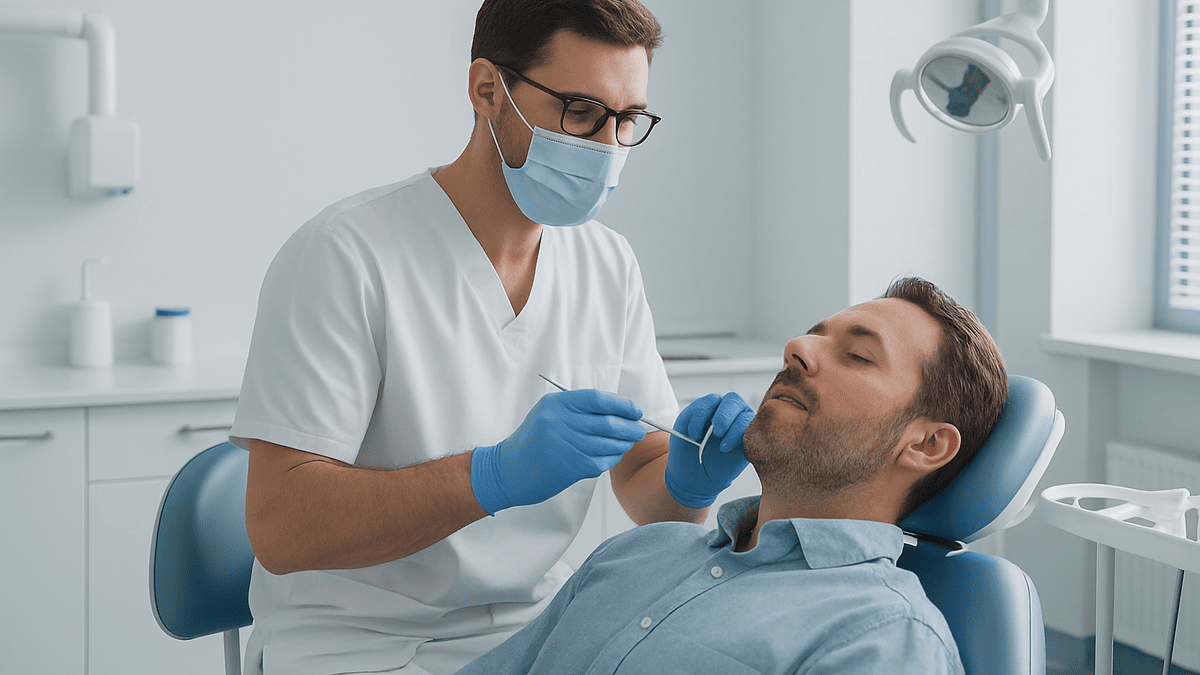
It happens over a sandwich, not a candy bar. A molar that has been quietly holding a filling since college gives a small, sharp complaint when you bite down on the left side, then nothing. You chew on the right for a week. The dentist taps, presses a little plastic wedge against one cusp, and says the sentence you half expected: this one probably needs a crown.
The question of who needs a porcelain crown comes up in almost every dental practice every day, and the honest answer is more interesting than “anyone with a big filling.” A crown is a decision about physics as much as decay. It asks whether the tooth still has enough of itself left to survive the roughly one hundred pounds of force a back tooth can meet in a hard bite.
This explainer walks through the three situations that most often lead to that conversation, cracked teeth, heavily filled teeth and root-treated teeth, and what the evidence says about when a crown helps, when it can wait, and what to ask before anyone picks up a drill.
What is a porcelain crown, and what is it not?
A crown is a custom-made cap that covers the whole visible part of a tooth down to, or just below, the gumline. The NHS describes it plainly as a cap that completely covers a real tooth, used when a tooth is broken, weakened by decay or has a very large filling. Porcelain, in dental language, means a tooth-colored ceramic that is fired at high temperature and polished to mimic enamel.
Not every “porcelain crown” is the same material. Three families show up most often. Feldspathic or layered porcelain is the most glass-like and the most lifelike, and also the most brittle. Lithium disilicate is a glass ceramic reinforced with tiny crystals, which gives it more strength while keeping translucency. Zirconia is a dense crystalline ceramic, sometimes called a white metal because it behaves more like a metal than glass; it is the toughest of the three and the least translucent unless it is a newer layered version. Metal-ceramic crowns, often called porcelain-fused-to-metal, have a metal shell with porcelain baked on top.
A crown is not a filling, which repairs part of a tooth and relies on the surrounding walls for support. It is not a veneer, which covers only the front surface. It is not an implant, which replaces a tooth that has been removed. Those distinctions matter because a crown is the most invasive option that still keeps the natural root. To fit one, the dentist must remove a layer of tooth all the way around, usually between one and two millimeters, which is why the question of who needs a porcelain crown is really a question of whether the benefit of full coverage outweighs the cost of that irreversible reduction.
Who needs a porcelain crown, and who is usually asked to wait?
The strongest case for a crown is a tooth that would otherwise split. Cleveland Clinic lists the classic reasons: a tooth weakened by extensive decay, a cracked or badly worn tooth, a tooth with a large filling and little natural structure left, a tooth that has had root canal treatment, and a tooth that needs to anchor a bridge or sit on an implant. In practice, three of those dominate the daily conversation, and they are the three in this article’s title.

Who is usually asked to wait? First, anyone with active gum disease around the tooth. A crown margin sitting against inflamed, bleeding gum is difficult to fit accurately and hard to keep clean. Treating the gums comes first. Second, a tooth with an untreated infection at the root tip; a crown seals the top, it does nothing for a problem underneath. Third, a small or moderate cavity where a filling or a partial-coverage ceramic (an onlay, which covers only the chewing surface and the weakened cusps) would preserve more tooth. Fourth, a cracked tooth whose crack runs below the gum or through the root, because no crown can hold together a tooth that is already in two pieces.
There is also a group for whom the answer is “not yet, but soon.” A tooth with a large old filling that is not painful, not cracked and not decayed does not need urgent replacement. Dentists often monitor these teeth over years. The tipping point tends to be a new symptom or a visible change, not the age of the filling alone. The decision in every case sits with the treating dentist, who can see the X-rays and test the tooth in the chair.
Why a cracked tooth so often ends up with a crown
A cracked tooth is a tooth with a fracture line that has not yet separated it into pieces. The typical story is exactly the sandwich moment: a brief, sharp pain on biting or on release, often hard to locate, sometimes with a flash of sensitivity to cold. Between episodes the tooth can feel completely normal, which is why people wait.
Cracks concentrate in lower back molars and in teeth that already carry fillings. The reason is mechanical. A filling sits inside the tooth like a wedge. Each time you bite, the remaining cusps flex outward a fraction, and after tens of thousands of cycles a crack can start at the corner of the filling and creep toward the root. Grinding or clenching multiplies the load, and so does a habit of chewing ice.
A crown works on a cracked tooth for one simple reason: it wraps the tooth like the metal band around a wooden barrel. Instead of the cusps flexing apart under load, the crown holds them together and spreads the force across the whole tooth. Dentists sometimes describe this as the ferrule effect, a ferrule being any band that binds. Fillings cannot do this, because they sit inside the walls rather than around them.
The crown will not, however, reverse a crack that has already reached the pulp (the living tissue inside the tooth) or split the root. That is why a cracked tooth is often first fitted with a temporary crown or an orthodontic band for a few weeks to see whether the symptoms settle. If biting pain resolves, a definitive crown usually follows. If pain persists or the tooth becomes tender to touch, root canal treatment may be needed first, and if the crack turns out to run down the root, extraction is the honest option. Your dentist will explain which path fits what they can see and test.
Heavily filled teeth: when a filling stops being enough
There is no law that says a filling must be replaced after a certain number of years, and MedlinePlus is clear that the goal of adult dental care is to keep as much natural tooth as possible. What changes the calculation is proportion. When a filling occupies more than roughly half the width of the tooth between the cusps, the remaining walls are thin, and each replacement removes a little more. A tooth that has been filled three or four times is often more filling than tooth.

Dentists look at several things before recommending full coverage on a heavily filled tooth. How thick are the remaining cusps? Is there decay creeping under the edge of the old filling? Are there visible craze lines, the fine surface cracks that show up when a light is shone through the tooth? Does the tooth hurt when pressure is applied to one cusp and released? Is the tooth an anchor for a partial denture or opposite a strong natural tooth that bites hard on it?
If the walls are still reasonably thick and the problem is a worn or leaking filling, a new filling or an onlay is usually preferred, because both keep more tooth. If a cusp has already broken off or the remaining walls are thin enough to flex, a crown starts to make sense, because at that point the tooth is at risk of a fracture that could take the whole thing.
One honest caveat: replacing a large filling with a crown means the tooth loses a further layer of enamel around its perimeter. For a tooth that is stable and symptom-free, that trade may not be worth making today. Ask what would change your dentist’s mind, and how they will monitor the tooth if you decide to wait.
Who needs a porcelain crown after a root canal?
Root canal treatment removes the infected or inflamed pulp from inside a tooth, cleans and shapes the canals, and fills them. The NHS notes that root canal treatment is usually successful, and that in about nine out of ten cases a treated tooth can survive for up to ten years. It also states that it is usually necessary to fit a crown to a back tooth afterward to prevent it fracturing, because a root-treated tooth is more brittle than a living one.
Why more brittle? Partly because the tooth has lost its internal moisture and blood supply, and partly because the access hole, plus whatever decay or old filling led to the root canal in the first place, has removed a large amount of structure from the center of the tooth. A molar after root canal treatment is often a hollow shell with thin walls, and molars carry the heaviest chewing loads in the mouth. That combination explains why a crown after root canal is the standard recommendation for premolars and molars.
Front teeth are different. An incisor that had a small access hole and is otherwise intact may be adequately restored with a filling alone, because front teeth cut rather than crush and have far less of their structure removed. The crown decision for a front tooth is usually driven by discoloration or an existing large restoration rather than fracture risk.
Timing matters. The crown is usually placed once the dentist is satisfied that the root canal has settled, which may be a matter of weeks; a temporary filling in the meantime is not designed for long-term chewing. Leaving a root-treated back tooth without a definitive restoration for a long period is one of the more common reasons such teeth are eventually lost. Your endodontist or general dentist will advise on the interval that suits your tooth.
Porcelain crown vs zirconia crown vs other options: a summary table
Do most dentists use porcelain crowns? Tooth-colored ceramics are now the common choice in many practices, but the honest answer is that no single material is right for every tooth. The choice balances strength, appearance, how much tooth must be removed, and what the opposing teeth are made of. The table below summarizes the trade-offs in guideline-level terms; specific brand names are deliberately left out.
| Option | Typical use | Main strengths | Main limitations |
|---|---|---|---|
| Layered porcelain (feldspathic or glass ceramic) | Front teeth, visible premolars | Closest match to natural enamel; translucent | Most prone to chipping under heavy bite; needs adequate thickness |
| Lithium disilicate | Front teeth, premolars, some molars | Good looks with more strength than layered porcelain; bonds well to tooth | Less robust than zirconia on heavily loaded molars |
| Zirconia | Molars, grinders, bridge anchors | Very high fracture resistance; can be made thinner, saving tooth | Less translucent in its strongest form; very hard on opposing teeth if left unpolished |
| Metal-ceramic | Molars, long-span bridges | Long track record; strong metal core | Grey line at gum margin over time; porcelain can chip off the metal |
| Full metal (gold alloy) | Back molars not visible when smiling | Kindest to opposing teeth; minimal tooth removal | Metallic color |
| Ceramic onlay | Teeth with damaged cusps but sound walls | Keeps far more natural tooth than a crown | Not suitable when walls are too thin or cracks extend deep |
A practical way to read this: the further back the tooth and the harder the bite, the more the balance tips toward zirconia or metal; the further forward and the more visible, the more it tips toward glass ceramics. Cleveland Clinic makes the same broad point, noting that zirconia is stronger while traditional porcelain is more lifelike but can chip.
How a porcelain crown is done: what actually happens
Most crowns take two visits, though some practices make ceramic crowns in the office in one day using a digital scanner and a milling machine. Cleveland Clinic describes the standard two-visit sequence, and it is worth knowing what each stage involves so that nothing surprises you.
At the first visit the tooth is numbed with local anesthetic. The dentist removes any decay and old filling material, then reshapes the tooth so that the crown can slide over it with parallel walls and a defined edge, called the margin, at or near the gumline. If too little tooth remains to hold a crown, a filling material or a small post inside a root-treated tooth may be added first to build a core. An impression is then taken, either with a putty-like material in a tray or with a digital scanner, along with a record of how your teeth meet and a shade match against the neighboring teeth. A temporary crown, usually acrylic, is cemented with a weak cement so it can be removed later.
Between visits, a dental laboratory makes the crown; Cleveland Clinic gives a typical wait of a couple of weeks. At the second visit the temporary is removed, the fit and bite are checked, small adjustments are made, and the crown is cemented or bonded permanently. A bite check with thin marking paper is repeated until you can close and slide comfortably.
What people rarely hear in advance: the reshaping step is the irreversible part. Once a tooth has been prepared for a crown, it will always need a crown or similar cover. That is not a reason to fear the procedure, but it is the reason a careful dentist prefers to be certain the tooth needs full coverage before starting.
How long do porcelain crowns last, and what shortens that?
Cleveland Clinic gives a typical range of five to fifteen years for a dental crown, with the caveat that many last longer with good care. That range is wide because the crown itself is rarely what fails. More often it is the tooth underneath or the join between the two.
Several factors shorten the life of a crown, and most are within reach of everyday habits. Decay at the margin is the most common. The edge where crown meets tooth is a tiny step that traps plaque, and enamel there is thin. Daily cleaning between teeth, with floss or interdental brushes, and fluoride toothpaste protect exactly this spot. Grinding and clenching, known as bruxism, load the crown far beyond normal chewing; the NHS notes that bruxism often happens during sleep and can crack teeth and fillings, and that a mouth guard or splint can help protect them. Chewing ice, pens or hard candy chips porcelain in the same way it chips natural teeth. Gum recession can expose the margin over time, which is a cosmetic issue with a tooth-colored crown but can leave root surface open to decay.
Material choice interacts with all of this. A layered porcelain crown on a heavy grinder’s molar is more likely to chip than a zirconia crown in the same mouth. A very hard, unpolished zirconia crown, on the other hand, can wear the natural tooth that bites against it. This is why dentists ask about clenching, look for wear facets on other teeth, and sometimes recommend a night guard alongside the crown rather than as an afterthought.
Regular check-ups matter because problems at a crown margin are usually painless until they are large. An X-ray can show early decay under a crown long before you would feel it.
What are the disadvantages of porcelain crowns?
Any honest explainer has to spend real space on the downsides, because a crown is a significant, permanent intervention. Cleveland Clinic and the NHS both list similar risks, and clinicians would add a few practical ones.
- Irreversible tooth removal. Preparing a tooth for a crown takes off healthy enamel and dentin all the way around. That tooth will need a crown for the rest of its life.
- Chipping and fracture. Glass-based porcelains can chip, particularly on molars or in people who grind. Repairs are possible for small chips, but a large fracture usually means a replacement crown.
- Sensitivity. Cold and biting sensitivity after cementation is common and usually settles over days to a few weeks. Persistent or worsening pain can signal that the pulp was already inflamed, and a small proportion of crowned teeth go on to need root canal treatment.
- Wear on the opposing tooth. Hard ceramics, especially unpolished zirconia, can wear the natural tooth they bite against faster than enamel wears enamel.
- Decay at the margin. The crown itself cannot decay, but the tooth beneath the edge can, and that decay is often hidden until it is advanced.
- Bite and gum problems. A crown that is fractionally high can cause jaw discomfort or tooth soreness until adjusted. A margin that sits too far under the gum can inflame it.
- Appearance changes over time. Natural teeth continue to darken with age; porcelain does not, so a crown that matched perfectly may look slightly lighter years later. Metal-ceramic crowns can show a grey line at the gum as tissue recedes.
- Loosening. Cement can wash out over years, allowing bacteria in. A crown that feels loose or moves should be seen promptly.
None of these make crowns a poor choice for the right tooth. They are the reason the right tooth matters.
The days and weeks after a crown: what recovery usually looks like
Recovery from a crown is modest compared with most procedures in medicine, but it has a rhythm worth knowing.
In the first few hours after either visit, the numbness wears off and the gum around the tooth may feel bruised where the retraction cord or impression material sat. Cleveland Clinic advises avoiding hard, sticky or chewy foods while a temporary crown is in place, because temporaries are held with weak cement and can lift off. Flossing beside a temporary is fine, but pull the floss out sideways rather than snapping it upward, which can dislodge the crown.
Over the following few days with a permanent crown, some sensitivity to cold or to biting is common. The tooth has been reshaped and the pulp inside is reacting. Cleveland Clinic describes this as usually temporary. A fluoride toothpaste designed for sensitive teeth is a reasonable everyday measure while it settles. If the crown feels high when you close, meaning you hit it before the other teeth, do not wait for it to wear in; ceramics do not wear in, and a quick bite adjustment fixes the problem in minutes.
Over the following weeks the gum around the margin should look pink and stop bleeding when brushed. Persistent redness or bleeding at one spot suggests the margin needs attention or that cleaning is missing that area.
Beyond that, the tooth should feel like your own. Most people forget which tooth is crowned. The maintenance then becomes the same as for any tooth, with two additions: tell every hygienist and dentist which tooth is crowned so they check its margin, and if you were advised to wear a night guard, wear it. A crown placed to protect a cracked tooth in a grinder is only as safe as the guard that stops the grinding.
Alternatives to a crown, and when less really is more
The best crown is sometimes the one you do not need yet. Several alternatives preserve more tooth, and a fair discussion should include them.
A direct filling in composite resin repairs a moderate cavity or replaces a failed filling while leaving the outer walls untouched. It is the right choice when enough sound wall remains to support it and there is no evidence of cracking. An onlay, made of ceramic or gold, is a lab-made restoration that covers the chewing surface and any weakened cusps but leaves the healthy outer walls in place. It offers much of the protective “holding together” effect of a crown for a tooth whose problem is a broken or thin cusp rather than a tooth-wide weakness. Bonded ceramic onlays have become a common middle path for heavily filled premolars and molars.
For a cracked tooth, a period of observation with a temporary crown or band is itself an alternative to committing straight away, because it tests whether full coverage relieves the symptoms before the tooth is permanently reshaped.
At the other end, extraction followed by an implant, a bridge or a denture is the alternative when a tooth is not worth saving: a crack running down the root, decay extending far below the gum, or a root canal that has failed and cannot be redone. Cleveland Clinic notes that crowns are also used on implants, so the two are not competitors so much as steps on a ladder. Removing a tooth that could have been crowned is a loss; crowning a tooth that will split anyway is a delay. The skill lies in telling them apart, and that judgment belongs to the dentist who has examined and X-rayed the tooth.
What people often get wrong about porcelain crowns
“A crowned tooth cannot decay.” The crown cannot, but the tooth beneath it can, and the margin is a favorite hiding place. Crowned teeth need exactly the same daily cleaning as the rest.
“A crown means the tooth is dead.” Most crowned teeth are alive. Only teeth that have had root canal treatment have lost their pulp. A crown on a living tooth can still feel hot, cold and pressure.
“Every root-treated tooth needs a crown.” The NHS guidance points to back teeth, where fracture risk is highest. A front tooth with a small access hole may do well with a filling.
“Porcelain is fragile, so metal is always safer.” Modern zirconia and lithium disilicate are far tougher than the porcelain of decades ago. The material should match the tooth and the bite, not a general rule.
“A crown will fix my sensitive tooth.” Sensitivity from exposed root surface or gum recession is not a crown problem, and crowning can temporarily make sensitivity worse. Sensitivity from a crack, by contrast, often does improve with full coverage.
“If it doesn’t hurt, it doesn’t need anything.” Cracks and decay under old fillings are often painless until late. Equally, an old filling that is stable and symptom-free does not need replacing because of its age alone. Both extremes miss the point, which is the condition of the tooth on examination and X-ray.
“Crowns last forever.” Cleveland Clinic’s typical range is five to fifteen years, and many last longer, but no crown is a permanent fix. Planning for eventual replacement is realistic, not pessimistic.
“A crown always needs a root canal first.” Most do not. Root canal treatment is done because the pulp is inflamed or infected, not because a crown is planned.
Questions to ask your care team before you agree to a crown
A good dentist welcomes questions, and the answers tell you a great deal about how carefully the decision has been thought through. Take these with you.
- What specifically is wrong with this tooth, and can you show me on the X-ray or photograph?
- Is there a crack, and does it appear to extend below the gum or toward the root?
- How much sound tooth structure remains once the old filling and any decay are removed?
- Would an onlay or a new filling be reasonable here, and what would I be giving up by choosing it?
- Is the tooth alive? Have you tested the pulp, and is there any sign it may need root canal treatment before or after the crown?
- Which material are you recommending for this tooth and why? Would a different material make sense given how I bite?
- Do you see signs that I grind or clench, and should a night guard be part of the plan?
- Where will the margin of the crown sit relative to my gum, and how will I clean it?
- If I decide to wait, what will you monitor, and what change would make you recommend acting sooner?
- What happens if the tooth becomes painful after the crown is placed?
- How do you handle a crown that later chips or comes loose?
You are not expected to understand every answer in technical detail. What you are listening for is a clear reason for full coverage that relates to this tooth’s structure, an acknowledgement of the alternatives, and a plan for the things that most often shorten a crown’s life: bite forces and margin cleaning. If the recommendation is for several crowns at once, it is entirely reasonable to ask which is most urgent and whether the others could be staged. The final decision rests with you and the treating dentist together.
When to call your doctor or dentist: red-flag signs
Most crowns settle uneventfully, but a few situations should not wait for the next routine appointment. Contact your dentist promptly if you notice any of the following.
- Pain on biting that is getting worse rather than better in the days after the crown is fitted, or a tooth that feels noticeably high when you close.
- Throbbing, spontaneous pain that wakes you at night or lingers for minutes after hot or cold. This can indicate the pulp is inflamed and may need root canal treatment.
- Swelling of the gum, cheek or face near the tooth, a bad taste, or a pimple-like bump on the gum that drains. The NHS describes these as features of a dental abscess, an infection that needs treatment rather than observation.
- A temporary or permanent crown that comes off. Keep it, avoid chewing on that side, and arrange to be seen; an exposed prepared tooth is sensitive and vulnerable.
- A crown that feels loose or rocks, even slightly, which allows bacteria under the edge.
- A chip or crack in the crown, especially with a sharp edge that cuts the tongue or cheek.
- Bleeding or persistent tenderness at the gum margin that does not improve with careful cleaning over a couple of weeks.
Seek urgent same-day care, through an emergency dentist or urgent medical services, if facial swelling is spreading, you develop a fever with dental pain, you have difficulty swallowing or breathing, or you cannot open your mouth fully. The NHS lists these as signs that a dental infection may be spreading and needs immediate attention. Do not attempt to re-cement a crown with household glue, and do not adjust a prescribed medicine on your own; if you are taking anything for pain or infection, follow the instructions of the clinician who prescribed it and tell your dentist what you are using.
Frequently asked questions
What are the disadvantages of porcelain crowns?
The main disadvantages are irreversible removal of healthy tooth to make room for the crown, a risk of chipping in glass-based porcelains, temporary sensitivity after fitting, possible wear on the opposing tooth with very hard ceramics, and hidden decay at the margin if cleaning is poor. A small proportion of crowned teeth later need root canal treatment. Cleveland Clinic and the NHS list similar risks; none rule out a crown for a tooth that genuinely needs one.
What is the average lifespan of a porcelain crown?
Cleveland Clinic gives a typical range of five to fifteen years, with many crowns lasting longer under good care. The range is wide because failure usually comes from decay at the crown edge, gum recession or heavy grinding rather than from the porcelain itself. Daily cleaning between teeth, regular check-ups and a night guard if you clench are the factors most within your control.
Do most dentists use porcelain crowns?
Tooth-colored ceramics are widely used and are the common choice for visible teeth, but there is no single material used by everyone. Dentists choose between layered porcelain, lithium disilicate, zirconia, metal-ceramic and full metal based on the tooth’s position, the strength of the bite and how much tooth remains. A heavily loaded back molar in someone who grinds may be better served by zirconia or metal than by traditional porcelain.
How long do porcelain crowns last on back teeth compared with front teeth?
The same five to fifteen year range cited by Cleveland Clinic applies broadly, but back teeth face far heavier chewing forces, so material choice matters more there. Front crowns are more likely to be replaced for appearance reasons as natural teeth darken with age, while back crowns are more often replaced for chipping, fracture or decay at the margin. No timeframe is guaranteed for any individual tooth.
Is a crown after root canal always necessary?
Not always. The NHS states that a crown is usually necessary on a back tooth after root canal treatment to prevent it fracturing, because the tooth becomes more brittle and has lost internal structure. Front teeth with a small access opening and otherwise sound structure are often restored with a filling alone. Your dentist or endodontist will base the recommendation on how much tooth remains and the forces it carries.
Porcelain crown vs zirconia crown: which is better?
Neither is better in every situation. Zirconia is much more resistant to fracture, can be made thinner and suits molars and people who grind, but its strongest form is less translucent. Traditional porcelain and glass ceramics such as lithium disilicate look closest to natural enamel and suit front teeth and premolars, but chip more easily under heavy load. Cleveland Clinic summarizes the trade-off the same way. The dentist matches the material to the tooth.
Can a cracked tooth be saved without a crown?
Sometimes. A small crack confined to a cusp may be managed with an onlay that covers and protects that cusp while leaving the rest of the tooth intact. A crack that produces biting pain and runs toward the center of the tooth usually needs full coverage to stop the halves flexing apart. A crack extending below the gum or down the root generally cannot be saved, and extraction is discussed instead.
Does getting a porcelain crown hurt?
The preparation is done under local anesthetic, so you should feel pressure and vibration but not pain. Afterward, soreness of the gum and sensitivity to cold or biting are common and, according to Cleveland Clinic, usually temporary, settling over days to a few weeks. Pain that worsens, throbs at night or lingers after hot and cold is not typical and should be reported to your dentist promptly.
Why is my crowned tooth still sensitive weeks later?
Some sensitivity can persist for a few weeks as the pulp recovers from preparation. Sensitivity that continues beyond that, or that is triggered by biting, may point to a crown that is fractionally high, a margin that is exposed, or a pulp that was already inflamed before the crown. Any of these is worth an appointment, because a bite adjustment is quick, and a pulp problem is easier to treat early.
What happens if I do nothing to a heavily filled tooth?
Often nothing for years, which is why dentists monitor stable, symptom-free teeth rather than rushing to crown them. The risk is that a thin wall or cusp fractures without warning, and if the break runs below the gum or through the root, the tooth may no longer be saveable. Regular examinations and X-rays let your dentist catch decay under the filling or a developing crack while a crown or onlay is still an option.
References
- Cleveland Clinic: Dental Crowns
- NHS: Root canal treatment
- NHS: Teeth grinding (bruxism)
- NHS: Dental abscess
This article is for general information only and is not a substitute for professional medical advice. Please consult a qualified doctor about your individual situation.

More from the Blog

Dental Crown Myths: Does a Crowned Tooth Stop Decaying and Never Need Care Again?
No. A dental crown covers the visible part of a tooth, but it cannot stop decay. The natural tooth structure beneath and around the…
What to Ask Before a Dental Bridge: How Many Teeth Are Reshaped and What the Plan Includes
Before agreeing to a dental bridge, ask which teeth will be reshaped and how much enamel each will lose, because a conventional bridge usually…

Flying After a Sinus Lift: Cabin Pressure, Timing and How International Patients Plan It
There is no published guideline setting an exact waiting period for flying after a sinus lift. Surgeons commonly ask patients to avoid air travel…

The First Week After Dental Implant Surgery: Swelling Peaks, Soft Foods and Stitches Explained
In the first week after dental implant surgery, swelling and bruising usually build over the first few days and then ease, light bleeding settles…
Intraoral Scanning vs Traditional Impressions: What Digital Dentistry Changes for the Patient
An intraoral scanner captures a digital 3D map of the teeth with a wand-shaped camera, while a traditional impression records their shape in a…

All On 4 for International Patients: How Long to Stay, the Healing Gap and the Second Trip
All on 4 international patients usually need two separate trips. The first covers surgery and a fixed temporary bridge, with most surgeons asking patients…