

Who Needs Medical Treatment for Chickenpox Beyond Comfort Care? Higher-Risk Groups Explained

Key Takeaways
- In healthy children aged roughly one to twelve, chickenpox usually clears on its own and comfort care is the standard of care, not a compromise.
- Antiviral medicine is generally considered for adolescents, adults, pregnant people, newborns exposed around delivery, and anyone with weakened immunity or chronic skin or lung disease.
- Antivirals only block new virus from being made, so CDC guidance notes the benefit is greatest when they start within 24 hours of the first spots.
- A person with chickenpox is contagious from one to two days before the rash until every blister has crusted, typically about a week after the rash begins.
- Aspirin-containing products should not be given to children or teenagers with chickenpox because of the link with Reye's syndrome, and the NHS advises checking with a doctor before using ibuprofen.
- Vaccine within three to five days of exposure, or an antibody preparation within ten days for those who cannot receive the vaccine, can prevent or soften the illness according to the CDC.
Most healthy children with chickenpox need only comfort care at home, because the illness usually clears on its own within one to two weeks. Medical treatment, typically an antiviral medicine, is generally considered for higher-risk groups: adolescents and adults, pregnant people, newborns, people with weakened immune systems, and those with chronic skin or lung conditions. A clinician makes that call, ideally within the first day of the rash.
It is 9 p.m., the baby monitor is quiet, and a parent is standing in a bathroom doorway counting spots on a four-year-old’s back. Twelve this morning. Closer to forty now. The child is cranky and itchy but still asked for a second bowl of cereal. Somewhere in that parent’s head a single question keeps circling: is this one of the cases that needs a doctor, or one of the cases that needs oatmeal and patience?
Working out who needs treatment for chickenpox is less about how dramatic the rash looks and more about who is wearing it. The same virus that gives a healthy preschooler a scratchy week can behave very differently in a teenager, a pregnant woman, a newborn, or anyone whose immune system is already stretched.
This explainer walks through what the evidence actually says about those groups, how antiviral treatment works and why its timing matters, what honest comfort care looks like at home, and which signs should send you to the phone rather than the medicine cabinet.
Who needs treatment for chickenpox, and who only needs comfort care?
Start with the reassuring part. In an otherwise healthy child between roughly one and twelve years of age, chickenpox is usually a self-limiting illness: the body’s immune system clears the virus without any medicine aimed at the virus itself. The Mayo Clinic notes that for most healthy children, management focuses on easing the itch and fever and preventing the scratched blisters from getting infected. Comfort care is not a lesser option here; it is the standard of care.
The picture shifts when the person with chickenpox belongs to a group in which the virus is more likely to spread to the lungs, the brain, or the bloodstream, or to trigger a serious bacterial infection of the skin. The CDC lists those higher-risk groups plainly: adolescents aged 13 and older, adults, pregnant women, newborns whose mothers develop chickenpox around delivery, and people with weakened immune systems from illness or medicines. Guidelines also flag children with chronic skin or lung conditions and those taking long-term salicylate (aspirin-type) or steroid medicines.
For these people, a clinician will usually weigh an antiviral medicine, a drug that interferes with the virus’s ability to copy itself, and sometimes a protective antibody preparation after exposure. The decision rests on three things: how high the baseline risk is, how far along the rash is, and whether any complication is already brewing.
So the honest answer to who needs treatment for chickenpox is not a symptom score. It is a risk-group question first, a timing question second, and a judgment call made by the treating clinician, who can see the whole picture, including things a worried parent cannot measure at the bathroom door.
How chickenpox actually unfolds in the body
Chickenpox is caused by the varicella-zoster virus, a member of the herpesvirus family that spreads through the air in respiratory droplets and through direct contact with fluid from the blisters. After exposure, the virus multiplies quietly in the lining of the nose and throat and in nearby lymph nodes before spilling into the bloodstream and seeding the skin. That silent stretch, the incubation period, runs about 10 to 21 days according to the CDC, which is why a classroom case can surface at home two or three weeks later.

Many children, and most adults, then have a prodrome, the one or two days of fever, tiredness, headache, and loss of appetite that come before any spots appear. The rash itself arrives in crops: flat pink marks that rise into small bumps, fill into clear fluid blisters, cloud over, and crust within a day or so, while fresh crops keep arriving behind them. Seeing spots at several different stages on the same patch of skin is one of the most distinctive features of the illness. The CDC describes a typical case as producing roughly 250 to 500 lesions over a rash period of about four to seven days.
Where is the virus most likely to be found? During the illness, in the throat secretions and blister fluid, which is why a person is contagious from one to two days before the rash until every blister has crusted. After recovery, the virus does not leave. It retreats along sensory nerves and settles, dormant, in clusters of nerve cells called ganglia near the spinal cord and skull. Decades later it can reawaken as shingles, a painful rash along the path of a single nerve.
Do you need a doctor for chickenpox?
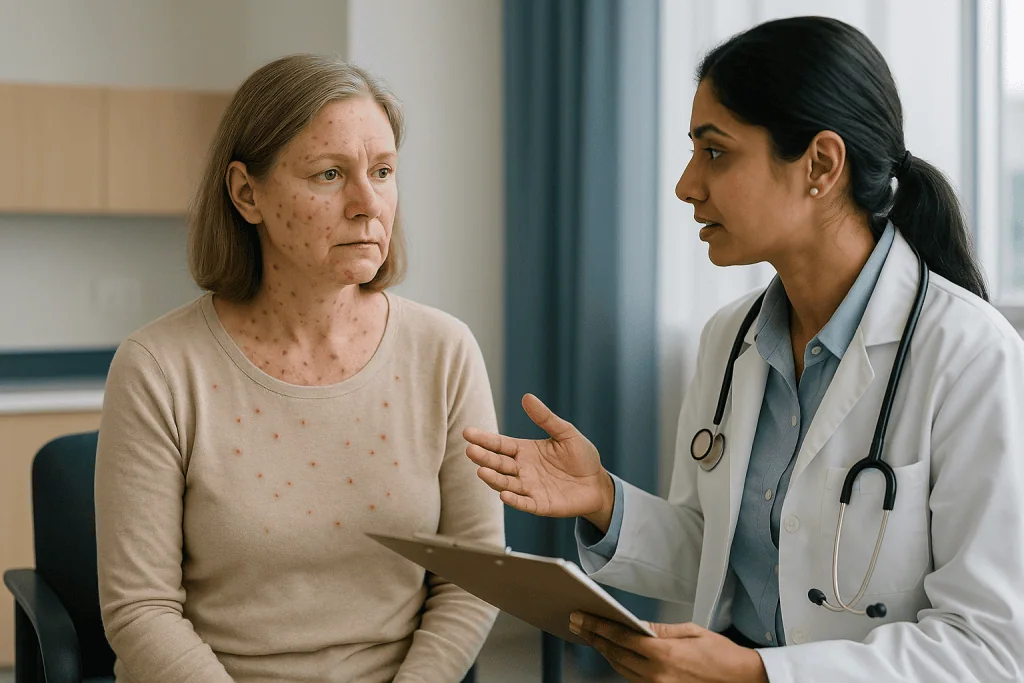
For a healthy child with a classic rash, mild fever and a reasonable appetite, you often do not need a visit, but you may still want a conversation. The NHS and MedlinePlus both suggest a phone call to your usual practice or nurse line rather than an unannounced walk-in, for a practical reason: a person with chickenpox is highly contagious, and waiting rooms contain pregnant patients, babies, and people on chemotherapy who are exactly the ones the virus harms most. Phoning first lets the clinic decide whether to see you at a quiet time, by video, or at all.
Diagnosis is usually clinical, meaning the clinician recognizes the pattern of blisters at mixed stages without any test. Laboratory confirmation by swabbing a blister is reserved for unclear cases, for vaccinated people whose milder rash is harder to read, or when the result would change management, for example in pregnancy or in someone with weakened immunity.
Certain situations should always prompt contact rather than a wait-and-see approach. The Mayo Clinic advises reaching out if the person with chickenpox is under one year old, is a teenager or adult, is pregnant, or has a weakened immune system, and in any case where the rash spreads to the eyes, becomes warm and red, or comes with a very high or prolonged fever. Those are not emergencies in every instance, but they are the cases where a clinician may want to start treatment while it can still do the most good.
In short: do you need a doctor for chickenpox? Not always for the child. Almost always for the groups above. And a quick call costs nothing in medical terms and often settles the question.
Chickenpox high-risk groups: who is usually offered medical treatment
Guidelines from the CDC and NHS converge on a short list of people for whom chickenpox carries a meaningfully higher chance of complications. The table below summarizes the usual starting position; the final decision always sits with the treating clinician, who may deviate for good reasons.
| Group | Why risk is higher | Usual approach |
|---|---|---|
| Healthy child, 1–12 years | Immune system typically clears the virus well | Comfort care at home; treatment not routinely offered |
| Adolescents (13+) and adults | More lesions, higher rates of varicella pneumonia | Antiviral often considered, especially within 24 hours of rash |
| Pregnant women | Risk of maternal pneumonia; fetal effects in early pregnancy | Urgent clinical review; treatment and timing individualized |
| Newborns (mother ill near delivery) | No protective maternal antibodies yet | Specialist assessment; protective antibody preparation often used |
| Weakened immune system | Virus can spread to lungs, liver, brain | Antiviral, often by intravenous route, under specialist care |
| Chronic skin or lung disease; long-term salicylate or steroid use | Higher chance of bacterial skin infection or respiratory complications | Antiviral commonly considered |
A few terms deserve plain definitions. “Weakened immune system,” or immunocompromised, covers people on cancer chemotherapy, organ-transplant recipients, those with HIV at low immune-cell counts, and anyone on high-dose steroids or other immune-suppressing drugs. “Varicella pneumonia” is lung inflammation caused directly by the virus rather than by a secondary bacterium.
Why the sharp line at adolescence? Immunity patterns and the way the virus behaves in a more mature immune system mean teenagers and adults tend to run higher fevers, grow more lesions, and develop lung involvement more often than young children, as the CDC’s clinical overview describes. That shift, not the calendar birthday, is what moves someone from one row of the table to another.
Chickenpox treatment for adults and teenagers
Adults are the group most often surprised to learn they belong in the higher-risk column. Chickenpox feels like a childhood illness, so an unvaccinated adult who never caught it as a child may dismiss the first spots as an allergy or insect bites. That delay matters, because the window in which antiviral medicine offers the most benefit is short.
The CDC reports that adults are more likely than children to develop serious complications. In the era before vaccination, adults made up only about five percent of reported chickenpox cases in the United States yet accounted for roughly a third of the deaths. The leading cause of that gap is varicella pneumonia, which tends to appear a few days into the rash as a dry cough, breathlessness, or chest discomfort, and which is more common in smokers and in pregnancy.
Because of this, clinical guidance generally favors offering an antiviral to otherwise healthy adolescents and adults who present early, typically within the first day of rash, rather than waiting to see whether the case turns severe. The same applies to a second case in a household, since the second person is often exposed more intensely and tends to have a heavier illness. The CDC specifically notes secondary household cases among the situations where treatment is worth considering.
Chickenpox treatment for adults otherwise follows the same comfort principles as for children: fluids, rest, itch control, and nails kept short. The difference is vigilance. An adult who develops breathing difficulty, chest pain, confusion, severe headache, or a stiff neck during chickenpox needs same-day medical assessment, not another day on the sofa. The infection is usually manageable, but only if the people around the patient know that an adult rash is a different proposition from a child’s.
Chickenpox in pregnancy and newborns: why the calendar matters
Pregnancy adds two separate concerns, one for the mother and one for the baby, and the timing of the infection changes which concern dominates.
For the mother, the main worry is varicella pneumonia, which the CDC and NHS note occurs more frequently and more severely in pregnancy than in other adults. Any pregnant woman who develops a chickenpox rash, or who has a significant exposure and is unsure of her immunity, is usually asked to contact her maternity team or doctor the same day. A blood test can check for existing antibodies, which many people have from childhood infection or vaccination even if they do not remember.
For the baby, infection during roughly the first 20 weeks of pregnancy carries a small risk of congenital varicella syndrome, a pattern of skin scarring, limb, eye and brain abnormalities. The CDC puts that risk in the range of under two percent, meaning the large majority of pregnancies affected by early chickenpox do not result in the syndrome, but the possibility is why specialist review and detailed scanning are offered.
The other critical window is the days around birth. If the mother’s rash appears from about five days before delivery to two days after, the baby can be born or exposed before protective maternal antibodies have crossed the placenta, and neonatal chickenpox in that setting can be severe. Specialist teams typically give the newborn a preparation of ready-made antibodies against the virus, known as varicella-zoster immune globulin, and watch closely.
Decisions in pregnancy involve weighing medicines against both maternal and fetal factors, so they belong entirely with the obstetric and pediatric team. The one thing a pregnant reader can do unprompted is make the call early.
How chickenpox antiviral treatment works and why the first 24 hours matter
The antivirals used against chickenpox belong to a class called nucleoside analogues. They are shaped like one of the building blocks the virus needs to copy its genetic material. Inside an infected cell, an enzyme that the virus itself makes switches the drug on; the altered building block is then slotted into the growing viral DNA chain, where it jams the process. Because the activating enzyme belongs to the virus rather than the person, the drug is largely inactive in healthy cells, which is one reason the class has been in routine use for decades.
That mechanism also explains the timing rule. These medicines stop new virus being made; they do nothing for virus that is already in the skin and bloodstream. The CDC’s clinical guidance notes that the benefit is greatest when treatment begins within 24 hours of the rash appearing, and the evidence summarized by the Mayo Clinic describes the effect in healthy people as a modest shortening of the illness and reduction in the number of new lesions, not a dramatic switch-off. Starting treatment several days in, once the rash has mostly crusted, generally adds little in an otherwise healthy person, which is why clinicians do not routinely prescribe late.
The route depends on risk. People with a functioning immune system who qualify are usually given an oral course lasting a matter of days, with the length set by the prescriber. People with seriously weakened immunity, or anyone with pneumonia, brain involvement, or widespread disease, are typically admitted and treated through a vein, where blood levels are more predictable and the team can monitor kidney function and hydration.
Whether to use an antiviral at all, which one, and for how long are questions for the prescribing clinician. What this section should leave you with is a single practical idea: if someone in a higher-risk group develops chickenpox, the clock starts at the first spot.
Who needs treatment for chickenpox after it starts: when a mild case changes course
Risk group is the first filter, but it is not the last. A healthy child who began in the comfort-care column can move into the treatment column if a complication develops. Knowing the main ones helps you recognize the shift.
The most common is secondary bacterial infection of the skin. Scratching opens a blister, and bacteria that normally live harmlessly on the skin, chiefly staphylococci and group A streptococci, get in. The CDC lists these infections, which can range from a single weeping spot to cellulitis, a spreading infection of deeper skin layers, as the leading complication in children. A blister that becomes increasingly red, hot, swollen, or painful, especially if a red area is expanding or the child seems unexpectedly unwell, warrants assessment, and antibiotics rather than antivirals are the usual response.
Less common but more serious are complications inside the body. Pneumonia, discussed earlier, is mostly an adult problem. Neurological involvement includes cerebellar ataxia, a usually temporary wobbliness and unsteady walking that appears as the rash fades, and encephalitis, inflammation of the brain, which presents with severe headache, drowsiness, confusion, or seizures. Dehydration is a quieter danger in small children whose mouth blisters make swallowing painful; the NHS highlights reduced wet diapers and listlessness as signs to act on.
Bleeding into the skin, blisters that look bruised or black, or a child who stops interacting are urgent signs rather than wait-until-morning ones. These are the moments when the honest answer to who needs treatment for chickenpox stops being about categories and becomes about what is happening in front of you. The treating team will decide what that treatment involves; your job is simply to get them looking.
Can an oat bath help with chickenpox? Comfort care the evidence supports
Yes, within limits. An oatmeal bath does not shorten chickenpox or fight the virus, and no mainstream source claims it does. What the Mayo Clinic and NHS do support is its role in itch relief: a lukewarm bath with finely ground (colloidal) oatmeal, or baking soda, coats the skin with a soothing film and calms the urge to scratch. The same pages note that cool baths, loose cotton clothing, and keeping the room from overheating help for the same reason, since warmth makes itch worse.
The point of itch control is not only comfort. Every scratch that opens a blister is a door for bacteria, so the humble measures that stop scratching are, in a real sense, infection prevention. Clipping fingernails short, putting cotton mittens or socks on a toddler’s hands at night, and dabbing calamine lotion on the spots are all endorsed by the NHS and Mayo Clinic for precisely this reason. A clinician may also suggest an oral antihistamine for a child whose itch wrecks sleep; whether and which is their call.
Fever and aches can be eased, but two cautions matter. First, products containing aspirin or other salicylates should not be given to children or teenagers with chickenpox, because of the link with Reye’s syndrome, a rare but dangerous swelling of the brain and liver; this warning appears on CDC, Mayo Clinic and NHS pages. Second, the NHS advises against using ibuprofen for chickenpox unless a doctor recommends it, because of a possible association with serious skin infections. Ask your clinician which fever reducer suits your child rather than reaching for whatever is in the cupboard.
Fluids, small soft meals, and ice pops for a sore mouth round out the list. None of it is glamorous. All of it is what the evidence actually backs.
What the next days and weeks usually look like
Families cope better when they know the shape of the illness, so here is the typical arc, drawn from CDC and NHS descriptions, with the reminder that individuals vary and the ranges are not promises.
Days one to two, before any spots: fever, tiredness, loss of appetite, and sometimes a headache. Children are often grumpier than they are ill. Adults tend to feel worse in this phase. A runny nose is not a hallmark feature, though mild cold-like symptoms can overlap, a point we return to in the myths section.
Days one to five of the rash: crops of spots appear, usually starting on the chest, back, and face before spreading outward, and new blisters keep arriving for about four to seven days. This is the itchiest stretch and the period of highest contagiousness. Fever usually settles within a few days of the rash starting; a fever that climbs again later is worth reporting.
Days five to ten: the last crops crust over. The CDC notes that a person is no longer considered contagious once every blister has formed a scab, which typically takes about a week from the first spot but can take longer. Schools and workplaces generally use that crusting rule for return.
Weeks two to four: scabs fall away. Pink or slightly darker marks commonly persist for weeks and, in most cases, fade gradually; permanent pitted scars are more likely at spots that were scratched open or infected. Fatigue in adults can linger a little beyond the rash.
For people on antiviral treatment, the course itself is short and runs concurrently with the early rash phase; clinicians usually arrange a check-in during or just after it. Any timeline that stretches well beyond these ranges, or that reverses direction, is a reason to call rather than wait.
What people often get wrong about chickenpox
Some beliefs about chickenpox are harmless folklore. A few lead to real harm, so they are worth correcting plainly.
“Chickenpox parties get it over with.” Deliberately exposing a child risks the complications described above, and there is no way to predict which child will have a rough course. The CDC advises against intentional exposure and points to vaccination as the way to gain immunity without the illness.
“Adults are immune by default.” Many adults are, from childhood infection or vaccination, but not all. An adult who is unsure can ask about a blood test for antibodies; guessing is the risky option, particularly before pregnancy.
“Once you have had chickenpox, that virus is gone.” It is not. The virus stays dormant in nerve ganglia for life and can reactivate as shingles. Second episodes of chickenpox itself are uncommon but do occur, as the CDC notes, and vaccinated people can have milder “breakthrough” cases with fewer spots.
“A runny nose means it is just a cold.” Can chickenpox cause a runny nose? Not typically; the classic prodrome is fever, fatigue, headache and loss of appetite. Children often carry an ordinary cold at the same time, which muddies the picture, so a runny nose neither confirms nor rules out chickenpox. Spots at mixed stages are the tell.
“Dried scabs are still contagious.” Once every lesion has crusted, the CDC considers the person non-infectious, even though scabs remain on the skin.
“The more spots, the more danger.” Spot count is a rough guide to severity in adults, but the signs that matter are the complications: breathing trouble, confusion, spreading redness, dehydration. A child with 300 well-behaved spots is usually fine; an adult with 50 spots and a cough is the one to worry about.
Exposure, vaccination and stopping the spread
Treatment is one half of the story; prevention and containment are the other, and both involve decisions a clinician can help with.
If someone without immunity has been exposed, the CDC advises that the chickenpox vaccine given within three to five days of exposure can prevent the illness or make it milder. For people who cannot receive a live vaccine, including pregnant women, newborns, and those with weakened immunity, a preparation of ready-made antibodies called varicella-zoster immune globulin can be given, ideally as soon as possible and up to ten days after exposure according to CDC guidance. Both options are time-sensitive, which is why an exposure in a higher-risk household member should trigger a same-day call.
Routine vaccination has changed the landscape dramatically. The CDC reports that before the vaccine, the United States saw roughly four million cases, around 10,500 to 13,000 hospitalizations, and 100 to 150 deaths from chickenpox each year, and that the two-dose schedule is more than 90 percent effective at preventing the disease. Vaccinated people who do catch chickenpox tend to have fewer lesions and less fever. The vaccine is a live, weakened virus, so it is not given in pregnancy or to people with significantly suppressed immunity; your clinician can advise on timing and alternatives.
Containing a case at home means keeping the person away from school, childcare or work, and away from anyone pregnant, newborn or immunocompromised, until every blister has crusted. Covering coughs, frequent handwashing, and not sharing towels or bedding reduce spread within the household, though the airborne nature of the virus means household contacts without immunity often catch it anyway. Letting the school or daycare know allows them to warn families who might include a higher-risk person.
Questions to ask your care team
A short, specific list makes a brief phone call or appointment far more useful. These are questions that families and adult patients commonly find worth asking; your care team will tell you which apply.
- Does the person with chickenpox fall into a higher-risk group, and if so, is antiviral treatment being considered or deliberately not?
- If treatment is recommended, how soon does it need to start, and what should we expect it to do and not do?
- Which fever reducer is appropriate for this person, and which products should we avoid?
- Is an antihistamine or other itch-relief option worth trying, or are baths and calamine enough for now?
- What signs would mean the illness is moving in the wrong direction, and which of those are same-day versus emergency?
- Is anyone else in the household at risk, and do they need a vaccine, an antibody preparation, or an immunity blood test?
- When can this person return to school, daycare or work, and how should we judge that at home?
- Are there any current medicines that chickenpox or its treatment could interact with, including inhalers, steroids or immune-suppressing drugs?
- For pregnant patients: which team should I contact if symptoms change, and what monitoring is planned?
- For adults: should I be checked for lung involvement if I develop a cough, and when?
Write the answers down. Chickenpox nights are long, and the reassurance of knowing exactly which symptom crosses the line, and who to call when it does, is worth more than any amount of generic advice.
When to call your doctor
Most chickenpox is managed at home without incident. The list below is not a symptom checker for diagnosing the illness; it is the set of warning signs, drawn from CDC, NHS and Mayo Clinic guidance, that mean a case already identified as chickenpox needs a clinician’s eyes.
Call your doctor the same day, or sooner if you are worried, if:
- The person is under one year old, a teenager or adult, pregnant, or has a weakened immune system or a chronic skin or lung condition, even with a mild rash.
- A blister or area of skin becomes increasingly red, hot, swollen or painful, or a red area is spreading.
- Fever lasts beyond four days, climbs very high, or returns after settling.
- The rash spreads to one or both eyes.
- A child is drinking little, has fewer wet diapers than usual, or is unusually listless.
- A new cough, breathlessness, or chest discomfort appears, especially in an adult or in pregnancy.
Seek emergency care immediately if there is difficulty breathing, severe or worsening headache, a stiff neck, confusion, unusual drowsiness or difficulty waking, repeated vomiting, a seizure, unsteady walking, or blisters that look bruised, black, or bleeding. These are the signs of pneumonia, brain involvement, or a serious bloodstream or skin infection, and the right response is a hospital rather than a call-back queue.
If you are unsure which category a symptom falls into, err toward the call. Clinicians would rather field a question about a red spot than meet an infection that has spread. The decision about what to do next, whether that is reassurance, an antiviral, antibiotics, or admission, belongs to the treating team, and getting them involved early is the single most useful thing you can do.
Frequently asked questions
Do you need a doctor for chickenpox in a healthy child?
Usually not for an uncomplicated case, though a phone call to your practice or nurse line is sensible to confirm the diagnosis and get advice on fever and itch relief. A visit becomes important if the child is under one, has a chronic condition, develops spreading redness around spots, stops drinking, or seems unusually drowsy. Phone before attending so the clinic can protect other patients from exposure.
Can an oat bath help with chickenpox?
It can ease the itch, which is genuinely useful, but it does not shorten the illness or act on the virus. The Mayo Clinic and NHS suggest lukewarm baths with colloidal oatmeal or baking soda as a soothing measure, alongside calamine lotion, cool loose clothing, and short fingernails. Less scratching means fewer opened blisters and a lower chance of bacterial skin infection.
Can chickenpox cause a runny nose?
A runny nose is not a typical feature. The usual early symptoms before the rash are fever, tiredness, headache, and loss of appetite. Children often have an ordinary cold at the same time, which can confuse the picture, so a runny nose neither confirms nor rules out chickenpox. The distinguishing sign is a rash with spots at several different stages at once.
Where is the varicella-zoster virus most likely to be found?
During active chickenpox, in throat and nasal secretions and in the fluid inside the blisters, which is how it spreads through the air and by touch. After recovery it does not leave the body; it lies dormant in clusters of sensory nerve cells called ganglia near the spine and skull, from which it can reactivate years later as shingles.
What chickenpox treatment for adults is usually considered?
For otherwise healthy teenagers and adults, clinicians often consider an oral antiviral medicine, ideally started within the first day of the rash, because adults have higher rates of complications such as varicella pneumonia. Comfort care, fluids and rest continue alongside. Anyone with breathlessness, chest pain, confusion or severe headache needs same-day assessment. The choice and course length rest with the prescribing clinician.
Which chickenpox high-risk groups need urgent review?
Pregnant women, newborns whose mothers develop a rash around delivery, people with weakened immune systems, and anyone already showing complications should be reviewed the same day. Adolescents, adults, and children with chronic skin or lung disease or on long-term steroid or salicylate medicines should also contact a clinician promptly, since early assessment keeps the option of timely treatment open.
How does chickenpox antiviral treatment work?
The medicines are nucleoside analogues: they mimic a building block of viral DNA, are switched on by an enzyme the virus makes, and then jam the copying process inside infected cells. Because they prevent new virus rather than removing existing virus, they help most when started early. In healthy people the effect is a modest shortening of the illness; in high-risk patients the aim is preventing severe spread.
How long is chickenpox contagious?
According to the CDC, from about one to two days before the rash appears until every blister has crusted over, which typically takes around a week from the first spots but can be longer. Dried scabs are not considered infectious. During that window the person should stay away from school or work and from anyone pregnant, newborn or immunocompromised.
What should I avoid giving a child with chickenpox?
Products containing aspirin or other salicylates, because of the association with Reye’s syndrome, a rare but serious brain and liver condition. The NHS also advises against using ibuprofen for chickenpox unless a doctor specifically recommends it, owing to a possible link with severe skin infections. Ask your clinician which fever reducer is appropriate rather than guessing.
Can someone get chickenpox after the vaccine?
Yes, though it is uncommon and usually mild. The CDC reports the two-dose schedule is more than 90 percent effective at preventing chickenpox, and “breakthrough” cases in vaccinated people typically involve fewer spots, little or no fever, and a shorter illness. Such cases can still spread the virus, so the same stay-home-until-crusted rule applies.
References
- CDC: Clinical Overview of Chickenpox (Varicella)
- NHS: Chickenpox
- MedlinePlus: Chickenpox
- CDC: Chickenpox Vaccination
This article is for general information only and is not a substitute for professional medical advice. Please consult a qualified doctor about your individual situation.

More from the Blog

Preparing for a First Pediatric Physical Therapy Visit: Reports, Braces and Loose Clothing
For a first pediatric physical therapy appointment, bring the referral, any recent medical or developmental reports, imaging results, and every brace, splint, orthotic, or…

Preparing Your Child for Sensory Integration Therapy: Reports to Bring and What to Wear
To prepare a child for sensory integration therapy, bring the referral letter, any developmental or diagnostic assessments, hearing and vision results, school reports, and…

Reinforcing Developmental Delay Therapy Between Sessions: Play-Based Activities Families Use
Between therapy sessions, families reinforce developmental delay therapy by folding short, playful versions of the therapist's current goals into everyday routines such as mealtimes,…
The ROP Screening Exam: Pupil Dilation, the Retina Check and How Stages Are Graded
An ROP eye exam checks a premature baby's retina for retinopathy of prematurity, abnormal blood vessel growth that can threaten sight. Dilating drops widen…

Braces, Splints and Seating in Pediatric Physical Therapy: Checking Fit as Your Child Grows
A child braces and splints fit check is a planned review of how an orthosis, splint or seating system sits on a growing body.…

What Happens in a Sensory Integration Therapy Session? Swings, Textures and Guided Play
A sensory integration therapy session is a structured, play-based occupational therapy visit, typically lasting about an hour, in which a trained therapist guides a…