

Who Qualifies for Pulmonary Rehabilitation? COPD, Interstitial Lung Disease and Lung Surgery

Key Takeaways
- Eligibility for pulmonary rehabilitation depends on a chronic lung diagnosis plus activity-limiting breathlessness despite treatment, not on a minimum lung function score.
- COPD is the most common qualifying diagnosis, but interstitial lung disease, bronchiectasis, pulmonary hypertension, cystic fibrosis and people before or after lung surgery are also recognized indications.
- Most exclusions are temporary holds for unstable heart conditions or active flares, and neither age nor oxygen use rules anyone out.
- Spirometry usually stays the same after a program; the well-documented gains are in walking distance, breathlessness during tasks and quality of life, driven by fitter muscles and calmer breathing.
- The NHS describes a standard course as two or more sessions weekly for at least six weeks, and StatPearls notes six to twelve weeks is typical, with home-based formats increasingly available.
- Benefits fade within months if regular activity stops, so the maintenance plan agreed in the final weeks matters as much as the sessions themselves.
Pulmonary rehabilitation is usually offered to adults with a chronic lung condition that limits daily activity despite standard treatment. COPD is the most common qualifying diagnosis, but interstitial lung disease, bronchiectasis, pulmonary hypertension, some asthma and people before or after lung surgery may also be eligible. Referral depends on symptoms and ability to take part safely, so the final decision rests with the treating clinician and the program's assessment team.
The garden was the first thing to go. Not the whole garden, just the far bed, the one that needed a trip back to the shed for the trowel. Then the stairs at her daughter’s house became something to plan around. When the pulmonologist finally said the word rehabilitation, she assumed it was for other people, sicker people, people with oxygen tanks on wheels.
That assumption is common, and it is usually wrong. The question of who qualifies for pulmonary rehabilitation gets asked far less often than it should, partly because the program sounds like a last resort and partly because nobody explains the entry criteria in plain terms.
So here they are. This article walks through the diagnoses that typically open the door, the situations where a program may ask you to wait, what the sessions involve, what honestly improves and what does not, and the questions worth bringing to your next appointment.
Who qualifies for pulmonary rehabilitation? The short version
Eligibility rests on three pieces, not one. First, a chronic respiratory diagnosis. Second, symptoms, most often breathlessness, that interfere with everyday life even though prescribed treatment is being taken as directed. Third, enough stability and motivation to attend supervised sessions and exercise safely.
Notice what is missing from that list: a minimum severity. Lung function tests such as spirometry, which measures how much air you can blow out and how fast, help confirm a diagnosis, but they do not by themselves decide who qualifies. Two people with identical test results can live completely different lives, one still walking the dog, the other avoiding the mailbox. Programs are built around the second person’s problem, which is what breathlessness has taken away, not the number on the printout.
The National Heart, Lung, and Blood Institute describes pulmonary rehabilitation as a supervised program combining exercise training, education and support for people with chronic lung disease, and lists COPD, interstitial lung disease, cystic fibrosis, pulmonary hypertension and preparation for or recovery from lung surgery among the situations where it is used. MedlinePlus frames the entry point similarly: a long-term lung problem that leaves you short of breath during ordinary activities.
Referral typically comes from a pulmonologist or primary care clinician, though some programs accept requests from surgeons, hospital discharge teams or heart-lung specialists. A program then runs its own intake assessment, usually including a walking test, a symptom questionnaire and a review of your heart and joint health, before confirming that you can start. That assessment is the real gatekeeper, and the sections below explain what it looks for.
What actually happens in a pulmonary rehab program
Picture a room with treadmills, stationary bikes, a few resistance bands and a rack of small dumbbells, plus a whiteboard and a circle of chairs. Sessions split roughly into two halves: supervised exercise and structured education.
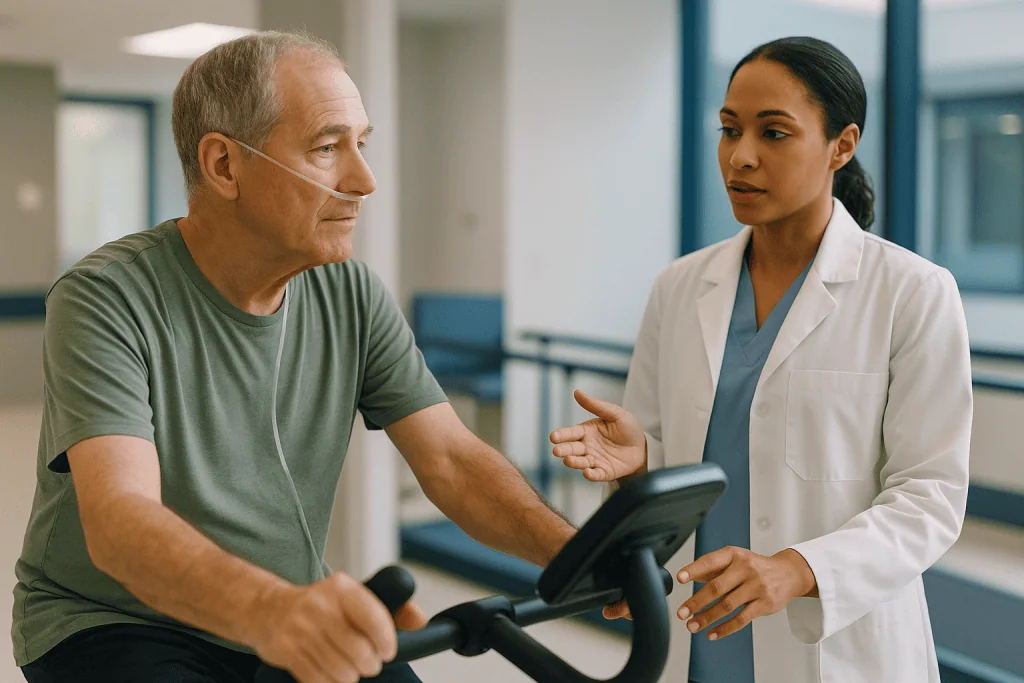
The exercise half is where most of the measurable change comes from. Endurance work on a bike or treadmill is set at an intensity based on your intake walking test and adjusted as you progress. Strength work targets the legs, which weaken quickly when breathlessness makes people sit more, and the shoulders and arms, which matter for lifting, reaching and hair washing. Staff monitor oxygen saturation, meaning the percentage of oxygen carried in your blood as measured by a fingertip clip, along with heart rate and how hard you feel you are working.
Breathing retraining runs alongside. Pursed-lip breathing, which means inhaling through the nose and exhaling slowly through slightly closed lips, helps some people with COPD empty trapped air more completely. Pacing strategies teach you to break a task into chunks rather than pushing through until you have to stop.
The education half covers how your lungs work, how your inhalers or other medicines act and why timing matters, energy conservation, nutrition, recognizing early signs of a flare and building an action plan agreed with your clinician. Many programs also include a psychologist or counselor, because anxiety and low mood travel closely with breathlessness.
The NHS describes a typical program as two or more group sessions a week for at least six weeks, and StatPearls notes that many programs run six to twelve weeks. Home-based and remotely supervised formats exist and are increasingly common, though the core ingredients, monitored exercise plus education, stay the same.
Pulmonary rehab for COPD: the diagnosis that qualifies most often
Chronic obstructive pulmonary disease, or COPD, is an umbrella term for emphysema and chronic bronchitis, conditions in which airways narrow and air becomes trapped, making each breath less efficient. It is the condition most pulmonary rehabilitation programs were designed around and the one for which the evidence base is deepest.
Who with COPD qualifies? Broadly, anyone whose breathlessness limits activity despite optimized inhaled treatment. Mayo Clinic lists pulmonary rehabilitation among core COPD treatments alongside medicines and, for some people, oxygen therapy, and describes it as appropriate across a wide range of severity rather than only at the advanced end. The NHS offers it to people with COPD who feel short of breath during daily activities and are able to take part in exercise.
Two moments deserve special mention. The first is soon after a hospital admission for an exacerbation, meaning a flare in which symptoms worsen sharply enough to need urgent treatment. StatPearls notes that starting rehabilitation shortly after such an admission is associated with lower readmission rates in studies, and many programs prioritize these referrals once the person is medically stable. The second is at the point of diagnosis for someone already limiting what they do, because deconditioning, the loss of fitness that comes from avoiding exertion, sets in quickly and compounds the lung problem.
People who use supplemental oxygen can and do qualify; programs simply adjust the flow during exercise under supervision. Using a cane or a walker is not a barrier. Continuing to smoke is not an automatic exclusion in most programs, though you will be asked about quitting and offered support, because it is the single intervention most likely to slow the disease.
Interstitial lung disease and pulmonary fibrosis: why the rules feel different
Interstitial lung disease, often shortened to ILD, is a group of conditions in which the tissue between the air sacs becomes inflamed or scarred, making the lungs stiff and reducing how well oxygen passes into the blood. Idiopathic pulmonary fibrosis, where the scarring has no identified cause, is the best-known member of the group.
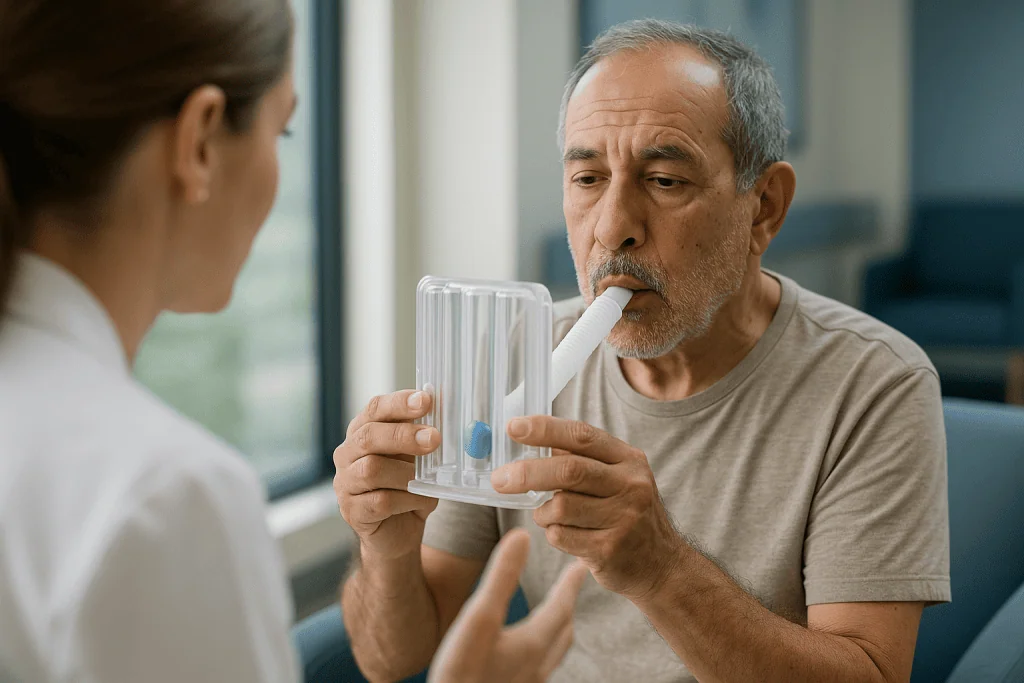
People with ILD absolutely qualify for pulmonary rehabilitation, and the NHLBI names it specifically. Yet the experience differs from COPD in ways worth understanding before you start. In COPD the main problem during exertion is air trapping; in ILD it is often a rapid fall in oxygen saturation with even modest effort. That means staff watch the fingertip monitor more closely, oxygen is used more frequently during sessions and the target intensity may look lower than a COPD neighbor’s on the next bike. This is not a sign the program is going badly. It is the program working as designed.
A dry cough that worsens with exertion is common in ILD and can make group exercise feel awkward. Good programs anticipate this and build in rest and pacing. Because some forms of ILD progress faster than COPD, StatPearls and other reviews note that gains from rehabilitation in ILD may be smaller or shorter-lived than in COPD, and honest programs say so at intake rather than promising parity.
Timing matters here too. Clinicians often prefer to refer earlier in ILD, while exercise capacity is still reasonably preserved, rather than waiting for severe disability. If a lung transplant evaluation is on the horizon, most transplant centers expect candidates to be actively participating in rehabilitation, which makes the referral a practical necessity as well as a symptom treatment.
Pulmonary rehab after lung surgery, and before it
Surgery on the lung, whether removal of a lobe for cancer, lung volume reduction for severe emphysema or transplantation, puts a temporary but heavy load on breathing. Rehabilitation is used on both sides of the operation, and the goals shift depending on which side you are on.
Before surgery, the approach is sometimes called prehabilitation. The idea is straightforward: a fitter body tolerates anesthesia, pain and reduced activity better. Programs for surgical candidates tend to be shorter and more intensive, focused on walking endurance, leg strength, breathing exercises and learning how to clear secretions, which is the mucus that pools in the airways after an operation. StatPearls lists preoperative optimization among accepted indications, particularly for lung volume reduction and transplant candidates, for whom participation is generally required as part of the evaluation.
After surgery, the emphasis moves to safe re-mobilization. Early walking begins in the hospital under the guidance of the surgical and physiotherapy team, and a formal outpatient program may follow once wounds are healing and the surgeon is satisfied. Sessions rebuild the fitness lost during recovery and address the guarded, shallow breathing pattern that pain tends to create.
Who qualifies in this setting is decided jointly by the surgeon, the pulmonologist and the rehabilitation team, and the timing is individual. Someone recovering from a lobectomy may be ready within a few weeks; a transplant recipient’s schedule is shaped by immune-suppressing medicines and infection precautions. Questions about when you can lift, drive or return to work belong with the surgical team, not the rehab gym, though the two usually coordinate closely.
Other diagnoses that may qualify you for pulmonary rehab
COPD, ILD and surgery account for most referrals, but the doors are wider than many people realize. The common thread is a chronic respiratory limitation that exercise training and education can address.
- Bronchiectasis, in which airways become permanently widened and prone to infection, benefits from exercise combined with airway-clearance techniques, and is a recognized indication in StatPearls.
- Asthma that remains limiting despite good inhaler treatment may qualify, particularly when fear of breathlessness has led to avoiding activity. Well-controlled asthma usually does not need a program.
- Pulmonary hypertension, meaning high blood pressure in the arteries of the lungs, was once considered a reason to avoid exercise. Supervised programs are now used for stable patients, though the NHLBI and specialist guidance emphasize that intensity is set carefully and cardiology input is standard.
- Cystic fibrosis is named by the NHLBI as an indication; programs are usually tailored to the person’s infection-control needs.
- Neuromuscular and chest wall conditions that weaken the breathing muscles, such as certain muscular dystrophies or severe kyphoscoliosis, can qualify, with exercise adapted to the underlying weakness.
- Persistent breathlessness after a serious respiratory infection, including some people recovering from severe COVID-19 pneumonia, has led to referrals in recent years, with programs adapting COPD-style structures.
Lung cancer without surgery is a gray area. Some programs accept people undergoing treatment whose breathlessness is limiting, provided the oncology team agrees the person is stable enough. Others focus on surgical candidates only. If your diagnosis is not on this list, that is not a no; it is a reason to ask.
Who is not suitable for pulmonary rehabilitation, or asked to wait
Programs decline or delay a small number of referrals, and the reasons fall into two groups: safety and practicality.
Safety exclusions center on the heart. Unstable angina, meaning chest pain from the heart that is new, worsening or occurring at rest, or a heart attack within the past several weeks, would ordinarily lead to a delay until a cardiologist confirms the person can exercise. Uncontrolled heart rhythm problems, severe aortic valve narrowing and uncontrolled high blood pressure fall into the same category. StatPearls lists these among relative contraindications, which means they are reasons to pause and evaluate rather than permanent bans. Once treated and stable, many of these people go on to enroll.
An active flare of the lung disease itself is another reason to wait. Someone in the middle of an exacerbation with fever, a marked increase in sputum or a recent change in oxygen requirement is generally asked to return once the acute episode settles. A recent blood clot in the lung, called a pulmonary embolism, similarly needs treatment and clearance before exercise begins.
Practical barriers are more common than medical ones. Severe cognitive impairment that prevents following instructions, an unstable psychiatric condition or an orthopedic problem that makes weight-bearing exercise impossible may rule out a standard program, though adapted alternatives sometimes exist. A person who cannot get to the site twice a week may be offered a home-based format instead.
Two things that do not exclude you: needing oxygen, and being older. Age alone is never a criterion. The intake assessment exists precisely to sort the genuinely unsafe from the merely unsure.
Eligibility at a glance: conditions, typical goals and common holds
The table below summarizes how programs typically approach the main qualifying groups. It reflects general guidance from the NHLBI, MedlinePlus and StatPearls rather than the rules of any single program, and your own team’s assessment always takes precedence.
| Situation | Usually qualifies when | Main program focus | Common reasons to delay |
|---|---|---|---|
| COPD | Breathless in daily life despite treatment; after a flare needing hospital care | Endurance, leg strength, breathing technique, flare action plan | Active exacerbation; unstable heart disease |
| Interstitial lung disease | Any stage with activity limitation; often referred early | Oxygen-monitored exercise, pacing, cough management | Rapid clinical decline needing reassessment; acute flare |
| Before lung surgery | Scheduled lobectomy, volume reduction or transplant evaluation | Short intensive conditioning, secretion clearance | Surgery date too close to complete a meaningful block |
| After lung surgery | Surgeon confirms wounds healing and mobilization safe | Rebuilding fitness, normalizing breathing pattern | Wound complications; unresolved air leak |
| Bronchiectasis | Frequent infections or breathlessness limiting activity | Exercise plus airway clearance | Active infection needing treatment |
| Pulmonary hypertension | Stable on specialist treatment | Carefully graded exercise with cardiology input | Recent fainting; unstable right heart failure |
A pattern emerges reading down the last column. Almost every hold is temporary and specific. The word rarely used in eligibility discussions is never; the word used constantly is stable. If you have been told you are not ready, the useful follow-up question is what would need to change, and when your case will be looked at again.
Does Medicare cover pulmonary rehab, and what about other insurance?
People ask this almost as often as they ask about eligibility, and the honest answer has two parts: coverage is common, and the details are administrative rather than medical, so this article will not quote figures.
In the United States, Medicare covers pulmonary rehabilitation for people with COPD of moderate or greater severity and for certain other respiratory conditions, when a physician orders it and the program meets defined requirements for supervision and content. Coverage is typically limited to a set number of sessions within a defined period, with additional sessions possible when the treating clinician documents medical need. The specific session limits, copayment structure and documentation rules change over time and differ between traditional Medicare and Medicare Advantage plans, which is why the program coordinator, not a magazine article, is the right source for current numbers.
Commercial insurance generally follows a similar model, often requiring prior authorization, meaning approval from the insurer before the first session. Medicaid coverage varies by state. Outside the United States, publicly funded health systems including the NHS provide pulmonary rehabilitation as part of standard COPD care, with access by clinician referral.
Three practical points help most people. Ask the program whether they handle authorization on your behalf; many do. Ask whether a home-based or hybrid format is covered if travel is the obstacle. And ask what happens if you miss sessions for illness, since a flare mid-program is common and most payers allow the block to be completed rather than forfeited.
What coverage rules should not do is shape the medical question. Whether you would benefit is decided by your symptoms and your clinician; how the sessions are paid for is a separate conversation that usually has a workable answer.
Can your lungs get better after pulmonary rehab? What improves and what does not
Here is the part most people are not told clearly enough, so it is worth being blunt. Pulmonary rehabilitation does not reverse emphysema, dissolve scar tissue or raise your spirometry numbers in any meaningful way. Lung function tests taken before and after a program usually look about the same. If a program implies otherwise, ask what evidence they are relying on.
What changes is nearly everything around the lungs. Leg muscles that had lost mitochondria, the cellular engines that use oxygen, regain them, so the same walk demands less from your breathing. The heart pumps more efficiently. The breathing pattern becomes slower and deeper, which in COPD reduces air trapping during effort. The brain’s alarm response to breathlessness, which had been amplifying every sensation into panic, quiets down with repeated safe exposure. The result is that you walk farther, climb more stairs and recover faster, even though the lungs themselves are unchanged.
Systematic reviews summarized in StatPearls report consistent improvements in exercise capacity, breathlessness scores and quality of life after pulmonary rehabilitation for COPD, with the strength of evidence rated high for these outcomes. Evidence for reduced hospital readmissions is strongest when rehabilitation begins soon after an exacerbation. Evidence on survival is less certain, and the NHLBI and MedlinePlus are careful not to claim it.
Gains fade if exercise stops. That is not a failure of the program; it is how muscle works. The most important variable after graduation is whether some form of regular activity continues, which is why the final weeks of a good program spend as much time on what comes next as on the treadmill.
What the first weeks of pulmonary rehab usually look like
The first appointment is an assessment, not a workout. Expect a detailed conversation about your history, current medicines and what you want back, whether that is gardening, grandchildren or simply getting to the car without stopping. A six-minute walk test, in which you cover as much distance as you comfortably can in six minutes on a flat corridor while staff track oxygen and heart rate, sets your baseline. You will fill in questionnaires about breathlessness, mood and daily function.
Week one and two are about learning the equipment, finding the right intensity and, frankly, discovering that you can push harder than fear had allowed. Many people describe the first sessions as reassuring rather than exhausting, because someone is watching the numbers so they do not have to. Muscle soreness is common and expected; sharp joint pain or chest pain is not, and should be reported immediately.
By weeks three and four, intensity is increased in small steps. This is typically when people notice that a familiar hill or staircase feels different. Education sessions by now have covered inhaler technique, which is corrected in a surprising proportion of long-term users, and the flare action plan.
The middle weeks can bring a plateau, and occasionally a setback if a cold or a flare interrupts attendance. Programs plan for this, and returning after a pause is normal.
The final sessions repeat the walking test and questionnaires so you can see the change in numbers rather than impressions, and staff work with you on a maintenance plan. The NHS describes the standard course as at least six weeks; StatPearls notes six to twelve is typical. What you are left with is a set of skills, not a completed treatment.
What people often get wrong about who qualifies for pulmonary rehabilitation
Myth: it is only for people on oxygen. Oxygen use is neither required nor a barrier. Many participants have moderate disease and no oxygen at all; they qualify because breathlessness has shrunk their lives.
Myth: if my lung function is too poor, exercise is dangerous. Supervised exercise with oxygen and heart monitoring is the safe way to exercise with severe lung disease, not the risky one. The genuine safety exclusions are mostly about the heart, not the lungs, and they are temporary.
Myth: it is a one-time fix. Rehabilitation is a course of training. Its benefits depend on continuing to move afterward, and repeat courses after a decline or a hospital admission are common and reasonable.
Myth: I have to be referred by a specialist. Pulmonologists refer most often, but primary care clinicians, surgeons and hospital discharge teams can refer too. If you think you qualify, ask whoever manages your lung condition.
Myth: my breathing will be measured and found unchanged, so it did not work. Spirometry is expected to stay roughly the same. The outcomes that matter, walking distance, breathlessness during tasks and quality of life, are measured separately and are where the evidence shows change.
Myth: it replaces my medicines. Rehabilitation sits alongside prescribed treatment. Programs review inhaler technique and timing, but any change to what you take is a decision for your prescribing clinician, never for the gym.
Myth: I am too old. Age is not a criterion. Programs routinely include people in their eighties and nineties, with exercise scaled to the person.
Myth: I smoke, so they will turn me away. Most programs enroll current smokers and offer quitting support, because the combination is more effective than either alone.
Questions to ask your care team before you start
A referral conversation is short and easy to leave with unanswered questions. Bringing a written list changes that. The questions below are the ones rehabilitation staff say they wish more people asked at the outset.
- Given my diagnosis and my current symptoms, do I qualify for pulmonary rehabilitation now, and if not, what would need to change?
- Is there anything about my heart, joints or other conditions that the program should know about before my assessment?
- Should I start before or after any planned surgery, and how will the surgical team and the program coordinate?
- Will I need oxygen during exercise, and how will that be decided?
- Is a home-based or hybrid format available if travel or work makes twice-weekly attendance hard?
- How long is the program, and what happens if I miss sessions because of a flare?
- What will be measured at the start and end, and what kind of change is realistic for someone with my condition?
- Will my inhaler technique and timing be reviewed, and who do I speak to if I have questions about my medicines during the program?
- What support is offered for anxiety or low mood related to breathlessness?
- What is the plan for maintaining activity after the program ends, and can I be re-referred in the future?
- Who do I contact if I feel unwell between sessions?
One more, worth asking plainly: what does the evidence say this program can and cannot do for my particular condition? A good team will answer with the same honesty this article has tried to use, distinguishing the strong evidence in COPD from the more modest and evolving picture in interstitial disease and pulmonary hypertension.
When to call your doctor
Pulmonary rehabilitation is safe when it is supervised, and staff are trained to respond to problems during sessions. Between sessions, and in the weeks before you start, certain changes should prompt a call to your treating clinician rather than waiting for the next appointment.
Seek urgent medical attention, including emergency services if severe, for chest pain or pressure that comes on with exertion or at rest, especially if it spreads to the arm, jaw or back; breathlessness so severe you cannot speak in full sentences; blue or gray lips or fingertips; coughing up more than a small streak of blood; fainting or near-fainting; or sudden confusion or drowsiness. These are red-flag signs that need same-day assessment.
Call your doctor or the program within a day or two if your breathlessness is clearly worse than your usual baseline for more than a day; if your sputum increases sharply or changes to yellow, green or brown; if you develop a fever; if your usual oxygen saturation readings, where you monitor them, are running lower than the range your clinician has told you is acceptable; if you notice new swelling in both ankles; or if you have new pain, redness or swelling in one calf, which can signal a blood clot.
Tell the program before your next session if you have had any of the above, started a course of antibiotics or steroids for a flare, changed a heart medicine or had a fall. Staff would rather adjust a session than have you push through something they did not know about.
None of this should discourage you from enrolling. The people most likely to experience a serious event are those exercising alone and unmonitored, which is exactly what a supervised program is designed to prevent.
After graduation: keeping the gains and knowing when to come back
The last session ends with numbers on a page, a longer walking distance, a lower breathlessness score, and a slightly hollow feeling. For six to twelve weeks somebody watched over you twice a week. Now it is Tuesday and the treadmill is gone.
This is the point where the evidence turns firmly toward habit. StatPearls and the NHLBI are consistent that improvements in exercise capacity decline over months when structured activity stops, and that ongoing exercise, in whatever form you will actually do, is what preserves them. The form matters less than the regularity. A daily walk that grows by a few minutes each week, a community exercise class designed for people with lung conditions, a stationary bike at home used while the news is on: all count.
Some programs run maintenance sessions, less frequent supervised classes for graduates. Others connect people to community groups or provide a written home plan built from the exercises you already know. Ask which your program offers before the final week, not after.
Re-referral is legitimate and, for many, expected. A hospital admission for a flare, a period of illness that undoes months of walking, a new diagnosis such as pulmonary hypertension on top of COPD, or preparation for surgery are all recognized reasons to repeat a course. Coverage rules on repeat programs vary, so the question is worth raising with your clinician and the program coordinator together.
What the woman in the garden found, months later, was not that the far bed had come closer. Her lungs were exactly as they had been. It was that the trip to the shed had stopped being a decision and gone back to being a walk. That is the realistic, evidence-supported goal, and it is available to far more people than currently ask.
Frequently asked questions
What diagnosis qualifies for pulmonary rehab?
Any chronic respiratory condition that limits daily activity despite treatment can qualify. COPD is the most common, followed by interstitial lung disease, bronchiectasis, pulmonary hypertension, cystic fibrosis, limiting asthma and preparation for or recovery from lung surgery. The National Heart, Lung, and Blood Institute lists these among accepted indications. Your clinician and the program’s intake team make the final decision based on symptoms and safety.
Who is not suitable for pulmonary rehabilitation?
Very few people are permanently unsuitable. Programs usually delay enrollment for unstable heart conditions such as recent heart attack, unstable angina or uncontrolled rhythm problems, for an active lung flare, or for a recent pulmonary embolism, until these are treated and stable. Severe cognitive impairment or an orthopedic problem that prevents exercise may require an adapted program. Age and oxygen use are not exclusions.
Can your lungs get better after pulmonary rehab?
The lungs themselves do not measurably recover; spirometry results typically stay about the same. What improves is the rest of the body: leg and heart muscles become more efficient, breathing becomes slower and deeper, and the fear response to breathlessness eases. Systematic reviews summarized in StatPearls show consistent gains in walking distance, breathlessness scores and quality of life, particularly in COPD.
How long will Medicare pay for pulmonary rehab?
Medicare covers pulmonary rehabilitation for qualifying conditions when ordered by a physician, typically for a limited number of sessions within a set period, with more possible when medical need is documented. The exact limits, copayment rules and authorization steps change over time and differ between plan types, so the program coordinator or your plan is the reliable source for current figures rather than a general article.
Is pulmonary rehab for COPD only for severe cases?
No. Mayo Clinic and the NHS describe pulmonary rehabilitation as appropriate across a wide range of COPD severity, whenever breathlessness limits everyday activity despite treatment. Many programs prioritize referral soon after a hospital admission for a flare, but early referral for someone already avoiding activity is also encouraged, because loss of fitness sets in quickly and worsens the impact of the lung disease.
Can I do pulmonary rehab after lung surgery, and when does it start?
Yes. Early walking begins in the hospital under the surgical team’s guidance, and a formal outpatient program may follow once wounds are healing and the surgeon confirms it is safe. The timing is individual: recovery from a lobectomy differs from recovery after transplant, where immune-suppressing medicines and infection precautions shape the schedule. The surgeon, pulmonologist and rehabilitation team decide together.
Do I need a specialist referral to qualify?
Usually not exclusively. Pulmonologists refer most often, but primary care clinicians, thoracic surgeons and hospital discharge teams can also refer in most systems. If you believe you qualify, raise it with whoever manages your lung condition. The program then carries out its own intake assessment, including a walking test and health review, before confirming a start.
Can I still qualify if I use oxygen or a walker?
Yes to both. Programs routinely include people on supplemental oxygen and adjust the flow during exercise under supervision. Using a cane or walker is not a barrier; exercise is adapted to your mobility. Interstitial lung disease in particular often requires oxygen during sessions because saturation can fall quickly with effort, and staff monitor this closely.
How long does a pulmonary rehabilitation program last?
The NHS describes a typical program as two or more group sessions a week for at least six weeks, and StatPearls notes that six to twelve weeks is common. Programs before surgery may be shorter and more intensive. Home-based and hybrid formats exist. Because gains fade when activity stops, the maintenance plan for afterward is as important as the program length.
Can I repeat pulmonary rehab if my breathing gets worse again?
Yes, repeat courses are recognized as reasonable after a hospital admission for a flare, a period of illness that undoes fitness, a new diagnosis or before planned surgery. Coverage rules for repeat programs vary by payer, so raise the question with your clinician and the program coordinator together. Rehabilitation is training, not a one-time treatment, and returning is not a sign of failure.
References
- Pulmonary Rehabilitation – MedlinePlus
- Pulmonary Rehabilitation – National Heart, Lung, and Blood Institute (NIH)
- Chronic obstructive pulmonary disease (COPD) – Treatment – NHS
- Pulmonary Rehabilitation – StatPearls – NCBI Bookshelf (NIH)
This article is for general information only and is not a substitute for professional medical advice. Please consult a qualified doctor about your individual situation.

More from the Blog

Family Support During Spinal Cord Injury Rehabilitation: Transfers, Home Set-Up and Rest
Family support during spinal cord injury rehabilitation means learning safe transfer techniques from the therapy team, preparing the home for wheelchair access and pressure-relief…

Before Your First Vestibular Rehabilitation Visit: Symptom Diary, Hearing Tests and Medicines
Before a vestibular rehabilitation first appointment, most teams ask for three things: a short symptom diary recording when dizziness happens, how long it lasts…
Skin Checks and Pressure Relief After Spinal Cord Injury Rehabilitation: A Daily Routine
Pressure sore prevention after spinal cord injury rests on a daily routine: inspect skin over bony areas at least once or twice a day,…

What a Pulmonary Rehabilitation Session Involves: Exercise, Breathing Training and Education
Pulmonary rehabilitation is a supervised program for people with chronic lung disease that combines exercise training, breathing techniques and education. A typical session includes…

Daily Life After Vision Rehabilitation: Practicing Contrast Strategies and Orientation Skills
Living with low vision after rehabilitation works best when contrast and orientation skills become daily habits: use dark-on-light or light-on-dark pairings for food, stairs,…
Shockwave Therapy for Plantar Fasciitis: What the Trials Show
Shockwave therapy shows moderate evidence of benefit for chronic plantar fasciitis. Randomized trials and meta-analyses find it relieves heel pain better than sham treatment…