

Why Channel Angle and Depth Shape How Natural a Sapphire Transplant Hairline Looks
Key Takeaways
- A sapphire blade only makes the recipient channel; the channel's angle, direction, depth and spacing are what determine whether transplanted hair lies naturally.
- Native hair exits the scalp at an acute, low angle and points in a direction that changes across the head, so channels made too upright produce a doll's-head look.
- Channels cut too shallow can leave raised, pebbled skin and loose grafts, while channels cut too deep can cause pitting and small cysts.
- Follicular units contain one to four hairs, and a natural hairline places fine single-hair units at an irregular front edge with larger units behind.
- Transplanted hairs shed within the first few weeks and most new growth appears over roughly six to nine months, so early photographs are not the final result.
- No large randomized trial shows sapphire FUE, steel FUE or DHI produces a more natural hairline; execution of the plan is the variable most tied to appearance.
Sapphire transplant results look natural mainly because of how each recipient channel is planned, not because of the blade material. A channel's angle fixes the direction the hair will grow, and its depth decides whether the graft sits flush with the skin. When angle follows the native pattern and depth matches the follicle, the hairline blends in; when they miss, hairs can stand up, dimple or cluster. Comparative evidence on blades is limited.
He has been standing at the bathroom mirror for a full minute, pushing his fringe back with two fingers and letting it fall again. The recession at the temples is not dramatic. It is the shape that bothers him: two corners creeping back, a hairline that no longer looks like his. He has read about sapphire transplant results on a forum, watched a dozen one-year videos, and now has a single worry he cannot shake. Some of those hairlines look like they were always there. Others look planted.
The difference is rarely the blade. Ask anyone who spends their working life making recipient sites and they will tell you the same thing: the hairline is decided by geometry, one tiny incision at a time. Angle, direction, depth, spacing. Thousands of small choices, each one setting where a hair will point for the rest of that person’s life.
This explainer walks through those choices in plain language, with the evidence weighed honestly, so the conversation with a surgeon starts from the right questions.
What is a sapphire blade, and what does it actually do?
A sapphire blade is a very small cutting tip made from synthetic, laboratory-grown sapphire rather than surgical steel. It is used during one specific step of follicular unit extraction, the method most people mean when they say FUE. Follicular unit extraction is a hair transplant technique in which naturally occurring bundles of hair are removed from the back and sides of the scalp one at a time with a tiny circular punch, then placed into the thinning area. Those bundles, called follicular units, usually contain between one and four hairs, according to Cleveland Clinic.
Once grafts have been harvested, the surgeon needs somewhere to put them. That is where the blade comes in. Each graft needs its own slit, or channel, in the skin of the recipient area. The sapphire blade makes those channels. Its advocates point to a harder, smoother edge that keeps its sharpness across many hundreds of incisions and allows a narrower slit for the same graft.
What the blade does not do is decide where the slit goes, how steeply it enters, or how far it travels. Those decisions belong to the person holding it. Mainstream patient resources from MedlinePlus, Mayo Clinic and the NHS describe the two main approaches to harvesting, follicular unit extraction and strip surgery, and do not single out any blade material as a determinant of outcome. The published research comparing sapphire tips with steel consists largely of small observational series rather than large randomized trials, so claims of superiority should be read as plausible rather than proven.
Think of the blade as a good pencil. It can make a cleaner line, but it cannot draw the portrait.
Why sapphire transplant results depend on the channel, not the crystal
Every recipient channel carries four pieces of information, whether or not the surgeon is thinking about them consciously. The first is angle, meaning how far the incision tilts from vertical relative to the skin surface. The second is direction, meaning which way along the scalp the tilt points: forward, backward, toward the ear. The third is depth, meaning how far the blade travels below the surface. The fourth is position, meaning how the channel sits in relation to its neighbors and to the existing hair.
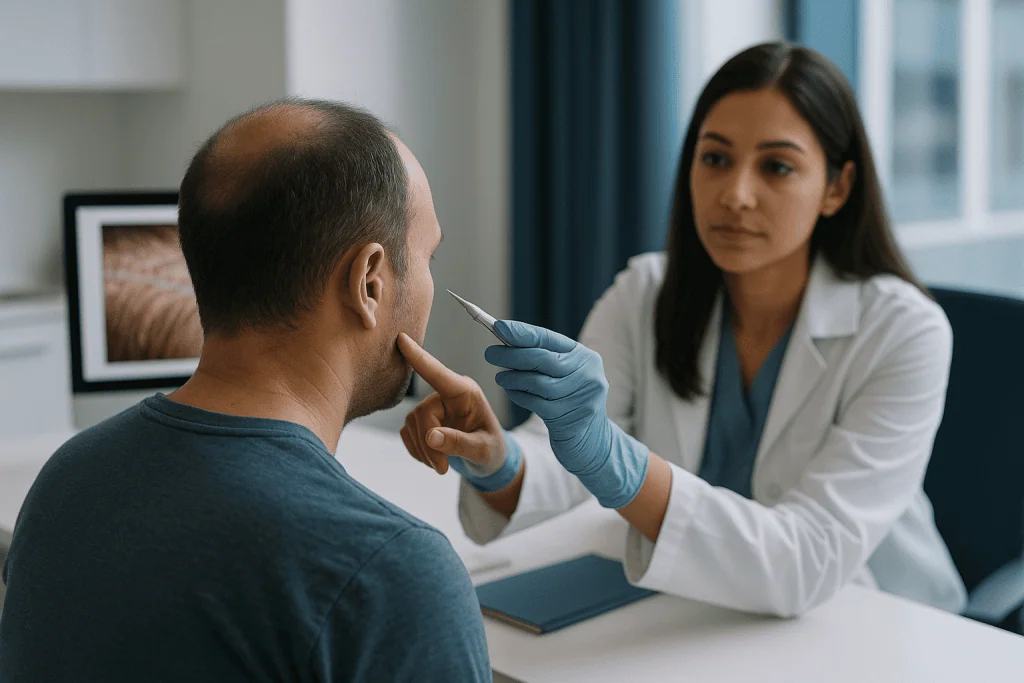
A hairline is the sum of all four, repeated across every graft in the front zone. Get three of them right and one wrong, and the eye still notices. Hair is unusually good at betraying geometry because each strand acts like a tiny arrow, pointing exactly where its root was set.
Consider two everyday comparisons. A tiler laying a herringbone floor can use flawless tiles and still produce a floor that looks off if the pattern drifts by a few degrees across the room. A gardener planting bulbs learns quickly that a bulb set too shallow heaves out of the soil and one set too deep may never surface. Neither problem is fixed by buying better bulbs.
This is why the same tool, in different hands, produces such different sapphire transplant results. The material sets a ceiling on how clean a single incision can be. The plan sets the ceiling on how natural the whole thing looks. When someone shows you a hairline and asks what went wrong, the honest answer almost always sits in angle, depth or spacing, and only rarely in the metal or mineral of the edge.
What actually happens during the recipient-site stage
A transplant day has a rhythm to it, and the recipient-site stage falls roughly in the middle. Before anything is cut, the surgeon marks the proposed hairline on the forehead while the patient sits upright, because a line drawn lying down can look very different once someone stands. This is the moment to disagree, ask for a mirror, and talk about how the line will age.
Local anesthetic is then used to numb the donor area and later the recipient area. This magazine does not discuss medicine amounts; the team will explain what to expect. Grafts are harvested from the back and sides with a small punch and kept in a chilled holding solution while the front of the scalp is prepared. MedlinePlus notes that a session commonly runs for several hours, sometimes most of a day.
Recipient-site creation is the part this article is about. With magnification, the surgeon makes each channel by pushing the blade in at a chosen tilt and direction to a chosen depth, then withdrawing it. The blade is often matched to the measured length and thickness of the grafts already harvested, because a channel that is too narrow crushes the graft and one too wide lets it sit loose. Channels are usually made in the front row first with single-hair units in mind, then progressively behind.
Finally, assistants or the surgeon place each graft into its channel with fine forceps, taking care to orient the hair’s natural curl in the same direction as the channel’s tilt. In a related approach called direct hair implantation, a hollow implanter pen makes the channel and places the graft in one motion. Either way, the graft heals in the position it was given. That position is permanent.
Channel angle: why direction is the first thing the eye reads
Look at anyone’s natural hairline up close and you will notice that hair does not stand up. It exits the skin at an acute angle, lying closer to the scalp than to perpendicular, and it points somewhere specific. At the front, hair tends to lean forward and slightly downward. At the temples it sweeps down and back toward the ear. At the crown it spirals in a whorl. Move an inch in any direction and the heading changes.
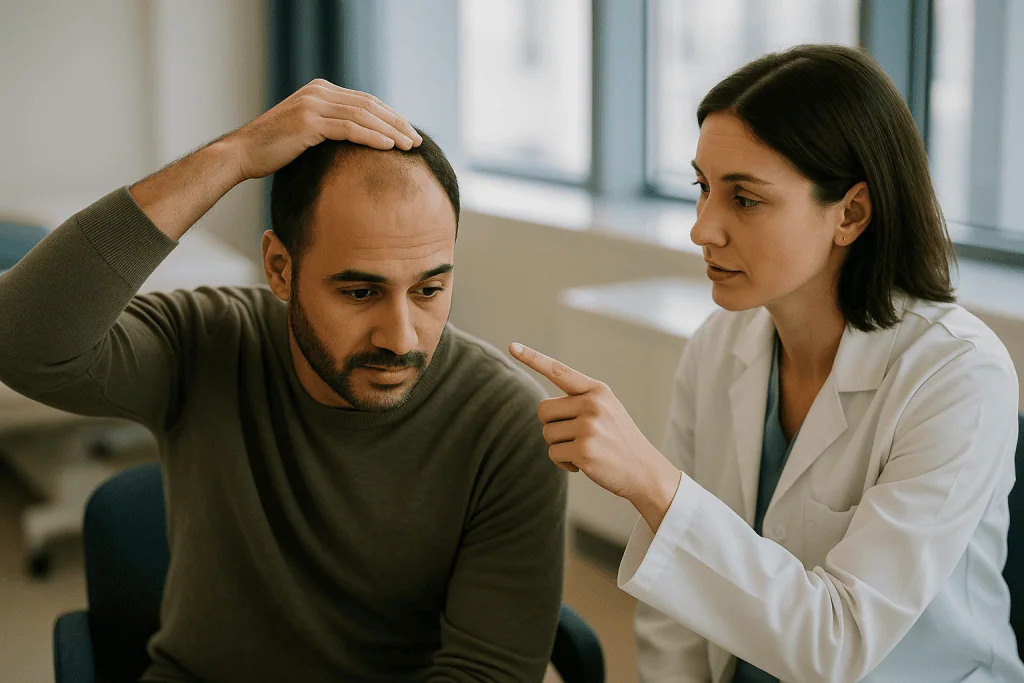
Angle and direction are set by the channel. When the blade enters at a steep, near-vertical tilt, the graft heals upright and the hair grows upright. A row of upright hairs at the front of the head is what people describe as a doll’s-head or toothbrush look. When channels are made at inconsistent directions, hairs cross one another and the hairline reads as disorganized even if the density is fine.
There is a geometric trade-off surgeons manage constantly. The flatter the angle, the longer the slit on the surface for the same depth, because the blade is traveling more sideways than down. A very flat channel therefore needs a slightly longer surface footprint and can crowd its neighbors. Steepen the angle and the footprint shrinks, but the hair stands up. The skill lies in finding the tilt that copies the surrounding native hair while keeping the channels compact enough for the planned density.
Flat angles have a second advantage. A hair lying at a low angle covers more skin than the same hair standing tall, in the same way that a hand held flat shades more of a table than a hand held upright. Much of the impression of fullness in a good hairline comes from this shading effect rather than from graft count alone.
Channel depth: too shallow, too deep, and why both show
Depth is less visible in a photograph than angle, which is why it is underrated. It matters because a graft is a small column of tissue with a top and a bottom, and it needs to sit so that its top lies level with the surrounding skin.
A channel that is too shallow leaves the graft sitting proud. In the first days it is more likely to be dislodged by a towel, a pillow or a fingernail. If it survives, its upper edge can heal slightly raised, producing a pebbled texture sometimes described as cobblestoning. Under bright overhead light, that texture shows even when hair is long enough to cover the scalp.
A channel that is too deep pulls the graft’s surface below skin level. As the skin heals over the edges, a small dimple forms at each site, an appearance often called pitting. Grafts buried entirely can develop small cysts weeks later as trapped skin cells continue to produce keratin. Very deep channels also reach larger blood vessels, which means more bleeding during placement and a wetter field that makes precise work harder.
Depth also interacts with existing hair. In a thinning zone where native follicles still live, a channel that goes deeper or wider than needed can injure a neighboring root. This is one reason surgeons measure grafts after harvest: a scalp with long, robust follicular units needs deeper channels than one with short, fine units, and using a single depth for everyone is a shortcut that shows. Some blades incorporate a depth stop for this reason, though a stop only helps if it has been set for the specific grafts in front of the surgeon.
Density, spacing and the single-hair front row
A natural hairline is not a line. It is a zone. The very front consists of scattered single hairs that are often finer than the hair behind them, followed by a transition where two- and three-hair units take over. There are small irregularities: a slight dip here, a cluster there, sometimes a lone hair a few millimeters ahead of everyone else. Surgeons deliberately design these imperfections because a perfectly straight, perfectly even front edge is the fastest way to signal that work was done.
Spacing is where channel planning meets biology. The recipient scalp has a finite blood supply, and each graft needs oxygen while new vessels grow into it over the first days. Pack channels too tightly and grafts compete; the result can be poor growth in the densest spots, and in rare cases the skin between channels breaks down. Space them too loosely and the area looks see-through under light. Surgeons therefore work toward a density that the tissue can support, often planning a second session later rather than forcing everything into one.
Graft selection feeds directly into this. Cleveland Clinic describes follicular units as containing one to four hairs, and a thoughtful plan puts the single-hair units at the leading edge, reserves the multi-hair units for the zone behind, and matches finer hairs to the front where they mimic what nature does. Channel size then has to follow: a slit sized for a three-hair graft will leave a single hair swimming, while a slit sized for a single hair will strangle a larger unit.
None of this is specific to sapphire. It is the same craft whether the edge is steel or crystal.
Sapphire FUE vs DHI: what the evidence really shows
People searching for sapphire FUE vs DHI are usually asking a simpler question: which one will look more natural on me? The honest answer is that the evidence does not crown a winner.
Both are versions of follicular unit extraction. The harvesting step is the same: grafts are removed one at a time with a small punch. The difference lies in how grafts are placed. In sapphire FUE, the surgeon creates all the recipient channels first, then grafts are inserted into the pre-made slits. In direct hair implantation, usually shortened to DHI, each graft is loaded into a hollow implanter pen whose needle makes the channel and releases the graft in the same motion.
Each approach has a practical logic. Pre-made channels let the surgeon design the entire pattern before any graft is committed, viewing angles and spacing as a whole. Implanter pens reduce the number of times a graft is handled with forceps and allow angle to be set at the moment of placement, though the process tends to be slower per graft and is technique-dependent in its own way.
What does the research say? Large randomized comparisons of these placement methods with long follow-up are lacking. The available literature is dominated by small series and expert descriptions. Major patient-facing sources, including the NHS, Mayo Clinic and MedlinePlus, describe FUE and strip harvesting as the two broad categories and do not rank placement tools. That silence is informative: when a difference is large and consistent, guidelines tend to mention it.
The variable that does appear to matter, across every method, is the planning and execution of angle, depth and spacing. A team fluent in one approach will generally serve a patient better than an unfamiliar team using the other.
Who a sapphire transplant is usually for, and who is asked to wait
Hair transplantation moves hair; it does not create it. That single fact shapes who is usually a candidate. According to Mayo Clinic and the NHS, the procedure suits people with pattern hair loss, the hereditary type also called androgenetic alopecia, who have enough healthy donor hair at the back and sides to cover the area they want treated. The donor hair keeps its resistance to hormonal thinning after it is moved, which is why the approach works at all.
Several groups are commonly asked to wait or to consider other options first. Younger adults whose pattern is still evolving present a planning problem: a hairline designed for a twenty-five-year-old face may sit too low once further recession appears behind it, leaving an island of transplanted hair. Many surgeons prefer to observe the pattern and stabilize it, often with medicines assessed by a prescribing clinician, before committing grafts.
People with diffuse thinning that also affects the donor area may not have a reliable supply. Those with active inflammatory scalp conditions, including alopecia areata in an active phase or scarring alopecias that are still progressing, are generally advised to have the condition controlled first, because grafts placed into inflamed skin may not survive. Bleeding disorders, poorly controlled diabetes, and certain medicines can raise procedural risk and need review by the treating team.
Expectations matter as much as anatomy. Someone hoping to recreate the density of their teenage years from a limited donor supply is likely to be disappointed, and a candid surgeon will say so. The NHS notes that hair transplantation is usually regarded as a cosmetic procedure and is not routinely available through public health services. The decision about suitability, timing and design rests with the treating team, not with a forum or a video.
Sapphire FUE recovery timeline: the first days and weeks
The sapphire FUE recovery timeline in the first fortnight is where channel depth quietly proves itself. Grafts set flush with the skin are less likely to be knocked loose, and channels of the right size close quickly around them.
Day one to three is about protection. The recipient area is dotted with tiny crusts, the scalp feels tight, and a bandage may be worn briefly over the donor area; MedlinePlus notes the scalp is often tender and that a dressing may be needed for a day or two. Sleeping with the head raised helps limit swelling. Forehead and eyelid puffiness commonly appears around the second to fourth day as fluid drifts downward with gravity, then settles.
By the end of the first week, most teams introduce gentle washing according to their own instructions, and the crusts begin to lift. This is a window when picking or scrubbing can dislodge a graft that is not yet anchored, so the rule is patience rather than effort. Numbness in the donor or recipient area is common and usually fades over weeks to months.
Then comes the part that alarms people who were not warned. MedlinePlus describes transplanted hairs falling out within the first few weeks after surgery. This shedding is expected: the follicle stays behind and enters a resting phase, while the original hair shaft is released. The area can look much as it did before the procedure for a while afterward. Nothing about this phase reflects the quality of the channel work. Angle and depth reveal themselves later, once new hairs emerge and begin to show their direction.
Return to desk work is often possible within days, though the team’s guidance on exercise, hats, sun and sweating varies and should be followed exactly.
How sapphire transplant results unfold over the following months
Hair is slow, and transplant judgments made too early are almost always wrong in one direction or the other. The table below sets out the typical arc as described by MedlinePlus and Cleveland Clinic, with a note on what each stage can and cannot tell you about channel work. Timeframes are typical ranges, not promises, and individual patterns vary widely.
| Stage | What is commonly seen | What it reveals about angle and depth |
|---|---|---|
| First 2–3 weeks | Crusts lift; transplanted hairs shed (MedlinePlus) | Skin texture is the only clue; raised or pitted sites may start to show |
| Weeks 3 to roughly month 3 | Resting phase; little visible growth | Nothing reliable yet; patience is the task |
| Around months 3–6 | Fine, often wispy new hairs appear unevenly | Direction becomes visible; upright or crossed hairs begin to stand out |
| Around months 6–9 | Most people notice substantial new growth (MedlinePlus) | Density and shading effect can be assessed in daylight |
| Around 12–18 months | Hair thickens and matures toward its final texture (Cleveland Clinic) | Fair point to judge the overall naturalness of the hairline |
Two features of this timeline deserve emphasis. First, early growth is finer than the hair it will become, so a hairline at month four can look sparse and slightly frizzy even when the plan was excellent. Second, hair direction is fixed from day one but only becomes obvious when strands are long enough to lie down. A hairline that looks spiky at three months may relax as length arrives, or may not; the surgeon who made the channels is the right person to ask which.
Photographs taken under identical lighting at consistent intervals are far more useful than memory. Overhead light exaggerates thinness and any surface irregularity, so comparisons should use the same lamp and the same angle each time.
Medicines around a transplant: mechanisms and timelines, not prescriptions
A hairline can only look natural if the hair behind it stays. Transplanted grafts come from a zone that resists hormonal thinning, but the native hairs around them do not, and continued recession behind a transplanted front produces an unnatural gap over time. This is why medicines often come up in the consultation. The decision to use any of them belongs to the prescribing clinician; what follows is mechanism and typical timing only.
Two drug classes have the strongest evidence for pattern hair loss, according to Mayo Clinic and the NHS. The first is the 5-alpha-reductase inhibitor class, of which finasteride is the commonly discussed example. These drugs reduce the conversion of testosterone to dihydrotestosterone, the hormone that miniaturizes susceptible follicles. Effects are judged over months rather than weeks, and the benefit is maintained only while treatment continues. Side effects exist and should be discussed candidly with the clinician.
The second is minoxidil, available in topical form and, in some settings, prescribed orally. Its full mechanism is not settled; it appears to widen small blood vessels and prolong the growth phase of the hair cycle. Mayo Clinic notes it can take several months to see whether it is helping, and that hair gained is lost if it is stopped. Some people notice increased shedding early on as follicles resynchronize.
Neither medicine changes what the channels look like. What they may do is protect the frame around the picture, so the angles and density the surgeon designed still make sense years later. Whether either is appropriate, and when to start relative to surgery, is a question for the treating team, who will weigh individual health, other medicines and preference.
What people often get wrong about a sapphire hair transplant hairline
Myths cluster around this topic, partly because so much of what people see is marketing footage. A few corrections, each grounded in what the evidence actually supports.
The blade makes the result. No mainstream guideline or large trial shows that sapphire tips produce more natural hairlines than steel. The planning of angle, depth and spacing is the variable with the clearest link to appearance.
More grafts means a better sapphire hair transplant hairline. Density beyond what the blood supply and donor reserve can support tends to harm growth and depletes hair that may be needed later. A lower graft count placed at the right angle can look fuller than a higher count placed upright.
Six-month photographs are final. MedlinePlus describes most new growth appearing over the first six to nine months, and Cleveland Clinic notes that maturation continues well beyond that. Early wispy hair is not the finished product.
A hairline should be low and straight. Natural hairlines are irregular zones with fine single hairs at the front. Straight, low lines age poorly as the face changes.
Transplanted hair never sheds. Transplanted hairs shed within weeks and regrow, and the follicles then follow a normal cycle. What they retain is resistance to hormonal thinning, not immortality.
Stem cell or growth-factor treatments regrow hair on a known timetable. These remain investigational for pattern hair loss. No major guideline gives a timeline for hair regrowth from stem cells because reliable regrowth has not been established in high-quality trials.
You can tell a good result from a celebrity’s head. Public figures’ treatments are private and undocumented. Speculation about what any individual used is not evidence and should not guide anyone’s decisions.
Risks and alternatives, described in neutral terms
Any procedure that makes thousands of small incisions carries risk, and a good consultation names them without drama. Mayo Clinic, the NHS and MedlinePlus list the recognized complications of hair transplantation, and they fall into two groups.
The first group is medical. Bleeding is usually minor but can be more troublesome if channels are deeper than needed or if a person takes medicines that affect clotting. Infection is uncommon and typically presents as spreading redness, warmth or pus. Folliculitis, an inflammation of individual follicles that looks like small pimples, can appear in the weeks after surgery. Swelling of the forehead, temporary numbness and itching are expected rather than exceptional. Rarely, poor blood supply in a densely packed area leads to skin breakdown.
The second group is aesthetic, and this is where channel work matters most. Grafts placed upright, crossed or too far forward produce an unnatural appearance that is difficult to reverse, since removing grafts means more incisions. Pitting from overly deep channels and cobblestoning from shallow ones are visible under bright light. Existing hair around the recipient zone can shed temporarily from the trauma of surgery, a phenomenon called shock loss, and in a thinning area some of it may not return. Small dot scars remain in the donor area and become visible if the hair there is cut very short. Some people need a further session.
Alternatives exist along a spectrum. Medicines assessed by a clinician may slow or partly reverse thinning. Scalp micropigmentation tattoos the appearance of shaved hair. Hair systems and styling change appearance without surgery. Low-level laser devices and platelet-rich plasma injections are marketed widely; Mayo Clinic describes the evidence for them as limited, and neither is a standard of care. Doing nothing is also a legitimate choice, and a respectful team will say so.
Questions to ask your care team before the channels are made
The most useful consultation questions are the ones that reveal how a team thinks about geometry. Bring these and listen for specific, unhurried answers.
- Who will make the recipient channels, and who will place the grafts? Will the surgeon do both, or will assistants handle placement under supervision?
- How will you decide the angle and direction of channels at the front, temples and behind the hairline? Can you show me on my own scalp where the direction changes?
- How will channel depth be matched to my grafts? Do you measure graft length after harvest and adjust?
- Where will the single-hair units go, and how will you build irregularity into the front edge?
- What density are you planning for the front zone, and why that number for my scalp and donor supply?
- How do you expect my native hair behind the transplant to behave over the next decade, and how does that affect where you draw the line?
- What does your plan look like if further recession appears later? Is donor hair being held in reserve?
- Which complications do you see most often, and what does your written aftercare plan say about washing, sleeping, exercise and sun?
- How and when will follow-up happen, and who do I contact if something worries me at night or on a weekend?
- Would you show me photographs of your own results at around a year, taken in consistent lighting, including some that did not go as hoped?
Notice that none of these questions is about blade material. If the answers keep steering back to the tool rather than to the plan, that is worth registering. A team confident in its channel work will usually be glad to talk about angles for as long as you want to listen.
When to call your doctor after a hair transplant
Most of the first two weeks involves sensations that are uncomfortable but expected: tightness, mild aching, itching, crusting and some forehead swelling. A handful of signs fall outside that pattern and warrant a prompt call to the treating team, or urgent care if the team cannot be reached.
Contact your doctor promptly if you notice spreading redness, increasing warmth or pus at the recipient or donor area, a fever, or pain that steadily worsens rather than eases over the first days. Bleeding that does not stop with gentle pressure held for several minutes, a rapidly enlarging swelling or firm lump under the skin, or an area of skin that turns dusky or dark should be assessed the same day. Sudden rash, hives, facial or throat swelling, wheezing or difficulty breathing after any medicine given around the procedure needs emergency care immediately.
Later signs matter too. Painful pimple-like spots that multiply across the recipient area may be folliculitis and are usually straightforward to manage when reviewed early. A persistent lump at a graft site weeks after surgery can be a small cyst and should be examined rather than squeezed. Numbness that is worsening instead of fading, or any new weakness in facial movement, deserves review.
If travel is involved after surgery, seek urgent care for calf pain or swelling, chest pain or sudden breathlessness, which can indicate a blood clot; staying mobile and hydrated on long journeys is basic prevention, and the team can advise on timing.
Finally, aesthetic worries are legitimate reasons to make contact. If at several months the hair direction looks wrong to you, ask for a review rather than waiting in silence. Every decision about treatment, adjustment or reassurance sits with the treating team, who know what was done and why.
Frequently asked questions
Is Sapphire FUE better than DHI?
Neither has been shown to be better in high-quality comparative research. Both are forms of follicular unit extraction; they differ only in how grafts are placed. Sapphire FUE uses pre-made channels, while DHI uses an implanter pen that makes the channel and places the graft in one motion. Mainstream sources such as the NHS and Mayo Clinic do not rank these tools. The team’s skill in setting angle, depth and spacing matters more than the method’s name.
What is a sapphire blade in a hair transplant?
A sapphire blade is a tiny cutting tip made from lab-grown sapphire, used to create the small slits, called channels, into which grafts are placed during follicular unit extraction. Its makers cite a hard, smooth edge that stays sharp across many incisions. The blade does not decide where a channel goes, how steeply it enters or how deep it runs; those choices belong to the surgeon and are what shape the hairline’s appearance.
What is the sapphire FUE recovery timeline?
Typical recovery follows a predictable arc, though individuals vary. Crusts form and lift over the first week or so, forehead swelling peaks around days two to four, and transplanted hairs shed within the first few weeks, according to MedlinePlus. New growth generally appears over the following months, with most people noticing substantial growth by six to nine months and continued maturation toward a year or more, as Cleveland Clinic describes. Your team’s aftercare plan takes priority.
Why do some transplanted hairlines look like doll hair?
The most common cause is channels made too upright, so the hairs grow perpendicular to the scalp instead of lying at the low, forward-leaning angle of natural frontal hair. A straight front edge without single-hair units, or grafts pointing in inconsistent directions, adds to the effect. These features are set when the channels are made and are difficult to reverse, which is why the planning stage deserves detailed questions before surgery.
How much does a sapphire hair transplant cost?
This magazine does not publish cost figures for any treatment, because prices vary widely with graft numbers, the team involved and the setting, and because cost is not a reliable marker of the planning quality that shapes a natural hairline. Ask the treating team for a full written explanation of what a quoted plan includes, including follow-up, and weigh it against the quality of their answers about channel angle, depth and design.
What did Elon Musk use to regrow hair?
Nobody outside a person’s own medical team knows what any public figure has used, and speculation is not evidence. The treatments with mainstream support for pattern hair loss, according to Mayo Clinic and the NHS, are two medicine classes, 5-alpha-reductase inhibitors and minoxidil, and hair transplantation, which moves hormone-resistant hair from the back and sides. Whether any of these suits an individual is a decision for that person’s own clinician.
How long does it take for stem cells to regrow hair?
There is no established timeline, because stem cell treatments for pattern hair loss remain investigational and have not been shown to regrow hair reliably in high-quality clinical trials. Mayo Clinic describes the evidence for many marketed regenerative approaches as limited, and no major guideline recommends them as standard care. Anyone offered such a treatment should ask what published trial data support it and discuss it with their treating clinician before proceeding.
Will my sapphire hair transplant hairline look natural?
It depends far more on the planning than on the blade. A natural hairline needs channels angled low and in the direction of surrounding hair, depth matched to graft length so grafts sit flush, fine single-hair units at an irregular front edge, and density the blood supply can support. Ask the surgeon to explain each of these decisions for your scalp. No technique guarantees an outcome, and final appearance is usually judged at about a year or more.
Can channel depth cause pitting or bumps after a hair transplant?
Yes. Channels cut deeper than the graft leave the graft’s surface below skin level, and as the edges heal over, a small dimple or pit can form at each site; a fully buried graft may develop a small cyst. Channels cut too shallow leave grafts sitting proud, which can heal as a raised, pebbled texture and raises the chance of a graft being dislodged early on. Matching depth to measured graft length reduces both problems.
When can I judge my sapphire transplant results?
A fair judgment usually comes at around twelve to eighteen months, when Cleveland Clinic describes hair reaching a more mature texture. Before that, MedlinePlus notes that transplanted hairs shed within weeks and that most new growth emerges over six to nine months, often fine and uneven at first. Hair direction is visible earlier than density, so concerns about angle can be raised with the team from a few months on, using consistent photographs under the same light.
References
This article is for general information only and is not a substitute for professional medical advice. Please consult a qualified doctor about your individual situation.

More from the Blog
What Happens During PRP for Hair Loss: From the Blood Draw to the Scalp Injections
During PRP for hair loss, a clinician draws a small tube of your own blood, spins it in a centrifuge to separate a platelet-rich…
How Surgeons Assess Keloid Risk and Scar Tendency Before an Afro Hair Transplant
Before an afro hair transplant, surgeons assess keloid risk by asking about personal and family scar history, examining existing scars anywhere on the body,…
How a Hair Transplant Without Shaving Is Done: Hidden Donor Windows and Graft Placement
A no shave hair transplant procedure harvests follicles from narrow, concealed strips of the back and sides of the scalp, trimmed short beneath longer…

Beard Transplant Recovery: Healing Without Ruining the Grafts
Most people are socially presentable within 7 to 10 days of a beard transplant, but biological recovery takes months. Grafts anchor securely by about…
How Technique Choice Changes Shaving and Placement: FUE or DHI for a Female Hair Transplant?
For a female hair transplant, FUE and DHI use the same method of harvesting follicles one by one from the back of the scalp;…
Hair Transplant Without Shaving Results: Does Working Around Existing Hair Limit Density?
A hair transplant can be done without shaving the whole head, usually as an unshaven or partially shaved follicular unit extraction. Working around existing…