

Why Dermatologists Prescribe a Priming Cream Before Pigmentation Laser Treatment
Key Takeaways
- A priming cream is prescribed to slow melanocyte activity and even out the skin surface so laser heat is less likely to trigger post-inflammatory hyperpigmentation, the most common pigment complication.
- Most priming formulas combine a tyrosinase inhibitor such as hydroquinone with a retinoid such as tretinoin, and MedlinePlus notes tretinoin typically takes two to six weeks or more to show visible change.
- Mayo Clinic warns that unprotected sun exposure in the two months before laser resurfacing can cause irregular pigmentation that may be permanent, so sun avoidance is part of priming, not an afterthought.
- Melasma melanocytes are unusually heat-sensitive, and Harvard Health notes lasers can worsen melasma in some people, which is why it attracts the most careful preparation.
- There is no universal number of days to stop hydroquinone before laser; protocols differ and the pause and restart are set by the prescriber based on your skin's response and the device.
- Trial evidence that priming specifically reduces post-laser darkening is mixed, so clinicians prime on the basis of sound mechanism and a favorable risk balance rather than a proven percentage.
Dermatologists often prescribe a priming cream before laser pigmentation treatment to quiet the pigment-producing cells in the skin, so the laser's heat is less likely to trigger new dark patches, a reaction called post-inflammatory hyperpigmentation. These creams usually pair a pigment-suppressing agent with a retinoid, sometimes with a mild steroid. Evidence for the benefit is mixed, and the choice, duration and pausing schedule rest with the prescribing clinician.
The appointment card says the laser session is in six weeks. Tucked behind it is a small tube with a handwritten label and a one-line instruction: thin layer, nightly, stop when we tell you. Nobody mentioned this part when a friend described her own dark-spot treatment as “in and out in twenty minutes.”
That tube is the priming cream before laser pigmentation work, and it puzzles almost everyone who receives one. Why treat the spots with a cream if the laser is supposed to do the job? Why wait? And why does the person prescribing it seem more interested in the weeks around the session than in the session itself?
The honest answer is that the laser is the loud part of the treatment, but the quiet part is where a lot of the risk lives. Pigment cells do not like being disturbed, and a well-chosen cream is one of the few tools that can talk them down before the light arrives.
What is a priming cream before laser pigmentation treatment?
A priming cream is a prescription topical, used on the skin for a stretch of weeks before a pigmentation laser session, whose purpose is preparation rather than the final result. The word “priming” borrows from painting: you are conditioning the surface so the main work takes evenly and with fewer surprises.
Most priming creams are built around agents that slow melanin production. Melanin is the brown-black pigment made by melanocytes, the specialized cells that sit at the base of the outer skin layer and hand pigment upward to their neighbors. In conditions such as melasma (patchy, symmetrical darkening usually on the cheeks, forehead or upper lip) and sun spots, those cells are overactive or their pigment has piled up where it shouldn’t. Cleveland Clinic notes that melasma affects roughly 15% to 50% of pregnant people and is far more common in women than men, which gives some sense of how many people arrive at a laser consult with exactly this problem.
The cream is not a substitute for the laser and the laser is not a substitute for the cream. Think of them as two instruments in the same piece. The cream lowers the baseline activity of the pigment cells and, in many formulas, speeds the turnover of the skin’s surface so that pigment already made is shed more predictably. The laser then targets what remains.
What a priming cream is not: it is not a cosmetic primer from a beauty counter, it is not something to buy on your own because a search result recommended it, and it is not a promise that the laser will work better. Its job is to tilt the odds away from a specific complication, and the people who understand that best are the ones who see the complication often.
How does a priming cream actually work in the skin?
Picture the melanocyte as a small factory with a single key enzyme on the production line. That enzyme is tyrosinase, which converts an amino acid into the building blocks of melanin. Most pigment-suppressing ingredients act on tyrosinase in one way or another: blocking it directly, competing with its raw material, or reducing the signals that tell the factory to speed up. Hydroquinone, the generic name for the agent most often at the center of these creams, is a tyrosinase inhibitor. Azelaic acid and kojic acid work along related lines.
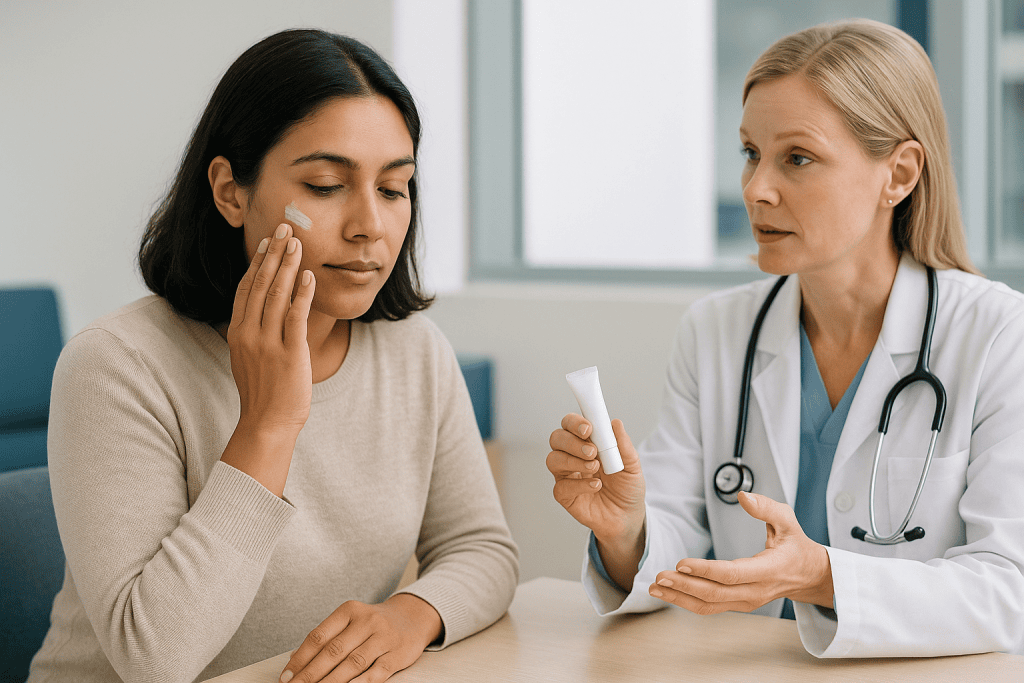
The second ingredient class in many priming formulas is a retinoid, a vitamin-A derivative such as tretinoin. Retinoids do something different: they accelerate the rate at which skin cells move from the base of the outer layer to the surface and flake off. Pigment that has already been deposited in those cells leaves with them. MedlinePlus describes tretinoin as typically needing two to three weeks, and sometimes up to six weeks or more, before visible change appears, which is one reason priming is measured in weeks rather than days.
Some formulas add a mild topical corticosteroid, a class of anti-inflammatory medicine, to reduce the irritation the other two ingredients can cause and to further calm pigment signaling. This three-part combination is what dermatologists often mean when they say “triple cream,” though the exact composition is a prescribing decision.
Put together, the effect is a skin surface that is thinner in its dead outer layer, more uniform in how it holds pigment, and staffed by melanocytes running below their usual pace. When laser energy then heats the pigment in the target spots, the surrounding cells are less primed to overreact. That is the theory, and it is a reasonable one. Whether it always plays out as hoped is a separate question, taken up later.
Why the laser alone can make dark spots darker
Here is the paradox that keeps dermatologists cautious. A laser designed to remove pigment can, in the wrong circumstances, produce more of it.
Pigmentation lasers work by selective photothermolysis, a long phrase for a simple idea: light of a chosen wavelength is absorbed mainly by melanin, which heats up and fragments while the surrounding tissue stays comparatively cool. Q-switched and picosecond lasers deliver that energy in extremely short pulses; fractional and non-ablative devices heat columns of skin to encourage remodeling. All of them, by design, cause a controlled injury.
Melanocytes respond to injury the way skin responds to a sunburn: by making more pigment. When that response outruns the intended clearing, the result is post-inflammatory hyperpigmentation (PIH), a new patch of darkening in the treated zone that can look worse than what the person came in with. Mayo Clinic lists changes in skin color, including darkening, among the risks of laser resurfacing and notes the risk is greater in people with brown or Black skin, where melanocytes are more reactive at baseline.
Melasma raises the stakes further. Harvard Health points out that lasers can worsen melasma in some people, because melasma melanocytes are unusually sensitive to heat and light of any kind. This is why a clinician may spend as much time discussing your skin type, your sun habits and your hormonal history as the device itself.
The priming cream sits in this gap. If the cells are running slower when the laser fires, and if the outer layer has been evened out, the post-treatment surge has less fuel. It does not remove the possibility of PIH. It is one of several measures, alongside conservative laser settings, strict sun protection and sensible spacing between sessions, aimed at keeping that possibility small.
Which medicines usually go into a priming cream?
Priming creams are prescribed, not standardized, so the contents vary. The classes below appear most often, described here for understanding rather than as a recommendation. What ends up on your label is the prescriber’s decision, made against your skin type, history and the device planned.

- Hydroquinone. A tyrosinase inhibitor and the most studied pigment-lightening agent. Its known drawbacks are irritation, temporary redness and, with prolonged uninterrupted use, a rare bluish-gray discoloration called exogenous ochronosis. Prescribers manage this by limiting duration and building in breaks, which is one reason you are told when to stop, not just when to start.
- Topical retinoids. Tretinoin and relatives speed cell turnover and disperse pigment granules. MedlinePlus advises that tretinoin can make skin more sensitive to sunlight and cause dryness, peeling and stinging, especially early on.
- Mild topical corticosteroids. Used briefly in combination formulas to blunt irritation. Long-term use on the face carries its own risks, including skin thinning, so this component is typically time-limited.
- Azelaic acid. A tyrosinase inhibitor with anti-inflammatory properties, sometimes chosen when hydroquinone is unsuitable, including for some people who are pregnant or breastfeeding, though that call belongs to the clinician.
- Others. Kojic acid, tranexamic acid in topical form, niacinamide and vitamin C derivatives appear in some regimens as adjuncts. Evidence for each varies, and none replaces the core agents in most protocols.
You will notice the list contains no strengths, schedules or quantities. That omission is deliberate. These are potent medicines with real side effects, and the combination that suits one person can inflame another. If the cream stings beyond mild tingling, peels heavily or produces new redness that lingers, that is information for your prescriber, not a sign to push through.
How to prep skin before laser treatment: the full picture
The cream is the headline, but people who search “how to prep skin before laser treatment” usually need the whole checklist, because the cream only works inside a wider routine. Dermatologists tend to emphasize five things.
Sun avoidance that starts early. Mayo Clinic advises that unprotected sun exposure in the two months before laser resurfacing can lead to irregular pigmentation that may be permanent. A tan is not a cosmetic issue here; it is extra pigment in the very layer the laser is aiming at, and it changes how energy is absorbed. Broad-spectrum sunscreen every morning, a hat, and shade become non-negotiable well before the session.
Stopping other actives. Over-the-counter exfoliating acids, scrubs, at-home peels and retinol serums stack irritation on top of the prescription. Most teams ask for a clean routine: gentle cleanser, moisturizer, sunscreen, and the prescribed cream.
No waxing, threading or bleaching the treatment area. These remove or irritate the outer layer unpredictably, and bleaching hair chemically stresses skin the laser will soon heat.
Disclosing medicines and history. Oral retinoids taken in the past, antibiotics that increase sun sensitivity, a history of cold sores (Mayo notes a clinician may prescribe antiviral medicine beforehand if you are prone to them), keloid scarring, and recent pregnancy or hormonal changes all shape the plan.
Managing expectations. Pigment that arrives with hormones or sun tends to return with hormones or sun. Preparation includes understanding that maintenance, not a single event, is the realistic frame for melasma in particular.
A small tell that the preparation is working: your skin feels calm, not raw, in the final week. Irritated skin going into a laser session is exactly what the whole routine is trying to avoid.
Who is usually asked to prime, and who is usually asked to wait
Not everyone booked for a pigmentation laser receives a priming cream, and not everyone who wants one is a good candidate for the laser right now. The pattern across guideline-level practice looks like this.
Priming is most often suggested for people with medium to deep skin tones, described in dermatology by the Fitzpatrick scale (a six-point classification of how skin responds to sun, from always burns to never burns), because their melanocytes react more vigorously to heat; people with melasma or a past episode of post-inflammatory hyperpigmentation after a rash, acne or a procedure; people planning fractional or resurfacing treatments that heat a wider area; and anyone whose history suggests pigment is easily provoked.
People commonly asked to wait or reconsider include those who are pregnant or breastfeeding, because several priming agents and the laser itself are typically deferred; anyone with an active infection, cold sore or flare of eczema, acne or rosacea in the treatment area; people with a recent tan or sunburn; those who have recently taken oral isotretinoin, since many clinicians prefer a gap before energy-based treatments; and people with unrealistic expectations about permanence. Cleveland Clinic describes melasma as often triggered by hormones and sun, and notes it may fade after pregnancy or when hormonal medicines stop, which means timing matters as much as technique.
Some people are asked to prime for longer than others. Deeper skin tones, stubborn melasma and a history of PIH often mean a more cautious runway, sometimes with a test patch on a small area before the full session. Others with fair skin and isolated sun spots may be treated with minimal preparation beyond sun avoidance.
None of these are rules you should apply to yourself. They are the considerations a clinician weighs, and the outcome of that weighing is a conversation, not a form.
Priming plan at a glance: what each part is for
A table helps here because people often confuse the roles of the different pieces. Everything below describes purpose and typical experience, not instructions.
| Element | What it is meant to do | What people commonly notice | Points the care team watches |
|---|---|---|---|
| Tyrosinase inhibitor (e.g., hydroquinone, azelaic acid) | Slow new melanin production so cells are less reactive when heated | Gradual lightening over weeks; mild tingling early on | Irritation, contact allergy, duration of use to avoid ochronosis |
| Topical retinoid (e.g., tretinoin) | Speed surface turnover and disperse existing pigment | Dryness, flaking, some redness in the first weeks; more sun sensitivity (MedlinePlus) | Excessive peeling, worsening redness, when to pause before the laser |
| Mild topical corticosteroid | Reduce irritation from the other agents | Calmer skin; usually little sensation | Kept short-term to avoid thinning or steroid-related redness |
| Broad-spectrum sunscreen and shade | Prevent new pigment and protect the primed surface | Daily habit; often reapplication outdoors | Compliance, since a tan can undo weeks of priming (Mayo Clinic) |
| Pause period before the session | Let irritation settle so the laser meets calm skin | Skin feels smoother and less sensitive | Exact timing, set by the prescriber |
| Restart after healing | Suppress the post-laser pigment surge | Return of mild tingling as the cream resumes | Only once the skin barrier has recovered |
Two things stand out when the plan is laid out this way. First, most of the work happens outside the laser room. Second, every row ends with a judgment call. The same agent that protects a patient at one duration can harm at another, which is why the columns describe what your team watches rather than what you should do.
What the weeks before your session usually look like
People like to know the shape of the runway even when the exact length is set for them. A typical priming period unfolds in three loose phases.
The adjustment phase. The first stretch after starting the cream is when skin is most likely to complain. Retinoids in particular bring dryness, fine flaking and a warm flush; MedlinePlus lists these as expected early effects of tretinoin that often ease with continued use. Many clinicians start with a thin application on alternating nights or a short contact time, then adjust, but the schedule is theirs to set. Your job is to notice and report, not to tough it out. Persistent burning, swelling or a rash spreading beyond the treatment area is a reason to stop and call, not a sign the cream is working harder.
The quiet middle. Once skin settles, changes are gradual and easy to miss day to day. Photographs taken in the same light every week or two are more honest than the mirror. Some lightening of existing spots is common, though the goal here is calm cells rather than a finished result. Sun protection is the whole game in this phase. Mayo Clinic’s caution about sun in the two months before resurfacing applies with equal force to pigmentation lasers.
The pause. Shortly before the session, most teams ask patients to stop the priming cream so the laser meets skin that is neither peeling nor inflamed. The length of that pause varies with the ingredients, your skin’s response and the device; it is set by the prescriber and is not a number to borrow from a forum.
Across all three phases, keep the rest of the routine boring. A gentle cleanser, a plain moisturizer and sunscreen are the supporting cast. Introducing a new serum during priming makes it impossible to tell what caused a reaction.
How long to stop hydroquinone before laser? The honest answer
This is one of the most typed questions on the topic, and the search results tend to offer a confident number. The clinically honest answer is that there is no single figure, and the reason is worth understanding.
Hydroquinone is stopped before a laser session for two main reasons. First, it can leave skin mildly irritated, and irritated skin absorbs laser energy less predictably and inflames more afterward. Second, some clinicians want to observe the true baseline color of the skin, without the cream’s temporary lightening, so that laser settings match reality. How long that takes depends on how your skin reacted during priming, whether a retinoid or steroid was also in the mix, what device is planned and how aggressive the settings will be.
Other protocols do not stop hydroquinone at all before certain low-energy treatments, on the reasoning that continuous suppression of melanocytes through the session offers more protection than a rest period. Both approaches exist in reputable practice, and the disagreement itself tells you something: the evidence is not strong enough to settle the question, so individual judgment fills the gap.
Restarting is similarly individualized. After the laser, the skin barrier needs time to recover before an active ingredient is applied again. Applying too early can sting, delay healing and, ironically, provoke the very inflammation you are trying to prevent. Your team will usually tie the restart to how the skin looks and feels at a follow-up check rather than to a fixed calendar.
If you are unsure what your instructions were, ask before the session rather than guessing. Clinics generally prefer a clarifying message to a patient who arrives with a peeling face because two different sources gave two different numbers.
Can I put cream before laser? What to have on your skin on the day
“Can I put cream before laser” usually means one of two things: can I keep using my priming cream up to the appointment, or can I wear anything at all on my face that morning. The answers differ.
On the priming cream, follow the pause instructions you were given; the previous section explains why the timing is individualized. On the morning itself, most teams ask for clean, product-free skin in the treatment area. That means no makeup, no sunscreen residue, no moisturizer with fragrance or exfoliating acids, no self-tanner and no perfume near the site. The reason is physical rather than fussy: any film on the skin can scatter or absorb light, alter how much energy reaches the target, and in some cases heat unevenly. Sunscreen and makeup particles in particular can interact with the beam.
Plain moisturizer the night before is generally fine and often encouraged, since well-hydrated skin tends to tolerate energy better than dry, flaky skin. Your clinician will typically cleanse the area again on arrival, and some apply a topical anesthetic cream, a numbing medicine that sits on the skin for a set time before the procedure. If you are prone to cold sores, Mayo Clinic notes that a clinician may prescribe preventive antiviral medicine around the procedure; that is arranged in advance, not on the day.
Afterward, the cream question flips. A bland, barrier-repairing moisturizer and gentle sunscreen are usually the only things permitted while the skin recovers. The priming agents return only when the team says the barrier has healed. Bringing a plain moisturizer you have already tolerated, rather than trying a new one, removes a variable during a week when your skin has enough to cope with.
What the days and weeks after the laser usually look like
The session takes minutes. The response takes weeks, and knowing what is ordinary keeps small worries from becoming big ones.
The first hours. Redness and a sensation like mild sunburn are common with pigmentation lasers. Treated spots often darken immediately; with Q-switched and picosecond devices this can look like a dusting of coffee grounds over each lesion. That darkening is the fragmented pigment lifting to the surface, not a complication.
The first week or so. The darkened spots flake off, usually without needing help. Picking them speeds nothing and raises the risk of scarring and post-inflammatory hyperpigmentation. Skin may feel tight and dry. Cleansing gently, moisturizing, and sun protection are the entire routine. Mayo Clinic describes redness lasting longer after ablative resurfacing, sometimes for months, whereas non-ablative pigment treatments typically settle faster; the exact course depends on the device.
Weeks two to several. As the flakes clear, the true early result appears. It is also the window in which PIH, if it is going to happen, tends to show, appearing as a soft brown patch across the treated area. Your team will want to see you in this period, both to judge the response and to decide when the priming cream can restart as a maintenance measure.
Beyond. Melasma especially tends to return with sun and hormonal shifts. Harvard Health frames melasma management as ongoing, with strict daily sun protection as the foundation. A laser series, in that light, is one chapter in a longer plan rather than an ending.
Across this whole stretch, the pattern to trust is steady improvement with brief, expected setbacks. The pattern to report is anything that gets worse after initially getting better.
Which primer is best for hyperpigmentation? Why there is no single answer
The question “which primer is best for hyperpigmentation” arrives in two forms, and both deserve a straight response.
If “primer” means the cosmetic product applied under makeup, no cosmetic primer treats hyperpigmentation. Some contain tinted pigments or light-reflecting particles that visually soften discoloration for a day, and some include mineral sunscreen, which helps by blocking new pigment formation. That is camouflage and prevention, not treatment, and it should not be confused with a prescription priming cream.
If “primer” means the medical pre-laser cream, there is still no universal best. The choice hinges on what the pigment actually is. Sun spots, medically called solar lentigines, are flat brown marks from cumulative sun exposure and often respond well to laser with modest preparation. Melasma is hormonally driven, sits at variable depths and is the condition most likely to flare with heat, so it tends to attract the most careful priming. Post-inflammatory hyperpigmentation left behind by acne or an injury behaves differently again, and in many cases responds to topical treatment alone without a laser at all. MedlinePlus lists these among the many causes of uneven skin darkening, and each has its own logic.
Depth matters too. Pigment in the epidermis, the outer layer, is more reachable by creams and by most pigment lasers. Pigment that has dropped into the dermis, the deeper layer, is less affected by topical agents and needs different laser strategies. A clinician often uses a handheld ultraviolet lamp to estimate depth before choosing anything.
So the best priming cream is the one matched to your diagnosis, your skin type and the device planned, prescribed by someone who has looked closely at your face and will be there when the skin reacts. A recommendation from a stranger’s search result cannot know any of those things.
What the evidence actually shows about priming before laser
A wellness magazine that promised you the cream guarantees a better result would be doing exactly what this one tries not to do. The truthful summary is that the rationale for priming is biologically sound, the practice is widespread, and the trial evidence is thinner and more mixed than its popularity suggests.
What is well established: hydroquinone, tretinoin and combination creams reduce pigment in melasma and other epidermal hyperpigmentation on their own, and Harvard Health describes them as mainstays of melasma treatment. Retinoids reliably increase epidermal turnover. Sun exposure before and after laser raises the risk of pigmentary complications, a point Mayo Clinic makes plainly.
What is less certain: whether applying these agents before the laser, specifically, lowers the rate of post-inflammatory hyperpigmentation compared with applying them only afterward. Small studies have pointed in different directions, with some finding a protective effect after resurfacing and others finding no measurable difference. Study designs vary in the agents used, the laser type, the skin tones included and how PIH was measured, which makes pooling them difficult. Because no percentage from a systematic review can be stated cleanly here, none is offered.
What most clinicians conclude from that picture is pragmatic. The cream carries modest, manageable risk when used for a limited period under supervision. PIH, once it occurs, can take months to fade and is distressing. Facing an uncertain benefit against a well-understood harm, many choose to prime, particularly in deeper skin tones and melasma, while acknowledging that the choice rests on plausibility plus experience rather than on a definitive trial.
That is an honest position. If your dermatologist frames it this way, it is a sign of good practice, not hedging.
What people often get wrong about priming creams and pigment lasers
The myths around this topic are stubborn, partly because the treatment involves a visible machine and an invisible cream, and people naturally credit the machine.
“If the cream lightens spots, more of it works faster.” Pigment agents have a ceiling, and beyond it you buy irritation, not speed. Overuse of hydroquinone without breaks is precisely the pattern linked to ochronosis, a discoloration far harder to treat than the original spots.
“The laser is doing the real work; the cream is a formality.” For melasma, the reverse is closer to true. Harvard Health notes lasers can worsen melasma in some people, and many dermatologists treat melasma primarily with topicals and sun protection, reserving lasers for selected cases.
“Once the spots are gone, they’re gone.” Sun spots may not return in the same place, but new ones form with continued exposure, and melasma is notorious for recurring. Cleveland Clinic describes melasma as a condition that can fade and come back, particularly with hormonal shifts and sun.
“I can prep with an over-the-counter version and skip the prescription.” Retinol serums and cosmetic brightening products are not equivalent to prescription agents, and layering them on top of a prescription increases irritation without adding benefit.
“Darker skin can’t have laser treatment.” It can, with appropriate devices, conservative settings, careful priming and an experienced operator. The risk of pigmentary change is higher, as Mayo Clinic notes, which is a reason for more preparation, not a bar.
“Tingling means I’m allergic.” Mild tingling in the first weeks is expected with retinoids and tyrosinase inhibitors. Swelling, spreading rash, blistering or itching that intensifies is different and needs a call.
The thread through all of these is the same: the cream is medicine, the laser is a tool, and both need a steady hand behind them.
Questions to ask your care team before you start priming
A good consultation leaves you knowing not just what to apply but why, and what to do when something feels off. Bring a short list. Clinicians tend to welcome it, because a patient who understands the plan follows it more closely.
- What exactly is the pigment you are treating, and how deep does it sit? Is a laser the right first step for it, or would topical treatment alone be reasonable to try?
- Which ingredients are in the priming cream, and what is each one there to do?
- What side effects are expected in the first weeks, and which ones should make me stop and contact you?
- When should I stop the cream before the session, and when will I restart it afterward? Will that be a fixed date or judged at a follow-up?
- Which of my current skincare products, supplements or medicines should I pause, and when?
- How should I protect the area from sun before and after, and for how long does that matter most?
- What does a typical response look like for someone with my skin type and this condition, and what would make you decide to change course?
- Will you do a test patch first? If a dark patch appears after treatment, what is the plan for managing it?
- How many sessions are usually needed for this kind of pigment, and what maintenance is realistic afterward?
- Who do I contact, and how quickly, if something worries me between visits?
Notice that none of these questions ask for a guarantee. Pigment treatment is a probabilistic business, and the most trustworthy answers will include the phrase “it depends” more than once. Write down what you are told, especially the stop and restart instructions, and keep the note with the cream rather than in your head.
When to call your doctor during priming or after laser
Most of what you will experience with a priming cream and a pigment laser is predictable and mild. The following are not, and each deserves a same-day call to the team looking after you rather than a wait-and-see.
During the priming weeks: burning or stinging that continues for hours after application rather than fading in minutes; swelling of the eyelids, lips or face; a rash, hives or itching spreading beyond where the cream was applied, which can signal contact allergy; blistering, weeping or cracking of the skin; or any bluish-gray or slate-colored change in the treated skin, which should prompt a review of hydroquinone use.
After the laser: pain that increases after the first day instead of easing; spreading redness, warmth, pus or a honey-colored crust, which can indicate infection; clusters of small painful blisters, which can signal a cold sore outbreak in treated skin and typically needs prompt antiviral treatment; blistering or open areas beyond the expected fine flaking; a treated area that is turning noticeably darker or lighter than the surrounding skin over the following weeks; or raised, thickened, or itchy scar-like tissue.
Anywhere in the process: fever, feeling unwell, or facial swelling with difficulty breathing or swallowing. The last of these is an emergency and should be treated as one through local emergency services.
Photograph anything you are unsure about in natural light and send it with your message; teams can judge a lot from a clear image. Never restart a paused cream, add a new product or apply a home remedy to a reacting area while you wait for a reply.
Every decision about continuing, pausing or changing the cream, and about whether and when the next laser session happens, sits with the clinician who prescribed it. That is not a formality. It is the part of the treatment that keeps the quiet weeks quiet.
Frequently asked questions
How should I prep skin before laser treatment for pigmentation?
Preparation usually means several weeks of strict sun protection, using only the prescribed priming cream plus a gentle cleanser, moisturizer and sunscreen, and stopping exfoliating acids, scrubs, retinol serums, waxing and bleaching in the area. Mayo Clinic advises avoiding unprotected sun for the two months before laser resurfacing. Tell your team about past oral retinoids, cold sores and any pregnancy or hormonal changes, and arrive with clean, product-free skin on the day.
Which primer is best for hyperpigmentation?
No single primer is best, because the right cream depends on what the pigment is, how deep it sits, your skin type and the laser planned. Cosmetic primers only camouflage discoloration and do not treat it. Prescription priming creams are individualized, usually built around a tyrosinase inhibitor with a retinoid and sometimes a mild steroid, and the specific combination is a prescribing decision made after examining your skin, not something to choose from a search result.
Can I put cream before laser on the day of my session?
Most teams ask for clean, bare skin in the treatment area on the morning of the session: no makeup, sunscreen residue, fragranced moisturizer or self-tanner, because any film can scatter or absorb laser energy and heat unevenly. A plain moisturizer the night before is generally fine. Your priming cream should have been paused according to the instructions you were given; if you are unsure of those, confirm with the clinic before you arrive.
How long should I stop hydroquinone before laser?
There is no single figure, and any confident number you read online is a guess about your skin. The pause exists so the laser meets calm, non-irritated skin and so settings match your true baseline color; some protocols for low-energy treatments do not pause at all. The length depends on your reaction during priming, the other ingredients in the cream and the device, so it is set by your prescriber and confirmed at your pre-session check.
Why does my dermatologist want weeks of cream before a twenty-minute laser?
Because pigment cells respond to the laser’s heat the way they respond to a sunburn, by making more pigment, and a cream that has slowed them for weeks reduces the fuel for that reaction. Retinoids also need time to work; MedlinePlus notes tretinoin can take two to six weeks or more to show change. The weeks of preparation are aimed at the complication, post-inflammatory hyperpigmentation, rather than at the result itself.
Does the priming cream guarantee I will not get dark patches after laser?
No. Priming lowers the likelihood of post-inflammatory hyperpigmentation but does not remove it, and the trial evidence that pre-laser cream specifically reduces the rate is mixed. Conservative laser settings, strict sun protection, appropriate spacing between sessions and an experienced operator matter alongside the cream. Mayo Clinic notes pigment changes after laser are more common in brown and Black skin, which is why preparation is often longer for deeper skin tones.
Can I use an over-the-counter brightening serum instead of the prescription?
Cosmetic brightening products and retinol serums are not equivalent to prescription agents and should not substitute for them or be layered on top of them. Adding extra actives during priming increases irritation without adding benefit, and irritated skin going into a laser session is exactly what the routine tries to prevent. If cost or tolerability is an issue, raise it with your prescriber, who may have alternatives such as azelaic acid to consider.
What side effects of the priming cream are normal, and which are not?
Mild tingling, dryness, fine flaking and some redness in the first weeks are expected, especially with retinoids, and often ease with continued use according to MedlinePlus. Not normal: burning that persists for hours, swelling, a rash spreading beyond the application area, blistering, or any bluish-gray discoloration, which warrants a review of hydroquinone use. Stop the cream and contact your team the same day for any of these rather than pushing through.
Will I restart the priming cream after the laser, and why?
Often yes, once the skin barrier has healed, because the weeks after laser are when pigment cells are most likely to overreact and produce new darkening. Restarting too early can sting, delay healing and provoke inflammation, so teams usually judge timing at a follow-up rather than by a fixed date. For melasma in particular, ongoing topical treatment and daily sun protection are the foundation of long-term control, with laser as one part of the plan.
Is laser pigmentation treatment permanent once I have primed properly?
Treated sun spots may not return in the same place, but new ones form with continued sun exposure, and melasma is well known for recurring with hormonal shifts and ultraviolet light regardless of how well the preparation went. Cleveland Clinic describes melasma as a condition that can fade and return. A realistic frame is management rather than a one-time fix, with strict daily sun protection as the single habit that most protects the result.
References
- Cleveland Clinic: Melasma: Causes, Symptoms & Treatment
- MedlinePlus: Tretinoin Topical
- MedlinePlus: Skin – abnormally dark or light
This article is for general information only and is not a substitute for professional medical advice. Please consult a qualified doctor about your individual situation.

More from the Blog

Microsurgery Risks Explained: Why Blood Flow Is Watched Hourly in the First Days
Microsurgery complications most often involve the tiny reconnected blood vessels that feed transplanted tissue, called a flap. A clot in the artery or vein…

Scar Treatment Results: What Realistic Improvement Looks Like and Why Sessions Repeat
Realistic scar treatment results mean a scar that is flatter, softer, paler and less noticeable, not a scar that vanishes. Scar tissue is permanent,…

Neck Lift Recovery Time: Healing Stages, Scars and Results That Settle
Most people look socially presentable about two to three weeks after a neck lift, once visible bruising fades and swelling starts to settle. Full…
How to Prepare for Microneedling: Sun, Retinoids and the Two Weeks Before Your Session
Preparing for microneedling usually means keeping the skin out of strong sun and free of sunburn or tan for the two weeks beforehand, pausing…
IPL Photorejuvenation Results: Why Spots Darken Before They Fade and How Sessions Build
IPL photorejuvenation results usually appear gradually. Treated brown spots often turn darker and coffee-ground-like for several days before flaking away over one to two…

Surface Reconstruction Recovery: Early Supervised Walking, Physical Therapy and Milestones
Surface reconstruction recovery after ocular surface surgery usually unfolds in stages: the corneal surface layer re-covers over days, comfort and light sensitivity settle over…