

Why Does the Shoulder Ache After Laparoscopic Urology Surgery? Gas Pain Explained

Key Takeaways
- The shoulder ache after keyhole surgery is referred pain from the diaphragm, whose phrenic nerve shares spinal segments C3 to C5 with nerves that supply the shoulder.
- Carbon dioxide used to inflate the abdomen stretches the diaphragm, briefly forms carbonic acid on its lining, and leaves pockets that rise beneath the dome when you sit up.
- Gas-related shoulder pain usually peaks in the first one to two days and fades within a few days, whereas positioning strain can take one to two weeks and nerve stretch longer.
- Trapped carbon dioxide is outside the bowel, so burping, passing wind, and anti-bloating products cannot release it; walking and deep breathing speed its absorption into the blood and out through the lungs.
- Releasing gas thoroughly at closure, a lung recruitment maneuver by the anesthesiologist, and lower insufflation pressure have the best evidence for reducing this pain; warmed gas and cavity rinses have mixed results.
- Pain that worsens rather than eases, or arrives with breathlessness, chest pain, fever, a rigid belly, or a swollen calf, does not fit the gas-pain pattern and needs urgent medical review.
Shoulder pain after laparoscopic surgery is usually referred pain: the carbon dioxide gas used to inflate the abdomen stretches and irritates the diaphragm, whose phrenic nerve shares spinal roots with nerves supplying the shoulder, so the brain misplaces the ache. It typically eases over one to a few days as leftover gas is absorbed. Sudden, severe, or worsening pain with breathlessness or chest symptoms needs urgent medical review.
Two days after a keyhole kidney operation, a man in his sixties sits up in bed and frowns, not at the four small dressings on his side, but at his right shoulder. Nobody touched it. He has spent the whole stay expecting the belly to hurt, and instead he feels as though he slept on a rock. He wonders, quietly, whether something has gone wrong up there.
Nothing has. Shoulder pain after laparoscopic surgery is one of the most reliably surprising parts of recovery, precisely because it shows up so far from where the surgeon worked. Patients having a nephrectomy, pyeloplasty, adrenalectomy, or robot-assisted prostatectomy hear about it in the consent discussion, then forget, then feel it.
What follows is the honest version: where the ache comes from, why the shoulder of all places, how long it tends to linger, what surgical teams do to blunt it, and, most usefully, how to tell an annoying but harmless gas pain from the rare shoulder pain that needs a phone call.
Why does shoulder pain after laparoscopic surgery happen when nothing touched the shoulder?
The short explanation is that the shoulder is not the problem. The diaphragm is, and the brain is reading the map wrong.
The diaphragm is the dome-shaped sheet of muscle that separates the chest from the abdomen and does most of the work of breathing. It is supplied by the phrenic nerve, which leaves the spinal cord high in the neck, mainly from the third, fourth, and fifth cervical segments. Those same segments send sensory nerves out to the skin and joint of the shoulder, over the top of the collarbone and along the outer shoulder cap.
When the underside of the diaphragm is stretched or irritated, pain signals travel up the phrenic nerve and arrive at those neck-level segments. The brain has a lifetime of experience linking that address with the shoulder and almost none linking it with the diaphragm, which you cannot see, touch, or normally feel. So it assigns the pain to the shoulder. Clinicians call this referred pain, meaning pain felt at a site distant from the tissue producing it. It is the same wiring that lets a heart attack ache in the left arm or a gallbladder inflame the right shoulder blade.
Referred pain has a recognizable character. It is usually a deep, dull, poorly localized ache rather than a sharp point you can press on. Pressing the shoulder itself does not reproduce it, and moving the arm often does not change it much, although deep breaths, coughing, sitting up, or lying flat frequently do. Cleveland Clinic describes this diaphragm-to-shoulder referral as an expected effect of laparoscopy, not a complication, which is why teams mention it before you go to sleep rather than after you wake up asking.
How laparoscopic urology surgery actually works, and where the gas comes in
Laparoscopic surgery, often called keyhole surgery, means operating through several small incisions using a thin camera called a laparoscope and long, slender instruments, rather than one large cut. In urology it is used for removing all or part of a kidney, reconstructing a blocked ureter at the kidney junction, removing an adrenal gland, and, increasingly with a surgical robot that the surgeon controls from a console, removing the prostate. MedlinePlus and Mayo Clinic both describe these approaches as standard options alongside open surgery.
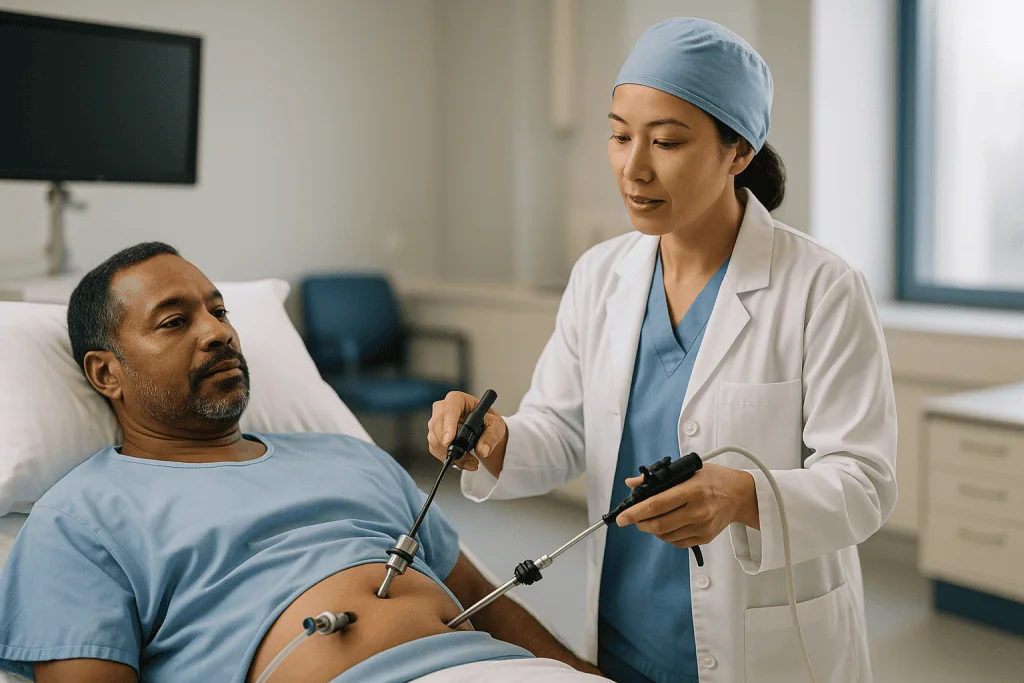
The catch is space. The abdomen is not an empty room; the organs sit packed against one another. To see anything, the surgeon needs to lift the abdominal wall away from the contents, and the tool for that is gas. Carbon dioxide is pumped in through a narrow needle or port until the belly is gently inflated, a step called insufflation. The gas is held at a controlled pressure, typically in the low teens of millimeters of mercury, for the whole operation, which for a kidney or prostate procedure can be several hours.
Carbon dioxide is chosen deliberately. It does not support combustion when electrical instruments are used, it dissolves readily in blood, and the lungs clear it efficiently. Those same properties are why the leftover gas eventually disappears on its own.
At the end, the surgeon lets the gas out, removes the ports, and closes the small wounds. Some gas inevitably stays behind, trapped in pockets under the diaphragm or between loops of bowel. That residue, plus the hours of stretch the diaphragm has just endured, is the seed of the shoulder ache that arrives, often a little cruelly, the day after you thought the hard part was over.
Why does carbon dioxide gas irritate the diaphragm?
Several things happen to the diaphragm during a laparoscopic operation, and the ache is probably the sum of them rather than any single insult.
The first is mechanical stretch. Inflating the abdomen pushes the diaphragm upward and holds it there, tensioning the thin layer of peritoneum that lines its underside. Peritoneum is the membrane covering the abdominal organs and cavity, and the part attached to the diaphragm is richly supplied by phrenic nerve endings. Stretch those endings for two or three hours and they complain afterward, much as a hamstring does after being held in a long stretch.
The second is chemistry. Carbon dioxide dissolves in the thin film of fluid on the peritoneal surface and forms carbonic acid, briefly lowering the local pH. Acidic irritation of nerve endings is a plausible and widely discussed contributor, which is one reason research has looked at rinsing or buffering the cavity, with mixed results.
The third is the leftover gas itself. Carbon dioxide is lighter than the organs around it, so when you sit or stand it rises to the highest point in the abdomen, directly beneath the diaphragm. Each pocket presses on the same sensitive membrane. Lie flat and it shifts; sit up and it settles back under the dome, which is why many people notice the ache change with position.
A fourth factor is the gas condition. Cylinder carbon dioxide is cold and dry as it enters the body. Cooling and drying of the peritoneal surface may add to irritation, and warmed, humidified gas has been studied for that reason, although the evidence on shoulder pain specifically is inconsistent rather than conclusive.
The body resolves all four by the same route: the trapped gas dissolves into the blood, travels to the lungs, and leaves with each exhalation.
Which side hurts, and does the type of urology operation matter?
Patients often ask why the ache picks one shoulder. For kidney and adrenal surgery, the honest answer is that it frequently does not match the operated side in any neat way, although the right shoulder is a common site after abdominal laparoscopy of all kinds. One reason is anatomy: the liver occupies the right upper abdomen, and gas that rises tends to collect between the liver and the right diaphragm. Another is positioning. Kidney operations are usually done with the patient tilted onto their side, so gas pools under whichever half of the diaphragm is uppermost.

The surgical route matters too. Most laparoscopic nephrectomies enter the peritoneal cavity, the transperitoneal approach, which exposes the whole diaphragm to gas. Some surgeons instead work behind the peritoneum, the retroperitoneal approach, keeping the gas in a smaller space that has less contact with the diaphragm. That approach is chosen for surgical reasons, not for comfort, but shoulder pain is often less prominent afterward.
Robot-assisted prostatectomy adds a different ingredient. The patient lies with the head tilted steeply downward so the bowel slides away from the pelvis. Gravity then pushes the abdominal contents up against the diaphragm for hours, adding to the stretch, and the shoulders themselves are braced to stop the body sliding. Some of the shoulder discomfort after prostate surgery is therefore genuine musculoskeletal strain layered on top of referred gas pain.
Length of surgery is the other consistent theme. Longer insufflation means longer stretch and more dissolved gas. A partial nephrectomy that preserves kidney tissue may take longer than a straightforward total removal, and complex reconstructions longer still. None of this is a reason to choose one operation over another; it is context for why two people with the same diagnosis can have very different shoulders on day two.
Gas pain after laparoscopy or something else? How to tell the difference
Most post-laparoscopy shoulder pain is benign, but the shoulder is also where a few serious problems can announce themselves, so it is worth knowing the pattern rather than simply hoping.
| Feature | Referred gas pain | Positioning strain | Warning pattern |
|---|---|---|---|
| Onset | Within a day of surgery | Present on waking | Any time, often sudden |
| Character | Deep, dull, hard to pinpoint | Sore to touch, worse with arm movement | Severe, crushing, or escalating |
| Breathing | Worse with deep breath, eases as gas clears | Little change | Breathless, fast breathing, chest tightness |
| Trend | Improves day by day | Improves over one to two weeks | Worsens or comes with fever, sweating, faintness |
| Other clues | Bloated belly, moves with position | Tingling or weakness in the arm | Swollen calf, new belly rigidity, coughing blood |
The single most useful test is direction of travel. Gas pain reaches its peak in the first day or two and then fades, sometimes unevenly but unmistakably downward. Pain that climbs, spreads to the chest, or brings breathlessness does not fit that story. NHS guidance on laparoscopy recovery lists chest pain, shortness of breath, and calf swelling among symptoms that need prompt medical attention because they can signal a blood clot in the lung.
Fever with worsening abdominal or shoulder pain is a different flag. Rarely, fluid such as urine, blood, or bowel contents can leak inside the abdomen after urological surgery and irritate the same diaphragm, producing the same referred ache. The difference is that this pain does not improve, and the person generally feels increasingly unwell rather than simply sore.
None of this is for self-diagnosis. It is a framework for deciding how quickly to pick up the phone, and when in doubt the answer is sooner.
How long does gas pain last after laparoscopic surgery?
The pattern most people describe is a slow start and a steady finish. Immediately after waking, the belly and the incisions dominate. The shoulder typically announces itself later that day or on the first morning after, once you begin sitting up and walking and the trapped gas rises to the top of the abdomen.
NHS patient information on laparoscopy describes shoulder and abdominal discomfort from the gas as something that usually passes within a few days, and Cleveland Clinic gives a similar picture of pain that resolves over days rather than weeks. Within that range, the first 24 to 48 hours are usually the worst, with clear improvement by day three or four. A small number of people feel a milder, intermittent twinge for up to a week, especially after long operations or those involving steep head-down positioning.
The gas clears through simple physiology. Carbon dioxide dissolves into blood in the vessels lining the peritoneum, circulates to the lungs, and is breathed out. Your body already moves large volumes of carbon dioxide every minute, so the extra load is modest. Moving around speeds this along because it shifts the gas pockets, brings them into contact with more absorbing surface, and encourages deeper breathing.
Pain from positioning or shoulder bracing follows a different clock. Muscle and ligament soreness can take one to two weeks to settle, and if a nerve was compressed or stretched during a long operation, tingling or weakness may take longer, sometimes weeks to months, while the nerve recovers. Persistent arm symptoms should be reported so the team can examine you and, if needed, arrange physiotherapy.
If the shoulder is still genuinely painful, rather than mildly stiff, beyond a week, or has stopped improving and started worsening, that is no longer typical gas pain and deserves a conversation with the surgical team rather than more waiting.
Who is usually offered laparoscopy, and who is asked to wait or consider another route?
Laparoscopic and robot-assisted approaches are now the default for many urological operations, including most kidney removals, pyeloplasty for a blocked kidney junction, adrenal tumors, and prostate removal for cancer confined to the gland. Mayo Clinic notes that people having a laparoscopic nephrectomy generally recover faster and with less pain than after open surgery, which is why surgeons reach for it first when the anatomy allows.
Some situations push the decision the other way. Very large kidney tumors, tumors that extend into the main vein draining the kidney, or dense scarring from earlier abdominal operations can make keyhole access unsafe or impractical, and an open incision may be the sounder choice. Severe heart or lung disease is another consideration: the abdominal pressure and absorbed carbon dioxide put extra demand on breathing and circulation during the operation, and the anesthetic team may judge that a shorter open procedure, a lower insufflation pressure, or a retroperitoneal approach is safer.
Being asked to wait usually has nothing to do with the shoulder. Uncontrolled blood pressure, poorly controlled diabetes, a recent chest infection, anemia, or a need to pause blood-thinning medicines are common reasons to delay surgery by days or weeks so the body is in the best state to tolerate an anesthetic. Smoking cessation before surgery reduces breathing complications, and some teams build in time for that.
A practical point for anyone with an existing shoulder problem, such as a frozen shoulder, rotator cuff tear, or previous shoulder surgery: tell the team beforehand. It does not change whether laparoscopy is appropriate, but it does let the anesthetic team pad and position that arm carefully and helps everyone interpret shoulder pain afterward without confusion. The choice of approach, and its timing, rests with the surgical and anesthetic team weighing your particular anatomy and health.
What surgeons and anesthesiologists do to reduce trapped gas after keyhole surgery
Because shoulder pain is predictable, a good deal of research has gone into blunting it, and the evidence is a mixture of solid, promising, and unproven. Knowing which is which is useful when you talk to your team.
The most consistently supported measures happen at the end of the operation. Surgeons can spend a little extra time actively expelling gas before closing, gently pressing the abdomen while the ports are still open and tilting the table so gas moves toward the exit. Anesthesiologists can add a pulmonary recruitment maneuver, in which the lungs are inflated with a few sustained breaths under pressure so the diaphragm descends and pushes residual gas out of the cavity. Systematic reviews, mostly in gynecological laparoscopy, have found this reduces shoulder pain in the first day or two, and the principle applies equally in urology.
Lower insufflation pressure is another well-studied lever. Working at a slightly lower pressure than tradition dictates reduces diaphragm stretch and is associated with less shoulder pain in several trials, though it can make the view harder for the surgeon, so it is a judgment call during the operation rather than something a patient can request in advance.
Warmed and humidified gas has a reasonable theoretical basis, but trial results on shoulder pain specifically are inconsistent; some show benefit, others none. Instilling local anesthetic into the abdominal cavity or leaving a small volume of warmed fluid in place at closure have been tested with mixed findings. Leaving a drain solely to vent gas is not supported.
The honest summary is that no technique eliminates the ache, several trim it, and the team will already be using the ones with the best evidence for your operation. Asking what they routinely do is reasonable; demanding a specific technique is not, because each has trade-offs the people in the room are best placed to weigh.
What helps referred shoulder pain from the diaphragm once you are home
The most effective home remedy is unglamorous: get up and move. Walking shifts the gas pockets, encourages deep breathing, and helps the bowel wake up, which eases the bloating that often travels with shoulder pain. Short, frequent walks, a few minutes every hour or two while awake, tend to work better than one long effort. NHS and Mayo Clinic recovery advice for laparoscopic and kidney surgery both stress early gentle mobility for exactly these reasons, alongside reducing the risk of blood clots.
Position matters. Because carbon dioxide rises, many people find lying flat, or lying with the knees bent, moves the gas off the diaphragm and quiets the shoulder for a while. Others prefer being propped up. Experiment; there is no wrong answer if it is comfortable. Warmth on the shoulder, from a warm wrap or a warm shower, soothes the muscle tension that builds around a persistent ache, although it does nothing to the gas itself.
Deep, slow breathing is more than relaxation. Filling the lungs fully pushes the diaphragm down against the gas pockets and increases the surface across which carbon dioxide is absorbed. Coughing with a pillow braced against the belly protects the incisions while clearing the chest.
Medicines have a place, and your team will have given you a plan before discharge. Simple painkillers of the paracetamol type and anti-inflammatory class are the usual backbone for this kind of ache; stronger prescription analgesics are generally reserved for the incisions in the first days. Follow the written plan you were given, take nothing extra without checking, and do not stop a prescribed medicine early because the shoulder has improved. Whether anti-inflammatories are suitable after kidney surgery depends on your kidney function, which is precisely why that decision sits with the prescribing clinician and not with a magazine.
Gas pain does not respond to remedies aimed at bowel gas, such as peppermint or simethicone-type products, because the gas is outside the bowel, not inside it.
Is it the gas, or was my shoulder hurt on the operating table?
Not every post-operative shoulder ache is referred from the diaphragm. Operations lasting several hours require the body to be held still in positions no one would choose voluntarily, and the shoulder is vulnerable.
For kidney and adrenal surgery, the patient lies on their side with the lower arm extended on a board and the upper arm supported. For robot-assisted prostatectomy, the table is tilted head-down, sometimes steeply, and padded braces on the shoulders stop the body sliding. Hours of pressure on the shoulder brace, or of the arm held out at an angle, can leave the joint and surrounding muscles sore. This pain is usually present on waking, feels like a bruise or strain, is tender when pressed, and worsens when you lift or rotate the arm. It fades over one to two weeks.
Nerve stretch is rarer but more important to recognize. The brachial plexus, the bundle of nerves running from the neck through the shoulder into the arm, can be stretched or compressed by a shoulder brace or an over-extended arm. The clues are not pain so much as numbness, tingling, pins and needles, or weakness in the hand or arm on that side. Most positioning-related nerve injuries recover fully, but recovery is measured in weeks to months, and the team needs to know so they can document it, examine you, and arrange follow-up or physiotherapy.
Anesthetic and surgical teams take positioning seriously, with padding, limits on how far the arm is abducted, and checks during long operations, and true nerve injury after urological laparoscopy is uncommon. The practical message is simple: an ache that behaves like gas pain, dull and improving, needs nothing more than patience; a shoulder that is tender, weak, or tingling deserves a specific mention at your first follow-up, or sooner if it worsens.
What the first days and weeks after laparoscopic urology surgery usually look like
Recovery has a rhythm, and the shoulder has its own place in it.
The first day is dominated by grogginess, a sore belly, and the various tubes: a urinary catheter after prostate or bladder-related surgery, sometimes a drain after kidney surgery. Nurses will get you sitting on the edge of the bed and, if all is well, walking a short distance. This is often when the shoulder first speaks up.
Days one to three are the shoulder’s peak. The incisions are settling, the bowel is sluggish, the belly feels bloated, and the referred ache is at its most noticeable, particularly on sitting up, coughing, or taking a deep breath. Many people having a laparoscopic nephrectomy go home within this window; Mayo Clinic describes a hospital stay of a few days as typical, with individual variation. Robot-assisted prostatectomy patients often leave sooner, with the catheter still in place for a week or so.
By the end of the first week, the shoulder is usually quiet or reduced to an occasional twinge. Abdominal wall soreness around the ports lingers longer, and fatigue often outlasts every specific pain. Walking distances increase; lifting anything heavier than a light shopping bag is generally discouraged for several weeks so the internal and external wounds can knit.
Between two and six weeks most people return to desk work, driving once they can brake sharply without pain and are off strong analgesics, and gentle exercise. Mayo Clinic suggests avoiding strenuous activity and heavy lifting for around six weeks after nephrectomy, with the surgeon tailoring that to the individual. Full energy can take longer.
Through all of this, the shoulder is the one symptom that reliably improves fastest. If it is the exception to that rule, that is worth reporting.
What people often get wrong about shoulder pain after laparoscopic surgery
The first misunderstanding is that the gas is in the shoulder. It is not, and cannot be. The gas sits in the abdomen; only the pain signal travels, along nerves that share a spinal address with the shoulder. Massaging, stretching, or icing the shoulder does no harm but does not touch the cause.
The second is that the gas can be passed like wind. Carbon dioxide in the peritoneal cavity is outside the gut entirely, so burping, passing gas, or anti-bloating products will not release it. Bowel gas is real after surgery too and does respond to walking and time, but the two are separate problems that happen to coexist.
The third is that shoulder pain means the surgeon made a mistake, or that something is leaking. Referred gas pain is an expected effect described in patient literature from the NHS, Cleveland Clinic, and Mayo Clinic. It is the exception, a pain that worsens instead of improving or that arrives with fever, breathlessness, or a rigid belly, that points to a complication.
The fourth is that more painkiller is always the answer. Gas pain is largely a waiting game measured in days, and mobility does more for it than escalating doses. The team’s written plan already accounts for this.
The fifth is the opposite error: assuming every shoulder pain after surgery must be gas and therefore ignorable. Blood clots in the lung, heart problems, and internal leaks can all present with pain in the shoulder or chest region. The patterns differ, as the table above lays out, and the safe rule is that new, severe, or escalating pain always earns a call.
Finally, some believe shoulder pain predicts a slow recovery. It does not. It reflects how much gas lingered and how long the diaphragm was stretched, not how well the operation went or how quickly the rest of you will heal.
Questions to ask your care team before and after keyhole urology surgery
A five-minute conversation before the operation, and a clear plan for afterward, takes most of the alarm out of the shoulder ache. These are the questions patients find most useful.
- Which approach will you use for my operation, through the peritoneum or behind it, and does that change what I should expect to feel afterward?
- How long is the operation likely to take, and will I be positioned on my side or head-down? What do you do to protect my shoulders and arms during that time?
- What do you routinely do at the end of the operation to release trapped gas?
- How long does shoulder pain usually last after this specific procedure in your experience, and what would make you want to hear from me sooner?
- What is my pain plan for going home, which medicines are for the incisions and which for the general ache, and are anti-inflammatories suitable given my kidney function?
- How much walking should I aim for in the first week, and when can I lift, drive, and return to work?
- If I have an existing shoulder problem, what should I tell the anesthetic team on the day?
- Who do I call, at any hour, if I develop chest pain, breathlessness, a swollen leg, fever, or pain that is getting worse rather than better?
Write the answers down or ask for them in your discharge paperwork; anesthetic afterglow is unkind to memory. Most teams welcome these questions because a patient who knows the difference between expected discomfort and a warning sign is easier to look after and far less likely to sit at home worrying about a shoulder that is behaving exactly as it should. Whatever the answers, the specifics of technique, medicines, and activity limits belong to the team that operated on you, not to general advice.
When to call your doctor: red flags after laparoscopic urology surgery
Referred gas pain is a nuisance that fades. The following are not, and each justifies contacting the surgical team or emergency services without waiting for the next appointment.
Call emergency services immediately for chest pain or pressure, sudden or worsening shortness of breath, coughing up blood, fainting or near-fainting, or a fast or irregular heartbeat. These can indicate a clot that has traveled to the lungs or a heart problem, and both are time-critical. A swollen, warm, or painful calf, especially on one side, suggests a clot in the leg and also needs same-day assessment.
Contact the surgical team urgently for a fever, shaking chills, or feeling progressively more unwell; abdominal pain that intensifies rather than eases, or a belly that becomes hard, distended, and tender; shoulder pain that is severe, escalating, or has not begun to improve after several days; persistent vomiting or an inability to keep fluids down; no urine output, or a sudden large change in the amount, color, or presence of blood in urine or from the catheter after prostate or kidney surgery; leakage of fluid from a wound, or a wound that becomes red, hot, swollen, or discharges pus.
Also report, less urgently but within a day or two, any numbness, tingling, or weakness in the arm or hand on either side, which may indicate a positioning-related nerve stretch that should be examined and documented.
NHS and Mayo Clinic guidance for laparoscopic and kidney surgery recovery both list breathlessness, chest pain, fever, worsening abdominal pain, and wound problems among the reasons to seek care promptly. If you are unsure whether something counts, treat that uncertainty as the signal. Surgical teams would far rather take a reassuring phone call than an avoidable emergency admission, and no one will criticize a patient for asking about a shoulder that turned out to be gas.
Frequently asked questions
Why does my shoulder hurt after laparoscopic kidney surgery?
Because the carbon dioxide gas used to inflate your abdomen stretched and irritated the underside of your diaphragm, and the nerve that carries that signal shares spinal roots with the nerves supplying the shoulder. Your brain assigns the pain to the shoulder even though nothing was done there. Leftover gas rising under the diaphragm when you sit up keeps the irritation going until it is absorbed over a few days.
How long does gas pain last after laparoscopic surgery?
For most people the shoulder ache is worst in the first one to two days and fades within a few days as the trapped carbon dioxide dissolves into the blood and is breathed out. NHS and Cleveland Clinic patient guidance describe resolution over days rather than weeks. Occasional twinges for up to a week can occur after long operations, but pain that is not improving or is worsening should be reported to your surgical team.
Is gas pain after laparoscopy dangerous?
In itself, no. Referred shoulder pain from residual gas is an expected effect of keyhole surgery rather than a complication, and it resolves on its own. The concern is that other, rarer problems such as a lung clot, heart trouble, or an internal leak can also cause shoulder or chest pain. Those tend to be severe, worsening, or accompanied by breathlessness, fever, or a hard, painful belly, and they need urgent assessment.
Can I get rid of trapped gas after keyhole surgery by burping or passing wind?
No. The gas responsible for the shoulder ache is in the peritoneal cavity, the space around the organs, not inside the bowel, so it cannot be burped or passed. It leaves by dissolving into blood and being exhaled. Walking, deep breathing, and changing position help that process. You may also have ordinary bowel gas after surgery, which does respond to moving around, but it is a separate issue.
Why does referred shoulder pain from the diaphragm get worse when I sit up or take a deep breath?
Carbon dioxide is lighter than the surrounding organs, so when you sit or stand it rises to the highest point in the abdomen, directly under the diaphragm, and presses on its sensitive lining. A deep breath pushes the diaphragm down against those gas pockets. Lying flat or with knees bent often shifts the gas and eases the ache for a while, which is a useful trick in the first few days.
Does the shoulder pain mean my surgeon left too much gas in or did something wrong?
No. Some residual gas is unavoidable after any laparoscopic operation, and the diaphragm has been stretched for hours regardless of how carefully the gas was released. Surgeons and anesthesiologists use techniques such as thorough gas expulsion and lung recruitment maneuvers to reduce the ache, but none eliminates it. The pain reflects the physics of the procedure, not the quality of the surgery or how well the rest of you will heal.
Will painkillers help shoulder pain after laparoscopic surgery?
They can take the edge off, and your team will have given you a written plan before discharge covering which medicines to use for the incisions and the general ache. Simple analgesics are the usual backbone. Whether anti-inflammatory medicines are appropriate after kidney surgery depends on your kidney function, so follow the plan you were given and check with the prescribing clinician before adding or changing anything. Mobility usually helps as much as medication.
Why is it usually the right shoulder that hurts after abdominal laparoscopy?
The liver fills the right upper abdomen, and gas tends to collect between it and the right half of the diaphragm, so the right shoulder is a common site. Positioning also plays a role: after kidney surgery done on your side, gas pools under whichever side of the diaphragm was uppermost. Left-sided or both-shoulder pain is entirely normal too and does not indicate a problem.
How do I know if my shoulder pain is a positioning injury rather than gas?
Positioning-related soreness is usually present as soon as you wake, feels like a bruise or strain, is tender when you press on it, and worsens when you lift or rotate the arm; gas pain is deep, hard to pinpoint, unaffected by touch, and changes with breathing and posture. Numbness, tingling, or weakness in the arm or hand suggests a stretched nerve and should be reported to your team so it can be examined and followed up.
Can anything be done before robot-assisted prostatectomy to reduce shoulder pain afterward?
You can tell the anesthetic team about any existing shoulder problem so they pad and position that side with particular care, and you can ask what the team routinely does to release gas at the end of the operation. Steep head-down positioning and shoulder braces are part of why this procedure can leave the shoulders sore. Decisions about insufflation pressure and end-of-case maneuvers rest with the surgical and anesthetic team during the operation.
References
This article is for general information only and is not a substitute for professional medical advice. Please consult a qualified doctor about your individual situation.

More from the Blog

Shockwave Therapy or Endoscopic Removal: Which Kidney Stone Treatment Fits Your Stone?
Shock wave lithotripsy breaks a kidney stone from outside the body using focused sound waves, while ureteroscopy passes a thin scope up the urinary…

Orchiopexy Recovery for Children: Swelling, Incision Care and When Rough Play Can Resume
Most children recover from orchiopexy, the operation that moves an undescended testicle into the scrotum, over roughly two to four weeks. Expect scrotal swelling…

UTI Warning Signs: Fever, Flank Pain and the Moment to Seek Urgent Care
A UTI that brings fever, chills, or pain in the side or back (flank pain) may mean the infection has reached a kidney. Seek…

Who Is a Candidate for Robotic Urology? Prior Surgery, Body Weight and Heart Health Considered
A candidate for robotic urologic surgery is usually someone who needs an operation on the prostate, kidney, bladder or ureter, is fit enough for…

When Is VUR Surgery Considered? Watchful Waiting, Endoscopic Injection and Reimplantation
VUR surgery is usually considered when watchful waiting is no longer working or is unlikely to work: repeated febrile urinary infections despite preventive antibiotics,…

How Sling Surgery for Stress Incontinence Works: Anesthesia, the Procedure and Time in Hospital
A sling surgery procedure treats stress urinary incontinence by placing a narrow strip of synthetic mesh or the patient's own tissue under the urethra…