

Why Hysteroscopy Is Scheduled After Your Period Ends: Timing, Medicines and Preparation

Key Takeaways
- The uterine lining is thinnest in the days just after a period, which is why the first week after bleeding stops is the preferred window for a clear hysteroscopic view.
- Scheduling before ovulation, plus a urine test on the day, is how departments exclude pregnancy, and many ask for contraception or abstinence from the start of the preceding period.
- A diagnostic hysteroscopy usually takes 5 to 30 minutes and most people return to normal activities the next day, with spotting for a few days to a week.
- After menopause or on continuous hormonal contraception the lining stays thin, so cycle timing becomes largely irrelevant.
- Hormonal medicines such as progestogens or GnRH analogues are sometimes used before operative procedures to thin the lining or create a bleed-free window; the decision belongs to the prescribing clinician.
- Routine screening hysteroscopy before a first IVF cycle has not been shown in large randomized trials to raise live birth rates when the cavity looks normal; benefit comes from treating specific findings.
Hysteroscopy is usually scheduled in the days just after a period ends because the uterine lining is at its thinnest then, giving the clearest view of the cavity, and because pregnancy can be reliably excluded at that point in the cycle. Timing is less critical for people who are postmenopausal or on continuous hormonal contraception. The treating team confirms the exact window for each patient.
The booking clerk asks a question that has nothing to do with the diagnosis and everything to do with the calendar: “When did your last period start?” You pause, scroll through a phone app, and give a date. She counts forward on her fingers and offers a slot that falls a few days after your next bleed is due to finish. Not before. Not during. After.
That small piece of choreography is not bureaucracy. Hysteroscopy timing in the menstrual cycle is built around what the inside of the uterus looks like on a given day, and the difference between a thick, folded lining and a thin, quiet one can be the difference between a confident answer and a repeat appointment.
This explainer walks through why the post-period window is preferred, what happens when your cycle refuses to cooperate, which medicines tend to come up in the conversation, and what the days afterward usually look like, using what mainstream evidence actually supports.
Why the days after your period are the preferred hysteroscopy window
A hysteroscopy is an examination of the inside of the uterus using a thin, lighted telescope passed through the vagina and cervix. The whole point is to see the cavity clearly, and clarity depends on the endometrium, the lining that thickens and sheds each cycle.
Right after a period, that lining is at its thinnest for the month. The cavity walls are smooth and pale, so a polyp, a fibroid bulging inward or a band of scar tissue stands out against them like a pebble on a bare floor. Wait two weeks and the same lining has grown thick and velvety under the influence of estrogen. Folds can mimic polyps, small lesions can hide, and the surgeon spends more time distinguishing normal from abnormal. Johns Hopkins and Cleveland Clinic both describe the first week after menstruation as the best time for the view, and NHS guidance echoes the same principle.
Pregnancy is the second reason. Hysteroscopy is not performed in a known or possible pregnancy, and the days immediately after bleeding are the point in a natural cycle when conception since the last period is least likely. A urine test on the day adds a second check, but the scheduling itself is the first safeguard.
There is a third, quieter benefit. Fresh menstrual blood clouds the fluid used to expand the cavity and can wash debris across the lens. Booking after flow has stopped means the surgeon works in a clearer field, which matters most when the aim is a precise diagnosis or a targeted removal rather than a general look around.
What actually happens during a hysteroscopy
Most diagnostic hysteroscopies are outpatient procedures. You lie on an examination couch much like a smear test. The clinician may or may not use a speculum, the instrument that gently holds the vaginal walls apart, depending on the size of the hysteroscope and the technique.
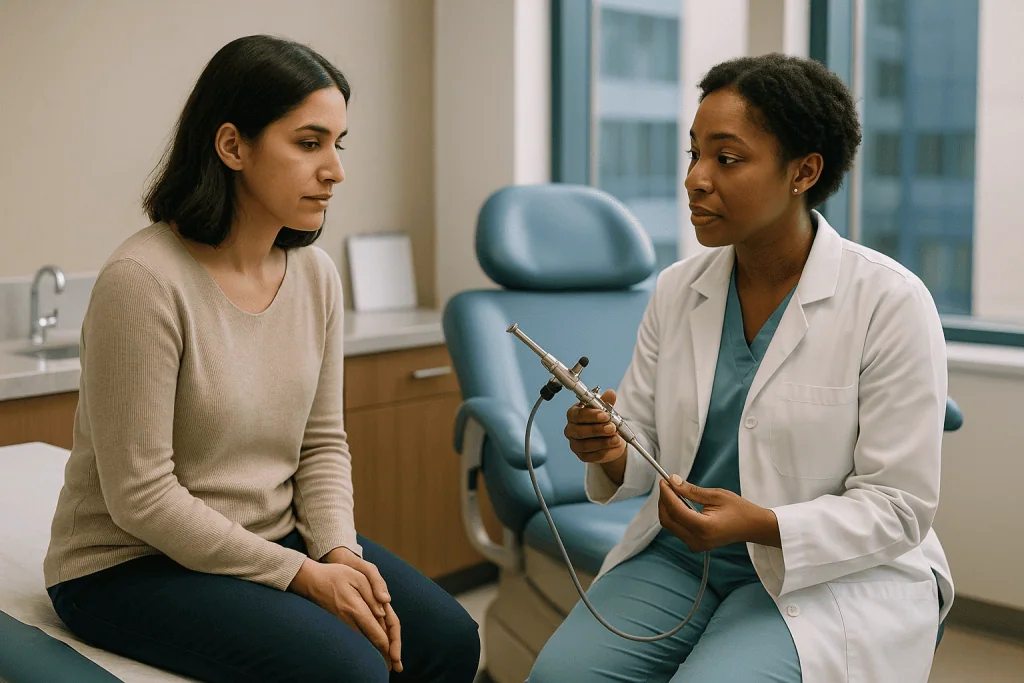
The hysteroscope is passed through the cervix, the neck of the womb, into the cavity. Sterile fluid, usually saline, flows through the scope to open the walls so they can be inspected; the uterus is normally a collapsed space, and without fluid there would be nothing to see. A camera relays the picture to a screen, which many people are invited to watch.
If treatment is planned, such as removal of a polyp, tiny instruments pass down a channel in the scope. These operative procedures sometimes take place under general anesthesia in a day-surgery setting, especially when larger fibroids or scar tissue are involved. The NHS notes that the examination itself usually takes 5 to 30 minutes, though you should plan for longer in the department overall.
Sensation varies widely. Some people describe period-type cramping as the fluid enters; others feel very little. Local anesthetic injected into the cervix, a numbing spray or a general anesthetic may be offered depending on the plan and your preference. The NHS is explicit that you can ask to stop at any point, and that a procedure can be rebooked under a different form of anesthesia if it becomes too uncomfortable.
Afterward you rest briefly, have a drink, and, for outpatient procedures, usually go home the same day.
What is the best day for hysteroscopy? Cycle phases at a glance
There is no single magic number, because cycles differ. Mayo Clinic describes a typical cycle as anywhere from 21 to 35 days, with bleeding lasting 2 to 7 days. What clinics actually aim for is a phase, not a date: the early follicular phase, meaning the stretch after bleeding stops and before ovulation, which occurs around day 14 in a 28-day cycle.
| Cycle phase | What the lining is doing | How it affects hysteroscopy |
|---|---|---|
| Menstruation (roughly days 1–5) | Shedding; active bleeding | Blood clouds the view; usually avoided unless urgent |
| Early follicular (roughly days 5–10) | Thin, regenerating | Preferred window; clearest cavity, pregnancy unlikely |
| Late follicular to ovulation (roughly days 10–14) | Thickening quickly | Still workable; folds may begin to obscure small lesions |
| Luteal (after ovulation) | Thick, secretory | Harder to interpret; early pregnancy cannot be excluded |
Notice the pattern. As the month advances, two problems grow together: the lining thickens and the chance of an undetected early pregnancy rises. Both push scheduling toward the beginning of the cycle.
If your bleeding tends to run long, the window narrows and the team may ask you to call on the day flow stops so a slot can be confirmed. If your bleeding is short, there is more room to maneuver. Either way, the phase matters more than the exact day, and a scan or a pregnancy test can supplement the calendar when needed.
Is it okay to have a hysteroscopy during your period?
Usually the answer is “not ideally,” but it is not an absolute rule, and the reasoning is worth understanding rather than taking on faith.

Active bleeding does three unhelpful things. It stains the distending fluid, so the camera peers through a pink haze. Clots and strips of shedding lining float across the field and can be mistaken for abnormalities. And the lining itself is at its most irregular, making the surgeon’s job of reading the cavity harder.
None of this makes the procedure dangerous. If a hysteroscopy is urgent, for example when bleeding is heavy and a cause needs to be found promptly, or when a woman is bleeding continuously and there is no bleed-free window to wait for, surgeons will often proceed. Extra fluid flow can clear the view, and experienced operators are used to working in less than perfect conditions.
Where the procedure is planned and non-urgent, most departments will offer to rebook if you arrive bleeding heavily. Light spotting at the tail end of a period is often acceptable; a full flow usually is not. The practical advice is simple: if your period arrives unexpectedly close to the appointment, phone the department rather than assuming it will be canceled or assuming it will go ahead. Policies vary between units, and the clinician’s judgment on the day is what counts.
For people whose bleeding is unpredictable, the scheduling conversation shifts from “which day” to “how do we create a bleed-free window,” which is where hormonal medicines sometimes enter the discussion, covered later in this article.
Who hysteroscopy is usually for, and who is usually asked to wait
Hysteroscopy is commonly offered to investigate heavy or irregular periods, bleeding after menopause, suspected polyps or fibroids seen on ultrasound, difficulty conceiving or repeated miscarriage where a uterine cause is suspected, and to locate a displaced intrauterine device. Operative hysteroscopy is used to remove polyps and certain fibroids, divide scar tissue or a septum, and sometimes to treat the lining itself.
Certain situations lead to postponement rather than refusal. A known or suspected pregnancy is the clearest: the procedure is not carried out until pregnancy is excluded, and a scheduled hysteroscopy will be deferred if a test on the day is positive. An active pelvic or vaginal infection is another; clinicians generally treat the infection first, because introducing an instrument into the uterus while infection is present risks spreading it upward.
Heavy bleeding on the day, as discussed, often prompts rebooking for a planned procedure. Some people with significant heart or lung conditions are asked to wait while an anesthetic assessment is completed if a general anesthetic is planned. Uncontrolled high blood pressure is another common reason for a pause in day-surgery settings.
Cervical cancer or a suspicion of it is a situation where the surgical team will decide on the appropriate route rather than proceeding with a routine hysteroscopy.
Being asked to wait is not a judgment that the procedure is unsuitable for you. It is usually a matter of sequencing: clearing the one thing that would make the examination less safe or less informative, then rebooking. Your team should tell you exactly what needs to change and when the next window opens.
How timing changes when your cycle isn't regular or has stopped
The tidy calendar logic assumes a predictable monthly bleed. Many people booked for hysteroscopy do not have one, and the approach adapts.
After menopause, the lining is thin all the time because estrogen levels are low. Timing to a cycle becomes irrelevant, and the appointment can go ahead on any convenient day. Bleeding after menopause is itself one of the most common reasons for referral, so this group makes up a large share of outpatient hysteroscopy lists.
On continuous hormonal contraception, whether the combined pill taken back to back, a progestogen-only method, an implant or a hormonal intrauterine system, the lining is usually kept thin and bleeding is often light or absent. Clinicians generally schedule at any point and simply confirm contraception has been used correctly. If you are taking a combined pill with a monthly break, the team may ask you to book in the week after your withdrawal bleed, or may suggest continuing the packs to avoid a bleed altogether; that is their decision to make with you.
Irregular cycles, common with polycystic ovary syndrome or around perimenopause, are the trickiest. Some units simply ask you to call when a bleed finishes. Others will arrange a scan to check the lining thickness or, if a bleed-free window cannot be predicted, may consider short-term hormonal treatment to create one.
Breastfeeding, recent miscarriage and recent childbirth all alter cycles too, and the team will want to know about each. The common thread is that the goal, a thin lining and no possibility of pregnancy, stays the same even when the route to it changes.
Which medicines your care team may discuss before the day
Medicines come up in the hysteroscopy conversation for four distinct reasons, and it helps to know which is which. Every decision below belongs to the prescribing clinician; nothing here is a suggestion to start, stop or alter anything.
Pain relief. Many departments suggest taking a simple over-the-counter painkiller, typically from the NSAID class, before an outpatient hysteroscopy. The mechanism is straightforward: these drugs reduce prostaglandins, the chemicals that drive uterine cramping. Your team will tell you whether, when and what is appropriate for you, particularly if you have kidney, stomach or bleeding concerns.
Cervical preparation. In some cases, especially operative procedures or when the cervix is expected to be tight, a prostaglandin analogue may be prescribed to soften the cervix beforehand. It works by loosening the connective tissue so the scope passes more easily. Evidence for benefit is strongest in specific groups, and not everyone needs it.
Creating a thin lining. Where bleeding is unpredictable or the lining needs to be thin for a treatment such as fibroid removal or ablation, hormonal medicines may be used for a period beforehand. Progestogens and GnRH analogues, drugs that temporarily switch off the ovaries’ hormone signals, both suppress lining growth. These carry their own side effects and are used selectively.
Existing medicines. Anticoagulants, antiplatelet drugs and some diabetes medicines may need adjustment around a procedure. This is a decision for the team that prescribed them, made in coordination with the surgeon, never something to change on your own.
Antibiotics are not routinely given for diagnostic hysteroscopy; infection rates are low and guideline bodies do not recommend blanket prophylaxis.
Pregnancy tests, contraception and hysteroscopy timing in the menstrual cycle
The single non-negotiable in hysteroscopy timing in the menstrual cycle is excluding pregnancy. Instruments and fluid inside a pregnant uterus risk disturbing an implanted embryo, so departments treat this as a safety rule rather than a preference.
Scheduling in the days after a period is the first layer. In a natural cycle, ovulation has not yet happened, so conception since the last bleed is not possible. Most units add a second layer: a urine pregnancy test on the day, regardless of what you report. This is standard practice for anyone who could be pregnant, and it is not a comment on your reliability.
The third layer is contraception advice for the weeks before. Many clinics ask you either to abstain from intercourse or to use reliable contraception from the first day of the period preceding the appointment until the procedure itself. The logic is that a urine test detects pregnancy only once the hormone has risen enough, typically a couple of weeks after conception, so a very early pregnancy could theoretically slip beneath the threshold. Timing the appointment before ovulation and asking for barrier or hormonal cover closes that gap.
People trying to conceive often find this frustrating, particularly when the hysteroscopy is part of a fertility investigation. It can feel like losing a month. The trade-off is real but the reasoning is sound, and a fertility team can usually plan the hysteroscopy into a cycle so the delay is minimal.
If there is any chance you could be pregnant when the appointment arrives, say so before anything begins. Rebooking is routine; proceeding in doubt is not.
How to prepare in the week before
Preparation for a hysteroscopy is light compared with most procedures, but a few practical steps make the day smoother.
Know your dates. Have the start date of your last period ready, note how long your bleeds usually last, and tell the department promptly if a period arrives early or late. Many people find a simple calendar note more reliable than memory.
Follow the fasting instructions you are given, not the ones a friend was given. Outpatient hysteroscopy under local anesthetic usually requires no fasting; the NHS suggests eating and drinking normally. General anesthetic requires fasting for a set number of hours, and the pre-assessment team will specify.
Bring a sanitary pad. Some spotting afterward is common, and tampons are generally advised against for a short period to reduce infection risk.
Arrange company if there is any chance of sedation or general anesthetic. You will not be allowed to drive home, and many departments will not discharge someone without an escort. Even after a local-only procedure, some people feel light-headed; the NHS notes that feeling faint affects roughly 1 in 200 people having the procedure without a general anesthetic, so a companion is sensible.
Wear something easy. Loose, comfortable clothing and a top you can keep on save fuss. Leave jewelry at home if a general anesthetic is planned.
Write down your questions. The ones people most often forget to ask are about what the findings mean and what happens next; there is a dedicated list later in this article.
Finally, if you are anxious, tell the team. Options for pain relief and anesthesia are broader than most people assume, and the conversation is easier before the day than during it.
What the days and weeks after usually look like
Most people who have an outpatient hysteroscopy walk out within an hour and are back to ordinary activities the next day, according to NHS recovery guidance. The first evening often brings period-like cramping and a dull ache low in the pelvis, easing over a day or two. Simple pain relief, as advised by your team, is usually all that is needed.
Spotting or light bleeding is expected. The NHS describes this as lasting a few days and sometimes up to a week, and it may be pinkish or brown rather than red. Watery discharge is also common as the last of the saline used to fill the cavity drains out. If tissue was removed, bleeding may be slightly heavier or last a little longer than after a purely diagnostic look.
Departments generally advise avoiding sex, tampons and swimming for about a week or until the bleeding has stopped, to lower the small risk of infection while the cervix settles. Showers are fine straight away.
After an operative hysteroscopy under general anesthetic, recovery stretches a little: perhaps a day or two of feeling washed out from the anesthetic, and a few days off strenuous exercise. The tissue sent to the laboratory, if any, usually takes a couple of weeks to report, and the results conversation is where the real decisions happen.
Emotionally, the days after can be a mix of relief and impatience. Some people are given a preliminary verbal finding on the day; others must wait for the formal report. Ask which applies to you before you leave so the waiting is at least predictable.
When will your period come after hysteroscopy, and what counts as Day 1
For a diagnostic hysteroscopy performed in the early follicular phase, the procedure does not usually reset the cycle. Ovulation proceeds on its normal schedule and the next period arrives roughly when it would have, sometimes a few days early or late as a response to stress or the anesthetic. Spotting in the days immediately afterward is procedure-related bleeding, not a period.
Operative procedures can shift things. Removing a polyp or fibroid disturbs more of the lining, and the next bleed may be lighter, heavier or slightly delayed. If hormonal medicines were used beforehand to thin the lining, the first bleed after stopping them may be unusually light or delayed while the ovaries resume their normal rhythm. Endometrial ablation, which deliberately destroys the lining, is a separate case; Mayo Clinic notes that periods commonly become much lighter and in some cases stop, and this is an intended effect rather than a side effect.
The Day 1 question comes up constantly among people undergoing fertility treatment, because embryo transfer and monitoring cycles are counted from it. The usual convention is that Day 1 is the first day of full, red flow, not spotting. Post-procedure spotting that trails into a true period can blur the line, and the sensible move is to ask your fertility team how they want you to count rather than guessing.
If no period arrives within about six weeks of a hysteroscopy and you could be pregnant, take a test. If you are not pregnant and the bleed is more than a couple of weeks overdue, mention it at follow-up; it is rarely a sign of a problem, but it is worth recording.
Are you more fertile after a hysteroscopy?
This is one of the most searched questions about the procedure, and the honest answer is: it depends entirely on what was found and treated.
Where hysteroscopy removes something that was plausibly interfering with implantation, such as an endometrial polyp, a fibroid protruding into the cavity, intrauterine scar tissue or a septum, correcting that problem can improve the chance of conception for that individual. Mayo Clinic notes that polyps are among the causes considered when investigating infertility, and observational studies support removing cavity-distorting lesions before assisted conception. That is fertility restored toward normal, not fertility boosted above it.
Where the cavity turns out to be normal, the picture is different. Large randomized trials in Europe examined whether performing a routine screening hysteroscopy before a first IVF cycle improved live birth rates in people with a normal ultrasound, and they did not find a benefit. Guideline bodies therefore do not recommend routine hysteroscopy for everyone before IVF; it is reserved for those with a suspected abnormality or repeated implantation failure.
A popular belief holds that the procedure itself, by “irritating” or “refreshing” the lining, makes the uterus more receptive. Evidence for that idea is limited and inconsistent, and it should not be presented as a proven effect. What the procedure reliably does is answer a question about the cavity; any change in fertility flows from that answer.
If conception is your goal, the useful conversation is not “will this make me more fertile” but “what did you find, does it need treating, and when can we try or proceed with treatment.” Your fertility team can give a personalized answer that no general article can.
What people often get wrong
Myth: the procedure must happen on a specific cycle day, and if you miss it you have lost the month. In reality, clinics aim for a phase, usually the week after bleeding stops, with flexibility at either end. Missing an exact day rarely means starting over.
Myth: you cannot have a hysteroscopy if you are on the pill. Hormonal contraception often makes scheduling easier, not harder, because the lining stays thin and pregnancy risk is managed. The team may simply ask you to continue your method.
Myth: spotting after the procedure means the surgeon damaged something. Light bleeding for several days is expected and reflects the cervix and lining settling. Heavy bleeding or a fever is a different matter, covered in the red-flag section.
Myth: hysteroscopy is a treatment for infertility in itself. It is a way to look inside the uterus and treat specific findings. When the cavity is normal, routine hysteroscopy has not been shown to raise live birth rates before IVF.
Myth: a hysteroscopy is essentially the same as a dilation and curettage. Older “blind” procedures scraped the lining without seeing it. Hysteroscopy is done under direct vision, which is precisely why the thin-lining window matters: the surgeon is looking, not feeling.
Myth: you have to stop all your usual medicines. Most people continue everything as normal. A small number of drugs, notably anticoagulants, may need adjustment, and only the prescribing clinician should make that call.
Myth: postmenopausal women need to time the procedure too. Without a cycle, the lining is thin throughout and any convenient day works.
Questions to ask your care team
Good questions turn a fifteen-minute appointment into a plan you actually understand. These are the ones that tend to matter most for timing and preparation.
- Which phase of my cycle are you aiming for, and what should I do if my period arrives early, late or is still going on the day?
- Do you want me to use contraception or abstain from sex in the weeks before, and from which day?
- Will I have a pregnancy test on the day regardless of what I report?
- Is this a diagnostic look, a planned treatment, or both, and could a diagnostic procedure turn into a treatment on the day?
- What anesthetic or pain-relief options are available, and can I change my mind if it becomes uncomfortable?
- Should I take anything for pain beforehand, and if so, when? Are any of my regular medicines affected?
- Will you use medicine to soften my cervix or thin my lining, and what side effects should I expect from it?
- How long will I be in the department, and do I need someone to take me home?
- What bleeding and discharge are normal afterward, and for how long?
- When will I receive results, in what form, and who will explain them?
- If something is found, what are the treatment options and their alternatives, including doing nothing for now?
- If I am trying to conceive or planning fertility treatment, how should I count Day 1 afterward and when can I resume?
Bring the list on paper or on your phone, and do not hesitate to ask the same question twice if the first answer was not clear. Teams expect it.
When to call your doctor
Serious complications after hysteroscopy are uncommon. The NHS lists accidental damage to the uterus or cervix, heavy bleeding, infection and reactions to anesthetic as recognized but infrequent risks. Knowing what warrants a call means you can relax about everything else.
Contact your care team, or seek urgent care if it is out of hours, if you notice any of the following in the days after the procedure:
- Heavy bleeding that soaks through a pad in an hour or less, or passing large clots.
- Fever, chills or feeling generally unwell, which can signal infection.
- Foul-smelling or greenish vaginal discharge.
- Pelvic or abdominal pain that is severe, worsening, or not relieved by the pain relief you were advised to use.
- Pain or difficulty passing urine.
- Feeling faint, breathless or having a racing heartbeat.
- Bleeding or discharge that continues beyond the timeframe your team described, or restarts heavily after settling.
Call sooner rather than later. A brief telephone triage can distinguish expected cramping from something that needs review, and departments would far rather hear from you about a false alarm than miss an early infection.
Before the procedure, contact the team if you develop a fever, a new vaginal discharge, or think you might be pregnant, or if your period arrives so that you would be bleeding heavily on the day. Any of these may lead to rescheduling, which is a routine adjustment rather than a setback.
Every decision about proceeding, postponing, medicines and follow-up rests with the clinicians looking after you. This article explains the reasoning; they apply it to your situation.
Frequently asked questions
What day of your period is a hysteroscopy performed on?
Usually none of them. Clinics aim for the week after bleeding has finished, the early follicular phase, when the lining is thin and pregnancy can be excluded. In a typical 28-day cycle that often falls around days 5 to 10, but the exact day is less important than the phase, and your team will confirm the window that fits your cycle.
Is it okay to have a hysteroscopy during your period?
It is not ideal for a planned procedure, because blood clouds the view and shedding lining can be mistaken for abnormalities. It is not dangerous, and urgent hysteroscopies do go ahead during bleeding. If your period arrives unexpectedly close to the appointment, phone the department; many will rebook for heavy flow but proceed with light spotting.
How soon does your period come after hysteroscopy?
After a diagnostic hysteroscopy in the early cycle, the next period usually arrives on roughly its normal schedule, since ovulation is not disrupted. Spotting for a few days afterward is procedure-related, not a period. Operative procedures or pre-treatment hormones may make the next bleed lighter or slightly delayed. Mention a bleed more than a couple of weeks overdue at follow-up.
What counts as Day 1 after a hysteroscopy for fertility tracking?
The usual convention is the first day of full red flow, not spotting. Post-procedure spotting can blur into a true period, so fertility teams often give their own counting rule. Ask yours before the procedure how they want Day 1 recorded, because embryo transfer and monitoring schedules are built from it.
Are you more fertile after a hysteroscopy?
Only if something was found and treated. Removing a polyp, a cavity-distorting fibroid, scar tissue or a septum can restore fertility toward normal for that person. When the cavity is normal, large randomized trials have not shown that routine hysteroscopy before IVF improves live birth rates, and the idea that the procedure itself makes the lining more receptive is not well supported.
Can I have a hysteroscopy while on hormonal contraception?
Yes, and it often simplifies scheduling. Continuous methods keep the lining thin and manage pregnancy risk, so the appointment can usually be booked on any day. If you take a combined pill with a monthly break, the team may ask you to book after the withdrawal bleed or to run packs together; follow their instructions rather than changing anything on your own.
Does hysteroscopy timing matter after menopause?
Generally not. Without a cycle, estrogen is low and the lining stays thin throughout, so the view is clear on any day. Bleeding after menopause is one of the most common reasons for referral, and these appointments are scheduled for convenience rather than by calendar. A pregnancy test is not needed once menopause is established.
What medicines might be prescribed before a hysteroscopy?
Four types come up: a simple painkiller, often an NSAID, to ease cramping; occasionally a prostaglandin analogue to soften the cervix; hormonal medicines such as progestogens or GnRH analogues to thin the lining before operative procedures; and adjustments to existing drugs like anticoagulants. Each is decided by the prescribing clinician, and none is routine for every patient.
How long does recovery from a hysteroscopy take?
For an outpatient diagnostic hysteroscopy, most people resume normal activities the next day, according to NHS guidance, with cramping for a day or two and spotting for a few days, sometimes up to a week. Teams usually advise avoiding sex, tampons and swimming for about a week. Operative procedures under general anesthetic add a day or two of feeling tired.
What if my period is late or irregular and I cannot predict a window?
Tell the department. Options include calling on the day a bleed finishes so a slot can be confirmed, an ultrasound to check lining thickness, or short-term hormonal treatment to create a predictable bleed-free window. Irregular cycles are common with polycystic ovary syndrome and perimenopause, and units have routine ways of working around them.
References
- NHS: Hysteroscopy (overview)
- NHS: Hysteroscopy, what happens
- MedlinePlus Medical Encyclopedia: Hysteroscopy
- Cleveland Clinic: Hysteroscopy
This article is for general information only and is not a substitute for professional medical advice. Please consult a qualified doctor about your individual situation.

More from the Blog

After Robotic Hysterectomy: Redness, Discharge or Fever and When to Contact Your Surgeon
After a robotic hysterectomy, mild pinkness at the small incisions, light brown or pink vaginal discharge for up to six weeks, and low-grade warmth…

What to Expect From PCOS Treatment: How Cycles, Skin and Weight Respond Over Months
PCOS treatment results arrive on different clocks. Hormonal treatments usually make bleeding predictable within one to three cycles, while skin and unwanted hair often…

Vaginal Infections During Pregnancy: Why Treatment Is Chosen Carefully and Follow-Up Matters
A vaginal infection during pregnancy is common and usually manageable, but clinicians choose treatment carefully because some medicines are preferred over others while a…

After Fibroid Surgery: Heavy Bleeding, Fever or Rising Pain and When to Call Your Team
After fibroid surgery, call your surgical team the same day if you soak through a sanitary pad every hour for two hours or more,…

How PCOS Is Tested and Diagnosed: Blood Tests, Ultrasound and the Rotterdam Criteria
PCOS is diagnosed by pattern rather than a single test. Clinicians use the Rotterdam criteria: at least two of three features, infrequent or absent…

How to Check for Fibroids, and What They Look Like
You cannot reliably check for fibroids at home. Fibroids are noncancerous growths in the muscular wall of the uterus, and they are usually confirmed…